Climate change at G20: nuclear included in plans, but not with enthusiasm
David Lowry’s Blog 2nd June 2019 Climate change was the only issue where consensus failed to be reached at the G20 meeting of leaders of the globe’s biggest economies, held in in
Osaka, Japan at the end of last week. Nuclear still is seen as having a
place in the energy mix, but without any real enthusiasm. http://drdavidlowry.blogspot.com/2019/07/g20-in-osaka-blows-hot-and-cold-over.html
USA Security Adviser John Bolton denies report of ‘nuclear freeze’ agreement with North Korea
 John Bolton shoots down report of ‘nuclear freeze’ agreement with North Korea John Bolton shoots down report of ‘nuclear freeze’ agreement with North KoreaWhite House adviser dismisses reports of a ‘freeze’ of North Korea’s nuclear weapons arsenal. Politico, By QUINT FORGEY 7/1/19, White House National Security Adviser John Bolton on Monday dismissed reports that the administration is considering agreeing to a “freeze” of North Korea’s nuclear weapons arsenal as opposed to a more comprehensive denuclearization pact.Prior to U.S. President Donald Trump’s meeting Sunday with North Korean leader Kim Jong Un — where Trump became the first sitting commander-in-chief to step into the isolated communist state — the New York Times reported that administration officials have been mulling a deal with Pyongyang to halt production of new nuclear material as a way to kickstart a new round of talks with Kim’s regime. But the head of Trump’s National Security Council slammed the Times story, writing online that “there should be consequences” for its publishing. Bolton did not specify whether it was the Times or whoever its source was that should face those consequences.
“I read this NYT story with curiosity. Neither the NSC staff nor I have discussed or heard of any desire to ‘settle for a nuclear freeze by North Korea,’” Bolton tweeted, describing the report as “a reprehensible attempt by someone to box in the President.”…… The North Korean government has been especially critical of Bolton throughout Trump’s yearlong crusade to broker an arms agreement with Pyongyang, with a foreign ministry spokesman branding the hawkish former U.S. ambassador to the United Nations as a “warmonger” and “defective human product” in May. https://www.politico.eu/article/john-bolton-shoots-down-report-of-nuclear-freeze-agreement-with-north-korea/ |
|
Report that Trump administration is considering accepting North Korea as a nuclear power
New York Times: Trump administration mulling plan that would accept North Korea as a nuclear power, By Devan Cole, CNN July 1, 2019 Washington The Trump administration is mulling a potential deal with North Korea that would accept the country as a nuclear power if it freezes its existing nuclear programs in exchange for the US lifting its “most onerous” sanctions against the country, The New York Times reported Sunday.
The plan would aim to prevent more nuclear weapons from being created in the country, but “it would not, at least in the near future, dismantle any existing weapons, variously estimated at 20 to 60. Nor would it limit the North’s missile capability,” according to the paper.
The Times, which noted that US officials previously said they would never support such a plan, said officials in the administration hope the idea “might create a foundation for a new round of negotiations” with North Korea and noted that the administration’s current goal is still to fully denuclearize the country.
………. As a part of the plan reported by the Times, US negotiators would try to get North Korean negotiators to agree to “expand the definition” of Yongbyon, the country’s main nuclear-fuel production site. Under the potentially new definition of Yongbyon, the site would reach “beyond its physical barriers” to include various facilities around the country, including one where America and South Korea believe the country is producing uranium fuel.
A senior US official involved in North Korean policy told the Times “there was no way to know if North Korea would agree to this,” and noted that in the past, North Korean negotiators “insisted” that only Kim “could define what dismantling Yongbyon meant,” according to the report.
Stephen E. Biegun, the State Department’s special representative for North Korea, told the Times on Sunday that the paper’s account of the administration’s potential deal was “pure speculation” and that his team was “not preparing any new proposal currently,” saying, “What is accurate is not new, and what is new is not accurate.”
White House national security adviser John Bolton also disputed the Times report Monday, tweeting that he read the story “with curiosity.”……….
Former Director of National Intelligence James Clapper told CNN’s John Berman that “the general idea of accepting the current nuclear arsenal, whatever it is, is a good start point.”
“I’ve come around to the position some months ago that perhaps as at least an initial plateau, in the interest of getting something done, it might be worth considering capping what the North Koreans have now and then maybe on a much longer term basis trying, you know, to get them to reduce their nuclear holdings to zero, which I think is going to be very difficult,” Clapper said Monday on CNN’s “New Day.”
Clapper, who served in the Obama administration, said the plan reported by the Times would “require some very complex negotiations” and that it would need a verification regime, which “would be a hard pill for the North Koreans to swallow.”https://edition.cnn.com/2019/07/01/politics/north-korea-nuclear-freeze-trump-administration/index.html
‘Wonderful chemistry’ between Trump and Kim, as nuclear negotiations remain stalled
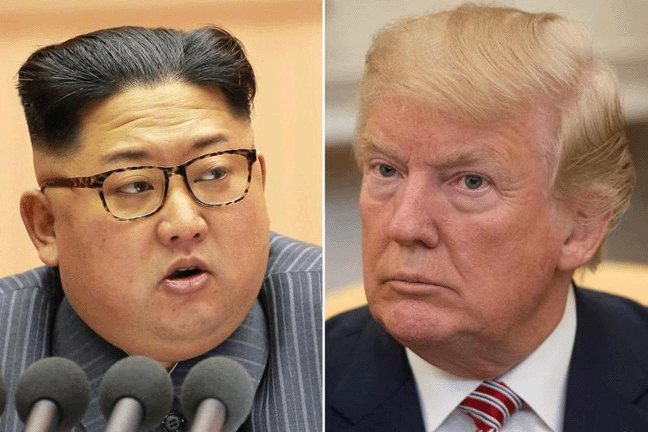 Keeping Up With the Plot of the Trump-Kim Nuclear Show, Bloomberg, By Jon Herskovitz and Youkyung Lee, July 1, 2019, Three meetings between the leaders of the U.S. and North Korea resulted in no concrete plans to end Pyongyang’s atomic ambitions. President Donald Trump and Kim Jong Un have toned down hostile rhetoric since they first shook hands in Singapore in June 2018. They were cordial even after their second summit broke down in Hanoi in February, and took an historic stroll together into North Korea four months later. All the while, Pyongyang’s nuclear program quietly advanced as U.S.-backed sanctions choked its moribund economy. The two countries can’t agree on what the denuclearization of North Korea means and what rewards should be given, if any, in response to Pyongyang’s moves toward disarmament. But Trump has invited Kim to the White House, while a top aide to Kim has touted the “mysteriously wonderful” chemistry between the two leaders.
1. What have they agreed to?
The first summit resulted in a bare-bones declaration that contained four main items: To normalize ties between the U.S. and North Korea, formally end the 1950-53 Korean War, repatriate U.S. war remains and — crucially — “to work toward complete denuclearization of the Korean Peninsula.” But “work toward” is undefined. It’s also unclear whether the U.S. nuclear umbrella over South Korea is included. U.S. Secretary of State Michael Pompeo says that Kim accepted the “final, fully verified denuclearization of North Korea.” North Korea points out the agreement referred to the entire peninsula and insists U.S. weapons must go at the same time, or it would be left vulnerable to attack. A meeting between Kim and Trump within the Demilitarized Zone in June 2019 led to an agreement to resume working-level talks that could iron out details of any deal.
2. What does the U.S. want?
To start, the U.S. wants North Korea to provide an inventory of weapons, facilities and fissile material it has produced. Kim’s regime calls that akin to asking for a “target list.” Further steps would include inspections, closing facilities and destroying weapons, and even surrendering nuclear material, according to proliferation experts. Past talks have faltered on the question of inspections and verification.
3. What does North Korea want?
Kim wants “corresponding measures,” or immediate rewards, for any steps his regime makes. In a televised New Year’s address, Kim threatened to take a “new path” if Washington didn’t relax crippling economic sanctions.
He signaled that any deal might require weakening the U.S.-South Korean alliance, urging Seoul not to resume military exercises with the American side. And he made clear that he believed the denuclearization pledge includes “strategic assets” such as America’s nuclear-capable planes and warships. But his language was less bellicose than past years, possibly reflecting his limited options.
4. What has North Korea offered?
In Hanoi, North Korea offered to shut down parts of its Yongbyon nuclear complex, which has served as the crown jewel of its atomic program, in return for sanctions relief. The aging facility about 60 miles north of Pyongyang was once the main source of its fissile material, turning out roughly enough plutonium each year for one atomic bomb. But North Korea has since turned to uranium enrichment for weapons. Still, Yongbyon remains its main atomic research facility and a complete closure would affect its nuclear program…….. https://www.bloomberg.com/news/articles/2019-07-01/keeping-up-with-plot-of-the-trump-kim-nuclear-show-quicktake
Trump says Iran ‘playing with fire’ after exceeding nuclear deal limit
WASHINGTON (Reuters) 2 July 19, – U.S. President Donald Trump said on Monday Iran was playing with fire after Tehran said it had exceeded its limit for low-enriched uranium allowed under a 2015 nuclear deal with world powers.
Asked at a White House event if he had a message for Iran, Trump said he did not have a message, but Iran knew what it was doing and was “playing with fire.” Reporting by Jeff Mason; Writing by Mohammad Zargham; editing by Grant McCool .https://www.reuters.com/article/us-mideast-iran-usa-fire/trump-says-iran-playing-with-fire-after-exceeding-nuclear-deal-limit-idUSKCN1TW3X3
Urgent need for international diplomacy: the world facing a renewed nuclear arms race
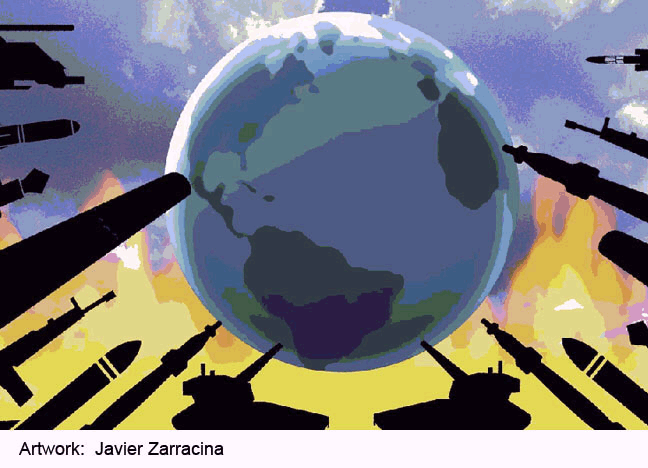 Without diplomacy, the world’s major powers risk a renewed nuclear arms race, The Hill, BY DR. VIATCHESLAV MOSHE KANTOR, 07/01/19 The reaction to the airing of the HBO series “Chernobyl,” dramatizing the most disastrous nuclear power plant accident in history, and to the news of President Trump’s aborted strike on Iran, amply shows the potential for horrific widescale nuclear catastrophe and the public’s desire to know the true extent of the risk.
Elsewhere, the eyes of the world are trained on the clock that is ticking down to the expiration of the Intermediate-Range Nuclear Forces Treaty (INF Treaty) in August 2019 and the potential end of the New Strategic Arms Reduction Treaty (START) in 2021.
These are troubling times. Despite the weekend’s high-profile foray into North Korean territory by President Trump – the first such visit by a sitting U.S. president – substantive progress between the United States and North Korea over the denuclearization of the Korean Peninsula is at a standstill. ……
The prospects of a multilateral treaty with China are looking slim. In the background, heightening tensions between the U.S., Europe and Russia risks undermining global stability. …..
This instability coincides with a crisis in diplomacy and a discernible lack of dialogue between the world’s major powers. This could not come at a worse time, when for the first time in nearly 50 years the demise of key international treaties means there will be no agreed limits on nuclear weapons. In the absence of substantive bilateral talks, there are no prospects of setting such limits in place. …….
Talks are apparently underway to secure the extension of the New START Treaty by a further five years, although this outcome is by no means certain.
Any future nuclear catastrophic event would not necessarily be the result of the actions of an established government intentionally deploying a nuclear weapon but could occur through a tragic accident like the disaster at Chernobyl…….
Organizations such as The International Luxembourg Forum are important mainstays of dialogue, promoting nuclear nonproliferation and working to reduce the risks of nuclear conflict. Nuclear experts have a key role to play in rebuilding a culture of trust and understanding in our political life. ……. https://thehill.com/opinion/energy-environment/451125-without-diplomacy-the-worlds-major-powers-risk-a-renewed-nuclear
A call for Australia to get nuclear weapons
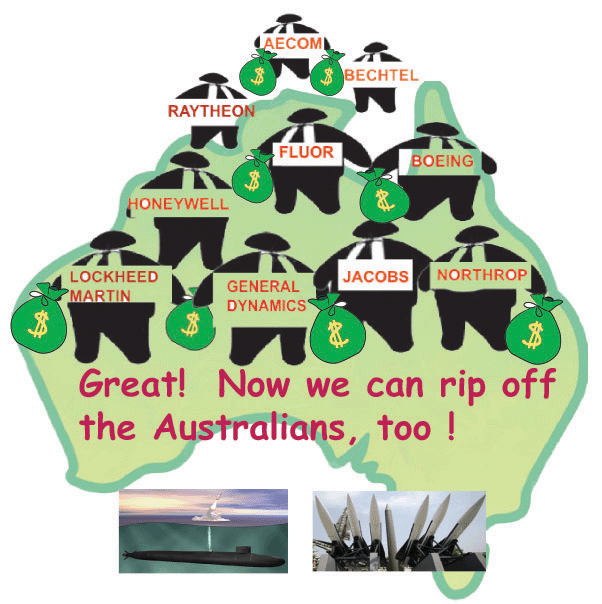
Nuclear arsenal must be on Australia’s agenda, argues defence expert, SMH, By Harriet Alexander, July 1, 2019 Australia can no longer rely on the United States to protect it in Asia and should consider developing its own nuclear weapons for the event that China becomes hostile, former defence strategist and security analyst Hugh White argues in a controversial new book.
Professor White argues in How to Defend Australia the assumption that the United States would protect the nation against any attack by a major power, which has underpinned Australian defence policy since the Cold War, is no longer true as China emerges as the dominant power in Asia.
For Australia to be self-reliant, it would need to boost defence spending from 2 per cent to 3.5 per cent of GDP – or $30 billion – and consider the “difficult and uncomfortable” question of developing its own nuclear capability, said Professor White, a professor in strategic studies at the Australian National University……..
Although most think tanks and strategic policy institutes in the United States continued to assert that dominance in Asia was a strategic priority, America’s global leadership has not figured as a priority for President Donald Trump nor for the contenders to the Democrat nomination, Professor White said. ……
Professor White said Australia should only consider defensive weapons such as submarine-launched ballistic missiles.
“We need to be extremely careful about how we talk about this and very conscious of the extraordinary cost to us of acquiring nuclear weapons,” Professor White said.
“It would make us less secure in some ways, that’s why in some ways I think it’s appalling.”
The last prime minister to canvass the development of nuclear weapons in Australia was Robert Menzies in the 1960s.
Professor White, a former deputy secretary for strategy and intelligence with the Department of Defence, was dismissed as alarmist when he first foreshadowed in 2010 the demise of American influence in Asia. But the Lowy Institute’s international security program director Sam Roggeveen said he had since been proved correct.
Mr Roggeveen said the regional complications of Australia developing nuclear weapons would be huge, with Indonesia probably having to follow suit, but the logic was inescapable.
“If we ever completely decouple from the [US] alliance then it’s hard to see how we could essentially maintain our independence against China’s coercion if we didn’t have nuclear weapons,” Mr Roggeveen said.
The bipartisan political consensus on Australian defence policy is opposed to the development of nuclear weapons, and the domestic shipbuilding program would leave Australia “hopelessly vulnerable” if it ever came to a fight with China, Mr Roggeveen said.
“According to White, we are locking in a defence force for a generation that will be totally unsuited to the world we are entering,” he wrote in a book review for The Interpreter. “That’s the scandal.”
The Minister for Defence, Linda Reynolds, said: “Australia stands by its Non-Proliferation Treaty pledge, as a non-nuclear weapon state, not to acquire or develop nuclear weapons.”
La Trobe Asia executive director Euan Graham said the US alliance was more resilient than Professor White described and China had shown no signs of aggression, but he agreed Australia should think about developing its nuclear capability.
“We’re talking about 15 to 20 years acquisition timeframe and the security environment that we’re facing will almost certainly be more severe then that it is now,” Dr Graham said.
“I think Australia has to be thinking about what will be be required to move to a nuclear weapon posture because that can’t happen overnight.” https://www.smh.com.au/politics/federal/nuclear-arsenal-must-be-on-australia-s-agenda-argues-defence-expert-20190701-p52306.html
No solution found to the nuclear issue, after European talks with Iran end
European Talks With Iran End, Leaving Nuclear Issue Unsettled, NYT, By David E. Sanger, June 28, 2019 WASHINGTON — A last-minute effort by European powers to persuade Iran not to breach limits on its stockpile of nuclear fuel ended inconclusively on Friday, with the Iranians saying that Britain, France and Germany had made only modest progress in developing a system to get around tight American sanctions on trade with Tehran.
As he left the talks in Vienna, Abbas Araghchi, the Iranian deputy foreign minister, said he expected Iran would go ahead with its plan to break the ceiling on how much low-enriched uranium it was allowed to possess. That breach could come as early as this weekend, potentially setting off another confrontation with the Trump administration, after a week of recriminations and military threats following the downing of an American drone and attacks on tankers.
“It is still not enough, and it is still not meeting Iran’s expectations,” Mr. Araghchi told reporters, according to news reports from Vienna. …….
Breaking the stockpile limit would not, by itself, give Iran enough fuel to produce a nuclear weapon. But the European participants in the 2015 agreement have been urging the Iranians not to dispense with the accord, for fear that the Trump administration might react with a military or cyberstrike against the Iranians…….
The United States’ special envoy for Iran, Brian H. Hook, said this week that the sanctions have already cost Iran more than $50 billion…….https://www.nytimes.com/2019/06/28/us/politics/europe-iran-nuclear-deal.html
Iran doesn’t want to leave the nuclear agreement, calls on Europe for trade help
No Intention to Quit JCPOA Despite Nuclear Rollbacks Financial Tribune, 29 June 19, Europe should take further measures to ensure that the special trade channel set up to keep trade with Iran afloat satisfies Tehran’s demands, a senior diplomat said on Saturday, while stressing that the country does not intend to leave the nuclear agreement.
“I personally believe that INSTEX, in its current condition, isn’t enough. This mechanism without money is like a beautiful car without fuel,” Iran’s ambassador to the United Nations, Majid Takht-Ravanchi, told the media in New York, IRNA reported.
In early May, a year after US President Donald Trump pulled out of the 2015 Iran nuclear agreement, Tehran announced a decision to abandon some of its commitments under the deal, officially known as the Joint Comprehensive Plan of Action.
Iran would resume higher uranium enrichment in 60 days if the remaining signatories fail to make good on promises to shield its oil and banking sectors from the reimposed and tightened US sanctions.
On Friday, the European Union announced in a statement that the Instrument in Support of Trade Exchanges or INSTEX, the financial mechanism set up by France, Britain and Germany to facilitate some trade with Iran, is now operational and the first transactions are being processed. ….. (subscribers only) https://financialtribune.com/articles/national/98697/no-intention-to-quit-jcpoa-despite-nuclear-rollbacks
Putin talks of Russia, USA , resuming negotiations on nuclear arms reduction treaty
Putin was commenting on his meeting with US President Donald Trump the day before, most of which took place behind closed doors.
“We have tasked our respective foreign minister to start lower-level talks on [nuclear disarmament],” Putin said.
The talks, according to Putin’s comments carried by the Russian Interfax news agency, would be related to extending the New START (Strategic Arms Reduction Treaty), which went into force in 2011 after talks between Trump’s predecessor Barack Obama and Russia’s then-President Dmitry Medvedev.
Fears of restarting nuclear race
The New START limits the number of deployed nuclear warheads ready to use on intercontinental missiles and heavy bomber bases to 1,550. The treaty also imposes various other restrictions to US and Russian nuclear capabilities. It is set to expire in 2021.
According to 2019 data provided by the Bulletin of the Atomic Scientists, both the US and Russia currently have about 1,600 deployed strategic nuclear heads at their disposal. Russia has a total of 6,500 nuclear warheads, compared to 6,185 on the US side.
Russia’s Putin has repeatedly warned that the New START expiry date could signal a new nuclear arms race.
INF on the brink
On Saturday, he refused to give a timeline for the talks and said it was “too early to talk about” the likelihood of getting to an agreement.
Putin’s remarks come after the US accused Russia of violating the Intermediate-Range Nuclear Forces (INF) Treaty by developing a new missile system.
The document, signed in 1987 between the US and the now defunct Soviet Union, prohibits the possessing and testing of short- and medium-range nuclear weapons.
Both Russia and the US have since suspended their participation in the accord. The US has pledged to pull out of the agreement if Russia is not in compliance by August 2 this year.
Russia threatens military response to any NATO action over nuclear-ready missile
NATO says it will act unless Russia destroys nuclear-ready missile
NATO says it will act unless Russia destroys nuclear-ready missile, CNBC, JUN 26 2019
KEY POINTS
- NATO has said Russia’s SSC-8 missile violates terms of a 1987 missile treaty.
- The U.S. says it will exit the treaty unless Russia stops their production.
- But Russia has continued to develop and site the missiles within range of Europe.
- NATO said Russia must destroy its short-range nuclear-ready cruise missile system, or the alliance will be forced to respond.
The U.S. has previously said it will quit a decades-old missile treaty with Russia if the latter fails to destroy the missile, labeled the SSC-8 by NATO.
The 1987 INF Treaty between the U.S. and Russia sought to eliminate nuclear and conventional missiles, as well as their launchers, with short ranges (310–620 miles) and intermediate ranges (620–3,420 miles).
NATO has said the SSC-8 violates those terms and that Russia has been deploying the system at locations which could threaten countries across Europe.
Speaking at a press conference in Brussels Tuesday, NATO Secretary-General Jens Stoltenberg said Russia had just five weeks to scrap the system and save the treaty…….. https://www.cnbc.com/2019/06/25/nato-says-russia-must-end-nuclear-ready-missile-ssc-program.html
Warning to Australia’s Prime Minister: don’t blindly follow Bolton and Pompeo into war against Iran
Acting on Iran has painful shades of joining the US in Iraq The Age, Tony Walker, 1 July 19, Here’s a word of advice to Prime Minister Scott Morrison. Unless he wants to risk a smudge on his reputation of the sort that accompanies John Howard to this day: don’t get involved in conflict with Iran beyond limited naval engagement in a Gulf peace-keeping role.
When we read that Canberra is open to joining an international effort to ratchet up pressure on Iran “in consultation with our allies and partners”, this invites disquieting questions.
If Morrison is talking about involvement in a “global coalition”, as described by the hawkish US Secretary of State Mike Pompeo, then he might remind himself of what happened when Australia last lent itself to a so-called “Coalition of the Willing”.
That was 17 years ago in 2002 when John Howard – as one of the “three amigos” with Britain’s Tony Blair and Spain’s Jose Maria Aznar – joined George W. Bush in promoting a disastrous invasion of Iraq.
Only World War II, which absorbed one-third of American GDP, or $4 trillion in today’s dollars, has cost more than the Iraq debacle at $1 trillion (a total $2 trillion if Afghanistan is included).
These are the measurable costs in people, materiel and nation building. Incalculable are the ongoing costs of the destabilisation of the entire Middle East, and the empowerment of Iran…..
In a multi-year assignment in the Middle East I reported the Iran-Iraq war (1980-88); the first Gulf War (1990-1991), in which the US and its allies routed the Iraqi military; and the invasion of Iraq (2003). If I learned anything from those experiences it is that wars are easier to start than to finish. …..
Morrison is surrounded by a weak national security team. The national security committee of cabinet does not include one individual with credible security experience. …….
Morrison might remind himself that Canada’s then-prime minister, Jean Chretien, kept his country out of the Iraq war. The sky did not subsequently fall in on Ottawa.
All this is relevant today given that Morrison found himself last week in the presence over dinner of the two most hawkish members of the Trump administration. Secretary of State Pompeo and National Security Adviser John Bolton both advocated air strikes against Iranian targets in retaliation for suspected Iranian attacks on gulf oil facilities before the President, at the 11th hour, called off military action.
Bolton has been an intemperate advocate of regime change in Tehran. In an interview with The Australian newspaper, Pompeo said Australia had a key role in a “global coalition”. What that means is anyone’s guess.
Morrison would be well advised not to be suckered into joining a counter-punch against Iran. His response to requests for any significant Australian military involvement should be emphatically: No. https://www.theage.com.au/world/middle-east/acting-on-iran-has-painful-shades-of-joining-the-us-in-iraq-20190628-p5227h.html
Tokyo monitoring USA-North Korea negotiations, hoping that there will be some real improvement
Japan hopes latest Trump-Kim meeting will help get nuclear, abduction talks moving again, Japan Times , 29 June
KYODO, Japan hopes the third meeting between U.S. President Donald Trump and North Korean leader Kim Jong Un on Sunday will reinvigorate stalled denuclearization talks and help resolve the issue of past abductions of Japanese citizens.
“The meeting could serve as an opportunity for North Korea to come out of its shell,” a senior Japanese Foreign Ministry official said.
Trump and Kim held talks in the Demilitarized Zone dividing the two Koreas and agreed to restart denuclearization talks within weeks following the rupture of their last summit in Hanoi in February.
Tokyo is closely monitoring whether the two countries will move forward negotiations on the denuclearization of North Korea and improve their ties, which could help the U.S. government set up a summit between Prime Minister Shinzo Abe and Kim, as the Japanese leader is hoping for……….https://www.japantimes.co.jp/news/2019/06/30/national/japan-hopes-latest-trump-kim-meeting-will-help-get-nuclear-abduction-talks-moving/#.XRkibT8zbGg
Progress in diplomatic talks with Iran, but might not save the nuclear deal
 Nuclear talks progress ‘not enough’ for Iran to change course, INSTEX payment system now operational, but Iran says needs to be used for oil purchases to be useful. Aljazeera, 29 June 19
Diplomats meeting in Vienna in a bid to save a 2015 nuclear deal between Iran and world powers made progress but it was “not enough” to stop Tehran scaling back compliance with the accord, according to the Iranian deputy foreign minister.
Officials from the deal’s remaining signatories – China, Russia, the United Kingdom, France, Germany and Iran – as well as the European Union, held talks in the Austrian capital on Friday after Tehran warned that it would soon breach a limit on the amount of enriched uranium set out in the agreement.
“It was a step forward, but it is still not enough and not meeting Iran’s expectations,” Iran’s Deputy Foreign Minister Abbas Araqchi told reporters. “I don’t think the progress made today will be enough to stop our process but the decision will be made in Tehran.”…….https://www.aljazeera.com/news/2019/06/nuclear-talks-progress-iran-change-190628160308104.html
1 This Month
26 September – International Day for the Total Elimination of Nuclear Weapons





PLEASE OPPOSE HR 8255 AND S.3639 – bills would accelerate satellite deployment, with no environmental review or safeguards – https://ncstd5li.quorum.us/campaign/169331/
To see nuclear-related stories in greater depth and intensity – go to https://nuclearinformation.wordpress.com
-
Archives
- September 2026 (291)
- August 2026 (330)
- July 2026 (355)
- June 2026 (287)
- May 2026 (306)
- April 2026 (356)
- March 2026 (251)
- February 2026 (267)
- January 2026 (308)
- December 2025 (358)
- November 2025 (359)
- October 2025 (375)
-
Categories
- 1
- 1 NUCLEAR ISSUES
- business and costs
- climate change
- culture and arts
- ENERGY
- environment
- health
- history
- indigenous issues
- Legal
- marketing of nuclear
- media
- opposition to nuclear
- PERSONAL STORIES
- politics
- politics international
- Religion and ethics
- safety
- secrets,lies and civil liberties
- spinbuster
- technology
- Uranium
- wastes
- weapons and war
- Women
- 2 WORLD
- ACTION
- AFRICA
- Atrocities
- AUSTRALIA
- Christina's notes
- Christina's themes
- culture and arts
- Events
- Fuk 2022
- Fuk 2023
- Fukushima 2017
- Fukushima 2018
- fukushima 2019
- Fukushima 2020
- Fukushima 2021
- general
- global warming
- Humour (God we need it)
- Nuclear
- RARE EARTHS
- Reference
- resources – print
- Resources -audiovicual
- Weekly Newsletter
- World
- World Nuclear
- YouTube
-
RSS
Entries RSS
Comments RSS

