NPT’s 50th Anniversary Encourages 17 Signatories To Remind Five Nuclear-Weapons States of Their Commitments
 NPT’s 50th Anniversary Encourages 17 Signatories To Remind Five Nuclear-Weapons States of Their Commitments IDN -In Depth News By UN Bureau, 24 May 20, NEW YORK (IDN) – The upcoming 2020 Review Conference of a landmark international treaty on the Non-Proliferation of Nuclear Weapons (NPT), postponed due to the COVID-19 pandemic, presents “a timely opportunity for the States Parties to undertake a comprehensive review and assessment” of its current status, says the Joint Communiqué issued on May 19 by 17 States Party to the NPT. NPT’s 50th Anniversary Encourages 17 Signatories To Remind Five Nuclear-Weapons States of Their Commitments IDN -In Depth News By UN Bureau, 24 May 20, NEW YORK (IDN) – The upcoming 2020 Review Conference of a landmark international treaty on the Non-Proliferation of Nuclear Weapons (NPT), postponed due to the COVID-19 pandemic, presents “a timely opportunity for the States Parties to undertake a comprehensive review and assessment” of its current status, says the Joint Communiqué issued on May 19 by 17 States Party to the NPT.
A total of 191 States have joined the Treaty, including the five nuclear-weapon States – USA; Russia, China, Britain and France – which entered into force in 1970. More countries have ratified the NPT than any other arms limitation and disarmament agreement, which analysts perceive as a testament to the Treaty’s significance. Signatories to the communique look forward to work with other States Parties. There is no doubt that the implementation of disarmament commitments would have allowed more resources to be allocated for sustainable development as well as international cooperation and preparedness to deal with such public health and global emergencies. “It is now time that States Parties translate words into concrete actions backed by clear and agreed-upon benchmarks and timelines. Only through such efforts can we look ahead towards a successful next 50 years of the NPT, improving on the important achievements of the last 50 years, which we presently commemorate,” accentuates the communique. Following is the full text of the Joint Communique:…… https://www.indepthnews.net/index.php/opinion/3564-five-nuclear-weapons-states-urged-to-fulfil-commitments-on-npt-s-50th-anniversary |
|
Saudi Arabia’s push for nuclear power – a nuclear weapons danger
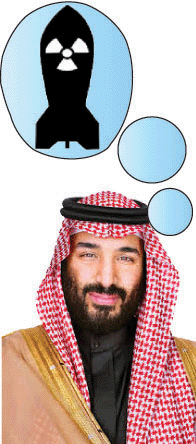 Arms control experts concerned by Saudi nuclear reactor push, Aljazeera
Satellite images show work progressing on Saudi reactor even though international IAEA inspectors are still frozen out. by Jonathan Tirone • Bloomberg. 22 May 2020 Saudi Arabia is pushing ahead to complete its first nuclear reactor, according to satellite images that have raised concern among arms-control experts because the kingdom has yet to implement international monitoring rules.
Satellite photos show the kingdom has built a roof over the facility before putting in place International Atomic Energy Agency regulations that allow inspectors early verification of the reactor’s design. Foregoing on-the-ground monitoring until after the research reactor is completed would be an unusual move normally discouraged under regulations to ensure civilian atomic programs aren’t used to make weapons.
Saudi Arabia has repeatedly pledged that its nuclear program is strictly for peaceful purposes, but Crown Prince Mohammed Bin Salman also said the kingdom would develop a bomb if its regional rival Iran did so. Those statements made in 2018 raised a red flag within the nuclear monitoring community which is uneasy that it has more ability to access nuclear sites in Iran than it does in Saudi Arabia.
Saudi Arabia’s ministry of energy didn’t respond to a request to comment.
While Saudi Arabia has been open about its ambitions to generate nuclear power, less is known about the kinds of monitoring the kingdom intends to put in place. President Donald Trump’s administration sent a letter to Saudi Arabia last year setting requirements to access U.S. atomic technology. The baseline for any agreement is tougher IAEA inspections.
…….. At issue is the weak and outdated set of IAEA safeguard rules, called the “Small Quantities Protocol,” or SQP, that Saudi Arabia continues to follow, according to Laura Rockwood, the IAEA’s former chief lawyer who drafted stricter inspection guidelines to which the vast majority of countries adhere.
Satellite images show that a thick lattice of roof beams is now covering the 10-meter (33 feet) high steel reactor vessel. Argentina’s state-owned INVAP SE sold the low-powered research reactor to Saudi Arabia.”The problem is that design-information verification has to be carried out while it’s being constructed,” said Rockwood, who now directs the Open Nuclear Network in Vienna
While Saudi Arabia adheres to the Nuclear Non-Proliferation Treaty, the bedrock agreement that regulates the spread of material needed to induce fission, it still has to implement monitoring rules in line with its nuclear program development.
“Saudi Arabia’s agreement right now is completely minimal, out of date, and unequal to the task of providing the kind of transparency that the IAEA and other member states need about Saudi Arabia’s nuclear program,” said Sharon Squassoni, a researcher and former diplomat on non-proliferation issues at George Washington University.
–With assistance from Verity Ratcliffe. https://www.aljazeera.com/ajimpact/arms-control-experts-concerned-saudi-nuclear-reactor-push-200521155658787.html
Lithuania wants to stop Belarus new nuclear plant, so close to the border
The facility at Ostrovets – also called Astravyets – lies just 45 kilometres from the Lithuanian capital Vilnius and is set to go online in July.
It’s Belarus’ first nuclear plant and comes 34 years after the Chernobyl nuclear disaster in Ukraine caused havoc in the south of the country.
While France has dozens of nuclear reactors, many countries, including Germany, have pledged to phase theirs out. The amount of electricity generated by nuclear in the EU dropped from around 45% in 2006 to 28% in 2018.
For Belarus, it’s a source of pride. The 2.4-GW power plant — built with Russian money and supervision — will lessen that nation’s dependence on Moscow for energy.
Ostrovets Unit 1 reactor is expected to go online in July, while the near-identical Ostrovets 2 is set for a sign-off in the fall.
But, since the outset of the project in 2011, Lithuania has been vehemently against it. Vilnius claims it is a geopolitical scheme spearheaded by Russia to keep Lithuania quiet and keep Belarus on a tighter lead.
“The plant is being built in breach of safety standards, including the UN’s Espoo and Aarhus conventions,” Arvydas Sekmokas, Lithuania’s former energy minister, told Euronews.
“Minsk has disregarded International Atomic Energy Agency (IAEA) recommendations made after the Fukushima disaster that plants should not be built within 100 kilometres of major population centres.
“I still believe that we still can halt the project. Otherwise, not only Lithuania but all of Europe can pay a heavy price for it.
“The world knows very well the praise-worthy stories of Austria and Sweden, which shut down their nuclear plants after they were already built.”
Lithuania has held drills to prepare for a nuclear emergency. Vilnius, with a population of more than half a million people, would have to be evacuated in the worst-case scenario of an accident at Ostrovets………
Comprehensive Nuclear Test Ban Treaty at risk, due to Donald Trump’s accusations ?
The report made waves for raising “concerns” about China’s adherence to a “zero-yield” nuclear testing standard, as called for by the 1996 Comprehensive Nuclear Test Ban Treaty. Although neither the United States or China has ratified the treaty, both have signed it, and both claim to abide by a nuclear testing moratorium.
US allegations in this regard are nothing new……….
Although US accusations are unlikely to be true, they could give a convenient pretext to officials who want to withdraw the US signature from the treaty, allowing the United States to resume its own nuclear testing. In fact, that may be the entire point. ……..
The treaty bans nuclear explosions, including hydronuclear testing, but it doesn’t prohibit all nuclear experiments. For example, it doesn’t prohibit preparations for nuclear tests, meaning that nuclear-weapon states can continue to maintain and staff their sites, and even place devices in boreholes or tunnels, provided that they don’t set them off. Both Russia and the United States conduct subcritical experiments (weapons-related work not involving an explosive chain reaction) and have been for decades. Since they are not generating yield, they are permissible under the treaty. In its rebuttal of the compliance report, Russia makes clear that it carries out “so-called subcritical tests, which,” it adds, “in no way run counter to our obligations in this area.”………
Why withdrawal would be lose-lose. If the United States is simply looking for a pretext to withdraw its signature so it can resume nuclear testing, that would be a lose-lose proposition.
First, it would give up a constraint on its strategic rivals, without receiving any clear benefits from its newfound freedom of action. While most nuclear weapon states have retained their capabilities to conduct tests by maintaining their tests sites and keeping staff on the books, they would all face different challenges to a resumption.
For China and the Russia, these obstacles can be overcome quickly, due to the nature of their political systems. Their test sites are maintained and appear to be in a state of readiness. For them, the main question would be whether they want to lose their diplomatic advantage by moving first to break the moratorium………
Perhaps the worst consequence of withdrawal, though, is that the United States would give up leverage to prevent future North Koreas from trying to join the nuclear club………..
…..the United States and Russia, if both were parties, could agree to mutual visits falling short of on-site inspections. They could decide on close monitoring of nuclear test sites. They could agree on the notification and monitoring of permitted activities, such as subcritical testing. Because the United States has not ratified, these options are not on the table. But it’s not too late. https://thebulletin.org/2020/05/will-the-trump-administrations-accusations-doom-the-nuclear-test-ban-treaty/
A mistaken idea, to put U.S. nuclear weapons in Poland
|
US nukes in Poland are a truly bad idea, Brookings Institute, Steven PiferMonday,May 18, 2020 On May 15, the U.S. Ambassador in Warsaw, Georgette Mosbacher, suggested relocating U.S. nuclear weapons based in Germany to Poland. One hopes this was just a mistake by a political appointee unfamiliar with NATO nuclear weapons issues, not a reflection of official U.S. government thinking. Moving nuclear weapons to Poland would prove very problematic.
The U.S. Air Force maintains 20 B61 nuclear gravity bombs at Buchel Air Base in Germany (as well as B61 bombs on the territory of four other NATO members). Kept under U.S. custody, the bombs could, with proper authorization in a conflict, be made available for delivery by German Tornado fighter-bombers. This is part of NATO’s “nuclear sharing” arrangements.
The Tornados are aging, and the German Ministry of Defense is considering purchasing F-18 aircraft to continue the German Air Force’s nuclear delivery capability. That has reopened debate within Germany about the presence of U.S. nuclear arms there, with Social Democratic Party (SPD) parliamentary leader Rolf Mützenich calling for their removal……….
First, moving U.S. nuclear weapons to Poland would be expensive……
Second, deploying the B61 bombs in Poland would make them more vulnerable to Russian preemptive attack in a crisis or conflict……
Third, placing nuclear weapons in Poland would be hugely provocative to Russia. …..
Fourth, a U.S. proposal to relocate its nuclear weapons to Poland would prove very divisive within NATO. The members of the alliance stated in 1997 that “they have no intention, no plan, and no reason to deploy nuclear weapons on the territory of new [NATO] members.” They incorporated that into the “Founding Act” that established relations between NATO and Russia…… https://www.brookings.edu/blog/order-from-chaos/2020/05/18/us-nukes-in-poland-are-a-truly-bad-idea/
|
|
Iran’s Nuclear and Military Efforts in the Shadow of Coronavirus and Economic Collapse
EXECUTIVE SUMMARY: Notwithstanding the difficult challenges of the coronavirus crisis and a deteriorating economy, Iran is pushing ahead with its uranium enrichment and missile and space programs as well as its activities in Syria. It also has yet to concede to the US in their clash over sailing in the Gulf. Tehran fears that any sign of weakness might endanger the Islamist regime, particularly as resentment continues to grow among ordinary Iranians. With that in mind, it is doing all it can to flex its muscles for both domestic and international audiences………
The latest IAEA report says the agency continues to liaise with Iranian authorities regarding IAEA inspections of natural (non-enriched) uranium particles of an anthropogenic (i.e., man-made) source from an Iranian site that has not yet been declared to IAEA: the warehouse in Turkuzabad, a suburb of Tehran, which was unveiled by Israeli PM Benjamin Netanyahu in a speech to the UN General Assembly on September 27, 2018. According to the BBC on March 3, the IAEA dispatched a document to several member states claiming that Iran has rejected a request to allow inspection access to three other unidentified sites as well. According to the document, the inspectors want to find out if natural uranium is being used at any of the sites from which they are being barred. At another site, the IAEA says there have been activities that are “consistent with efforts to sanitize part of the location.”
Iran’s violations of the nuclear agreement—its raising of the uranium enrichment rate to 4.5% and accumulation of uranium in excess of the 300 kg UF6 limit—does not currently have a military aspect. This is because uranium enriched at a rate of less than 5% is suitable solely as a nuclear fuel for power reactors and cannot be used for nuclear weapons (for which the enrichment degree required is at least 90%). Iranian officials claim these violations are meant to pressure the EU into neutralizing the sanctions imposed on Iran by the US……..
Iran’s overall situation is quite distressing. The Iranian people have lost faith in the regime—especially now, in view of the ravages of the coronavirus pandemic. The people (along with the rest of the world) doubt the official casualty figures. At this writing, the regime is claiming about 110,000 cases and about 6,800 deaths, but the true numbers are estimated to be much higher. This distrust became stronger against the backdrop of the authorities’ false reporting of the downing of a Ukrainian passenger jet on January 8 after takeoff from Tehran (most of its passengers were either Iranian or of Iranian origin).
The coronavirus outbreak has dealt a new blow to the Iranian economy, which had already collapsed in 2018 as a result of US sanctions. The real (the Iranian currency) plummeted to unprecedented lows, and the Iranian street expressed its anger that the regime had wasted so much money on its operations in Syria. According to the London Arab newspaper al-Sharq al-Awsat on January 1, 2020, Iranian president Rouhani said damage to the Iranian economy resulting from sanctions by the end of 2019 was $200 billion…….
It is highly doubtful that the Iranian people are ready to eat grass in order to bring the regime’s dreams of an Iranian nuclear bomb to fruition. Though the mullahs’ goal of becoming a regional power that controls Shiite Islam across the Middle East remains unfulfilled, the regime continues to do what it can to demonstrate its power. The object is to show the world that Iran is not capitulating to the US in any way—not regarding its nuclear and space programs, and not militarily. It also seeks to project an image of strength to the increasingly resentful Iranian people, as it fears that signs of weakness could bring an end to its rule. However, the regime’s investments in security at the expense of the nation’s welfare may turn out to boomerang against it. https://besacenter.org/perspectives-papers/iran-nuclear-military-efforts/
Torture would await Assange in the US prison system
 From the frying pan into the fire. The torture that awaits Julian Assange in the US.https://www.thecanary.co/uk/analysis/2020/05/10/from-the-frying-pan-into-the-fire-the-torture-that-awaits-julian-assange-in-the-us/
Tom Coburg 10th May 2020 WikiLeaks founder Julian Assange is currently held in Belmarsh prison awaiting hearings that could see him extradited to the US to face prosecution for alleged espionage-related offences.
Award-winning US journalist Chris Hedges described the torture that would await Assange in the US prison system, adding “they will attempt to psychologically destroy him”. If extradited, Assange would likely be detained in accordance with ‘Special Administrative Measures’ (SAMs). One report equates this to a regime of sensory deprivation and social isolation that may amount to torture.
Journalists speak out
US journalist Chris Hedges spoke about the treatment Assange is likely to receive in the US. He argues that the US authorities will “psychologically destroy him” and that conditions imposed could see him turned into a ‘zombie’ to face life without parole:
Australian journalist John Pilger agrees:
If Julian is extradited to the US, a darkness awaits him. He’ll be subjected to a prison regime called special administrative measures… He will be placed in a cage in the bowels of a supermax prison, a hellhole. He will be cut off from all contact with the rest of humanity.
From the frying pan…
Assange is already in a precarious position, alongside all other UK prisoners. Belmarsh is a high-security Category A facility and, as with all other prisons in the UK, inmates there are at risk to infection from coronavirus (Covid-19).
On 28 April, the BBC reported that there were “1,783 “possible/probable” cases of coronavirus – on top of 304 confirmed infections across jails in England and Wales”. Also that there were “75 different “custodial institutions”, with 35 inmates treated in hospital and 15 deaths”.
Vaughan Smith, who stood bail for Assange, reported that the virus was “ripping through” Belmarsh:
We know of two Covid-19 deaths in Belmarsh so far, though the Department of Justice have admitted to only one death. Julian told me that there have been more and that the virus is ripping through the prison.
Assange has a known chronic lung condition, which could lead to death should he become infected with coronavirus. Assange’s lawyers requested he is released on bail to avoid succumbing to the virus, but that request was rejected.
As for the psychological effects of segregation, a European Committee for the Prevention of Torture and Inhuman or Degrading Treatment or Punishment report argued that it can “can have an extremely damaging effect on the mental, somatic and social health of those concerned”.
…and into the fire
It’s likely that Assange will be placed under SAMs if he is extradited to the US. The Darkest Corner, a report authored by the Allard K. Lowenstein International Human Rights Clinic and The Center for Constitutional Rights, describes how SAMs work.
In its summary, the report explains that:
SAMs are the darkest corner of the U.S. federal prison system, combining the brutality and isolation of maximum security units with additional restrictions that deny individuals almost any connection to the human world. Those restrictions include gag orders on prisoners, their family members, and their attorneys, effectively shielding this extreme use of government power from public view.
It continues:
SAMs deny prisoners the narrow avenues of indirect communication – through sink drains or air vents – available to prisoners in solitary confinement. They prohibit social contact with anyone except for a few immediate family members, and heavily regulate even those contacts. And they further prohibit prisoners from connecting to the social world via current media and news, limiting prisoners’ access to information to outdated, government-approved materials. Even a prisoner’s communications with his lawyer – which are supposed to be protected by attorney-client privilege – can be subject to monitoring by the FBI.
It ominously adds that: “Many prisoners remain under these conditions indefinitely, for years or in some cases even decades”. Moreover, these conditions can be used as a weapon to force a prisoner to plead guilty:
In numerous cases, the Attorney General recommends lifting SAMs after the defendant pleads guilty. This practice erodes defendants’ presumption of innocence and serves as a tool to coerce them into cooperating with the government and pleading guilty.
The report provides further details on how SAMs incorporate sensory deprivation and social isolation measures that “may amount to torture”. Also, it argues that the SAMs regime contravenes both US and international laws.
ECHR article 3
Should the UK courts agree to extradite Assange, he could face months, if not decades, of psychological torture. However, Article 3 of the European Court of Human Rights states clearly: “No one shall be subjected to torture or to inhuman or degrading treatment or punishment”. Under that article, the US extradition request should be rejected by the UK courts.
For a publisher to be subjected to such a nightmare scenario would be intolerable.
Russia proposes 3 year extension of Strategic Arms Reduction Treaty (Start-3): USA silent
 Russia proposes five-year extension of nuclear weapons treaty, https://www.plenglish.com/index.php?o=rn&id=55581&SEO=russia-proposes-five-year-extension-of-nuclear-weapons-treaty Temas Relacionados: 11Moscow, May 11 (Prensa Latina) Russia proposed on Monday to extend for another five years the validity of the Strategic Arms Reduction Treaty (Start-3), amid the silence of the United States to refer to that possibility.
In the course of five years, a new mechanism for controlling weapons of mass destruction can be developed, said Russian Deputy Foreign Minister Sergei Riabkov.
Contacts between Moscow and Washington in the area of strategic weapons are maintained on a permanent basis, stressed the Russian deputy foreign minister, who admitted the absence for now of any intention from the White House to seek an extension of the agreement, without conditions.
I believe that Start-3 has worked and produced results over the past decade and can be sought to be extended for another five years to achieve a new agreement or to improve the existing one in that important area, the official said.
Riabkov described the American hopes that the so-called Chinese factor might have some influence on the Russian position as unrealistic. One cannot unite in a single discussion issues, the content of which is lacking in common, he said.
For the Russian diplomat, it is truly cumbersome to overload the already difficult relations between Russia and the United States with new problems and concerns.
On the 50th anniversary of the signing of the Nuclear Non-Proliferation Treaty, it would be wise to show the utmost responsibility for keeping Start-3, signed in Prague in April 2010, he observed. That compromise expires next year.
The Nuclear Non-Proliferation Treaty- its promise and its failure
 Now, nuclear disarmament is at a standstill, existing treaties have either been dismantled or at risk, development in underway of new types of nuclear weapons with new missions and lowered threshold of use, and threats of use of nuclear weapons have been sounded.
|
25 Years After the Indefinite Extension of The Nuclear Non-Proliferation Treaty: A Field of Broken Promises and Shattered Visions InDepth News, By Tariq Rauf 11 May 20, VIENNA (IDN) – “I long ago took to heart the words of Omar Bradley, spoken virtually a half century ago, when he observed, having seen the aftermath of the bombs on Hiroshima and Nagasaki, thus: ‘We live in an age of nuclear giants and ethical infants. We live in a world that has achieved brilliance without wisdom, power without conscience. We’ve unlocked the mysteries of the atom and forgotten the lessons of the Sermon on the Mount. We know more about war than we know about peace, more about killing than we know about living’.”
These remarks were made by General George Lee Butler, the last Commander of the United States Strategic Air Command (SAC) in a speech in Ottawa, Canada, on 11 March 1999. “Why a country that makes atomic bombs would ban fireworks”, asked a child at the United Nations kindergarten in New York. ………..Decision on the Indefinite Extension of the NPT The momentous decision to extend the NPT indefinitely was taken on Thursday, 11 May 1995, in the 17th plenary meeting of the review and extension conference starting at 12:10 PM New York time. The President of the 1995 NPT Review and Extension Conference (NPTREC), Ambassador Jayantha Dhanapala (Sri Lanka), began the meeting by saying that, “I apologize to all delegations for the delay in convening this meeting, but I assure them that it was for very good reasons. Consultations were taking place amongst delegations to ensure that our work should progress smoothly. We also commence a little after high noon to intensify the drama of the occasion”. Dhanapala informed the delegates that three proposals were on the table regarding options for the extension of the Treaty, these were: (1) a proposal by Mexico, calling for indefinite extension along with a number of procedural elements; (2) a proposal submitted by Canada on behalf of 103 States parties and subsequently sponsored by eight additional States parties, calling for the indefinite extension with no added elements; and (3) a proposal submitted by Indonesia and 10 States parties and subsequently sponsored by three additional States parties; calling for an extension for rolling fixed periods of twenty-five years with a review and extension conference at the end of each fixed period to conduct an effective and comprehensive review of the operation of the Treaty, and for the Treaty to be extended for the next fixed period of twenty-five years unless the majority of the parties to the Treaty decided otherwise at the review and extension conference………. The principles and objectives contained recommendations and actions covering all three pillars of the NPT: (1) nuclear disarmament; (2) nuclear-non-proliferation; and (3) peaceful uses of nuclear technologies. Continue reading |
Bosnia aims to stop Croatia’splan for radioactive waste dump close to the border
|
Croatia and Bosnia at loggerheads over nuclear waste plan, Emerging Europe, May 7, 2020, Nikola Đorđević
Tensions are flaring between Bosnia and Herzegovina and Croatia over the latter’s controversial plan to store nuclear waste at Čerkezovac, a former military installation on the border between the two countries.
The location has been selected by the Croatian government as its designated site for the storage of its share of waste produced by the Krško nuclear power plant in Slovenia. Environmentalists have warned that the site could have serious consequences for the health of both the people in the area and the ecosystem. Last summer a number of protests against the plans to dump waste at Čerkezovac were held just over the border, in the town of Novi Grad, in Bosnia and Herzegovina’s Republika Srpska. Since then, the Croatian parliament has reconfirmed that the military installation in the Trgovska Gora mountains remains its preferred choice as the site of the nuclear waste disposal programme. Čerkezovac will be given over to Fond NEK, the entity responsible for decommissioning the Krško plant and the disposal of radioactive waste and spent nuclear fuel. Krško, opened in 1983, was set to be decommissioned in 2023, although Slovenia and Croatia have agreed to extend operation at the plant to 2043. Before the waste site can be built, an environmental study must be carried out: this has yet to happen. “We are talking about storing nuclear waste in a complex that is located 800 metres from the river Una,” says Mario Crnković, a member of the Green Team NGO which was involved in last year’s protests. “In Novi Grad alone, 15,000 people consume water from the river. It is also a national park, home to 325 species of animal, of which 92 are protected.” Green Team is not the only organisation that has raised concerns. Others have claimed that if the waste disposal plan proceeds, some 250,000 people could be in danger. Bosnian officials have also raised concerns publicly. Some have pointed out that Croatia intends to build the site in an area with a predominately ethnic Serb population. “The eventual building of the nuclear waste disposal site on Trgovska Gora is completely unacceptable because it would endanger the health of 250,000 people in 13 municipalities near the river Una, and have a negative effect on the environment,” says Staša Košarac, Bosnia and Herzegovina’s minister of foreign trade and economic relations……. Despite all the opposition, Croatia remains steadfast in its determination to go ahead with the plan. NGOs like Green Team have called on the Bosnian government to raise the issue at international level. “We expect Bosnia and Herzegovina as a state to act responsibly to stop this. We also expect experts from the non-governmental sector to be included in the process,” Mr Crnković concludes. https://emerging-europe.com/news/croatia-and-bosnia-at-loggerheads-over-nuclear-waste-plan/ |
|
Lithuania presses Belarus to delay use of nuclear fuel, for safety reasons
|
Lithuania urges Belarus not to use nuclear fuel delivered to new power plant https://bnn-news.com/lithuania-urges-belarus-not-to-use-nuclear-fuel-delivered-to-new-power-plant-213078 After Belarus announced that nuclear fuel has been delivered to its new Astravyets nuclear power plant, Lithuania has called on Minsk not to load it into power productions facilities before international safety recommendations have been met, according to the Lithuanian Foreign Ministry.
On Wednesday, May 6, the issue was discussed in a telephone conversation between Minister of Foreign Affairs of Lithuania Linas Linkevičius and Minister of Foreign Affairs of Belarus Vladimir Makei.
Therefore, we urge Belarus not to load nuclear fuel into its nuclear power station until full implementation of the recommendations by international experts. We agreed to consult regularly on all these issues,» told L. Linkevičius as quoted by the Lithuanian Foreign Ministry. Lithuania’s Ministry of Foreign Affairs also sent a diplomatic note to Belarus, requesting the neighbouring state to give priority to safety rather than to the construction schedule, and to avoid jeopardizing its own residents, as well as citizens in other countries. A positive step in this direction, as is expected by Lithuania and the European Union, would be to halt the launch of the Belarusian NPP and to immediately organize an official EU expert review of the implementation of the stress test recommendations under the National Action Plan, as well as to promptly welcome a group of international experts that would monitor the process, the Lithuanian Foreign Ministry wrote in the press release. |
|
Trump plans to divert development aid for poor countries, to promoting the nuclear industry
|
In a list of official recommendations to President Trump last month, the Nuclear Fuels Working Group argued the U.S. needs to sell nuclear power technology abroad and battle the influence of countries like China and Russia that have become dominant suppliers. One way to do that, the group said, is to lift restrictions at the U.S. International Development Finance Corporation (DFC) to let the agency fund nuclear projects alongside other development work. But development groups worry that tapping the DFC to greenlight nuclear projects will do more to promote American interests than alleviate poverty.
“I struggle to see it as something they should be doing,” Conor Savoy, executive director of the Modernizing Foreign Assistance Network. There’s also a concern that the projects won’t benefit the poorer countries the DFC is charged with helping. Setting up nuclear power systems requires a higher level of infrastructure, meaning overseas projects might be more likely to find a home in Eastern Europe than Sub-Saharan Africa. “The DFC was supposed to invest in those countries very sparingly,” Savoy said of wealthier nations.
To access DFC funds for an initiative of this kind, the agency would have to lift its prohibition on supporting nuclear projects, a move that only requires an internal policy change, without any congressional action. The agency has signaled a willingness to make that change. “DFC welcomes the recommendation in the administration’s Nuclear Fuel Working Group report to remove DFC’s prohibition on financing nuclear power projects in developing countries. Access to affordable and reliable power is essential for developing countries to advance their economies,” the agency said in a statement Monday…….
The DFC was started in 2019, replacing its predecessor — the Overseas Private Investment Corporation — with double the funding and fewer restrictions on how to spend it. But the $60 billion agency also has an expanded mission: elevating the world’s poorest countries while also advancing U.S. foreign policy. Development experts, however, say there’s been an imbalance between those two goals in the agency’s short history…….
There’s been a skewing toward more national security areas. They’ve tried to counter that by highlighting their more development-focused projects, but in terms of volume of commitments, in terms of sheer volume of money, it does seem to be skewing more toward national security priorities and less toward development,” Savoy said…….. https://thehill.com/policy/energy-environment/496295-trumps-push-to-use-global-aid-for-nuclear-projects-alarms
|
|

U.S. Congress kept in the dark about government nuclear negotiations with Saudi Arabia
 U.S. should keep Congress informed about nuclear talks with Saudis: GAO, https://www.reuters.com/article/us-usa-saudi-nuclearpower/us-should-keep-congress-informed-about-nuclear-talks-with-saudis-gao-idUSKBN22G2X Timothy Gardner
6 May 20, WASHINGTON (Reuters) – The U.S. Departments of State and Energy should commit to regular briefings to relevant committees in Congress on talks about nuclear power cooperation with Saudi Arabia, a congressional watchdog said in a report on Monday.
The Government Accountability Office, or GAO, report said Congress should consider amending the 1954 Atomic Energy Act, or AEA, to require the briefings for the House Committee on Foreign Affairs and the Senate Committee on Foreign Relations about negotiations on nuclear power sharing.
Lawmakers concerned about nonproliferation issues associated with nuclear power development had complained they were being kept in the dark about Trump administration talks with Saudi Arabia, many of which were led by former Energy Secretary Rick Perry. Concern grew after Crown Prince Mohammed bin Salman told CBS in 2018 that the kingdom did not want to acquire a nuclear bomb, but would do so if its rival Iran did so.
Some U.S. lawmakers want the United States to insist that Saudi Arabia agree to a so-called gold standard that restricts enrichment and reprocessing, potential pathways to making fissile material for nuclear weapons. The United States struck such an agreement with the United Arab Emirates in 2009. If Saudi Arabia develops nuclear power without the gold standard, the UAE would likely seek to be released from its agreement.
Senators Robert Menendez, a Democrat, and Marco Rubio, a Republican, had asked the GAO last year to review U.S. agency negotiations with Saudi Arabia on nuclear power, partially because they were concerned the Energy Department, not the State Department took the lead.
The senators said they would explore legislative changes recommended by the GAO. “Congress must reassert its critical role in reviewing nuclear cooperation agreements to ensure these agreements do not pose an unnecessary risk to the United States” they said.
The senators said they would explore legislative changes recommended by the GAO. “Congress must reassert its critical role in reviewing nuclear cooperation agreements to ensure these agreements do not pose an unnecessary risk to the United States” they said.
As with viruses, containment of atomic weapons may be good, but eradication is best.
The Novel Coronavirus and Nuclear Weapons As with viruses, containment of atomic weapons may be good, but eradication is best. Common Dreams by Sergio Duarte , Ira Helfand 4 May 20
The entire international community is justifiably concerned and disturbed with the serious consequences of the novel coronavirus pandemic. Thousands have already died and many more are in danger. Local and national governments find it increasingly difficult to deal adequately with the sanitary and social emergency deriving from the spread of the virus. It will take many months before the situation can come back to normal.
What has this to do with nuclear weapons?
In the current climate of fear, uncertainty and helplessness, it is impossible not to think about what would happen in the case of a different and more ominous disaster: a nuclear conflagration, albeit of limited proportions. The possessors of nuclear weapons are relentlessly increasing the destructive power of their arsenals and seem willing to use them as they see fit to respond to their perceived security concerns. This, in fact, brings insecurity to all. Command and control systems are not immune against cyber viruses and accidents, nor are they protected against whimsical or emotionally unstable rulers. ……..
The entire international community is justifiably concerned and disturbed with the serious consequences of the novel coronavirus pandemic. Thousands have already died and many more are in danger. Local and national governments find it increasingly difficult to deal adequately with the sanitary and social emergency deriving from the spread of the virus. It will take many months before the situation can come back to normal.
What has this to do with nuclear weapons?
In the current climate of fear, uncertainty and helplessness, it is impossible not to think about what would happen in the case of a different and more ominous disaster: a nuclear conflagration, albeit of limited proportions. The possessors of nuclear weapons are relentlessly increasing the destructive power of their arsenals and seem willing to use them as they see fit to respond to their perceived security concerns. This, in fact, brings insecurity to all. Command and control systems are not immune against cyber viruses and accidents, nor are they protected against whimsical or emotionally unstable rulers.
It may well be impossible to eliminate all disease-causing viruses; yet nuclear disarmament is not only possible, but a legally binding obligation embedded in Article VI of the NPT. Fifty years after the Treaty’s inception, it is high time for the possessors of nuclear weapons to effectively comply with this obligation. As with viruses, containment may be good, but eradication is best. https://www.commondreams.org/views/2020/05/04/novel-coronavirus-and-nuclear-weapons, Common Dreams
Trilateral Track 2 Nuclear Dialogues Consensus Statement
Trilateral Track 2 Nuclear Dialogues Consensus Statement https://www.rusi.org/rusi-news/trilateral-track-2-nuclear-dialogues-consensus-statement News, 4 May 2020
United States, Americas, France, Proliferation and Nuclear Policy, UK, Europe
The 2019 Consensus Statement, signed by all track 2 delegates and published on 13 March 2020, can be found here. Topics discussed during the 2019 dialogues include: the future of the rules-based international nuclear order; the role of alliances; new risks and challenges for escalation and strategy; nuclear responsibility and transparency.
Professor Malcolm Chalmers, RUSI’s Deputy Director-General, states:
Tom Plant, Director of RUSI’s Proliferation and Nuclear Policy programme, observed that:
The 2019 Consensus Statement makes several striking recommendations – on the need for extension of New START, on the role of the Iran nuclear deal as the starting point for any new arrangement, and on the importance of reaffirming at the highest levels the principle that “a nuclear war cannot be won and must never be fought” – but perhaps most significant is its call for the UK, US and France to be more open on nuclear weapons issues. In highlighting the potential for information operations to exploit unnecessary secrecy to weaken public and international trust, and to undermine efforts to maintain stability and deterrence, it indicates a valuable and urgent area of focus for our three governments.
Peter Watkins, formerly Director General in the UK Ministry of Defence responsible for strategic defence policy, and currently an Associate Fellow with Chatham House, comments that:
At a time of growing risks to international stability and increasing pressure on the international arms control framework, it is more critical than ever to build political and public understanding of the achievements of arms control – not least the Nuclear Non-Proliferation Treaty itself – and the role of credible, responsible deterrence policies. That is the essential mission of these trilateral talks.
Sir Tony Brenton, formerly the British Ambassador to Russia, and currently a Fellow at Wolfson College Cambridge, highlights that:
In the last few years North Korea has become the world’s ninth nuclear armed state, Russia has announced a radical modernisation of its nuclear arsenal, the deal holding Iran back from going nuclear has collapsed, and the world’s nuclear arms control regime may be on its deathbed. These are deeply worrying developments which underline the importance of the trilateral nuclear dialogue as a way of helping the three Western nuclear powers to stay in close touch on them.
Professor Sir David Omand of the War Studies Department of King’s College London states:
These trilateral discussions provide a unique opportunity to bring together those in the US, UK, and France who had long experience in maintaining responsible nuclear stewardship over many years with current officials who are carrying the responsibility today. It is important that governments, amongst all the other pressing issues facing them, recognise the importance of the nuclear policy and arms control issues that were raised in these discussions.
Tom McKane, formerly Director General for strategy in the UK Ministry of Defence, and currently a Distinguished Fellow at RUSI, outlines that:
At a time when the world felt increasingly unsafe and there are well-founded concerns about the potential for miscalculation and misunderstanding in relation to nuclear deterrence and proliferation, the Trilateral discussions promote real understanding of these important subjects.
Sam Dudin, the UK Nuclear Policy Research Fellow at RUSI, comments that:
These dialogues have called on P3 governments to do more to develop and communicate a narrative supporting their nuclear deterrence policies and nuclear arms control, as part of a genuine, substantive and well-informed debate on nuclear weapons, facilitated by greater transparency with our publics. At a time when the old architecture of nuclear arms control is collapsing, such a debate might outline where there is potential to strike a new arms control deal.
1 This Month
26 September – International Day for the Total Elimination of Nuclear Weapons





PLEASE OPPOSE HR 8255 AND S.3639 – bills would accelerate satellite deployment, with no environmental review or safeguards – https://ncstd5li.quorum.us/campaign/169331/
To see nuclear-related stories in greater depth and intensity – go to https://nuclearinformation.wordpress.com
-
Archives
- September 2026 (290)
- August 2026 (330)
- July 2026 (355)
- June 2026 (287)
- May 2026 (306)
- April 2026 (356)
- March 2026 (251)
- February 2026 (267)
- January 2026 (308)
- December 2025 (358)
- November 2025 (359)
- October 2025 (375)
-
Categories
- 1
- 1 NUCLEAR ISSUES
- business and costs
- climate change
- culture and arts
- ENERGY
- environment
- health
- history
- indigenous issues
- Legal
- marketing of nuclear
- media
- opposition to nuclear
- PERSONAL STORIES
- politics
- politics international
- Religion and ethics
- safety
- secrets,lies and civil liberties
- spinbuster
- technology
- Uranium
- wastes
- weapons and war
- Women
- 2 WORLD
- ACTION
- AFRICA
- Atrocities
- AUSTRALIA
- Christina's notes
- Christina's themes
- culture and arts
- Events
- Fuk 2022
- Fuk 2023
- Fukushima 2017
- Fukushima 2018
- fukushima 2019
- Fukushima 2020
- Fukushima 2021
- general
- global warming
- Humour (God we need it)
- Nuclear
- RARE EARTHS
- Reference
- resources – print
- Resources -audiovicual
- Weekly Newsletter
- World
- World Nuclear
- YouTube
-
RSS
Entries RSS
Comments RSS

