Britain, France, Germany not happy that USA will end waivers for Iran civilian nuclear projects
“We deeply regret the decision by the United States to end the three exemptions for key nuclear projects of the Joint Comprehensive Plan of Action (JCPOA), including the Arak reactor modernization project,” the statement said.
“These projects, including the Arak reactor modernization project, endorsed by U.N. Security Council Resolution 2231, have served the non-proliferation interests of all and provide the international community with assurances of the exclusively peaceful and safe nature of Iranian nuclear activities,” the three counties said.
Wednesday the United States announced the end of the waivers, which had allowed the continuation of projects related to Iran’s civil nuclear program, even though the Trump administration abandoned the 2015 international plan of action in 2018.
Under the waivers Russian, Chinese and European companies worked on the conversion of Iran’s Arak heavy water reactor to civilian purposes and on the transfer of nuclear fuel abroad.
Ex-president Kravchuk estimates compensation for Ukraine’s nuclear weapons at US$250 bln.
Ex-president Kravchuk estimates compensation for Ukraine’s nuclear weapons at US$250 bln. UNIAN Information Agency 30 May 20 No negotiations were held with the United States on the compensation.Leonid Kravchuk, the first president of independent Ukraine, estimates compensation for scrapping the country’s nuclear weapons after signing the Budapest memorandum at US$250 billion. “The nuclear weapons were tactical, they also went to Russia. There were Backfire carriers, these are legendary aircraft. They also were transferred to Russia. If one counts everything – it’s somewhere about US$250 billion,” Kravchuk told Ukrainian TV host and journalist Alesia Batsman during the Batsman program.
Iran envoy says that Trump has pulled the final plug in violating nuclear deal
“Two yrs ago @realDonaldTrump ceased participation in #JCPOA. Now, in further violation of JCPOA & UNSCR 2231 @SecPompeo pulls final plug, imposing penalties for compliance EVEN w/nuclear provisions of 2231,” Takht-Ravanchi tweeted on Thursday.
He added, “Claiming US is STILL ‘Participant’ is not just preposterous; it’s FALSE.”
U.S. President Donald Trump quit the agreement, negotiated under his predecessor Barack Obama, in May 2018.
But the Trump administration until now had issued waivers to allow companies, primarily from Russia, to keep carrying out the work of the agreement without risking legal ramifications.
However, Washington announced on Wednesday that it was ending the waivers.
Russian Foreign ministry spokeswoman Maria Zakharova said on Thursday the U.S. is acting in a dangerous and unpredictable way.
“Washington’s actions are becoming more and more dangerous and unpredictable,” Zakharova told reporters.
“The nature of this behavior is clearly disruptive,” Zakharova said, accusing Washington of undermining international security.
“grave challenge to global peace and security” – Nuclear watchdog on potential U.S. nuclear test
 Nuclear watchdog says any US test would be ‘grave challenge to peace’
Lassina Zerbo, head of body monitoring test ban treaty, responds to White House discussions about potential first US test for 28 years, Guardian, Julian Borger in Washington, Fri 29 May 2020 The head of the international watchdog monitoring nuclear tests has warned that a US return to testing being contemplated by the Trump administration would present a “grave challenge to global peace and security”.
The idea was shelved for the time being, but appears not to have been rejected outright. Drew Walter, acting deputy assistant secretary of defence for nuclear matters, said this week that an underground nuclear test could be carried out within months “if the president directed”.
Arms control advocates said that the fact such a step was contemplated was disturbing, as it would be likely to lead to a return to nuclear testing by the world’s other nuclear weapons powers, and the demise of the 1996 Comprehensive Nuclear-Test-Ban treaty (CTBT)……
The US signed the CTBT in 1996 but the Senate voted against ratifying it. The treaty has been signed and ratified by 168 states but it will not come into force until the US, China, Israel and Egypt have ratified it, and it is signed and ratified by India, Pakistan and North Korea.
Meanwhile, the US has observed a voluntary moratorium on tests, as have the UK, France, Russia and China, and the CTBTO preparatory commission was established to set up a network of 300 seismic, hydroacoustic, infrasound and radionuclide sensors around the world, that helped identify nuclear tests by India, Pakistan and North Korea.
Zerbo noted that the US is the biggest financial contributor to the CTBTO and its verification regime.
Over the past year, the US has accused Russia and China of secretly conducting very low-yield tests, an accusation that both countries have denied, and for which the US has yet to provide evidence.
“The CTBTO’s international monitoring system [IMS] has been operating as normal and has not detected any unusual event,” Zerbo said. The IMS, complemented by the national technical means of the states signatories themselves, provides full confidence that the system can detect nuclear test explosions according to the provisions of the treaty.”
He added that the only way to remove all doubts was to bring the CTBT into force.
“At that point, the provisions for on-site inspections would come into effect, allowing for on-site visits at short notice if requested by any state party.” https://www.theguardian.com/world/2020/may/28/nuclear-watchdog-us-underground-test-challenge-to-peace
Chinese involvement in Sizewell nuclear plant the ‘next Huawei
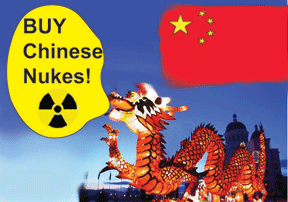 Telegraph 27th May 2020, Chinese involvement in Sizewell nuclear plant the ‘next Huawei’, MPs warn.
Call for energy policy and how the UK interacts with China to be reviewed.
Chinese involvement in the Sizewell C nuclear power station will be the
“next Huawei,” MPs have warned, as they called for an entire overhaul
of the energy policy.
It comes after EDF, the French energy company on
Wednesday submitted an application to build the next nuclear power plant in
Suffolk, which it intends to develop with the state-owned energy company,
China General Nuclear Power Group (CGN).
However Sir Iain Duncan Smith, the
former Conservative leader, warned the power plant was “the next
Huawei”. “It is another major manifestation of the problem we face
having set out on the wrong path with China years ago,” Sir Iain told The
Daily Telegraph.
Fiji ratifies the TREATY ON THE PROHIBITION OF NUCLEAR WEAPONS.
Prohibition of Nuclear weapons treaty ratified https://www.fbcnews.com.fj/news/parliament/prohibition-of-nuclear-weapons-treaty-ratified/
|
|

Bankrupt French company AREVA, now resuscitated as Framatome to engineer UK’s nuclear fleet

Framatome to provide engineering services to UK nuclear fleet, 29 May 2020 French company Framatome has signed a framework agreement with EDF in the UK to provide engineering services to support ongoing nuclear power plant operations…… EDF in the UK operates a fleet of eight nuclear power stations: Sizewell B, Hinkley Point B, Dungeness B, Hartlepool, Heysham 1 and 2, Hunterston, and Torness. https://www.neimagazine.com/news/newsframatome-to-provide-engineering-services-to-uk-nuclear-fleet-7944809
Trump administration to remove almost all sanctions relief to Iran
 US clamps down on waivers tied to Iran’s nuclear cooperation, Matthew Lee, Ap Diplomatic Writer, The Wilton Bulletin, , Wednesday, May 27, 2020 WASHINGTON (AP) — The Trump administration announced Wednesday it is ending nearly all of the last vestiges of U.S. sanctions relief provided under the 2015 Iran nuclear deal. US clamps down on waivers tied to Iran’s nuclear cooperation, Matthew Lee, Ap Diplomatic Writer, The Wilton Bulletin, , Wednesday, May 27, 2020 WASHINGTON (AP) — The Trump administration announced Wednesday it is ending nearly all of the last vestiges of U.S. sanctions relief provided under the 2015 Iran nuclear deal.Secretary of State Mike Pompeo said he would revoke all but one of sanctions waivers covering civil nuclear cooperation. The waivers had allowed Russian, European and Chinese companies to continue to work on Iran’s civilian nuclear facilities without drawing American penalties…… Pompeo also imposed sanctions on two officials with Iran’s atomic energy organization who are involved in the development and production of centrifuges used to enrich uranium. The nuclear cooperation waivers were last renewed in late March and were due to expire at the end of the month. The revocations will give foreign companies 60 days to wind down their operations. Pompeo in March had opposed extending the waivers, which are among the few remaining components of the nuclear deal that the administration has not canceled. But officials said Treasury Secretary Steven Mnuchin had prevailed in an internal debate by arguing the coronavirus pandemic made eliminating the waivers unpalatable at a time when the administration is being criticized for refusing to ease sanctions to deal with the outbreak.
President Donald Trump withdrew from the nuclear deal in 2018 and has steadily reimposed U.S. sanctions on Iran that had been eased or lifted under its terms. The “civilian-nuclear cooperation” waivers allow foreign companies to do work at some of Iran’s declared nuclear sites without becoming subject to U.S. sanctions.
Deal supporters say the waivers give international experts a valuable window into Iran’s atomic program that might otherwise not exist. They also say some of the work, particularly at the Tehran reactor on nuclear isotopes that can be used in medicine, is humanitarian in nature………. https://www.wiltonbulletin.com/news/article/US-to-revoke-Iran-nuclear-cooperation-sanctions-15298267.php |
|
Trump withdraws from Open Skies Treaty, throws more doubt on the future of the New START nuclear treaty
 Open Skies withdrawal throws nuclear treaty into question, The Hill, BY REBECCA KHEEL – 05/25/20 Open Skies withdrawal throws nuclear treaty into question, The Hill, BY REBECCA KHEEL – 05/25/20
President Trump‘s move this week to withdraw from an international pact meant to prevent accidental war has added to concerns about the fate of a separate arms control treaty with Russia. The Trump administration says formal talks with Moscow on extending the New START agreement, which places limits on deployed nuclear warheads, will start imminently. But after Trump announced Thursday he is withdrawing from the Open Skies Treaty, arms control advocates raised fresh doubt about the future of New START, which is set to expire in February. Trump has shown deep skepticism toward international agreements — and those negotiated under the Obama administration in particular — but the administration insists it hasn’t given up on arms control….. he person Trump has tapped to negotiate an extension or replacement has made no guarantees, saying at a think tank event this past week he’s “not going to speculate” on whether the treaty will be extended “at this very early stage” and arguing the United States could win an arms race if need be. “We know how to win these races and we know how to spend the adversary into oblivion,” Marshall Billingslea, the special presidential envoy for arms control, said during a Hudson Institute webcast. “If we have to, we will, but we sure would like to avoid it.” The wrangling over the decades-old arms control regime comes as much of the world’s attention is focused instead on the coronavirus pandemic, which Democrats have accused Trump of using as a cover to withdraw from Open Skies with little attention. “The president should be focused on combating the coronavirus, not dragging America toward a costly and potentially devastating nuclear arms race,” House Foreign Affairs Committee Chairman Eliot Engel (D-N.Y.) said in a statement on Trump’s move to pull out of Open Skies….. New START caps the number of deployed nuclear warheads the United States and Russia can have at 1,550 a piece, and it places limits on deploying weapons that can deliver the warheads and creates a verification regime that includes 18 on-site inspections per year. The agreement, which was negotiated by the Obama administration, is set to expire Feb. 5, 2021. But the treaty includes an option to extend it for another five years without needing the approval of either country’s legislature. Arms control advocates have sounded the alarm about the future of New START since last year after Trump withdrew from the Intermediate-range Nuclear Forces Treaty, a pact that banned Russia and the United States from having ground-launched missiles of a certain range. Now, those warnings are intensifying. In a statement opposing Trump’s Open Skies withdrawal, Sen. Jeanne Shaheen (D-N.H.) also highlighted “the uncertainty surrounding its commitment to New START,” calling the combination of both “very alarming.” The Open Skies Treaty, which was first proposed by former President Eisenhower but didn’t enter into force until 2002, allows its more than 30 signatories, including the U.S. and Russia, to fly unarmed observation flights over each other. The intention is to provide transparency about military activities to avoid miscalculations that could lead to war. The Trump administration formally submitted its notice of intent to withdraw Friday, kicking off a six-month period before the withdrawal is final. ……. Russia, meanwhile, has previously offered to extend the treaty immediately without any preconditions and has also recently expressed a willingness to include some of the new weapons Washington is concerned about. But on the heels of the U.S. withdrawal from Open Skies, Ryabkov on Friday cast doubt on New START’s extension…… Derek Johnson, executive director of Global Zero, which advocates for the elimination of nuclear weapons, argued Trump’s move on Open Skies “does not bode well for New START.” “Rather than accept Russia’s offer to extend New START immediately and without preconditions, the Trump administration has proposed instead to negotiate a new trilateral agreement that includes China. Without extending New START, this proposal is either a fool’s errand or a deliberate farce,” Johnson said in a statement. “Getting China’s nuclear forces under control is a worthy goal, and sustained efforts are required to do that — but if New START goes the way of the Intermediate-Range Nuclear Forces and Open Skies Treaties, the possibility of a bigger deal goes with it.” https://thehill.com/policy/defense/499240-open-skies-withdrawal-throws-nuclear-treaty-into-question |
|
Iran tops the list of countries which accepted inspections of the International Atomic Energy Agency in 2019.
|
‘The goal of opponents is to undermine confidence and cooperation between Tehran and IAEA’
JCPOA ensuring Iran’s nuclear program is peaceful, says Russia, Tehran Times May 25, 2020 “The purpose of #JCPOA is to restore confidence in exclusively peaceful nature of nuclear program of #Iran,” Ulyanov tweeted on Monday.“The deal fulfils this task,” he wrote. “No sign of military dimension was found. The goal of opponents is opposite- to undermine confidence and cooperation between Tehran and #IAEA.” In an earlier tweet on Sunday, the Russian envoy wrote, “Opponents of #JCPOA call for a ‘renewed coalition of pressure on Tehran’. In their article in Newsweek, published on Sunday, they try to instruct #IAEA what it ‘must’ and ‘should’ do. IAEA is independent. It’s Board of Governors and Secretariat will decide for themselves on how to proceed.” The Newsweek article that Ulyanov referred to, titled “The IAEA must report its latest findings on Iran’s nuclear weapons program”, called for a renewed coalition of pressure on Tehran in order to “address the regime’s nuclear program from its roots.” “World powers should make clear to Iran that it can no longer conceal its nuclear past and potentially its present—or swift international penalties will follow,” added the article written by Jacob Nagel, former acting national security advisor to Israeli Prime Minister Benjamin Netanyahu, and Andrea Stricker, a research fellow at FDD. This is while Iran tops the list of countries which accepted inspections of the International Atomic Energy Agency in 2019. “Last year, the Islamic Republic received 21 percent of the entire visits that were made to various nuclear sites across the world by inspectors of the International Atomic Energy Organization (IAEA),” Kazem Gharibabadi, Iran’s ambassador to the Vienna-based international organizations, said earlier this month. He was citing the IAEA’s 129-page 2019 Safeguards Implementation Report. “The agency continued to verify and monitor the nuclear-related commitments of the Islamic Republic of Iran under the Joint Comprehensive Plan of Action,” read the 129-page report prepared for diplomats that accounts for resources spent on enforcing the landmark 2015 agreement among world powers…….. |
|
Lithuania, Belarus sign nuclear incident notification agreement
|
Lithuania, Belarus sign nuclear incident notification agreement
Source: Xinhua| 2020-05-26 01:02:32|Editor: huaxia VILNIUS, May 25 — The nuclear safety authorities of Lithuania and Belarus signed an agreement on early notification of a nuclear accident and on the exchange of important nuclear safety information, Lithuania’s State Nuclear Power Safety Inspectorate (VATESI) announced here on Monday.
In order to protect the public by minimizing the potential radiation-related risks and consequences, the two authorities agreed to exchange key information immediately after a nuclear incident or when the monitoring systems indicate a radiation dose-rate level that could be hazardous to the public health, said a VATESI press release. ….. Lithuania’s authorities have regularly raised questions about the environmental and nuclear safety of the Ostrovets nuclear power plant in Belarus…..http://www.xinhuanet.com/english/2020-05/26/c_139087159.htm |
|
On weapons treaties US administration is blundering toward nuclear chaos
 Fumbling the nuclear football: is Trump blundering to arms control chaos?
The president believes he alone can negotiate away nuclear weapons and win a Nobel prize – but he has quit three treaties and gutted his administration of experts, Guardian, Julian Borger in Washington Sun 24 May 2020
The Trump administration signaled this week that it was ready to get back in the business of nuclear arms control. A newly appointed envoy, Marshall Billingslea, made his first public remarks to announce talks with Russia are about to resume.
“We have concrete ideas for our next interaction, and we’re finalizing the details as we speak,” Billingslea said.
The fact that this relaunch came on the same day that the US was pulling out of the Open Skies Treaty (OST) – the third withdrawal from an arms control agreement under the Trump presidency – underlined the contradictions at the heart of the administration’s approach towards nuclear weapons.
According to those who have worked for him on the issue, Trump is preoccupied with the existential threat of nuclear war, and resolved that he alone can conjure a grand arms control bargain that would save the planet – and win him the Nobel prize.
But at the same time, he is clearly thrilled by the destructive power that the US arsenal gives him, boasting about the size of his nuclear button, and a mystery “super duper” missile he this week claimed the US had up its sleeve.
Administration officials have been left to try to confect a coherent-sounding policy out of such contradictory impulses – so far without success.
“He believes only he has what it takes to make the big deal, if only everyone else – all the experts – would get out of his way,” a former senior official said. “But he just has no idea about how to make it happen.”
 Billingslea, the new envoy, is not an arms control specialist. He previously served as the undersecretary for terrorist financing at the US Treasury and was nominated last year to the top human rights job at the state department – but that foundered amid controversy over his involvement in the post 9/11 torture programme . The arms control envoy job did not require Senate confirmation.
In his maiden speech as envoy, Billingslea made clear that if there were to be a new arms race, the US would win.
“We know how to win these races and we know how to spend the adversary into oblivion,” he said in a videoconference organised by the conservative Hudson Institute thinktank on Thursday. It was a statement of bravado as the US plunged into recession owing about $7tn in foreign debt, $1tn to China.
Billingslea argued Trump would succeed through his mastery of the art of the deal.
“The president has a long and successful career as a negotiator, and he’s a master at developing and using leverage,” he said, showing an early instinct for what it takes to keep your job in this administration.
So far, however, Trump has failed to negotiate a single arms control agreement. His flamboyant summitry with Kim Jong-un produced nothing, and the North Korean nuclear weapons programme has continued unabated. Meanwhile the president has taken the US out of three arms control agreements, leaving them dead, dying or maimed.
He walked out of the nuclear deal with Iran in 2018, and the following year withdrew from the Intermediate-range Nuclear Forces (INF) treaty, which had kept nuclear missiles out of Europe since the cold war. Then on Thursday, he confirmed the US was leaving the OST, agreed in 1992 as a means of building transparency and trust between Russia and the west through observation overflights of each other’s territory.
That may not be the end of Trump’s arms control demolition. The Senate never ratified the 1996 Comprehensive Test Ban treaty, which – partly as a result – has yet to come into force. But the US has signed it and observes a voluntary moratorium on nuclear tests.
Hawks in the administration, however, want a renunciation. At a high-level White House meeting last week, the suggestion was raised that the US carry out its first underground nuclear test since 1992, according to former officials. The proposal was resisted by the state and energy departments. A senior administration official told the Washington Post however the proposal is “very much an ongoing conversation.”
The only arms control agreement still in effect is the 2010 New Start treaty, which limits US and Russian deployed strategic nuclear weapons to 1,550 each. It is due to expire in February but it can be extended for another five years. The Trump administration has not taken a position on whether it wants an extension, however.
“There’ll be plenty of time to look at the full range of options related to that treaty,” Billingslea said. At the same time he made clear he viewed New Start as being inadequate, criticising its verification requirements, its exclusion of non-strategic, shorter-range weapons – and, most importantly, the fact that it does not include China……
Arms control advocates in the administration believe that the insistence on China’s inclusion was originally pushed by Trump’s third national security adviser, John Bolton, a lifelong opponent of arms control treaties, and his like-minded aide, Tim Morrison, as a means of killing off New Start.
……Disarmament advocates worry that even if Billingslea re-establishes regular contacts with Moscow, the US no longer has the diplomatic muscle to pursue substantive, complex arms negotiations because of the steady loss of experienced staff responsible for such negotiations.
“It’s not obvious they have a kind of a serious team in place to try and make that happen,” a western diplomat said.
“Three years after entering office, the Trump administration lacks a coherent set of goals, a strategy to achieve them, or the personnel or effective policy process to address the most complex set of nuclear risks in US history,” a group of arms control experts wrote in a report this month by the disarmament group, Global Zero. “Put simply, the current US administration is blundering toward nuclear chaos with potentially disastrous consequences.” https://www.theguardian.com/world/2020/may/24/nuclear-weapons-donald-trump-arms-control-chaos
Britain will have to decide whether it wants nuclear power stations funded — and powered — by China.
 Times 24th May 2020, The great China dilemma: Caught between two superpowers, Britain faces difficult decisions on everything from nuclear power to medicine. On the picturesque Suffolk coast, a battle is intensifying that will help define Britain’s relationship with China. Times 24th May 2020, The great China dilemma: Caught between two superpowers, Britain faces difficult decisions on everything from nuclear power to medicine. On the picturesque Suffolk coast, a battle is intensifying that will help define Britain’s relationship with China.In one corner is a group of celebrities and locals, including the Love Actually actor Bill Nighy, and Andy Wood, chief executive of Adnams brewery in Southwold. In the other are two nuclear power giants, Electricité de France (EDF) and China General Nuclear (CGN).
China and France want to build Sizewell C, a nuclear power station capable of supplying 7% of the UK’s electricity. The Stop Sizewell C campaigners share one concern with some politicians, notably the hard right of the Conservative Party: why is Britain relying on China to
supply its electricity? “China is adept at cyber-attacks,” said Alison Downes of Stop Sizewell C. “I would doubt whether there could be a 100% cast-iron guarantee that operating systems were immune to that. Even if you set aside security concerns, you’ve got real vulnerabilities with a government that is prepared to use economic sanctions.” Sizewell is just a part of the communist state’s Belt and Road initiative to dominate the world with cash, technology and influence. It plans to use the UK as a showcase for its nuclear technology, with state-owned CGN providing 20% of the funds for Sizewell.
China is also helping bankroll the delayed and over-budget Hinkley Point C power station in Somerset. However, the bigger prize lies on the Essex coast at Bradwell. There, 40 miles east of London, CGN wants to install its homegrown HPR1000 nuclear reactors. CGN will be the two-thirds owner of the Bradwell plant, EDF the junior partner.
EDF and CGN claim that the power stations will be impervious to cyber attack. In
Britain, a new China-sceptic organisation, the China Research Group, has been formed by Tory MPs led by Tom Tugendhat, chairman of the foreign affairs select committee. It is a far cry from the “golden era” in Sino-British relations promised by David Cameron in 2015, when Chinese
president Xi Jinping visited the UK and the pair drank pints in a pub. At CGN, concern is growing about the rising tide of Sinophobia and its investment in the UK. As the Chinese embassy in London pumps out defensive statements about China’s role in tackling Covid-19, Britain will have to decide whether it wants nuclear power stations funded — and powered — by China. CGN’s UK chief executive, Zheng Dongshan, is understood to have
pressed energy minister Nadhim Zahawi for clarity around the UK’s intentions on new nuclear. https://www.thetimes.co.uk/edition/business/the-great-china-dilemma-6rdmhw3wl |
USA’s Plan to spend Russia and China ‘into oblivion’ in arms race will bankrupt only America
|
Scott Ritter is a former US Marine Corps intelligence officer. He served in the Soviet Union as an inspector implementing the INF Treaty, in General Schwarzkopf’s staff during the Gulf War, and from 1991-1998 as a UN weapons inspector. Follow him on Twitter @RealScottRitter In a stunning display of arrogance, ignorance, and hubris, President Trump’s new arms control czar threatens to spend America’s adversaries into “oblivion” in any new arms race. But the joke is on him.
Trump’s newly appointed Special Presidential Envoy for Arms Control Marshall Billingslea has breathed new life into an historical interpretation that holds the United States won the Cold War with the Soviet Union by escalating an arms race that turned out to be unsustainable for Moscow, bankrupting the Soviet economy and accelerating the collapse of the Soviet Union as a political entity. In remarks made to the Hudson Institute, a conservative think tank, Billingslea noted that the threat of a new arms race would be enough to bring both China and Russia to the negotiating table for the purpose of crafting a new trilateral arms control treaty that would replace the current bilateral New START treaty, scheduled to expire in February 2021. We intend to establish a new arms control regime now, precisely to prevent a full-blown arms race,” Billingslea said. If, however, either Russia or China (or both) decided to forego negotiations and continue to pursue new strategic nuclear weapons, then President Trump “has made clear that we have a tried and true practice here”.
|
|

NPT’s 50th Anniversary Encourages 17 Signatories To Remind Five Nuclear-Weapons States of Their Commitments
 NPT’s 50th Anniversary Encourages 17 Signatories To Remind Five Nuclear-Weapons States of Their Commitments IDN -In Depth News By UN Bureau, 24 May 20, NEW YORK (IDN) – The upcoming 2020 Review Conference of a landmark international treaty on the Non-Proliferation of Nuclear Weapons (NPT), postponed due to the COVID-19 pandemic, presents “a timely opportunity for the States Parties to undertake a comprehensive review and assessment” of its current status, says the Joint Communiqué issued on May 19 by 17 States Party to the NPT. NPT’s 50th Anniversary Encourages 17 Signatories To Remind Five Nuclear-Weapons States of Their Commitments IDN -In Depth News By UN Bureau, 24 May 20, NEW YORK (IDN) – The upcoming 2020 Review Conference of a landmark international treaty on the Non-Proliferation of Nuclear Weapons (NPT), postponed due to the COVID-19 pandemic, presents “a timely opportunity for the States Parties to undertake a comprehensive review and assessment” of its current status, says the Joint Communiqué issued on May 19 by 17 States Party to the NPT.
A total of 191 States have joined the Treaty, including the five nuclear-weapon States – USA; Russia, China, Britain and France – which entered into force in 1970. More countries have ratified the NPT than any other arms limitation and disarmament agreement, which analysts perceive as a testament to the Treaty’s significance. Signatories to the communique look forward to work with other States Parties. There is no doubt that the implementation of disarmament commitments would have allowed more resources to be allocated for sustainable development as well as international cooperation and preparedness to deal with such public health and global emergencies. “It is now time that States Parties translate words into concrete actions backed by clear and agreed-upon benchmarks and timelines. Only through such efforts can we look ahead towards a successful next 50 years of the NPT, improving on the important achievements of the last 50 years, which we presently commemorate,” accentuates the communique. Following is the full text of the Joint Communique:…… https://www.indepthnews.net/index.php/opinion/3564-five-nuclear-weapons-states-urged-to-fulfil-commitments-on-npt-s-50th-anniversary |
|
1 This Month
26 September – International Day for the Total Elimination of Nuclear Weapons





PLEASE OPPOSE HR 8255 AND S.3639 – bills would accelerate satellite deployment, with no environmental review or safeguards – https://ncstd5li.quorum.us/campaign/169331/
To see nuclear-related stories in greater depth and intensity – go to https://nuclearinformation.wordpress.com
-
Archives
- September 2026 (283)
- August 2026 (330)
- July 2026 (355)
- June 2026 (287)
- May 2026 (306)
- April 2026 (356)
- March 2026 (251)
- February 2026 (267)
- January 2026 (308)
- December 2025 (358)
- November 2025 (359)
- October 2025 (375)
-
Categories
- 1
- 1 NUCLEAR ISSUES
- business and costs
- climate change
- culture and arts
- ENERGY
- environment
- health
- history
- indigenous issues
- Legal
- marketing of nuclear
- media
- opposition to nuclear
- PERSONAL STORIES
- politics
- politics international
- Religion and ethics
- safety
- secrets,lies and civil liberties
- spinbuster
- technology
- Uranium
- wastes
- weapons and war
- Women
- 2 WORLD
- ACTION
- AFRICA
- Atrocities
- AUSTRALIA
- Christina's notes
- Christina's themes
- culture and arts
- Events
- Fuk 2022
- Fuk 2023
- Fukushima 2017
- Fukushima 2018
- fukushima 2019
- Fukushima 2020
- Fukushima 2021
- general
- global warming
- Humour (God we need it)
- Nuclear
- RARE EARTHS
- Reference
- resources – print
- Resources -audiovicual
- Weekly Newsletter
- World
- World Nuclear
- YouTube
-
RSS
Entries RSS
Comments RSS

