USA provocation of China, Iran, Russia.
|
Lest you fear that peace might break out in the Middle East, there’s always the possibility of a U.S. assault on Iran. That chance greatly increased with the Trump regime’s monumental blunder of smashing the Iran nuclear treaty. Trump clearly thought his high-handed rejection would cow the Iranians. He was wrong. In an apparent rage, he ratcheted up sanctions, threats, insults and then – an assassination, the logical conclusion of which was war, had Trump not come to his senses. Since then things have cooled down a bit, though not enough to stop the Trump regime from interfering with Iran’s oil trade with Venezuela or from making preposterous accusations about Iranian plots against the U.S. ambassador to South Africa, an official with no relation to Iran, known mostly for her business in expensive handbags and for donating to Trump. What the idiotically bellicose U.S. policy toward Iran – including the recent U.S. push for more sanctions – has mainly achieved is a warm embrace between Iran and China. And that’s not a matter susceptible to piracy on the high seas – the preferred U.S. approach to tankers taking Iranian fuel to Caracas. Nor will wild charges about planned assassinations of obscure, random U.S. bureaucrats affect this relationship. The Trump regime has blustered, threatened, insulted and caused the great Iran-China friendship to sink deep roots and blossom. Lest you fear that peace might break out in the Middle East, there’s always the possibility of a U.S. assault on Iran. That chance greatly increased with the Trump regime’s monumental blunder of smashing the Iran nuclear treaty. Trump clearly thought his high-handed rejection would cow the Iranians. He was wrong. In an apparent rage, he ratcheted up sanctions, threats, insults and then – an assassination, the logical conclusion of which was war, had Trump not come to his senses. Since then things have cooled down a bit, though not enough to stop the Trump regime from interfering with Iran’s oil trade with Venezuela or from making preposterous accusations about Iranian plots against the U.S. ambassador to South Africa, an official with no relation to Iran, known mostly for her business in expensive handbags and for donating to Trump.
What the idiotically bellicose U.S. policy toward Iran – including the recent U.S. push for more sanctions – has mainly achieved is a warm embrace between Iran and China. And that’s not a matter susceptible to piracy on the high seas – the preferred U.S. approach to tankers taking Iranian fuel to Caracas. Nor will wild charges about planned assassinations of obscure, random U.S. bureaucrats affect this relationship. The Trump regime has blustered, threatened, insulted and caused the great Iran-China friendship to sink deep roots and blossom. It probably would have anyway, but Trump surely deserves credit for nourishing it. As Time reported on July 29, Iran is negotiating a 25-year deal with China, with “billions of dollars worth of Chinese investments in energy, transportation, banking and cybersecurity in Iran.” There also could be “weapons development and intelligence sharing and joint military drills.” In short, this $400 billion deal is huge and alarm bells are ringing frantically in Washington. They shouldn’t be. If the Trump regime had been paying attention, they would have seen this coming, because it’s the logical outcome of their absurd hostility to both countries. But then, cultural illiteracy regarding Iran is a feature of Republican policy in the Middle East. After all, the Bush regime invaded, conquered and destroyed Iraq – war crimes whose main beneficiary was Iran, which had no love, to say the least, for Saddam Hussein and was more than happy to cement its brotherhood with newly ascendant Iraqi Shia. This is the sort of stuff any high schooler could have alerted the Bush regime to in advance. But alas, the GOP’s geopolitical geniuses had no use for even high school wisdom. To ensure we all got that point, the Trump regime quickly pounced on one of Obama’s few decent and intelligent moves in the Middle East – the Iran nuclear treaty – and shredded it. Still, the U.S. military’s focus has shifted. That shift started with Obama’s odious “pivot to China.” According to Chinese State Councilor Wang Yi, quoted by Russia Today, U.S. intervention in the South China Sea is “the main driver of militarization there.” Currently several countries in the region claim territory in the South China Sea – China, Vietnam, Malaysia, the Philippines, Indonesia and Brunei. Some of these claims overlap, thus causing disputes, RT reports. The U.S. stirs the pot with its “freedom of navigation” military patrols. Naturally this intervention has led to incidents between the Chinese and U.S. militaries. And worse could happen any time. China regards the South China Sea as its backyard and the U.S. presence there as a provocation. After all, how would Washington react to Chinese military patrols in the Gulf of Mexico? That is the territorial equivalent of what the U.S. does to China, though Washington refuses to recognize this in its quest for global dominance. It’s the same with U.S. aggression in the Black Sea, where the target is Russia. In August, the U.S. held military drills in the Black Sea, known, in the not too distant past, as the shores of Russia. Earlier, Andrei Krasov of the State Duma Defense Committee told the Interfax agency: “The actions of American reconnaissance aircraft will not remain without reaction.” Indeed, in late July, Russia reported intercepting an American reconnaissance flight over the Black Sea. Two much of this sort of stuff could lead to war. So what we have here is the U.S. fishing in troubled waters. NATO has already nearly surrounded Russia, which now boasts supersonic nuclear weapons. In response, Trump recently revealed that the U.S. has some sort of secret “super” weapon. Which only makes the Black Sea brinksmanship more dangerous. Both adversaries are armed to the teeth. To make matters worse, Trump has ripped up all nuclear treaties with Russia except START – and that is at death’s door. A war with either Russia, China or Iran would be catastrophic, as anyone with a brain knows. Nor would it solve any of the myriad disasters currently besetting the U.S.: an out-of-control pandemic, with more fatalities than any other country in the world and no end in sight; economic collapse, with tens of millions jobless and millions facing eviction and homelessness in a few months; a climate taking revenge on fossil fuel capitalism by burning up large swaths of the globe, including the American West Coast; other human-induced, climate change, extreme weather events elsewhere in the U.S., like the currently soggy Gulf Coast; the rise of violent, over-armed, know-nothing, radical right-wing vigilantes; racial unrest. And those are just the big, obvious monster weeds in the American front yard. Washington should take a page from Voltaire and tend its own garden. Forget about the Black Sea, the South China Sea and the Gulf of Oman. Now is not the time for new conflict. Because as every school child knows, never is the only time for nuclear war. |
|

‘Reverse course’ towards full nuclear disarmament – UN chief
|
‘Reverse course’ towards full nuclear disarmament – UN chief, https://news.un.org/en/story/2020/09/1073832
25 September 2020, Peace and Security
On the International Day for the Total Elimination of Nuclear Weapons marked on Saturday, the UN chief has underscored the need to “reverse course and return to a common path to nuclear disarmament”. Almost 75 years since the adoption of the first General Assembly resolution in 1946, which committed the UN to the goal of ridding the planet of nuclear weapons, “the world continues to live in the shadow of nuclear catastrophe”, Secretary-General António Guterres said in his message commemorating the day. Relationships between States possessing nuclear weapons are characterized by “division, distrust and an absence of dialogue”, he warned, noting that as they increasingly choose to pursue strategic competition over cooperation, “the dangers posed by nuclear weapons are becoming more acute”. According to the UN chief, all States have a responsibility to ensure that such deadly armaments “eliminated completely” from national arsenals. COVID in the mixDrawing attention to the wide range of global fragilities brought about by COVID-19 – from pandemic readiness and inequality to climate change to lawlessness in cyberspace – the top UN official called “preparedness to address the threat of nuclear weapons” one of those vulnerabilities. “We need a strengthened, inclusive and renewed multilateralism built on trust and based on international law that can guide us to our shared goal of a world free of nuclear weapons”, he said. Pressurize nuclear powers The UN has long upheld that the onus to lead disarmament is on the States that possess nuclear weapons. Mr. Guterres concurred that those nations must “return to real, good-faith dialogue to restore trust and confidence, reduce nuclear risk and take tangible steps in nuclear disarmament”. He also stressed that they reaffirm the shared understanding that “a nuclear war cannot be won and must not be fought” and take steps to implement the commitments they have made. A gloomy pictureYet, according to Stockholm International Peace Research Institute (SIPRI), some 13,400 nuclear weapons remain today. Moreover, the countries possessing these weapons have well-funded, long-term plans to modernize their nuclear arsenals. And while the number of deployed nuclear weapons has significantly decreased since the height of the Cold War, SIPRI attests that not one nuclear weapon had been physically destroyed pursuant to a treaty. Additionally, no meaningful nuclear disarmament negotiations are currently underway. Mr. Guterres emphasized that the death, suffering and destruction caused by the atomic bombing in Hiroshima and Nagasaki “must not be repeated”. “The only guarantee against the use of these abhorrent weapons is their total elimination”, spelled out the Secretary-General, adding that the UN “stands ready to work with all States to achieve this shared goal”.
|
|

Trump might abandon NEW START arms treaty, U.S. allies fear
 U.S. Allies Worry Trump Administration Might Let Key Nuclear Treaty With Russia Die
Internal documents acknowledge concern among allies about the expiration of the Obama-era New START accord, but U.S. negotiators are still playing hardball. Foreign Policy, BY JACK DETSCH, ROBBIE GRAMER SEPTEMBER 24, 2020, S. ALLIES ARE CONCERNED ABOUT THE REPERCUSSIONS OF THE LOOMING EXPIRATION OF THE OBAMA-ERA NEW START ARMS CONTROL TREATY BETWEEN THE UNITED STATES AND RUSSIA, ACCORDING TO AN INTERNAL ADMINISTRATION REPORT OBTAINED BY FOREIGN POLICY. MEANWHILE, FORMER OFFICIALS AND ARMS CONTROL EXPERTS WORRY THE ADMINISTRATION MAY BE SEEKING TO SLOW-WALK THE ACCORD TO DEATH BY MAKING IMPOSSIBLE DEMANDS OF RUSSIA JUST MONTHS BEFORE THE TREATY IS SLATED TO END.
The Trump administration faces a tight deadline to renew the 2010 New START Treaty, which slaps limits on the number of strategic launchers, such as intercontinental and submarine-launched ballistic missiles and heavy bombers that both nations can deploy. Unless both sides reach an agreement on an extension, it will end in February 2021, leaving no meaningful treaty to stave off the threat of an arms race. Top U.S. arms negotiator Marshall Billingslea appears to have temporarily set aside one condition already broadly dismissed as a nonstarter—adding China to the bilateral accord.
Still, he has insisted Beijing will have to be part of any agreement that would replace New START. “The next treaty will have to be multilateral, it will have to include China, and the framework that we are articulating together as two great powers, us and the Russians, will be the framework going forward that China will be expected to join,” Billingslea told reporters in a briefing last month.
In the meantime, U.S. officials have added other conditions: predicating a short-term extension of New START on expanded restrictions on Russia’s growing arsenal of tactical nuclear weapons.
So far, Russia hasn’t shown any inclination to go along with such preconditions for negotiating an extension of the treaty. As the clock winds down, U.S. allies in Europe and arms control experts fear New START might not be renewed.
In an internal State Department report for Congress, the Trump administration acknowledged that the United States’ closest allies are hoping to constrain Russia’s and China’s weapons programs. But the report also notes that allies are growing unnerved by the prospect of talks falling apart as Washington is distracted by a contested presidential election. ……..
Though Billingslea has tried to push the Russians to accept more weapons inspections, there is concern among experts that the United States would also lose vital intelligence into Russian nuclear modernization if the deal lapses. ……. https://foreignpolicy.com/2020/09/24/trump-putin-russia-new-start-nuclear-arms-control-u-s-allies-worry-trump-administration-might-let-key-nuclear-treaty-with-russia-die/
Media avoids covering the Assange extradition – despite it being the media “trial of the century”
 Julian Assange: Press Shows Little Interest in Media ‘Trial of Century’ https://fair.org/home/julian-assange-press-shows-little-interest-in-media-trial-of-century/, ALAN MACLEOD 25 Sept 20,
Labeled the media “trial of the century,” WikiLeaks founder Julian Assange’s extradition hearing is currently taking place in London—although you might not have heard if you’re relying solely on corporate media for news. If extradited, Assange faces 175 years in a Colorado supermax prison, often described as a “black site” on US soil.
The United States government is asking Britain to send the Australian publisher to the US to face charges under the 1917 Espionage Act. He is accused of aiding and encouraging Chelsea Manning to hack a US government computer in order to publish hundreds of thousands of documents detailing American war crimes, particularly in Afghanistan and Iraq. The extradition, widely viewed as politically motivated, has profound consequences for journalists worldwide, as the ruling could effectively criminalize the possession of leaked documents, which are an indispensable part of investigative reporting.
WikiLeaks has entered into partnership with five high-profile outlets around the world: the New York Times, Guardian (UK), Le Monde (France), Der Spiegel (Germany) and El País (Spain). Yet those publications have provided relatively little coverage of the hearing.
Since the hearing began on September 7, the Times, for instance, has published only two bland news articles (9/7/20, 9/16/20)—one of them purely about the technical difficulties in the courtroom—along with a short rehosted AP video (9/7/20). There have been no editorials and no commentary on what the case means for journalism. The Times also appears to be distancing itself from Assange, with neither article noting that it was one of WikiLeaks’ five major partners in leaking information that became known as the CableGate scandal.
The Guardian, whose headquarters are less than two miles from the Old Bailey courthouse where Assange’s hearing is being held, fared slightly better in terms of quantity, publishing eight articles since September 7.However, perhaps the most notable content came from columnist Hadley Freedman (9/9/20).
When asked in an advice article: “We live in a time of so much insecurity. But is there anything we can expect from this increasingly ominous-looking winter with any certainty?” she went on a bizarre tangential rant ridiculing the idea that Assange’s trial could possibly be “politicized,” also crassly brushing off the idea that his young children would never see their father again, and never answering anything like the question she was asked. Holding people to account “for a mess they could have avoided,” she notes, “is not ‘weaponizing’ anything — it is just asking them to do their jobs properly.” She also claimed that believing Assange’s trial was politicized was as ridiculous as thinking antisemitism claims were cynically weaponized against Labour leader Jeremy Corbyn, which, she meant to suggest, was a preposterous idea. This was not an off-the-cuff remark transcribed and published, but a written piece that somehow made it past at least one editor.
Like the Times, the Guardian appeared to be hoping to let people forget the fact it built its worldwide brand off its partnership with WikiLeaks; it was only mentioned in a forthright op-ed by former Brazilian president Lula da Silva (9/21/20), an outlier piece.
The Guardian should be taking a particularly keen role in the affair, seeing that two of its journalists are alleged by WikiLeaks to have recklessly and knowingly disclosed the password to an encrypted file containing a quarter-million unredacted WikiLeaks documents, allowing anyone—including every security agency in the world—to see an unredacted iteration of the leak. In 2018, the Guardian also falsely reported that Trump campaign chief Paul Manafort had conducted a meeting with Assange and unnamed “Russians” at the Ecuadorian embassy (FAIR.org, 12/3/18). And, as former employee Jonathan Cook noted, the newspaper is continually being cited by the prosecution inside the courtroom.
There were only two articles in the English or French versions of Le Monde (9/7/20, 9/18/20) and only one in either of Der Spiegel’s English or German websites (9/7/20), although the German paper did at least acknowledge its own partnership with Assange. There was no coverage of the hearings in El País, in English or Spanish, though there was a piece (9/10/20) about the US government thwarting a Spanish investigation into the CIA spying on Assange at the Ecuadorian embassy in London—accompanied by a photo of a protester against his extradition.
The rest of corporate media showed as little interest in covering a defining moment in press freedom. There was nothing at all from CNN. CBS’s two articles (9/7/20, 9/22/20) were copied and pasted from news agencies AP and AFP, respectively. Meanwhile, the entire sum of MSNBC’s coverage amounted to one unclear sentence in a mini news roundup article (9/18/20).
Virtually every relevant human rights and press freedom organization is sounding the alarm about the incendiary precedent this case sets for the media. The Columbia Journalism Review (4/18/19), Human Rights Watch and the Electronic Frontier Foundation note that the government includes in its indictment regular journalistic procedures, such as protecting sources’ names and using encrypted files—meaning that this “hacking” charge could easily be extended to other journalists. Trevor Timm, founder of the Freedom of the Press Foundation, told the court this week that if the US prosecutes Assange, every journalist who has possessed a secret file can be criminalized. Thus, it essentially gives a carte blanche to those in power to prosecute whomever they want, whenever they want, even foreigners living halfway around the world.
The United Nations has condemned his persecution, with Amnesty International describing the case as a “full-scale assault on the right to freedom of expression.” Virtually every story of national significance includes secret or leaked material; they could all be in jeopardy under this new prosecutorial theory.
President Donald Trump has continually fanned the flames, demonizing the media as the “enemy of the people.” Already 26% of the country (including 43% of Republicans) believe the president should have the power to shut down outlets engaging in “bad behavior.” A successful Assange prosecution could be the legal spark for future anti-journalistic actions.
Yet the case has been met with indifference from the corporate press. Even as their house is burning down, media are insisting it is just the Northern Lights.
Essential points from the 2020 World Nuclear Industry Status Report
Three takeaways from the 2020 World Nuclear Industry Status Report, https://thebulletin.org/2020/09/three-takeaways-from-the-2020-world-nuclear-industry-status-report/
John Krzyzaniak The size of the global nuclear fleet has been stagnant for 30 years, and last year was no different. According to the 2020 World Nuclear Industry Status Report, released Thursday, there were 408 nuclear reactors online across the world as of July 1, 2020—a decline of nine units since the middle of last year and roughly on par with the number of reactors in operation in 1988.
The bulky 361-page industry report was compiled by an international team of independent experts led by Mycle Schneider, a consultant based in Paris. Over the last 15 years, it has become well-known for offering accurate but often sobering assessments of the state of nuclear energy across the globe. Last year, Schneider pointedly asserted that “the world is experiencing an undeclared ‘organic’ nuclear phaseout.”
Although the 2020 report is overflowing with data, several key trends stand out.
First, although the raw number of worldwide reactors is well below its all-time high of 438, their actual combined electricity generation came close to setting a record. As a whole, they generated 2,657 terawatt-hours of electricity in 2019, only three terawatt-hours below the historic peak in 2006. The United States, Russia, and China all hit individual country records for total electricity production from nuclear energy. Nevertheless, nuclear energy’s share of the energy market is in long-term decline, as other forms of energy witness rapid expansion.
Second, China continues to be the main driver of new nuclear energy, but over the long term its intentions are uncertain. The number of new projects there appears to be slowing. Whereas two years ago there were 20 units under construction, today there are only 15. Moreover, China missed its nuclear energy goals for 2020 by a sizeable margin: It planned to have 58 gigawatts of installed nuclear capacity and 30 more gigawatts under construction, but it currently has about 45 gigawatts capacity online and only 14 more under construction.
Third, reactor construction delays and cost overruns continue to plague the nuclear industry and, notably, early indications suggest that small modular reactors may be no exception.
For 63 reactors that came online worldwide between 2010 and 2019, the mean construction time was 10 years. Tennessee’s Watts Bar Unit 2, which took more than 43 years from construction start to grid connection, was the only reactor completed in the United States during that time period. But even in China, where average construction times were among the lowest, delays were widespread, and in many cases the real construction times were double the initial expectations.
While small modular reactors exist mostly on paper, there are many companies hoping to change that, promising units that are safer, cheaper, and faster to build. Last month, the US Nuclear Regulatory Commission approved a small modular reactor design submitted by a company called NuScale Power. Though several hurdles remain, NuScale plans to build its first reactor at the site of the Idaho National Laboratory and supply power to Utah Associated Municipal Power Systems as early as 2029.
But other countries’ recent experiences, detailed in the report, point to the difficulties ahead. Russia brought two small reactors online in 2019, but these took over 12 years to build, and at a cost about six times as much as the original estimates. These are the famed floating reactors of the Akademik-Lomonosov—they’re literally installed on a large ship, and that complication almost certainly contributed to the delays and high costs.
But there are more comparable examples for NuScale. The CAREM-25, a 25-megawatt prototype small modular reactor in Argentina, was supposed to receive its first fuel load in 2017 but is at least three years behind schedule. Similarly, China’s High Temperature Reactor project is running four years behind schedule and, while China originally planned to build 18 more of these smaller reactors, the report suggests its appetite may be sated after just one.
That means if countries want to wean themselves off of fossil fuels and stave off the worst effects of climate change, they may need to look elsewhere. And, the report suggests, they already are. The world added 184 gigawatts of non-hydro renewable capacity in 2019, a stark contrast to the 8-gigawatt decline in nuclear capacity.
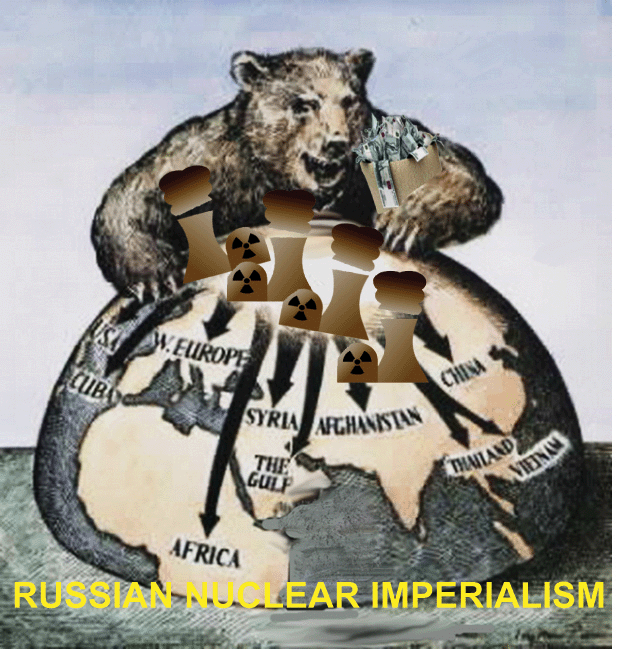
Power hungry Russia foisting nuclear power on Egypt – Africa – where it is not needed
|
Why Russia Is Pushing Unneeded Nuclear Power Plants On Egypt, Oil Price, By Haley Zaremba – Sep 22, 2020, In recent years, Russia and China have been facing off to spread their nuclear power dominion to a new, huge, and vastly untapped market: Africa. The two nuclear power giants have been in competition to corner the market, with Russia aiming to grow its position in a sector that China has historically dominated. Earlier this summer, German media company DW News reported on a new Russian-funded and -controlled nuclear center being developed in Kigali: “The Center of Nuclear Science and Technologies, planned for completion by 2024, will include nuclear research labs as well as a small research reactor with up to 10 MW capacity.” And the Rwandan plant is just the beginning. “Ethiopia, Nigeria and Zambia have signed similar deals with Rosatom, while countries such as Ghana, Uganda, Sudan, and DRC have less expansive cooperation agreements.”Now, there is a new forum for nuclear takeover in Africa: Egypt. As reported by AllAfrica this week, “Egypt’s venture into nuclear power has been planned from the top-down, with environmental groups and rights organizations expressing reservations, energy analysts questioning the need for the country’s first nuclear plant, and many details of agreements with Russia remaining murky.” ……….. The main issue at play here is water. In Egypt, most areas receive less than eighty millimeters of precipitation per year. Water, therefore, is an especially precious commodity. The top complaint, therefore, is about the massive quantities of water needed to keep nuclear reactors cool to avoid meltdown. Any concerns about public health due to radiation and high costs of construction are secondary to the issue of water usage.
Another common complaint is that nuclear is not really needed in Egypt, where considerable deposits of natural gas have been discovered off the coast – enough to account for an energy surplus. This raises questions about the purpose of the project – is it really to create more and greener energy, or is it ultimately about power relations and geopolitical attachments between the infamously opaque Egyptian Nuclear and Radiological Regulatory Authority and the infamously power-hungry Russian government? https://oilprice.com/Energy/Energy-General/Why-Russia-Is-Pushing-Unneeded-Nuclear-Power-Plants-On-Egypt.html |
|
It’s important to dispel three persistent myths about China’s nuclear weapons
 THE DANGEROUS MYTHS ABOUT CHINA’S NUCLEAR WEAPONS, War on the Rocks, DAVID LOGAN, SEPTEMBER 18, 2020
……….While the Cold War superpowers engaged in arms racing, China committed to building a “lean and effective” force. Since obtaining a nuclear weapons capability, China has publicly claimed a categorical no-first-use policy and has asserted that “China does not engage in any nuclear arms race with any other country and keeps its nuclear capabilities at the minimum level required for national security.”
Misplaced Attention: The Real Risks of Beijing’s Nukes
Misplaced Attention: The Real Risks of Beijing’s Nukes………..
Addressing the Risks
These myths can exacerbate dangerous nuclear dynamics between China and the United States. The belief that China’s no-first-use policy is a sham increases the risk of Washington misidentifying a Chinese signal of resolve as preparations for a nuclear strike………
The myths can also hobble efforts to address more legitimate risks. Many of these risks, particularly those rooted in different perceptions, could be mitigated through formal dialogue. Beijing and Washington can share and refine understandings about escalation dynamics or their aims in a crisis or conflict. But misperception and miscommunication, sometimes rooted in the very myths discussed above, can make it difficult carry out such dialogues…………
Perhaps most significantly, a misguided focus on the myths could, perversely, make those myths realities. ……….
fixating on poorly sourced or unfounded claims makes any dialogue both less likely to occur and less effective if it does happen. There are enough real concerns about China’s nuclear modernization that need to be addressed without being distracted by myths. https://warontherocks.com/2020/09/the-dangerous-myths-about-chinas-nuclear-weapons/

45 nations have now ratified the U.N. Treaty on the Prohibition of Nuclear Weapons

 KYODO NEWS –21 Sept 20 Malta, a Mediterranean island country, completed the ratification process for a U.N.-adopted nuclear ban treaty Monday, bringing the number of such countries and regions to 45 with a total of 50 required for the pact to enter into force, a nonprofit antinuclear organization said.The latest ratification comes on the same day the U.N. General Assembly held a ceremony marking the 75th anniversary of the world body’s founding.
 With the addition of one more signatory to the Treaty on the Prohibition of Nuclear Weapons, the International Campaign to Abolish Nuclear Weapons, or ICAN, hopes for an early enforcement of the pact, possibly by the end of this year.
However, the treaty’s potential effectiveness remains uncertain as all five permanent members of the U.N. Security Council, all of which are nuclear powers, have declined to ratify it.
Japan, the only country in the world to have experienced nuclear bombings, has not ratified the pact either, in light of its security alliance with the United States providing nuclear deterrence against adversaries.
The nuclear ban treaty, adopted in 2017, will enter into force 90 days after it has been ratified by at least 50 countries and regions. According to the United Nations, 84 countries and regions have signed the nuclear ban treaty.
In a related move, a group of 56 former leaders or ministers from countries that depend on U.S. nuclear deterrence on Monday released a letter urging the leaders of their respective countries to participate in the U.N. nuclear ban treaty.
From Japan, former Prime Minister Yukio Hatoyama, former Foreign Minister Makiko Tanaka and former Defense Minister Naoki Tanaka joined the petition.
Iran will not renegotiate nuclear deal if Biden wins US presidency, Zarif says
|
Iran will not renegotiate nuclear deal if Biden wins US presidency, Zarif says
Iranian foreign minister said returning to the terms of the accord should happen ‘without conditions’ Middle East Eye, By MEE staff, Washington: 21 September 2020
Iranian Foreign Minister Mohammad Javad Zarif said on Monday that Tehran has no plans of renegotiating the 2015 nuclear deal, stressing that Washington must return to the accord “without condition”.
Speaking to the Council on Foreign Relations in a virtual interview, Zarif discussed a broad range of topics including the prospect of reviving the nucler agreement that Donald Trump nixed in 2008. Asked how Iran would react if Joe Biden wins the US presidency in the upcoming November election, Zarif said Tehran is concerned with Washington’s policies, not internal US politics. ……. https://www.middleeasteye.net/news/iran-zarif-nuclear-deal-biden-us-presidency |
|
Russia rejects USA’ s terms for extending the New START arms control treaty
|
Russia rejects US terms for nuclear pact, Bunbury Mail, Gabrielle Tetrault-Farber , 21 Sept 20, Russia sees minimal chances of extending the New START treaty with the United States – their last major nuclear arms pact – as it does not accept conditions set out by Washington, Deputy Foreign Minister Sergei Ryabkov says. He spoke on Monday after Marshall Billingslea, the US Special Presidential Envoy for Arms Control, told a Russian newspaper that Moscow must accept a joint agreement with Washington on extending the treaty before the US presidential election in November. “I suspect that after President Trump wins re-election, if Russia has not taken up our offer, that the price of admission, as we would say in the US, goes up,” Billingslea told Kommersant newspaper in an interview.
Ryabkov said that position constituted an ultimatum and lowered the chances of reaching any kind of agreement to extend the deal, which expires in February next year. “We cannot talk in this manner,” TASS news agency quoted Ryabkov as saying. Another news agency, RIA, quoted him as saying the chances of a treaty extension were “minimal”…….. https://www.bunburymail.com.au/story/6935377/russia-rejects-us-terms-for-nuclear-pact/?cs=5461
|
|
Iran a most transparent country for IAEA inspections
Tehran’s Nuclear Program Most Transparent Among IAEA Members, https://financialtribune.com/articles/national/105333/tehran-s-nuclear-program-most-transparent-among-iaea-members , 18 Sept 20, Iran’s permanent representative to Vienna-based international organizations said the Islamic Republic has the most transparent nuclear program among member states of the International Atomic Energy Agency, as proven through numerous inspections of the country’s nuclear sites by the UN agency.
“The fact that 22% of all global inspections done by the IAEA have been carried out in Iran proves that Iran enjoys the most transparent peaceful nuclear program among the member states of the agency,” Kazem Gharibabadi said in an address to the IAEA Board of Governors on Thursday, IRNA reported.
The envoy reminded that the high level of cooperation between Tehran and the agency had not come by easily to be “easily weakened as a result of a few parties’ myopic political interests”.
He was referring to the United States and the Israeli regime’s immense pressure on the agency to try and find fault with Tehran’s nuclear work.
Under pressure from Israel, the US’ most prominent regional ally, Washington quit a historic 2015 nuclear accord with Tehran and world powers two years ago. The US then returned sanctions that the deal, formally known as the Joint Comprehensive Plan of Action, had lifted, not even bothering to exempt food items and medicines from the illegal bans.
Still under Israeli pressure, the agency cited “concerns” earlier this year about two Iran-based sites. Iran first refused access to the sites, arguing that the alleged information provided to the IAEA had been cooked up by Israel’s spy agencies.
Tehran, however, later allowed access to the sites on a purely voluntary basis and only to honor its cooperation with the IAEA.
“In order for the agency’s integrity to be preserved, its members should seriously avoid exerting any pressure on it,” Gharibabadi said.
JCPOA’s “handful of enemies” came up with “baseless and unfounded” allegations about the Iranian sites after falling short of all pretexts to destroy the international agreement, he said, urging the agency and its board to avoid falling for their plots.
Double StandardsThe Iranian official also criticized the double standards applied by the agency’s members toward the Israeli regime and its nuclear activities. He pointed out two instances of singularity concerning Israel, the regime’s being the only Middle Eastern party that has refused to sign up to the nuclear Non-Proliferation Treaty and is the exclusive owner of nuclear weapons in the region. “Still thanks to the double-standard approaches adopted by some IAEA members, the regime has snubbed the entire international community and IAEA’s requests to fall in line with the agency’s safeguards and allow inspections by its experts,” the Iranian diplomat said. “Israel remains the biggest source of concern for regional security,” Iran’s ambassador stressed, noting that the regime possesses various types of weapons of mass destruction, evaded similar treaties addressing these weapons and has recurrently threatened and attacked neighboring countries. |
|
US seeks to pressure Russia into nuclear weapons treaty concessions before election
|
US seeks to pressure Russia into nuclear weapons treaty concessions before election, By Kylie Atwood, CNN, September 18, 2020 Washington (CNN)The Trump administration is threatening Russia that they could increase the cost of extending the one remaining nuclear weapons treaty between the two countries if Moscow does not commit to meeting US demands, including agreeing to stronger verification measures, before the American presidential election in November.
The two countries have spent months negotiating over the renewal of the New START nuclear weapons treaty. Moscow has said it is open to renewing it for five years, while the Trump administration is seeking a new framework and will only renew the treaty if Russia makes additional commitments………
Billingslea’s declaration puts new pressure on Russia to come to the table before November, but Moscow is aware that the final outcome will be wholly dependent on who wins the election.
Some experts are skeptical that Russia will buckle under US pressure.
“The Trump administration is playing a risky game of chicken with the New START treaty, which has proven to be effective, which both sides are complying with and which is essential for US and Russian national security,” said Daryl Kimball, the executive director of the Arms Control Association. “I do not see the logic to Russia responding to this offer before November 3. They can see the polls. Why should they say yes to something right now when Trump may be out of office and they think they know the Biden administration will agree to an extension and follow on talks?”
Vice President Joe Biden has already said that he will sign off on renewing New START if he becomes president. The deadline for the extension is February 5, 2021 — which would give a possible Biden administration about two weeks to secure the extension.
The Trump administration suspended the Intermediate-Range Nuclear Forces Treaty last year, promptivng criticism that they are aiming to start a nuclear arms race. Billingslea and other Trump administration officials claim that is not the case…….
Trump has shown a keen interest in America’s nuclear arsenal, and appeared to share classified developments with journalist Bob Woodward, in an interview for his new book “Rage.” Trump states to Woodward: “I have built a nuclear — a weapons system that nobody’s ever had in this country before,” Trump said, according to a recording of their December 5, 2019, conversation, before going on to say: “We have stuff that Putin and Xi have never heard about before. There’s nobody. What we hae is incredible.”………….. https://edition.cnn.com/2020/09/18/politics/us-russia-nuclear-treaty/index.html
|
Julian Assange was offered a pardon, if he would name a source
Trump ‘associates’ offered Assange pardon in return for emails source, court hears
WikiLeaks founder was asked to reveal source of leak damaging to Hillary Clinton, hearing told, Guardian, Peter Beaumont in London, Sat 19 Sep 2020 Two political figures claiming to represent Donald Trump offered Julian Assange a “win-win” deal to avoid extradition to the US and indictment, a London court has heard.
Under the proposed deal, outlined by Assange’s barrister Jennifer Robinson, the WikiLeaks founder would be offered a pardon if he disclosed who leaked Democratic party emails to his site, in order to help clear up allegations they had been supplied by Russian hackers to help Trump’s election in 2016.
According to a statement from Robinson read out to the court, the offer was made by the then Republican congressman Dana Rohrabacher and Trump associate Charles Johnson at a meeting on 15 August 2017 at the Ecuadorian embassy in London where Assange was then sheltering. At the time he was under secret investigation by a US grand jury.
Robinson added: “The proposal put forward by Congressman Rohrabacher was that Mr Assange identify the source for the 2016 election publications in return for some kind of pardon, assurance or agreement which would both benefit President Trump politically and prevent US indictment and extradition.”
……….. The barrister added that Assange did not name the source of the emails.While Assange’s legal team first made the claim in February detailing a deal for a pardon in exchange for denying the source of the emails was Russia, Robinson’s statement – admitted as evidence by the court – provides substantial details of the meeting………
Robinson’s description of the offer suggests Trump was prepared to consider a pardon for Assange in exchange for information almost a year before a federal grand jury issued a sealed indictment against the WikiLeaks founder.
If it is confirmed that the approach did indeed have the approval of Trump, it would mark the latest in a number of interventions by the US president in relation to the investigation into Russian election interference.
In her statement, Robinson said Rohrabacher and Johnson “wanted us to believe they were acting on behalf of the president”.
“They stated that President Trump was aware of and had approved of them coming to meet with Mr Assange to discuss a proposal – and that they would have an audience with the president to discuss the matter on their return to Washington DC,” she said……
Appearing to confirm that the approach had been made, James Lewis QC, for the US government, said: “The position of the government is we don’t contest these things were said,” adding: We obviously do not accept the truth of what was said by others.” ……. https://www.theguardian.com/media/2020/sep/18/trump-offered-julian-assange-pardon-in-return-for-democrat-hacking-source-court-told
While other nations seek conciliation, agreement, the U.S. will declare that all international sanctions are back in force
 US to declare nuclear sanctions on Iran are restored, Rome Sentinel, September 17, 2020 US to declare nuclear sanctions on Iran are restored, Rome Sentinel, September 17, 2020WASHINGTON — In defiance of overwhelming opposition, the United States is preparing to declare that all international sanctions against Iran have been restored. Few countries believe the move is legal, and such action could provoke conflict at the United Nations. Despite an agreement brokered during the Obama administration, Iran still pursues nuclear enrichment necessary to produce nuclear weapons. The Associated Press story did not mention that an explosion two months ago at Natanz, Iran, destroyed a key facility likely used to manufacture high quality centrifuges essential for refining uranium for such weapons. President Donald Trump’s administration will announce on Saturday that U.N. sanctions on Iran eased under the 2015 nuclear deal are back in force. Other members of the U.N. Security Council, including U.S. allies, disagree and have vowed to ignore the step. The Trump administration already has slapped extensive sanctions on Iran, but could impose penalties on countries that don’t enforce the U.N. sanctions it claims to have reimposed. Trump plans to address Iran in a speech to the General Assembly on Tuesday. ……. https://romesentinel.com/stories/us-to-declare-nuclear-sanctions-on-iran-are-restored,103958 |
|
IAEA and China helping Saudi Arabia with its nuclear ambitions
China and IAEA are helping Saudi Arabia achieve its nuclear ambitionsAlthough Saudi Arabia has pledged that its nuclear program is strictly peaceful, Crown Prince Mohammed Bin Salman said the kingdom would develop a bomb if Iran did so. The Print JONATHAN TIRONE 16 September, 2020 Vienna: The United Nations nuclear watchdog has been working in parallel with Chinese officials to help Saudi Arabia exploit uranium — the key ingredient for nuclear power and weapons — despite its inspectors being frozen out of the kingdom.
The International Atomic Energy Agency published a document ahead of its annual conference next week showing the Vienna-based organization assisting Saudi efforts to make nuclear fuel. An institute in Beijing affiliated with the IAEA has been prospecting for uranium in Saudi Arabia……..
The Saudis have stepped up their pursuit of nuclear technologies in recent years, piquing the interest of companies from South Korea to Russia and the U.S. The kingdom is nearing completion of its first reactor, a low-powered research unit being built with Argentina’s state-owned INVAP SE. It has repeatedly pledged that its nuclear program is strictly for peaceful purposes, but Crown Prince Mohammed Bin Salman said the kingdom would develop a bomb if its regional rival Iran did so.
Nuclear non-proliferation experts have long warned that without adequate safeguards, IAEA technical cooperation can unwittingly help countries develop weapons capabilities………
While Saudi Arabia has been open about its ambitions to generate nuclear power, less is known about the kinds of monitoring the kingdom intends to put in place. President Donald Trump’s administration sent a letter to Saudi Arabia a year ago setting requirements to access U.S. atomic technology. The baseline for any agreement is tougher IAEA inspections that include a so-called Additional Protocol — the same monitoring standard applied in Iran and more than 130 other nations, which allows inspectors wider access to sites including uranium mines.
The kingdom is among only 31 countries worldwide that still applies an old set of IAEA regulations that don’t allow inspections. On Monday, the agency said it was beginning a new initiative to roll back those rules because they can’t provide adequate assurance that all activity is for exclusively peaceful purposes.
“I’m approaching them, telling them that in 2020 this is no longer adequate,” Grossi said. “We have to be up to a minimum standard.”
The IAEA provided financial and technical aid to develop Pakistan’s uranium mines and improve plutonium-producing reactors even after the country tested a nuclear weapon in 1998 in defiance of a non-proliferation treaty. While that aid was intended for civilian nuclear power, scientists involved in those projects said Pakistan used uranium mined with agency help for weapons.
The IAEA similarly helped North Korea develop its uranium mines before it kicked inspectors out in 2003. Syria, under investigation since 2007 for allegedly building a secret atomic-weapons reactor, used an IAEA-built lab to produce uranium ……..https://theprint.in/world/china-and-iaea-are-helping-saudi-arabia-achieve-its-nuclear-ambitions/503674/#:~:text=The%20International%20Atomic%20Energy%20Agency,for%20uranium%20in%20Saudi%20Arabia.
1 This Month
26 September – International Day for the Total Elimination of Nuclear Weapons





PLEASE OPPOSE HR 8255 AND S.3639 – bills would accelerate satellite deployment, with no environmental review or safeguards – https://ncstd5li.quorum.us/campaign/169331/
To see nuclear-related stories in greater depth and intensity – go to https://nuclearinformation.wordpress.com
-
Archives
- September 2026 (281)
- August 2026 (330)
- July 2026 (355)
- June 2026 (287)
- May 2026 (306)
- April 2026 (356)
- March 2026 (251)
- February 2026 (267)
- January 2026 (308)
- December 2025 (358)
- November 2025 (359)
- October 2025 (375)
-
Categories
- 1
- 1 NUCLEAR ISSUES
- business and costs
- climate change
- culture and arts
- ENERGY
- environment
- health
- history
- indigenous issues
- Legal
- marketing of nuclear
- media
- opposition to nuclear
- PERSONAL STORIES
- politics
- politics international
- Religion and ethics
- safety
- secrets,lies and civil liberties
- spinbuster
- technology
- Uranium
- wastes
- weapons and war
- Women
- 2 WORLD
- ACTION
- AFRICA
- Atrocities
- AUSTRALIA
- Christina's notes
- Christina's themes
- culture and arts
- Events
- Fuk 2022
- Fuk 2023
- Fukushima 2017
- Fukushima 2018
- fukushima 2019
- Fukushima 2020
- Fukushima 2021
- general
- global warming
- Humour (God we need it)
- Nuclear
- RARE EARTHS
- Reference
- resources – print
- Resources -audiovicual
- Weekly Newsletter
- World
- World Nuclear
- YouTube
-
RSS
Entries RSS
Comments RSS

