In 2017, USA considered plans to attack North Korea using nuclear weapons
|
US reviewed plans to use nuclear weapons on North Korea, strike leadership https://www.nknews.org/2020/09/us-reviewed-plans-to-use-nuclear-weapons-on-north-korea-strike-leadership/
Amid growing tensions in 2017, U.S. brushed up on plans to attack North Korea using nuclear weapons
Chad O’Carroll September 14, 2020 The United States reviewed plans to strike North Korea with as many as 80 nuclear weapons and updated leadership strike plans during the first year of Trump’s presidency, according to veteran journalist Bob Woodward’s new book, “Rage.”Woodward’s book reveals that, as tensions between North Korea and the U.S. sharpened in 2017 over Pyongyang’s testing of advanced missile technologies, then-Secretary of Defense Jim Mattis grew anxious about the possibility of nuclear war. Woodward cited direct interview material and informed sources to make these claims.Mattis did not think Trump would launch a preemptive strike on North Korea, but when tensions were
|
|
U.S. seeks to lower Russian uranium imports to boost U.S. nuclear industry
The Commerce Department and Rosatom initialed the draft amendment to the 1992 Russian Suspension Agreement to prevent
IAEA and SAudi Arabia in discussions on nuclear security checks
|
IAEA in wide-ranging talks with Saudi Arabia on tougher nuclear checks, By Reuters Staff. 14 Sept 20
VIENNA(Reuters) – The U.N. nuclear watchdog is in wide-ranging talks with Saudi Arabia about tougher supervision of the kingdom’s nuclear activities, the agency said on Monday, part of a wider effort to eliminate a “weakness” in the global inspections regime.
Saudi Arabia has a nascent nuclear programme that it wants to expand to eventually include proliferation-sensitive uranium enrichment. It is unclear where its ambitions end, since Crown Prince Mohammed bin Salman said in 2018 it would develop nuclear weapons if regional rival Iran did. Riyadh has yet to fire up its first nuclear reactor, allowing its programme to still be monitored under the Small Quantities Protocol (SQP), an agreement with the International Atomic Energy Agency that exempts less advanced states from many reporting obligations and inspections. “We are in conversation with them. They are interested in developing nuclear energy, for peaceful purposes of course,” IAEA chief Rafael Grossi said when asked about verification in Saudi Arabia………. https://uk.reuters.com/article/uk-saudi-nuclear-iaea-idUKKBN2652OW |
|
Russian nuclear submarines ‘hunted’ by NATO forces in the Barents sea
NATO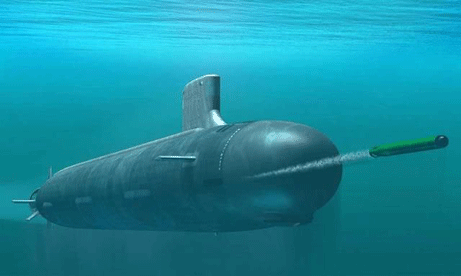 forces organized ‘a hunt’ of a nuclear Russian submarine in the Barents , Military, By Boyko Nikolov On Sep 13, 2020 MOSCOW, (BM) – NATO ships made an attempt to “take the pincers” of the Russian submarine in the waters of the Barents Sea, according to the Nation-news resource on September 12, learned BulgarianMilitary.com.
It is noted that the Russian submarine, which was “hunted” by NATO forces, is equipped with nuclear warheads and means of delivering them with Poseidon torpedoes. The American submarine, in turn, has Harpoon torpedoes and Tomahawk cruise missiles in its arsenal.
A similar incident is also reported in May 2020 in waters belonging to the Northern Sea Route. And also about the flight of a group of NATO bombers over the waters of the East Siberian Sea.
Such actions are assessed by the National Center for Defense Management of the Russian Federation as provocative.
US and British Navy maneuvers into Barents Sea are a signal to Moscow
For the first time since the mid-80s, under the supervision of the Russian fleet, four American and one British ship entered the Barents Sea, which indicates a growing intensity of the confrontation between the great powers in the Arctic, writes The Washington Times.
According to the newspaper, the purpose of this operation was to send a signal to Moscow, as well as to check the readiness of the Navy for action in any weather conditions.
Meanwhile, Norwegian officials refused to participate in this British-American operation – which speaks of its “provocative essence.”
According to officials of the US Navy, these exercises are necessary in order for the US armed forces to be ready to operate in various climatic conditions, including in the Arctic. However, the Trump administration does not particularly hide its intentions to repulse other states – mainly Russia, but also assertive China – that are trying to establish control over strategically important Arctic territories.
As expected, Moscow was not happy about the joint British-American operation. Russian media reported that the Northern Fleet is actively monitoring American and British ships in the Barents Sea.
So far, there have been no reports of close contact between Russian and American ships – as well as news of high-profile statements by senior Russian officials. However, as The Washington Times notes, recalling that it carefully monitors what is happening, Moscow sent a clear signal that it considers this Arctic territory to be its own.
According to American officials, on May 1, they notified Russia of an impending operation in order to avoid an “unintentional exacerbation.”According to officials of the US Navy, these exercises are necessary in order for the US armed forces to be ready to operate in various climatic conditions, including in the Arctic. However, the Trump administration does not particularly hide its intentions to repulse other states – mainly Russia, but also assertive China – that are trying to establish control over strategically important Arctic territories.
As expected, Moscow was not happy about the joint British-American operation. Russian media reported that the Northern Fleet is actively monitoring American and British ships in the Barents Sea.
So far, there have been no reports of close contact between Russian and American ships – as well as news of high-profile statements by senior Russian officials. However, as The Washington Times notes, recalling that it carefully monitors what is happening, Moscow sent a clear signal that it considers this Arctic territory to be its own.
According to American officials, on May 1, they notified Russia of an impending operation in order to avoid an “unintentional exacerbation.”………….. https://bulgarianmilitary.com/2020/09/13/nato-forces-organized-a-hunt-of-a-nuclear-russian-submarine-in-the-barents-sea/
UN nuclear ban treaty needs 6 more ratifications
The treaty prohibits the development, possession and use of nuclear weapons and was adopted with the support of 122 countries and territories three years ago.
Ireland and three other countries ratified the treaty last month, bringing the total number of ratifications to 44. The latest ratifications coincided with the 75th anniversaries of the atomic bombings of Hiroshima and Nagasaki.
The International Campaign to Abolish Nuclear Weapons, or ICAN, plans to calls on more countries to ratify the treaty in events at the UN headquarters to mark the International Day for the Total Elimination of Nuclear Weapons on October 2 and United Nations Day on October 24.
The treaty will come into effect 90 days after the number of ratifications reaches 50.
Nuclear powers, as well as Japan and other countries protected by the US nuclear umbrella, have not signed it.
Effective nuclear arms control engagement with China – the View from Beijing
Carnegie–Tsinghua Center for Global Policy 11 Sept 20, Effective nuclear arms control engagement with China will likely require confidence-building measures by the United States and greater support from the international community.
The United States will have to keep its public voice down while offering China concrete proposals to address the two countries’ asymmetric capabilities. If they’re to be taken seriously, these proposals should show a willingness by the United States to limit its own capabilities, particularly in areas of U.S. superiority such as air- and sea-launched missile systems and space-based capabilities.
Given China’s deep skepticism and outsider status in the arms control arena, engagement will require transparency and time to build confidence. One valuable starting point could be a reset of fundamental terms: China may be more eager to discuss “strategic ability” than “arms control.” Identifying cooperative measures for nuclear risk reduction would be a useful topic for initial discussions.
Professor Paul Rogers – a witness explaining how Julian Assange is to be extradited for POLITICAL REASONS
 Julian Assange clearly political, says extradition trial witness, https://www.theaustralian.com.au/world/julian-assange-clearly-political-says-extradition-trial-witness/news-story/735ef7d40551d52f4f7f12d9d6c318d7 JACQUELIN MAGNAY, FOREIGN CORRESPONDENT@jacquelinmagnay, THE TIMES, SEPTEMBER 10, 2020
Julian Assange’s nomination for the Senate during the 2013 federal election campaign and the establishment of the WikiLeaks political party the year before “clearly shows’’ the WikiLeaks founder has a political view and a libertarian standpoint, a witness has told the Old Bailey.
Professor Paul Rogers, the emeritus professor of peace studies at Bradford University, was called as a witness by Assange’s team to persuade the judge that Assange is being targeted for political means, and thus an extradition to the US should not be permitted under the Anglo-US extradition treaty.
In day three of the court hearing where Assange, 49, is objecting to extradition to the US, Professor Rogers said in written testimony that Assange’s expressed views, opinions and activities demonstrate very clearly “political opinions”. He cited how Assange had formed the political party to contest the Australian general election and “central of this is his view to put far greater attention to human rights’’.
He added: “The clash of those opinions with those of successive US administrations, but in particular the present administration which has moved to prosecute him for publications made almost a decade ago, suggest that he is regarded primarily as a political opponent who must experience the full wrath of government, even with suggestions of punishment by death made by senior officials including the current President.’’
But US prosecutor James Lewis QC said: “Assistant US Attorney Gordon D. Kromberg explicitly refutes that this is a political prosecution but rather an evidence-based prosecution.’’
In documents to the court, the prosecution says the investigation into Assange had been ongoing before the Trump administration came into office.
“Assange’s arguments are contradicted by judicial findings, made in the US District Court of the District of Columbia, that the investigation into the unauthorised disclosure of classified information on the WikiLeaks website remained ongoing when the present administration came into office,” the prosecution says.
Mr Lewis added: “If this was a political prosecution, wouldn’t you expect him to be prosecuted for publishing the collateral murder video?’’https://www.theaustralian.com.au/world/julian-assange-clearly-political-says-extradition-trial-witness/news-story/735ef7d40551d52f4f7f12d9d6c318d7
He said Assange was being extradited to face charges relating to complicity in illegal acts to obtain or receive voluminous databases of classified information, his agreement and attempt to obtain classified information through computer hacking; and publishing certain classified documents that contained the unredacted names of innocent people who risked their safety and freedom to provide information to the United States and its allies, including local Afghans and Iraqis, journalists, religious leaders, human rights advocates, and political dissidents from repressive regimes.
Professor Rogers told the court the motivation of Assange and WikiLeaks was to achieve greater transparency and was political. The trial continues.
The United States and its allies must learn how to live safely with a nuclear North Korea
On North Korea, Carnegie Endowment for International Peace,Toby Dalton, Co-director and Senior Fellow Nuclear Policy Program, 9 Sep 20,
The United States and its allies must learn how to live safely with a nuclear North
Three practical goals should inform a new U.S. policy toward North Korea:
- Prevent crises that could lead to war
- Cap North Korea’s arsenal of nuclear and long-range missiles and prevent their export
- Buffer the alliances with Japan and South Korea against likely North Korean provocations
Additional objectives—for instance, preventing illicit trafficking and improving human rights—are important but ultimately secondary. Though desirable, regime change is too risky and uncertain to pursue, as recent experiences in Iraq and Libya suggest.
Accomplishing these three goals will require new negotiations just to establish rules of the road. North Korean demands are bound to be distasteful, but the costs of a negotiated agreement would be far less than those incurred through war or through increased military deployments in East Asia and the construction of a more extensive missile defense shield.
The costs of a negotiated agreement would be far less than those incurred through war.
Reaching a deal will involve helping North Korea overcome its suspicious, hard-nosed attitude. But an even greater challenge will be changing how Washington thinks about detecting and addressing the Kim regime’s possible cheating on a deal……… https://carnegieendowment.org/2020/09/09/on-north-korea-pub-82524
India and China both have a nuclear no-first-use policy- nuclear war between them is less likely
India–China border dispute: the curious incident of a nuclear dog that didn’t bark, Bulletin of the Atomic Scientists, By Ramesh Thakur, Manpreet Sethi, September 7, 2020 On June 15, nuclear-armed China and India fought with fists, rocks, and clubs along the world’s longest un-demarcated and contested boundary. Twenty Indian soldiers were killed; Indian estimates put the Chinese dead at around 40. The two countries remain in a state of military standoff.
Like the case of the dog that didn’t bark, which interested the great fictional detective Sherlock Holmes, the nuclear dimension of the recent border clashes was conspicuous by its invisibility. This may be in part because of the nuclear no-first-use policy expressed in the official nuclear doctrines of both countries. At a time when geopolitical tensions are high in several potential nuclear theaters, the nuclear arms control architecture is crumbling, and a new nuclear arms race is revving, there is a critical need to look for ideas that can prevent potential crises from escalating. Other nuclear powers can learn from China’s and India’s nuclear policies.
The normalization of nuclear threats. Over the last few years, leaders of many of the nuclear weapons states have taken to nuclear bluster. After the outbreak of the Ukraine crisis and annexation of Crimea in 2014, facing hostile Western criticism, Russian President Vladimir Putin pointedly remarked, “Russia is one of the most powerful nuclear nations”—a subtle but clear nuclear warning to the West. In July 2016, asked in Parliament if she would be prepared to authorize a nuclear strike that could kill 100,000 people, British Prime Minister Theresa May unwaveringly answered, “Yes.” And who can forget the tit-for-tat exchange of belligerent rhetoric by US President Donald Trump and North Korean leader Kim Jong-un in 2017 before the blossoming of their bromance in 2018?
In February 2019, after an attack on Indian paramilitary forces at Pulwama led to a clash between the air forces of India and Pakistan, Pakistan’s Prime Minister Imran Khan warned of the possibility of a nuclear war. Indian Prime Minister Narendra Modi, caught in the heat of an election campaign, responded that India’s nukes were not reserved for celebrating the fireworks festival of Diwali. After India revoked Kashmir’s autonomous status that August, Khan reiterated that nuclear war was a real risk. His foreign minister repeated the warning in Geneva later that same year.
This rhetoric, besides being dangerous, has given rise to another problem. The more the leaders of the nuclear armed states revalidate the role of nuclear weapons in their national security, the more they embolden calls of nuclear weapons acquisition in other countries like Germany, Japan, South Korea and Australia.
China and India’s nuclear reticence. This is where China and India, in the midst of a military crisis, provide a striking contrast. Neither side has drawn attention to its nuclear weapons in the 2020 border clashes. Nor have many analysts across the globe expressed alarm that the prolonged state of disquiet between the two could spiral out of control into a nuclear exchange……….
China, India, and no first use. An important dimension, however, that has been underestimated in explaining the two countries’ apparent nuclear sobriety is the similarity in their approach to nuclear weapons and deterrence.
They are the only two of the nine nuclear armed states with the stated commitment to a no-first-use policy, and the force postures to match. …….
In 2014, China and India called for negotiations on a no-first-use convention among the world’s nuclear powers. It might be time for the United States and other countries to give it a serious look. Indeed, the China–India border standoff demonstrates the practical utility of a nuclear policy centered on no-first-use and merits wider international attention. https://thebulletin.org/2020/09/india-china-border-dispute-the-curious-incident-of-a-nuclear-dog-that-didnt-bark/
IAEA Providing Support for Saudi Arabia as It Plans to Adopt Nuclear Energy
|
IAEA Providing Support for Saudi Arabia as It Plans to Adopt Nuclear Energy: Saudi TV, By Reuters, Sept. 7, 2020, https://www.nytimes.com/reuters/2020/09/07/world/middleeast/07reuters-saudi-arabia-nuclearpower-iaea.html?auth=login-facebookDUBAI — The International Atomic Energy Agency (IAEA) director general Rafael Grossi was quoted on Monday as saying that Saudi Arabia was preparing to adopt nuclear energy and the agency was providing support, Saudi state TV Al-Ekhbariya reported. “Saudi Arabia is interested in nuclear energy and we are working on providing it with the necessary support,” Al-Ekhbariya quoted Grossi as saying. The kingdom has said it wants to tap nuclear technology for peaceful purposes and use nuclear power to diversify its energy mix. (Reporting by Dahlia Nehme; Editing by Rania El Gamal and Susan Fenton) |
|
The hazards of nuclear reactors in the Gulf region, and Saudi Arabia’s ambiguous energy program
 Why US wants Saudis to follow UAE’s path to nuclear energy, Christian Science Monitor , 4 Sept 20, Why US wants Saudis to follow UAE’s path to nuclear energy, Christian Science Monitor , 4 Sept 20, ” …… the Saudi energy program is shrouded in ambiguity, even confusion. Saudi rulers have shuffled the program between various government and royal agencies as it has stumbled to get off the ground, with few technical advancements.Concerned observers and veteran diplomats point to statements made by the crown prince during his visit to the U.S. in March 2018 that left no room for similar ambiguity over Saudi intentions should Iran pursue a nuclear weapon. “Without a doubt, if Iran ever developed a nuclear bomb, we would follow suit as soon as possible,” Crown Prince Mohammed told CBS in an interview. “Given Mohammed bin Salman’s statements and [Saudi Arabia’s] refusal to sign protocols on uranium enrichment, we cannot rule out the program being used for military reasons,” says Antonino Occhiuto, analyst at the U.S.-based Gulf States Analytics……… Regional hazardsThe mere presence of nuclear reactors in a Gulf region wracked with tensions, divisions, and asymmetrical warfare could be a security threat. The UAE will be shipping enriched uranium fuel and radioactive waste through the waters of the Persian Gulf and the Strait of Hormuz, narrow shipping lanes between Gulf states and Iran that have recently witnessed acts of sabotage and are a flashpoint of U.S.-Iran tensions. And just last year, a series of crude drones struck at the heart of Saudi Arabia’s ARAMCO oil processing facilities, causing immense damage and bringing Saudi oil production offline. Missiles from neighboring Yemen fall onto Saudi territory on a regular basis, even striking the capital, Riyadh. Iran-backed proxies across Yemen and even Iraq have entrenched ballistic missiles pointed at Gulf cities and sites as a defensive line should Tehran feel threatened……. https://www.csmonitor.com/World/Middle-East/2020/0903/Why-US-wants-Saudis-to-follow-UAE-s-path-to-nuclear-energy?cmpid=shared-email&cmpid=shared-twitter |
|
South Korea adviser calls for ‘six-party security summit’ to discuss North Korea nuclear issue
Moon’s adviser calls for ‘six-party security summit’ to discuss N.K. nuclear issue, Korea Herald, By Yonhap, 4 Sept 20, SEOUL (Yonhap) —A special security adviser to President Moon Jae-in on Friday suggested reviving the six-party talks on North Korea’s nuclear program in the form of a six-way summit, saying the issue is not a matter only between Washington and Pyongyang.
Moon Chung-in, special adviser for diplomatic and security affairs, made the remark during a security forum hosted by the Korea Institute for National Unification, stressing the importance of a “top-down approach” in efforts to resolve the issue.
“We need to revise the six-party talks that we failed in the past and we need to hold a ‘six-party security summit’ so that the leaders can discuss the issue of security and come up with an agreement on common security,” he said.
Iran Nuclear Deal Parties ‘United in Resolve’ to Preserve Agreement
 Iran Nuclear Deal Parties ‘United in Resolve’ to Preserve Agreement https://www.voanews.com/middle-east/voa-news-iran/iran-nuclear-deal-parties-united-resolve-preserve-agreement, By VOA News, September 02, 2020 A European Union official leading talks among Iran and a group of five world powers Tuesday said the participants are committed to keeping alive the 2015 nuclear deal that restricted Iran’s nuclear program in exchange for sanctions relief. Iran Nuclear Deal Parties ‘United in Resolve’ to Preserve Agreement https://www.voanews.com/middle-east/voa-news-iran/iran-nuclear-deal-parties-united-resolve-preserve-agreement, By VOA News, September 02, 2020 A European Union official leading talks among Iran and a group of five world powers Tuesday said the participants are committed to keeping alive the 2015 nuclear deal that restricted Iran’s nuclear program in exchange for sanctions relief.
Helga Schmid tweeted after the meeting in Vienna that “participants are united in resolve to preserve the #IranDeal and find a way to ensure full implementation of the agreement despite current challenges.” “All participants reaffirmed the importance of preserving the agreement recalling that it is a key element of the global nuclear non-proliferation architecture, as endorsed by United Nations Security Council Resolution 2231,” Schmid said in a later statement. The deal came under stress last year when Iran announced would take steps to walk away from its commitments, complaining it was not getting the promised economic relief after the United States imposed fresh sanctions. Those sanctions came after the Trump administration withdrew from the agreement in 2018, arguing it did too little to prevent Iran from developing nuclear weapons while giving the country too much in sanctions relief. Iran has denied it worked to build nuclear arms, and says it is able and prepared to reverse the actions it has taken to back away from the deal. Tehran has surpassed limits on the amount of enriched uranium it can hold at one time as well as the level to which it is allowed to enrich the material and has installed more advanced centrifuges. Representatives from Britain, China, France, Russia and Germany all took part in Tuesday’s talks, the latest in their efforts to salvage the agreement. Speaking with reporters after the meeting, Chinese representative Fu Cong called on Iran to return to full compliance with its requirements, but also said “the economic benefit that is due to Iran needs to be provided.” The U.N. Security Council resolution that enshrined the nuclear agreement includes mechanisms for participants to address non-compliance, and last month the United States sought to reinstate U.N. sanctions based on Iran’s violations of its requirements. The other signatories have rejected the U.S. move, something they reaffirmed at Tuesday’s talks. Schmid’s statement said that because the United States announced it was halting its participation in the nuclear deal and had not participated in any related activities since that time in May 2018, all of the remaining signatories agree it “therefore could not be considered as a participant state,” and thus “cannot initiate the process of reinstating U.N. sanctions.” The United States has argued that because it was an original member of the agreement, it retains the right to seek the snapback sanctions. The representatives at Tuesday’s talks also welcomed Iran’s decision last week to allow the U.N. atomic energy agency to inspect two sites where Iran is suspected of having stored or used undeclared nuclear material in the early 2000s. |
North Korea’s nuclear activity still a ‘serious concern’: UN watchdog
Nuclear activities in North Korea remain a cause for “serious concern,” and the rogue totalitarian state continues to enrich uranium, which could be used in an atomic weapon, the UN’s watchdog said in a recent report.
The activities by the country are in “clear violation of relevant UN Security Council resolutions,” the International Atomic Energy Agency wrote in the report that was released Tuesday.
The report also notes that what was once the heart of the country’s nuclear program, the Yongbyon site, has likely been shut down since 2018 — and that no plutonium has been produced there in the past year.
Nuclear activities in North Korea remain a cause for “serious concern,” and the rogue totalitarian state continues to enrich uranium, which could be used in an atomic weapon, the UN’s watchdog said in a recent report.
The activities by the country are in “clear violation of relevant UN Security Council resolutions,” the International Atomic Energy Agency wrote in the report that was released Tuesday.
The report also notes that what was once the heart of the country’s nuclear program, the Yongbyon site, has likely been shut down since 2018 — and that no plutonium has been produced there in the past year.
Still, the information it’s able to get about the program is “declining” because the agency’s been locked out of the hermit nation.
“Knowledge of the DPRK’s nuclear program is limited and, as further nuclear activities take place in the country, this knowledge is declining,” the report states.
If the arms treaty with Russia ends USA will spend even more than the planned $1.2 trillion on nuclear weapons
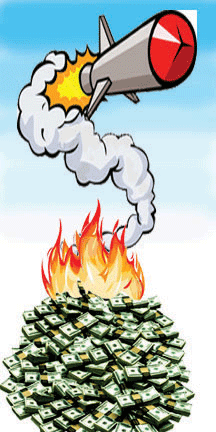 US nuclear weapons budget could skyrocket if Russia treaty ends, Defense US nuclear weapons budget could skyrocket if Russia treaty ends, Defense News, 27 Aug 20 News, 27 Aug 20
By: Joe Gould WASHINGTON ― The New START nuclear pact’s demise could cost the Department of Defense as much as $439 billion for modernization, plus $28 billion in annual maintenance costs, the Congressional Budget Office said in a report published Tuesday.
That price estimate, as the United States and Russia remain at odds over the treaty, reflects a threefold increase in weapons production costs. With Washington and Moscow’s responses to the expiration of New START unclear, CBO explored several possible paths, including other less expensive options. “If the New START treaty expired, the United States could choose to make no changes to its current plans for nuclear forces, in which case it would incur no additional costs,” the CBO study found. “If the United States chose to increase its forces in response to the expiration of the treaty, modest expansions could be relatively inexpensive and could be done quickly. Larger expansions could be quite costly, however, and could take several decades to accomplish.” The New START treaty limits each country to no more than 1,550 deployed nuclear warheads and 700 deployed missiles and bombers. Signed in 2010 by then-U.S. President Barack Obama and then-Russian President Dmitry Medvedev, the pact would expire Feb. 5, but includes an option to extend it for another five years without needing the approval of either country’s legislature. The analysis comes amid predictions of flattening defense budgets and as the United States and Russia concluded two days of arms control talks in Vienna last week with some signs of a possible willingness to extend the existing New START deal. A key sticking point is the U.S. demand to include China in any new treaty, even as China has repeatedly refused…….. Russia has offered an extension without any conditions. U.S. negotiator Marshall Billingslea indicated the U.S. was willing to talk about an extension but only if there were a politically binding framework for making changes to New START, which he called “deeply flawed.” House Armed Services Committee Chairman Adam Smith, D-Wash., and Senate Foreign Relations Committee ranking member Sen. Bob Menendez, D-N.J., said a failure to renew would drive the U.S. toward a dangerous and unaffordable arms race, as Russia would use a U.S. exit to “quickly expand its arsenal.” “Extending the New START Treaty for a full five years is clearly the right financial and national security choice,” they said in a joint statement. “America cannot afford a costly and dangerous nuclear arms race, particularly in the middle of our current financial, political, and health crises. We again call on the Trump Administration to extend the New START Treaty today.” Arms control advocates have likewise warned against the U.S. allowing the treaty to lapse with no limits on their nuclear arsenals, after both Moscow and Washington withdrew from the 1987 Intermediate-range Nuclear Forces Treaty last year. “Ever-increasing spending on nuclear weapons without an arms control framework that bounds U.S. and Russian nuclear forces is a recipe for budget chaos, undermining strategic stability, and damaging the health of the global nonproliferation regime,” said the Arms Control Association’s director for disarmament and threat reduction policy, Kingston Reif. “Such an approach also flies in the face of longstanding bipartisan Congressional support for the pursuit of modernization and arms control in tandem.” An expansion in nuclear weapons spending would likely place pressure on other parts of the national defense budget. CBO previously concluded the U.S. will spend $1.2 trillion over the next three decades on nuclear-weapons. Meanwhile, the Pentagon is not budgeting for New START’s expiration, according to a recent GAO report. U.S. lawmakers of both parties are pressuring the White House to extend the pact. ………. https://www.defensenews.com/congress/2020/08/25/cbo-us-nuclear-weapons-budget-could-skyrocket-if-russia-treaty-ends/ |
|
1 This Month
26 September – International Day for the Total Elimination of Nuclear Weapons





PLEASE OPPOSE HR 8255 AND S.3639 – bills would accelerate satellite deployment, with no environmental review or safeguards – https://ncstd5li.quorum.us/campaign/169331/
To see nuclear-related stories in greater depth and intensity – go to https://nuclearinformation.wordpress.com
-
Archives
- September 2026 (281)
- August 2026 (330)
- July 2026 (355)
- June 2026 (287)
- May 2026 (306)
- April 2026 (356)
- March 2026 (251)
- February 2026 (267)
- January 2026 (308)
- December 2025 (358)
- November 2025 (359)
- October 2025 (375)
-
Categories
- 1
- 1 NUCLEAR ISSUES
- business and costs
- climate change
- culture and arts
- ENERGY
- environment
- health
- history
- indigenous issues
- Legal
- marketing of nuclear
- media
- opposition to nuclear
- PERSONAL STORIES
- politics
- politics international
- Religion and ethics
- safety
- secrets,lies and civil liberties
- spinbuster
- technology
- Uranium
- wastes
- weapons and war
- Women
- 2 WORLD
- ACTION
- AFRICA
- Atrocities
- AUSTRALIA
- Christina's notes
- Christina's themes
- culture and arts
- Events
- Fuk 2022
- Fuk 2023
- Fukushima 2017
- Fukushima 2018
- fukushima 2019
- Fukushima 2020
- Fukushima 2021
- general
- global warming
- Humour (God we need it)
- Nuclear
- RARE EARTHS
- Reference
- resources – print
- Resources -audiovicual
- Weekly Newsletter
- World
- World Nuclear
- YouTube
-
RSS
Entries RSS
Comments RSS

