Polynesian MP calls on France for “vast project” to withdraw radioactive waste in Mururoa
|
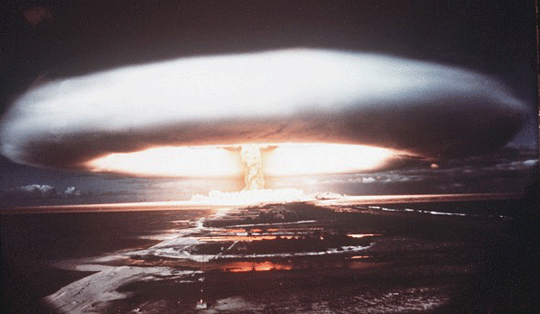
Polynesia: MP Moetai Brotherson asks Macron for a “vast project” to withdraw radioactive waste in Mururoa, 8 Feb 2020 https://la1ere.francetvinfo.fr/polynesie-depute-moetai-brotherson-demande-macron-vaste-projet-retrait-dechets-radioactifs-mururoa-798235.html [machine translate] The deputy of Polynesia Moetai Brotherson asked in a letter to Emmanuel Macron, who will be in April in the Polynesian archipelago, that he undertakes on “a vast project of withdrawal and reprocessing of all radioactive waste and residues from the Moruroa nuclear tests “.
From 1966 to 1996, the Mururoa and Fangataufa atolls were the scene of 193 nuclear tests , which had effects on the health and the environment of the populations. The head of state is expected to visit Polynesia in mid-April, when two summits are being held, “France-Oceania” and “One Planet Summit”.
” Mr. President, rather than ostrich, the French Republic would be honored to commit today to an ambitious and vast project to withdraw and reprocess all radioactive waste and residues from the tests Moruroa nuclear “, explains the deputy attached to the communist group in the Assembly and representative of Tavini Huiraatira, Polynesian separatist party, in a letter which AFP had a copy on Friday. Threats of collapse
He recalls that nuclear tests, ” especially in their underground part, generated a quantity of radioactive waste and residues “. ” Today, a significant proportion of this waste is stored in wells several hundreds of meters deep drilled in the coral ring of Moruroa, or worse, at the bottom of its lagoon, in particular at a place called ‘Colette bench ‘ “.
But ” cracks in the base of the atoll “, “induced by underground tests in particular “, threaten ” collapse part of the atoll. It appears that both the containment wells, as the Colette bank are precisely in the endangered area “,
“Dramatic message”For the Polynesian deputy, not to commit to the depollution of the site ” would be to send a dramatic message to the Polynesians, to the Peoples of the Pacific, but also to the People of France, in particular to his youth who wants to see (…) real strong actions in favor of the environment “. Moetai Brotherson underlines that ” the biggest investment made by the State in French Polynesia in recent years is the TELSITE geomechanical surveillance project of Moruroa. The billions invested still come to underline the reality of this collapse, real sword of Damocles, for the Polynesians first, for the Pacific region then, for the reputation of the French Republic finally
|
|
French President Emmanuel Macron seeks leading role in post-Brexit EU nuclear strategy
|
Macron seeks leading role in post-Brexit EU nuclear strategy, Defense News, By: Thomas Adamson, The Associated Press PARIS (AP) 8 Feb 20,— French President Emmanuel Macron on Friday advocated a more coordinated European Union defense strategy in which France, the bloc’s only post-Brexit nuclear power, and its arsenal would hold a central role.
Addressing military officers graduating in Paris, Macron set out his country’s nuclear strategy in a bid to show leadership one week after nuclear-armed Britain officially exited the EU. PARIS (AP) — French President Emmanuel Macron on Friday advocated a more coordinated European Union defense strategy in which France, the bloc’s only post-Brexit nuclear power, and its arsenal would hold a central role. Addressing military officers graduating in Paris, Macron set out his country’s nuclear strategy in a bid to show leadership one week after nuclear-armed Britain officially exited the EU……. https://www.defensenews.com/smr/nuclear-arsenal/2020/02/07/macron-seeks-leading-role-in-post-brexit-eu-nuclear-strategy/ |
|
|
U.S. Democrats call for five-year extension to nuclear arms treaty with Russia
 Dems call for five-year extension to nuclear arms treaty with Russia, . https://www.washingtontimes.com/news/2020/feb/5/dems-call-five-year-extension-nuclear-arms-treaty-/ By Lauren Meier – The Washington Times – Wednesday, February 5, 2020
The leading Democrats on the House and Senate Foreign Relations Committees are urging President Trump to strike a renewed nuclear arms treaty with Russia as the last such treaty between the two nuclear powers is set to expire in one year.
In a statement Wednesday, Rep. Eliot Engel of New York and Sen. Robert Menendez of New Jersey called on Mr. Trump to negotiate an extension with Russian President Vladimir Putin to continue the New Strategic Arms Reduction Treaty (New START) for an additional five years.
“This treaty has constrained Russia’s nuclear forces, provided strong and detailed verification measures to ensure Russia adheres to its commitments, and allowed the United States the flexibility to maintain a safe, secure, modern, and effective nuclear deterrent,” the members wrote.
They highlighted data exchanges and on-site inspections of nuclear facilities that are authorized under the Obama-era treaty that “provide unique insights into Russia’s nuclear forces and greatly assist our military in carrying out its deterrence mission.”
The U.S. and Moscow are the major signatories of the treaty, which limits the number of deployable American and Russian nuclear weapons to no more than 1,550.
The White House already pulled the U.S. out of the Intermediate-Range Nuclear Forces (INF) Treaty with Russia dealing with shorter-range “tactical” nuclear weapons, over what the U.S. says is Moscow’s continued noncompliance with the terms of the Cold War-era pact.
Mr. Putin has opened the door to immediately extending the treaty, which is set to expire in February 2021
Top EU diplomat to visit Tehran amid nuclear tensions
|
France 24, 2 Feb 2029, Top EU diplomat Josep Borrell was Monday due to visit Iran, said officials in Tehran and Brussels, on his first trip there since taking office, aiming to reduce rising tensions over the Islamic republic’s nuclear programme.
Borrel was set to meet President Hassan Rouhani, Foreign Minister Javad Zarif and parliamentary speaker Ali Larijani on the two-day trip, his office said in a statement. The 2015 nuclear deal between Tehran and a group of world powers has been crumbling since US President Donald Trump withdrew from it in 2018, and Washington has since stepped up sanctions and a campaign of “maximum pressure” against Iran. Borrell’s mission aims “to de-escalate tensions and seek opportunities for political solutions to the current crisis,” said the office of the EU’s high representative for foreign affairs and security policy. The visit will allow Borrell “to convey the EU’s strong commitment to preserve” the nuclear deal, known as the Joint Comprehensive Plan of Action, and to discuss cooperation between the EU and Iran, his office said……… https://www.france24.com/en/20200202-top-eu-diplomat-to-visit-tehran-amid-nuclear-tensions |
|
U.S. sanctions Iran’s atomic power chief for nuclear violations
|
U.S. sanctions Iran’s atomic power chief for nuclear violations
By Don Jacobson Jan. 31 (UPI) — The U.S. Treasury has imposed fiscal sanctions against Iran’s nuclear energy chief and ordered his U.S.-linked assets frozen, amid ongoing tensions between the Washington, D.C., and Tehran.The Treasury on Thursday sanctioned Ali Akbar Salehi, the head of the Atomic Energy Organization of Iran, saying the agency has played a significant role in Tehran violating nuclear regulations……. https://www.upi.com/Top_News/US/2020/01/31/US-sanctions-Irans-atomic-power-chief-for-nuclear-violations/3251580482287/
|
|
Donald Trump tweets that US will not lift sanctions to secure nuclear deal with Iran
 US will not lift sanctions to secure nuclear deal with Iran , https://www.sbs.com.au/news/us-will-not-lift-sanctions-to-secure-nuclear-deal-with-iran 26 Jan 2020, Donald Trump has tweeted that the US will not lift sanctions on Iran in order to negotiate a new nuclear deal.
The United States will not lift sanctions on Iran in order to negotiate, US President Donald Trump has tweeted, seemingly in response to a Der Spiegel interview with Iran’s foreign minister.
“Iranian Foreign Minister says Iran wants to negotiate with The United States, but wants sanctions removed. @FoxNews @OANN No Thanks!” Trump tweeted in English on Saturday and later in Farsi.
Iran’s Foreign Minister Mohammad Javad Zarif responded on Sunday by tweeting an excerpt from the interview with Der Spiegel published on Friday, where he said Iran is still open to negotiations with America if sanctions are lifted.
“@realdonaldtrump is better advised to base his foreign policy comments & decisions on facts, rather than @FoxNews headlines or his Farsi translators,” Zarif said in the tweet with the interview excerpt.
Tensions between Iran and the United States have reached the highest levels in decades after the US killed top Iranian General Qassem Soleimani in a drone strike in Baghdad on January 3, prompting Iran to fire missiles days later at bases in Iraq where US troops are stationed.
Tensions between the two have been increasing steadily since Trump pulled the United States out of Iran’s nuclear pact with world powers in 2018 and reimposed sanctions that have driven down Iran’s oil exports and hammered its economy.
Despite years of negotiations, we came once again to the brink of conflict with Iran.
Reporting on the Iran nuclear deal: ‘nothing happens until everything happens’Our world affairs editor reflects on how, despite years of negotiations, we came once again to the brink of conflict. Guardian, Julian Borger Sun 26 Jan 2020, Countries tend to go to war when diplomacy fails. But Washington and Tehran are now facing off because it succeeded. It was because the 2015 nuclear deal was Barack Obama’s proudest foreign policy achievement that Donald Trump was so determined to destroy it.
The US and Iran are sliding back towards the brink of conflict. If a missile had landed a little bit differently in the course of the latest exchange of hostilities, they would probably be at war by now.
As the pendulum has swung one way and then the other, the Guardian has tried to cover the diplomacy with the same depth and emphasis as the military manoeuvres, even when it seems slow-moving and complex.
When formal talks began between the Obama administration and the new government of Hassan Rouhani in September 2013, our foreign editor, Jamie Wilson, decided we should cover the whole process in detail because of the potentially historic nature of success, and the very high price of failure.
. When formal talks began between the Obama administration and the new government of Hassan Rouhani in September 2013, our foreign editor, Jamie Wilson, decided we should cover the whole process in detail because of the potentially historic nature of success, and the very high price of failure.
……… For Rezaian – now a Washington columnist – and many of those who saw the worst side of the Islamic Republic, its cruelties are all the more reason to prevent it developing nuclear weapons, and bind it into an international agreement. For others, particularly on the American right, any deal that eased the pressure on Iran’s economy would make the west complicit in Iran’s oppression at home and aggression abroad.
In the end, all those years of diplomacy and all the delicate compromises of the JCPOA, by which the Iranians accepted nuclear limits for sanctions relief, came to naught. Tehran’s nuclear programme is expanding again, and the US and Iran are back on the brink of conflict.
It is a chilling thought that no one in the US chain of command has the authority to stop Trump if he were to pick up the verification codes on the small plastic card (for some reason called the nuclear “biscuit”) that a US president always has close by, and order up Armageddon.
With that other extinction-level threat, the climate emergency, there is so much happening that it is impossible to keep up. But the nuclear threat is different: nothing happens until everything happens. By the time there is something substantial to report on, it could be far too late.https://www.theguardian.com/membership/2020/jan/25/iran-nuclear-deal-us-reporting
North Korea abandoning talks with “hostile” USA
|
North Korea walks away from nuclear talks with United States, blaming ‘brutal and inhumane’ sanctions,ABC News, 22 Jan 2020, North Korea has walked away from nuclear talks with the United States, saying a 2019 year-end deadline for the talks had been ignored so it no longer felt bound by commitments, which included a halt to its nuclear testing and the firing of inter-continental ballistic missiles.
Key points:
North Korean leader Kim Jong-un had earlier set a December 31 deadline for denuclearisation talks with the US and White House national security adviser Robert O’Brien said at the time the US had opened channels of communication. Mr O’Brien said he hoped Kim would follow through on denuclearisation commitments he made at summits with US President Donald Trump. However, that now would appear to be off the table with North Korea announcing at the United Nations-backed Conference on Disarmament that it was no longer interested in talks. “We found no reason to be unilaterally bound any longer by the commitment that the other party fails to honour,” Ju Yong Chol said while in Geneva. Speaking as the envoy from the People’s Democratic Republic of Korea (DPRK), he accused the US of applying “the most brutal and inhuman sanctions”.
“If the United States tries to enforce unilateral demands and persists in imposing sanctions, North Korea may be compelled to seek a new path.”……https://www.abc.net.au/news/2020-01-22/north-korea-ends-nuclear-talks-with-us/11887832 |
|
Nuclear’s swansong?
 Is This The Death Knell For Nuclear? https://finance.yahoo.com/news/death-knell-nuclear-200000585.html By Haley Zaremba – Jan 18, 2020 It’s nearly impossible to discuss climate change and the future of the energy industry without discussing nuclear energy. Nuclear energy produces zero carbon emissions, [ ed. not so!] it’s ultra-efficient, it’s already in widespread use, and could be scaled up to meet much more of our global energy needs with relative ease, but it is, and will likely always be, an extremely divisive solution.nuclear energy certainly has its fair share of drawbacks. It may not emit greenhouse gases, but what it does produce is deadly nuclear waste that remains radioactive for up to millions of years and we still don’t really know what to do with it other than hold onto it in ever-growing storage spaces. And then there are the horror stories that keep civilians and politicians alike wary if not outright antagonistic toward the technology. Chernobyl, Fukushima, and Three Mile Island loom large in our collective doomsday consciousness, and not without good reason.
We’re still dealing with the aftermath of these nuclear disasters. Japan is in many ways still reeling from 2011’s Fukushima nuclear disaster and recently even threatened to throw radioactive water into the Pacific Ocean or letting it evaporate into the air because they are running out of storage space for the wastewater they have been using to keep the damaged Fukushima reactors from overheating again. So yeah, nuclear isn’t perfect.
As paraphrased by environmental news site EcoWatch, the energy experts at Chatham House “agreed that despite continued enthusiasm from the industry, and from some politicians, the number of nuclear power stations under construction worldwide would not be enough to replace those closing down.” The consensus was that this is nuclear’s swan song, and we are now unequivocally entering the era of wind and solar power.
These conclusions were arrived at during a summit convened to discuss the findings of the World Nuclear Industry Status Report 2019, which concluded that “money spent on building and running nuclear power stations was diverting cash away from much better ways of tackling climate change.”
This echoes the sentiment of many other climate and energy experts, who have long been sounding the alarm bells that renewable energy is not being built up or invested in with nearly enough urgency. Last year the International Energy Agency announced that renewables growth has slumped, and that our current renewable growth rate of 18o GW of added renewable capacity per year is “only around 60 percent of the net additions needed each year to meet long-term climate goals”.
The International Renewable Energy Agency (Irena) did the math, calculating exactly how much renewable energy will need to be installed by 2030 if the world has any hope of meeting the goals set by the Paris climate agreement, and they found that “7.7TW of operational renewable capacity will be needed by 2030 if the world is to limit global warming to ‘well below’ 2C above pre-industrial levels, in line with the Paris Climate Agreement,” according to reporting by Wind Power Monthly. “However, at present, countries’ nationally determined contributions (NDCs) amount to 3.2TW of renewable installations by 2030, up from 2.3TW currently deployed.”
The World Nuclear Industry Status Report succinctly sums up the situation while sounding the death knell for nuclear: “Stabilising the climate is urgent, nuclear power is slow. It meets no technical or operational need that these low-carbon competitors cannot meet better, cheaper, and faster.”
Tehran warns it may cease cooperation with IAEA
Iran Says It Might Reconsider Cooperation With Nuclear Watchdog, https://www.haaretz.com/middle-east-news/iran/iran-says-it-might-reconsider-cooperation-with-nuclear-watchdog-1.8412402 19 Jan 2020
Tehran’s warning comes in response to EU powers triggering a dispute mechanism under the 2015 nuclear deal, Iran will review its cooperation with the United Nations’ nuclear watchdog should it face “unjust” measures, Iranian parliament speaker Ali Larijani said, after EU powers last week triggered a dispute mechanism under Tehran’s 2015 nuclear deal.
“We state openly that if the European powers, for any reason, adopt an unfair approach in using the dispute mechanism, we will seriously reconsider our cooperation with the International Atomic Energy Agency,” state TV quoted Larijani as saying.
France, Britain and Germany triggered the mechanism in the deal after Tehran continued to distance itself from the pact by decreasing its nuclear commitments in reaction to sanctions reimposed by Washington since the U.S. quit the agreement in 2018.
Tehran announced last week that it would abandon limitations under the deal on enriching uranium, though it said that Iran would continue cooperating with the UN nuclear watchdog (IAEA), which is policing the nuclear pact.
Under the deal between Iran and six major powers, Tehran agreed to curb its nuclear programme in exchange for lifting international sanctions against the Islamic Republic.
The three European nations said they still wanted the 2015 nuclear deal to succeed and were not joining a “maximum pressure” campaign by the United States.
Triggering the mechanism amounts to formally accusing Iran of violating the terms of the deal and could lead eventually to reimposing UN sanctions that were lifted under the pact.
The mechanism involves a Joint Commission, whose members are Iran, Russia, China, Germany, France, Britain and the European Union, seeking to resolve the dispute.
V4 group and Austria disagree on nuclear power
“We want to live in a diverse Europe,” that is yet unified when it comes to the main goals, said Kurz after meeting Commission President Ursula von der Leyen in Brussels on Tuesday (12 January).
Kurz emphasised that the V4 as a group are the second most important partner for Austria after Germany, but admitted that his country, a net contributor to the bloc’s budget, has a different point of view from the Visegrád partners when it comes to the distribution of European funds.
In the context of talks on the future EU budget for 2021-2027, Poland, Hungary, the Czech Republic and Slovakia are members of the so-called ‘Friends of cohesion’ group, while Austria and other rich countries are members of the so-called group of “frugal” countries.
“It is very important for Austria not to support nuclear energy but the funds should be allocated on development of renewable energy sources,” said Kurz.
discuss migration, border security, competitiveness, enlargement and climate. The newly appointed Austrian chancellor Sebastian Kurz, also in attendance, said he wanted to “fight” the “gaps” between Western and Eastern Europe.
“We want to live in a diverse Europe,” that is yet unified when it comes to the main goals, said Kurz after meeting Commission President Ursula von der Leyen in Brussels on Tuesday (12 January).
Kurz emphasised that the V4 as a group are the second most important partner for Austria after Germany, but admitted that his country, a net contributor to the bloc’s budget, has a different point of view from the Visegrád partners when it comes to the distribution of European funds.
In the context of talks on the future EU budget for 2021-2027, Poland, Hungary, the Czech Republic and Slovakia are members of the so-called ‘Friends of cohesion’ group, while Austria and other rich countries are members of the so-called group of “frugal” countries.
“It is very important for Austria not to support nuclear energy but the funds should be allocated on development of renewable energy sources,” said Kurz.
Hungarians and Slovaks are currently building new reactors to enlarge their existing power plants, a sore spot for the Austrian government that has previously pledged to fight the construction of new nuclear facilities in neighbouring countries “with all available political and legal means.” …… https://www.euractiv.com/section/politics/news/austria-and-v4-agree-on-everything-but-nuclear/
Despite USA, the European Union is determined to preserve the Iran nuclear deal
 EU willing to maintain Iran nuclear deal, risking rift with the US, By Alexandra Brzozowski | EURACTIV.com 11 Jan 2020, With the prospects of a potential US-Iran war fading, EU foreign minister during an emergency session on Friday (10 January), said they are willing to maintain the Iran nuclear deal as long as Tehran fulfils its commitments in order to achieve it.
In an attempt to avoid an escalation between Iran and the US, EU leaders in the recent week have intensified diplomatic activities, trying to salvage the EU-brokered nuclear deal while making sure the US-led anti-IS coalition continues to operate in Iraq after Iraq’s parliament called for the withdrawal of all foreign troops from the country.
“The region cannot afford another war, we call for an urgent de-escalation and maximum restraint,” EU’s chief diplomat Josep Borrell told reporters following the meeting in Brussels on Friday, that had reaffirmed European commitments preserving the Joint Comprehensive Plan Of Action (JCPOA).
“We have been saying in the past and we continue to say that we regret the US decision to withdraw from the deal,” Borrell said, “And we continue believing that this deal is a key element of the global nuclear non-proliferation architecture and critical for the regional stability.”
He also warned that negotiating a new pact would be a “very complex, highly technical process” that would take a long time………
Since the Trump administration decided to exit the deal in 2018, all three European parties to the pact – Britain, France and Germany – have repeatedly stressed their commitment to saving it, even after a call by Trump this week urging them to join him in walking away.
One of the contentious points between Europe and Washington has been the Instrument in Support of Trade Exchanges (INSTEX), which was born as the brainchild of France, Germany and the UK in January 2019, and recently joined by further European countries.
It was created as a special purpose vehicle to help EU companies do business with Iran and facilitate non-USD transactions to avoid breaking US sanctions against the country.
European efforts, however, to ensure that Iran can keep trading in spite of the sanctions have had little impact.
The Trump administration on Friday (10 January) imposed new sanctions on Iran, with the latest round set to target multiple sectors of the Islamic Republic’s economy, including construction, manufacturing, textiles and mining…….
Angela Merkel urges all parties to back Iran nuclear deal
 German Chancellor urges all parties to back Iran nuclear deal, MOSCOW (Reuters) – German chancellor Angela Merkel on Saturday repeated a call for all parties to respect the Iranian nuclear accord, despite Iran’s decision to intensify its enrichment of uranium and moves by the United States to impose economic sanctions.
“For this reason we will continue to employ all diplomatic means to keep this agreement alive, which is certainly not perfect but it is an agreement and it comprises commitments by all sides,” Merkel said.

Donald Trump’s latest unwise move -setting up a massive nuclear crisis with Iran
 Trump is setting up a massive nuclear crisis with Iran, The Week,
First, the fog of war created by the president’s decision to assassinate Soleimani led to tragedy, as Iran seems to have accidentally shot down a planeload of innocent civilians. While most of the blame goes to whichever incompetent Iranian operator pulled the trigger, the reality is that all 176 of those people, including 63 Canadians, would be alive today if the U.S. had not carried out its hit on Soleimani. For another, we should remember that a month passed between the assassination of Archduke Ferdinand and the outbreak of WWI.
More importantly, just because both the Trump administration and senior Iranian leadership seem to share an aversion to full-scale war and pulled back from the brink this time doesn’t mean that the Soleimani killing was costless for the U.S.
The day after the Iranian response, the seldom-seen Teleprompter Trump showed up to deliver a short, sober speech. “As long as I’m president of the United States, Iran will never be allowed to have a nuclear weapon,” President Trump said on Wednesday. He said this before saying “good morning” to the assembled crowd. The specter of an Iranian nuke is still, ostensibly, the overriding goal of American policy vis-à-vis Iran. Yet everything that Trump has done since the day he took office has made an Iranian nuclear breakout more likely.
https://theweek.com/articles/888687/trump-setting-massive-nuclear-crisis-iran
North Korea said it was ‘deceived’ by the US in 18 months of nuclear talks
- North Korea said it has been “deceived” by the United States in the last 18 months of broken down denuclearization talks.
- In a statement published Saturday, a top adviser wrote that despite the positive, personal relationship between President Donald Trump and North Korean leader Kim Jong Un, it was moving on from the “wasted time” spent in negotiations.
- Once-historic nuclear negotiations between the countries have broken down in the last year and a half as North Korea has increasingly rejected Washington’s hand in Pyongyang policy………. https://www.businessinsider.com.au/north-korea-says-deceived-by-the-united-states-2020-1?r=US&IR=T
1 This Month
26 April – Chernobyl: Inside the Meltdown airs on National Geographic on Sunday 26th April from 4pm
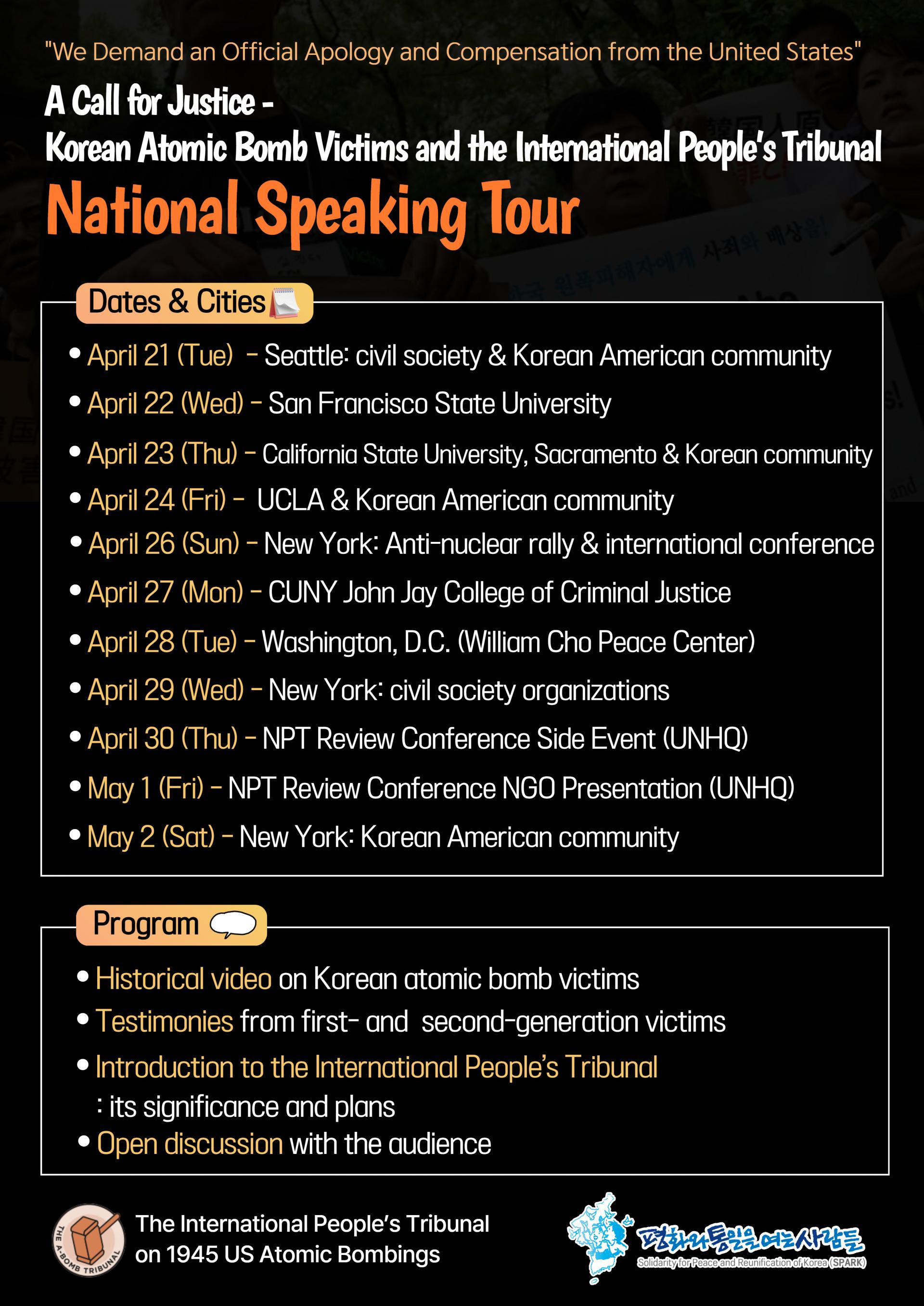
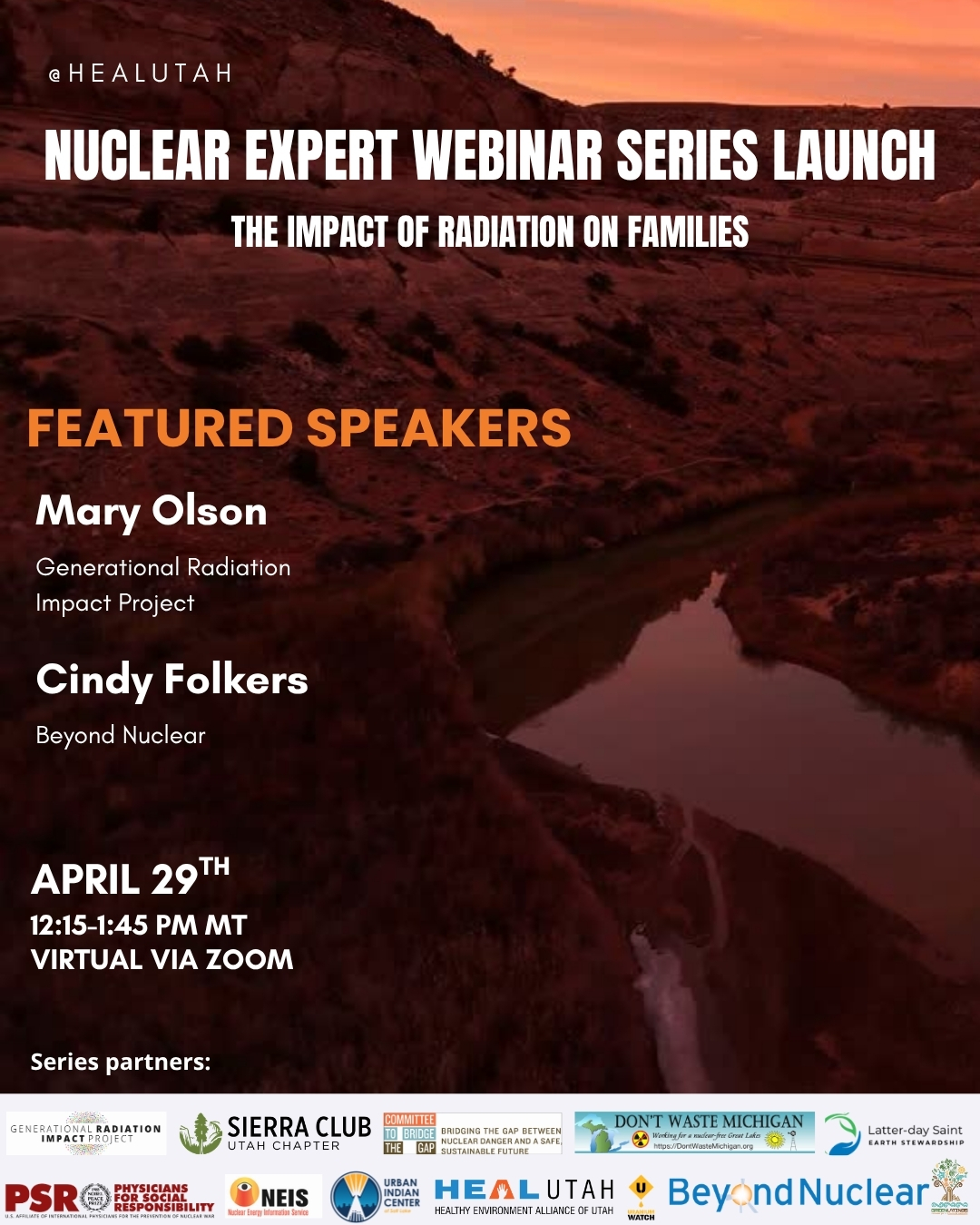
29 April – Nuclear Expert Webinar #1 – Radiation Impacts on Families with Mary Olson and Cindy Folkers
- 12:15 PM MT – 1:45 PM MT
- Location: Virtual – REGISTER TODAY

4 May -West Suburban Peace Coalition to discuss Iran war at May Educational Forum
Monday, May 4, 7:00 – 8:00 PM Central Standard Time
Title: : How Trump’s Narrative Tries to Shape the Reality of the War on Iran.
Contact Walt Zlotow, zlotow@hotmail.com 630 442 3045 for further information
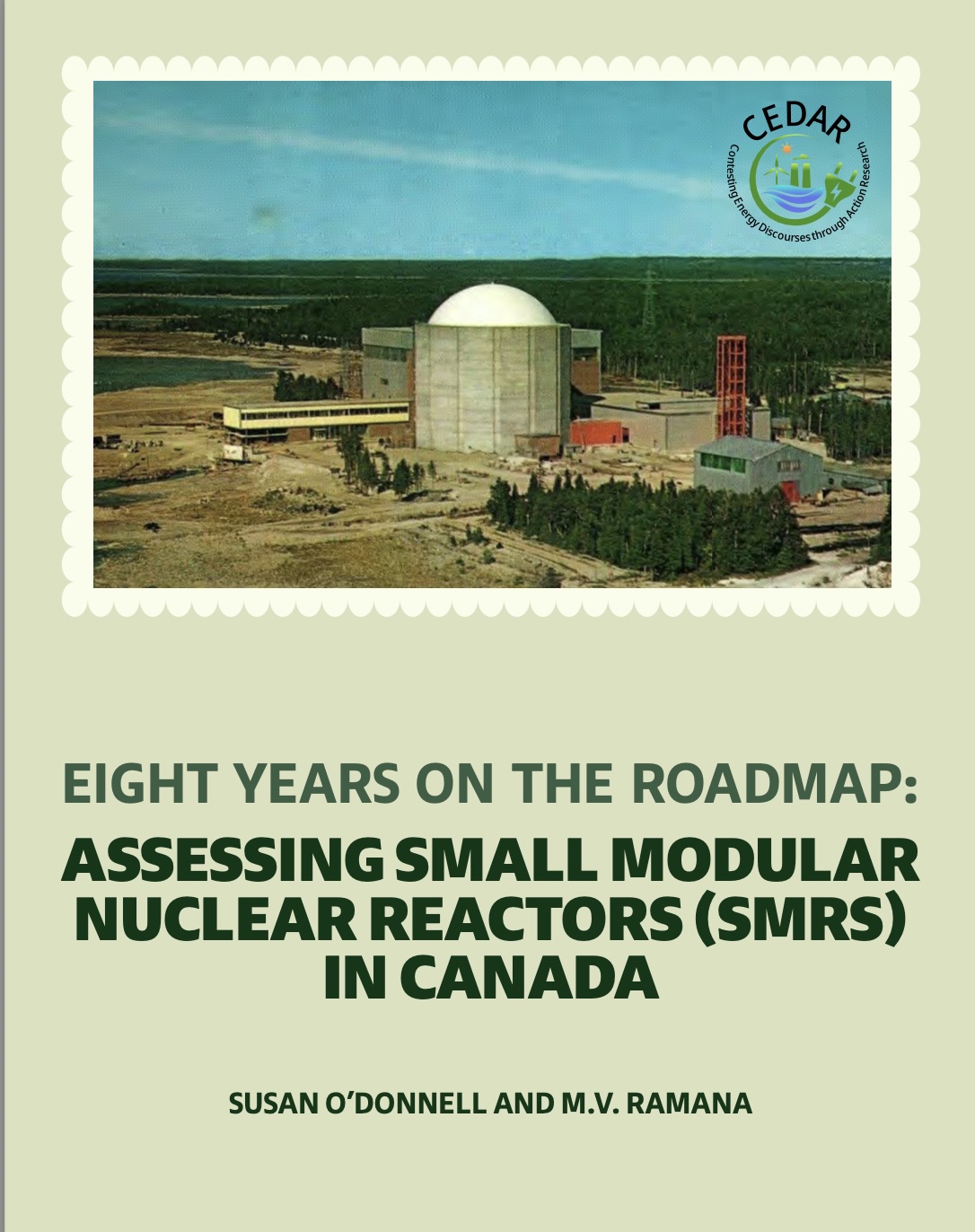
14 May – online event From Bombs to Data Centres: the Face of Nuclear Colonialism

Pine Ridge Uranium is the real threat, not Tehran- Tell Burgum: Stop the Extraction.
Chernobyl: The Lost Tapes – A good documentary on Chernobyl on SBS available On Demand for the next 3 weeks– https://www.sbs.com.au/ondemand/tv-program/chernobyl-the-lost-tapes/2352741955560
To see nuclear-related stories in greater depth and intensity – go to https://nuclearinformation.wordpress.com
-
Archives
- April 2026 (327)
- March 2026 (251)
- February 2026 (268)
- January 2026 (308)
- December 2025 (358)
- November 2025 (359)
- October 2025 (376)
- September 2025 (257)
- August 2025 (319)
- July 2025 (230)
- June 2025 (348)
- May 2025 (261)
-
Categories
- 1
- 1 NUCLEAR ISSUES
- business and costs
- climate change
- culture and arts
- ENERGY
- environment
- health
- history
- indigenous issues
- Legal
- marketing of nuclear
- media
- opposition to nuclear
- PERSONAL STORIES
- politics
- politics international
- Religion and ethics
- safety
- secrets,lies and civil liberties
- spinbuster
- technology
- Uranium
- wastes
- weapons and war
- Women
- 2 WORLD
- ACTION
- AFRICA
- Atrocities
- AUSTRALIA
- Christina's notes
- Christina's themes
- culture and arts
- Events
- Fuk 2022
- Fuk 2023
- Fukushima 2017
- Fukushima 2018
- fukushima 2019
- Fukushima 2020
- Fukushima 2021
- general
- global warming
- Humour (God we need it)
- Nuclear
- RARE EARTHS
- Reference
- resources – print
- Resources -audiovicual
- Weekly Newsletter
- World
- World Nuclear
- YouTube
-
RSS
Entries RSS
Comments RSS
 nuclear-news