Bipartisan House group asks Biden to stop Canada’s Great Lakes nuclear storage plans
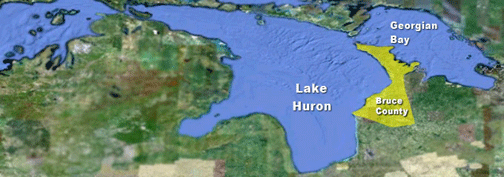
Bipartisan House group asks Biden to stop Canada’s Great Lakes nuclear storage plans, The Hill, BY SHARON UDASIN – 09/17/21 01:20 PM EDTRep. Dan Kildee (D-Mich.) is calling on the Biden administration to stop the Canadian government from storing nuclear waste in the Great Lakes Basin.
The Nuclear Waste Management Organization (NWMO), a nonprofit established by the Canadian government, recently unveiled plans to construct a site that “would permanently store more than 50,000 tons of high-level nuclear waste” in the town of South Bruce, Ontario, Kildee’s office said.
South Bruce, located within the Great Lakes Basin, is about 30 miles east of Lake Huron.
Kildee in a release from his office described high-level nuclear waste as “the most dangerous form of nuclear waste,” and said that if an accident involving such waste occurred in the Great Lakes region, it could take a catastrophic toll on public health in surrounding U.S. and Canadian communities.
“The Great Lakes are central to our way of life, and permanently storing nuclear waste so close to our shared waterways puts our economies and millions of jobs at risk in the fishing, boating and tourism industries,” Kildee said. “People in both the U.S. and Canada depend on the Great Lakes for drinking water, which could be contaminated if there ever was a nuclear waste incident.”
Kildee is offering a bipartisan resolution asking President Biden to work with the Canadian government to stop the plans for the storage. The resolution is co-sponsored by 11 Democrats and nine Republicans from states surrounding the Great Lakes.
“From recreational activities to economic opportunities, the Great Lakes are integral to our daily lives, and a spill of hazardous materials would be devastating to communities across the state,” one of the co-sponsors, Rep. Peter Meijer (R-Mich.), said in a statement. “We must continue to urge our Canadian allies to find an alternative storage site for nuclear waste.”
Tribal Chief Tim Davis, of the Michigan-based Saginaw Chippewa Indian Tribe, added his concerns, noting his community’s ongoing work “to eliminate the continuing threat of nuclear waste being deposited into Mother Earth so close to the largest fresh water repository on Earth.”………. https://thehill.com/policy/equilibrium-sustainability/572764-bipartisan-house-group-asks-biden-to-stop-canadas-great
For Australia Buying nuclear-powered submarines now doesn’t make sense strategically, and it doesn’t make sense operationally.

White says Australia is now tied more closely to the US strategy against China, which is aimed at stopping Beijing from challenging American primacy. Australia’s eventual acquisition of eight nuclear-powered submarines is not going to make any difference to Xi Jinping’s calculations.
And if deterrence fails, and we end up going to war, will eight Australian submarines make any difference to the outcome? I don’t think it will,” White says.
Nuclear family: Setting a new course in submarine policy
The acquisition of nuclear-powered submarines promises to transform the Australian navy, but there are some uncomfortable realities Australia must also confront. AFR Andrew Tillett correspondent ’17 Sep 21, ‘……………. n Thursday, the Prime Minister unveiling plans to build nuclear-powered submarines in Adelaide with the help of the United States and United Kingdom.
Morrison, who places a high premium on secrecy, had explored the proposal with a tight-knit circle of aides and officials for 18 months. So classified was their work that officials in Defence’s Capability, Acquisition and Sustainment Group, including those overseeing the $90 billion French submarine project, found out the dat before. Morrison effectively destroyed one of the shibboleths of Australian public policy – that nuclear technology falls in the “too hard” basket.
…………….. “This is a big policy shift in Washington, DC,” says Hugh White, Australian National University emeritus professor of strategic studies.
Buying nuclear-powered submarines now doesn’t make sense strategically, and it doesn’t make sense operationally.
The acquisition of nuclear-powered submarines promises to transform the navy – just a handful of countries operate them – but there are some uncomfortable realities Australia must also confront.
…….. A Defence-led taskforce will spend up to 18 months assessing whether the British or American submarine is the best option, along with workforce, shipyard and training needs. The government maintains construction can still start in the latter part of this decade, but the new submarine will be delivered a couple of years later than the French one would have been.
But this is predicated on the project going well. If Australia wants to tinker with the design, that will add time. There are also capacity constraints in the US and UK. Their shipyards are busy and the construction of Australian reactors will need to be squeezed into production schedules.
And despite assurances that reactors will be sealed and Australia effectively just has to “plug” them in, it goes without saying this is technology that has never been used here before. So even a 2040 delivery date may be optimistic.
China challenge
By then, it may be too late. “The challenge we face from China is not a challenge that is going to emerge in the 2050s. It’s happening now. The timeframe is wrong,” White says. “[Buying nuclear-powered submarines now] doesn’t make sense strategically, and it doesn’t make sense operationally.”
White says Australia is now tied more closely to the US strategy against China, which is aimed at stopping Beijing from challenging American primacy. Australia’s eventual acquisition of eight nuclear-powered submarines is not going to make any difference to Xi Jinping’s calculations.
And if deterrence fails, and we end up going to war, will eight Australian submarines make any difference to the outcome? I don’t think it will,” White says.
…… White says he is not against eventually acquiring nuclear-powered submarines but the question Morrison should be asking is what boats best suit Australian objectives, not American.
White says the navy’s priority should be using submarines closer to Australian shores to protect shipping lanes. He says for the cost of 12 French submarines, or eight nuclear-powered ones, Australia could buy 24 Collins class size conventionally powered subs.
“The reason we have been driven towards a big boat is we have decided our most important role is helping the US to hunt Chinese submarines in the South China Sea and East China Sea,” he says. “You would sink more enemy ships with 24 boats than you would with eight nuclear-powered ones.”…………… https://www.afr.com/policy/foreign-affairs/nuclear-family-setting-a-new-course-in-submarine-policy-20210916-p58s9t
The Australian submarine agreement: Turning nuclear cooperation upside down
The Australian submarine agreement: Turning nuclear cooperation upside down, Bulletin By Ian J. Stewart | September 17, 2021 The UK and US have announced they will support Australia in development of a nuclear submarine fleet and will provide (conventionally armed) Tomahawk cruise missiles. This is one of those exceedingly rare and exceedingly significant announcements that come along only every decade or so. The announcement literally turns existing precedence and practice on their heads in order to extend traditionally northern hemisphere cooperation to Australia and bolster its role in countering an increasingly assertive China. While much is not yet known, some of the ramifications and implications of this development are discernable.
Before considering the announcement’s specific implications, it is worth reiterating how exceedingly rare and significant it is. Many in the nonproliferation and strategic studies field will draw a parallel between this announcement and the 2005 announcement that the United States would renew civil nuclear cooperation with India. The so-called AUKUS declaration, like the other, was made with the grand purpose of securing an additional strategic ally against the rising China. However, neatly associated with both is also an expectation that domestic industries will benefit from access to a new market.
…. In this announcement, the United States and UK are overturning decades of accepted practice to support the transfer of a strategic capability to another country. The decision is sure to irk China and accelerate the spiral towards a Cold War-style standoff, with renewed strategies of containment against the revisionist power. The initiative has also offended France, which had become closer to the UK and, to a lesser extent, the US on nuclear matters in the last decade or so.
……. The Australian breakup with France is clearly not a happy one, with the French Embassy tweeting its contempt for how the announcement was made. On Friday, France announced it was recalling its ambassadors to the United States and Australia, calling the US-Australia agreement “unacceptable behavior between allies and partners.”
A second implication is for the nonproliferation regime itself. Much like the announcement of the US-India deal, AUKUS is already dividing the international security community. Many nonproliferation practitioners call foul, on the basis that, on the face of it, the announcement appears to cut across several norms, agreed rules, and accepted practices. The cooperation may be used by non-nuclear weapons states as more ammunition in support of a narrative that the weapons states lack good faith in their commitments to disarmament……..
A third implication involves precedence. There has been constraint in terms of naval nuclear reactor exports for many decades. However, several countries have been working to acquire naval nuclear reactors. Brazil is perhaps the first country that comes to mind. It will be argued by many that AUKUS reaffirms Brazil’s legitimacy in pursuing nuclear-powered submarines.
………. the British government is almost certainly thinking about it as a means to bolster Rolls Royce. The United States by law and by practice is particularly protective of its reactor technology. As such, the prospect of an independently designed UK reactor being sold to Australia could check a number of boxes.
The agreement may have an additional casualty in UK/French nuclear cooperation. …….. https://thebulletin.org/2021/09/the-australian-submarine-agreement-turning-nuclear-cooperation-upside-down/
Australian Greens blast nuclear submarine deal
Floating Chernobyls: : Greens blast sub deal https://www.perthnow.com.au/politics/floating-chernobyls-greens-blast-sub-deal-c-3978289, Matt CoughlanAAP, September 16, 2021
The Greens have warned Australia acquiring nuclear-powered submarines will create “floating Chernobyls” in the heart of major cities.
The UK and US will give Australia access to top secret nuclear propulsion technology for a fleet of new submarines to be built in Adelaide through new security pact AUKUS.

Greens leader Adam Bandt believes the move increases the prospect of nuclear war in the region and puts Australia in the firing line.
“It’s a dangerous decision that will make Australia less safe by putting floating Chernobyls in the heart of our major cities,” he told the ABC on Thursday.
It’s a terrible decision. It’s one of the worst security decisions in decades.”
Mr Bandt said the Greens would fight the decision and urged Labor to do the same.
“The prime minister needs to explain what will happen if there’s an accident with a nuclear reactor now in the heart of one of our major cities?” he said.
“How many people in Brisbane, Adelaide or Perth, will die as a result of it? What is going to happen if there is a problem with one of the nuclear reactors?”
It is understood the submarines will not require a civilian nuclear capability but rather will have reactors and fuel which will last the life of the vessel.
Independent senator and former submariner Rex Patrick wants an urgent parliamentary inquiry to report before the next federal election.
Senator Patrick, who has been a vocal critic of the $90 billion French submarine deal that is now over, said scrutiny was crucial.
We have to be careful we don’t move from one massive procurement disaster into something else that hasn’t been thought through properly,” he said.
The government has sunk $2.4 billion on the French program and is negotiating on other compensation, which remains commercial in confidence.
Labor leader Anthony Albanese and three senior frontbenchers received a briefing ahead of the announcement on Thursday morning.
3 old white politicians do a deal for the nuclear lobby – selling U.S. nuclear submarines to Australia

Why Biden Is Taking The Rare Step Of Sharing Nuclear Submarine Tech With Australia, https://www.npr.org/2021/09/15/1037338887/why-biden-is-taking-the-rare-step-of-sharing-nuclear-submarine-tech-with-austral AYESHA RASCOE, 15 Sept 21,
In a rare step, President Biden is announcing Wednesday that the United States plans to share its nuclear-powered submarine technology with Australia.
The announcement comes as Biden tries to refocus U.S. national security and economic policy on the threat posed by China.
There has been only one other time that the United States has shared what a senior administration official described as “extremely sensitive” technology — more than 60 years ago, back in 1958, with Great Britain. The United Kingdom will be involved with the new trilateral security partnership, known as AUKUS.
The decision comes amid escalated tension in recent years over territorial disputes in the South China Sea — a major shipping lane with oil and natural gas resources — with China building military outposts on several small reclaimed islands. The U.S. and other regional partners have stepped up their military presence in the region, and the U.S. is in the process of reorienting its military posture toward the Indo-Pacific.
Ahead of the formal announcement from the White House, a senior U.S. administration official insisted to reporters that the new security cooperation with Australia was not directed specifically at China.
“I think one of the thingsthat the United States has done most effectively in the Indo-Pacific is to secure peace and stability and to be the ultimate guarantor of that rules-based order,” the senior official said. “Over the last several years there have been questions: Does the United States still have the stomach? Do we have the wit and wisdom that we want to continue to play that role? What President Biden is saying with this initiative is, ‘Count us in.’ “
It’s about nuclear propulsion, not nuclear weaponsThe three AUKUS countries will launch an 18-month effort to determine how best to share the nuclear submarine propulsion technology, which will allow the Australian navy’s submarines to travel faster and farther, with more stealth.
“Australia has no intention of pursuing nuclear weapons,” the official told reporters. The Biden administration is working to move past the 20-year war in Afghanistan and the chaotic U.S. exit from Kabul. Biden has put countering China at the center of his economic and national security efforts, describing it as the biggest challenge of this era.
Australia’s prime minister will visit next week
Biden is set to meet in person at the White House next week with the leaders of India, Japan and Australia — what’s known as the “Quad.”
He invited leaders of Japan and South Korea as the first two foreign leaders to visit the White House in person earlier this year. And his first foreign trip in June to the Group of Seven and NATO was also focused on the economic and security threats posed by China.
For only the second time since taking office, Biden spoke last week to Chinese President Xi Jinping. He did not discuss the new security partnership “in any specific terms,” the senior U.S. official said, but emphasized to Xi that the United States planned to play a strong role in the region.
Iran appoints harsh critic of the nuclear deal to the Foreign Ministry
Crucial changes at Iran’s foreign ministry ahead of nuclear talks
Iran has appointed a staunch critic of the nuclear deal to a position that will have a significant impact on its future. Aljazeera, By Maziar Motamedi, 15 Sep 21,
Tehran, Iran – Shortly before talks resume in Vienna around restoring Iran’s 2015 nuclear deal, its foreign ministry has made some changes that may well prove critical.
Hardline diplomat Ali Bagheri Kani has been appointed as the new deputy for political affairs, replacing veteran diplomat Abbas Araghchi, who led six rounds of nuclear talks in Vienna up to late July – when talks stopped to allow Iran’s new President Ebrahim Raisi to form his administration.
Araghchi, a career diplomat and senior member of the team that negotiated the 2015 Joint Comprehensive Plan of Action (JCPOA) during the tenure of President Hassan Rouhani, is now an adviser to Foreign Minister Hossein Amirabdollahian, which may mean he has not been fully sidelined
If the nuclear file stays with the foreign ministry – as opposed to the Supreme National Security Council (SNSC) – Bagheri Kani, for years a staunch opponent of the nuclear deal, could become the new chief nuclear negotiator.
But even if he does not lead the negotiations, he is expected to play a significant role in pushing for a stricter stance on the lifting of unilateral sanctions imposed by the United States after it left the deal in 2018.
Bagheri Kani’s appointment was reportedly pushed for by Saeed Jalili, another opponent of the JCPOA and an ultraconservative senior member of the SNSC who ran for president in the June elections………….
The path ahead
The appointments come as Iran and the US, China, Russia, and European powers are expected to return to the Austrian capital at a critical stage for the JCPOA.
Iran’s foreign ministry spokesman on Monday said the Vienna talks would happen “in the near future”.
Another crisis looming over the resumption of the talks was avoided on Sunday when Iran and the global nuclear watchdog reached an agreement struck in Tehran…………… https://www.aljazeera.com/news/2021/9/15/crucial-changes-at-irans-foreign-ministry-ahead-of-nuclear-talks
China still way behind USA in nuclear weaponry: time for diplomacy and negotiations on arms control
China’s nuclear build-up: The great distraction, The Hill, BY ROSE GOTTEMOELLER, — 09/13/21 President Biden is reviewing America’s nuclear posture. By January, we should know what he thinks about U.S. nuclear weapons, what policies should govern them and how many we need. Congress is watching closely, and the Senate and House of Representatives are sure to debate the results; they always do.
But this year will be different. A new player has entered the field — China.
China is modernizing its nuclear forces. The recent discovery of three intercontinental ballistic missile (ICBM) silo fields in remote regions west and north of Beijing point to a big build-up of weapons and a different strategy for their use. Since acquiring nuclear weapons from the Soviets, the Chinese have taken the stance that they would not build up a large and highly alert force but instead would be ready to retaliate. This “second strike deterrence posture” has served them well, but now the Chinese seem to have decided it is not enough.
Which is why it is urgent that the Biden administration (and the Kremlin) get them to the table to ask them. Chinese nuclear force posture and strategy should be an equal concern in Washington and Moscow.
We can ask the Chinese separately, or together, but ask them we should. All three countries might even agree to take some early steps, such as exchanging deployment plans and information about nuclear doctrine. Such confidence-building measures would build mutual predictability and may stave off a nuclear arms race.
Most importantly, we must not panic. Even if the Chinese deploy intercontinental ballistic missiles in each of their new silos, the U.S. will still have a large and capable nuclear force structure and many more nuclear warheads. Some authorities have predicted that the Chinese may be able to quadruple their warhead numbers in coming years. If one goes by the Stockholm Peace Research estimate of 350 Chinese warheads, then China would end up with 1,400 total warheads. That compares with over 4,000 warheads available for deployment in both the United States and Russia. We need to keep a sharp eye on what they are doing but not rush into making rash changes in our own nuclear forces. ………………..
Most importantly, we must not panic. Even if the Chinese deploy intercontinental ballistic missiles in each of their new silos, the U.S. will still have a large and capable nuclear force structure and many more nuclear warheads. Some authorities have predicted that the Chinese may be able to quadruple their warhead numbers in coming years. If one goes by the Stockholm Peace Research estimate of 350 Chinese warheads, then China would end up with 1,400 total warheads. That compares with over 4,000 warheads available for deployment in both the United States and Russia. We need to keep a sharp eye on what they are doing but not rush into making rash changes in our own nuclear forces. https://thehill.com/opinion/international/571973-chinas-nuclear-build-up-the-great-distraction
Expert response to the pro nuclear report by the Joint Research Centre

Any major expansion of nuclear energy would delay the decommissioning of fossil-fired power plants, as the latter would have to remain in operation during this period and therefore make it hard to achieve the climate change mitigation objective. It is even possible to argue that nuclear energy hinders the use of other alternatives with low CO2 emissions because of its high capital intensity. Otherwise this capital could be used to expand alternative energy sources like sun, wind and water
While nuclear power generation in the electricity generation phase has been associated with relatively low greenhouse gas emissions from a historical perspective, the lions’ share of greenhouse gas emissions in the nuclear fuel cycle is caused by the front-end and back-end processing stages. Based on estimates, the CO2 emissions can be broken down into the construction of nuclear power plants (18%), uranium mining and enrichment (38%), operations (17%), processing and storing nuclear fuel (15%) and decommissioning activities at the power plant (18%) (BMK, 2020, p.6)
Generating huge quantities of dangerous waste is being continued for decades without any effective disposal solution being available. The JRC itself says that the primary and best waste management strategy is not to generate any radioactive waste in the first place. However, this assessment is not consistently applied within the report.
The draft of the delegated legal act is based on the recommendations of the so-called Technical Expert Group (TEG). …..The TEG did not recommend that nuclear energy should be included in the EU taxonomy register at that time and recommended an in-depth study of the DNSH criteria (TEG, 2020b).
It is clear that the JRC barely touched on some environment-related aspects of using nuclear energy or did not consider them in its assessment at all.
.… Questions must also be raised about the ageing process and the brittleness of materials and therefore the long-term behaviour of nuclear power plants beyond the original design period.
This very positive presentation of future prospects for nuclear energy, which is shown in the JRC Report, must be viewed critically………..this presentation by the JRC is suspect from a professional point of view and possibly indicates a lack of adequate independence .
Expert response to the report by the Joint Research Centre entitled “Technical assessment of nuclear energy with respect to the ‛Do No Significant Harm’ criteria in Regulation (EU) 2020/852, the ‛Taxonomy Regulation’” Particularly considering the suitability of criteria for including nuclear energy in EU taxonomy The Federal Office for the Safety of Nuclear Waste Management (BASE) with support from the Federal Office for Radiation Protection (BfS) June 2021
Summary
The Federal Office for the Safety of Nuclear Waste Management (BASE) with support from the Federal Office for Radiation Protection (BfS), acting on behalf of the Federal Ministry for the Environment, Nature Conservation and Nuclear Safety (BMU), has examined the report by the Joint Research Centre (JRC) of the European Union (EU) entitled “Technical assessment of nuclear energy with respect to the ‘Do No Significant Harm’ criteria of Regulation (EU) 2020/852 (‘Taxonomy Regulation’)” to see whether the JRC has used expertise that is complete and comprehensible when determining whether the use of nuclear fission to generate energy can be included in the taxonomy register.
The Taxonomy Regulation defines criteria that determine whether an economic activity (and therefore investments in this activity) can be viewed as ecologically sustainable. The JRC, the EU’s research centre, concludes in its report dated March 2021 that the conditions for including nuclear energy in EU taxonomy are met in terms of the “Do No Significant Harm” criteria (DNSH). Prior to this, the Technical Expert Group (TEG) had not yet recommended the inclusion of nuclear energy in EU taxonomy and advised the EU Commission to review the DNSH criteria more closely.
This expert response finds that the JRC has drawn conclusions that are hard to deduce at numerous points. Subject areas that are very relevant to the environment have also only been presented very briefly or have been ignored. For example, the effects of severe accidents on the environment are not included when assessing whether to include nuclear energy in the taxonomy register – yet they have occurred several times over the last few decades. This raises the question of whether the JRC has selected too narrow a framework of observation. The aspects mentioned and others listed in this expert response suggest that this is true.
This expert response also points out that the JRC mentions topics, but then fails to consider them further or in more detail, although they must be included in any assessment of the sustainability of using nuclear energy. The need to consider them is partly based on the fact that certain effects on the other environmental objectives in the Taxonomy Regulation must be expected if the matter is viewed more closely or at least cannot be excluded. In other cases, this need results from the fact that the Taxonomy Regulation refers to the UN approach in its 2030 Agenda in its understanding of sustainability – and the latter, for example, contains the goals of “considering future generations” and “participative decision-making”. Any sustainability, particularly for future generations, can only be guaranteed if attempts are made at an early stage to achieve acceptance in the population, enable future generations to handle the use of nuclear energy and its legacy or waste appropriately and ensure that information and knowledge are maintained in the long term. Generally speaking, it should be noted that the problem of disposing of radioactive waste has already been postponed by previous generations to today’s and it will ‘remain’ a problem for many future generations. The principle of “no undue burdens for future generations” (pp. 250ff) has therefore already been (irrevocably) infringed, while the DNSH-hurdle “significant[ly] harm” has also been infringed.
Continue readingFuture generations, participative decision-making, proliferation, uranium mining – extract from Expert response to pro nuclear JRC Report

Consideration of participative decision-making in societies in the JRC Report The involvement of stakeholders is greatly oversimplified in the JRC Report and is described in very optimistic terms. For example, NGOs are not considered in the description of interest groups and their role in developing a programme for deep geological repository sites
The effects on indigenous peoples, on whose land most of the uranium mines are located, is not mentioned in the report,
Expert response to the report by the Joint Research Centre entitled “Technical assessment of nuclear energy with respect to the ‛Do No Significant Harm’ criteria in Regulation (EU) 2020/852, the ‛Taxonomy Regulation’” 2021
………………………………...6. Future and further criteria in the Taxonomy Regulation – other sustainability goals and minimum standards The JRC Report deals with other aspects that are important for sustainable development in conjunction with disposing of high-level radioactive waste, in addition to the ecological criteria. The JRC Report particularly highlights consideration for future generations (JRC Report, Part B 5.2.3.3, p. 258) and the importance of participative decision-making (JRC Report, Part B 5.2.3.1, p. 254) when searching for a repository site. The JRC Report formulates both aspects as important requirements when searching for a repository site. The two requirements of “considering future generations” and “participative decision-making“, however, are not considered in any further depth – e.g. mentioning the challenges associated with these requirements when searching for a repository site for radioactive waste. The report emphasises that there is still no repository for high-level radioactive waste in operation anywhere in the world (JRC Report, Part A 1.1.1, p. 17), but leaves open the question of whether there is any connection here with the challenges of “considering future generations” and “participative decision-making”. ..
Regardless of disposal, the problem of proliferation (cf. section 6.3), which is only mentioned in a very rudimentary manner in relation to reprocessing in the JRC Report, and uranium mining (cf. section 6.4) mean that it is necessary to treat the topics of intergenerational justice and participation separately in terms of the sustainability of using nuclear energy. Even in the case of severe nuclear power plant accidents, where large amounts of radioactive substances are discharged into the environment, generational justice is an important aspect of sustainability. The example of Chernobyl shows that coping with the consequences of an accident will also plague future generations – ranging from restrictions or non-usage possibilities in the affected areas and even the planned dismantling of the damaged reactor block and disposing of the retrieved nuclear fuel.
6.1 “Considering future generations” and “participative decision-making” in conjunction with disposal ……..
Considering future generations and participative decision-making in any society represent individual sustainability goals in the United Nations’ 2030 Agenda for Sustainable Development (UN, 2015) …….. These two sustainability goals are not adequately considered in the JRC Report with a view to nuclear disposal, but are important for assessing the fundamental issue of sustainability, which is also part of the Taxonomy Regulation
Consideration of sustainability aspects and future generations in the JRC Report Developing and introducing a geological disposal programme/disposal system takes decades and is associated with costs that are hard to calculate. Monitoring after the closure of the repository will also continue for at least another 100 years. For example, France expects the operational time for a repository alone to exceed 100 years. During this long period, following generations will have to deal with problems that have been caused by previous generations
The risk of long-term financial burdens that are hard to calculate (as the example of the Asse II mine illustrates) and the risks caused by geological disposal for several generations are not adequately treated in the JRC Report. ……… The report fails to provide any in-depth analysis of this aspect and provides a distorted picture, particularly with a view to the aspect of sustainability and intergenerational justice, by ignoring the negative consequences of using nuclear energy.
Consideration of participative decision-making in societies in the JRC Report The involvement of stakeholders is greatly oversimplified in the JRC Report and is described in very optimistic terms. For example, NGOs are not considered in the description of interest groups and their role in developing a programme for deep geological repository sites (JRC Report, Part B 5.2.3.1, p. 253-254). Part B 5.2.3.1, p. 254 of the JRC Report ignores the fact that it may not be possible to reach consensus among the stakeholders. This also oversimplifies the problem of searching for a site and presents it in a one-sided way
There is no discussion either that – where no social consensus on using nuclear energy exists – its use itself can represent a blockage factor for solving the repository issue – at least experience in Germany illustrates this. Abandoning nuclear power and therefore resolving a social field of conflict, which had continued for decades, was a central factor in ensuring that discussions were relaunched about a site election procedure and led to a broad consensus. …….
Conclusion
Overall, it is necessary to state that the consideration of sustainability in the JRC Report is incomplete and needs to be complemented in terms of the minimum objectives and other sustainability goals. The broad sustainability approach adopted by the United Nations is not picked up. EU taxonomy is based on this broad approach. It therefore makes sense to already analyse the use of nuclear energy and the disposal of radioactive waste specifically now – and in the context of other sustainability goals like considering future generations and participative involvement in societies.
6.2 Preservation of records, .Preservation of records, knowledge and memory (RK&M) regarding radioactive waste repositories is only mentioned once as a quotation from Article 17 of the Joint Convention (JRC Report, Part B 1.2, p. 206) and once rudimentarily in Part B 5.2.3.3, p. 259f. This does not do justice to its importance for future generations (cf. sections 2.1 and 6.1 of this expert response). …………. . Requirements like these are not taken into account in the JRC Report.
6.3 Proliferation The JRC Report only mentions the risk of proliferation – i.e. the spread or transfer of fissionable material, mass weapons of destruction, their design plans or launching systems – very briefly in conjunction with the civil use of nuclear power. This analysis is inadequate to do justice to proliferation in the light of the DNSH criteria related to the environmental objectives, as it represents a considerable risk for almost all sustainability goals.
The military and civil use of nuclear energy have been closely connected to each other historically. The technologies for their use are often dual-use items, i.e. they can in principle be used for both civil and military purposes. It is therefore necessary to create an extensive network of international controls as part of using nuclear energy and the supply and disposal of fuels associated with it in order to minimise the risk of military misuse by state or non-state players. This particularly applies to fissionable material like uranium-235 and plutonium-239, which are used when generating nuclear energy or produced in power reactors. In addition to this, significant risks are also created by other radioactive substances if they are stolen and used in an improper manner (“dirty bombs”).
Processes that are particularly important for proliferation are created when manufacturing nuclear fuel (uranium enrichment) and reprocessing spent nuclear fuel materials: the technologies for uranium enrichment can be used with modifications to produce highly enriched uranium to build a nuclear weapon. During reprocessing, plutonium is separated and it can be used for nuclear weapons. Even if the plutonium vector, which is produced in power reactors, does not have the ideal properties for military use from a physics point of view, it is still basically suitable for making weapons (Mark, 1993; US DoE, 1994).
Using nuclear energy to generate electricity is therefore associated with specific risks of proliferation. As nuclear weapons have unique destructive potential in many respects (Eisenbart, 2012), the issue of sustainability for this type of energy generation should not ignore this aspect. ……
6.4 Uranium mining – specific requirements for sustainable mining ……………….. There is no real discussion of the term “sustainable mining” in the JRC Report (cf. particularly JRC Report Part A 3.3.1.4, p. 76 at the bottom). The report does not examine the discussion about sustainable mining has any repercussions for investigating the environmental effects of uranium mining. However, it is important in terms of other sustainability goals or the minimum safeguards laid down in Article 18 of the Taxonomy Regulation (cf. BMK, 2020, p. 22 too)
All those involved in mining and processing uranium ore should be mentioned in conjunction with sustainability. The effects on indigenous peoples, on whose land most of the uranium mines are located, is not mentioned in the report, for example. The rights of these people for a just share in all the resources (ranging from clean water to reasonable healthcare and even the ownership of the raw material, uranium) are not considered, but should be to an extensive degree from sustainability points of view as regards taxonomy …………….. https://www.base.bund.de/SharedDocs/Downloads/BASE/EN/reports/2021-06-30_base-expert-response-jrc-report.pdf.pdf?__blob=publicationFile&v=6
The nuclear lobby gears up to take ”green” nuclear energy spin to the European Commission and on to COP26

As German election nears, EU plays for time on nuclear’s green recognition. Euractiv, 10 Sept 21, The inclusion of nuclear power in the EU’s green finance taxonomy is “the most likely” outcome in view of the scientific reports submitted to the European Commission in the past months, EU experts believe. But Brussels is not entirely decided yet and is seen playing for time before the German election this month.
Is nuclear electricity a green source of energy or does it pose a “significant harm” to the environment?This seemingly simple debate, which has divided EU politicians for the last two years, is about to reach its climax with a decision expected in the coming months……………
The Commission’s in-house scientific body, the Joint Research Centre, released a much-awaited report on nuclear power on 2 April. Its conclusions were clear: nuclear power is a safe, low-carbon energy source comparable to wind and hydropower, and as such, it qualifies for a green investment label under the EU’s green finance taxonomy.
These conclusions were subsequently backed by two other EU bodies, the Euratom Article 31 expert group and the Scientific Committee on Health, Environmental and Emerging Risks (SCHEER)…………
Diplomats and industry lobbyists consulted by EURACTIV concurred: the most likely outcome is that the European Commission will table a proposal in the coming months, possibly as late as November or December, after the formation of the new German government.
From what we understand, the [proposal] itself will likely come out around October–December this year,” said Jessica Johnson, communications director at Foratom, the trade association representing the nuclear industry in Brussels.
An EU diplomat, for his part, spoke of “September-November”.
German political hurdles
The recognition of nuclear power as a ‘green’ source of energy is not a foregone conclusion though, and the decision could still go either way because of continued opposition to nuclear in Germany and four other EU member states.
In July, Germany’s environment minister Svenja Schulze sent a letter to the Commission – also signed by her counterparts in Austria, Denmark, Luxembourg, and Spain – asking for nuclear to be kept out of the EU’s green finance taxonomy.
The topic is politically sensitive in Germany, which is about to complete its nuclear phase-out next year. Any move by the European Commission to label the energy source as ‘green’ is likely to pollute the political debate ahead of the election on 26 September………….
German political hurdles
The recognition of nuclear power as a ‘green’ source of energy is not a foregone conclusion though, and the decision could still go either way because of continued opposition to nuclear in Germany and four other EU member states.
In July, Germany’s environment minister Svenja Schulze sent a letter to the Commission – also signed by her counterparts in Austria, Denmark, Luxembourg, and Spain – asking for nuclear to be kept out of the EU’s green finance taxonomy.
The topic is politically sensitive in Germany, which is about to complete its nuclear phase-out next year. Any move by the European Commission to label the energy source as ‘green’ is likely to pollute the political debate ahead of the election on 26 September.
“Assuming that the Commission already knows it is going to propose including nuclear in the taxonomy, it would indeed be in its own interest to wait for the outcome of the German elections,” said Thomas Pellerin-Carlin, a researcher and director at the Jacques Delors Institute’s energy centre.
From the Commission’s point of view, the German election may not be the biggest source of worry, though.
In the pro-nuclear camp, positions are possibly even more entrenched, with France leading a coalition of seven pro-nuclear countries, which also includes Czechia, Hungary, Poland, Slovakia, and Slovenia.
France will fight for nuclear to be considered as a decarbonised energy source in Europe,” said the country’s economy minister Bruno Le Maire.
“I don’t want there to be any doubts about this. We will lead this fight with the greatest determination,” he said in April……..
French elections looming large
Seen from Brussels, the political context in France may actually appear more daunting than the German one.
With the presidential election coming up next April, a negative decision on nuclear risks triggering a political backlash in France, just as the country prepares to take the rotating EU Council Presidency in January.
“It would fuel French political attacks on ‘Brussels’” from a wide range of parties, Pellerin-Carlin said. In turn, this would undermine Emmanuel Macron’s re-election campaign because the French president has always positioned himself as a convinced pro-European.
“From a political point of view, the debate on nuclear power and the taxonomy risks raising questions about Macron’s European record and Europe’s place in France,” he said……………
the anti-nuclear camp has not given up just yet. And the most prominent critic is the German environment ministry, which appointed its own expert group to review the EU’s JRC study.
In their conclusions, published on 14 July, the German experts slammed the JRC report for ignoring entire subject areas like the possibility of a nuclear accident.
“For example, the effects of severe accidents on the environment are not included when assessing whether to include nuclear energy in the taxonomy register – yet they have occurred several times over the last few decades,” the report noted. “This raises the question of whether the JRC has selected too narrow a framework of observation,” it added.
The German experts also remarked that the JRC mentions topics like radioactive waste disposal, but then fails to consider them in more detail.
“The JRC itself says that the primary and best waste management strategy is not to generate any radioactive waste in the first place. However, this assessment is not consistently applied within the report,” the German experts wrote.
According to them, “the JRC Report is therefore incomplete and fails to comprehensively assess the sustainability of using nuclear energy.”
A pro-nuclear Commission
So what will the Commission now do?
According to Pellerin-Carlin, the various scientific reports have clearly paved the way for the Commission to label nuclear as ‘green’.
“The current dynamics lead me to think that the Commission will make a proposal in this direction,” he told EURACTIV. “According to expert reports that have been issued, there is not enough evidence that waste is a problem that causes ‘significant’ harm to the environment,” he said.
Besides, the European Commission itself is seen as broadly pro-nuclear. “Within the Commission, President Ursula von der Leyen is not known for taking anti-nuclear positions, unlike many German politicians,” Pellerin-Carlin pointed out.
“In fact, looking at the College of Commissioners, I don’t see anyone who is fiercely anti-nuclear,” he added, saying a majority of Commissioners “have accepted nuclear power as a transitional energy source, and in any case as a necessary evil” in the energy transition, while coal is being phased out.
“And then within the Commission, there is Thierry Breton, who is a key figure on this subject, and who somewhat exceeds his prerogatives as Internal Market Commissioner by campaigning publicly in favour of nuclear power.”
Throwing gas into the mix
The outcome of the Commission’s thinking may be slightly different though, and could also incorporate natural gas into the mix.
In its April communication on the taxonomy, the EU executive said it “will adopt a complementary delegated act” that will cover nuclear energy subject to the completion of the various EU scientific assessments. “This complementary Delegated Act will also cover natural gas and related technologies as transitional activity,” the Commission added………..
French elections looming large
Seen from Brussels, the political context in France may actually appear more daunting than the German one.
With the presidential election coming up next April, a negative decision on nuclear risks triggering a political backlash in France, just as the country prepares to take the rotating EU Council Presidency in January. https://www.euractiv.com/section/energy/news/as-german-election-nears-eu-plays-for-time-on-nuclears-green-recognition/
U.S., Japan, S.Korea to meet over N.Korea nuclear standoff
U.S., Japan, S.Korea to meet over N.Korea nuclear standoff, By Josh Smith SEOUL, Sept 10 (Reuters) – Officials from the United States, South Korea and Japan will hold a meeting on North Korea next week in Tokyo, South Korea’s foreign ministry confirmed on Friday.
The three countries have been discussing ways to break a standoff with North Korea over its nuclear weapons and ballistic missile programmes, which have drawn international sanctions.
……………. U.S. President Joe Biden’s administration has said it will explore diplomacy to achieve North Korean denuclearisation, but has shown no willingness to ease sanctions.
…… Pyongyang has also said it is open to diplomacy, but that it sees no sign of policy changes from the United States, citing issues such as sanctions as well as joint military drills with South Korea.Reporting by Josh Smith and Hyonhee Shin in Seoul and David Brunnstrom in Washiington; Editing by Kevin Liffey and Alistair Bell https://www.reuters.com/world/us-japan-skorea-meet-over-nkorea-nuclear-standoff-2021-09-10/
Planned UK-Australia trade deal – a dangerous precedent for climate change policy
Green groups and opposition MPs have responded angrily to news the UK
government has agreed to drop binding climate targets from the planned
UK-Australia trade deal, accusing Ministers of “a massive betrayal of our
country and our planet”.
Greenpeace’s John Sauven offered a withering
assessment of the government’s decision, warning that it set a dangerous
precedent for future trade deals with other carbon intensive nations. “It
will be a race to the bottom, impacting on clean tech sectors and farmers’
livelihoods. There should be a moratorium on trade deals with countries
like Australia until they improve on their weak climate targets and end
deforestation. At the moment the public and parliament are being duped by
the Prime Minister into thinking this deal is great for Britain when in
reality nothing could be further from the truth.”
Business Green 9th Sept 2021
Iran blocking UN atomic agency access to nuclear-related sites, IAEA says
Iran blocking UN atomic agency access to nuclear-related sites, IAEA says, Mint. LAURENCE NORMAN, The Wall Street Journal, 8 Sep 21,
- U.S., European powers must now decide whether to seek formal censure of Tehran, U.N. atomic agency says. Iran is refusing to allow inspectors access to nuclear-related sites and hindering a probe by the United Nations atomic agency while continuing to expand its nuclear activities, the International Atomic Energy Agency said in two confidential reports Tuesday, casting doubt on efforts to revive the 2015 nuclear deal.
The reports leave the Biden administration and its European allies facing a choice between pushing for a formal rebuke of Iran—which Tehran’s new hard-line government has warned could scuttle the resumption of nuclear talks—or refraining from action, potentially undercutting the authority of the IAEA and its leadership.
The future of the nuclear deal is already in the balance. New Iranian President Ebrahim Raisi, pressed by European and U.S. officials to quickly resume the talks on restoring the deal, has said his government is prepared to return to the Vienna negotiations but refused to fix a date. The last talks took place in June…… (subscribers only) https://www.livemint.com/economy/iran-blocking-un-atomic-agency-access-to-nuclear-related-sites-iaea-says-11631033739871.html
UN General Assembly President calls for halt to nuclear tests

General Assembly President calls for halt to nuclear tests, https://www.miragenews.com/general-assembly-president-calls-for-halt-to-628411/The President of the UN General Assembly, Volkan Bozkir, on Wednesday called for an end to nuclear tests, as ambassadors gathered to commemorate the International Day against Nuclear Tests, observed annually on 29 August.
Despite recent developments in advancing nuclear disarmament, more remains to be done, said Mr. Bozkir, urging countries which have yet to sign or ratify the Comprehensive Nuclear-Test-Ban Treaty (CTBT) to do so without delay.
More than 2,000 nuclear tests have been conducted since the advent of nuclear weapons. While the rate of testing has declined, they have not stopped,” he said.
“These tests have long lasting health and environmental consequences. They devastate the communities they impact. They displace families from their homelands.”
Progress on disarmament
Underlining the General Assembly’s commitment to nuclear disarmament, Mr. Bozkir welcomed progress achieved over the past year amid the challenges of the COVID-19 pandemic.
The Treaty on the Prohibition of Nuclear Weapons, adopted in 2017, entered into force this past January after securing the required 50 ratifications.
The United States and Russia also extended their nuclear arms reduction agreement, known as the New START Treaty, for an additional five years through February 2026.
Work lies ahead
However, he stressed that more needs to be done, including arranging meetings to review the Non-Proliferation Treaty, which must be held no later than February 2022, and convening the Fourth Conference of Nuclear-Weapon-Free Zones and Mongolia, postponed since April 2020.
Mr. Bozkir also called for action to advance the CTBT, adopted in 1996, which bans all explosive nuclear weapons tests anywhere and by any nation.
The treaty has been signed by 185 countries, and ratified by 170, including three nuclear weapon States. However, it must be signed and ratified by 44 specific nuclear technology holder countries before it can enter into force.
“As my term as the President of the General Assembly comes to an end in a few days, I would like to take this opportunity to call on States that have yet to sign or ratify the Comprehensive Nuclear-Test-Ban Treaty, to do so as soon as possible,” said Mr. Bozkir.
End of an era
The International Day against Nuclear Tests commemorates the 29 August 1991 closure of the Semipalatinsk test site in Kazakhstan, where more than 450 nuclear devices were exploded over four decades during the Soviet era.
The closure signalled “the end of the era of unrestrained nuclear testing”, UN Secretary-General António Guterres said in his message to the event, which was delivered by UN High Representative for Disarmament, Izumi Nakamitsu.
The Secretary-General also called for the CTBT to be ratified, and for renewed global commitment to end nuclear tests.
Israel’s ‘alarmist claims’ raise the stakes against Iran
Israel’s ‘alarmist claims’ raise the stakes against Iran, Israeli leaders have issued a series of threats against Iran over its nuclear programme, reviving ‘plans’ for action. Aljazeera, By Thomas O Falk, 5 Sept 21
Israeli leaders have revived threats against Iran after warning it is just months away from possessing a nuclear weapon.
The United States and Israel have formed a high-level team to tackle the Iran nuclear issue, Prime Minister Naftali Bennett announced last week after meeting President Joe Biden.
“The immediate follow-up was to form a joint team based on the joint objectives of rolling Iran back into their box and preventing Iran from ever being able to break out a nuclear weapon,” Bennett said
“We set up a joint team with our national security adviser and America’s, and we’re working very hard, and the cooperation is great… The president was very clear about he won’t accept Iran going nuclear, now or in the future.”
In light of the lack of progress on the negotiations with Iran on a return to the Joint Comprehensive Plan of Action (JCPOA), Biden said during his meeting with Bennett at the White House that “other options” would be possible if the diplomatic approach with Tehran failed.
Israel’s Minister of Defense Benny Gantz, meanwhile, urged the international community to develop a “Plan B” to prevent Iran from developing nuclear weapons as prospects of returning to the 2015 nuclear deal dwindle.
“Iran is only two months away from acquiring the materials necessary for a nuclear weapon,” Gantz told dozens of ambassadors and envoys at an August 25 briefing.
“Iran has the intention to destroy Israel and is working on developing the means to do so,” he said. “Israel has the means to act and will not hesitate to do so. I do not rule out the possibility that Israel will have to take action in the future in order to prevent a nuclear Iran.”
‘Not empty words’
While Gantz did not go into specifics, analysts have their own idea of what Plan B could mean.
“What is referred to as Plan B actually appears to be Israel’s Plan A – coercive measures that likely will draw the US and Iran into a broader war that will see the balance in the region shift dramatically in the direction of Israel while forestalling any US-Iran rapprochement for years if not decades,” Trita Parsi, executive vice president of the Quincy Institute for Responsible Statecraft, told Al Jazeera
However, even if Plan B were slightly more subtle than the aforementioned scenario, Gantz’s words should be taken seriously, said Yaniv Voller, senior lecturer in politics of the Middle East at the University of Kent.
“These threats are not merely empty words. Israel and the US have proved that they can carry out operations inside Iran and sabotage Iranian nuclear facilities and infrastructure,” Voller told Al Jazeera.
The choice of words by Gantz is reminiscent of the previous times Israel exaggerated the Iranian threat, security experts said.
“These claims are probably no more valid than the whole series of alarmist claims the Israelis have been making about Iran’s nuclear capability since the 1990s,” Stephen Zunes, professor of politics and chair of the Middle Eastern Studies programme at the University of San Francisco, told Al Jazeera.
“Each and every one of these frightening predictions over the past quarter-century has proven wrong, so there is no reason to take this latest iteration any more seriously.”
Key stumbling block
The dispute over the international nuclear agreement with Iran remains one of the primary reasons for the tensions in the Middle East, which have increased in recent years. Israel continues to feel its very existence is threatened by Iran’s nuclear programme………………….. https://www.aljazeera.com/news/2021/9/5/israels-alarmist-claims-raise-the-stakes-against-iran
1 This Month

of the week – THE ONENESS of HUMANITY

25 June- THE PUKE ON NUKES
Thursday, June 25, 2026
7pm Central Time (8pm ET, 6pm MT, 5pm PT) UTC – 5
From NRC & DOE Deregulation to Techno-Fascist Billionaires Going Nuclear, Plus a Few Songs from Atomic Cabaret REGISTER
26 June – Radiation Trainwreck at the NRC / Join the Protect Better Campaign – https://us02web.zoom.us/meeting/register/4ZlZ5_qLSHGiLSCg8FF6Bg#/registration

1st July – Webinar Waste of Space: The Environmental Harm of Military and Civil Space Activity st July, 7 pm

Report Launch Online: We are seeing an increasing exploitation of space for military and commercial purposes. This must change.

Protect Sazan Island from the Trump family! https://secure.avaaz.org/campaign/en/protect_sazan_island_from_the_trump_family_loc/?bqFCVab&v=174511&cl=22707147157&_checksum=5e9dde668860e8231c33699735e16a1fbf22ab2cb01da50c999fe8732b9775ef&utm_source=email&utm_medium=blast_email&utm_campaign=174511


Cuba Is Not a Failed State – It Is a Besieged State
PETITION: “Global Appeal to Endorse Palestinian Right of Return of Refugees”
To see nuclear-related stories in greater depth and intensity – go to https://nuclearinformation.wordpress.com
-
Archives
- June 2026 (251)
- May 2026 (306)
- April 2026 (356)
- March 2026 (251)
- February 2026 (268)
- January 2026 (308)
- December 2025 (358)
- November 2025 (359)
- October 2025 (376)
- September 2025 (257)
- August 2025 (319)
- July 2025 (230)
-
Categories
- 1
- 1 NUCLEAR ISSUES
- business and costs
- climate change
- culture and arts
- ENERGY
- environment
- health
- history
- indigenous issues
- Legal
- marketing of nuclear
- media
- opposition to nuclear
- PERSONAL STORIES
- politics
- politics international
- Religion and ethics
- safety
- secrets,lies and civil liberties
- spinbuster
- technology
- Uranium
- wastes
- weapons and war
- Women
- 2 WORLD
- ACTION
- AFRICA
- Atrocities
- AUSTRALIA
- Christina's notes
- Christina's themes
- culture and arts
- Events
- Fuk 2022
- Fuk 2023
- Fukushima 2017
- Fukushima 2018
- fukushima 2019
- Fukushima 2020
- Fukushima 2021
- general
- global warming
- Humour (God we need it)
- Nuclear
- RARE EARTHS
- Reference
- resources – print
- Resources -audiovicual
- Weekly Newsletter
- World
- World Nuclear
- YouTube
-
RSS
Entries RSS
Comments RSS
 nuclear-news