Analysts In Iran Pessimistic Over Nuclear Talks, Oppose Further Delays
Analysts In Iran Pessimistic Over Nuclear Talks, Oppose Further Delays, Iran International, 6 Sept 21
Reza Nasri, a senior international relations expert in Iran has warned the Iranian government that delaying the resumption of nuclear talks with world powers would give an opportunity to the deal’s opponents in the West to erect new hurdles to a new agreement.
Nasri told ISNA news website in Iran that some American opponents of the 2015 nuclear agreement known as JCPOA may try to use this opportunity to form alliances against the revival of the deal among members of the US Congress…………………. https://iranintl.com/en/world/analysts-iran-pessimistic-over-nuclear-talks-oppose-further-delays
What’s next for the Iran nuclear deal?
Iran nuclear deal: What’s next for the JCPOA?
With a conservative government in Iran and Biden touting ‘other options’, restoring JCPOA will be difficult, analysts say, Aljazeera, By Ali Harb, 3 Sep 2021 Washington, DC – Tehran says it is seeking sanction relief; Washington says containing the Iranian nuclear programme is a national security priority.
And so, both countries maintained that they have an interest in reviving the 2015 nuclear deal. But six rounds of talks in Vienna earlier this year have failed to produce a path to restore the multilateral agreement.
The election of conservative President Ebrahim Raisi in Iran has further complicated the situation. Negotiations have been on ice since June with the Iranian government in transition. Last week, the Iranian parliament approved Raisi’s cabinet, but the parties are yet to set solid plans for resuming the negotiations.
With hardliners consolidating power in Iran and US President Joe Biden tackling multiple crises at home, analysts have said reviving the nuclear pact will be difficult.
Negar Mortazavi, an Iranian-American journalist and analyst, said she is pessimistic about the prospects of reinstating the deal, formally known as the Joint Comprehensive Plan of Action (JCPOA).
A Raisi government run by ideologues and more interested in relations with China and Russia will not be rushing to negotiate with the US, she said.
“I’m prepared for the possibility that the return would not happen,” Mortazavi told Al Jazeera.
“And this is not only on the Iranian side, but it’s also the Biden administration. Joe Biden himself – even though he did promise a return to the JCPOA – it doesn’t seem like he’s willing to spend the political capital that is required for this return
Iran says all sanctions must go
As a candidate, Biden pledged to restore the deal that saw Iran curb its nuclear programme in exchange for lifting sanctions against its economy.
The administration says it seeks to make the deal “longer and stronger” and use it as a platform to address broader issues with Tehran, including Iran’s ballistic missiles and regional activities.
On Thursday, Iran’s foreign minister Hossein Amirabdollahian said Iran agrees “in principle” to resuming the Vienna talks.
The Iranian Foreign Ministry said Amirabdollahian told his German counterpart, Heiko Maas, that negotiations must “result in removing all sanctions on the country and fulfilling the rights of the Iranian people”…………………
Since 2015, Trump imposed more than 1,000 sanctions on Iran, and Biden added a few of his own.
The Biden administration has expressed willingness to remove some sanctions not officially labelled as nuclear. But Iran said it wants all sanctions revoked. And so, the two countries have to agree on the scope of sanction relief. Even then, sanctions cannot be undone with the stroke of a pen. Removing them can be a lengthy process that involves several government agencies…………………https://www.aljazeera.com/news/2021/9/3/iran-nuclear-deal-whats-next-for-the-jcpoa
Iran’s new foreign minister Warns Tehran May Not Return to Nuclear Talks Until November
New Iranian FM Warns Tehran May Not Return to Nuclear Talks Until November . by Sharon Wrobel, 1 Sept 21,
Iran’s new foreign minister hinted that a resumption of talks on the revival of the 2015 Joint Comprehensive Plan of Action (JCPOA) deal could take up to two to three months.
“The other side understands that it will take two or three months for the new government to be established in Iran and plan for any sort of decision on this topic,” Foreign Minister Hossein Amir-Abdollahian told state TV in an interview on Monday night.
Last week, Iran’s parliament approved most of the hardline nominees put forward by newly elected President Ebrahim Raisi………… https://www.algemeiner.com/2021/08/31/new-iranian-fm-warns-tehran-may-not-return-to-nuclear-talks-until-november/
U.S. says North Korea nuclear report shows “urgent need for dialogue” -official
U.S. says North Korea nuclear report shows “urgent need for dialogue” -official WASHINGTON, Aug 30 (Reuters) Reporting by Doina Chiacu; Editing by Nick Macfie, 31 Aug 21, – A U.N. watchdog report that North Korea appears to have restarted a nuclear reactor reflects an urgent need for dialogue and the United States is seeking to address the issue with Pyongyang, a senior administration official said on Monday.
The International Atomic Energy Agency said in its report dated Friday that the signs of operation at the 5-megawatt (MW) reactor, which is seen as capable of producing weapons-grade plutonium, were the first to be spotted since late 2018.
“This report underscores the urgent need for dialogue and diplomacy so we can achieve the complete denuclearization of the Korean peninsula,” the senior administration official said on customary condition of anonymity.
“We continue to seek dialogue with the DPRK (Democratic People’s Republic of Korea) so we can address this reported activity and the full range of issues related to denuclearization.”……….
Biden’s administration has said it will explore diplomacy to achieve North Korean denuclearization, but shown no willingness to ease sanctions. https://www.reuters.com/world/china/us-says-north-korea-nuclear-report-shows-urgent-need-dialogue-official-2021-08-30/
U.S. Strategic Command general tries to stir up trouble about nuclear arsenals
US Strategic Command general aspires to muddy the water of nuclear arsenals, By Hu XijinGlobal Times, Aug 29, 2021 US Air Force Lieutenant General Thomas Bussiere, who is deputy commander of the US Strategic Command which oversees the nuclear arsenal, said on Friday that China will soon surpass Russia as the top nuclear threat of the US, a Reuter report said………..
I think Bussiere’s remarks had two malicious goals. First, he wants to sow discord between Russia and China, instigating a sense of crisis in Russia that China’s nuclear capabilities are to surpass Russia.
His reasoning is problematic. The number of nuclear warheads in China and Russia is not in the same order of magnitude. It is known that Russia owns more nuclear warheads than the US. It’s incredible that China’s nuclear capability could surpass that of Russia in the foreseeable future.
Bussiere said his judgment is not based solely on the number of China’s stockpiled nuclear warheads, but he didn’t give any other parameters. Instead, he just vaguely said that it also depends on how they are “operationally fielded.” What he wants to achieve is to confuse and mislead the public.
It’s well-known that China is the sole nuclear power that has declared a policy of “no-first-use” of nuclear weapons at any time, and, under any circumstances. China has far fewer nuclear warheads than Russia or the US, and has made the aforementioned self-restrained commitment. How can China’s nuclear deterrent surpass that of Russia?
Bussiere’s second purpose is sinister, too. ……..
He wanted to prevent China from increasing nuclear deterrent, and, to sustain the huge disparity of nuclear weapons between China and the US………… https://www.globaltimes.cn/page/202108/1232705.shtml
Don’t Expect Real Climate Solutions From COP26. It Functions for Corporations.
Don’t Expect Real Climate Solutions From COP26. It Functions for Corporations. Simon Pirani, Truthout August 29, 2021
n the run-up to the United Nations Climate Change Conference (COP26) in the U.K. in November — the 26th session of the talks that were launched in Rio de Janeiro in 1992 — the governments of the world’s richest countries are making ever-louder claims that they are effectively confronting global warming. Nothing could be more dangerous than for social, labor and environmental movements to take this rhetoric at face value and assume that political leaders have the situation under control
There are three huge falsehoods running through these leaders’ narratives: that rich nations are supporting their poorer counterparts; that “net zero” targets will do what is needed; and that technology-focused “green growth” is the way to decarbonize.
First, wealthier countries claim to be supporting poorer nations — which are contributing least to global warming, and suffering most from its effects — to make the transition away from fossil fuels.
But at the G7 summit in June, the rich countries again failed to keep their own promise, made more than a decade ago, to provide $100 billion per year in climate finance for developing countries. Of the $60 billion per year they have actually come up with, more than half is bogus: analysis by Oxfam has shown that it is mostly loans and non-concessional finance, and that the amounts are often overstated.
Compare this degrading treatment of the Global South with the mobilization of many hundreds of billions for the post-pandemic recovery. Of $657 billion (public money alone) pledged by G20 nations to energy-producing or energy-consuming projects, $296 billion supports fossil fuels, nearly a third greater than the amount supporting clean energy ($228 billion).
Meanwhile, the impacts of climate change are magnified by poverty. This year’s floods, wildfires and record temperatures in Europe and North America have been frightful enough. The same phenomena cause far greater devastation outside the Global North.
In 2020, “very extensive” flooding caused deaths, significant displacement of populations and further impacts from disease in 16 African countries, the World Meteorological Organization’s (WMO’s) annual climate report recorded. India, China and parts of Southeast Asia suffered from record-breaking rainfall and flooding, too……………….
The political leaders’ second fiction is their pledge to attain “net zero” greenhouse gas emissions by 2050 (the U.S., U.K. and Europe) or 2060 (China).
“Net zero” signifies a point at which the amount of greenhouse gases being pumped into the atmosphere is balanced by the amount being withdrawn. Once, it may have been a useful way of taking into account the way that forests, in particular, soak up carbon dioxide. But three decades of capitulation to fossil fuel companies, since the UN Framework Convention on Climate Change was signed in 1992, have turned it into a monster of deceit.
Thanks to corporate capture and government complicity, many of the greenhouse gas emissions projections in the Intergovernmental Panel on Climate Change’s recent report factor in huge levels of carbon removal by dubious technologies that do not, and may never, work at scale (e.g., carbon dioxide removal, carbon capture and storage, and bioenergy with carbon capture and storage). Governments have drawn up “net zero” targets reliant on these myths………….
The politicians’ third and more complex deception is in the technology-centered “decarbonization” measures they embrace in the name of “green growth.” These rely on tweaking, rather than transforming, the big technological systems through which most fossil fuels are consumed — transport networks, electricity grids, urban infrastructure, and industrial, agricultural and military systems………………
In the U.S., community groups advocate zero-carbon energy systems as part of an integrated approach to a “just transition” away from fossil fuels.
Governments resist because the corporations resist. Energy corporations fear decentralized electricity generation outside of their control; property developers despise regulation that compels them to use zero-carbon building techniques; gas distributors hate electric heat pumps. Just as oil companies and car manufacturers dread radical decarbonization of transport, petrochemical giants fear plastic-free supply chains, big agribusiness is terrified by low-carbon food systems, and so on.
Climate researchers have shown that absolute zero (not “net zero”) emissions is entirely achievable, by reducing energy throughput and living differently. The path is blocked not by technological factors, but by political ones: by the dynamics of wealth and power that constitute capitalism — the same dynamics that force the burden of climate change on the Global South.
Tackling climate change involves overcoming those dynamics. It is not so much about replacing bad government with good government, as it is about subverting, confronting, confounding and defeating corporate power. It is about developing a vision of our collective future that goes beyond capitalism………….
The most powerful response to looming climate catastrophe will come not from within the COP26 process, but from outside it, in the actions of grassroots organizers, communities, social and labor movements, and of society as a whole. https://truthout.org/articles/dont-expect-real-climate-solutions-from-cop26-it-functions-for-corporations/?
US nuclear policy reflects a hypocritical Cold War mindset
US nuclear policy reflects hypocrisy, Cold War mindset
By Jiang Tianjiao | China Daily | 2021-08-21 09:29 US arms control experts, including former secretary of defense William Perry, recently wrote to Japanese Prime Minister Yoshihide Suga, asking him to support the “no first use of nuclear weapons” policy the Joe Biden administration is likely to propose. But despite the good intentions of people like Perry, it is difficult to change the stubborn conservative thinking and offensive nuclear strategy of most US politicians.
After the end of the Cold War, the US nuclear arms control policy has undergone periodic fluctuations, but on the whole, it is still dominated by conservative forces not averse to fighting a nuclear war. In the 1990s, with the collapse of the bipolar world order, the Bill Clinton administration tried to promote arms control, but the conservative forces, using the possibility of some countries possessing weapons of mass destructions as a pretext, helped build an overwhelming public opinion against it………….
In its latest “Nuclear Posture Review Report”, the US not only called for a comprehensive upgrading of the nuclear arsenal, but also said that in case it faces a “major non-nuclear strategic attack”, it will actively respond with nuclear weapons.
Although the Democratic Party has always supported arms control, “first use of nuclear weapons” has become the politically correct strategic stance for the Biden administration for three key reasons.
First, the “first use of nuclear weapons” policy has become part of the strategic culture of the US. During the Cold War, the US prepared for a possible nuclear war with the Soviet Union and accordingly engaged in capacity-building. But even three decades after the end of the Cold War, the US is still preparing to fight and win a nuclear war. As such, it cannot give up the “first use” policy.
Second, the “first use of nuclear weapons” policy is the keystone of the US’ deterrence strategy and the basis of its global alliance system. Since the beginning of the Cold War, the US has provided its global allies with a nuclear umbrella. If it abandons its “first use” policy, it can no longer provide the nuclear umbrella for its allies, which would increase the possibility of nuclear proliferation among its allies such as Japan and the Republic of Korea and could eventually lead to the collapse of the US alliance system.
Third, the “first use of nuclear weapons” policy is what gives the US asymmetric advantages in any
strategic competition and conflict with another country. The US is also worried that rival countries could acquire asymmetric means, thanks to the rapid development of the new military technology, to launch sudden attacks against it……… The author is an assistant director of the Center for BRICS Studies, Fudan Development Institute. http://global.chinadaily.com.cn/a/202108/21/WS61205711a310efa1bd66a3c9.html
Iran Foreign Ministry defends latest nuclear measures
Foreign Ministry Defends Latest Nuclear Measures, Financial Tribune, 21 Aug 21,
Iran reiterated that its nuclear program is peaceful and said it had informed the International Atomic Energy Agency about its latest nuclear enrichment activities.
It added that its moves away from the 2015 nuclear deal would be reversed if the United States returned to the accord and lifted sanctions.
“If the other parties return to their obligations under the nuclear accord and Washington fully and verifiably lifts its unilateral and illegal sanctions … all of Iran’s mitigation and countermeasures will be reversible,” Foreign Ministry Spokesman Saeed Khatibzadeh said, ISNA reported.
The remarks by the senior diplomat came after the UN atomic watchdog said in a report on Tuesday that Iran has accelerated its enrichment of uranium to the 60% purity level……………………….
The talks have been at a standstill since the inauguration of Iran’s new President Ebrahim Raeisi, although he says he supports efforts to lift US sanctions. https://financialtribune.com/articles/national/109860/foreign-ministry-defends-latest-nuclear-measures
Russia, Germany, hope efforts to save Iran nuclear deal will be continued — Putin
Russia, Germany hope efforts to save Iran nuclear deal will be continued — Putin, Tass, 20 Aug 21, The Russian leader also said he had informed Merkel about his telephone conversation with Iranian President Ebrahim Raisi on August 18 MOSCOW, August 20. /TASS/. Russia and Germany hope that efforts towards saving the Iran nuclear deal will be continued after a new government is formed in Iran, Russian President Vladimir Putin said after talks with visiting German Chancellor Angela Merkel.
“When discussing the situation around the Iran nuclear deal, we with Mrs Chancellor expressed the hope that after a new government is formed in Iran, strenuous efforts will be continued to preserve the Joint Comprehensive Plan of Action,” he said.
Putin also said he had informed Merkel about his telephone conversation with Iranian President Ebrahim Raisi on August 18.
The JCPOA Joint Commission has had several offline meetings in Vienna since April to discuss prospects for the United States’ possible return to the deal and steps needed to ensure full and efficient compliance with the deal’s terms by all its signatories. The commission members continue to discuss ways of restoring the nuclear deal at informal meetings in various formats, including at an expert level. JCPOA participants also hold separate consultations with the US delegation without Iran’s participation. It was originally planned to finish consultations in late May and then – in early June………… https://tass.com/politics/1328453
Biden’s Iran envoy calls nuclear deal’s fate ‘one big question mark
Biden’s Iran envoy calls nuclear deal’s fate ‘one big question mark’, Politico, By ALEXANDER WARD and QUINT FORGEY 08/19/2021 ROBERT MALLEY, the man President JOE BIDEN has tasked with putting the United States back into the Iran nuclear deal, isn’t supremely confident he’ll succeed in his mission.
“It’s just one big question mark,” he told NatSec Daily during an exclusive interview in his State Department office. Rejoining the multinational accord “is not something that we can fully control,” he said, citing a lack of engagement from the Iranians.
Negotiations between the United States, Iran and five world powers have proceeded fruitlessly since April. Tehran’s side won’t even speak directly with Washington’s and instead prefers working through intermediaries while in Vienna. That dance was complicated by the arrival of new Iranian President EBRAHIM RAISI, a hardliner who experts suspect is more skeptical of the diplomatic effort than his pact-signing predecessor. No open bargaining has taken place since Raisi came to power in mid-July.
………….. Should the United States and Iran fail to agree on terms in the coming months, the envoy says his team is preparing some contingencies. One is that Washington and Tehran sign a wholly separate deal, complete with different parameters than the current accord. Another is a suite of punitive responses in coordination with European allies, though Malley didn’t specifically detail what those would be………… https://www.politico.com/newsletters/national-security-daily/2021/08/19/exclusive-bidens-iran-envoy-calls-nuclear-deals-fate-one-big-question-mark-494049
Chinese nuclear power firm CGN could be pushed out of UK’s Bradwell nuclear power project – and then what?

Could CGN be pushed out of the UK’s nuclear industry? The Conservative backwoodsman MPs smell blood on China. They have already reversed Government policy and banned Huawei from involvement in rolling out the fifth generation (5G) of wireless communications networks.
They now intend to stop another Chinese firm, CGN, from showcasing its HPR1000 technology when building a replacement nuclear power station at Bradwell in Essex. The MPs will achieve this by amending the forthcoming National Security and Investment Bill.
Trouble is, CGN already has contracts signed to part-fund nuclear power stations together with Electricité de France, at Hinkley Point in Somerset and Sizewell in Suffolk. In both cases, the Chinese have absolutely key engineering roles, with know-how not easily replaced.
The big question is: if CGN were kicked out of Bradwell, whether they would also walk away from the other two projects. Of course in doing so, they would then be in breach of many existing contractual obligations. But, in
such circumstances, good luck with suing the Chinese government.
Electrical Review 16th Aug 2021
Could CGN be pushed out of the UK’s nuclear industry?
Hopes rise that Iran hardliner will rejuvenate nuclear deal
Hopes rise that Iran hardliner will rejuvenate nuclear deal. New foreign minister likely to wield more influence in Tehran than his predecessor, Ft.com 13 Aug 21, ”……………………………………..Amirabdollahian, a hardliner close to Iran’s elite Revolutionary Guards, is set to become the main interlocutor with the west after he was nominated this week as the Islamic Republic’s foreign minister. He takes over from Mohammad Javad Zarif, a veteran US-educated diplomat who used a mix of charm and skills honed over a decade as the face of Iranian diplomacy in his dealings with western powers. Zarif was one of the main supporters of the nuclear deal, which he helped seal and then battled to keep alive as tensions with the west soared after Donald Trump, the then US president, abandoned the accord three years ago.
But Iranian analysts are optimistic that Amirabdollahian — a 57-year-old graduate of Iran’s universities who comes from a humble background — may be able to revive the deal and achieve more lasting diplomatic results. They say his connections to the powerful hardline factions at the heart of the regime will give him greater domestic influence than Zarif, who by his own admission was often undermined by the Revolutionary Guards. “Under Amirabdollahian, we will not see more radicalism, rather more co-ordination between the diplomatic and military fields,” said a regime insider. ……………..
Amirabdollahian is no stranger to nuclear talks. In 2013 he was involved in secret discussions with Omani officials. These led to confidential meetings with Americans and Europeans that were the forebear to the 2015 accord. ……
Mohammad Mohajeri, a conservative analyst, said choosing Amirabdollahian over more radical figures who opposed the nuclear deal signalled that Raisi wanted to avoid escalating tensions with its foes…….. https://www.ft.com/content/03c031f7-9194-4cb4-b3c7-91c176d4b770
The Case for a New North Korean Nuclear Deal

The Case for a New North Korean Nuclear Deal
Mutual distrust has doomed past efforts to settle a deal between the U.S. and North Korea., The Diplomat
By Iordanka Alexandrova, August 11, 2021 President Joe Biden is planning a full review of U.S. policy toward North Korea. However, unless his team abandons bilateralism and the insistence on “inspections first, negotiations later,” his new approach is unlikely to break the nuclear stalemate with Pyongyang.
The diplomatic impasse continues because the two sides cannot find a way to trust each other.
Negotiating a nuclear deal between North Korea and the United States is challenging since both sides face strong incentives to cheat. When negotiating, Washington hopes to see Pyongyang cooperate by disarming, at which point it will be tempted to make new demands. Pyongyang prefers to reap the benefits of cooperation with Washington, while making sure its deterrent stays in place as insurance. As a result, neither can credibly commit to uphold the terms of any agreement………………
The only hope to restrain North Korea’s nuclear development is through a reversal of American policy. Biden would have to revive multilateral talks, ease sanctions, and commit to concessions to negotiate a mutually acceptable deal…………
There are two main reasons why the timing is perfect for crafting a new functional deal.
First, Pyongyang appears more willing to cooperate. The country is in deep economic trouble. Kim’s unprecedented recognition that North Korea has failed to fulfill its latest economic plan speaks of the gravity of the current situation. The coronavirus pandemic has also taken its toll on the country. Kim desperately needs a moment of stability, making him more likely to agree to meaningful concessions as long as they do not threaten the security of his regime.
Second, this time it may be possible to help North Korea trust U.S. security guarantees. Regional powers today are better equipped to assume more active roles in underwriting the deal between Washington and Pyongyang. China and possibly Russia have grown both their interest and capabilities to act as guarantors of an arms control agreement. There is a role for South Korea, albeit different from the course of direct inter-Korean cooperation pursued by the current administration. Seoul can offer its own guarantee, such as a promise to advocate on behalf of Pyongyang before Washington to increase mutual trust and understanding. Japan would be an important part of this effort as well.
Ultimately, the success of a deal will depend on the ability of North Korea and the United States to overcome their mutual distrust. If they use the present opportune moment to set in motion a virtuous circle of trust-building, a solution of the nuclear issue might soon come in sight. https://thediplomat.com/2021/08/the-case-for-a-new-north-korean-nuclear-deal/
Iran’s research reactors prove the nuclear deal is still working
How Iran’s research reactors prove the nuclear deal is still working, Bulletin of the Atomic Scientists By Samuel M. Hickey | August 11, 2021 An underexamined success story from the 2015 Iran nuclear deal negotiations is the effective blocking of Tehran’s ability to collect plutonium for a nuclear bomb. Not only has the nuclear deal, known officially as the Joint Comprehensive Plan of Action (JCPOA), been effective in constraining Iran’s program, but it could, suitably adapted, provide a standard of guidance for research reactor construction that would lower proliferation risks worldwide.
There are two pathways to get the fissile material to fuel a nuclear bomb. The first is to enrich uranium, and the second is to recover plutonium from the spent fuel of a reactor. The JCPOA blocked both pathways. Now, Iran’s advancing enrichment program is the key obstacle for diplomats trying to revive the deal, and those talks have dragged on for months as the program marches forward.
Many nuclear weapons, including that used on Hiroshima, are uranium-based. However, every country that has a nuclear weapon has produced and separated plutonium for weapons. Iran has not reopened this path despite efforts by its conservative-dominated parliament to pressure the United States to lift sanctions in return for nuclear deal compliance. In December 2020, Iran passed a nuclear law requiring a return to a threatening research reactor design. So far, Iran has not adhered to that law because the modifications made to the original design under the JCPOA made the reactor even more efficient. This suggests that even in its weakened state, the JCPOA continues to provide permanent solutions to potential proliferation concerns. Its revival can further cement these gains as a “longer and stronger” deal is sought.
The inherent problem with nuclear reactors. Here’s the conundrum for nuclear negotiators both with Iran now and potentially with other countries in the future: Given enough time, all civilian research reactors will produce enough plutonium for a nuclear weapon that could be reprocessed—or separated from irradiated uranium—in their spent fuel. Some, like Iran’s Arak heavy water research reactor, as originally designed, are particularly well suited for plutonium production but also have civilian purposes such as medical radioisotope production and the testing of nuclear fuel and materials. Argentina, Brazil, South Korea, Sweden, and Taiwan have considered acquiring reprocessing plants but eventually demurred, given international reaction to the potential for proliferation. There is no public evidence that Iran has a reprocessing facility.
Since the Trump administration pulled out of the JCPOA, Iran has introduced advanced centrifuges and stockpiled uranium. This means that the amount of time for Iran to pursue a nuclear weapon via the enriched uranium path has been significantly decreased. However, the spent fuel pathway has not been reactivated as Iran has not done any work to reconstruct the Arak heavy water research reactor to its original design nor has it engaged in any reprocessing activities. Iran’s hedging strategy, ostensibly to accumulate leverage in negotiations to revive the JCPOA, suggests that nuclear brinksmanship with uranium enrichment grants a certain flexibility that plutonium does not……………………….. https://thebulletin.org/2021/08/how-irans-research-reactors-prove-the-nuclear-deal-is-still-working/
UN pledges full support to Nagasaki voices fuelling ‘powerful global movement’ against nuclear arms
UN pledges full support to Nagasaki voices fuelling ‘powerful global movement’ against nuclear arms. https://news.un.org/en/story/2021/08/1097372 9 Aug 21, António Guterres has reaffirmed the full support of the United Nations to amplifying the powerful testimony of the survivors of the atomic bomb that was dropped on the Japanese city of Nagasaki, 76 years ago, which has helped build a “powerful global movement against nuclear arms”.
In his message to the Nagasaki Peace Memorial on the 9 August anniversary, the UN Secretary-General said he continued to be humbled by the “selfless acts of the hibakusha, the name given to those who survived and continue to bear witness.
“Your courage in the face of immense human tragedy, is a beacon of hope for humanity”, he said in his address, delivered on his behalf at the ceremony by the UN High Representative for Disarmament Affairs, Izumi Nakamitsu.
“I reaffirm the full support of the United Nations to ensuring that your voices are heard by the world’s people, and especially by younger generations.”
Out of the ashes
The UN chief told the people of the city that was devastated in 1945, just days after the first bomb was dropped by the United States on Hiroshima during the final days of World War Two, that they had built a “cultural metropolis” out of the ashes.
“Your dynamic city exemplifies modernity and progress, while you work diligently to prevent devastation from ever befalling another city”, he said, warning however that the prospect of another nuclear weapon being used, were as dangerous now, as any time since the height of the Cold War between the US and former USSR.
“States are racing to create more powerful weapons, and broadening the potential scenarios for their use. Warlike rhetoric is turned up to maximum volume, while dialogue is on mute”, said the Secretary-General.
Grounds for hope
But two developments this year provide grounds for hope, in the form of the reaffirmation from the US and Russia, “that a nuclear war cannot be won and must never be fought”, together with a commitment to engage in arms control talks.
Secondly, said Mr. Guterres in his message, the Treaty on the Prohibition of Nuclear Weapons has now come into force, representing “the legitimate fears of many States, about the existential danger posed by nuclear weapons.”
And for the parties to the Nuclear Non-Proliferation Treaty, the UN chief said they all parties now need to reinforce “the norm against nuclear weapons” at the upcoming Tenth Review Conference, and take real steps towards elimination.
It is incumbent on all Member States of the UN, “to seek the abolition of the most deadly weapons ever made”, said Mr. Guterres, and together, we must prevent the tragedy of Nagasaki’s nuclear destruction, “from ever occurring again.”
1 This Month

of the week – THE ONENESS of HUMANITY
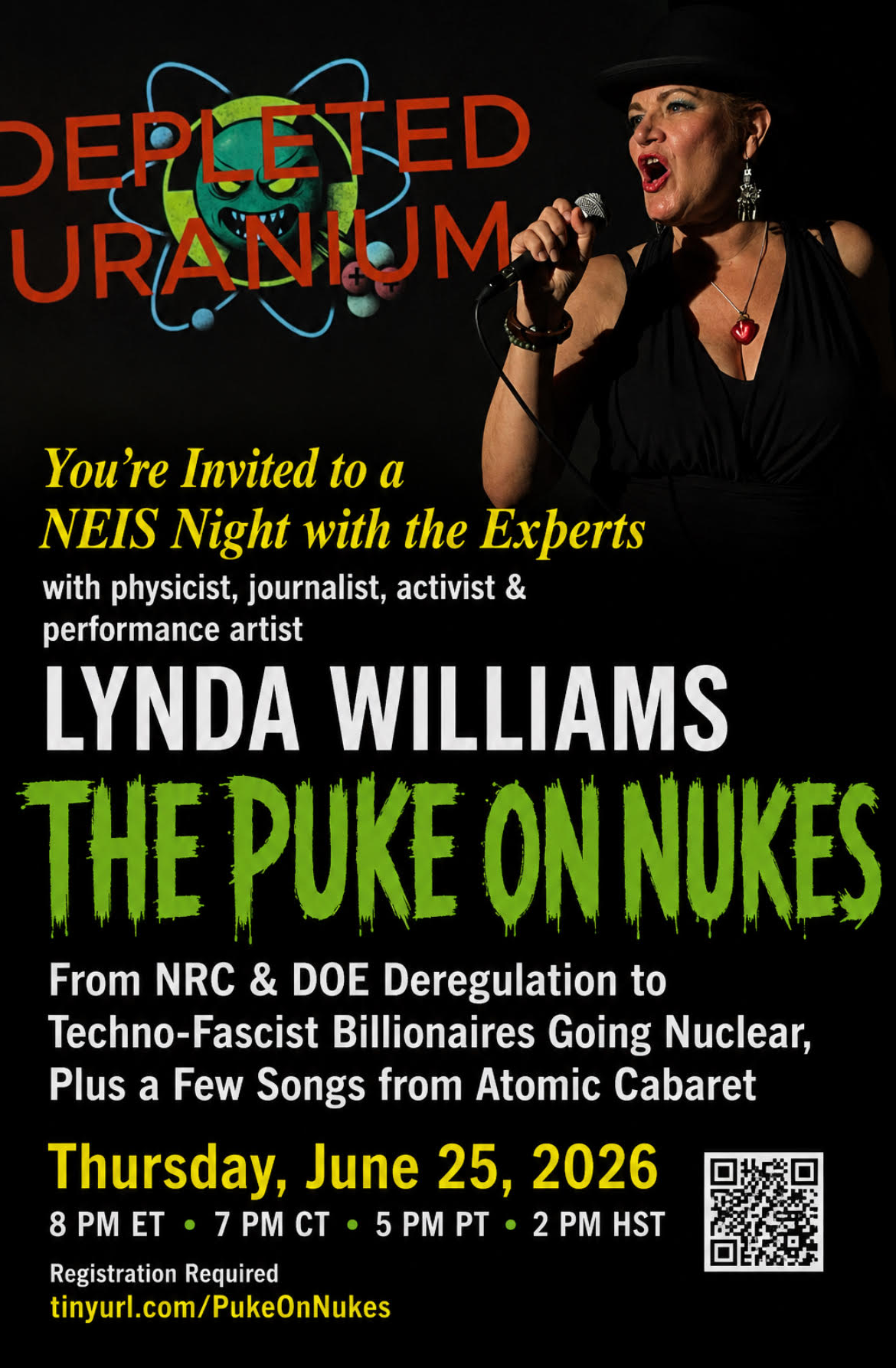
25 June- THE PUKE ON NUKES
Thursday, June 25, 2026
7pm Central Time (8pm ET, 6pm MT, 5pm PT) UTC – 5
From NRC & DOE Deregulation to Techno-Fascist Billionaires Going Nuclear, Plus a Few Songs from Atomic Cabaret REGISTER
26 June – Radiation Trainwreck at the NRC / Join the Protect Better Campaign – https://us02web.zoom.us/meeting/register/4ZlZ5_qLSHGiLSCg8FF6Bg#/registration

1st July – Webinar Waste of Space: The Environmental Harm of Military and Civil Space Activity st July, 7 pm

Report Launch Online: We are seeing an increasing exploitation of space for military and commercial purposes. This must change.

Protect Sazan Island from the Trump family! https://secure.avaaz.org/campaign/en/protect_sazan_island_from_the_trump_family_loc/?bqFCVab&v=174511&cl=22707147157&_checksum=5e9dde668860e8231c33699735e16a1fbf22ab2cb01da50c999fe8732b9775ef&utm_source=email&utm_medium=blast_email&utm_campaign=174511


Cuba Is Not a Failed State – It Is a Besieged State
PETITION: “Global Appeal to Endorse Palestinian Right of Return of Refugees”
To see nuclear-related stories in greater depth and intensity – go to https://nuclearinformation.wordpress.com
-
Archives
- June 2026 (251)
- May 2026 (306)
- April 2026 (356)
- March 2026 (251)
- February 2026 (268)
- January 2026 (308)
- December 2025 (358)
- November 2025 (359)
- October 2025 (376)
- September 2025 (257)
- August 2025 (319)
- July 2025 (230)
-
Categories
- 1
- 1 NUCLEAR ISSUES
- business and costs
- climate change
- culture and arts
- ENERGY
- environment
- health
- history
- indigenous issues
- Legal
- marketing of nuclear
- media
- opposition to nuclear
- PERSONAL STORIES
- politics
- politics international
- Religion and ethics
- safety
- secrets,lies and civil liberties
- spinbuster
- technology
- Uranium
- wastes
- weapons and war
- Women
- 2 WORLD
- ACTION
- AFRICA
- Atrocities
- AUSTRALIA
- Christina's notes
- Christina's themes
- culture and arts
- Events
- Fuk 2022
- Fuk 2023
- Fukushima 2017
- Fukushima 2018
- fukushima 2019
- Fukushima 2020
- Fukushima 2021
- general
- global warming
- Humour (God we need it)
- Nuclear
- RARE EARTHS
- Reference
- resources – print
- Resources -audiovicual
- Weekly Newsletter
- World
- World Nuclear
- YouTube
-
RSS
Entries RSS
Comments RSS
 nuclear-news