Why a new convention to protect nuclear installations in war is a bad idea
Bulletin of the Atomic Scientists, y Michal Onderco, Clara Egger | December 5, 2022 In recent weeks, several voices have called for adopting new legal instruments to protect civilian installations from military attacks during conflicts. The prime motivation stems from Russia’s shelling and occupation of the Zaporizhzhia nuclear power plant—Europe’s largest—as part of its ongoing war against Ukraine. This event, combined with Russia’s repeated transgression of international laws of armed conflicts, is said to reveal the weaknesses and inadequacy of existing legal protections. Such arguments were also aired during the 2020 NPT Review Conference held this summer in New York (after a two-year delay due to the global COVID-19 pandemic) as well as, more recently, in the columns of the Bulletin of the Atomic Scientists. Proponents of improved legal protections argue that a new convention is needed because of the ambiguity of existing international laws and the lack of enforcement mechanisms.
Although concerns about the protection of nuclear sites in war settings are wholly justified, the cure proposed might be worse than the disease. First, calls for a new regime reflect a partial reading of the legal and political mechanisms surrounding the protection of nuclear installations during a conflict. Second, because international law and political commitments already protect against attacks on nuclear installations, a new convention could add undesirable complexity with countries picking and choosing their commitments, which ultimately would weaken existing protections. Calls for new legal instruments would also send counterproductive signals in a context where the value of international norms is already challenged at the domestic and global levels.
There are no gaps. Legally, international humanitarian law norms already establish a detailed and unambiguous system of protection to avoid nuclear facilities becoming battlefields or being targeted by military attacks. The obligations of warring parties derive from two sources: They are linked to the general protection applicable to all types of civilian infrastructure in wartime but are reinforced and by specific protections applicable to nuclear power plants.
By default, nuclear facilities are considered civilian infrastructures even if doubts exist about their use, according to the Additional Protocol I to the Geneva Conventions (1977) as well as in contact areas (when military forces or combat operations are in the vicinity of power plants). This consideration is confirmed in the official commentary on the Additional Protocol I published by the International Committee of the Red Cross in 1987. Nuclear facilities are therefore already protected against attacks and reprisals.
………………………………… Overall, the legal protection against attacks on installations “containing dangerous forces” are seen as so fundamental that they are recognized as a part of the customary international humanitarian law, binding states regardless of whether they signed and ratified (or withdrew from) relevant international treaties. For example, the current military legal codes of Russia, Israel, and the United States (to name a few) all contain such provisions. From the legal perspective, nuclear facilities are on very safe grounds.
……………. The Additional Protocols to the Geneva Conventions explicitly provide that nuclear facilities must not be attacked even as part of broader military campaigns, if such an attack “may cause the release of dangerous forces and consequent severe losses among the civilian population” (cited in Article 56(1) of Additional Protocol I). This protection applies against retaliatory action (as cited in Art 56(4) of Additional Protocol I), and legal experts have even argued that such an act falls under the definition of a war crime (Art 85(3) of Additional Protocol I).
……………………………… Fragmentation is dangerous. Not only is a new convention in regard to attacks on nuclear power plants unnecessary; it would be politically and legally damaging. Adopting a new treaty would signal that current norms have become obsolete, making existing commitments irrelevant. ………………………………… more https://thebulletin.org/2022/12/why-a-new-convention-to-protect-nuclear-installations-in-war-is-a-bad-idea/
Macron pushes a “renaissance” while French nuclear flops

A farce that would make Feydeau blush — Beyond Nuclear International
A farce that would make Feydeau blush — Beyond Nuclear International
Will USA take any notice at all, as Australia’s Prime Minister and world media call for Julian Assange’s release?
The telling question here is whether Albanese will get any purchase with the Washington set. While enjoying a reputation as a pragmatic negotiator able to reach agreements in tight circumstances, the pull of the US national security establishment may prove too strong. “We now get to see Australia’s standing in Washington, valued ally or not,” was the guarded response of Assange’s father John Shipton.
Julian Assange and Albanese’s Intervention https://theaimn.com/julian-assange-and-albaneses-intervention/ December 1, 2022, by: Dr Binoy Kampmark
The unflinching US effort to extradite and prosecute Julian Assange for 18 charges, 17 of which are chillingly based upon the Espionage Act of 1917, has not always stirred much interest in the publisher’s home country. Previous governments have been lukewarm at best, preferring to mention little in terms of what was being done to convince Washington to change course in dealing with Assange.
Before coming to power, Australia’s current Prime Minister Anthony Albanese had made mention of wishing to conclude the Assange affair. In December 2019, before a gathering at the Chifley Research Centre, he described the publisher as a journalist, accepting that such figures should not be prosecuted for “doing their job”. The following year, he also expressed the view that the “ongoing pursuit of Mr Assange” served no evident “purpose” – “enough is enough”.
The same point has been reiterated by a number of crossbenchers in Australia’s parliament, represented with much distinction by the independent MP from Tasmania, Andrew Wilkie. In a speech given earlier this year to a gathering outside Parliament House, the Member for Clark wondered if the UK and Australia had placed their relations with Washington at a premium so high as to doom Assange. “The US wants to get even and for so long the UK and Australia have been happy to go along for the ride because they’ve put bilateral relationships with Washington ahead of the rights of a decent man.”
The new Australian government initially gave troubling indications that a tardy, wait-and-see approach had been adopted. “My position,” Albanese told journalists soon after assuming office, “is that not all foreign affairs is best done with the loudhailer.”
Documents obtained under freedom of information also showed an acknowledgment by the Albanese government of assurances made by the United States that the WikiLeaks founder would have the chance to serve the balance of any prison sentence in Australia. But anybody half-versed in the wiles and ways of realpolitik should know that the international prisoner transfer scheme is subordinate to the wishes of the relevant department granting it. The US Department of Justice can receive the request from Assange, but there is nothing to say, as history shows, that the request will be agreed to.
Amidst all this, the campaign favouring Assange would not stall. Human rights and press organisations globally have persistently urged his release from captivity and the cessation of the prosecution. On November 28, The New York Times, the Guardian, Le Monde, El País and Der Spiegel published a joint open letter titled, “Publishing is not a Crime.”
The five outlets who initially worked closely with WikiLeaks in publishing US State Department cables 12 years ago have not always been sympathetic to Assange. Indeed, they admit to having criticised him for releasing the unredacted trove in 2011 and even expressed concern about his “attempt to aid in computer intrusion of a classified database.”
Had the editors bothered to follow daily trial proceedings of the extradition case in 2020, they would have noted that the Guardian’s own journalists muddied matters by publishing the key to the encrypted files in a book on WikiLeaks. A mortified Assange warned the State Department of this fact. Cryptome duly uploaded the cables before WikiLeaks did. The computer intrusion charge also withers before scrutiny, given that Chelsea Manning already had prior authorisation to access military servers without the need to hack the system.
But on this occasion, the publishers and editors were clear. “Cablegate”, with its 251,000 State Department cables, “disclosed corruption, diplomatic scandals and spy affairs on an international scale.” They had “come together now to express [their] grave concerns about the continued prosecution of Julian Assange for obtaining and publishing classified materials.”
Very mindful of their own circumstances, the media outlets expressed their grave concerns about the use of the Espionage Act “which has never been used to prosecute a publisher or broadcaster.” Such an indictment set “a dangerous precedent, and threatens to undermine America’s First Amendment and the freedom of the press.”
The same day of the letter’s publication, Brazil’s President-elect Lula da Silva also added his voice to the encouraging chorus. He did so on the occasion of meeting the WikiLeaks editor-in-chief Kristinn Hrafnsson and Joseph Farrell, an associate of the organisation, and expressed wishes that “Assange will be freed from his unjust imprisonment.”
The stage was now set for Albanese to make his intervention. In addressing parliament on November 30 in response to a question from independent MP Monique Ryan, Albanese publicly revealed that he had, in fact, been lobbying the Biden administration for a cessation of proceedings against Assange. “I have raised this personally with the representatives of the US government.”
The Australian PM was hardly going to muck in on the issue of the WikiLeaks agenda. Australia remains one of the most secretive of liberal democracies, and agents of radical transparency are hardly appreciated. (Witness, at present, a number of venal prosecutions against whistleblowers that have not been abandoned even with a change of government in May.)
Albanese drew a parallel with Chelsea Manning, the key figure who furnished WikiLeaks with classified military documents, received a stiff sentence for doing so, but had her sentence commuted by President Barack Obama. “She is now able to participate freely in society.” He openly questioned “the point of continuing this legal action, which could be caught up now for many years, into the future.”
For some years now, the plight of Assange could only be resolved politically. In her address to the National Press Club in Canberra delivered in October this year, Assange’s lawyer Jennifer Robinson acknowledged as much. “This case needs an urgent political solution. Julian does not have another decade to wait for a legal fix.” This point was reiterated by Ryan in her remarks addressed to the prime minister.
The telling question here is whether Albanese will get any purchase with the Washington set. While enjoying a reputation as a pragmatic negotiator able to reach agreements in tight circumstances, the pull of the US national security establishment may prove too strong. “We now get to see Australia’s standing in Washington, valued ally or not,” was the guarded response of Assange’s father John Shipton.
Vladimir Putin open to talks on Ukraine if West accepts Moscow’s demands
ABC News 3 Dec 22
Russian President Vladimir Putin is “open to negotiations” on Ukraine but the West must accept Moscow’s demands, the Kremlin says, a day after US President Joe Biden said he was willing to talk with the Russian leader.
Key points:
- The Kremlin says the US’s refusal to recognise annexed territory in Ukraine as Russian was hindering a search for ways to end the war
- The IAEA wants to establish a protective zone around the Zaporizhzhia nuclear plant, which has been repeatedly shelled over the last few months
- An investigation into whether the Moscow branch of the Orthodox church is entitled to operate in Kyiv is underway
Speaking after talks on Thursday at the White House with French President Emmanuel Macron, Mr Biden said he was ready to speak with Mr Putin “if in fact there is an interest in him deciding he’s looking for a way to end the war”, adding the Russian leader “hasn’t done that yet”.
Mr Biden has not spoken directly with Mr Putin since Russia invaded Ukraine on February 24.
In March, Mr Biden branded Mr Putin a “butcher” who “cannot stay in power”.
In Moscow’s first public response to Mr Biden’s overture, Kremlin spokesman Dmitry Peskov told reporters: “The president of the Russian Federation has always been, is and remains open to negotiations in order to ensure our interests.”
Mr Peskov said the US refusal to recognise annexed territory in Ukraine as Russian was hindering a search for ways to end the war.
Moscow has previously sought sweeping security guarantees, including a reversal of NATO’s eastern enlargement………………………………….. more https://www.abc.net.au/news/2022-12-02/russia-open-to-talks-on-ukraine-if-west-accepts-moscows-demands/101730102
NATO Exists To Solve The Problems Created By NATO’s Existence
https://caitlinjohnstone.substack.com/p/nato-exists-to-solve-the-problems Caitlin Johnstone, 30 Nov 22
NATO has doubled down on its determination to eventually add Ukraine to its membership, renewing its 2008 commitment to that goal in a meeting between the foreign ministers of the alliance in Bucharest, Romania this past Tuesday.
Antiwar’s Dave DeCamp writes:
The Romanian city was where NATO initially made the promise to Ukraine back in 2008, and at the time, US officials acknowledged that attempting to bring the country into the alliance could spark a war in the region.
“We made the decision in Bucharest in 2008 at the summit,” NATO Secretary-General Jens Stoltenberg said on Tuesday. “I was there … representing Norway as Prime Minister. I remember very well the decisions. We stand by those decisions. NATO’s door is open.”
In a joint statement, the NATO foreign ministers, including Secretary of State Antony Blinken, said that they “reaffirm” the decisions that were made at the 2008 Bucharest summit.
It has become fashionable among the mainstream western commentariat to claim that Russia’s invasion of Ukraine had nothing to do with NATO expansion, but as recently explained by Philippe Lemoine for the Center for the Study of Partisanship and Ideology, that’s a completely false narrative that requires snipping past comments made by Putin out of the context in which they were made. Many western experts warned for years in advance that NATO expansion would lead to a conflict like the one we’re seeing today, and they were of course correct.
The recent push to expand NATO in Ukraine along with nations like Finland and Sweden as justified by “Russian aggression” is a good example of what professor Richard Sakwa has called the “fateful geographical paradox: that NATO exists to manage the risks created by its existence.” As the late scholar on US-Russia relations Stephen Cohen explained years before the Ukraine crisis erupted in 2014, Moscow sees NATO as an “American sphere of influence,” and the expansion of NATO and NATO influence as expansion of that sphere. It reacts to this with hostility just as the US would react to China or Russia building up aggressive military alliances on its borders, and arguably with vastly more restraint than the US would.
Other future examples of Sakwa’s fateful geographical paradox are likely to include the push to reconfigure NATO into an alliance dedicated to “restraining” China, which of course means halting China’s rise on the world stage and working to constrict, balkanize and usurp it. A recent Financial Times article titled “Washington steps up pressure on European allies to harden China stance” gives new detail to this agenda:
The US is pushing European allies to take a harder stance towards Beijing as it tries to leverage its leadership on Ukraine to gain more support from Nato countries for its efforts to counter China in the Indo-Pacific.
According to people briefed on conversations between the US and its Nato allies, Washington has in recent weeks lobbied members of the transatlantic alliance to toughen up their language on China and to start working on concrete action to restrain Beijing.
US president Joe Biden identified countering China as his main foreign policy goal at the start of his administration, but his efforts have been complicated by the focus on Russia’s invasion of Ukraine in February.
But with Russian president Vladimir Putin’s invasion in its 10th month, Washington was making a concerted effort to push China back up Nato’s agenda, the people said.
The “North Atlantic” Treaty Organization added China to its security concerns for the very first time this past June, and ever since it’s seen a mad push from Washington to ramp up aggressions against Beijing. Another Financial Times article titled “Nato holds first dedicated talks on China threat to Taiwan” details a meeting between alliance members this past September:
They also discussed how Nato should make Beijing aware of the potential ramifications of any military action — a debate that has gained significance following Russia’s invasion of Ukraine amid questions about whether the west was tough enough in its warnings to Moscow.
The US has been urging allies, particularly in Europe, to focus more on the threat to Taiwan, as concerns mount that Chinese president Xi Jinping may order the use of force against the island.
Senior US military officers and officials have floated several possible timelines for military action, with some eager to increase the sense of urgency to ensure Washington and its allies are prepared.
Some are noticing that Washington’s eagerness to “increase the sense of urgency” on this front can easily wind up having a provocative effect which serves as a self-fulfilling prophecy.
Bonnie Glaser, director of the Asia program at the German Marshall Fund of the United States, told Bloomberg a month ago that Washington’s haste to prepare everyone for another major conflict could “end up provoking the war that we seek to deter.”
“NATO should be renamed ASFP: the Alliance for Self Fulfilling Prophecies,” tweeted commentator Arnaud Bertrand of the alliance’s discussions about Taiwan.
“A defensive alliance doesn’t look to pick fights with a country on a different continent,” tweeted Jacobin’s Branko Marcetic. “This is some classic mission creep from NATO – or, more accurately, Washington.”
When you ignore all the empty narrative fluff and really boil it down to the raw language of actual behavior, NATO’s existence really does seem to be premised on the circular reasoning that without NATO there’d be nobody to protect the world from the consequences of NATO’s actions. It goes out of its way to threaten powerful nations and then justifies its existence by their responses to those threats. It’s a self-licking ice cream cone, or, if you prefer, a self-licking boot.
And this is all happening as news comes out that European nations are beginning to notice they’re bearing a lot more of the cost of Washington’s proxy warfare in Ukraine than the US is, while the US reaps all the profits. In an article titled “Europe accuses US of profiting from war,” Politico reports:
Top European officials are furious with Joe Biden’s administration and now accuse the Americans of making a fortune from the war, while EU countries suffer.
When you ignore all the empty narrative fluff and really boil it down to the raw language of actual behavior, NATO’s existence really does seem to be premised on the circular reasoning that without NATO there’d be nobody to protect the world from the consequences of NATO’s actions. It goes out of its way to threaten powerful nations and then justifies its existence by their responses to those threats. It’s a self-licking ice cream cone, or, if you prefer, a self-licking boot.
And this is all happening as news comes out that European nations are beginning to notice they’re bearing a lot more of the cost of Washington’s proxy warfare in Ukraine than the US is, while the US reaps all the profits. In an article titled “Europe accuses US of profiting from war,” Politico reports:
Top European officials are furious with Joe Biden’s administration and now accuse the Americans of making a fortune from the war, while EU countries suffer.
“The fact is, if you look at it soberly, the country that is most profiting from this war is the U.S. because they are selling more gas and at higher prices, and because they are selling more weapons,” one senior official told POLITICO.
The explosive comments — backed in public and private by officials, diplomats and ministers elsewhere — follow mounting anger in Europe over American subsidies that threaten to wreck European industry.
Washington is taking extreme risks and angering allies at this time because it’s getting to do-or-die time as far as preserving US unipolar hegemony is concerned. As Antiwar’s Ted Snider explains in a recent article, the US proxy war in Ukraine has never really been about Ukraine, and hasn’t even ultimately been about Russia. In the long run this standoff has always been about China, and about the desperate campaign of the US empire to preserve its unrivaled domination of this planet.
“The war in Ukraine has always been about larger US goals,” writes Snider. “It has always been about the American ambition to maintain a unipolar world in which they were the sole polar power at the center and top of the world.”
“Events in Ukraine in 2014 marked the end of the unipolar world of American hegemony,” Snider says. “Russia drew the line and asserted itself as a new pole in a multipolar world order. That is why the war is ‘bigger than Ukraine,’ in the words of the State Department. It is bigger than Ukraine because, in the eyes of Washington, it is the battle for US hegemony.”
“If Ukraine is about Russia, Russia is about China,” Snider writes. “The ‘Russia Problem’ has always been that it is impossible to confront China if China has Russia: it is not desirable to fight both superpowers at once. So, if the long-term goal is to prevent a challenge to the US led unipolar world from China, Russia first needs to be weakened.”
Snider quotes Lyle Goldstein, a visiting professor at Brown University, who says that “In order to maintain its hegemonic position, the US supports Ukraine to wage hybrid warfare against Russia…The purpose is to hit Russia, contain Europe, kidnap ‘allies,’ and threaten China.”
As the world becomes more multipolar and securing total control looks less and less likely, the empire is fighting more and more like a boxer in the later rounds who’s been down on the scorecards the entire fight: taking more risks, throwing wild haymakers, preferring the possibility of a knockout loss over the certainty of losing a decision.
We’re at the most dangerous point in humanity’s abusive relationship with US unipolar domination, for the same reason the most dangerous point in a battered wife’s life is right when she’s trying to escape. The empire is willing to do terrible and risky things to retain control. “If I can’t have you no one can” is a line that can be said to a wife, or to the world.
The importance of opposing these megalomaniacs, and their games of nuclear chicken, has never been higher.
Taxpayers to hand China millions of pounds to quit Sizewell nuclear plant

Taxpayers will hand China millions of pounds to quit its nuclear power
venture in Suffolk as part of a £700m deal as the “golden era” of
UK-China relations comes to an end. The Government is spending an initial
£679m to help get the £20bn Sizewell C nuclear power plant project off the
ground and has confirmed part of this will go to state-owned China General
Nuclear (CGN) under an exit deal.
It has not disclosed what proportion will
go to CGN but a Government spokesman said the payment “covers the value
of their shareholding, their contribution to the project’s development and
a commercial return reflecting their work to date”. He added: “The
value of their 20pc stake in the project is commercially confidential.
“CGN has decided to exit the project at this stage in its development,
following constructive commercial negotiations.”
Telegraph 29th Nov 2022
Iran ‘not optimistic’ about nuclear deal revival talks
Argus, By Nader Itayim, 28 November 2022,
Iran’s foreign ministry said today the country is committed to finding a diplomatic solution to its nuclear dispute with the US and European countries, but said it is “not optimistic” the negotiations with Washington to restore the 2015 nuclear agreement will bear fruit.
Tehran and Washington began talks in Vienna in April 2021 aimed at reviving the deal, known formally as the Joint Comprehensive Plan of Action (JCPOA), which former US President Donald Trump reneged on in 2018 before he reimposed sanctions on Iran’s banking and energy sectors. After good signs of progress earlier this year, the negotiations stalled some months ago over several points of contention primarily concerning the extent of US sanctions relief for Iran should the deal be revived…………………….
Last week Iran said it had begun enriching uranium to 60pc purity at its Fordow nuclear site, in response to a resolution passed by the International Atomic Energy Agency’s (IAEA) board of governors urging Tehran to co-operate with a long-standing investigation into uranium traces it found at three undeclared Iranian nuclear sites. This is the first time enrichment would reach such a level at Fordow, although enrichment to 60pc purity has been happening at Iran’s other site, Natanz, since the first half of 2021.
The US, EU, and UK, meanwhile, have been imposing new sanctions on a host of Iranian individuals and entities for their involvement in the production and supply of drones to Russia for use against Ukraine……… https://www.argusmedia.com/en/news/2395141-iran-not-optimistic-about-nuclear-deal-revival-talks
The coming Sinophobic calamity
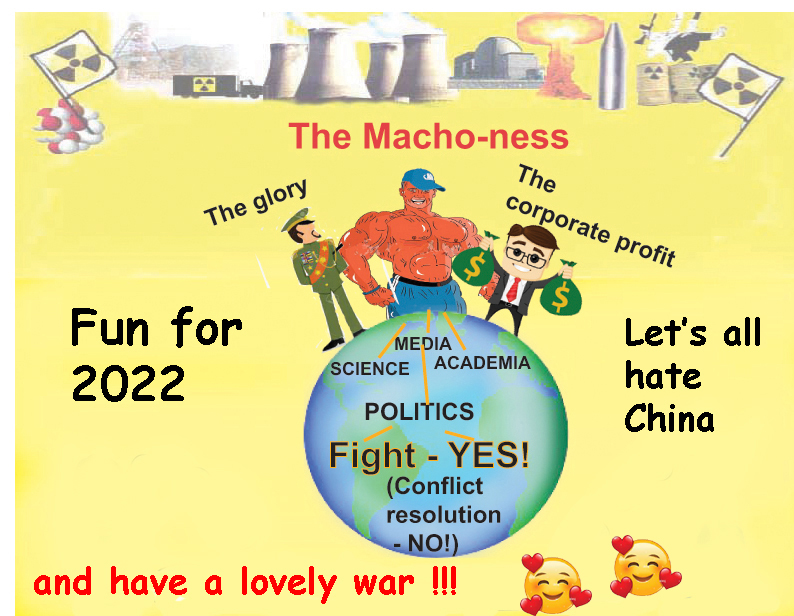
Expect to see such China-hating maniacs back in government in the unlikely event that Trump regains the white house.
powerful Dems like Biden and Nancy Pelosi went out of their way prior to the election to prove that they, too, are tough on China; Pelosi with her idiotic and inflammatory jaunt to Taiwan last summer and Biden, with his many pronouncements that Washington backs Taipei to the hilt and will go to war to prove it.
there are people in his administration who walk back his bellicose yowls….. they ARE oblivious. They aim to drag the Ukraine war out as long as possible
https://johnmenadue.com/the-coming-sinophobic-calamity/ By Eve Ottenberg, Nov 24, 2022,
Neither the red wave nor the blue one materialised in the latest USA election, which removes some of the impetus for the coming congressional Sinophobic rampage.
Some, not all. The relatively good results for Biden mean that for the moment he no longer needs the Beijing boogeyman and could afford to be gracious toward China’s leader, Xi Jinping at the G20 summit. But the GOP won by enough last week to say that so did Sinophobia. The Dems may be, quite despicably, all about World War III with Moscow, but it is a partisan endeavour, because a recent poll revealed that 48 percent of Republicans think we spend too much on the Ukraine war. And the congressional GOP responds to its base.
But war with Beijing, the GOP project, is not a partisan effort; it is bipartisan, and the Republicans are quite proud of and open about that. So their House win last week means one thing: the military and the security state will push ferociously for the assault on China that they have long lusted for, though they are happy, for now, for that assault to remain economic. But don’t be fooled. There is real danger afoot. Those Dems who really want to avert World War III with Beijing will have to be very nimble. And they will have to go about it in a relentless, low-profile manner, because anyone perceived as standing up to the bash-China juggernaut will be crushed, regardless of the lull in Biden’s incendiary rhetoric.
At the top of the GOP foreign affairs agenda is economic war with China – no matter what price we pay (and it will be high) in inflation. Because you can’t slap economic sanctions on your biggest trading partner with impunity. You can’t even slap economic sanctions on any major economy, like Russia’s, without them backfiring badly, as Biden and birdbrain Eurocrats found out when their precious sanctions on Moscow started destroying western economies. Regardless, an economic fight to the death with Beijing is the first item on the GOP to-do list. The second item is actual, all-out, military hot war with China, if it makes any hostile move on Taiwan. Or, for some congressional Neanderthals, even if it doesn’t.
GOP congressmen are all keyed up about confronting Beijing militarily and have been since the Trump administration, with its Sinophobic fanatics like his trade advisor Peter Navarro and Trump national security council member, a foaming-at-the-mouth China-basher, Matt Pottinger, both egging Trump on to heights of folly that could have culminated in a planet-killing nuclear war. Navarro and Pottinger hyped the insane hysteria that China deliberately created covid in a lab and unleashed it (on its own population, an oddity that these two geniuses never bothered to explain), with Navarro proclaiming the arrant nonsense that the “virus was a product of the Chinese Communist Party.” Expect to see such China-hating maniacs back in government in the unlikely event that Trump regains the white house.
According to Trump’s NSC advisor H.R. McMaster, quoted by the Washington Post in April 2020, Pottinger is “central to the biggest shift in U.S. foreign policy since the cold war, which is the competitive approach to China.” So, not to put too fine a point on it, Pottinger bequeathed us disaster. And don’t forget Trump secretary of state Mike Pompeo, no slouch in the anti-China psychosis department, jetting into Taiwan last year to inflame the separatist movement by lauding the Chinese territory as a great “nation,” and hectoring Europeans, as he did in 2020, to sever economic ties with Beijing. This crabby approach to Europe’s Chinese links is now de rigueur in Washington.
And when the Exceptional Empire gets crabby, watch out! The empire carped and groused about Nordstream 1 and 2 for years. Then came the imperial news – from Biden of course – that if Russia invaded Ukraine, Washington would stop Nordstream 2. When asked how this would happen, he said, “I promise you, we will be able to do it.” No one speculated back then that this pronouncement might mean Washington was ready to go full-on Don Corleone. Because Biden didn’t specify how. But barely a year later – voila! Some mysterious somebody blew up both pipelines. Whoever could it be?
So it’s time for imbecile Eurocrats to wake up. The gangsters who exploded their gas pipelines now eye their trade with China, though admittedly blowing up tankers shipping manufactured goods is a more complicated affair. But the Empire is nothing if not creative when it comes to destroying what it perceives as a threat. Assassinations, riots, coups, curating Nazi movements, bombing pipelines – and I’m sure the list includes things we haven’t even thought of or don’t know about. So who knows what could be afoot. Who knows? I’ll tell you: Bipartisan anti-China thugs, led by the GOP, the same GOP whose senator Ted Cruz made a cause celebre out of blocking Nordstream.
Knowing all this, powerful Dems like Biden and Nancy Pelosi went out of their way prior to the election to prove that they, too, are tough on China; Pelosi with her idiotic and inflammatory jaunt to Taiwan last summer and Biden, with his many pronouncements that Washington backs Taipei to the hilt and will go to war to prove it. But at least the election soothed and lowered the temperature of Biden’s bullying, and at least there are people in his administration who walk back his bellicose yowls. They know what a global nuclear catastrophe such a war would be, even if they appear oblivious to the same thing in Ukraine. And they ARE oblivious. They aim to drag the Ukraine war out as long as possible, something Moscow, with its repeated warnings that more NATO weapons only prolong the war, seems not to have taken note of.
Thus the two hydra heads of the bipartisan war party, demonstrating that if indeed the next stage of development after imperial, late-capitalist oligarchy is outright fascism (and if it is, we better figure out a way to stop it, fast), the death wish remains the same. Because no, fascists are not pacifists, no matter how much they demur over the cost of Washington’s abominable proxy war with Moscow in Ukraine. Biden risks global conflagration in Europe, while whoever the GOP vomits up to replace him will simply refocus the nukes onto East Asia.
Expect the worst. “House Republicans plan to put sharp scrutiny on China next year if they win the majority, including establishing a select committee to take on Beijing on a range of economic and military issues,” led an article in the Hill October 28. The GOP believes this work would largely be bipartisan. Gee, I wonder how they got that idea? Could Biden’s war whoops directed at Beijing have anything to do with it? If those whoops and hollers were cynical politics as usual (I suspect they were), this is a very dangerous game. They may box the white house into a policy it didn’t really mean to adopt and one that could leave tens of millions of Americans and an equal number of Chinese, uh, radioactive. But Biden’s played that game before. During the Reagan years and after, while in congress, he tacked right, leaving a ghastly legislative legacy that the great cowards in the progressive caucus would do well to ponder.
House minority leader Kevin McCarthy has long wanted a China select committee, the Hill reports, and “tried to work with Democrats to create one in 2020.” But Pelosi pulled Dems out of this potential quagmire – quite surprisingly, considering her characterisation of the very violent and brutal Hong Kong riots as “beautiful” and her later incitement of Taiwan’s independence, that is, incitement of war – with a foresight she has since lost and one can only hope she quickly recovers.
But intermittent Dem common sense isn’t the only hope. Hard at work to avert the coming debacle between the U.S. and China has been Code Pink. This organisation currently runs campaigns to urge the senate to oppose the Taiwan Policy Act, which would arm Taiwan to the teeth and end the One China policy – a huge blow to peace prospects; to tell congress to stand for peace with China; and condemning “the escalating U.S. militarisation of Guam and the wider Asia-Pacific region.” Code Pink does great work to contain the U.S. anti-China lunacy. But that’s only one organisation.
The GOP wants war with China. The Dems want – and have got – war with Russia, one they intend to drag out for years. Either way, ordinary people all over the globe lose badly. If there’s anyone in government with the sense and the power to stall or, better yet, undo Washington’s coming confrontation with Beijing, now would be a good time to get cracking.
First published in COUNTERPUNCH Nov 19
Pandora’s box of nuclear progress
Why uranium mining, nuclear energy, and atomic bombs are all steps in the path to destruction
By Cymry Gomery, Coordinator of Montréal for a World BEYOND War
This op-ed was inspired by a presentation by Dr. Gordon Edwards of the Canadian Coalition for Nuclear Responsibility on November 16, 2022.
The Russia-Ukraine conflict has many worried that we are on the brink of nuclear war. Putin has put Russia’s nukes on high alert and President Biden grimly warned last month of the risk of nuclear “armageddon”. New York City shocked the world with its PSA on how to survive a nuclear attack, while the Doomsday Clock is just 100 seconds to midnight.
However, nuclear bombs are just the last in a series of related products and activities—uranium mining, nuclear energy, and nuclear bombs—whose production is rooted in the fact that human moral understanding of the world lags far behind our technical skills. They are all progress traps.
What is a progress trap?
The notion of progress is generally perceived in a positive light in Western society. If we can find an innovative way to do something more quickly, with less effort, we feel pleased. However, this perception was called into question by Ronald Wright in his 2004 book A Short History of Progress. Wright defines a progress trap as ”a chain of successes which, upon reaching a certain scale, leads to disaster. The dangers are seldom seen before it’s too late. The jaws of a trap open slowly and invitingly, then snap closed fast.”
Wright mentions hunting as an early example, because as humans developed tools that were more efficient at killing ever more animals, they eventually exhausted their food supply and starved. With industrialization, hunting gave way to factory farms, which seems very different, but in fact was just another version of a progress trap. Not only do factory farms cause immense suffering to animals, they are hurt humans too: People in developed countries consume too many calories, of food of questionable suitability to humans, and often die of cancers and obesity-related diseases.
Now let’s look at uranium mining, nuclear energy and nuclear bombs in this light.
The Uranium mining progress trap
Uranium, a heavy metal that was discovered in 1789, was initially used as a colorant for glass and pottery. However, eventually humans discovered that uranium can be used to effect nuclear fission, and since 1939 that miraculous property has been harnessed to produce nuclear energy for civilian purposes, and to make bombs for the military. That is the “successful” aspect of Wright’s definition (if you are okay with considering both keeping people warm and killing them as desirable outcomes).
Canada is the world’s single largest supplier of uranium, and most of the mines are in the North where Inuit communities—typically the most disadvantaged and least politically influential demographic in Canada—are exposed to uranium dust, tailings, and other hazards.
Uranium mining creates radioactive dust that workers can inhale or accidentally ingest, leading to lung cancer and bone cancer. Over time, workers or people living near a uranium mine can be exposed to high concentrations, which can damage their internal organs, notably the kidneys. Animal studies suggest that uranium affects reproduction, the developing fetus, and increases the risk of leukemia and soft tissue cancers.
This is alarming enough; however the progress trap comes into play when one considers the half-life of uranium, the period during which it decays and emits gamma radiation (electromagnetic radiation which we also know as X-rays). Uranium-238, the most common form, has a half-life of 4.46 billion years.
In other words, once uranium is brought to the surface through mining, a Pandora’s box of radiation is unleashed on the world, radiation that can cause lethal cancers and other illnesses, for billions of years. That’s a progress trap right there. But that’s not the whole story. This uranium is not finished its destructive mission. It can now be used to make nuclear energy and nuclear bombs.
The Nuclear energy progress trap
Nuclear energy has been touted as a clean energy because it does not produce greenhouse gasses (GHG). However, it is far from clean. In 2003, a study produced by nuclear advocates at the Massachusetts Institute of Technology identified costs, safety, proliferation, and waste as the four “unresolved problems” with nuclear power……………………………………………………………
So nuclear energy is also a progress trap. Anyway, there are other means of producing energy—wind, sun, hydro, geothermal–which are less costly. However, even if nuclear energy were the cheapest energy, it would still be off the table to any project manager worth her salt, because it is highly polluting, entails the risk of nuclear disasters such as have already happened at Fukushima and Chernobyl, and because persistent nuclear waste poisons and kills humans and animals.
Also, nuclear waste produces plutonium, which is used to make nuclear bombs—the next step in the “progress” continuum.
The nuclear bomb progress trap
Yes, it has come to this. Humans are capable of wiping out all life on Earth with the push of a button. Western civilization’s obsession with winning and hegemony has led to a situation where we have mastered death but failed at life. This is the penultimate example of human technological intelligence outpacing human emotional and spiritual evolution.
An accidental missile launch could lead to the greatest global public health disaster in recorded history. A war using fewer than half the nuclear weapons of India and Pakistan alone would lift enough black soot and soil into the air to cause a nuclear winter. In his book Command and Control, author Eric Schlosser documents how nuclear weapons provide what he calls an “illusion of safety,” while, in fact, posing real danger due to the threat of accidental detonation. Schlosser documents how hundreds of incidents involving nuclear weapons have nearly destroyed our world through accident, confusion, or misunderstanding.
One way out of the mutually assured destruction (so tellingly rendered as MAD) trap we have created is the Treaty for the Prohibition of Nuclear Weapons (TPNW), which entered into force in 2021, and has been signed by 91 nations and ratified by 68. However, the nuclear armed nations have not signed, nor have NATO member countries like Canada.
Washington’s Iron Curtain in Ukraine
Peace and Planet Newsby Diana Johnstone | Fall 2022 Edition
This article is from June 2014; the editors found it profoundly accurate and quite prescient about the shape of things we are witnessing today.
ATO leaders are currently acting out a deliberate charade in Europe, designed to reconstruct an Iron Curtain between Russia and the West.
With astonishing unanimity, NATO leaders feign surprise at events they planned months in advance. Events that they deliberately triggered are being misrepresented as sudden, astonishing, unjustified “Russian aggression.” The United States and the European Union undertook an aggressive provocation in Ukraine that they knew would force Russia to react defensively, one way or another.
They could not be sure exactly how Russian president Vladimir Putin would react when he saw that the United States was manipulating political conflict in Ukraine to install a pro-Western government intent on joining NATO. This was not a mere matter of a “sphere of influence” in Russia’s “near abroad,” but a matter of life and death to the Russian Navy, as well as a grave national security threat on Russia’s border.
A trap was thereby set for Putin. He was damned if he did, and damned if he didn’t. He could underreact, and betray Russia’s basic national interests, allowing NATO to advance its hostile forces to an ideal attack position.
Or he could overreact, by sending Russian forces to invade Ukraine. The West was ready for this, prepared to scream that Putin was “the new Hitler,” poised to overrun poor, helpless Europe, which could only be saved (again) by the generous Americans.
In reality, the Russian defensive move was a very reasonable middle course. Thanks to the fact that the overwhelming majority of Crimeans felt Russian, having been Russian citizens until Khrushchev frivolously bestowed the territory on Ukraine in 1954, a peaceful democratic solution was found. Crimeans voted for their return to Russia in a referendum which was perfectly legal according to international law, although in violation of the Ukrainian constitution, which was by then in tatters having just been violated by the overthrow of the country’s duly elected president, Victor Yanukovych, facilitated by violent militias. The change of status of Crimea was achieved without bloodshed, by the ballot box.
Nevertheless, the cries of indignation from the West were every bit as hysterically hostile as if Putin had overreacted and subjected Ukraine to a U.S.-style bombing campaign, or invaded the country outright – which they may have expected him to do.
U.S. Secretary of State John Kerry led the chorus of self-righteous indignation, accusing Russia of the sort of thing his own government is in the habit of doing. “You just don’t invade another country on phony pretext in order to assert your interests. This is an act of aggression that is completely trumped up in terms of its pretext,” Kerry pontificated. “It’s really 19th-century behavior in the 21st century.” Instead of laughing at this hypocrisy, U.S. media, politicians and punditry zealously took up the theme of Putin’s unacceptable expansionist aggression. The Europeans followed with a weak, obedient echo.
It Was All Planned at Yalta
In September 2013, one of Ukraine’s richest oligarchs, Viktor Pinchuk, paid for an elite strategic conference on Ukraine’s future that was held in the same Palace in Yalta, Crimea, where Roosevelt, Stalin and Churchill met to decide the future of Europe in 1945.
The Economist, one of the elite media reporting on what it called a “display of fierce diplomacy,” stated that: “The future of Ukraine, a country of 48m people, and of Europe was being decided in real time.” The participants included Bill and Hillary Clinton, former CIA head General David Petraeus, former U.S. Treasury Secretary Lawrence Summers, former World Bank head Robert Zoellick, Swedish Foreign Minister Carl Bildt, Shimon Peres, Tony Blair, Gerhard Schröder, Dominique Strauss-Kahn, Mario Monti, Lithuanian President Dalia Grybauskaite, and Poland’s influential Foreign Minister Radek Sikorski. Both President Viktor Yanukovych, deposed five months later, and his recently elected successor Petro Poroshenko were present. Former U.S. energy secretary Bill Richardson was there to talk about the shale-gas revolution which the United States hopes to use to weaken Russia by substituting fracking for Russia’s natural gas reserves. The center of discussion was the “Deep and Comprehensive Free Trade Agreement” (DCFTA) between Ukraine and the European Union, and the prospect of Ukraine’s integration with the West. The general tone was euphoria over the prospect of breaking Ukraine’s ties with Russia in favor of the West.
Conspiracy against Russia? Not at all. Unlike Bilderberg, the proceedings were not secret. Facing a dozen or so American VIPs and a large sampling of the European political elite was a Putin adviser named Sergei Glazyev, who made Russia’s position perfectly clear.
Glazyev injected a note of political and economic realism into the conference. Forbes reported at the time on the “stark difference” between the Russian and Western views “not over the advisability of Ukraine’s integration with the EU but over its likely impact.” In contrast to Western euphoria, the Russian view was based on “very specific and pointed economic criticisms” about the Trade Agreement’s impact on Ukraine’s economy, noting that Ukraine was running an enormous foreign accounts deficit, funded with foreign borrowing, and that the resulting substantial increase in Western imports could only swell the deficit. Ukraine “will either default on its debts or require a sizable bailout.”
The Forbes reporter concluded that “the Russian position is far closer to the truth than the happy talk coming from Brussels and Kiev.”
As for the political impact, Glazyev pointed out that the Russian-speaking minority in Eastern Ukraine might move to split the country in protest against cutting ties with Russia, and that Russia would be legally entitled to support them, according to The Times of London.
In short, while planning to incorporate Ukraine into the Western sphere, Western leaders were perfectly aware that this move would entail serious problems with Russian-speaking Ukrainians, and with Russia itself. Rather than seeking to work out a compromise, Western leaders decided to forge ahead and to blame Russia for whatever would go wrong. ……………………….
Plan A and Plan B
U.S. policy, already evident at the September 2013 Yalta meeting, was carried out on the ground by Victoria Nuland, former advisor to Dick Cheney, deputy ambassador to NATO, spokeswoman for Hillary Clinton, wife of neocon theorist Robert Kagan. Her leading role in the Ukraine events proves that the neo-con influence in the State Department, established under Bush II, was retained by Obama……………..
As Victoria Nuland boasted in Washington, since the dissolution of the Soviet Union in 1991, the United States has spent $5 billion to gain political influence in Ukraine (this is called “promoting democracy”)…….
What called public attention to Victoria Nuland’s role in the Ukrainian crisis was her use of a naughty word, when she told the U.S. ambassador, “Fuck the EU.” But the fuss over her bad language veiled her bad intentions.
……………………………… What called public attention to Victoria Nuland’s role in the Ukrainian crisis was her use of a naughty word, when she told the U.S. ambassador, “Fuck the EU.” But the fuss over her bad language veiled her bad intentions.
………………….
The Protection Racket Returns
But first of all, the United States needs Russia as an enemy in order to “save Europe,” which is another way to say, in order to continue to dominate Europe.
…………………………………………………………….. Perhaps the most extraordinary aspect of the current charade is the servility of the “old” Europeans. Apparently abandoning all Europe’s accumulated wisdom, drawn from its wars and tragedies, and even oblivious to their own best interests, today’s European leaders seem ready to follow their American protectors to another D-Day … D for Doom. https://peaceandplanetnews.org/ukraine-iron-curtain/
Merkel explains why she wasn’t surprised by Russia’s offensive in Ukraine

https://www.rt.com/news/567189-merkel-ukraine-russia-conflict-surprise/ 26 Nov 22
The Minsk Agreements became “eroded” and the EU was reluctant to talk to Moscow, the former German chancellor told Der Spiegel
Former German Chancellor Angela Merkel says she was not surprised when the conflict between Russia and Ukraine broke out in late February. The retired leader was speaking to Der Spiegel in a lengthy interview published on Thursday.
“It did not come as a surprise,” Merkel told the outlet. By then, “the Minsk Agreements were eroded,” the former chancellor stated, referring to the 2014 ceasefire deal brokered by Germany and France, which were designed to give the eastern regions special status within Ukraine.
She also said her efforts to establish another dialogue platform for Russia and the EU in 2021 had come to nothing.
I wanted, together with [French President] Emmanuel Macron, to create an independent European discussion format with Putin through the European Council,” Merkel said, explaining that she faced opposition from other members of the EU’s top body.
“I no longer had the strength to assert myself,” she noted, as everyone knew she was about to step down. She faced the same problem on her farewell visit to Moscow, sensing she no longer had the ability to influence Putin, for whom she said “only power counts.”
The former German leader said she “wished for a more peaceful time” after her departure and would have “pushed for [her initiative] further” had she decided to lead her party into the 2021 parliamentary elections and won.
The former chancellor also acknowledged that she had not moved forward “even a millimeter” in resolving not only the Ukraine crisis, but the tensions between “Transnistria and Moldova, Georgia and Abkhazia,” as well as the crises in Syria and Libya. “It was time for a new approach,” she said.
Merkel, however, defended her opposition to admitting Georgia and Ukraine into NATO, arguing that she “bought time” for Kiev to better prepare for the Russian offensive.
However, Merkel still believes that Berlin should not be “the first nation to send state-of-the-art tanks” to Kiev, warning that it would only damage Berlin’s relations with Moscow. “Russia would then be only further set against Germany,” she said.
Merkel faced criticism at home over the conflict for supposedly making the German economy too reliant on Russian gas. The ex-chancellor defended her decisions, saying that buying gas from Moscow was the best way towards a green future and the move away from coal.
Could the Minsk II agreement Have Prevented the War in Ukraine?
a significant minority of Ukrainians want to remain close to Russia, and for them fully integrating with the West represents a loss.
The fundamental problem for Ukraine was that a majority of citizens sought closer ties with the West, but a significant minority sought closer ties with Russia, and these two aspirations were mutually incompatible.
Daily Sceptic, BY NOAH CARL., 23 NOVEMBER 2022,
Since Russia’s invasion of Ukraine began, Western commentators have spent a huge amount of time expressing moral outrage at Russia’s actions, but comparatively little time thinking about how the war could have been prevented.
This is puzzling. Even if Ukraine manages to win, this victory will have come at an enormous price – tens of thousands of lives, millions of refugees (many of whom may never return), and untold damage to the country’s infrastructure. No matter what the outcome, the war will have been disastrous for ordinary Ukrainians.
It therefore seems essential to ask whether it could have been prevented.
One possible way it could have been prevented is through deterrence. NATO members could have announced in advance, ‘We commit to defending Ukraine if it is ever attacked by Russia’. Alternatively, the U.S. and its allies could have armed Ukraine to the teeth by transferring huge quantities of offensive weapons.
The disadvantages of this approach are obvious. It might have caused Russia to invade even sooner to forestall the arrival of NATO troops or weapons. And if Russia did call the West’s bluff, it might have sparked World War III, as NATO would have pre-committed to entering the war on Ukraine’s side.
As late as February 2014, the percentage of Ukrainians who wanted to join the EU was only 5 points higher than the percentage who wanted to join the Eurasian Customs Union. The balance of opinion then shifted after the ‘Revolution of Dignity’.
There’s another possible way the war could have been prevented: through the implementation of Minsk II. This was an agreement signed in 2015 by representatives from Russia, Ukraine and the two separatist republics, which aimed to bring an end to the fighting in Donbas. It was based on a plan drawn-up by the leaders of France and Germany.
Although Minsk II ultimately failed, since neither side honoured the terms, it was unanimously endorsed
by the UN Security Council.
Critics of Minsk II say it was too favourable to the Russian/separatist side. This is because the agreement would have granted significant autonomy to the two Donbas regions, allowing them to veto Ukraine’s future membership of NATO and possibly its membership of the EU as well. (Minsk II is roughly equivalent to the plan John Mearsheimer put forward in 2014, which emphasised Ukrainian neutrality.)
For Ukrainians who aspire to fully integrate with the West, not being able to join NATO or the EU represents a major loss. Yet a significant minority of Ukrainians want to remain close to Russia, and for them fully integrating with the West represents a loss.
Likewise, almost half of Ukrainians opposed the Maidan protest movement, including a plurality who “[did] not support it all”. For this reason alone, calling the subsequent change of government a ‘Revolution of Dignity’ is highly dubious.
The fundamental problem for Ukraine was that a majority of citizens sought closer ties with the West, but a significant minority sought closer ties with Russia, and these two aspirations were mutually incompatible.
You might say that in a democracy, the majority gets to decide the future path of the country, so Minsk II was fundamentally unfair. Yet it’s widely understood that in ethnically divided countries, the majority often has to make concessions to the minority for the sake of overall stability. Half the parliamentary seats in Lebanon are reserved for Christians and half for Muslims, regardless of the ethnic make-up of the country (which no one quite knows), to prevent one group from dominating the other.
In any case, the European interest – as judged by the leaders of France and Germany – was preserving stability in Ukraine, rather than ensuring the country’s pro-Western majority got its way.
According to the New York Times, the plan for Minsk II emerged “in response to reports that lethal assistance was now on the table in Washington”. In other words, the U.S. wanted to start supplying Ukraine with offensive weapons, so France and Germany stepped in to broker a peace deal before that happened.
Why did Minsk II fail? As I’ve already stated, neither side upheld its end of the bargain. Yet historian Anatol Lieven argues it could have worked but for “the refusal of Ukrainian governments to implement the solution and the refusal of the United States to put pressure on them to do so”…………………………
why, as the country’s main backer, did the U.S. not pressure Ukraine to implement the agreement? After all, the U.S. endorsed the agreement in its capacity as a member of the UN Security Council, and the U.S. pressures its allies to do things all the time.
The obvious reason is that U.S. interests were not served by the implementation of Minsk II.
From a Western perspective, preventing the war in Ukraine would have required the French and Germans to act more decisively, or the Americans to look beyond their own interests. Unfortunately, neither of these eventualities came to pass…………………………… https://dailysceptic.org/2022/11/23/could-minsk-ii-have-prevented-the-war-in-ukraine/
SCOTT RITTER: The Back Channel
Burns’ job is only to keep what will be a major escalation of the war from spinning out of control – to keep it from going nuclear. That has been his job from the start.
The conditions for a settlement on U.S. and Ukrainian terms — such as Russia withdrawing from the four territories it recently annexed as well as Crimea, paying reparations and turning over senior military and civilian leaders for prosecution as war criminals — have almost no chance of happening.
Such thinking only underscores the hubris-laced fantasy world Washington has crafted for itself. The notion that Russia is somehow losing its military conflict with NATO-backed Ukraine, and its economic war with the West, is belied by the increasing desperation inherent in the growing calls for a negotiated settlement by senior U.S. officials.
Communications between the U.S. and Russia are essential for preventing an out-of-control crisis and a conduit exists for ongoing, high-level dialogue. But what is it really for?
By Scott Ritter, Consortium News 22 No 22,
According to The Wall Street Journal, White House National Security Advisor Jake Sullivan has been involved with a secretive “back channel” line of communication with top Russian officials as part of an effort by the U.S. and Russia to prevent the war in Ukraine from escalating into a nuclear conflict.
Among the officials named as representing the Russian conduit for this “back channel” are Yuri Ushakov, a senior foreign policy adviser to Russian President Vladimir Putin, and Nikolai Patrushev, the head of Russia’s security council.
…………………….. the key to who might be taking the lead in the current Russian “back channel” lies with the man who headed up the March 2013 delegation in Oman — William Burns, a career diplomat who at the time served as deputy secretary of state and is now director of Central Intelligence.
His name is synonymous with “back channel.”
It was Burns who, based on these secret Oman meetings, hammered out the initial draft of the JCPOA. The background story, described by Burns in his autobiography, aptly titled The Back Channel, is what made the long-time diplomat an attractive choice for Biden to head the C.I.A.
When the Biden administration wanted to discuss the escalating crisis surrounding Ukraine in the fall of 2021, it was Burns who was dispatched. In addition to meeting with Patrushev, Ushakov and other senior Russian security officials (including his Russian counterpart, Sergei Naryshkin, the director of Russia’s Foreign Intelligence Service, or SVR) Burns had a conversation with Putin by telephone.
This kind of high-level access is what makes Burns the ideal conduit for a substantive “back channel” between the U.S. and Russia……………………………………………
‘Only About Nukes’
Significantly, senior Biden administration officials quickly quashed any notion that Burns was engaged in “back channel” diplomacy regarding an end to the Ukraine conflict…………………….
The U.S. mainstream media had been enthralled with the narrative of a Sullivan-run back channel seeking an early end to the conflict.
Russia will not negotiate a settlement on U.S./Ukrainian terms, only Russian terms. Russian terms will be dictated by the arrival of 220,000 fresh troops, organized into 10-15 divisions, starting next month.
Burns’ job is only to keep what will be a major escalation of the war from spinning out of control – to keep it from going nuclear. That has been his job from the start…………..
the notion of a separate Sullivan-run “back channel,” one focused on finding a diplomatic off-ramp to the Russian-Ukrainian conflict, lingers, promoted in part by the self-serving attitude of a Biden administration that believes itself somehow in control of events in Ukraine.
The conditions for a settlement on U.S. and Ukrainian terms — such as Russia withdrawing from the four territories it recently annexed as well as Crimea, paying reparations and turning over senior military and civilian leaders for prosecution as war criminals — have almost no chance of happening.
General Mark Milley, chairman of the Joint Chiefs of Staff, has argued that now is the time for negotiations, given the fact that, according to him, there is neither a way for Russia to win nor for Ukraine to regain its lost territory. “So, if there’s a slowdown in the tactical fighting, that may become a window — possibly, it may not — for a political solution, or at least the beginnings, for talks to initiate a political solution,” Milley said.
Milley’s pro-negotiation stance, however, is opposed by many of America’s European partners, whose position is perhaps best captured by NATO Secretary General Jens Stoltenberg, who on Nov. 14, while speaking to the heads of the foreign and defense ministries of the Netherlands, declared:
“The only way to achieve a solution to the Russian-Ukrainian conflict is on the battlefield. Many conflicts are resolved at the negotiating table, but this is not the case, and Ukraine must win, so we will support it for as long as it takes.”
Russia, it appears, fully agrees — this conflict will be settled on the battlefield. At the moment, Russia is shutting down the Ukrainian economy and Ukrainian society by destroying large sectors of Ukraine’s electrical power grid, throwing much of Ukraine into a cold darkness just as winter sets in.
Russia has stabilized the battlefield, withdrawing from untenable terrain while pouring 87,000 recently mobilized troops into the front lines to solidify its defenses. Meanwhile, it continues to undertake offensive operations in the Donbass, destroying Ukrainian forces while capturing territory that is part of the Donetsk.
Ukrainian casualties have been horrific, and overwhelmingly lop-sided — in the month of October alone, in the Kherson front, Ukraine lost some 12,000 men, while Russian casualties were around 1,500, according to the Russian Defense Ministry. Ukraine has released no figures, but the U.S. says 100,000 soldiers on both sides have been killed in the conflict, a figure impossible to verify.
Over the horizon, in combat training centers throughout Russia, more than 200,000 additional troops are finalizing their combat training and preparations. Sometime next month they will begin arriving on the battlefield, organized into 10-15 division equivalents.
When they arrive, Ukraine will have no response, having squandered its NATO-trained and equipped forces on pyrrhic political victories. The photo opportunities on the city square in Kherson will fade into memory once Russia unleashes this new force.
And there’s nothing either NATO or Ukraine can do to stop them.
While Russia engaged in negotiations with Ukraine at the beginning of the war and offered a deal to Kiev, which was stopped by the West, the facts on the ground have since changed.
Anyone attempting to breathe life into the concept of a Sullivan-driven “back channel” designed to bring Russia to the negotiating table must first discount Russia’s improving military posture. Russia simply will not be drawn to a negotiation designed to negate the advantages it has been accruing on the battlefield and beyond.
The Sullivan “back channel” is little more than the collective West negotiating with itself.
Russia’s negotiation will be on the battlefield.
Scott Ritter is a former U.S. Marine Corps intelligence officer who served in the former Soviet Union implementing arms control treaties, in the Persian Gulf during Operation Desert Storm and in Iraq overseeing the disarmament of WMD. His most recent book is Disarmament in the Time of Perestroika, published by Clarity Press. https://consortiumnews.com/2022/11/22/scott-ritter-the-back-channel/
Zelensky trapped by Moscow and Washington

by Thierry Meyssan, Translation Roger Lagassé
The evolution of the balance of power on the Ukrainian battlefield and the tragic episode of the G20 in Bali mark a reversal of the situation. If the West still believes that it will soon defeat Moscow, the United States has already begun secret negotiations with Russia. They are preparing to let go of Ukraine and to put the blame solely on Volodymyr Zelensky. As in Afghanistan, the awakening will be brutal.
VOLTAIRE NETWORK | PARIS (FRANCE) | 22 NOVEMBER 2022
I was talking to an open-minded leader of the European Parliament in Brussels ten days ago, and I listened to him tell me that the Ukrainian conflict was certainly complex, but that the most obvious thing was that Russia had invaded that country. I replied by observing that international law obliged Germany, France and Russia to implement resolution 2202, which Moscow alone had done. I continued by reminding him of the responsibility to protect the populations in case of failure of their own government. He cut me off and asked me: “If my government complains about the fate of its citizens in Russia and attacks that country, will you find that normal? Yes,” I said, “if you have a Security Council resolution. Do you have one? » Disconcerted, he changed the subject. Three times I asked him if we could talk about the Ukrainian “integral nationalists”. Three times he refused. We parted courteously.
The question of the responsibility to protect should have been nuanced. This principle does not allow for a war, but for a police operation, conducted with military means. That is why the Kremlin is careful not to refer to this conflict as a “war”, but as a “special military operation”. Both terms refer to the same facts, but “special military operation” limits the conflict. As soon as his troops entered Ukraine, Russian President Vladimir Putin made it clear that he did not intend to annex this territory, but only to liberate the people persecuted by the Ukrainian “Nazis”. In a previous long article, I pointed out that, if the expression “Nazis” is correct in the historical sense, it does not correspond to the way these people call themselves. They use the expression: “integral nationalists”. Let’s remember that Ukraine is the only state in the world with an explicitly racist constitution.The question of the responsibility to protect should have been nuanced. This principle does not allow for a war, but for a police operation, conducted with military means. That is why the Kremlin is careful not to refer to this conflict as a “war”, but as a “special military operation”. Both terms refer to the same facts, but “special military operation” limits the conflict. As soon as his troops entered Ukraine, Russian President Vladimir Putin made it clear that he did not intend to annex this territory, but only to liberate the people persecuted by the Ukrainian “Nazis”. In a previous long article, I pointed out that, if the expression “Nazis” is correct in the historical sense, it does not correspond to the way these people call themselves. They use the expression: “integral nationalists”. Let’s remember that Ukraine is the only state in the world with an explicitly racist constitution.
The fact that international law gives Russia the upper hand does not mean that it has a blank check. Everyone must criticize the way it applies the law. Westerners still find Russia “Asian”, “savage” and “brutal”, even though they themselves have been far more destructive on many occasions.
REVERSAL OF THE SITUATION
Now that the Russian and Western points of view have been clarified, it is clear that several events have prompted a Western shift……………………………….
Since the beginning of the conflict, Ukraine has been able to count on unlimited aid from the United States and its allies. However, the mid-term elections in the USA have removed the majority of the Biden administration in the House of Representatives. From now on, Washington’s support will be limited. Similarly, the European Union is also finding its limits. Its populations do not understand the rising cost of energy, the closure of certain factories and the impossibility of heating normally……………………………………..
THE TRAP
.. the West imposed a video intervention by Volodymyr Zelensky as they had done on August 24 and September 27 at the United Nations Security Council. However, while Russia had tried in vain to oppose it in September in New York, it accepted it in November in Bali. At the Security Council, France, which held the presidency, violated the rules of procedure to give the floor to a head of state by video.
On the contrary, at the G20, Indonesia held an absolutely neutral position and was not likely to accept giving him the floor without Russian authorization. This was obviously a trap. President Zelensky, who does not know how these bodies work, fell into it.
After having caricatured Moscow’s action, he called for its exclusion from the… “G19”. G19 “. In other words, the little Ukrainian gave an order on behalf of the Anglo-Saxons to the heads of state, prime ministers and foreign ministers of the 20 largest world powers and was not heard.
In reality, the dispute between these leaders was not about Ukraine, but about whether or not to submit to the American world order. All the Latin American, African and four Asian participants said that this domination was over; that the world is now multipolar.
…………………….. It is likely that Washington was in league with Moscow. The United States realizes that things are turning against it on a global scale. It will have no hesitation in blaming the Ukrainian regime. William Burns, director of the CIA, has already met Sergei Narychkin, the director of the SVR, in Turkey
………..it is not surprising that a few days after the G20 slap in the face, Volodymyr Zelensky contradicted his American sponsors for the first time in public. He accused Russia of having launched a missile at Poland and maintained his words when the Pentagon indicated that he was wrong, it was a Ukrainian counter-missile.
The idea, for him. was to continue to act in line with the Treaty of Warsaw, concluded on April 22, 1920, by Symon Petlioura’s integral nationalists with the regime of Piłsudski; to push Poland to go to war against Russia. This was the second time Washington rang a bell in his ears. He did not hear it.
Probably, these contradictions will no longer manifest themselves in public. Western positions will soften. Ukraine has been warned: in the coming months it will have to negotiate with Russia. President Zelensky can plan his escape now, because his bruised compatriots will not forgive him for deceiving them.
Iran Media Looks Beyond Nuclear Deal As Negotiations ‘Fail’
https://www.iranintl.com/en/202211243491 Iran International Newsroom, 24 Nov 22
With nuclear talks frozen and the US and Europe levying further sanctions, Iranian commentators are looking at life under permanent US ‘maximum pressure.’
IRNA, the official news agency, November 24 portrayed Iran’s acceleration of its nuclear program since 2019 as a series of responses to United States, Israeli or European actions – beginning 2018 with the US “covenant-breaking” in leaving the 2015 Iran nuclear agreement, the JCPOA (Joint Comprehensive Plan of Action), and imposing ‘maximum pressure’ sanctions.
Iran’s announcement Tuesday that it was enriching uranium to 60 percent at the Fordow site was yet another “reaction to the excesses of the West,” IRNA argued, just as enrichment to 60 percent at Natanz, another nuclear site, in April came in response to “sabotage actions” at the site attributed to Israel.
In fact, Iran decided to start 60-percent enrichment in early 2021 just as the new US administration had announced its readiness to return to the JCPOA and talks in Vienna were about to begin.
Tehran announced the latest move as a reply to a resolution raised by France, Germany, the United Kingdom, and the United States passed November 17 at the board of the 37-member board of the International Atomic Energy Agency (IAEA). The US and ‘E3’ had “tied a technical and legal case…to events inside the country and protests turned into riots,” IRNA argued. “The troika of Europe and the United States stopped the nuclear talks under the pretext of unrest inside Iran.”
Casting further doubts on talks, IRNA argued, was the looming return to power of Benjamin Netanyahu, which it suggested would “definitely intensify…the Zionist regime’s delusional claims against the Islamic Republic of Iran.”
‘Impasse’ in diplomacy
Separately, Fararu, a privately owned news agency, carried a discussion with Hosseini Kanani-Moghadam, head of Iran’s conservatively-inclined Green Party, and Fereydoun Majlesi, a former diplomat who has for some time been pessimistic over the JCPOA.
Majlesi argued that “the West” had long given up hope of negotiating with Iran and sought to re-use tactics that had undermined the Soviet Union. “Western countries,” he said, had judged that President Ebrahim Raisi’s government, which took office in 2021, inclined against the JCPOA with ministers asking why Iran accepted nuclear restrictions while gaining nothing from the agreement.
The result was an “impasse” in diplomatic efforts to restore the JCPOA – an impression confirmed, Majlesi said, by the French president and Canadian prime minister recently meeting “supporters of subversion in our country,” a reference to exiled activists and social-media ‘influencers.’ This accelerated an “agenda against Iran” over “recent years” that had “led to significant economic pressures” aimed at “impoverishing Iran.”
Kanani-Moghadam argued that Iran retained political levers “in the event of the escalation of hostile policies,” including “complete withdrawal from the JCPOA” (presumably ending all nuclear restrictions but staying within the Nuclear Non-Proliferation Treaty), or even leaving the NPT.
Bagheri-Kani in India: Focus on economy
Post-JCPOA thinking were also evident in discussions during the visit to India of Ali Bagheri-Kani, deputy Iranian foreign minister and leading nuclear negotiator. While IRNA Thursday reported Bagheri-Kani attacking “the atmosphere created by some western media regarding the developments in Iran,” its focus was business.
While Bagheri-Kani’s brief as one of five deputy ministers is politics, his interview with Asia International News Agency(ANI) also focused on economics, and how commerce might continue should US ‘maximum pressure’ last. ANI noted that bilateral trade had risen 46 percent between 2011-12 and 2019-20.
While criticizing the US for disrupting world energy security with sanctions against Iran, Russia, and Venezuela, Bagheri-Kani highlighted potential for Iran to help India over energy in return for food exports, presumably through barter or non-dollar arrangements. He also stressed that India’s project for developing Chabahar port, in Sistan-Baluchistan province, was continuing.
New Delhi has been slow to develop the port in fear of US punitive action under ‘maximum pressure.’ Once a major buyer of Iranian oil, India has grown increasingly frustrated at Washington’s approach. It abstained, along with Pakistan, at the recent vote condemning Iran at the IAEA board.
1 This Month



26 September – International Day for the Total Elimination of Nuclear Weapons


PLEASE OPPOSE HR 8255 AND S.3639 – bills would accelerate satellite deployment, with no environmental review or safeguards – https://ncstd5li.quorum.us/campaign/169331/
To see nuclear-related stories in greater depth and intensity – go to https://nuclearinformation.wordpress.com
-
Archives
- September 2026 (245)
- August 2026 (330)
- July 2026 (355)
- June 2026 (287)
- May 2026 (306)
- April 2026 (356)
- March 2026 (251)
- February 2026 (267)
- January 2026 (308)
- December 2025 (358)
- November 2025 (359)
- October 2025 (375)
-
Categories
- 1
- 1 NUCLEAR ISSUES
- business and costs
- climate change
- culture and arts
- ENERGY
- environment
- health
- history
- indigenous issues
- Legal
- marketing of nuclear
- media
- opposition to nuclear
- PERSONAL STORIES
- politics
- politics international
- Religion and ethics
- safety
- secrets,lies and civil liberties
- spinbuster
- technology
- Uranium
- wastes
- weapons and war
- Women
- 2 WORLD
- ACTION
- AFRICA
- Atrocities
- AUSTRALIA
- Christina's notes
- Christina's themes
- culture and arts
- Events
- Fuk 2022
- Fuk 2023
- Fukushima 2017
- Fukushima 2018
- fukushima 2019
- Fukushima 2020
- Fukushima 2021
- general
- global warming
- Humour (God we need it)
- Nuclear
- RARE EARTHS
- Reference
- resources – print
- Resources -audiovicual
- Weekly Newsletter
- World
- World Nuclear
- YouTube
-
RSS
Entries RSS
Comments RSS
 nuclear-news