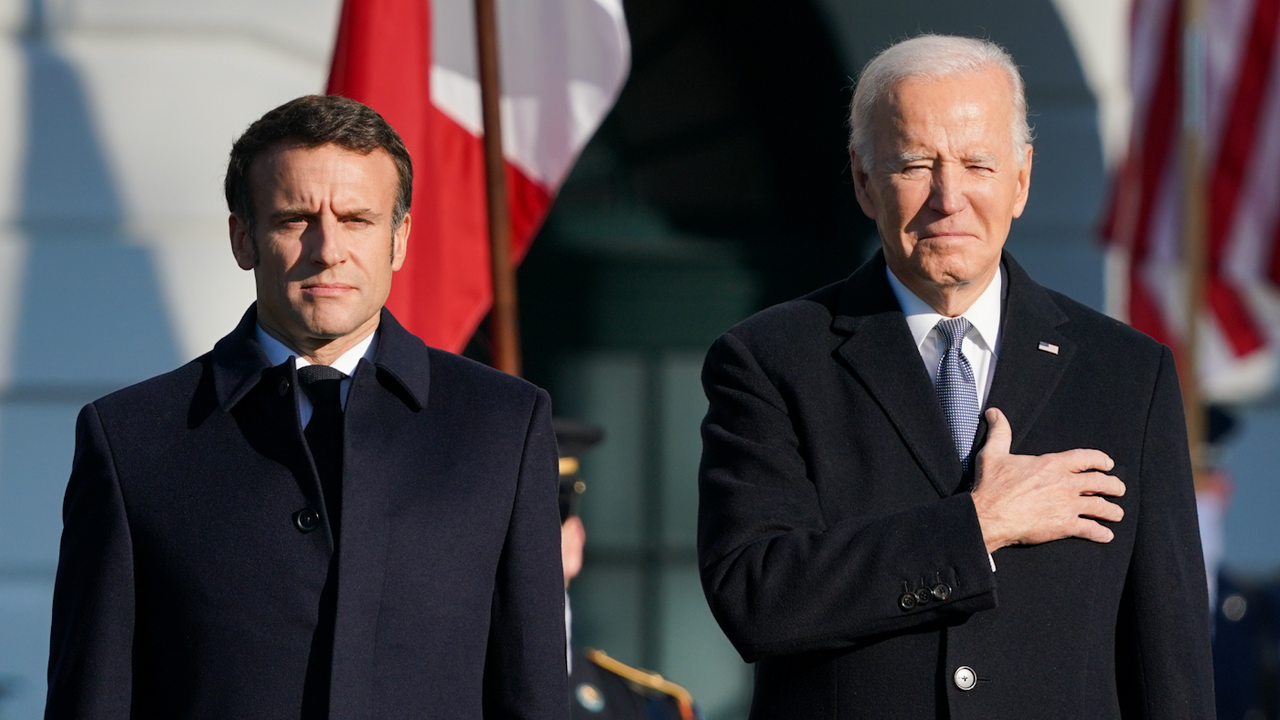
What the Pentagon Doesn’t Want You to Know About China
WEI YU, Dec 20, 2022, Common Dreams
We must be vigilant about the warmongering lies about China.
Escalating tension with China was a mistake, and building a colossal military budget is doubling down on this mistake.
To encourage Congress to authorize the largest defense budget ever, the Pentagon just released its annual report on China, which dangerously misrepresents the country’s defense strategy. Such deliberate lies about China to drum up justification for more US war spending need to be urgently addressed.
Let’s debunk these lies:
On Nuclear Weapons: The Pentagon reports that China possesses around 400 nuclear warheads with no clear plan on how to use them. If this estimation of China’s arsenal is correct, it’s still trivial compared to the US’s almost 6,000 warheads. China is the only nuclear power with an unconditional “no first use” policy, and has been clear that it only intends to use its nuclear power for assurance and defense. Meanwhile, the United States is the only country to have used nuclear weapons in war and has also flirted with escalating tensions into a nuclear war with Russia this year. Who is preparing for war?
On Global Military Presence: The Pentagon reports that since China established its first overseas military base in Djibouti, it has ambitions to expand its military presence globally. At the same time, the United State has more than 750 military bases in around 80 countries. This includes more than 250 bases in the Asia-Pacific encircling China with 375,000 personnel in the Indo-Pacific Command, while China has no military presence in the Western Hemisphere. Who is preparing for war?
On International Order: The Pentagon reports that China may challenge the US in the international arena. It is true that China is taking the lead internationally in economic development, in technological innovation, and in fighting climate change. Other countries around the world are happy for its support in growing their capacities to be independent of United States hegemony in their regions. China builds relationships through economic cooperation and good diplomacy. In contrast, the United States asserts its global dominance through direct or proxy war, occupation, crippling sanctions, and regime-changing coups. The international order that the United States seeks to maintain is rooted in violence and destruction. Let’s invest in peace, not war!
While the United States is desperately pursuing its outdated policy of enforcing global hegemony, the rest of the world is already moving towards a multilateral sphere, which ensures the greatest chance for peace. Escalating tension with China was a mistake, and building a colossal military budget is doubling down on this mistake. We must be vigilant about the warmongering lies about China. “China is not our enemy” is not a hollow slogan but firm ground that peacemakers stand on.
Ways to Take Action:……………………………. more https://www.commondreams.org/views/2022/12/20/what-pentagon-doesnt-want-you-know-about-china
Comments on a Jerusalem Post article that praised Ukraine’s Nazi Azov battalion.
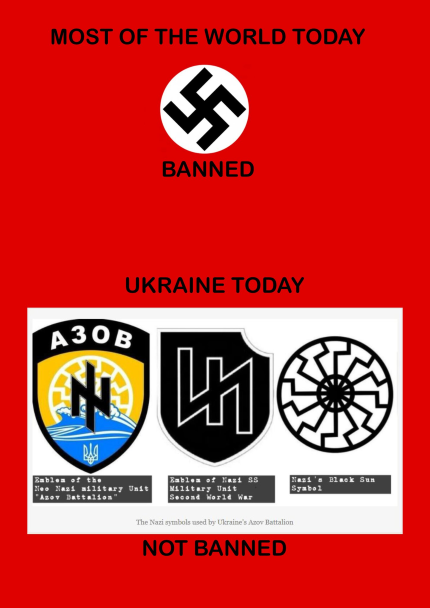

The AZOV regiment is visiting Israel. But not all Jews are taken in by this whitewashing of the Nazi history and influence in Ukraine. Below are some of the comments on the rather fawning Jerusalem Post article.
george130556, 21 December, 2022 Eternal shame on Israel for receiving these modern-day Nazis, who worship the murderers of tens of thousands of Jews in Ukraine during WWII.
Maurits2307 21 December, 2022 – “associated with neo-Nazi and far-right symbolism and ideologies, the Azov Regiment today insists that it has largely purged those sentiments from the regiment.” Russia is doing the purging. In the field, Ukranians still act like Nazis with multiple recorded war crimes. They wear Nazi insignia on their uniforms. Their vehicles have Nazi military insignia. If it looks like a Nazi, acts like a Nazi. It´s a Nazi.
Boris_SF 21 December, 2022, It is the Ukrainian establishment that glorify monsters like Chmelnitcki, Petliura, Bandera, Shukhevych and many officers of the Ukrainian SS Galicia Division on streets, squares and statues, all over Ukraine. It is true.
Jack, 20 December, 2022 Ukraine has this weird fixation with Israel
Israel should not be getting involved, Ukraine is soaked in Jewish blood, how Jews can want to help them defies belief.
Maybe read some history re pogroms and ww2, before you fall all over yourself to help them.
bjashka, 20 December, 2022 Don’t understand why we are welcoming Ukraine nationalist of contraversal Azov battalion. Part of the battalion members are public n@zis and were banned in US and Europe for this.
Baruch Baruch 20 December, 2022 As a Jew, an Israeli and a human being I am shocked that we are befriending these guys. I dont care about their battles with Russians. Their history, imagery and ideology as well as themed youth and adult training camps speaks for itself. Disgraceful to host these Na…. fascists
Jossef Perl, 20 December, 2022 Zelensky, his foreign minister and his ambassador to Israel have been putting a lot of outlandish demands on Israel (more than on many other European countries), yet at the same time Ukraine has continued to vote against Israel in the UN. Outrageous!
Adam Burman, 20 December, 2022 Over 230 missiles fired by the Ukraine armed forces at Donetsk peoples republic yesterday, hitting 20 residential buildings, 6 civil infrastructure facilities, and Kalinin hospital.
but hey, keep cheerleading your pet Ukronutsis, right?
PS: That hospital was bombed by the Ukronazis using Swedish Howitzers.
“…………….. The visit was initiated by the Israeli Friends of Ukraine organization and with the support of the Ukrainian Embassy in Israel and the Nadav Foundation.
T. Hoekstra, 20 December, 2022 This reeks of a whitewashing of Azov from their neonaughty brand.
Neonoughties however generally are not just anti-semites but white supremacist.
Also Masada was the place the defenders got into cannbalism or suicide.
Not really heroic, but tragic.
When it comes to Mariupol just look for how they arrived in Mariupol.
And how they took care of the protesting local population.
Any Pro Maidan apologist should get sick of these Azov guys.
Chikwa, 21 December, 2022 Terribly sad that Israelis ignoring their history. Those who do so are doomed to repeat it. We witnessed on TV how the Ukrainian soldiers discriminated vs African and Asian students trying to leave the Country as the Fled Putins army. Annti Semitismbis on the rise in EU and America. Liberal Jews turn a blind eye !
Miroslav Iliaš, 21 December, 2022 Half of the article is about how Azov Regiment distances itself from its neonazi past. We will see at the end of the bloody day – when the war finishes, how the Ukrainian society will deal with its dark past.
Ghost of kiev, 20 December, 2022 Well done JPost, just whitewash the azov n@zis.
democritique21 December, 2022, I can’t seem to quite get this! We allow a self-proclaimed natsi battalion to enter Eretz Israel and complain about the NYT’s natsi symbol stylized crossword???
maria992, 21 December, 2022 Total ignorance in history and secondary no comparison to Masada as Ukrainian are of Russian origin.
Adam Burman, 20 December, 2022 Ha Ha Ha! Jpost is actually running hasbara for Ukronazis.
National Socialists of the world Unite, I suppose, huh…
pizzaparty2579, 21 December, 2022 Is Israel a Jewish state? If so, how could Israel let these monsters in? Guess they are here to beg for money and we are the masochists.
ErastF , 21 December, 2022, I’m baffled. How was decided that just the Azov people will represent the Ukrainian interests in Israel? I don’t expect anything from the Ukrainian ambassador but didn’t the Israel friends of Ukraina hear something about the Azov regiment?
george130556, 21 December, 2022, Israel welcomes mass murderers, who carried out the massacres of civilians in Mariupol, Kramatorsk, Bucha, and Izyum.
wolfsonia, 21 December, 2022 , If Israel wants to stay or at least look neutral then hosting Azov is a stupid idea.
TCohen 19 Dec 22, The Azov Battalion ARE Nazis, so Israel’s allowance of entry IS UNACCEPTABLE and DEAD WRONG!
Yrraf, 21 December, 2022 Yes, every picture of the regiment shows how “distanced” they are from nazi ideology. For all people in the comment section go to the army recognition site and check for news that Ukrainian soldiers captured enough Russian BMP-3 IFVs to equip one battalion. Not a Rusian source, and without any hesitation, they are showing captured Rusian IFV with Wehrmacht insignia in Azov service. That’s how modern “journalists” in Izrael respect dead ancestors slaughtered by that same sick ideology.
MJandecka, 21 December, 2022 Azov? Neo Nazis.
************************************************************
Ukraine’s Azov Regiment visits Israel: ‘Mariupol is our Masada’, Azov officer Ilya Samoilenko, one of the defenders of the Azovstal steelworks in Mariupol, led the delegation to Israel. Jerusalem Post, By TZVI JOFFRE DECEMBER 20, 2022 https://www.jpost.com/international/article-725351
Zelensky’s ‘Hollywood-style’ US visit a ‘proxy war’ promotion
Rt.com 23 Dec 22
Russia’s ambassador to the US, Anatoly Antonov, has accused Washington of waging a “proxy war” against Moscow, saying that all the statements and declarations made during Ukrainian President Vladimir Zelensky’s visit only further prove that the Biden administration is not interested in a peaceful settlement…………
The ambassador specifically noted the US pledge to supply Kiev with Patriot air defense missiles, warning that such weapons and their crews would be legitimate targets for the Russian military. He also slammed the growing speculation about deliveries of ATACMS missiles and long-range attack drones……
Moscow has repeatedly tried to “appeal to common sense at all levels,” the diplomat said, stressing that shipments of increasingly modern and long-range weapons and other provocative actions by the US and its allies are leading to an escalation, with consequences “impossible to even imagine.” https://www.rt.com/russia/568712-washington-zelensky-ambassador-antonov/
European NATO members should reduce reliance on US – Macron
https://www.rt.com/news/568736-european-nato-reliance-macron/ 23 Dec 22, The countries should bolster their own defense to become less dependent on both the bloc and Washington, the French president says.
French President Emmanuel Macron has said European NATO members should become more autonomous and less dependent on the US-led alliance regarding their own security. He made the remarks late Wednesday, as he spoke to reporters in Paris after returning from a summit in Amman, Jordan.
“An alliance isn’t something I should depend on. It’s something that I should choose, something I work with,” Macron stated. “We must rethink our strategic autonomy.”
Macron identified “technology and defense capabilities” as areas in which European nations should seek to reduce their dependence on the alliance, and the US in particular. He added, however, that member states should not endeavor to break away from the bloc or develop an alternative to it.
“There is no European security architecture without strategic autonomy, inside NATO and with NATO, but not dependent on NATO,” he said.
Macron also touched upon the ongoing hostilities between Russia and Ukraine, in which the latter has received wide-ranging Western support. While reiterating his support for the “absolute defense of Ukraine,” he said once again that Moscow’s security concerns should be also addressed.
“When I speak of guarantees, I’m talking about all of these countries, for us, but also for Russia,” Macron stated. “This means that one of the essential points we must address – as President Putin has always said – is the fear that NATO comes right up to its doors, and the deployment of weapons that could threaten Russia.”
In recent weeks, the French president has repeatedly said that the conflict must eventually end with negotiations, which should yield security guarantees for everyone, including Russia. This stance triggered a barrage of criticism from Ukraine and some EU nations, with Poland, Slovakia, and the Baltic states openly opposing Macron’s suggestion.
Russia has signaled on several occasions that it is ready to talk with Ukraine – and the West as a whole – while insisting that its own interests must be taken into account if negotiations are to occur. Moscow has blamed the lack of diplomatic efforts to end the conflict on Kiev. On Wednesday, the head of Russia’s Federation Council, Valentina Matvienko, said there is “no background for negotiations to take place in the near future: There is nothing [to discuss] and with no one.”
Senior officials in Kiev have repeatedly issued belligerent statements, with Ukrainian President Vladimir Zelensky pledging to re-capture the former Ukrainian regions of Donetsk, Lugansk, Kherson, and Zaporozhye – which joined Russia in early October – as well as Crimea, which broke away from Kiev in 2014. Zelensky has even ‘banned’ himself from negotiating with Russian President Vladimir Putin.
Iran after a region free of nuclear weapons, Kharrazi says
TEHRAN, Dec. 19 (MNA) – Expressing Iran’s readiness to return to its JCPOA obligations, the head of Iran’s Foreign Policy Strategic Council said that for decades, Iran has been after a region free of nuclear weapons……………………………..
Iran ready to return to its JCPOA obligations
He also referred to IAEA technical team’s visit to Tehran, saying, “Now Iran is ready to return to its JCPOA obligations. Many problems have been solved so far except for the safeguard issues, and we hope that these issues will be resolved during this visit.”
For decades, Iran has been after a region free of nuclear weapons, he said, stressing that Israel’s nuclear weapons should also be destroyed and it should join safeguard.
Today, Iran has the necessary nuclear capability, but the country has no intention to build nuclear weapons, he underlined. https://en.mehrnews.com/news/195126/Iran-after-a-region-free-of-nuclear-weapons-Kharrazi-says
Chinese nuclear company still has a stake in UK’s Hinkley Point C project, and approval to build Bradwell project.
Following mounting pressure from Washington, the UK decided to ban Huawei
and other vendors it considered to be a high security risk from its 5G
networks in 2020. In November, after months of prevaricating, the
Government blocked the sale of Newport Wafer Fab, the UK’s largest
semiconductor plant, to Chinese-owned Nexperia.
It also bought the Chinese
state-owned power group CGN out of its stake in the Sizewell C nuclear
energy project in Suffolk. Under a long-standing deal, CGN, which the US
placed on an export blacklist back in 2019 after Washington accused it of
stealing American know-how for military purposes, invested in Hinkley Point
C power station in Somerset; then Sizewell C, which has just been given the
green light; and is still technically due to be the lead investor at
Bradwell-on-Sea in Essex where it is hoping to instal its own design of
reactor.
The Chinese company still retains a stake in Hinkley Point and
received formal approval for Bradwell from the UK’s nuclear regulator in
February. But there is growing scepticism at Westminster that the Chinese
will ever be able to build on the site.
Telegraph 18th Dec 2022
https://www.telegraph.co.uk/business/2022/12/18/how-foreign-states-raided-britains-crown-jewels/
Iran says Jordan summit ‘good opportunity’ for nuclear talks
Al-Monitor. Agence France-Presse, December 19, 2022 — Tehran (AFP)
Iran’s foreign minister said Monday that a summit to take place this week in Jordan will be a “good opportunity” for negotiations aimed at restoring the 2015 nuclear accord.
On-off talks to revive the deal, formally known as the Joint Comprehensive Plan of Action (JCPOA), started in April last year directly between Iran and Britain, China, France, Germany and Russia, and indirectly with the United States.
But the indirect talks between the Washington and Tehran, mediated by the European Union, have stalled for several months with Iran facing protests over the September 16 death in custody of Mahsa Amini, a 22-year-old Iranian of Kurdish origin.
………………………………
Meanwhile, a UN nuclear watchdog team led by deputy director-general Massimo Aparo left Iran on Monday, after a one-day visit aimed at resolving a years-long impasse over an enquiry into undeclared uranium particles found in the country, ISNA news agency reported.
The International Atomic Energy Agency team met with Iranian officials including Mohammad Eslami, the head of the Atomic Energy Organisation of Iran, ISNA said.
The IAEA has for years been calling on Iran to explain the presence of undeclared man-made uranium found at three sites, requesting access and the collection of samples.
The two parties discussed “future cooperation” among other issues, ISNA said……………………….more: https://www.al-monitor.com/originals/2022/12/iran-says-jordan-summit-good-opportunity-nuclear-talks#ixzz7nxK78WmI
UN committee adopts Russian draft resolution on prevention of arms race in space
https://tass.com/world/1531171 16 Dec 22
The resolution drew support from 124 delegations, while 48 voted against it and 9 abstained
UNITED NATIONS, November 1. /TASS/. The UN General Assembly First Committee on Tuesday adopted Russia’s draft resolution on Further Practical Measures for the Prevention of an Arms Race in Outer Space.
The resolution drew support from 124 delegations, while 48 voted against it and 9 abstained. The resolution is now expected to be considered by a full General Assembly in December. The document underscores the importance of taking urgent measures in order to forever prevent the deployment of weapons in the outer space, use of force or threat of force in the outer space, from space against Earth and from Earth against objects in space. The document calls on all states to achieve via negotiations corresponding legally binding multilateral agreements.
The UN General Assembly First Committee approved the Russian draft resolution “No first placement of weapons in outer space.” The document was supported by 123 delegations, with 50 voting against and 4 abstaining. The draft document is now expected to be reviewed by the General Assembly’s full membership in December.
The document was co-authored by 18 other states. It calls to promptly begin a substantial work based on the updated version of the 2008 draft agreement on prevention of deployment of weapons in space, use of force or threat of force against space objects, introduced by Russia and China. It reaffirms the need for examination and adoption of practical measures during development of agreements for prevention of an arms race in the outer space.
The committee approved without a vote the Russian draft resolution on Transparency and Confidence-Building Measures in Outer Space Activities.
The committee also adopted the Russian draft resolution “Transparency and confidence-building measures in outer space activities” without a vote. The document states that the UN Secretary General must inquire about opinions and proposals of member states on practical implementation of transparency measures, contained in the 2013 report of Group of government experts on transparency and trust-building measures in space.
For the Western leaders, Minsk Agreements were designed to buy time for Ukrainians to get ready for conflict with Russia
Former German chancellor Angela Merkel’s astonishing admission vis-a-vis Minsk II, made during an interview with German newspaper Die Zeit recently merely confirms that Putin was played for a fool when he entered negotiations for Minsk II with Germany, France and Ukraine in 2015. Russia entered said negotiations in good faith while the other parties involved did not. Thousands of lives lost and counting seven years on is the result.
Again and again, Ukraine’s future prosperity, security and stability upon becoming independent in 1991 was always dependent on it being a bridge between Russia and the West not the battlefield it became.
Merkel admits Minsk Agreements were designed to buy time for Ukrainians to get ready for conflict with Russia, yet Putin? Medium, John Wight, 13 Dec 22.
Sooner or later people in the West are going to have to wake up to the hard truth that their enemy is not at the gates but within the gates — this in the shape of ruling elites that have driven our world to the brink of destruction economically, ecologically, environmentally, and militarily with their lust for power, hegemony, domination and riches.
Before we go on, though, let us take a moment to deal with the usual ordure that gets shovelled in the direction of those in writing in the West who dare not type the name Putin in a sentence without also including words such as ‘tyrant’, ‘dictator’, ‘monster’ either before or after it — and preferably both. Here it is just as Eduardo Galeano said: “The marketplace of fear requires a steady supply of monsters.”
Russian President Vladimir Putin is a brutal man leading his country through a brutal period in human affairs. But he is not the architect of this brutal period; on the contrary, the Russia he has led since 2000 has been among the most grievous victims of it.
Canadian author and journalist Naomi Klein, in her remarkable work Shock Doctrine, describes how Russia was used as a laboratory by US free market think tanks, gurus and economists, who descended on the country while still reeling from the shock of the implosion of the Soviet system in the early 1990s. Their objective was the establishment of a pure market economy shorn of state intervention, wherein the market would decide who worked and who did not, who could heat themselves and who could not, who ate and who could not — and ultimately who would live and who would not………………………
The primary aim of the free market economic ‘hitmen’ who arrived in Russia in early 1990s was the decimation of every vestige of state involvement in the nation’s economy or economic life. Rather than the arbiter of social justice and guarantor of economic stability, the government was now to be reduced to the role of facilitator and guardian of the interests of international investors, shareholders, speculators, and global corporations.
This process entailed the deregulation of the banking system, the removal of social protections and safety nets, the lifting of price controls and the privatisation of all state owned sectors of the economy, sold off to speculators at a fraction of their true value. The aforementioned reforms were laid down as conditions of post-Soviet Russia’s membership of the IMF, when it applied to join under its first post-Soviet president, Boris Yeltsin, in 1992.
Moscow at this point was on the verge of bankruptcy, burdened with an external debt of $66 billion in the wake of the Soviet’s Union’s dissolution. The creditor nations of the G7 made it a condition of their cooperation in rescheduling the country’s debt that the IMF play a central role as policy advisor, lender and coordinator of assistance. Russia’s sovereignty, in other words, was to be suborned to the diktats of the IMF in Washington…………………………………………
the impact of this economic medicine on Russian society was nothing short of devastating. Most Russians consumed 40 percent less in 1992 after a year of shock therapy than they consumed in 1991, while a third of the population fell below the poverty line……………………
That the country managed to recover from this horrific decade was in large part down to the stewardship of Vladimir Putin. He it was who restored national pride, faced down the oligarchs who’d taken control of the nation’s economy, and reasserted the primacy of the state over that of blind economic forces.
Benefiting from its domination of the European energy market and an extended period of high oil and gas prices, Russia’s economic growth from 1999 — when Putin first became prime minister — to 2008 was exponential……………………..
The Putin so demonised in the West today is the same Putin that broached the possibility of Russia becoming a member of NATO with US President Bill Clinton in 2000. The Putin so demonised in the West today is the same Putin who was the first leader to call US President George W. Bush to express his condolences after 9/11 and offered the use of Russian airbases in Central Asia for US airstrikes against Al Qaeda and the Taliban in Afghanistan, staged in response.
That Putin is now to all intents engaged in conflict against the West in Ukraine marks an abject failure not of Russian but Western foreign policy in the wake of the demise of the Soviet Union.
Former German chancellor Angela Merkel’s astonishing admission vis-a-vis Minsk II, made during an interview with German newspaper Die Zeit recently merely confirms that Putin was played for a fool when he entered negotiations for Minsk II with Germany, France and Ukraine in 2015. Russia entered said negotiations in good faith while the other parties involved did not. Thousands of lives lost and counting seven years on is the result.
Again and again, Ukraine’s future prosperity, security and stability upon becoming independent in 1991 was always dependent on it being a bridge between Russia and the West not the battlefield it became.
In the words of Professor John J. Mearsheimer:
U.S. and European leaders blundered in attempting to turn Ukraine into a Western stronghold on Russia’s border. Now that the consequences have been laid bare, it would be an even greater mistake to continue this misbegotten policy. https://johnwight1.medium.com/merkel-admits-minsk-ii-was-designed-to-buy-time-for-the-ukrainians-to-get-ready-for-conflict-with-504191f7872d
A Tale of Two Nuclear Plants Reveals Europe’s Energy Divide
An upgraded power plant in Slovakia has angered neighboring Austria and fueled the debate over nuclear power and independence from Russian gas.
Wired, MORGAN MEAKER, DEC 13, 2022
……………………………………….. Europe remains deeply divided on the use of nuclear power. Of the European Union’s 27 member states, 13 generate nuclear power, while 14 do not. “It’s still a very national debate,” says Bunsen. That means public attitudes can drastically change from one side of a border to the other. Surveys show that 60 percent of Slovakians believe nuclear power is safe, while 70 percent of their neighbors in Austria are against it being used at all—the country has no active nuclear plants.
……… workers are preparing a new reactor—where nuclear fission will take place—for launch in early 2023.
………….. Europe remains deeply divided on the use of nuclear power. Of the European Union’s 27 member states, 13 generate nuclear power, while 14 do not. “It’s still a very national debate,” says Bunsen. That means public attitudes can drastically change from one side of a border to the other. Surveys show that 60 percent of Slovakians believe nuclear power is safe, while 70 percent of their neighbors in Austria are against it being used at all—the country has no active nuclear plants.
For the two neighbors, Mochovce has become a focal point in the debate over how Europe should transition away from fossil fuels. To supporters in Slovakia, Mochovce’s expansion—the launch of Unit Three is expected to be followed two years later by Unit Four—demonstrates how even a small country can become an energy heavyweight. Unit Three will make Slovakia the second-largest producer of nuclear power in the EU, after France. But neighboring Austrians cannot ignore what they consider to be the drawbacks: the mammoth costs associated with building or improving aging facilities, the problems associated with disposing of nuclear waste, and the sector’s reliance on Moscow for uranium, the fuel which powers the reactor. Last year, the EU imported one fifth of its uranium from Russia.
For years, politicians and activists in Austria have also alleged that Mochovce is not safe, with local newspapers using maps to illustrate how close Mochovce is to Vienna: just 150 kilometers. “It’s a Soviet design from the 1980s, without a proper containment,” claims Reinhard Uhrig, an antinuclear campaigner with Austrian environmental group GLOBAL 2000. The containment is one of a series of safety systems that prevents radioactive material being released into the environment in case of an accident. “Apart from these inherent design problems, there have been major issues with the quality control of the works,” he says, describing nuclear power as a dangerous distraction from real solutions to the climate crisis.
Concerns in Austria about Mochovce’s safety were exacerbated by Mario Zadra, an engineer turned whistleblower who worked on Mochovce units Three and Four between 2009 and 2018. Zadra alleges the plant’s emergency diesel generators were suffering serious technical issues and cooling towers fundamental for safety were built with the wrong material. “Other components important for safety, like the main steam isolation valves, were in a shameful condition,” says Zadra, whose video and photo evidence have been verified by GLOBAL 2000. Since Zadra and other whistleblowers went public in 2018, Mochovce has been accused of corruption, raided by police, and inspected by the International Atomic Energy Agency. “I’m sure things have improved since the inspections,” Zadra says, but he still doesn’t believe the plant is safe due to what he calls the company’s “poor safety culture.”
………………………………….. Long-term, Austria is aiming to run 100 percent on renewables by 2030. Wind, solar, and hydro power currently account for 77 percent of the country’s power generation.
Austria is now agitating to spread its antinuclear message on an EU level. Officials have criticized nuclear power plants not just in Slovakia, but also in other neighboring countries, including the Czech Republic and Hungary. On New Year’s Eve 2021, the European Commission released a proposal which defined nuclear as well as natural gas as “green investments.” In response, Austria launched a legal challenge, calling for the inclusion of the two energy sources to be annulled. “Neither nuclear energy nor fossil gas are green investments,” says Gewesseler.
Zwentendorf and Mochovce demonstrate the extremes of Europe’s nuclear power debate. But between those extremes, it’s messy. The EU might have agreed to become the first climate-neutral continent by 2050, but consensus on how that will happen remains elusive. Weish, the Austrian scientist, believes there’s a lot more debating to be done. “The EU needs to have the debate Austria had back in the 1970s,” he says. https://www.wired.com/story/nuclear-energy-europe/
Japanese prime minister may seek in-depth nuclear abolition talks at Hiroshima G7 summit
Japan Times, 11 Dec 22, HIROSHIMA – Prime Minister Fumio Kishida on Sunday expressed hope to hold thorough debates for a world without nuclear weapons at next year’s Group of Seven summit in Hiroshima in May.
“I want to deepen discussions (at the G7 summit) so that we can release a strong message toward realizing a world free of nuclear weapons,” he said at a closing ceremony for the first meeting of the International Group of Eminent Persons for a World without Nuclear Weapons, or IGEP, held in Hiroshima for two days from Saturday.
“We are facing tough barriers over nuclear disarmament, such as growing threats to use nuclear weapons,” Kishida said, asking IGEP member experts to “produce meaningful outcomes regarding specific ways to bring the tough reality closer to the ideal.”………………… more https://www.japantimes.co.jp/news/2022/12/11/national/fumio-kishida-nuclear-weapons/
USA and UK welded together firmly in the grip of the nuclear lobby, with their Small Nuclear Reactor folly.

UK and US ‘like-minded’ on nuclear power as key to energy security,
SMR, Rob Harris, December 7, 2022 British Prime Minister Rishi Sunak and his counterpart, US President Joe Biden, have announced a new venture to secure supply and reduce price volatility, with the US promising to more than double the amount of gas it exported to the UK last year.
British Prime Minister Rishi Sunak and his counterpart, US President Joe Biden, have announced a new venture to secure supply and reduce price volatility, with the US promising to more than double the amount of gas it exported to the UK last year.
The new “UK-US Energy Security and Affordability Partnership” will aim to reduce global dependence on Russian energy exports, stabilise energy markets and step up collaboration on energy efficiency, nuclear and renewables.
But the focus on nuclear sharpens the divide between Australia’s attitudes towards a civil nuclear power industry and those of its two closest allies – governments of all persuasions in Canberra have outlawed a domestic industry and resisted calls to overturn the ban for decades……………..
In a joint statement, Sunak and Biden said their new agreement would promote nuclear energy as “a safe and reliable part of the clean energy transition”.
“This includes deepening global collaboration on nuclear fuels and advanced nuclear technologies.”
They said both nations would work to deepen global collaboration between “like-minded countries” on small modular reactors (SMRs) and support a resilient and diversified nuclear fuel supply chain………………………………….
Nuclear power is now firmly back on the agenda, particularly in Britain and France, amid new fears for energy security following Russia’s invasion of Ukraine and the ever-greater need to reduce global carbon emissions.
The US, with 92 commercial reactors, is the world’s largest producer, accounting for more than 30 per cent of the nuclear-generated electricity worldwide.
Large reactor projects are still facing financial and construction problems, with the UK’s 3.2 gigawatt Hinkley Point C plant hit by delays and cost overruns. But analysts believe [for “analysts” read “nuclear salesmen”]the time may be right for SMRs – which could also prove affordable to nations unable to fund large nuclear plants…………
Australian Prime Minister Anthony Albanese this week rebuffed a push by South Australian Premier, Peter Malinauskas, to restart the nuclear debate in Australia, citing waste and safety concerns as key reasons nuclear should not be considered as an energy option………
“I haven’t changed my view that it’s a huge distraction from what we need to do. It just doesn’t add up,” he said on Adelaide radio 5AA. “That’s essentially the problem. Every five years or so we have this economic analysis of whether nuclear power stacks up and every time it’s rejected.”……….. https://www.smh.com.au/world/europe/uk-and-us-like-minded-on-nuclear-power-as-key-to-energy-security-20221207-p5c49q.html
Europe accuses US of profiting from war

EU officials attack Joe Biden over sky-high gas prices, weapons sales and trade as Vladimir Putin’s war threatens to destroy Western unity.
BY BARBARA MOENS, JAKOB HANKE VELA AND JACOPO BARIGAZZI, NOVEMBER 24, 2022 “………………….. Top European officials are furious with Joe Biden’s administration and now accuse the Americans of making a fortune from the war, while EU countries suffer.
“The fact is, if you look at it soberly, the country that is most profiting from this war is the U.S. because they are selling more gas and at higher prices, and because they are selling more weapons,” one senior official told POLITICO.
The explosive comments — backed in public and private by officials, diplomats and ministers elsewhere — follow mounting anger in Europe over American subsidies that threaten to wreck European industry. The Kremlin is likely to welcome the poisoning of the atmosphere among Western allies.
“We are really at a historic juncture,” the senior EU official said, arguing that the double hit of trade disruption from U.S. subsidies and high energy prices risks turning public opinion against both the war effort and the transatlantic alliance. “America needs to realize that public opinion is shifting in many EU countries.”………………………..
As they attempt to reduce their reliance on Russian energy, EU countries are turning to gas from the U.S. instead — but the price Europeans pay is almost four times as high as the same fuel costs in America. Then there’s the likely surge in orders for American-made military kit as European armies run short after sending weapons to Ukraine. ……………………….
Officials on both sides of the Atlantic recognize the risks that the increasingly toxic atmosphere will have for the Western alliance. The bickering is exactly what Putin would wish for, EU and U.S. diplomats agreed.
The growing dispute over Biden’s Inflation Reduction Act (IRA) — a huge tax, climate and health care package — has put fears over a transatlantic trade war high on the political agenda again. EU trade ministers are due to discuss their response on Friday as officials in Brussels draw up plans for an emergency war chest of subsidies to save European industries from collapse.
“The Inflation Reduction Act is very worrying,” said Dutch Trade Minister Liesje Schreinemacher. “The potential impact on the European economy is very big.”
“The U.S. is following a domestic agenda, which is regrettably protectionist and discriminates against U.S. allies,” said Tonino Picula, the European Parliament’s lead person on the transatlantic relationship…………………………
Behind the scenes, there is also growing irritation about the money flowing into the American defense sector.
The U.S. has by far been the largest provider of military aid to Ukraine, supplying more than $15.2 billion in weapons and equipment since the start of the war. The EU has so far provided about €8 billion of military equipment to Ukraine, according to Borrell.
According to one senior official from a European capital, restocking of some sophisticated weapons may take “years” because of problems in the supply chain and the production of chips. This has fueled fears that the U.S. defense industry can profit even more from the war.
The Pentagon is already developing a roadmap to speed up arms sales, as the pressure from allies to respond to greater demands for weapons and equipment grows. ……………………… more https://www.politico.eu/article/vladimir-putin-war-europe-ukraine-gas-inflation-reduction-act-ira-joe-biden-rift-west-eu-accuses-us-of-profiting-from-war/
UN: Israel must take ‘immediate steps’ to give up nuclear weapons
https://www.middleeastmonitor.com/20221208-un-israel-must-take-immediate-steps-to-give-up-nuclear-weapons/ December 8, 2022
The UN General Assembly has called on Israel to take “immediate steps” to surrender its nuclear weapons and implement UN resolutions fully on the establishment of a nuclear weapon-free zone in the Middle East.
The General Assembly vote was carried 149-6 yesterday. Israel, Canada, Micronesia, Palau, the US and Liberia opposed the resolution, while another 26 countries abstained, including India and many European states.
Among other provisions, the draft resolution called for immediate steps towards the full implementation of the resolution on the Middle East adopted by the 1995 Non-Proliferation Treaty. The key component of the package deal adopted in the treaty calls for the creation of a Middle East “zone free of nuclear weapons as well as other weapons of mass destruction” including “their delivery systems.”
The world body insisted that Israel must “accede to the Treaty without further delay, and not to develop, produce, test or otherwise acquire nuclear weapons, to renounce their possession and to place all its unsafeguarded nuclear facilities under full-scope International Atomic Energy Agency (IAEA) safeguards.”
Israel’s possession of nuclear weapons is an open secret. Although it’s widely believed to have a stockpile of nuclear weapons, the apartheid state neither acknowledges nor denies the existence of a nuclear arsenal. Israel is not a party to the Non-Proliferation Treaty and has not accepted IAEA safeguards on some of its principal nuclear activities.
Western countries have generally tolerated Israel’s policy of nuclear ambiguity despite the threat it poses to the region. The UN resolution presumes that Israel has such weapons and calls on it to accede to the Non-Proliferation Treaty.
Macron: Russia Needs Security Guarantees ‘Essential’ To Ending The War

https://www.zerohedge.com/geopolitical/macron-russia-needs-security-guarantees-which-are-essential-ending-war BY TYLER DURDEN 6 Dec 22
As we detailed earlier, a clear division is arising between Europe and the United States over Washington’s more hawkish and hardline stance on resisting all negotiations with Russia, but instead which is centered on encouraging Kiev to pursuing ‘victory’ on the battlefield.
“The fact is, if you look at it soberly, the country that is most profiting from this war is the U.S. because they are selling more gas and at higher prices, and because they are selling more weapons,” one senior European official bluntly complained to Politico last month.
Underscoring that Europe is more ready to pursue avenues of negotiated settlement in Ukraine, over the weekend French President Emmanuel Macron urged for the West to take seriously Russia’s security concerns regarding NATO expansion near its border. He called for greater willingness to give Moscow the “guarantees” necessary for negotiations to be successful. He called them ‘essential’ if the West wants to get serious about talks and peaceful settlement.
“We need to prepare what we are ready to do, how we protect our allies and member states, and how to give guarantees to Russia the day it returns to the negotiating table,” President Macron said in an interview that aired Saturday.
That’s when he underlined something which a mere months ago would elicit rage and accusations of ‘pro-Kremlin’ stooge among Western mainstream punditry. “One of the essential points we must address — as President Putin has always said — is the fear that NATO comes right up to its doors, and the deployment of weapons that could threaten Russia,” Macron said.
The timing of the remarks was interesting given the interview was recorded while he was on the US on a state visit to the White House, and it aired as he departed.
According to The New York Times, “The interview with TF1, a French television network, appeared sympathetic to the concerns of President Vladimir V. Putin of Russia and was immediately picked up prominently by TASS, the Russian state news agency. It prompted an angry reaction in Ukraine.”
While there was no immediate reaction from the Biden administration, the Ukrainian presidency’s office said such negotiations and security guarantees would only be possible “after tribunal, conviction of war authors and war criminals” and the “imposition of large-scale reparations.”
Separately, David Arakhamia, the chief of the Ukrainian negotiating group involved in short-lived ceasefire talks in the opening months of the war, also echoed that Russian forces must first “leave the territory of our country; pay reparations; punish all war criminals; voluntarily give up nuclear weapons.”
The Times further points out that Russian state media was quick to amplify Macron’s interview statements:
Responding to a tweet from TASS featuring Mr. Macron’s remarks, Nicolas Tenzer, a prominent French political scientist and essayist, commented: “Devastating.”
During the summer months and prior, European leaders seemed to tilt toward Washington’s more hardline approach to the conflict, but with the energy crisis becoming more acute and now headed into the winter months it appears a new consensus is emerging.
As another example, German Chancellor Olaf Scholz spoke with President Vladimir Putin on Friday, with the Kremlin side later saying that Scholz admitted the West’s policy on Ukraine is “destructive” and that Berlin may pursue a rethinking of its policy
1 This Month



26 September – International Day for the Total Elimination of Nuclear Weapons


PLEASE OPPOSE HR 8255 AND S.3639 – bills would accelerate satellite deployment, with no environmental review or safeguards – https://ncstd5li.quorum.us/campaign/169331/
To see nuclear-related stories in greater depth and intensity – go to https://nuclearinformation.wordpress.com
-
Archives
- September 2026 (245)
- August 2026 (330)
- July 2026 (355)
- June 2026 (287)
- May 2026 (306)
- April 2026 (356)
- March 2026 (251)
- February 2026 (267)
- January 2026 (308)
- December 2025 (358)
- November 2025 (359)
- October 2025 (375)
-
Categories
- 1
- 1 NUCLEAR ISSUES
- business and costs
- climate change
- culture and arts
- ENERGY
- environment
- health
- history
- indigenous issues
- Legal
- marketing of nuclear
- media
- opposition to nuclear
- PERSONAL STORIES
- politics
- politics international
- Religion and ethics
- safety
- secrets,lies and civil liberties
- spinbuster
- technology
- Uranium
- wastes
- weapons and war
- Women
- 2 WORLD
- ACTION
- AFRICA
- Atrocities
- AUSTRALIA
- Christina's notes
- Christina's themes
- culture and arts
- Events
- Fuk 2022
- Fuk 2023
- Fukushima 2017
- Fukushima 2018
- fukushima 2019
- Fukushima 2020
- Fukushima 2021
- general
- global warming
- Humour (God we need it)
- Nuclear
- RARE EARTHS
- Reference
- resources – print
- Resources -audiovicual
- Weekly Newsletter
- World
- World Nuclear
- YouTube
-
RSS
Entries RSS
Comments RSS
 nuclear-news