Australian Navy commanders will have full operational control over their submarines and the powerful nuclear reactors onboard, despite the potential presence of US or UK engineers.
Key points:
US or UK personnel may go to sea on Australian nuclear submarines
Australian technicians will understand “every detail” of how the reactors work
Construction in Adelaide shipyards may begin by end of 2020s
Vice Admiral Jonathan Mead, chief of the AUKUS submarine taskforce, has rejected criticisms that the nuclear propulsion program, based on US technology, would undermine Australian sovereignty.
“When we take command of our first boat, we will have sovereign capability,” he told 7.30‘s Sarah Ferguson in an exclusive interview.
Details of extensive plans to build a fleet of eight boats powered with weapons-grade uranium will be revealed next month.
Vice Admiral Mead was asked what would happen onboard in the event of any dispute over the nuclear reactor, including following an accident, between a US or UK engineer and the boat’s Australian commander.
“We would expect anyone, be it a foreign engineer or an Australian engineer, to provide advice,” he said.
But the commanding officer of that submarine, the Australian, would have “command and control over the reactor, over the submarine – unequivocal”.
Australians will understand ‘every detail’ of welded-shut nuclear reactors
The defining feature of the submarine deal is that the highly enriched uranium reactors that power the boats will be supplied by either the US or UK, and “welded shut”.
The use of weapons-grade fuel means the reactors do not need to be opened for refuelling over the 30-plus-year life of the boat. Reactors that run on low-enriched uranium, like those used by the French and Chinese navies, do require refuelling.
This also means Australia will not need to manufacture nuclear fuel – one of the commitments the country has made to the International Atomic Energy Agency.
Vice Admiral Mead said Australia would, however, be sending people to US “design facilities” so we would understand “every element of detail of that reactor”.
No Australian reactors … for now
Asked if Australia is considering building its own nuclear reactors in the future, Vice Admiral Mead said: “We are not envisioning that at the moment, we haven’t gone into that at the moment.”
The senior Navy official has spoken previously about the need for the AUKUS program to have public support.
Asked what would happen to an Australian nuclear-propelled submarine that was hit by a missile, Vice Admiral Mead said he could not reveal the technical details but that “nuclear-powered submarines are designed for exacting standards”.
He also said that submariners receive only minimal doses of radiation onboard – less than an ordinary person walking the streets of a capital city.
UK or US-designed boat, and when will we see them?
Addressing the scale of the program, Vice Admiral Mead said if Australia wanted to begin construction of new boats in Adelaide “towards the end of this decade” the government would need to quickly finalise the construction of a revamped shipyard.
He also described the extraordinary staffing requirements of the project, requiring nuclear physicists, chemists and engineers, as well as specialist tradesmen.
One of the biggest questions around AUKUS is whether Australia would be left without a functioning submarine force before the new boats are launched, as the ageing Collins fleet approaches retirement.
Vice Admiral Mead said unequivocally there would be no gap, but would not be drawn on the Navy’s specific plans.
The UK defence secretary, Ben Wallace, recently suggested a new submarine design the three countries could share was under consideration.
Asked whether that strategy would further delay the delivery of new submarines, Vice Admiral Mead reaffirmed there would be no gap in Australia’s capability.
China is the motivation
Vice Admiral Mead said rapid changes in the Indo Pacific had sharpened strategic competition.
“We’ve also seen in recent years a significant modernisation in the Chinese military, particularly the Navy,” he said.
Australia’s current fleet of Collins class submarines run on diesel-electric engines that are extremely quiet when running off the battery.
Nuclear submarines have massive range and the stealth advantage of not needing to resurface, but they do have reactor components that can’t be easily switched off to “go quiet”.
The pros and cons of nuclear and conventional submarines have led defence analysts to suggest a new generation of diesel submarines should be considered as well, particularly to operate closer to the Australian coastline – while the nuclear boats could be prioritised for operations further away from the mainland.
But Vice Admiral Mead said the nuclear submarines would be a good option in both theatres.
“Nuclear-powered submarines provide a capability to deploy away from the home shore, or to deploy close to home shore,” he said.
Pressed on whether conventional submarines would be quieter for closer operations, Vice Admiral Mead said under some circumstances nuclear submarines could be “just as quiet”.
“It’s often more to do with the age and the technology of the submarine that we are dealing with,” he said.
Vice Admiral Mead said the purpose of nuclear-powered submarines was to “put the greatest question of doubt in the enemy’s mind” and “if necessary, respond with massive firepower”.
Thankfully, one or two sober notes of reflection have prevailed, even from within the military-intelligence fraternity. The Center for Strategic and International Studies has issued a few self-evident truths. ‘Balloons are not an ideal platform for spying,’ writes James Andrew Lewis, ‘they are big and hard to hide. They go where the winds take them’. Such instruments ‘would be a strange choice for a technologically advanced and sophisticated opponent’.
Independent Australia, By Binoy Kampmark | 13 February 2023
Hysteria over balloons is a strange thing, writes Dr Binoy Kampmark.
HOT AIR balloons first appeared during the Napoleonic era, where they served as delivery weapons for bombs and undertook surveillance tasks. High-altitude balloons were also used by, of all powers, the United States during the 1950s, for reasons of gathering intelligence, though these were shot down by the irritated Soviets.
On 28 January, a device reported to be a “high-altitude surveillance balloon” entered U.S. airspace in Alaska. It then had a brief spell in Canadian airspace before returning to the U.S. via Idaho on 31 January.
On 4 February, with the balloon moving off the coast of South Carolina, a decision was made by the U.S. military to shoot it down using an F-22 Raptor from the First Fighter Wing based at Langley Air Force Base. The Pentagon has revealed that the collection of debris is underway.
In response, the Chinese Foreign Ministry issued a stern note of disapproval, protesting:
‘The US attack on a civilian unmanned airship by force.’
This was ‘a clear overreaction and a serious violation of international practice’. Beijing also issued a note of apology, regretting ‘the unintended entry of the ship into U.S. airspace due to force majeure’.
A U.S. State Department official, while noting the statement of regret, felt compelled to designate:
‘The presence of this balloon in our airspace [as] a clear violation of our sovereignty as well as international law.’
Rumours of a second Chinese balloon flying across Latin America were also confirmed by a spokesperson of the Chinese Foreign Ministry on 6 February, who described it as being “of a civilian nature and is used for flight tests”.The instrument had been impaired by weather in its direction, having “limited self-control capabilities”.
The Pentagon’s press secretary, Brigadier General Pat Ryder, also confirmed the existence of the second balloon, reaching the predictably opposite conclusion to his Chinese counterparts:
“We are seeing reports of a balloon transiting Latin America. We now assess it is another Chinese surveillance balloon.”
This overegged saga has seen much airtime and column space dedicated to those in the pay of the military-defence complex. Little thought was given to the purpose of such a seemingly crude way of collecting military intelligence. Timothy Heath of the Rand Corporation went so far as to extol the merits of such cheeky devices. For one thing, they were hard to detect, making them somehow reliable.
General Glen VanHerck, commander of North American Aerospace Defense Command and U.S. Northern Command, made reference to a number of Chinese spy balloons that supposedly operated with impunity during the Trump Administration. “I will tell you that we did not detect those threats,” he said. This had resulted in a “domain awareness gap that we have to figure out”.
The begging bowl for even larger defence budgets is being pushed around the corridors of power.
Lawyers of international law have also had their say, reaching for their manuals, and shaking their heads gravely. Donald Rothwell of the Australian National University thought that:
‘The incursion of the Chinese balloon tested the boundaries of international law.’
Thankfully, one or two sober notes of reflection have prevailed, even from within the military-intelligence fraternity. The Center for Strategic and International Studies has issued a few self-evident truths. ‘Balloons are not an ideal platform for spying,’ writes James Andrew Lewis, ‘they are big and hard to hide. They go where the winds take them’. Such instruments ‘would be a strange choice for a technologically advanced and sophisticated opponent’.……………………………..
The Chinese explanation has been scoffed at and derisively dismissed. Yet balloons are an almost quotidian feature of scientific and meteorological work, whatever the official explanation offered by Beijing might be. NASA’s own Scientific Balloon Program, for instance, has been most engaged of late.
The organisation was keen to tout its fall 2022 campaign involving six scientific, engineering and student balloon flights in support of 17 missions.
The scale of any one mission be sizeable. ‘Our balloon platforms’, came the description from NASA’s Scientific Balloon chief Debbie Fairbrother, ‘can lift several thousand pounds to the edge of space, allowing for multiple, various scientific instruments, technologies, and education payloads to fly together in one balloon flight’.
The disproportionate nature of Washington’s reaction to Beijing over such balloons also looks rather odd in the face of the vast surveillance technologies it deploys against adversaries and friends.
US DOE changes rules for nuclear information exchange with Mexico, Colombia, Egypt
S and P Global, William Freebairn,
Mexico rules relaxed after nuclear cooperation agreement reached
Work with Colombia, Egypt now requires specific permission
The US Department of Energy has made it easier to share nuclear information with Mexico and harder to do so for Colombia and Egypt.
In a new rule effective Feb. 9, DOE expanded the requirements for sharing nuclear energy technology with Mexico, doing away with a limit that had only allowed such general sharing on matters related to upgrades and operation of its single nuclear power plant, Laguna Verde, or research reactors. Now, the country becomes a generally-authorized destination for sharing nuclear technology without those limits, DOE said
Under rules in Part 810 covering the exchange of certain non-public commercial nuclear energy technology, countries may be generally authorized, meaning information can be shared with those countries as well as citizens of those countries working at nuclear facilities in the US.
The United States is not preparing to go to war against China. The United States is preparing Australia to go to war against China.
Defence and military weapons manufacturing industries in Australia are now largely owned by US weapons corporations – Lockheed Martin, Raytheon, Boeing, Thales, NorthropGrumman. The deep integration of Australia’s defence industries and economy into the US military-industrial complex greatly influences Australia’s foreign/defence policies.
The Threat. All these preparations are justified by the false premise that China presents a military threat. China has not invaded anywhere. It has never proposed use of force against other countries. It has enshrined in its Constitution the ‘Three No’s – No military alliances; No military bases; No use, or threat to use, military force. China has, however, reserved the right to use force to prevent secession by Taiwan.
Guardian, By John Lander, Feb 1, 2023Edited transcript of a speech to the Committee for the Republic, Salon, 18 January 2023.
The ANZUS Treaty
A look at the ANZUS Treaty and the way it has been manipulated over time will explain why I have come to this conclusion.
Originally defensive in concept, the ANZUS Treaty was seen by Australia from its very beginning as a means to “achieve the acceptance by the USA of responsibility in SE Asia” (Percy Spender) to shield Australia from perceived antagonistic forces in its region. It has, however, developed into an instrument for the furtherance of US ability to prosecute war globally – previously in Iraq and Afghanistan, currently against Russia and potentially against China.
The ANZUS Treaty, usually referred to in reverential tones as “The Alliance”, has been elevated to an almost religious article of faith, against which any demur is treated as heresy amounting to treachery. Out of anxiety to cement the US into protection of Australia, the Alliance has been invoked as justification for Australia’s participation in almost every American military adventure – or misadventure – since WW II.
Unlike NATO or the Defence Treaty with Japan, the ANZUS treaty actually provides no guarantee of protection, merely assurances to consult on appropriated means of support in the event that Australia should come under attack.
On the other hand, the Alliance has facilitated the steady growth of American presence in Australia, to the point that it pervades every aspect of Australian political, economic, financial, social and cultural life. Australians fret about China “buying up the country”, but American investment is ten times the size.
They are unaware or uncaring that almost every major Australian company across the resources, food, retail, mass media, entertainment, banking and finance sectors has majority American ownership. Right now US corporations eclipse everyone else in their ability to influence our politics through their investment in Australian stocks.
The transfer of Australian assets to American ownership has continued unabated: In the second half of 2021 then Treasurer Josh Frydenberg approved the transfer of $130 billion of Australian assets to foreign private equity funds, benefiting Goldman Sachs who facilitated the transactions, by multimillions of dollars. Josh Frydenberg now is employed by Goldman Sachs:
Sydney Airport – Macquarie Bank led by a NY investment banker
AusNet (electricity infrastructure) $18 billion takeover by Brookfield – NY via Canada
SparkInfrastructure (electricity) $5.2 billion takeover by American interests
AfterPay financial transaction system $39 billion takeover
Healthscope, second-biggest private hospitals group (72 Hospitals) taken over by Brookfield and now controlled in the Cayman Islands.
The USA and the UK between them represent nearly half of all foreign investment. China plus Hong Kong represents 4.2%. The 4 big “Aussie” banks are dependent on foreign capital which dictate local banks’ policies and operations.
Defence and military weapons manufacturing industries in Australia are now largely owned by US weapons corporations – Lockheed Martin, Raytheon, Boeing, Thales, NorthropGrumman. The deep integration of Australia’s defence industries and economy into the US military-industrial complex greatly influences Australia’s foreign/defence policies.
That, plus US capture of Australia’s intelligence and policy apparatus through the “Five Eyes” network and ASPI (which has lobbyists from American arms manufacturers on a Board headed by an operative trained by the CIA) means that the US is able to swing Australian policy to support America in almost all its endeavours.
Despite the fact that it contains no guarantee of US protection of Australia, the Treaty and further arrangements under its auspices, such as the 2014 Force Posture Agreement and now AUKUS, have greatly facilitated US war preparation in Australia. This has accelerated exponentially in the past few years. The US now describes Australia as the most important base for the projection of US power in the Indo-Pacific.
Indicators of war preparations
* 2,500 US marines stationed in Darwin practicing for war with the Australian Defence Forces, soon to include the Japanese Defence Forces
* Establishment of a regional HQ for the U.S. Indo-Pacific Command in Darwin
* Lengthening the RAAF aircraft runways in Northern Territory at our expense for servicing US fighters and bombers
* Proposed stationing of 6 nuclear weapons-capable B52 Bombers at RAAF Tindal in NT
* Construction of massive fuel and maintenance facilities in Darwin NT for US aircraft
* Proposed acquisition of eight nuclear-propelled submarines at the cost of $170 billion for hunter-killer operations in the Taiwan Strait
* Construction, at the cost of $10 billion, of a deep water port on Australia’s east coast for US and UK nuclear powered and nuclear missile-carrying submarines
* The long-established satellite communications station known as Pine Gap in central Australia has recently, and is still being, expanded and upgraded. It is key to the command and control of US forces in the Indo-Pacific (and even as far afield as Ukraine)
The Government and right wing anti-China analysts and commentators, whose opinions dominate main stream media, accept the Defence Minister’s contention that this militarisation enhances Australia’s sovereignty by strengthening the range and lethality of Australia’s high-end war-fighting capability to provide a credible deterrent to a potential aggressor.
Many analysts and commentators outside the governing elite, including myself, argue that these arrangements effectively cede Australian sovereignty to America. This is especially because of the provisions of the Force Posture Agreement of 2014, entered into under the auspices of ANZUS.
I understand that a paper has been circulated to the Committee, expounding the details of the FPA, so in summary, it gives unimpeded access, exclusive control and use of agreed facilities and areas to US personnel, aircraft, ships and vehicles and gives Australia absolutely no say at all in how, when where and why they are to be used.
All Australian analysts, whether sympathetic or antipathetic to China, agree on one point. That is, that if the US goes to war against China over the status of Taiwan, or any other issue of contention, Australia will inevitably be involved.
The Threat
All these preparations are justified by the false premise that China presents a military threat. China has not invaded anywhere. It has never proposed use of force against other countries. It has enshrined in its Constitution the ‘Three No’s – No military alliances; No military bases; No use, or threat to use, military force. China has, however, reserved the right to use force to prevent secession by Taiwan.
It has recently rapidly increased its defence capability in response to the fearsome US naval presence and war-fighting exercises just off its coastline. Its defence budget is one third that of the US and the bases that it has constructed in the South China Sea pale into insignificance compared to the hundreds of bases that the US has ranged all around China.
So, if China is not a military threat, why is it designated as the primary systemic threat of the collective West, led by the US? The answer lies in the word “systemic”. China has expressed a determination to revamp the global financial system to make it fairer for developing countries. Kissinger is reputed to have said: “If you control money, you control the world”. The US currently controls world finance and China (with Russia) is out to change that.
The US, which played the leading part in the establishment of the post-World War II institutions, has become a leading revisionist, abandoning the UN for “coalitions of the willing”. The US has declined to join important Conventions like those on the Law of the Sea and on Climate. It has refused to accept the jurisdiction of the International Court of Justice and the International Criminal Court, and has exempted itself from the Genocide Convention. It has played a leading part in the weakening of the World Trade Organisation by imposing trade restrictions on other countries, while not agreeing to new appointments to the WTO’s appellate tribunal, so preventing that body from functioning.
China is the second-largest (or by some calculations, the largest) economy in the world. It is the major trading partner of over 100 countries, mainly in the global south, but including Australia and a number of other Western countries. Hence China has the clout to undermine the “international rules-based order” set up by, and for the benefit of, the West.
China has already established an alternative to the Anglo-American international financial transaction system: – the Cross-border Interbank Payments System CIPS, (in which, ironically a number of Western banks are shareholders). In collaboration with Russia and within the BRICS (Brazil, Russia, India, China & South Africa) China is creating an alternative to the almighty dollar as the preferred currency for trade and for national reserve holdings.
It seems that the US has concluded that, since it can’t constrain China economically, it will have to get it bogged down in a long-drawn-out war to hinder its economic growth and hamper its infrastructure development cooperation with other countries. On 25 March 2021 President Biden vowed to prevent China from overtaking the US as the most powerful country in the world – “not on my watch” he said.
Nevertheless, the latest CSIS computer modelling, like previous modelling by the Rand Corporation, indicates that all involved in a Sino-US war would lose.
Proxy War
All of these analyses overlook one significant point. US determination to pursue the Wolfowitz doctrine of preventing the rise of any power that could challenge US global supremacy (neither Russia, nor Europe, nor China) has not diminished, but has morphed into a strategy of fighting its adversaries by proxy.
This has been clearly demonstrated by the war in Ukraine. A White House press briefing on 25 January 2022, before the Russian intervention, stated that “the US, in concert with its European partners, will weaken Russia to the point where it can exercise no influence on the international stage”.
Political leaders from Biden, through Pelosi and on to Members of Congress have told Ukraine that “your war is our war and we are in it for as long as it takes”. Congressman Adam Schiff put it bluntly that “we support Ukraine… to fight Russia over there, so that we don’t have to fight it over here”.
In the case of China, defined in the NDS as the principal threat to the US, the proxy of choice is clearly Taiwan. The strategy envisages:
• a world-wide media campaign (going on for several years already) to portray China as the aggressor;
• goading China into taking military action to prevent Taiwan’s secession;
• leaving Taiwan to conduct its own defence, with constant resupply of arms and equipment from the US, at great profit to the military/industrial complex;
• sustaining Taiwan sufficiently to keep China ‘bogged down’, thus hampering its economic development and its infrastructure cooperation with other countries;
• avoiding direct military engagement, in order to maintain the full capacity of US forces, while China’s would be significantly depleted; Although Biden has publicly re-affirmed adherence to the ‘One China’ principle, the US has been goading China by;
• stationing the bulk its naval power off the coast of China;
• ‘freedom of navigation’ and combat exercises in the South China Sea and Taiwan Straits;
• visits by senior US officials using US military aircraft;
• creation of a putative ‘Air Defence Identification Zone’ (ADIZ) extending well over mainland territory and then alleging Chinese violation of it;
• secretly providing military training personnel (whilst denying it);
• including Taiwan in the Summit for Democracy (9-10 December 2021), implying it is a separate country;
Many Australian politicians, (although not the present government), joined in goading China, by encouraging Taiwan to consider the possibility of declaring independence, which would trigger military action by China.
If Australia were to make good on its promise to ‘save Taiwan’, it would be devastated:
• The Australian navy would be obliterated, given the disparity between China’s and Australia’s forces;
* command/control centres (and possibly cities) in Australia could be wiped out by Chinese missiles. Australia has no anti-missile defence;
• To preserve its own assets, and to forestall the descent into nuclear conflict, the US would not engage directly in defence of Australia;
• US ‘support’ would be through massive arms sales to replace our losses – just as in Ukraine – at further profit to the US military/industrial complex;
• ASEAN is unlikely to support Australia. It has renewed and up-graded its Comprehensive Strategic Partnership with China. Each member country has infrastructure projects under China’s BRI, which they would not want to jeopardise in a ‘no-win war’;
Support from India is unlikely, despite its membership of the Quad – which is nothing more than a consultative dialogue. India has security commitments to China under the SCO and gets its arms from Russia, which has a “better than treaty” relationship with China.
• Australia relies heavily on China for many daily necessities. In a war, deliveries from China would be severely disrupted.
The increasing size of China’s economic (and, by extension military) strength, to which Australia contributes important resources and from which it derives so much benefit, is portrayed as a threat to Australia’s security. This has Australia trapped in the absurd policy paradox of preparing to go to war against China to protect Australia’s trade with China.
Recent developments in Taiwan, particularly the county and municipal elections, which caused the President, Tsai Ingwen, to resign her leadership of the pro-Independence Party, suggest that Taiwan prefers the status quo and is unwilling to be the proxy of the US in a war with Beijing.
Australia thus becomes the potential proxy.
In the name of the Alliance, American service personnel (active and retired) are now embedded in Australian defence policy making institutions and in command and control positions within the ADF. All of the American military assets installed in Australia under the Alliance and the AUKUS deal, are now “interchangeable” with the ADF, making it possible to use them as putative Australian forces against China, while the US stands aside and maintains the same pretence of “no engagement”, as it is doing in Ukraine.
This is why I said at the beginning that the US is preparing to send Australia to war against China.
Whilst these are the dangers that the ANZUS Alliance poses for Australia if the US instigates a war against China, there are risks for the US also.
1. There would be crippling expense that further exacerbates the US wealth divide and related domestic political breakdown. Supplying the weaponry and everything else required for a proxy war with China would be a bigger drain on the US budget than the Ukraine conflict. The expenditure would flow back to the military industrial complex, constituting a further massive transfer of wealth from the ordinary taxpayer to the plutocrat billionaires. It would blow out the already unsustainable national debt, and either take away from expenditure on essential services and infrastructure, or, if they print money, further blow out inflation. The political and social breakdown that the US is already suffering as a consequence of its real economic decline and widening wealth gap could only intensify to breaking point.
2. The slide into a direct war would probably be inevitable. Planning a proxy war is all very well as an academic exercise, but sticking with those plans when the fighting starts will be very difficult. There are already lunatic politicians and “experts” in the US who think America can win a direct war, so when China starts bombing Australia, and good old Aussie “mates” are dying in massive numbers, the voices of those in the US advocating direct engagement will be amplified. Combined with the already extreme polarisation of US politics in which ONLY war is bipartisan, the risk that extremists will take the US into direct conflict, and a nuclear showdown with China, is very serious.
3. The folding in of Japan into the AUKUS arrangements will increase the risk that Japan would be obliged to assist Australia in any military conflict with China. The US, because of its Defence Treaty with Japan, would then be obliged to join in the fighting, vitiating its plan to avoid direct military engagement.
A point of historical irony:
I’ll wind up with a bit of historical irony, in which I was personally involved:
In the early 70’s, we had been kept completely in the dark about the secret Kissinger visits to China, until the plan for Nixon to visit was announced. Feeling blindsided by a momentous change in US policy towards China, we produced Policy Planning Paper QP11/71 of 21 July 1971.
It recognised.. “political disadvantage resulting from the manner in which the United States conducts its global policies” and argued that this would mean that. “The American alliance, in a changing power balance, will mean less to us than it has in the past.”
It went on:
“If anything, this argument has been strengthened by recent United States actions and America’s failure to consult us on issues of primary importance to Australia. Accordingly, we shall need, now more than ever, to formulate independent policies, based on Australian national interests and those of our near neighbours…”
This is even more true today than it was in the 1970’s. For example, Australia was not consulted in the precipitate US withdrawal from Afghanistan, despite our role as ‘loyal’ supporter of the US in that ill-advised conflict. Our indignant protestations were met with Biden’s statement that “America acts only in its own interests”.
Our present predicament is due largely to the failure of a succession of Australian Governments to take this analysis to heart and act upon it. Prime Minister Fraser, who replaced Whitlam, ironically came to a very similar view towards the end of his life, which he set forth in detail in his book ‘Dangerous Allies’, but too late to do anything about it. He identified the paradox that Australia needs the US for its defence, but it only needs defending because of the US.
A couple of pertinent quotes, first from the late Jim Molan:
“Our forces were not designed to have any significant independent strategic impact. They were purely designed to provide niche components of larger American missions.”
We were, in his view, abdicating our own defence and cultivating complete dependence on the Americans.
And from Chris Hedges:
“Finally, the neo-cons who have led the U.S. into the serial debacles of Afghanistan, Iraq, and now Ukraine, costing the country tens of trillions of dollars and even greater amounts of destroyed reputational capital, will claim their customary immunity from any accountability for their savage failures and cheerily move on to their next calamity. We need to be on the lookout for their next gambit to pillage the treasury and advance their own private interests above those of the nation. It will surely come.”
An (incomplete) list of some of the commentators from whom I have drawn:
Richard Tanter – military analyst, Nautilus Foundation
Brian Toohey – author (political and historical analysis)
Mike Scrafton was a senior Defence executive, and ministerial adviser to the minister for defence
Paul Keating was the prime minister of Australia from 1991 to 1996.
Geoff Raby AO was Australia’s ambassador to China (2007–11); He was awarded the Order of Australia for services to Australia–China relations and to international trade.
Gregory Clark began his diplomatic career with postings to Hong Kong and Moscow. He is emeritus president of Tama University in Tokyo and vice-president of the pioneering Akita International University.
Dr Mike Gilligan worked for 20 years in defence policy and evaluating military proposals for development, including time in the Pentagon on military balances in Asia.
Jocelyn Chey AM is Visiting Professor at the University of Sydney and Adjunct Professor at Western Sydney University and UTS. She formerly held diplomatic posts in China and Hong Kong. She is a Fellow of the Australian Institute of International Affairs.
Joseph Camilleri is Emeritus Professor at La Trobe University in Melbourne, a Fellow of the Australian Academy of Social Sciences, and President of Conversation at the Crossroads
David S G Goodman is the Director, China Studies Centre, University of Sydney.
Geoff Miller was Director-General, Office of National Assessments, deputy secretary, Department of Foreign Affairs, Ambassador to Japan and the Republic of Korea, and High Commissioner to New Zealand.
Cavan Hogue was Ambassador to USSR and Russia. He also worked at ANU and Macquarie universities.
Defense News, By David Gompert and Hans Binnendijk 8 Feb 23
The row over China’s surveillance balloon could, once the dust settles, present a chance to begin lessening the risk of nuclear war between the two superpowers.
While the United States is right to charge China with violating its airspace in an apparent attempt to spy on America’s strategic missile systems in Montana, this episode reminds us that the two nations have no mechanism to exchange views and clear up misconceptions on the purpose of their respective nuclear arsenal.
Consequently, suspicions abound.
It is understandable that this infamous spy balloon has riled up the American body politic. Yet, it is important to keep the strategic situation in mind. The United States and China are in a stable state of mutual deterrence, meaning that neither power could launch a nuclear first strike on the other without inviting devastating retaliation. That said, the greater the mutual suspicions about intent, the greater the danger that this stability could fail.
The absence of a way to build mutual confidence between the United States and China regarding nuclear weapons and nuclear war is potentially dangerous. The United States is unsure what to make of China’s build-up of its nuclear arsenal, and China is fearful that the United States seeks the capability to deny China a credible deterrent. What makes this situation increasingly perilous are the rising tensions in Sino-U.S. relations in the Pacific and the growing risks of escalating crises and even war there.
In an article in the journal Survival to be published soon, we spell out the case and agenda for a process whereby the superpowers could clarify why they have nuclear weapons and the doctrines governing their use.
Specifically, we recommend direct and candid bilateral strategic stability talks on nuclear doctrines, forces, intentions, and worries. This would be coupled with confidence-building measures such as providing prior notifications of missile testing, clarifying the purpose of new weapons, and managing disconcerting intelligence.
This could reduce suspicions, such as Chinese fears that the United States aspires to have a first-strike capability and American fears that China will relentlessly expand its capability to target U.S. deterrent forces. Each nation would of course continue independent intelligence-gathering. But “worst-case” interpretation of intelligence could be mitigated by dialogue.
“Based on the information available as of December 31, 2022, the United States cannot certify the Russian Federation to be in compliance with the terms of the New START Treaty.”
This finding was not unexpected. In August 2022, in response to a US treaty notification expressing an intent to conduct an inspection, Russia invoked an infrequently used treaty clause “temporarily exempting” all of its facilities from inspection. At the time, Russia attempted to justify its actions by citing “incomplete” work regarding Covid-19 inspection protocols and perceived “unilateral advantages” created by US sanctions; however, the State Department’s report assesses that this is “false:”
Contrary to Russia’s claim that Russian inspectors cannot travel to the United States to conduct inspections, Russian inspectors can in fact travel to the United States via commercial flights or authorized inspection airplanes. There are no impediments arising from U.S. sanctions that would prevent Russia’s full exercise of its inspection rights under the Treaty. The United States has been extremely clear with the Russian Federation on this point.”
Instead, the report suggests that the primary reason for suspending inspections “centered on Russian grievances regarding U.S. and other countries’ measures imposed on Russia in response to its unprovoked, full-scale invasion of Ukraine.”
Echoing the findings of the report, on February 1st, Cara Abercrombie, deputy assistant to the president and coordinator for defense policy and arms control for the White House National Security Council, stated in a briefing at the Arms Control Association that the United States had done everything in its power to remove pandemic- and sanctions-related limitations for Russian inspectors, and that “[t]here are absolutely no barriers, as far as we’re concerned, to facilitating Russian inspections.”
Nonetheless, Russia has still not rescinded its exemption and also indefinitely postponed a scheduled meeting of the Bilateral Consultative Commission in November. In a similar vein, this is believed to be tied to US support for Ukraine, as indicated by Deputy Foreign Minister Sergei Ryabkov who said that arms control “has been held hostage by the U.S. line of inflicting strategic defeat on Russia,” and that Russia was “ready for such a scenario” if New START expired without a replacement.
These two actions, according to the United States, constitute a state of “noncompliance” with specific clauses of New START. It is crucial to note, however, the distinction between findings of “noncompliance” (serious, yet informal assessments, often with a clear path to reestablishing compliance), “violation” (requiring a formal determination), and “material breach” (where a violation rises to the level of contravening the object or purpose of the treaty).
It is also important to note that the United States’ findings of Russian noncompliance are not related to the actual number of deployed Russian warheads and launchers. While the report notes that the lack of inspections means that “the United States has less confidence in the accuracy of Russia’s declarations,” the report is careful to note that “While this is a serious concern, it is not a determination of noncompliance.” The report also assesses that “Russia was likely under the New START warhead limit at the end of 2022” and that Russia’s noncompliance does not threaten the national security interests of the United States.
The high stakes of failure: worst-case force projections after New START’s expiry
Both the US and Russia have meticulously planned their respective nuclear modernization programs based on the assumption that neither country will exceed the force levels currently dictated by New START. Without a deal after 2026, that assumption immediately disappears; both sides would likely default to mutual distrust amid fewer verifiable data points, and our discourse would be dominated by worst case thinking about how both countries’ arsenals would grow in the future……………………………………………………….
On February 16, 2022, a full week before Putin sent combat troops into Ukraine, the Ukrainian Army began the heavy bombardment of the area (in east Ukraine) occupied by mainly ethnic Russians. Officials from the Observer Mission of the Organization for Security and Co-operation in Europe (OSCE) were located in the vicinity at the time and kept a record of the shelling as it took place. What the OSCE discovered was that the bombardment dramatically intensified as the week went on until it reached a peak on February 19, when a total of 2,026 artillery strikes were recorded. Keep in mind, the Ukrainian Army was, in fact, shelling civilian areas along the Line of Contact that were occupied by other Ukrainians.
We want to emphasize that the officials from the OSCE were operating in their professional capacity gathering first-hand evidence of shelling in the area. What their data shows is that Ukrainian Forces were bombing and killing their own people.This has all been documented and has not been challenged.
So, the question we must all ask ourselves is this: Is the bombardment and slaughter of one’s own people an ‘act of war’?
We think it is.And if we are right, then we must logically assume that the war began before the Russian invasion (which was launched a full week later) We must also assume that Russia’s alleged “unprovoked aggression” was not unprovoked at all but was the appropriate humanitarian response to the deliberate killing of civilians. In order to argue that the Russian invasion was ‘not provoked’, we would have to say that firing over 4,000 artillery shells into towns and neighborhoods where women and children live, is not a provocation? Who will defend that point of view?
No one, because it’s absurd. The killing of civilians in the Donbas was a clear provocation, a provocation that was aimed at goading Russia into a war. And –as we said earlier– the OSCE had monitors on the ground who provided full documentation of the shelling as it took place, which is as close to ironclad, eyewitness testimony as you’re going to get.
This, of course, is a major break with the “official narrative” which identifies Russia as the perpetrator of hostilities. But, as we’ve shown, that simply isn’t the case. The official narrative is wrong. Even so, it might not surprise you to know that most of the mainstream media completely omitted any coverage of the OSCE’s fact-finding activities in east Ukraine. The one exception to was Reuters that published a deliberately opaque account published on February 18 titled “Russia voices alarm over sharp increase of Donbass shelling”. Here’s an excerpt:
Russian Foreign Minister Sergei Lavrov voiced alarm on Friday over a sharp increase in shelling in eastern Ukraine and accused the OSCE special monitoring mission of glossing over what he said were Ukrainian violations of the peace process….
Washington and its allies have raised fears that the upsurge in violence in the Donbass could form part of a Russian pretext to invade Ukraine. Tensions are already high over a Russian military buildup to the north, east and south of Ukraine.
“We are very concerned by the reports of recent days – yesterday and the day before there was a sharp increase in shelling using weapons that are prohibited under the Minsk agreements,” Lavrov said, referring to peace accords aimed at ending the conflict. “So far we are seeing the special monitoring mission is doing its best to smooth over all questions that point to the blame of Ukraine’s armed forces,” he told a news conference.
Ukraine’s military on Friday denied violating the Minsk peace process and accused Moscow of waging an information war to say that Kyiv was shelling civilians, allegations it said were lies and designed to provoke it.” (Russia voices alarm over sharp increase of Donbass shelling, Reuters)
Notice the clever way that Reuters frames its coverage so that the claims of the Ukrainian military are given as much credibility as the claims of the Russian Foreign Minister. What Reuters fails to point out is that the OSCE’s report verifies Lavrov’s version of events while disproving the claims of the Ukrainians. It is the job of a journalist to make the distinction between fact and fiction but, once again, we see how agenda-driven news is not meant to inform but to mislead.
The point we are trying to make is simple: The war in Ukraine was not launched by a tyrannical Russian leader (Putin) bent on rebuilding the Soviet Empire. That narrative is a fraud that was cobbled together by neocon spin-meisters trying to build public support for a war with Russia. The facts I am presenting here can be identified on a map where the actual explosions took place and were then recorded by officials whose job was to fulfill that very task. Can you see the difference between the two? In one case, the storyline rests on speculation, conjecture and psychobabble; while in the other, the storyline is linked to actual events that took place on the ground and were catalogued by trained professionals in the field. In which version of events do you have more confidence?
Bottom line: Russia did not start the war in Ukraine. That is a fake narrative. The responsibility lies with the Ukrainian Army and their leaders in Kiev.
And here’s something else that is typically excluded in the media’s selective coverage. Before Putin sent his tanks across the border into Ukraine, he invoked United Nations Article 51 which provides a legal justification for military intervention. Of course, the United States has done this numerous times to provide a fig leaf of legitimacy to its numerous military interventions. But, in this case, you can see where the so-called Responsibility To Protect (R2P) could actually be justified, after all, by most estimates, the Ukrainian army has killed over 14,000 ethnic Russians since the US-backed coup 8 years ago. If ever there was a situation in which a defensive military operation could be justified, this was it. But that still doesn’t fully explain why Putin invoked UN Article 51. For that, we turn to former weapons inspector Scott Ritter, who explained it like this:
“Russian President Vladimir Putin, citing Article 51 as his authority, ordered what he called a “special military operation”…. under Article 51, there can be no doubt as to the legitimacy of Russia’s contention that the Russian-speaking population of the Donbass had been subjected to a brutal eight-year-long bombardment that had killed thousands of people.… Moreover, Russia claims to have documentary proof that the Ukrainian Army was preparing for a massive military incursion into the Donbass which was pre-empted by the Russian-led “special military operation.” [OSCE figures show an increase of government shelling of the area in the days before Russia moved in.]
..The bottom line is that Russia has set forth a cognizable claim under the doctrine of anticipatory collective self-defense, devised originally by the U.S. and NATO, as it applies to Article 51 which is predicated on fact, not fiction.
While it might be in vogue for people, organizations, and governments in the West to embrace the knee-jerk conclusion that Russia’s military intervention constitutes a wanton violation of the United Nations Charter and, as such, constitutes an illegal war of aggression, the uncomfortable truth is that, of all the claims made regarding the legality of pre-emption under Article 51 of the United Nations Charter, Russia’s justification for invading Ukraine is on solid legal ground.” (“Russia, Ukraine & the Law of War: Crime of Aggression”, Consortium News)
Here’s a bit more background from an article by foreign policy analyst Danial Kovalik:
“One must begin this discussion by accepting the fact that there was already a war happening in Ukraine for the eight years preceding the Russian military incursion in February 2022. And, this war by the government in Kiev… claimed the lives of around 14,000 people, many of them children, and displaced around 1.5 million more … The government in Kiev, and especially its neo-Nazi battalions, carried out attacks against these peoples … precisely because of their ethnicity. ..
While the UN Charter prohibits unilateral acts of war, it also provides, in Article 51, that “nothing in the present Charter shall impair the inherent right of individual or collective self-defense… ” And this right of self-defense has been interpreted to permit countries to respond, not only to actual armed attacks, but also to the threat of imminent attack.
In light of the above, it is my assessment.. that Russia had a right to act in its own self-defense by intervening in Ukraine, which had become a proxy of the US and NATO for an assault – not only on Russian ethnics within Ukraine – but also upon Russia itself.” (“Why Russia’s intervention in Ukraine is legal under international law”, RT)
So, has anyone in the western media reported on the fact that Putin invoked UN Article 51 before he launched the Special Military Operation?
No, they haven’t, because to do so, would be an admission that Putin’s military operation complies with international law. Instead, the media continues to spread the fiction that ‘Hitler-Putin is trying to rebuild the Soviet empire’, a claim for which there is not a scintilla of evidence. Keep in mind, Putin’s operation does not involve the toppling of a foreign government to install a Moscow-backed stooge, or the arming and training a foreign military that will be used as proxies to fight a geopolitical rival, or the stuffing a country with state-of-the-art weaponry to achieve his own narrow strategic objectives, or perpetrating terrorist acts of industrial sabotage (Nord-Stream 2) to prevent the economic integration of Asia and Europe. No, Putin hasn’t engaged in any of these things. But Washington certainly has, because Washington isn’t constrained by international law. In Washington’s eyes, international law is merely an inconvenience that is dismissively shrugged off whenever unilateral action is required. But Putin is not nearly as cavalier about such matters, in fact, he has a long history of playing by the rules because he believes the rules help to strengthen everyone’s security. And, he’s right; they do.
And that’s why he invoked Article 51 before he sent the troops to help the people in the Donbas. He felt he had a moral obligation to lend them his assistance but wanted his actions to comply with international law. We think he achieved both.
Here’s something else you will never see in the western media. You’ll never see the actual text of Putin’s security demands that were made a full 2 months before the war broke out. And, the reason you won’t see them, is because his demands were legitimate, reasonable and necessary. All Putin wanted was basic assurances that NATO was not planning to put its bases, armies and missile sites on Russia’s border. In other words, he was doing the same thing that all responsible leaders do to defend the safety and security of their own people.
Here are a few critical excerpts from the text of Putin’s proposal to the US and NATO: [on original]………………………….
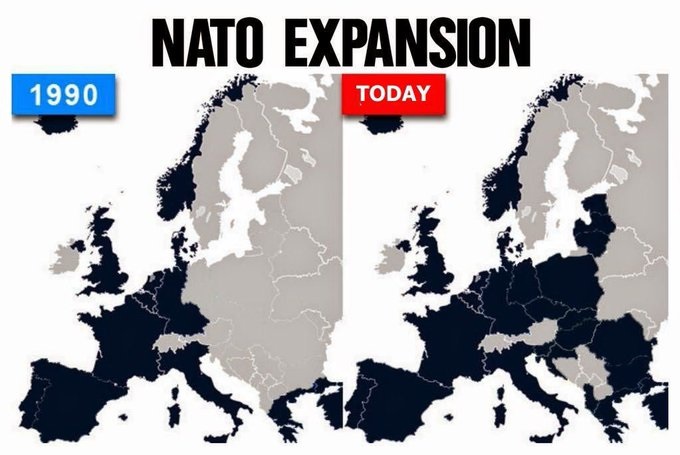
It doesn’t take a genius to figure out what Putin was worried about. He was worried about NATO expansion and, in particular, the emergence of a hostile military alliance backed by Washington-groomed Nazis occupying territory on his western flank. Was that unreasonable of him? Should he have embraced these US-backed Russophobes and allowed them to place their missiles on his border? Would that have been the prudent thing to do?
So, what can we deduce from Putin’s list of demands?
First, we can deduce that he is not trying to reconstruct the Soviet empire as the MSM relentlessly insists. The list focuses exclusively on security-related demands, nothing else.
Second, it proves that the war could have easily been avoided had Zelensky simply maintained the status quo and formally announced that Ukraine would remain neutral. In fact, Zelensky actually agreed to neutrality in negotiations with Moscow in March, but Washington prevented the Ukrainian president from going through with the deal which means that the Biden administration is largely responsible for the ongoing conflict. (RT published an article today stating clearly that an agreement had been reached between Russia and Ukraine in March but the deal was intentionally scuttled by the US and UK. Washington wanted a war.)
Third, it shows that Putin is a reasonable leader whose demands should have been eagerly accepted. Was it unreasonable of Putin to ask that “The Parties shall refrain from deploying their armed forces and… military alliances.. in the areas where such deployment could be perceived by the other Party as a threat to its national security”? Was it unreasonable for him the ask that “The Parties shall eliminate all existing infrastructure for deployment of nuclear weapons outside their national territories”?
Where exactly are the “unreasonable demands” that Putin supposedly made?
There aren’t any. Putin made no demands that the US wouldn’t have made if ‘the shoe was on the other foot.’
Forth, it proves that the war is not a struggle for Ukrainian liberation or democracy. That’s hogwash. It is a war that is aimed at “weakening” Russia and eventually removing Putin from power. Those are the overriding goals. What that means is that Ukrainian soldiers are not dying for their country, they are dying for an elitist dream to expand NATO, crush Russia, encircle China, and extend US hegemony for another century. Ukraine is merely the battlefield on which the Great Power struggle is being fought.
There are number points we are trying to make in this article:
Who started the war? Answer– Ukraine started the war
Was the Russian invasion a violation of international law? Answer– No, the Russian invasion should be approved under United Nations Article 51
Could the war have been avoided if Ukraine declared neutrality and met Putin’s reasonable demands? Answer– Yes, the war could have been avoided
The last point deals with the Minsk Treaty and how the dishonesty of western leaders is going to effect the final settlement in Ukraine. I am convinced that neither Washington nor the NATO allies have any idea of how severely international relations have been decimated by the Minsk betrayal. In a world where legally binding agreements can be breezily discarded in the name of political expediency, the only way to settle disputes is through brute force. Did anyone in Germany, France or Washington think about this before they acted? (But, first, some background on Minsk.)
The aim of the Minsk agreement was to end the fighting between the Ukrainian army and ethnic Russians in the Donbas region of Ukraine. It was the responsibility of the four participants in the treaty– Germany, France, Russia and Ukraine– to ensure that both sides followed the terms of the deal. But in December, former German Chancellor Angela Merkel said in an interview with a German magazine, that there was never any intention of implementing the deal, instead, the plan was to use the time to make Ukraine stronger in order to prepare for a war with Russia. So, clearly, from the very beginning, the United States intended to provoke a war with Russia.
On September 5, 2014, Germany, France, Ukraine and Russia all signed Minsk, but the treaty failed and the fighting resumed. On February 12, 2015, Minsk 2 was signed, but that failed, as well. Please, watch this short segment on You Tube by Amit Sengupta who gives a brief rundown of Minsk and its implications: (I transcribed the piece myself and any mistakes are mine.) …………………. [Transcription on original]
There’s no way to overstate the importance of the Minsk betrayal or the impact it’s going to have on the final settlement in Ukraine. When trust is lost, nations can only ensure their security through brute force. What that means is that Russia must expand its perimeter as far as is necessary to ensure that it will remain beyond the enemy’s range of fire. (Putin, Lavrov and Medvedev have already indicated that they plan to do just that.) Second, the new perimeter must be permanently fortified with combat troops and lethal weaponry that are kept on hairtrigger alert. When treaties become vehicles for political opportunism, then nations must accept a permanent state of war. This is the world that Merkel, Hollande, Poroshenko and the US created by opting to use ‘the cornerstone of international relations’ (Treaties) to advance their own narrow warmongering objectives.
We just wonder if anyone in Washington realizes whet the fu** they’ve done?
Biden and Blinken must not let the spy balloon controversy stand in the way of talks on nuclear crisis management and arms control.
Foreign Policy By Sahil Shah, a Senior Fellow and Program Manager at the Council on Strategic Risks’ Janne Nolan Center on Strategic Weapons. 6 Feb23
Shortly before U.S. Secretary of State Antony Blinken was slated to depart for Beijing on the Biden administration’s first cabinet-level visit, the trip was postponed. The last-minute schedule change came after a Chinese surveillance balloon was confirmed to be floating above sensitive U.S. military sites, including potentially an active nuclear missile silo field in Montana. Over the weekend, the balloon was shot down by a U.S. F-22 fighter jet once the expected debris no longer posed a threat to civilians.
The incident is reminiscent of those that occurred during the Cold War involving the United States and the Soviet Union—and it comes at a time when many are debating whether Washington and Beijing are now headed toward a similar relationship. Blinken’s now-postponed visit was an attempt to follow up on the Biden-Xi meeting at the G-20 summit in Bali, Indonesia, last year. Encouragingly, the summit provided the best recent opportunity for diplomacy between the United States and China—one that could provide some answers on how the two countries can best avoid a “new Cold War” and reduce the risks of unnecessary conflict and inadvertent escalation.
As was true during the Cold War, spy balloons are not the only things looming over the fraught relationship between the United States and China—nuclear weapons are, too. In addition to ever-increasing tensions over Taiwan, it is no secret that China’s ambition for a diversified nuclear arsenal and wider military modernization is accelerating, with Beijing expanding strategic and conventional forces to back up its “wolf warrior” diplomacy.
Since university researchers made it public two years ago that China is developing extensive missile silo fields and Beijing shocked U.S. intelligence services by testing a hypersonic fractional orbital bombardment system just weeks later, there has been a growing conversation on how Washington can adequately deter Beijing. However, there is another side that cannot be ignored: The United States and China must return to talks at the earliest available opportunity to discuss their shared responsibility to reduce the risk of nuclear war through crisis management and arms control.
Foreign-policy chief Josep Borrell sees no good alternative to reviving the nuclear deal even as the Biden administration shifts focus
KYIV, Ukraine—The European Union’s top diplomat, Josep Borrell, is refusing to give up on efforts to rescue the 2015 Iranian nuclear deal, even as Tehran cracks down on protesters at home and helps Russia in its war against Ukraine.
The Pentagon earlier said on Friday that the balloon did not pose a “military or physical” threat.
It’s widely known that US aircraft, appearing in civilian or military purposes, operate around China much more frequent than Chinese aircraft do around the US
China expressed strong dissatisfaction and protest on Sunday against the US’ move to shoot down a non-threatening Chinese airship for civilian use, calling the US’ move an overreaction and vowing to reserve the right to take necessary actions. By turning an unintentional accident into an incident that has been hyped by the US officials and media, Washington is adding new uncertainties into the already-intense relations with China, creating a bad precedent for blurring the line between civilian and military uses, experts said.
The Chinese Foreign Ministry expressed strong dissatisfaction and protested against the US’ use of force to shoot down a Chinese civilian unmanned airship, urging the US to properly handle the incident.
The Chinese side has verified the situation and communicated with the US side multiple times, saying the unintended entry of the airship into US airspace was due to force majeure and the incident was totally an accident, the ministry said.
The US military on Saturday local time shot down a “suspected Chinese spy balloon” off the Carolina coast following an authorization of the Biden administration after the airship has been flying over the US for days. The action was hailed by the US President Joe Biden as “a success,” according to US media reports.
The “balloon episode” went viral on the US social media. A number of US hawks on China-related matters have been hyping the use of balloon for spying purpose and deliberately distorted it as “a direct assault on the US national sovereignty.”
“The US attack on Chinese civilian unmanned airship by force is an obvious overreaction,” Senior Colonel Tan Kefei, a spokesperson at China’s Ministry of National Defense, said in a statement on Sunday.
China will reserve the right to take necessary measures in dealing with similar situations, Tan said.
Tan’s remarks mean that if a foreign airship accidentally enters the Chinese airspace, the Chinese forces could also shoot it down in a similar manner, observers said.
Biden was first briefed on the balloon Tuesday and has been receiving updates from his national security team, CNN said. The Pentagon earlier said on Friday that the balloon did not pose a “military or physical” threat………………………………………….
Overreaction, bad precedent
The US shooting down the Chinese civilian balloon is also considered an overreaction from a technical point of view, said military aviation experts.
Despite admitting that the balloon did not pose a military or physical threat, an F-22 fighter of the US Air Force fired an AIM-9X air-to-air missile and shot down the balloon, supported by F-15 fighters, tankers and warships, the Pentagon said on the day on its website.
The missile was fired from the F-22 from an altitude of 58,000 feet (17,678 meters) when the balloon was 60,000 and 65,000 feet, the Pentagon said.
This is like shooting a mosquito with a cannon, which is not only overreacting but also impractical, a Chinese military expert who requested anonymity told the Global Times on Sunday.
Compared with an unmanned balloon that flies with the wind, the US interception method that featured an advanced stealth fighter jet and fired a missile is too costly………………………………….
It’s widely known that US aircraft, appearing in civilian or military purposes, operate around China much more frequent than Chinese aircraft do around the US, Lü noted. ………… more https://www.globaltimes.cn/page/202302/1284857.shtml
Last September, Fiona Hill and Angela Stent wrote this in Foreign Affairs: “According to multiple former senior U.S. officials, in April 2022, Russian and Ukrainian negotiators appeared to have tentatively agreed on the outlines of a negotiated interim settlement.”
In the end, of course, no such settlement was agreed. Which may be, at least in part, because Boris Johnson advised Zelensky not to sign it during his “surprise visit” to Kiev in early April.
As you may recall, one of Zelensky’s “close associates” told Ukrainska Pravda that Johnson was an “obstacle” to negotiations because he’d brought two simple messages: “Putin is a war criminal, he should be suppressed, not negotiated with. And secondly, if you are ready to sign any agreements on guarantees with him, then we are not. We can with you, but not with him, he will still abandon everyone.”
According to Roman Romanyuk, writing in Ukrainska Pravda:
Behind this visit and Johnson’s words lies much more than a simple reluctance to engage in agreements with Russia. The collective West, which back in February suggested that Zelenskyi surrender and run away, now felt that Putin is actually not as all-powerful as they imagined him to be. Moreover, right now there was a chance to “press him”. And the West wants to use it.
It should be noted that Romanyuk disagrees that Johnson’s visit was the main reason the deal fell through. In his view, concerns that “Ukrainian society might not accept such a deal” loomed larger. Others interpret the evidence differently.
Putin himself has claimed the West scuttled negotiations, noting in his September 21st speech that “after certain compromises were coordinated, Kiev was actually ordered to wreck all these agreements”.
Now, the former Israeli PM Naftali Bennett has lent credence to this view, claiming that the West “blocked” a draft peace deal between Russia and Ukraine. The revelation came in a long interview (in Hebrew) posted on Bennett’s YouTube channel.
Bennett’s words cannot be dismissed as mere speculation, given that he played a central role mediating between the two sides, after a request from Zelensky at the war’s outset.
In the interview, Bennett states that he believed Israel’s national interest would be served by a policy of neutrality, which is why he accepted the request to mediate. Toward this end, he sought to understand the interests of both sides.
“Putin’s perception,” he says, “was wait, when the wall came down, we reached an agreement with NATO that they wouldn’t expand … why are you introducing Ukraine into NATO?” Later in the interview, he states that “the war broke out because of the demand to join NATO”.
After a sequence of phone calls with the two leaders, Bennett flew to Moscow on March 7th. (Meanwhile, Russian and Ukrainian negotiators were holding talks at Gomel in Belarus.)
He says that Putin then “made two big concessions”. He promised not to “take out” Zelensky, and he “renounced disarmament of Ukraine”. The same day, Zelensky also “made a big concession” – he “relinquished joining NATO”. Describing these as “huge steps on each side”, Bennett’s impression was that “both sides very much want a ceasefire”.
According to the former Prime Minister, Putin was “very pragmatic”, and “so was Zelensky”. As an example of Putin’s pragmatism, he mentions that Putin “totally understood Zelensky’s political constraints”. Asked whether Putin is “gung ho to fight at all costs”, Bennett replies “no” because “he has goals to achieve”.
Regarding the various Western leaders involved, he says that “Boris Johnson adopted the aggressive line”, whereas “Macron and Scholz were more pragmatic”, and “Biden was both”.
Then we get to the most interesting part. “I think there was a legitimate decision by the West,” Bennett explains, “to keep striking Putin”, to take the “more aggressive approach”. “So they blocked it?” the interviewer asks. “Yes. They blocked it.”
Bennet’s account obviously comports closely with Romanyuk’s observation that the West felt there was a chance to “press” Putin.
One reason to be sceptical is that, insofar as Bennett’s mediation efforts ultimately failed, he has an incentive to blame outside forces (in this case, the West). For now, we can’t be sure exactly what happened. But the revelations are striking, consistent as they are with the earlier report in Ukrainska Pravda – down to the detail of Johnson being particularly hawkish.
The latest row comes as the IAEA chief hopes for progress in a potential visit to Tehran in February.
Tehran, Iran – Iran and the Western parties to its 2015 nuclear deal have once more clashed over the country’s nuclear programme, this time after a report by the International Atomic Energy Agency (IAEA) on the sensitive Fordow uranium enrichment site.
The global nuclear watchdog said in a confidential report on Wednesday leaked by Western media that the interconnection between two cascades of advanced IR-6 centrifuges at Fordow had been changed in a way that was “substantially different” from what Iran had declared.
The agency also pointed out this is inconsistent with Iran’s obligations under a safeguards agreement required by the Treaty on the Non-Proliferation of Nuclear Weapons (NPT).
Iran’s nuclear chief, Mohammad Eslami, dismissed the report on Thursday by calling it “incorrect” and claiming an agency inspector had made a mistake.
“We immediately offered explanations that were communicated the same day and the agency inspector also became aware of their mistake,” he said, denouncing the fact that confidential IAEA reports are regularly leaked to the media.
But the E3 – France, Germany and the United Kingdom – and the United States, Western signatories to Iran’s 2015 nuclear accord with world powers that also included China, Russia and the EU, rejected Iran’s stance in a statement on Friday.
“We judge Iran’s actions based on the impartial and objective reports of the IAEA, not Iran’s purported intent,” they said, calling on Iran to fully cooperate with the agency.
“We recall that the production of high-enriched uranium by Iran at the Fordow Enrichment Plant carries significant proliferation-related risks and is without any credible civilian justification.”…………………………..
The Fordow site is so important that enrichment there had been forbidden under the Joint Comprehensive Plan of Action (JCPOA), as the nuclear accord is officially known. But Iran has gradually abandoned any limits set in the accord after the US unilaterally withdrew from it in 2018 and imposed sanctions.
Talks to restore the deal remain deadlocked since September, with the US publicly maintaining it does not currently prioritise advancing the talks following deadly protests in Iran, while Tehran claims Washington is secretly sending messages to reach an agreement.
The latest clash on Fordow comes as IAEA Director General Rafael Grossi had said last month he hopes to visit Tehran in February to hold talks with Iranian officials on the unresolved cases of nuclear particles found years ago at several Iranian sites.
We, the governments of France, Germany, the United Kingdom and the United States, take note of the report by the International Atomic Energy Agency (IAEA) that Iran has implemented a substantial change in the configuration of some of its centrifuges without informing the Agency in advance.
These centrifuges produce high-enriched uranium up to 60% and are located at the Fordow Enrichment Plant. As stated by the Agency, this unnotified change is inconsistent with Iran’s obligations under its NPT-required Comprehensive Safeguards Agreement.
Such lack of required notification undermines the Agency’s ability to maintain timely detection at Iran’s nuclear facilities. The newly reported change in configuration of centrifuge cascades used to produce near-weapons-grade uranium underscores the need for Iran to meet all its safeguards reporting obligations, and to accept whatever safeguards monitoring the IAEA sees as necessary in light of Iran’s production of such highly enriched uranium.
The US embassy in the Solomon Islands reopened on Thursday, decades after being shut down as redundant, amid concerns in Washington about the South Pacific archipelago’s overtures to Beijing.
The mission in Honiara will consist of a charge d’affaires, a “couple” of State Department employees and a “handful” of locals, according to Associated Press, which described the reopening as part of an effort to “counter China’s push into the Pacific.”
In a pre-recorded statement, US Secretary of State Antony Blinken said that through its new embassy, Washington will be “better positioned” to advance democracy and “tackle shared challenges.”
Located about 1,800 kilometers northeast of Australia, the Solomons last hosted a US diplomatic mission in 1993, when the State Department decided to downsize due to the end of the Cold War. The US had played a key role in liberating the archipelago from Japanese occupation during the Second World War, in the bloody Guadalcanal campaign.
In 2019, however, Honiara decided to transfer its diplomatic relations with China from the nationalist exiles in Taiwan to the Communist government in Beijing. The decision touched off riots in Guadalcanal, with protesters targeting Chinese businesses and setting fire to the prime minister’s residence.
In 2022, Honiara signed a security agreement with China, causing further alarm in the US and Australia. The State Department informed Congress that reopening the embassy was a priority given China’s “growing influence” and fears of a military build-up in the Solomons.
The US had told the Solomons that Washington would have “significant concerns and respond accordingly” to any “permanent military presence, power-projection capabilities, or a military installation” by China.
The Australian government said any kind of Chinese naval base in the archipelago would be a “red line” for Canberra, while some commentators even called for invading the islands.
In response to those concerns, Solomon Islands Prime Minister Manasseh Sogavare said that Australia remains the “security partner of choice,” and issued assurances that there would be no Chinese military base, insisting the security pact with Beijing “had solely domestic applications.”







 nuclear-news