Scott Ritter: Anyone Who Doesn’t Get How Serious New START Suspension is ‘Doesn’t Appreciate Life’
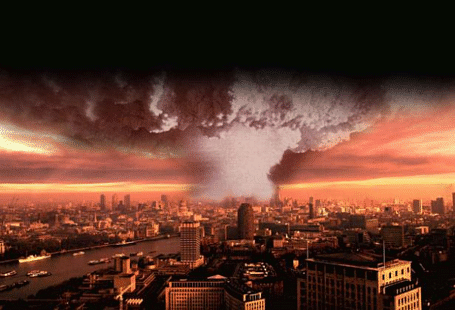
We’re not allowing Russian inspectors to come and inspect us while demanding that we go inspect Russia.
Unfortunately, we have people today in Washington, D.C., that believe in American nuclear superiority or American nuclear supremacy, and they don’t believe in arms control. And we need to replace them. We need to get rid of them. We need to bring in people who recognize that arms control is the only way to save the human race.”
Leaving aside the “theater of the absurd” and “bluster” of Joe Biden’s rhetoric during his trips to Ukraine and Poland this week, the consequences of the US effort to strategically weaken and destroy Russia are far more serious than anyone in Washington seems to realize, ex-UN weapons inspector and retired US Marine major Scott Ritter fear
“There’s nothing covert about this. It was theater. Theater of the absurd,” Ritter said of Biden’s visit to Kiev on Monday to meet with President Volodymyr Zelensky, speaking to Sputnik’s Wilmer Leon and Garland Nixon on The Critical Hour radio show.
“So absurd that while Biden was there, Zelensky arranged to have air raid sirens sound to make it look as if Biden was under attack….Then Biden goes to Poland, where he issues a speech. I was in the middle of a webinar earlier, so I don’t know the totality of the speech. I saw the beginning of it, but it just seems to be a regurgitation of more of the same – ‘unity against Russia, support for Ukraine’, etc., etc. Bluster, bluster, bluster,” Ritter added.
On Tuesday, Russian President Vladimir Putin announced the suspension of the New Strategic Arms Reduction Treaty (New START) with the US, citing Washington’s efforts to “inflict a strategic defeat” on Russia and help Ukraine launch drone attacks against Russia’s strategic deterrent while “absurdly” calling for more nuclear inspections.
“Meanwhile, the consequences of the American-led effort to attack Russia, to weaken Russia, to destroy Russia, to be honest, are playing out. Putin’s suspending Russian participation in the last remaining arms control treaty between our two nations. And anybody who doesn’t understand how serious this is probably doesn’t appreciate life. Without arms control agreements, there will be a nuclear arms race at a time when technology far outpaces that of the last arms race, which was the unfettered arms race in the late 1960s or early 1970s,” Ritter said.
Ritter knows a thing or two about arms control, serving as an inspector implementing the Intermediate Range Nuclear Forces Treaty – a late Cold War agreement which eliminated an entire class of US and Soviet ground-based nuclear missile systems in the 500-5,500 km range. Today, he fears, radical advances in technology make effective arms control all the more crucial to saving the world from nuclear Armageddon.
“Today, we’re talking about missiles with greater speed, greater accuracy, hypersonic maneuvering warheads that can’t be shot down by missile defense. So, so deadly, so accurate, so fast that any error, any mistake, any miscalculation has to be assumed that it’s going to have dire consequences. So you must respond. In the past, we dodged a bullet because we had time enough for people to say [to the other side] ‘this launch of American missiles against Russia was, in fact, not a launch. It was a mistake.’
Today, if they detect a launch, they have to respond because they don’t have time. They don’t have the luxury of time to say, wait a minute, let’s just wait to get more data.
. With this treaty going away, an arms race will occur and there will be nothing that is capable of putting that genie back in the bottle. And this could be fatal, probably will be fatal to everybody here. So we need to pray that the United States gets over its Ukraine fixation and gets into how do we stop the world from dying in a nuclear holocaust to which we will be singularly responsible for initiating,” Ritter urged.
President Putin and other Russian officials have addressed the lack of response time issue repeatedly in recent years, going back to when Washington decided to deploy Tomahawk-capable anti-missile defense systems in Poland and Romania, and threatened to incorporate Ukraine into NATO and station nuclear-capable missiles there.
“I have already said – they’ll put missile systems in Ukraine, 4-5 minutes’ flight time to Moscow. Where can we move? They have simply driven us into such a state that we have to tell them: stop,” Putin said in December 2021, after Moscow handed Washington and NATO a pair of comprehensive security proposals meant to dramatically reduce tensions between Russia and the Western bloc.
The West rejected the draft treaties in January 2022, reiterating that NATO’s eastward expansion was nonnegotiable. A month later, escalated attacks on the Donbass by Kiev sparked a Russian military operation in Ukraine.
“The problem is the concept of meaningful arms control was developed during the time of the Cold War, when the United States actually respected and feared its opponent, the Soviet Union. When the Soviet Union collapsed, the United States no longer respected or feared Russia. And we used arms control as a means of furthering our strategic advantage,” Ritter explained. “And then when we found arms control treaties to be inconvenient, such as the Anti-Ballistic Missile Treaty, we withdrew from the Intermediate Nuclear Forces Treaty, which I played a major role in. We withdrew from Open Skies, and now we’re cheating on the last remaining treaty, New START. We’re not allowing Russian inspectors to come and inspect us while demanding that we go inspect Russia. And so the Russians have suspended this. This is all a power play by the United States to further what we believe to be our strategic advantage over Russia.”
Today, the former weapons inspector warned, “Russia is no longer a defeated, compliant state. The Russians have nuclear superiority over us today. Their missiles are better than anything we have. We don’t have a missile defense system worthy of the name. And so if there was a nuclear conflict, we would be annihilated. Now the good chance is we would annihilate them, too. Which brings us back to the situation that we existed in the 1960s, where we suddenly realized that this concept of mutually assured destruction wasn’t a bad concept because it sort of put the brakes on nuclear conflict.
Unfortunately, we have people today in Washington, D.C., that believe in American nuclear superiority or American nuclear supremacy, and they don’t believe in arms control. And we need to replace them. We need to get rid of them. We need to bring in people who recognize that arms control is the only way to save the human race.”
Biden team has ‘deeply rooted hatred for Russia’ – US congressman

I know that Donald Trump is awful. And so is his Republican support team. Nevertheless, sometimes they say something sensible – something that needs to be said
Senior State Department officials Victoria Nuland and Antony Blinken are “dangerous fools,” Paul Gosar declared
Senior officials at the US State Department are attempting to get the country “involved in another world war” with Russia, Arizona Congressman Paul Gosar tweeted on Friday. Gosar, Twitter CEO Elon Musk, and former president Donald Trump, have all named Victoria Nuland as the most dangerous among this group in recent days.
Responding to an RT article on Musk accusing Nuland of “pushing this war” in Ukraine, Gosar declared that the billionaire “is correct.”
“Both Nuland and Blinken have a deeply rooted irrational hatred of Russia, and they seek to get the US involved in another world war,” he continued. “These are dangerous fools who can get us all killed.”
In a follow-up tweet, Gosar wrote that “as a non-soldier, Nuland is quite willing to endorse violence and war.” The Republican lawmaker then quoted the article, which stated that Nuland had “endorsed regime change in Russia, celebrated the US’ destruction of the Nord Stream pipelines, and called for the indefinite flow of arms into Ukraine.”
As assistant secretary of state for European and Eurasian Affairs in 2014, Nuland helped to orchestrate the pro-Western coup that unseated democratically elected president Viktor Yanukovich. Nuland traveled to Kiev and promised military aid to the rioters, and was recorded plotting to install a successor to Yanukovich.
As Biden’s secretary of state, Blinken has promised to keep weapons flowing into Ukraine “for as long as it takes,” and advised Kiev in December not to seek the kind of negotiated settlement that would liken to a “phony peace.”
Gosar has been a persistent critic of the Biden administration’s Ukraine policy since Russia’s military operation began a year ago on Friday. However, although the Republican Party now controls the House of Representatives, there is little the Arizona congressman can do to change the administration’s course. A significant bipartisan majority supports continued military aid to Ukraine, with only 11 Republicans, Gosar included, sponsoring legislation that would cut funding for Kiev.
These Republicans are all allies of former president Donald Trump. In a campaign video released on Tuesday, Trump blamed the situation in Ukraine on Nuland and “others like her” in the Biden administration. Nuland, he said, was “obsessed with pushing Ukraine towards NATO,” adding that the conflict would have “never happened if I was your president.”
Stop or START? — Shouldn’t we ban, rather than limit, nuclear weapons?

Shouldn’t we ban, rather than limit, nuclear weapons?
Stop or START? — Beyond Nuclear International
Does an arms reduction treaty matter when zero nuclear weapons is the only safe number?
By Linda Pentz Gunter
After writing an initial quick reaction piece about Russian president Vladimir Putin’s decision to suspend his country’s participation in the New START Treaty, there has been time for some logic to set in. In other words, I have thought more about this and something doesn’t add up.
What doesn’t make sense is the inherent contradiction of, on the one hand, condemning Putin’s decision to step back from the last treaty that limits the US and Russia’s nuclear weapons arsenals, but on the other, espousing a conviction that there can never be few enough nuclear weapons unless that number is zero.
Why does it matter, then, whether the two nuclear super powers agree to cap their arsenals at “only” 3,000 or so lethal nuclear missiles and warheads each? Given the utter destruction of planet Earth that these would cause if used, an escalation (or even a decrease) seems irrelevant.
Dr. Ira Helfand of International Physicians for the Prevention of Nuclear War put this case all too clearly in a February 22 appearance on Democracy Now! when he told host, Amy Goodman: “The New START treaty, while somewhat useful, is a very limited document and a very inadequate treaty. It still allows the United States and Russia to maintain — and they do — 3,100 strategic nuclear weapons, ranging in size from 100 kilotons to 800 kilotons. That is six to 50 times more powerful than the bombs which destroyed Hiroshima.”
It’s a treaty, Helfand said, that “allows both the United States and Russia to maintain arsenals which are capable of destroying modern civilization six times over.”
So is there any point to START, “New” or otherwise? Surely we need to stop the manufacture, possession, siting (including in other people’s countries), and especially the use of nuclear weapons and get rid of them altogether? And the only instrument equipped to do that is the Treaty on the Prohibition of Nuclear Weapons……………………………….
more https://beyondnuclearinternational.org/2023/02/24/stop-or-start/—
China’s Position on the Political Settlement of the Ukraine Crisis
2023-02-24 https://www.fmprc.gov.cn/mfa_eng/zxxx_662805/202302/t20230224_11030713.html
1. Respecting the sovereignty of all countries. Universally recognized international law, including the purposes and principles of the United Nations Charter, must be strictly observed. The sovereignty, independence and territorial integrity of all countries must be effectively upheld. All countries, big or small, strong or weak, rich or poor, are equal members of the international community. All parties should jointly uphold the basic norms governing international relations and defend international fairness and justice. Equal and uniform application of international law should be promoted, while double standards must be rejected.
2. Abandoning the Cold War mentality. The security of a country should not be pursued at the expense of others. The security of a region should not be achieved by strengthening or expanding military blocs. The legitimate security interests and concerns of all countries must be taken seriously and addressed properly. There is no simple solution to a complex issue. All parties should, following the vision of common, comprehensive, cooperative and sustainable security and bearing in mind the long-term peace and stability of the world, help forge a balanced, effective and sustainable European security architecture. All parties should oppose the pursuit of one’s own security at the cost of others’ security, prevent bloc confrontation, and work together for peace and stability on the Eurasian Continent.
3. Ceasing hostilities. Conflict and war benefit no one. All parties must stay rational and exercise restraint, avoid fanning the flames and aggravating tensions, and prevent the crisis from deteriorating further or even spiraling out of control. All parties should support Russia and Ukraine in working in the same direction and resuming direct dialogue as quickly as possible, so as to gradually deescalate the situation and ultimately reach a comprehensive ceasefire.
4. Resuming peace talks. Dialogue and negotiation are the only viable solution to the Ukraine crisis. All efforts conducive to the peaceful settlement of the crisis must be encouraged and supported. The international community should stay committed to the right approach of promoting talks for peace, help parties to the conflict open the door to a political settlement as soon as possible, and create conditions and platforms for the resumption of negotiation. China will continue to play a constructive role in this regard.
5. Resolving the humanitarian crisis. All measures conducive to easing the humanitarian crisis must be encouraged and supported. Humanitarian operations should follow the principles of neutrality and impartiality, and humanitarian issues should not be politicized. The safety of civilians must be effectively protected, and humanitarian corridors should be set up for the evacuation of civilians from conflict zones. Efforts are needed to increase humanitarian assistance to relevant areas, improve humanitarian conditions, and provide rapid, safe and unimpeded humanitarian access, with a view to preventing a humanitarian crisis on a larger scale. The UN should be supported in playing a coordinating role in channeling humanitarian aid to conflict zones.
6. Protecting civilians and prisoners of war (POWs). Parties to the conflict should strictly abide by international humanitarian law, avoid attacking civilians or civilian facilities, protect women, children and other victims of the conflict, and respect the basic rights of POWs. China supports the exchange of POWs between Russia and Ukraine, and calls on all parties to create more favorable conditions for this purpose.
7. Keeping nuclear power plants safe. China opposes armed attacks against nuclear power plants or other peaceful nuclear facilities, and calls on all parties to comply with international law including the Convention on Nuclear Safety (CNS) and resolutely avoid man-made nuclear accidents. China supports the International Atomic Energy Agency (IAEA) in playing a constructive role in promoting the safety and security of peaceful nuclear facilities.
8. Reducing strategic risks. Nuclear weapons must not be used and nuclear wars must not be fought. The threat or use of nuclear weapons should be opposed. Nuclear proliferation must be prevented and nuclear crisis avoided. China opposes the research, development and use of chemical and biological weapons by any country under any circumstances.
9. Facilitating grain exports. All parties need to implement the Black Sea Grain Initiative signed by Russia, Türkiye, Ukraine and the UN fully and effectively in a balanced manner, and support the UN in playing an important role in this regard. The cooperation initiative on global food security proposed by China provides a feasible solution to the global food crisis.
10. Stopping unilateral sanctions. Unilateral sanctions and maximum pressure cannot solve the issue; they only create new problems. China opposes unilateral sanctions unauthorized by the UN Security Council. Relevant countries should stop abusing unilateral sanctions and “long-arm jurisdiction” against other countries, so as to do their share in deescalating the Ukraine crisis and create conditions for developing countries to grow their economies and better the lives of their people.
11. Keeping industrial and supply chains stable. All parties should earnestly maintain the existing world economic system and oppose using the world economy as a tool or weapon for political purposes. Joint efforts are needed to mitigate the spillovers of the crisis and prevent it from disrupting international cooperation in energy, finance, food trade and transportation and undermining the global economic recovery.
12. Promoting post-conflict reconstruction. The international community needs to take measures to support post-conflict reconstruction in conflict zones. China stands ready to provide assistance and play a constructive role in this endeavor.
Chomsky: A Stronger NATO Is the Last Thing We Need as Russia-Ukraine War Turns 1
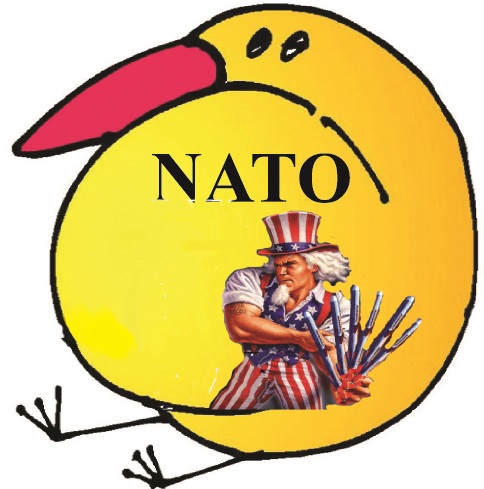
It is becoming increasingly obvious that this is now a U.S./NATO-Russia war via Ukraine, Noam Chomsky argues. By C.J. Polychroniou , TRUTHOUT, February 23, 2023
he war in Ukraine is almost a year old, with no end in sight to the fighting, suffering and destruction. In fact, the war’s next phase could turn into a bloodbath and last for years, as the U.S. and Germany agree to supply Ukraine with battle tanks and as Volodymyr Zelenskyy urges the West to send long-range missiles and fighter jets.
It is becoming increasingly obvious that this is now a U.S./NATO-Russia war, Noam Chomsky argues in the exclusive interview for Truthout that follows, excoriating the idea that, in light of Russia’s invasion of Ukraine, there needs to be a stronger NATO rather than a negotiated settlement to the conflict. “Those calling for a stronger NATO might want to think about what NATO is doing right now, and also about how NATO depicts itself,” Chomsky says, warning of “the growing threat of steps up the escalation ladder to nuclear war.”
……………………………. Noam Chomsky: We can usefully begin by asking what is not on the NATO/U.S. agenda. The answer to that is easy: efforts to bring the horrors to an end before they become much worse. “Much worse” begins with the increasing devastation of Ukraine, awful enough, even though nowhere near the scale of the U.S.-U.K. invasion of Iraq or, of course, the U.S. destruction of Indochina, in a class by itself in the post-WWII era.
………………………………………………………………. What’s probably coming next is not concealed. The press has just reported that the Pentagon is calling for a top-secret program to insert “control teams” in Ukraine to monitor troop movements. It has also revealed that the U.S. has been providing targeting information for all advanced weapon strikes, “a previously undisclosed practice that reveals a deeper and more operationally active role for the Pentagon in the war.” At some point there might be Russian retaliation, another step up the escalation ladder.
Persisting on its present course, the war will come to vindicate the view of much of the world outside the West that this is a U.S.-Russian war with Ukrainian bodies — increasingly corpses. The view, to quote Ambassador Chas Freeman, that the U.S. seems to be fighting Russia to the last Ukrainian, reiterating the conclusion of Diego Cordovez and Selig Harrison that in the 1980s the U.S. was fighting Russia to the last Afghan.
………………………………… It’s a bonanza for major sectors of the U.S. economy, including fossil fuel and military industries. In the geopolitical domain, it resolves — at least temporarily — what has been a major concern throughout the post-WWII era: ensuring that Europe remains under U.S. control within the NATO system instead of adopting an independent course and becoming more closely integrated with its natural resource-rich trading partner to the East.
…………………….. Is there any hope for diplomatic efforts to escape the steady drift to disaster for Ukraine and beyond? Given Washington’s lack of interest, there is little media inquiry, but enough has leaked out from Ukrainian, U.S., and other sources to make it reasonably clear that there have been possibilities, even as recently as last March. We’ve discussed them in the past and more bits of evidence of varying quality keep trickling through.
Do opportunities for diplomacy still remain? As fighting continues, positions predictably harden. Right now, Ukrainian and Russian stands appear irreconcilable. That is not a novel situation in world affairs. It has often turned out that “Peace talks are possible if there is a political will to engage in them,” the situation right now, two Finnish analysts suggest. They proceed to outline steps that can be taken to ease the way toward further accommodation. They rightly point out that the political will is there in some circles: among them the chairman of the Joint Chiefs of Staff and senior figures in the Council of Foreign Relations. So far, however, vilification and demonization are the preferred method to deflect such deviation from the commitment to “much worse,” often accompanied by lofty rhetoric about the cosmic struggle between the forces of light and darkness………………………………………………………….
Those calling for a stronger NATO might want to think about what NATO is doing right now, and also about how NATO depicts itself. The latest NATO summit extended the North Atlantic to the Indo-Pacific, that is, all the world. NATO’s role is to participate in the U.S. project of planning for a war with China, already an economic war…………………………………………………………………………………………………….. more https://truthout.org/articles/chomsky-a-stronger-nato-is-the-last-thing-we-need-as-russia-ukraine-war-turns-1/?eType=EmailBlastContent&eId=da654450-6ace-4f52-b5e8-4ab0cb44901c,
Australian Defense Minister Attempts to Reassure Thailand Over Nuclear Subs

Defense Post 24 Feb 23, Australia’s defense minister aimed to reassure Thailand on Friday that plans to acquire a new fleet of nuclear submarines would enhance “collective security” in the region after neighboring countries voiced concerns.
The submarine issue came up during a visit to Manila earlier this week, Defense Minister Richard Marles told AFP in an interview, and was also on the agenda for Friday’s talks with Thai Prime Minister Prayut Chan-O-Cha, who is responsible for defense……………..
Malaysia and Indonesia have expressed concerns about the acquisition, warning against an arms race.
But Marles said Australia wanted to build a “sense of confidence” about the plan…………….
Marles said Friday that “acquiring a conventionally powered submarine is not going to form part of any solution.” https://www.thedefensepost.com/2023/02/24/australia-thailand-nuclear-subs/
France mounts ‘aggressive’ nuclear push with eye on EU industrial plan

“They’re trying to get nuclear everywhere where it doesn’t fit … to have policy lock-in,” said one EU diplomat who spoke on condition of anonymity, adding: “Everybody is a little annoyed at the French — it’s very aggressive.”
Paris looks out for its atomic industry as the sector faces a crossroads.
BY VICTOR JACK, 17 Feb 23, https://www.politico.eu/article/france-aggressive-nuclear-energy-push-eu-industrial-plan-renewables/
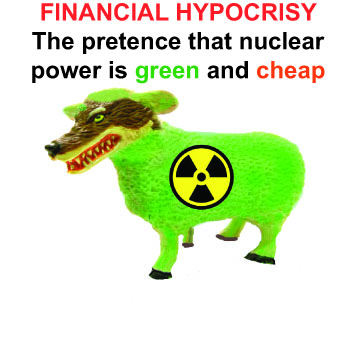
With its atomic industry at a crossroads, France is mounting a lobbying blitz to put nuclear energy on par with renewables in EU climate legislation — and unlock benefits from the bloc’s upcoming plans to boost green industries.
Paris argues that if the ultimate goal of the EU’s climate targets is to decarbonize the bloc, that should mean nuclear plants, with their negligible CO2 emissions, have a key role to play alongside renewables.
But that push — and attempt to reposition nuclear as a green technology — is also a strategy to strengthen Paris’ hand down the line in accessing cash from the bloc’s upcoming mammoth industrial strategy, six diplomats told POLITICO.
“They’re trying to get nuclear everywhere where it doesn’t fit … to have policy lock-in,” said one EU diplomat who spoke on condition of anonymity, adding: “Everybody is a little annoyed at the French — it’s very aggressive.”
The move is designed to “build leverage for other arguments” down the line, a second EU diplomat said.
Asked whether France expects nuclear to be counted as a “clean technology” in the upcoming industrial plan and therefore benefit from it, a senior French energy ministry official told POLITICO that “the [EU sustainable investment rules] recognize the fact that nuclear … is a technology that contributes to the transition.”
“So in absolute terms, it seems to us that this question already has an answer.”
Small victory, bigger problem
Paris notched a first victory last week on the EU’s long-awaited rules governing what counts as “renewable hydrogen.”
Unlike most other countries, hydrogen producers in France will be able to count the electricity taken from the grid as renewable as long as they also sign a long-term power contract with an existing renewables provider. The exception was made because 70 percent of France’s electricity comes from low-emissions nuclear.
But this promotion of nuclear-powered hydrogen — also known as “pink” or “low-carbon” hydrogen — is only one part of France’s broader push to inject atomic energy into EU green policy files, in which it has so far been less successful.
In late January, Paris attempted to insert low-carbon hydrogen into a renewables cooperation partnership with Ukraine, but was ultimately overruled.
It also led a push alongside eight other EU countries this month for pink hydrogen to be included in the EU’s Renewable Energy Directive, arguing that it should contribute toward 2030 targets for greening transport and industry.
When it didn’t get its way, France accused Spain and Germany of reneging on promises to recognize the role of low-carbon hydrogen.
“It would not be understandable for Spain and Germany to take different positions in Brussels and not keep their commitments,” French Energy Minister Agnès Pannier-Runacher told reporters last week.
Atomic needs
The push comes as experts predict France’s electricity demand will rise sharply as the country electrifies to meet its climate goals, and its ageing nuclear fleet declines.
Historically an exporter of electricity to its EU neighbors, France last year was forced to import power to meet its consumption needs as half its nuclear fleet was forced into maintenance due to corrosion and other technical problems.
And with the country’s largest utility EDF announcing a nine-month halt to another nuclear reactor earlier this month, that leaves two-fifths of its reactors still out of action.
“A lot of these nuclear reactors are ageing,” said Carlos Torres Diaz, senior vice president and head of power at Rystad Energy, a consultancy, who predicts some will be decommissioned already “in the next decade.”
Add to that French electricity demand is set to rise from 417 to 715 terawatt-hours by 2030, Torres Diaz said, meaning “there will need to be some investments.”
Paris is clearly aware of the challenge. In a sharp U-turn from his previous policy, President Emmanuel Macron announced plans to build six new reactors last February, with an eye on building eight more.
But that won’t come cheap, with new nuclear plants typically costing “billions,” Torres Diaz said. “If they need to renew all this ageing capacity then they will need to get the funding … If it’s not a green source of energy they will struggle to get some financing.”
That’s where the EU’s Green Industrial Plan comes in.
Announced last month, the upcoming plan is Brussels’ attempt to help the bloc go toe-to-toe with the United States’ $369 billion Inflation Reduction Act with a range of tax relaxations and new industrial benchmarks for 2030.
From the proposed European Sovereignty Fund, to more state aid allowances and potentially a competitive auction for a 10-year fixed-rate renewable hydrogen contract, there’s ample opportunity for France to cash in.
With the discussion still in its early days and specific language on policy not yet nailed down, that gives France an opening to stake out its position.
In the planned Net-Zero Industrial Act, for example, which aims to slash red tape on “net-zero” technologies, the “precise product scope [of the technologies] remains to be defined,” according to the European Commission.
Marion Labatut, EDF’s deputy director of EU affairs, agreed “it would be good” if nuclear were included in the upcoming strategy. She added that the utility would be interested in accessing the Commission’s hydrogen auction, for example.
And while France is likely to face resistance from nuclear-skeptic countries including Germany and Luxembourg, recent diplomatic efforts indicate Paris is not likely to give up easily.
In fact, pink hydrogen was on the agenda during the first official meeting between Commission President Ursula von der Leyen and French Prime Minister Élisabeth Borne on Thursday.
Overall, this push “is very unsurprising,” a third EU diplomat said. “The French are very skilled at using crises to push their own strategic policies ahead.”
Alexandre Léchenet and Giorgio Leali contributed reporting.
Explainer: The New START nuclear treaty, and why Vladimir Putin is walking away from it
ABC News, 22 Feb 23, Russia’s President Vladimir Putin’s announcement on Tuesday (local time) that Moscow is suspending its participation in the last remaining US-Russia arms control treaty will have an immediate impact on America’s ability to monitor Russian nuclear activities.
Key points:
- Vladimir Putin says Russia will suspend its participation in the New START nuclear arms treaty
- The treaty required both the US and Russia to communicate about their nuclear arsenals, allow on-site inspections and adhere to limits on nuclear warheads
- The US had previously signalled it would withdraw from the treaty under the Trump administration, but signed an extension in 2021
However, the pact was already on life support.
Mr Putin’s decision to suspend Russian cooperation with the treaty’s nuclear warhead and missile inspections follows Moscow’s cancellation late last year of talks that had been intended to salvage an agreement that both sides have accused the other of violating.
In his state of the nation address to the Russian people, Mr Putin said Russia was suspending its participation in the treaty because of US support for Ukraine, and accused the US and its NATO allies of openly working for Russia’s destruction.
The US had previously walked away from the treaty. During the Trump administration, the US declined to engage in negotiations to extend it, accusing Moscow of flagrant violations.
But when President Joe Biden took office in 2021, his administration signed a five-year extension.
Here’s a look at New START, and what Russia’s announcement means for keeping US and Russian nuclear weapons in check………………………………………………………………… more https://www.abc.net.au/news/2023-02-22/new-start-us-russia-arms-control-treaty-explainers/102008364
Iran denies enriching uranium to 84 percent purity amid IAEA row
The IAEA says it is talking to Iran over enrichment, as Tehran says the agency is being used as a ‘political tool’.
Aljazeera, By Maziar Motamedi, 20 Feb 202320 Feb 2023
Tehran, Iran – Iran has denied that it has intentionally enriched uranium to a purity of 84 percent amid ongoing issues with the global nuclear watchdog and disagreements over its 2015 nuclear deal.
US-based financial news agency Bloomberg reported on Sunday that inspectors with the International Atomic Energy Agency (IAEA) had found uranium enriched to a purity of 84 percent — just below the 90 percent required for a bomb — and are trying to determine if it was produced intentionally.
This is the highest purity uranium ever found in Iran, which has gradually boosted its enrichment since 2019, one year after the unilateral withdrawal of the United States from its nuclear deal with world powers, and has declared enrichment up to 60 percent. Iranian officials have said that they are not seeking a nuclear weapon.
“The IAEA is aware of recent media reports relating to uranium enrichment levels in Iran,” the agency wrote on Twitter early on Monday. “Director General @rafaelmgrossi is discussing with Iran the results of recent Agency verification activities and will inform the IAEA Board of Governors as appropriate.”
Behrouz Kamalvandi, the spokesperson for the Atomic Energy Organisation of Iran, told the state-linked Fars news website late on Sunday that particles with a purity of higher than 60 percent had been found by inspectors, but that had happened before and was nothing out of the ordinary.
“The existence of a uranium particle or particles with a purity of over 60 percent in the enrichment process does not mean that there has been enrichment over 60 percent,” he said.
“This is something very natural which can even occur as a result of a decrease in the feed of centrifuge cascades at a moment. What matters is the final product, and the Islamic Republic of Iran has so far not tried to enrich over 60 percent.”
According to Kamalvandi, an issue like this was not something the agency would even report to its member states, so the fact that it has been leaked to Western media showed it was an effort towards “smearing and warping facts”.
The spokesperson also repeated Iranian accusations that the agency was being used as a “political tool” to pressure Iran with confidential reports previously leaked to media in Western countries……………………………………………
There has been no significant progress on efforts to restore the nuclear deal since September, when the Western parties accused Iran of derailing the talks.
Since then, they have imposed several rounds of sanctions on Iranian officials and entities for allegedly selling drones to Russia for the war in Ukraine, and for cracking down on antigovernment protests.
Tehran, for its part, has maintained that it wants a deal and has accused the West of lacking political will.
Russia and China are also part of the JCPOA. https://www.aljazeera.com/news/2023/2/20/iran-denies-enriching-uranium-to-84-percent-purity-amid-iaea-row
Saudi Arabia says nuclear arms race in the Middle East ‘cannot be ruled out’
Kingdom wants to be involved in global negotiations with Iran
N UK, 19 Feb 23,
Saudi Arabia’s Minister of Foreign Affairs, Prince Faisal bin Farhan Al Saud, has said he “cannot rule out” a nuclear arms race in the region.
Speaking at the Munich Security Conference, he said the kingdom was concerned about Iran’s nuclear programme and wanted negotiations between Tehran and world powers to resume.
At a session titled Middle Men: The Geostrategic Role of Middle Eastern Countries, Prince Faisal said: “If one state gets nuclear weapons, especially one that has expressed aggression towards its neighbours, I think everyone will start thinking about how to protect themselves.
“I hope that never happens. If it is a genie that gets out, it will be very hard to put back into the bottle…………………………………………………….. more https://www.thenationalnews.com/world/uk-news/2023/02/18/saudi-arabia-says-nuclear-arms-race-in-the-middle-east-cannot-be-ruled-out/
Iranians Caught Between Optimism, Pessimism Over Nuclear Talks
Iran International News.19 Feb 23
Iranian media sounded optimistic this week following news on Wednesday that Tehran and Washington seemed to be negotiating over a prisoner exchange deal.
But gradually the optimism dissipated as no follow-up news was heard and the foreign ministry spokesman on Saturday told a local news website that the talks have stopped.
Moderate conservative Khabar Online in Tehran was quick to pick up the news about “Progress in the Iran-US negotiations.” The website’s editors were upbeat that finally, US officials have spoken positively about the revival of the Joint Comprehensive Plan of Action (JCPOA), which is another name for the 2015 nuclear deal with Iran.
Khabar Online observed that “Although some analysts maintain that pressures by Israel and disputes with the Congress as well as some domestic political issues give reasons to the Biden Administration to be reluctant about resuming the nuclear talks, yet the bigger picture indicates a more positive outlook compared to past weeks and months.”
Indirect nuclear talks between Tehran and Washington reached a deadlock in September 2022, when at the same time antigovernment protests broke out in Iran. The US in early October signaled that it is not focused on the negotiations any more and is determined to support the rights of protesters………………………….
Apart from statements by President Ebrahim Raisi and Foreign Minister Hossein Amir-Abdollahian, Iranian nuclear chief Mohammad Eslami also told the press that Iran is prepared to continue the nuclear negotiations based on previous agreements.
Regardless of any real or imagined progress, Iran’s former ambassador to London, Mohsen Baharvand warned in a commentary he wrote for Etemad Newspaper that the possible death of the JCPOA will have unforeseeable repercussions. Baharvand said: “After the death of the JCPOA is announced any of the two parties might resort to actions that would endanger regional and international peace.”…………………………..more https://www.iranintl.com/en/202302197995
Post-war Ukraine – a triumphal land owned by Western business corporations.
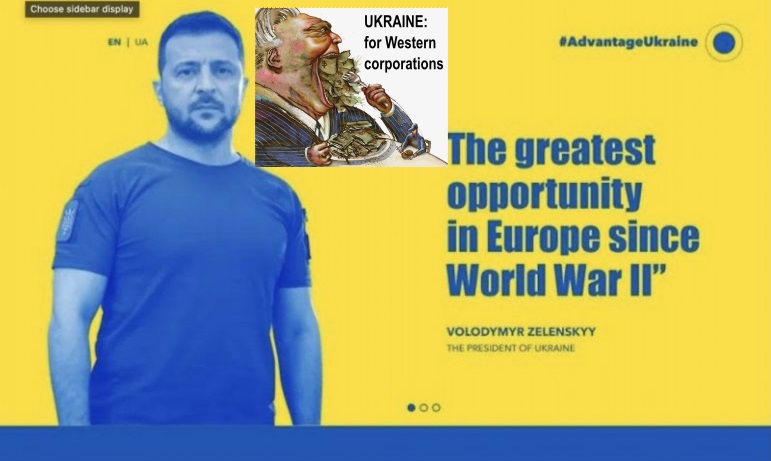
tough neoliberal policies to be imposed on post-war Ukraine, with calls for cutting labour laws , “opening markets”, lowering tariffs, deregulating industries and “selling state-owned enterprises to private investors”.
Zelensky invited foreign companies to come and exploit its abundant resources and cheap labour and offered Wall Street “a chance to invest … in projects worth hundreds of billions of dollars”.
Along with the nature of the arms being supplied, so have the objectives changed, at least the stated ones. We started, so it seems, to help Ukraine defend itself against Russian invasion, then we began talking about a “Ukrainian victory” to inflict a “strategic defeat” on Russia that would leave it “weakened”, with the fall of the Putin government. We have now reached the point that a former Polish foreign minister, currently a MEP, organised a meeting in the European Parliament on January 31, 2023 to “discuss the prospects for decolonisation and de-imperialisation of the Russian Federation” (i.e., the dissolution of the Russian Federation).
Great Expectations: The Ukraine to come, By Stefania Fusero, New Cold War, Feb 13, 2023:
Originally published in Italian on La Citta Futurà, Feb 11, 2023:
The collective West, increasingly becoming more directly involved in the conflict in Ukraine, has been vague about the objectives of its participation in the war and has repeatedly contradicted itself on the nature and number of weapons to be sent to Ukraine. From another standpoint, however, it has maintained clarity and constancy over time: the total dedication to a neoliberal project for a Ukraine open to Western corporations in which workers have no guardianship or protection.
The Western powers – the USA, NATO and the EU – have maintained a linear, unequivocal and steady standpoint on the management of the conflict in Ukraine, if not a vocal partisan support for one of the parties involved (the post-Maidan Ukrainian government), the demonisation of the Russian Federation and a disdainful rejection of the ancient art of diplomacy.
While French president Macron, a week after the entry of Russian troops into Ukraine stated, “we are not at war against Russia”, after less than a year the German foreign minister Annalena Baerbock declared in front of the EU parliamentarians “we are fighting a war against Russia.” On the other hand, if at the beginning of the Russian military operations Biden pledged to avoid a direct conflict between the US and Russia, US intelligence officials have recently revealed that not only have the CIA and US special forces been conducting clandestine military operations in Ukraine, but that the CIA, together with a spy agency of another NATO country, is engaged in sabotage operations within the Russian Federation itself.
Not to mention the escalation in arms shipments to Ukraine by Western countries – the most striking example is certainly Germany, which at the beginning of the conflict reluctantly announced that it would just send helmets and a field hospital, then, amid the indignation expressed by various allied countries and subjected to ever stronger pressure, after less than a year announced it would send tanks, no less. Thus, in a few months, Germany reneged on the principles of foreign policy pursued after the defeat of Nazism, one of which required Germany not to send weapons to any conflict zones, a policy which can be summed up in the German pledge ‘never again’. Which amounts to a complete reversal of the policy of peaceful coexistence with Russia and Eastern Europe pursued by such statesmen as Willy Brandt, having major implications for the entire European continent, not just Germany.
Just a few years have passed – but it feels like centuries – since, on 7 May 2015, Foreign Minister Frank-Walter Steinmeier solemnly celebrated in Volgograd the 70th anniversary of the end of WW2. “Here in Stalingrad, these people brought about the first decisive turnaround in the war. Here in Stalingrad, these people began Europe’s liberation from Nazi dictatorship. In doing so, they made immeasurable sacrifices. As a German, I bow before these victims in sorrow. And I ask for forgiveness for the infinite suffering that Germans inflicted on others in the name of Germany, here in this city, all over Russia, in the parts of the then Soviet Union that are now Ukraine and Belarus, and all over Europe…”.
No one has described such escalation better than former Ukrainian Defence Minister Oleksii Reznikov as of October last year. “When I was in D.C. in November, before the invasion, and asked for Stingers, they told me it was impossible. Now it’s possible. When I asked for 155mm guns, the answer was no. HIMARS, no. HARM, no. Now all of that is a yes. Therefore, I’m certain that tomorrow there will be tanks and ATACMS and F-16s.”
Along with the nature of the arms being supplied, so have the objectives changed, at least the stated ones. We started, so it seems, to help Ukraine defend itself against Russian invasion, then we began talking about a “Ukrainian victory” to inflict a “strategic defeat” on Russia that would leave it “weakened”, with the fall of the Putin government. We have now reached the point that a former Polish foreign minister, currently a MEP, organised a meeting in the European Parliament on January 31, 2023 to “discuss the prospects for decolonisation and de-imperialisation of the Russian Federation” (i.e., the dissolution of the Russian Federation).
On the other hand, it is not the first time that a plan to dismantle the Russian Federation has been openly talked of, under the guise of an improbable anti-imperialist struggle – see for example a conference organised on June 23, 2022 in Washington by the CSCE, a US government agency otherwise known as the Helsinki Commission. If anything, such initiatives can now be officially held at the institutional seat of the EU parliament.
Whereas the trajectory of Western military involvement in the Ukraine conflict has apparently been confused and cobbled together, the stance on the economic, social and political future of Ukraine has instead remained clear and constant over time.
The table is laid
4-5 July 2022, Lugano: Ukraine Recovery Conference.
Representatives of Western governments and corporations (US, EU, UK, Japan and South Korea) met in Switzerland to plan a series of tough neoliberal policies to be imposed on post-war Ukraine, with calls for cutting labour laws , “opening markets”, lowering tariffs, deregulating industries and “selling state-owned enterprises to private investors”. The URC (Conference on the Recovery of Ukraine) was not a novel initiative, but a continuation of the “Conference on the Reform of Ukraine”(URC) started in 2017. Same acronym, same spirit, i.e., to urge “strengthening market economy”, “decentralisation, privatisation, state enterprise reform, land reform, state administration reform” and “Euro-Atlantic integration”.
September 6, 2022: Volodymyr Zelensky virtually opens the New York Stock Exchange by symbolically ringing the bell via video streaming.
On the same day he had an editorial in the Wall Street Journal in which he launched the neoliberal ‘Advantage Ukraine’ program. Zelensky invited foreign companies to come and exploit its abundant resources and cheap labour and offered Wall Street “a chance to invest … in projects worth hundreds of billions of dollars”.
January 23, 2023: Zelensky delivers a video speech to the US National Association of State Chambers of Commerce meeting at Boca Raton, Florida, entitled After the War, American Business Can Become a Locomotive of Global Economic Growth.
A transcript of the speech is published on the institutional website of the Ukrainian presidency: “And – when we’ll be able to end this war by throwing out the occupiers – in the same manner together we’ll be able to start the difficult work of rebuilding Ukraine – our cities, our economy, our infrastructure. It is already clear that this will be the largest economic project of our time in Europe. It is obvious that American business can become the locomotive that will once again push forward global economic growth.
We have already managed to attract attention and have cooperation with such giants of the international financial and investment world such as Black Rock, J.P. Morgan and Goldman Sachs. Such American brands as Starlink or Westinghouse have already become part of our, Ukrainian, way… And everyone can become a great business by working with Ukraine. In all sectors -from weapons and defence to construction, from communications to agriculture, from transport to IT, from banks to medicine.”
Disaster capitalism
As to now, no one is able to predict what will remain of Ukraine at the end of the war, but the project of the Western actors involved is very clear and has already begun to be put into practice.
Ukraine was already the poorest country in Europe and if, like all the others in the former Soviet Union, it suffered from the brutal shock therapy* that had turned them into market economies, the neoliberal shock therapy imposed was not as devastating to Ukraine as it was to Russia. And there are still some state-owned assets in Ukraine to appeal to Western corporations. Last August Zelensky effectively eliminated the right to collective bargaining and union representation for the majority of Ukrainian workers, thus making them even poorer.
As economist Michael Hudson argues, Ukraine may well be the poorest country in Europe, but it is so for 99% of citizens; for the remaining 1% – the corrupt kleptocrats of the most corrupt country in Europe – it will instead become the richest country. And of course, the invitation to exploit the country’s riches is being extended to investors on the New York Stock Exchange. “Come on in and join the party! Someone’s loss is turned into somebody else’s gain. And that’s what happens in a class war. It’s a zero-sum game. There is no attempt at all to raise living standards.”
Class war has long been declared on the lower classes in the entire collective West, not just in Ukraine, suffice it to recall what French President Macron said last August: “What we are currently living through is a kind of major tipping point or a great upheaval…we are living the end of what could have seemed an era of abundance…”
Professor Michael Hudson comments: “When he said the ‘end of abundance’, what he really meant was the beginning of an IMF austerity program applied to Europe. And the end of the abundance for the 90% is a bonanza of abundance for the 1%, for the financial sector. They’re making huge, huge gains in all of this… Austerity for the population means we’re now going to put the class war in business here…It’s lower wages, enabling higher profit opportunities for the companies. It’s going to be the end of abundance for wage earners, but it’ll be a bonanza for the monopoly owners and for the banks.”
It is class warfare in Europe and the USA, but in Ukraine it is simultaneously a vicious, cynical proxy war that has been mercilessly shredding hapless Ukrainians into cannon fodder.
* the so-called shock therapy was inaugurated in Pinochet’s Chile, then it was implemented in Russia and in the other USSR countries after the end of the Soviet Union to turn them into market economies. Prices were liberalised while eliminating any social guarantees for citizens, causing an increase in excess mortality and a decrease in life expectancy, together with growing economic inequality, corruption and poverty. Assets and companies were sold out at bargain prices to local and foreign speculators who became enormously rich, while the social fabric unravelled causing an exponential increase in disease, suicide and crime.
Sources:
Mission Creep? How the US role in Ukraine has slowly escalated,
Branko Marcetic in Responsible Statecraft, 23 Jan 2023
The dissolution of the Russian Federation is far less dangerous than leaving it ruled by criminals, Anna Fotyga, 27 Jan 2023
German tanks in the Ukraine. Again (Maria Zakharova, Russian foreign ministry spokeswoman)
German tanks in the Ukraine. Again (Maria Zakharova, Russian foreign ministry spokeswoman)
Speech by Foreign Minister Frank-Walter Steinmeier in Volgograd to commemorate the end of the Second World War 70 years ago, Federal Foreign Office 7 May 2015
Decolonizing Russia – a moral and strategic imperative, CSCE 23 June 2022
President of Ukraine’s address to the participants of the meeting of the National Association of State Chambers, President of Ukraine 23 Jan 2023
West prepares to plunder post-war Ukraine with neoliberal shock therapy: privatization, deregulation, slashing worker protections, Ben Norton in Geopolitical Economy, 28 July 2022
Zelensky is literally selling Ukraine to US corporations on Wall Street, Ben Norton in Geopolitical Economy, 9 Sept 2022
Ukraine’s Zelensky sends love letter to US corporations, promising ‘big business’ for Wall Street, Ben Norton in Geopolitical Economy, 25 Jan 2023
Economist Michael Hudson on debt relief, inflation, Ukraine disaster capitalism, petrodollar crisis, Ben Norton in Geopolitical Economy, 8 Sept 2022
EU Commission abandons plans to sanction Russia’s nuclear industry.
EU Commission scratches Russia nuclear sanctions plans
Ukrainian President Volodymyr Zelenskyy had urged the EU to sanction Rosatom, the Russian state nuclear energy company.
The European Commission has abandoned plans to sanction Russia’s nuclear sector or its representatives in its next sanctions package, three diplomats told POLITICO on Thursday.
The EU executive initially told EU countries that it would try to draw up sanctions targeting Russia’s civil nuclear sector. And, ahead of a meeting of EU leaders last week, Ukrainian President Volodymyr Zelenskyy urged the bloc at least to issue sanctions against Russian nuclear energy company Rosatom.
But that plan has failed, the three diplomats said, pointing to the latest sanctions drafts.
The EU’s sanctions packages are divided into multiple parts: New rules that target specific sectors, such as aviation or military, and lists that impose visa restrictions and asset freezes on individuals and companies — but none include the nuclear sector, according to drafts seen by POLITICO and EU diplomats who spoke on condition of anonymity……………
France has also expressed prudence, with a French economy ministry official telling reporters earlier this week that “many nuclear power plants use fuel of Russian energy.”…………………
Biden says three aerial ‘objects’ US shot down likely not related to China surveillance
President Biden addressed recent aerial objects during a Thursday press briefing
By Chris Eberhart | Fox News, 17 Feb 23
Three aerial objects that were shot down after the military’s take-down of the Chinese spy balloon aren’t believed to be connected to China or other surveillance operations, President Biden said Thursday.
The intelligence committee is still assessing the three unknown aerial objects. “We don’t yet know what these three objects were, but nothing right now suggests they were related to China’s spy balloon program or that they were surveillance vehicles from any other country,” the president said during Thursday afternoon’s press briefing.
“These three objects were most likely balloons tied to private companies, recreation or research institutions studying weather or conducting other scientific research,” Biden said.
Fighter jets shot down at least four aerial objects, including a Chinese spy balloon that flew across country from Alaska to South Carolina, over an eight-day stretch.
………………. “But make no mistake, if any object presents a threat to the safety security of American people, I will take it down.” Reporters shouted questions at the president, but he left without taking any. https://www.foxnews.com/politics/biden-says-three-objects-shot-down-most-likely-from-private-companies-not-from-china
Australia’s dangerous and ill-judged obsession with the American “Alliance”
After that Australian forces, or rather their equipment, was aligned to a newer kind of threat from irregular or insurgent forces in Western Asia, conflicts in which Australia had little or no direct interest but was engaged there to keep the US on-side

The proposed long term acquisition of nuclear submarines has completely upended our diplomatic and strategic positioning, as revealed (perhaps unintentionally) by Defence Minister Richard Marles when he told a gathering in London this month that the AUKUS goal is to create “a more seamless defence industrial space” between the three countries, affirming that Australia is more tied at the hip to the US than previously admitted – because we would not have national control over the submarines in relation to their location and deployment, thereby severely compromising our national sovereignty.
The submarines would have little purpose for independent defence if ranged against China
Pearls and Irritations. By Andrew Farran, Feb 16, 2023
How might the renown mid-20th century linguist Ludwig Wittgenstein have addressed the current defence strategic review?
As the perceptive mid-20th century Cambridge based English/Austrian linguist Ludwig Wittgenstein explained, the answer you get to a question depends on how the question is formed. The same wisdom could have been conveyed to military planners in the past when they set out to plan force structures for twenty or more years ahead. Wrong question. Wrong answers.
Looking back, think of all the military expenditure over the past twenty years and more that has been wasted as being unusable or irrelevant to purpose. Think of the lost opportunities for sound force development and the money saved that might have been available for under-resourced schools, hospitals and welfare assistance falling short of need.
After World War Two planning remained where it had left off, with established formations around divisions, battalions and platoons, essentially ground forces and an expensive aircraft carrier unsuitable for serious combat. After much debate a viable carrier fleet was seen as unattainable and unaffordable with the loss of the existing fleet air arm. Upgrades on traditional lines were undertaken following the Korean War but thereafter with Vietnam becoming the main preoccupation (misconceived), and keeping faith with the US on military commitments, the conventional wisdom in military circles was that future conflict would involve containing insurgents in Asian jungles and the protection of naval approaches around continental Australia and its resources of a conventional nature.
Nonetheless a parallel objective was the search for a silver bullet that would provide cover for all contingencies whether existing or not. Hence the embrace by government of the F111 fighter/bomber not withstanding the tribulations of its procurement and eventual deployment (the latter being relatively little as it happened). After that Australian forces, or rather their equipment, was aligned to a newer kind of threat from irregular or insurgent forces in Western Asia, conflicts in which Australia had little or no direct interest but was engaged there to keep the US on-side – being our insurance in case of larger dangers closer to home.
…………………………. The real threat to America today is largely internal given rising levels of rioting and disaffection (racial and otherwise). But concern over America’s decline vis a vis China, whether real or not, is now front and centre on force structure issues.
…………….. As before we have looked for a magic pudding that would enhance our profile and please our once great and powerful friends. Hence as was the case with the F111s, and more recently the F-35s we have become fixated with nuclear powered submarines, having decided they are needed for long range deployment.
There is much that is unreal about this move. Firstly long range deployment implies that China is the potential or envisaged enemy requiring Australian engagement at that level. While China might be seen as flexing its muscles lately it has done nothing in this regard that is different from the United States. Both seek to protect and advance their relative status. But for neither side would this be advanced by military conflict.
……………..
wider world has a vested interest in the avoidance of counter-productive warfare and a deep felt need for viable multilateralism.
(See Jeffrey Sachs, “The new geopolitics”.)
………………………… The proposed long term acquisition of nuclear submarines has completely upended our diplomatic and strategic positioning, as revealed (perhaps unintentionally) by Defence Minister Richard Marles when he told a gathering in London this month that the AUKUS goal is to create “a more seamless defence industrial space” between the three countries, affirming that Australia is more tied at the hip to the US than previously admitted. – because we would not have national control over the submarines in relation to their location and deployment, thereby severely compromising our national sovereignty.
That would be a high price to pay even if we were engaged in a major war as was the case in 1942; but it is not and should not be the price we pay on speculation over assumed threats that are anything but imminent. The submarines would have little purpose for independent defence if ranged against China which can deploy a growing number of nuclear powered and armed submarines together with some 50 conventional powered ones (bearing in mind too that North Korea could deploy just as many given that the Korean War remains unresolved).
The Strategic Review currently underway will certainly strengthen our capacity to protect our immediate off-shore regions and coastline with new technologies including drones for enhanced surveillance, medium range missiles and sea mines, and survivable platforms to support them – while appreciating at the same time that in a high conflict situation the Chinese or any other militarily powerful nation could lob missiles on our vulnerable locations with disconcerting accuracy (including cities, Pine Gap and North West Cape). That point could well be the end of us sooner than we would like to think
So why buy into this unless doing so would make a difference when we know it would not. There is a lot more to this issue for the government to consider than when Prime Minister Menzies and his Cabinet decided on Australian forces being deployed in Vietnam or when Prime Minister Howard and his kitchen cabinet decided similarly in the case of Iraq – both gigantic mistakes. https://johnmenadue.com/the-defence-strategic-review-and-australias-alliance-obsession/
1 This Month



26 September – International Day for the Total Elimination of Nuclear Weapons


PLEASE OPPOSE HR 8255 AND S.3639 – bills would accelerate satellite deployment, with no environmental review or safeguards – https://ncstd5li.quorum.us/campaign/169331/
To see nuclear-related stories in greater depth and intensity – go to https://nuclearinformation.wordpress.com
-
Archives
- September 2026 (245)
- August 2026 (330)
- July 2026 (355)
- June 2026 (287)
- May 2026 (306)
- April 2026 (356)
- March 2026 (251)
- February 2026 (267)
- January 2026 (308)
- December 2025 (358)
- November 2025 (359)
- October 2025 (375)
-
Categories
- 1
- 1 NUCLEAR ISSUES
- business and costs
- climate change
- culture and arts
- ENERGY
- environment
- health
- history
- indigenous issues
- Legal
- marketing of nuclear
- media
- opposition to nuclear
- PERSONAL STORIES
- politics
- politics international
- Religion and ethics
- safety
- secrets,lies and civil liberties
- spinbuster
- technology
- Uranium
- wastes
- weapons and war
- Women
- 2 WORLD
- ACTION
- AFRICA
- Atrocities
- AUSTRALIA
- Christina's notes
- Christina's themes
- culture and arts
- Events
- Fuk 2022
- Fuk 2023
- Fukushima 2017
- Fukushima 2018
- fukushima 2019
- Fukushima 2020
- Fukushima 2021
- general
- global warming
- Humour (God we need it)
- Nuclear
- RARE EARTHS
- Reference
- resources – print
- Resources -audiovicual
- Weekly Newsletter
- World
- World Nuclear
- YouTube
-
RSS
Entries RSS
Comments RSS
 nuclear-news