The UK Government Knows How Extreme the Online Safety Bill Is

SCHEERPOST, By Joe Mullin / Electronic Frontier Foundation (EFF)
The U.K.’s Online Safety Bill (OSB) has passed a critical final stage in the House of Lords, and envisions a potentially vast scheme to surveil internet users.
The bill would empower the U.K. government, in certain situations, to demand that online platforms use government-approved software to search through all users’ photos, files, and messages, scanning for illegal content. Online services that don’t comply can be subject to extreme penalties, including criminal penalties.
Such a backdoor scanning system can and will be exploited by bad actors. It will also produce false positives, leading to false accusations of child abuse that will have to be resolved. That’s why the OSB is incompatible with end-to-end encryption—and human rights. EFF has strongly opposed this bill from the start.
Now, with the bill on the verge of becoming U.K. law, the U.K. government has sheepishly acknowledged that it may not be able to make use of some aspects of this law. During a final debate over the bill, a representative of the government said that orders to scan user files “can be issued only where technically feasible,” as determined by Ofcom, the U.K.’s telecom regulatory agency. He also said any such order must be compatible with U.K. and European human rights law. ……………………………………………………………………………
People Need Privacy, Not Weak Promises
Let’s be clear: weak statements by government ministers, such as the hedging from Lord Parkinson during this week’s debate, are no substitute for real privacy rights.
Nothing in the law’s text has changed. The OSB gives the U.K. government the right to order message and photo-scanning, and that will harm the privacy and security of internet users worldwide. These powers, enshrined in Clause 122 of the OSB, are now set to become law. After that, the regulator in charge of enforcing the law, Ofcom, will have to devise and publish a set of regulations regarding how the law will be enforced.
Several companies that provide end-to-end encrypted services have said they will withdraw from the U.K. if Ofcom actually takes the extreme choice of requiring examination of currently encrypted messages. Those companies include Meta-owned WhatsApp, Signal, and U.K.-based Element, among others. ……………………….
Finally, lawmakers in other jurisdictions, including the United States, should take heed of the embarrassing result of passing a law that is not just deceptive, but unhinged from computational reality. The U.K. government has insisted that through software “magic,” a system in which they can examine or scan everything will also somehow be a privacy-protecting system. Faced with the reality of this contradiction, the government has turned to an 11th hour campaign to assure people that the powers it has demanded simply won’t be used. https://scheerpost.com/2023/09/15/the-uk-government-knows-how-extreme-the-online-safety-bill-is/
Two years after AUKUS announcement, American politicians are divided on delivery of submarines to Australia
ABC By North America bureau chief Jade Macmillan in Washington DC, 16 Sept 23
A Republican senator has renewed calls for the US to step up its production of nuclear-powered submarines before selling them as part of AUKUS, arguing America is as “unprepared” as it was ahead of the Pearl Harbor attack.
The US is set to transfer at least three Virginia-class submarines to Australia from the early 2030s under the AUKUS agreement.
However, the top Republican on the Senate Armed Services committee, Roger Wicker, told a hearing in Washington this week that the US was failing to meet its own shipbuilding targets.
“We should be producing somewhere between 2.3 and 2.5 attack submarines a year to fulfil our own requirements as we implement AUKUS,” he said………….
Senator Wicker insists he supports the AUKUS agreement but has refused to back legislation in congress authorising the transfer of the submarines, arguing substantial new investments are needed in America’s shipbuilding capacity first.
In a letter to the president last month, he and 24 other Republicans argued selling submarines to Australia without a clear plan to replace them would “unacceptably weaken” the US fleet at the same time that China expands its military power.
Push for speed amid prospect of another Trump term
The AUKUS agreement will see Australia obtain up to five Virginia-class submarines from the US before eventually building its own nuclear-powered boats.
But two years after the deal was first announced, the US Congress still needs to sign off on several legislative proposals to progress it.
They include legislation to approve the sale of the subs, to allow Australia to make a promised $3 billion contribution to US shipyards, and to facilitate the sharing of sensitive technology………………………………………………………………………………………………
The political debate in the United States comes amid ongoing questions in Australia about the merits and the cost of AUKUS, which could have a price tag of up to $386 billion…………………………
Tensions within the Labor Party were exposed at its recent national conference, while former prime minister Paul Keating has described the agreement as the “worst deal in all history”.

Australian Defence Minister Richard Marles also previously expressed confidence in the level of bipartisan support for the agreement in the US………………………………
Public Need Versus the Business of War
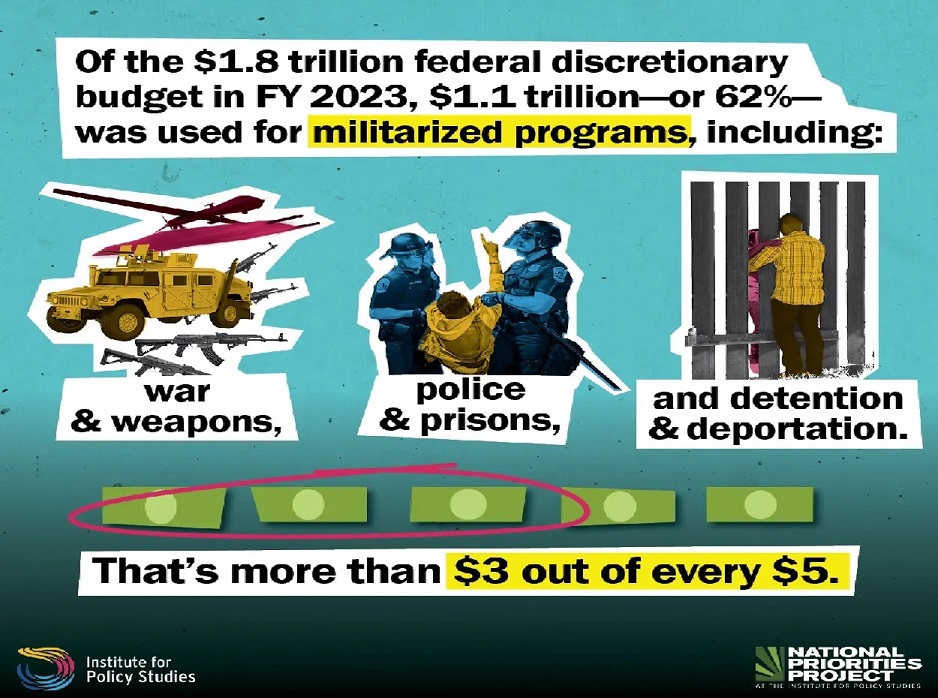
What does military contracting tell us about the priorities of the U.S. ruling class?
CHRISTIAN, SEP 16, 2023 Christian’s Substack
The American public is hurting. The bare necessities—clean water, nutritious food, and affordable housing—are hard to come by.
Tap water is contaminated with lead, PFAS, and other pollutants. The water systems that serve cities and towns suffer additional stressors, including drought, overuse, and a failure to incorporate greywater systems. And, like many necessities, you have to pay for it in the United States: Water utility prices continue to go up and up.
Hunger is a severe problem. ……………………………………
Housing is prohibitively expensive. …………………………………..
What is U.S. Congress doing as the public suffers?
Water Is Not a Priority
Every year, U.S. Congress appropriates money for two federal water funds. The Environmental Protection Agency gives this money to states in the form of grants. The Washington Post recently reported, “Since 2022, the federal allocation has totaled roughly $5.5 billion, amounting to a literal and figurative drop in the bucket for a nation with an estimated $625 billion backlog in projects just to provide cleaner, reliable drinking water.”
In other words, Congress has allocated 0.88 percent of the funding needed to establish infrastructure that dependably provides potable water.
It gets worse. Members of Congress skim funds off the top……………………………………
Food is Not a Priority
Stephen Semler, co-founder of the Security Policy Reform Institute, recently showed that annual U.S. military spending increased during the Trump administration by 20 percent in nominal terms and then increased during the first two years of the Biden administration by 15 percent in real terms. The military budget is now a record $858 billion for fiscal 2023, a bipartisan feat.
Food insecurity “climbed 18 percent during the same stretch,” Semler explained. “Something’s wrong when either military spending or food insecurity spikes over a two-year period. When they soar in tandem, it’s an abomination…”
There is plenty of money available to make sure people don’t go hungry. For example, the amount of money to be spent over several years on new land-based nuclear weapons ($263.9 billion) could instead build 52.5 million community gardens ($2,750 each) across the country, with more than enough money left over ($119.52 billion) to cover a year of food stamps. Tax dollars, we see, could be used to nourish instead of accidentally or deliberately eliminating human life on Earth.
The Housing Crisis……………………………………
Support the Troops
Evidence suggests that the federal government doesn’t even prioritize the troops’ water, food, and housing…………………………………………………………………………………
A State of Permanent Warfare
Military and intelligence personnel don’t deploy themselves. The U.S. ruling class deploys them.
When “successful,” military or intelligence operations open up an economy to multinational corporations, enriching the ruling class. Examples spanning the three main eras of the military-industrial complex (the first Cold War, the “global war on terror”, and today’s “strategic competition”) illustrate this success:……………………………………………………………………………………….
Moreover, U.S. military activity itself is extremely profitable for Wall Street and top corporate executives, as the U.S. military doesn’t shoot, move, or communicate—let alone eat, refuel, fly, or spy—without corporate goods and services. Corporations absorb more than half of the U.S. military budget. Many regularly price gouge the military.
The ruling class is organized and relentless in its pursuit of profit. The three branches of government (legislative, judicial, executive) largely respond to the needs of this class. Some of the richest and/or most influential members of U.S. government, such as a coal baron or a person who has profited from the provision of healthcare, even come from that class.
The Front Burner
A military aircraft, the F-35 Joint Strike Fighter, embodies the priorities of the ruling class. With a lifetime cost expected to top $1.7 trillion, the F-35 is on track to becoming the most expensive weapon of all time………………………………………………………………………………………………………………
One-Two Punch
The military-industrial complex is a one-two punch to the public………………………………………………………………………………… more https://thebusinessofwar.substack.com/p/public-need-versus-the-business-of?utm_source=post-email-title&publication_id=1769284&post_id=137081544&utm_campaign=email-post-title&isFreemail=true&r=c9zhh&utm_medium=email
50 US Lawmakers Reintroduce ‘CBDC Anti-Surveillance State Act’ to Protect ‘the American Way of Life’
BY PATRICIA HARRITY ON
Fifty U.S. lawmakers have reintroduced the CBDC Anti-Surveillance State Act to prohibit the Federal Reserve from issuing a retail Central Bank Digital Currency while protecting innovation and any future development of true digital cash. This is in direct opposition to the Globalists and the WEF agenda that seeks to enslave and remove all personal freedoms and privacy with CCP-style credit scores and surveillance.
U.S. Congressman Tom Emmer (R-MN) who has been a longtime advocate that any Fed-issued digital dollar (central bank digital currency) remain open, permissionless, and private announced on Tuesday that he and 49 other lawmakers have reintroduced the CBDC Anti-Surveillance State Act “to halt the efforts of unelected bureaucrats in Washington D.C. from issuing a Central Bank Digital Currency (CBDC) that dismantles Americans’ right to financial privacy.”
“If not open, permissionless, and private — like cash — a CBDC is nothing more than a CCP-style surveillance tool that can be weaponized to oppress the American way of life.” argues the congressman, “President Biden is willing to compromise the American people’s right to financial privacy for a surveillance-style CBDC. I don’t believe in compromising Americans’ rights,” he added.
CBDC Power
In many Western countries, including England, the USA, and Australia, banks are continuing to push towards the goal of Central Bank Digital Currencies as the only money as they plan to completely phase out cash use before the end of 2024. Individuals may argue that they already mostly use digital banking and debit or credit cards.
However, we have witnessed the freezing of the bank accounts of protesters in 2022 by Canadian PM Justin Trudeau simply for standing against the tyrannical restrictions of the plandemic, and hundreds of personal bank accounts were frozen under special powers.
Although yes, banks already have the power to close your account if they deem it necessary at the moment there is a small number of people already dealing with this, with their only offence being buying Bitcoin or questioning why the banks need to know what we’re doing with our money or questioning the banks ever tightening rules about holding an account with them, imagine what’s going to happen with CBDCs as the only legal currency says Brad Bleckwehl author of from the gutter up.
He continues:
“If you think the careers, contracts, and accounts of famous people getting canceled for saying or doing something that offends has nothing to do with you.. think about how ever-tightening PC culture is growing, and how authoritarian our Western governments have been becoming in recent years.”
“They’re literally trying to pass misinformation and censorship bills so they can legally control what we’re allowed to talk about. Combine the loss of freedom of speech with the ability to blackball us financially by freezing CBDCs, and we’re headed to a very bleak time for society. It’s not just going to be what is currently considered socially acceptable or not, it’s going to be forced behavior, forced ways of thinking. Look at how they bullied us with covid vaxxes.” (source).
The news of this pushback against the authoritarian control of our finances is huge
CBDC Anti-Surveillance State Act Updated, Reintroduced
Congressman Emmer posted on social media platform X: “Today, with 49 of my Republican colleagues, I reintroduced the CBDC Anti Surveillance State Act.” (source)……………………………………………………………………………………………………………….
“Bottom Line: If not open, permissionless, and private — like cash — a CBDC is nothing more than a CCP-style surveillance tool that can be weaponized to oppress the American way of life,” the lawmaker concluded,
The House Financial Services Committee will consider his bill this month. more https://expose-news.com/2023/09/14/50-us-lawmakers-reintroduce-cbdc-anti-surveillance-state-act-to-protect-the-american-way-of-life/
Sunak gives China green light to build UK nuclear plants despite nationbeing ‘threat to our way of life’
The Government has rejected calls
for Chinese state-linked firms to be excluded entirely from Britain’s
nuclear sector. China will not be permanently barred from investing in
Britain’s nuclear energy despite posing a “threat to our open and
democratic way of life”, the Government has said.
Ministers were accused
of a “patronising” and “misleading” approach by senior
Conservatives after ruling out a ban and insisting existing rules on China
are already tough enough. A committee of MPs suggested that allowing firms
with links to the Beijing regime to be involved in the civil nuclear sector
provided an “incentive and opportunity for espionage”.
In its response,
the Government said that it would consider new ways to scrutinise China’s
involvement in Hinkley Point C, which is already well under way, but would
not impose a blanket ban. It said: “The Government will continuously
review measures to ensure that economic security and critical national
infrastructure is protected. All investment involving critical
infrastructure is subject to thorough scrutiny and needs to satisfy strong
legal, regulatory, and national security requirements.” Future nuclear
projects would be “subject to these individual assessments” in which
the Government characterises as “a one step at a time approach” –
although a Chinese firm has already been bought out of the Sizewell C
project in which it was originally an investor.
iNews 14th Sept 2023
Ukrainians blame Zelensky for corruption – poll

https://www.rt.com/news/582796-ukraine-corruption-poll-zelensky-responsible/ 13 Sept 23
Nearly eight in ten citizens believe the country’s president is “directly responsible” for rampant graft, a new survey has shown
The vast majority of Ukrainians believe that President Vladimir Zelensky is at fault for widespread corruption in the country’s government and military, a new study has revealed.
The poll, released on Monday, found that 78% of Ukrainian adults see Zelensky as “directly responsible” for Kiev’s corruption problem. It was conducted by the Ilko Kucheriv Democratic Initiatives Charitable Foundation and the Kiev International Institute of Sociology.
Prior to the launch of Russia’s military offensive in February 2022, Ukraine consistently ranked among the world’s most corrupt nations, but it was touted as a bastion of freedom and democracy as the US and its NATO allies rallied public support for massive aid to Kiev. However, Ukrainian corruption remains a concern and could hinder the country’s bid to join the European Union, an unidentified Western diplomat told Politico on Monday.
Ukraine is a “very corrupt country,” the diplomat said, adding that Zelensky’s plan to use the Security Service of Ukraine (SBU) to prosecute graft cases could “send the wrong message.” Upon landing in Kiev for a surprise visit on Monday, German Foreign Minister Annalena Baerbock reportedly said Ukraine needed to step up its efforts to fight corruption.
The Ukrainian poll was conducted from July 3 to July 17 in face-to-face interviews with thousands of citizens across the country. There were no major differences in findings based on region or socioeconomic factors. Respondents aged 60 and older took a harsher view, with 81% saying Zelensky was responsible for government corruption. The rate was 70% in the youngest segment, ages 17 to 29. Overall, only 18% of Ukrainian adults disagreed with the statement that Zelensky bears responsibility.
Documents obtained by the International Association of Investigative Journalists in 2021 showed that Zelensky and his business partners set up offshore companies to purchase lavish properties in central London. Zelensky transferred his stake in one of the companies to an aide just before he was elected president in 2019. Supporters of former Ukrainian president Petro Poroshenko accused Zelensky and his associates of using their offshore accounts to evade taxes.
Zelensky has purged officials in his government for alleged corruption, including an embezzlement scheme involving humanitarian aid. Just this month, he sacked Defense Minister Aleksey Reznikov, who came under fire earlier this year over purchases of military rations at inflated prices. However, the new defense chief, Rustem Umerov, is reportedly under investigation for alleged crimes in his previous job.
Huge nuclear lobbying aimed at British Parliament

The Nuclear Industry Association will host the third Nuclear Week in
Parliament (NWiP) between the 11th and 13th of September 2023. In January
2023, the rescheduled week saw hundreds of Parliamentarians and industry
representatives engage in various events.
Back in its annual September slot, this year’s NWiP will be packed with multiple events and receptions, plus opportunities for NIA members to hold their complementary meetings.
The week will focus on engaging with Parliamentarians on various topics,
including new build, Advanced Nuclear Technologies, and the fuel cycle.
This will build on our Summer Conference, due to be held in the Concorde
Conference Centre in Manchester on Wednesday, 14 June 2023.
Nuclear Industry Association (accessed) 13th Sept 2023
https://www.niauk.org/nuclear-week-in-parliament-2023-sponsorship-opportunities/
Germany advises against nuclear power in Uganda
The Independent September 13, 2023
Kampala, Uganda | THE INDEPENDENT | The Ambassador of the Federal Republic of Germany, Matthias Schauer, has advised against plans by Uganda to invest in nuclear power plants.
Ambassador Schauer joins a number of local and international experts who have advised Uganda against plans to put up 2000-megawatt nuclear.
Schauer, whose country continues to support Uganda’s clean energy projects and policies said nuclear power generation is not only costly but environmentally sensitive.
He was speaking at the launch of the Energy Policy for Uganda 2023 at the Sheraton Hotel in Kampala.
He said the plans to put nuclear power plants seem not to fit in the goals of the new policy.
According to the ambassador, Uganda is envied by industrial nations including Germany for its abundant hydropower and huge potential for solar power.
Germany stopped producing any electricity from its nuclear power plant in April this year.
He said Germany shut down its nuclear power plants for fear of disasters like the Chornobyl disaster in 1986 and the 2011 Fukushima Daiichi nuclear power plant disaster.
The Energy Ministry Permanent Secretary Irene Bateebe last year indicated that Uganda needs nine billion dollars to put up a nuclear power plant.
But the Ambassador says putting up a nuclear power plant costs between $15-20 billion.
The new policy which is replacing the one developed in 2002 identifies the development of nuclear as part of the plans for Uganda’s energy mix.
The policy among other strategies suggests Public-private partnership investments, including decommissioning, spent fuel, and radioactive waste management, in nuclear power development.
The government has in the past suggested a phased approach towards putting up the first reactors for the 2000-megawatt nuclear power plant by the end of 2031……………………………….
https://www.independent.co.ug/germany-advises-against-nuclear-power-in-uganda/
—
In Australia nuclear energy remains weapon of choice for climate deniers and coal lobby.
ReNeweconomy, Giles Parkinson 11 September 2023
The Nationals, and the Liberal Party coalition partners, are in furious
agreement: They are not the slightest bit serious about strong climate
action, and the only difference between former National leader Barnaby
Joyce and current leader David Littleproud is that Joyce wants to stop the
pretence.
Littleproud, let’s remember, believes that net zero 2050 means
not having to do much any time soon. Like too many corporates, and the
fossil fuel industry in particular, it’s an excuse to sit around and do
nothing – make some grand promises and wait for some new technology to come
along that doesn’t disrupt their business plan. Nuclear, and small modular
reactors, are a perfect tool for this. SMRs don’t exist in any western
country, do not have a licence to exist, and no-one – even in the nuclear
industry – seriously believes they will be in commercial production within
a decade, if then.
Renew Economy 11th Sept 2023
USA & NATO responsible for Ukraine war, German & French public say in poll
Most people in Germany and France blame the United States and/or NATO for the war in Ukraine, according to a poll conducted not by a pro-Russian group but rather by anti-Putin activists.
BEN NORTON, SEP 10, 2023, Geopolitical Economy Report
Original shows tables of poll results.
Most people in Germany and France blame the United States or NATO for the war in Ukraine, according to a poll conducted not by a pro-Russian group but rather by anti-Putin activists.
This public opinion is unlikely to have a significant impact on government policy, however.
Germany’s Foreign Minister Annalena Baerbock stated bluntly in a NATO-funded conference in 2022 that Berlin would support Ukraine “no matter what my German voters think”.
In the German poll, respondents were only allowed to pick one answer. In France, the poll was a bit different, and people could blame multiple parties for starting the war in Ukraine. (This explains why the sum of the latter poll is greater than 100%.)
Among the French surveyed, 43% blamed the USA, 36% NATO, 19% Ukraine, and 19% other European countries, while 40% blamed Putin.
These results suggest that many average Europeans can see clearly that the conflict in Ukraine is not merely a battle between Kiev and Moscow, but rather a proxy war that the NATO military alliance, led by the United States, is waging against Russia.
The outcome of these polls is even more striking when one considers who sponsored them.
The so-called “Anti-Corruption Foundation” was founded by Russian opposition politician Alexei Navalny, a regime-change activist who is openly supported by Western governments…………………………………………………………………………………………….more https://geopoliticaleconomy.substack.com/p/us-nato-responsible-ukraine-war-poll?r=nxsz
Ukrainian Dissident Resists NATO’s Proxy War
September 10, 2023, By Max Blumenthal / YouTube
Ukrainian journalist and exiled antiwar dissident Ruslan Kostaba has been jailed and brutally attacked for his years of opposition to his government’s war in the Donbas, and his calls for peace with Russia. From exile, he speaks to The Grayzone’s Max Blumenthal about the growing movement in Ukraine against escalating the war, and the price his countrymen face for attempting to escape the war.
Comment. Kalen
Thanks for the first on SP post about peace activism in Ukraine although it is very diverse with many angles and ideologies. Most of them acquired legitimacy many years ago when they did what real peace peace movements must do namely tried to promote peace like Minsk agreements and prevent wars not freezing them. They failed among other things because their voice was suppressed in the western peace movements that actually fueled the war. Now Ukrainians for peace and that also includes non-pacifists are appalled by Ukraine being used by NATO as bloody battlefield to preserve US hegemony over Eurasia.
The western peace movements’ silence and betrayal of gruesome fate of thousands of Ukrainian peace activists exiled, hundreds murdered and imprisoned by Kiev regime while protesting eight years of Donbas war against civilians, Kiev escalation of war financed by US and in last 18 months calling for peace talks with Russia is one of darkest chapters of western peace movements already tarnished by adopting nonsense of just wars and humanitarian killings.
The old western anti war movements are all dead, some act like war craving zombies. They burned to ashes. There is nothing to resurrect as they were always fundamentally wrong and morally highly ambiguous as long as they were judging foreign societies they had no idea about pushing supposedly universal superiority of western liberalism they were themselves clueless about. As a result they often externally fueled conflicts, prevented any solutions of social peace to be achieved by local communities’ cooperation free of dogmatic political or religious influences.
Oregon hasn’t said never to nuclear power, but it should

BY LLOYD K. MARBET, Sep 10, 2023 https://www.bendbulletin.com/opinion/guest-column-oregon-hasnt-said-never-to-nuclear-power-but-it-should/article_5f0b13ec-4e93-11ee-873b-6fbd0628540c.html
Recently, editorials have appeared across Oregon in a number of newspapers. They are remarkably similar, and subtly deceptive in their content, as if the Nuclear Pied Piper is once again in town, playing new music for a great revival if only you will follow the Pied Piper down its unforseen road once again.
Have we resolved the problems of the nuclear fuel cycle? NO! A complicated cycle consisting of: — availability of uranium, mining, milling, enrichment, and fuel fabrication — construction of nuclear power plants with its delays and tremendous cost overruns — uncertain safety of nuclear plant operations with government limited liability leaving taxpayers holding the bag — targets of war, terrorism and natural disasters — radiation releases difficult to detect, and health effects difficult to prove, with ongoing disputes over the number of deaths — radioactive wastes throughout the fuel cycle demanding permanent disposal, up to thousands of years for high level radioactive waste — and decommissioning of an elaborate contaminated nuclear infrastructure. The problems of the nuclear fuel cycle are not resolved, nor fully accounted for!
Nuclear energy is not “zero emissions.” Oregon law measures carbon emissions at only one point in its fuel cycle: at the generation of electricity. The nuclear fuel cycle is an ongoing tragedy visiting its impacts on generations to come. Commercial “Small Modular Nuclear Reactors” are unproven designs on paper. If we are going to save ourselves from Climate Annihilation the time for honest accountability has come. Read Mark Jacobson’s book “No Miracles Needed: How Today’s Technology Can Save Our Climate and Clean Our Air.”
Oregon’s ballot measure and legislative referral process is a valuable educational tool for enlightening the electorate on important issues. It is also the reason why I strongly support preserving the ballot measure law passed by Oregon voters in 1980 and not repealing this hard-fought effort, that has protected Oregonians for 43 years by requiring the commercial nuclear power industry to have a “terminal” repository for its high level radioactive waste before producing any more. This law doesn’t say never to nuclear power.
Secondly, and most important, it provides, by referral to all Oregon voters, the right to make the final decision on whether proposed commercial nuclear power plants are needed, cost effective, and can safely operate in our state! The Bulletin’s editorial provides an incorrect history of the 1980 and 1986 ballot measures. The 1986 ballot measure on nuclear power was not passed into law!
Why are nuclear proponents seeking another vote on the 1980 law? Especially when repealing what gives Oregonians an ongoing vote on whether the nuclear industry has successfully met its obligation to provide a viable cost effective energy resource, capable of terminally disposing its high level nuclear wastes.
In the last Oregon legislative session, a hearing was held on one of the two identical bills that sought to re-refer the 1980, not the failed 1986, ballot measure to another vote. Both 2023 bills “fizzled out” after a House Committee heard testimony in favor of them and overwhelming testimony in opposition! Especially of note is testimony provided by Dirk Dunning, formerly of the Oregon Department of Energy, and Tami Thatcher, formerly of the Idaho National Laboratory. All testimony is available to read online at: tinyurl.com/Testimonyonnukes.
Eastern European NATO Countries Fear Peace Talks Between Ukraine and Russia
Poland and the Baltic states are worried growing opposition to the proxy war inside the US could lead to negotiations
SCHEERPOST, By Dave DeCamp / Antiwar.com,6 Sept 23
NATO members that border Russia and Belarus are afraid that growing opposition to the proxy war in Ukraine inside the United States will put pressure on the Ukrainians to pursue peace talks with Russian President Vladimir Putin, The Hill reported on Tuesday.
While the Biden administration’s stated policy is to back Ukraine for “as long as it takes,” and the majority of Congress still supports the proxy war, there is there is fatigue among Americans. A recent poll from CNN found that 55% of Americans are against Congress authorizing more spending on the conflict.
Former President Trump, the Republican frontrunner for the 2024 election, has claimed he would end the war in Ukraine within “24 hours.” The Biden administration is looking to sign a long-term security deal with Ukraine to tie the hands of a future administration on the issue, but the political climate has some NATO members nervous that peace might be pursued.
The report said that for Poland and the Baltic states of Latvia, Lithuania, and Estonia, talking with Putin is a “red line.” The four nations want the US and the rest of Ukraine’s Western backers to prepare for a future where the Russian leader is completely isolated……………………….
Ukrainian President Volodymyr Zelensky has maintained demands for peace talks that are a non-starter for Moscow, including a full Russian withdrawal and Russia ceding Crimea. Zelensky and his government will likely not drop the maximalist demands unless Ukraine loses the support of the US and NATO, which Kyiv has acknowledged is fueling the entire war effort……………………………………………. more https://scheerpost.com/2023/09/06/eastern-european-nato-countries-fear-peace-talks-between-ukraine-and-russia/
Japan announces emergency relief for seafood exporters hit by China’s ban over Fukushima water
Japan announces emergency relief measures for seafood exporters hit by
China’s ban. Japanese Prime Minister Fumio Kishida announced on Monday a
20.7 billion yen ($141 million) emergency fund to help exporters hit by a
ban on Japanese seafood imposed by China in response to the release of
treated radioactive wastewater from the damaged Fukushima nuclear power
plant.
Daily Mail 4th Sept 2023
Globe & Mail 5th Sept 2023
Guam nuclear energy ban focus of Tuesday hearing

By Joe Taitano II – For Variety, Sep 4, 2023 https://www.mvariety.com/news/regional_world/guam-nuclear-energy-ban-focus-of-tuesday-hearing/article_4a573368-4abf-11ee-aaa0-4335e65acd7f.html
HAGÅTÑA (The Guam Daily Post) — Residents can weigh in Tuesday morning on a proposal to ban nuclear energy from Guam’s shores.
Bill 151-37, sponsored by Sen. Sabina Perez, would ban nuclear reactors, from conventional reactors large enough to provide for the island’s entire energy consumption in one site to microreactors that can provide about as much power as the Dandan Solar Farm in a package that can fit on an airplane.
The hearing is scheduled for 9 a.m. Tuesday at the Guam Congress Building.
Perez said while nuclear power is becoming more popular in response to climate change, her bill intends to protect the community and environment from the inherent dangers of nuclear power.
“The main concerns are the likelihood of radiation exposure in a typhoon and an earthquake-prone region that could exacerbate recovery efforts. Additionally, our community is suffering from increasing rates of cancer compared to the continental U.S., which is experiencing declining rates,” Perez said.
She said adequate storage and disposal of nuclear waste could be a concern, given the limited space and growing population on island.
“As Pacific Islanders who are on the front lines of climate change, our future should not be built on risk but on responsible innovation for a sustainable future,” she said.
The text of the bill also weighs the strategic military importance of the island.
While federal officials planning a 360-degree missile defense system for the island have shot down ideas that nuclear microreactors could be used to power the new systems, both Andersen Air Force Base and Naval Base Guam were identified as candidates for portable nuclear power plants in a study commissioned by the Army in 2018.
The Pentagon last year announced plans to deploy portable nuclear reactors to remote forward operating bases, though Guam hasn’t been officially announced as a candidate site.
The hearing will be livestreamed on GTA Channel 21, Docomo Channel 117 and the Guam Legislature Media YouTube channel.
1 This Month
23-25 October – on Zoom – World BEYOND War’s annual global conferenc


Shut down the radiation-damaged Heysham nuclear reactors now
To see nuclear-related stories in greater depth and intensity – go to https://nuclearinformation.wordpress.com

Say No to NASA’s Reckless Nuclear Reactor on the Moon
Say No to NASA’s Reckless Nuclear Reactor on the Moon
-
Archives
- October 2026 (180)
- September 2026 (339)
- August 2026 (330)
- July 2026 (355)
- June 2026 (287)
- May 2026 (306)
- April 2026 (356)
- March 2026 (251)
- February 2026 (267)
- January 2026 (308)
- December 2025 (358)
- November 2025 (359)
-
Categories
- 1
- 1 NUCLEAR ISSUES
- business and costs
- climate change
- culture and arts
- ENERGY
- environment
- health
- history
- indigenous issues
- Legal
- marketing of nuclear
- media
- opposition to nuclear
- PERSONAL STORIES
- politics
- politics international
- Religion and ethics
- safety
- secrets,lies and civil liberties
- spinbuster
- technology
- Uranium
- wastes
- weapons and war
- Women
- 2 WORLD
- ACTION
- AFRICA
- Atrocities
- AUSTRALIA
- Christina's notes
- Christina's themes
- culture and arts
- Events
- Fuk 2022
- Fuk 2023
- Fukushima 2017
- Fukushima 2018
- fukushima 2019
- Fukushima 2020
- Fukushima 2021
- general
- global warming
- Humour (God we need it)
- Nuclear
- RARE EARTHS
- Reference
- resources – print
- Resources -audiovicual
- Weekly Newsletter
- World
- World Nuclear
- YouTube
-
RSS
Entries RSS
Comments RSS

