Nuclear energy touted at West Virginia Chamber forum, but key cost, oversight and waste management questions linger
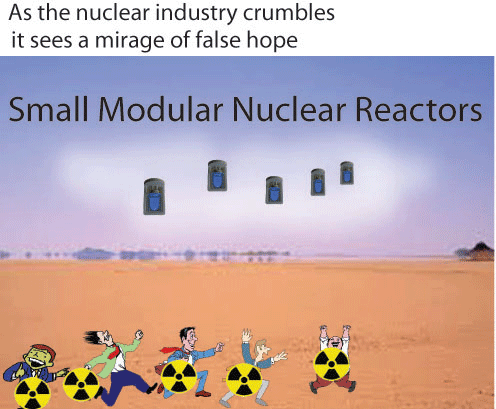
The Herald Dispatch, By Mike Tony 4 Sept 23
West Virginia political and business leaders made clear during last week’s state Chamber of Commerce annual summit they see a significant role for nuclear power in the state’s energy future.
“It’s a promise for our state,” Sen. Shelley Moore Capito, R-W.Va., said of nuclear energy during a summit speech at The Greenbrier resort in White Sulphur Springs Wednesday.
But recent federal reports have observed key cost, waste management and federal oversight questions linger over unconventional — or “advanced” — nuclear technologies that supporters say would be safer and cheaper than existing nuclear reactors.
……………………………………….. Emil Avram, vice president of business development at Virginia-based Dominion Energy, estimated the nuclear facility Dominion is exploring would require an investment of $3 billion to $5 billion per 300- to 400-megawatt facility — and that the company is planning to build up to 18 of those units over the next 25 years.
“So we also have to find sustainable, I’ll call it balance-sheet solutions for our company as we build out this capital-intensive infrastructure,” Avram said.
……………………………………Small modular reactor technology is not yet market-ready. The Department of Energy has approved cost-share awards to develop small modular reactors that can be operational by the end of the decade.
A Congressional Research Service overview of advanced nuclear reactors published in February noted research on small modular reactors suggesting their small size will keep them from achieving economies of scale.
The overview noted a 2018 study by researchers from Carnegie Mellon and Harvard universities and the University of California, San Diego predicting the cost per unit of power of a small modular reactor would very likely be higher than that of a large reactor, even if the smaller reactors may be cheaper to build.
The unit cost of producing electricity from nuclear energy was slightly more than coal and over double that of solar, geothermal, onshore wind or natural gas in the federal Energy Information Administration’s annually published energy outlook for 2022.
In its overview, the Congressional Research Service, a nonpartisan policy analysis agency within the Library of Congress, quoted a 2023 conclusion from the National Academies of Sciences, Engineering, and Medicine that there’s a “learning curve for both small modular reactor construction costs and deployment [that] needs to be understood……………………………………………………
The West Virginia Legislature lifted restrictions on nuclear power plant construction early in the 2022 regular legislative session.
The Senate on July 27 included the Capito and Carper-led nuclear measure, the Accelerating Deployment of Versatile, Advanced Nuclear for Clean Energy (ADVANCE) Act, in the National Defense Authorization Act that passed through the chamber. The National Defense Authorization Act would approve fiscal year 2024 appropriations and establish policies for Department of Defense programs…………………………………………..
A recent federal government watchdog report found the agency charged with protecting public safety and health regarding nuclear energy has important work to do to prepare for an expected influx of advanced nuclear reactor applications.
The Nuclear Regulatory Commission has staffing and licensing review issues that could hinder the agency’s oversight and developers’ ability to deploy advanced nuclear reactors, the Government Accountability Office found in its report released in July.
The office found commission officials and most stakeholders it interviewed indicated the commission faces challenges in hiring and retaining staff needed to review advanced reactors.
Existing commission guidance does not clearly advise agency staff on how to establish and manage licensing review schedules for incomplete applications, the Government Accountability Office found.
Without such guidance, the commission’s reviews of advanced reactor applications may not be clear and predictable, the office warned.
Capito and Rep. Cathy McMorris Rodgers, R-Wash., the top Republican on the House Energy and Commerce Committee, had asked the office last year to assess the commission’s preparedness to review and approve advanced nuclear reactor applications.
the Congressional Research Service noted some advanced reactor technologies have chemical properties that pose safety concerns, including reactivity, toxicity, or corrosiveness of the primary coolant in the case of sodium, lead and molten salts, respectively.
It’s unclear whether future advanced nuclear reactor technologies would improve on past handling of reprocessing wastes, the Congressional Research Service report observed. The service cited a National Academies of Sciences, Engineering, and Medicine report published this year finding that amounts and types of waste that will be generated by advanced reactors are difficult to estimate “at this early stage” of development. https://www.herald-dispatch.com/news/nuclear-energy-touted-at-wv-chamber-forum-but-key-cost-oversight-and-waste-management-questions/article_7941cf2a-19dc-57e7-a44d-30a7672728da.html
Illinois legislators have a lot to learn about nuclear power
Lawmakers in Springfield who are not willing to put much effort into learning fundamental details have no business writing future energy legislation, writes David A. Kraft, director of the Nuclear Energy Information Service.
David A. Kraft, director, Nuclear Energy Information Service, Sept 4, 2023, https://chicago.suntimes.com/2023/9/4/23855690/illinois-legislators-moratorium-nuclear-energy-info-service-small-modular-reactors-pritzker-letters
Rich Miller’s Aug. 25 column about Gov. J.B. Pritzker’s veto of the attempt to repeal the Illinois nuclear construction moratorium provides a valuable picture of the politics behind nuclear legislation (“Pritzker sends mixed messages on moratorium of new Illinois nuclear plants”).
It also demonstrates how important it is for legislators to actually know something about what they’re advocating or voting for. It has been clear throughout all the hearings that Illinois legislators lack the depth of knowledge about proposed nuclear reactors needed before financially binding ratepayers and the Illinois economy to a pro-nuclear future.
Nuclear proponents — particularly sponsoring Sen. Sue Rezin — “hotly dispute,” as Miller wrote, Pritzker’s concerns that drafting (SB 76) that way would “open the door to large-scale nuclear power plants.” The 11th-hour language change advocating “advanced reactors” drove his concern.
However, the governor is 100% correct and nuclear advocates 100% wrong.
A 2023 report by the Congressional Research Service clearly states, “Advanced reactor designs come in a wide range of sizes, from less than 15 MWe to 1,500 MWe or more.” The latter is 400 MWe larger than an Illinois Braidwood reactor.
A simple 30-minute Google search found several other sources report “advanced reactor” sizes ranging from 600 to 1700 MWe.
Legislators not willing to put this much effort into learning such fundamental details have no business writing Illinois’ energy future legislation.
The governor said: “Small Modular Reactors are very beneficial. … They do seem to work very well, and they do seem to be safe, but they’re going to be several years of testing yet ahead.”
Well, no, governor, they do not. Simply because as you also said, they do not yet exist. They are proposed to have safer qualities. But none have been built to demonstrate them yet.
Throughout this process, our organization repeatedly advocated for creating a panel of qualified experts to better research these and other issues. The current level of demonstrated nuclear ignorance validates that suggestion.
The State of Nuclear Instability in South Asia: India, Pakistan, and China
LAWFARE Debak Das, Sunday, September 3, 2023,
The uneasy nuclear balance between India and Pakistan is being unsettled by India’s competition with China and China’s competition with the United States.
Editor’s Note: The India-Pakistan nuclear dynamic has long been a concern, indeed a nightmare, for security analysts. The Korbel School’s Debak Das argues that the growing India-China rivalry, and China’s growing nuclear competition with the United States, add new dimensions to this long-standing problem and create additional risks for nuclear escalation.
Prime Minister Narendra Modi’s state visit to Washington, D.C., in June has prompted a debate on the United States’ bet on India as a military partner to check China in the Indo-Pacific. A key part of this debate is the nuclear relationship among India, China, and Pakistan. Twenty-five years ago—in May 1998—India and Pakistan both tested nuclear weapons, initiating a trilateral nuclear rivalry in Southern Asia.
Since then, these three states have steadily increased their numbers of nuclear warheads and their fissile material production. The uneasy strategic stability in the region is also marked by technological advances in missile technology, counterforce capabilities, and an expanding spectrum of nuclear delivery vehicles available to every side. India and China’s repeated border clashes along the Himalayas and broader competition in the Indo-Pacific add a layer of complexity to the problem. This rivalry has led to developments in military technology and organization—especially India’s new Integrated Rocket Force—that increase the risk of escalation in the region. Added with Pakistan’s devolving domestic political environment characterized by renewed civilian-military clashes and India’s statements about abandoning its no-first-use policy, there are a number of different pathways to nuclear instability in the region that should generate broad concern in the international community.
Increasing Vulnerability From Nuclear Modernization
Both India and Pakistan have consistently modernized their nuclear forces over the past two decades. Each is aiming to ensure that they can match each other at lower levels of escalation. These technological advancements have led to increased vulnerability for both sides at different levels of the escalation ladder. This ranges from the ability to use low-yield nuclear weapons in specific battlefields as well as being able to conduct large strategic countervalue strikes on each other’s cities.
Pakistan has adopted a strategy of “full spectrum deterrence” that allows for the use of nuclear weapons in response to low-scale conventional war, even considerably below the nuclear threshold. As a part of this strategy, Islamabad has introduced tactical/battlefield nuclear weapons with short ranges—like the Hatf IX Nasr missile, which has a 60-kilometer range. It has also built a number of ground- and air-launched nuclear-capable cruise missiles, with ranges between 350 and 700 kilometers. Pakistan also introduced its Babur-3 nuclear-capable sea-based cruise missile in 2017 after India commissioned a nuclear submarine.
India, meanwhile, has been reported to be building flexible preemptive counterforce nuclear systems. These include more precise nuclear delivery systems with short ranges, multiple independently targetable reentry vehicle systems on ballistic missiles, and a growing arsenal of cruise missiles. India is also building a new series of surface-to-surface ballistic missiles, Pralay (with a range of 150 to 500 kilometers), alongside its existing land- and sea-based cruise missiles, which have a range of 1,000 kilometers. To increase the survivability of its nuclear forces, New Delhi has built a “triad” of delivery systems with the ability to launch nuclear weapons from air-, land-, and sea-based platforms. It is reinforcing this triad with plans to build three more nuclear submarines—in addition to the one already in service, INS Arihant—presumably with the goal of eventually having a “continuous-at-sea-deterrence” patrol capability, like the navies of the United Kingdom, Russia, the United States, and France.
In their attempts to increase the vulnerability of their adversary, both India and Pakistan have increased the range of their nuclear weapons. …………………………………………………….
Emulating China: India’s New Integrated Rocket Force
Alongside the modernization of its nuclear weapons, India is currently restructuring its ballistic missile forces. New Delhi is creating an Integrated Rocket Force (IRF) that will contain both nuclear-capable and conventional ballistic and cruise missiles. ……………………………..
India’s creation of the IRF is a mistake. The IRF will likely place nuclear-capable and conventional ballistic missiles within the same force; this will change India’s present policy of ballistic missiles being dedicated to only carrying nuclear weapons. Using the same missiles in both conventional and nuclear roles increases the chance of inadvertent escalation…………………………………………………………………………………
China in Nuclear South Asia
In the past two decades, China’s role in South Asia has grown exponentially, especially along India’s border, which has further complicated the nuclear relationship between India and Pakistan.
Sino-Indian altercations along the Line of Actual Control (LAC) in the Himalayas, along with growing naval competition in the Indo-Pacific, have shifted India’s priorities with nuclear weapons modernization toward addressing threats from China. …………………………………………………………………………………………………………….
Indeed, what is at work in the subcontinent is not just a “trilateral nuclear competition”—it is a quadrilateral competition. China is responding to the United States’ nuclear modernization and ballistic missile defense. India is responding to China’s modernization and force expansion. And Pakistan is attempting to ensure that it does not lag behind India by maintaining some form of nuclear parity at all levels of escalation.
Devolving Domestic Politics and No First Use
In addition to expanding nuclear arsenals, both India and Pakistan face different challenges to nuclear stability from their respective domestic politics. The devolving political situation in Pakistan has created new possibilities for ways in which the government could lose command and control of its nuclear weapons. The current state of domestic political turmoil between former Prime Minister Imran Khan (and his party, Pakistan Tehreek-e-Insaf) and the military establishment under army chief General Asim Munir has sparked considerable chaos. …………………………………………
On the Indian side, the government’s increasing ambivalence toward its no-first-use policy is a clear threat to nuclear stability in the region. …………………………………………………………………………………………………………………….
What Washington Must Not Do
Recent calls by scholars such as Ashley Tellis to arm India with thermonuclear weapons and naval nuclear reactor designs present a dangerous policy option. ……………………………………………………………..
Twenty-five years after the overt nuclearization of South Asia, there are enough drivers of strategic instability in the India-Pakistan-China nuclear relationship. The United States needs to be cognizant of this as it crafts an Indo-Pacific policy aimed at countering China. Indeed, it should aim to deemphasize the nuclear dimension of this competition and avoid entangling India in a four-way nuclear competition among the United States, China, India, and Pakistan. https://www.lawfaremedia.org/article/the-state-of-nuclear-instability-in-south-asia-india-pakistan-and-china
South Koreans worry about Fukushima water: more disapprove of President Yoon
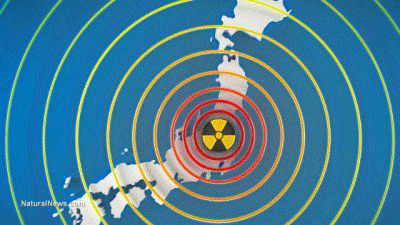
A majority of South Koreans are worried about Japan’s discharge of treated
radioactive water from the Fukushima nuclear plant into the sea despite
efforts by their government to allay fears, a poll published on Friday
showed.
Japan says the water from the wrecked nuclear power plant is safe
and it began releasing it into the Pacific on Aug. 24 despite objections at
home and abroad, particularly from China, Japan’s biggest trade partner,
which banned Japanese seafood.
The South Korean government, however, has
said it sees no scientific problem with the water release, though stressing
it does not approve of it, and banning the import of seafood from waters
off Fukushima, north of Tokyo. President Yoon Suk Yeol has led a campaign
to ease public concern and encourage consumption of seafood. On Thursday,
he visited a major fisheries market to shop and have lunch. Despite such
efforts, South Korean environmental groups and many members of the public
are alarmed and Yoon’s disapproval rating has risen to the highest in
months, a Gallup Korea poll of 1,002 people showed.
Reuters 1st Sept 2023
Nuclear “lobbying” blurs into bribery

So will Congress continue to stanch the bleeding by authorizing more federal funds through the IRA and other legislation in its determination to squander funds on slow, expensive new reactors that could take decades to arrive? Or could the deep pockets of a US oligarch like Gates present an overwhelming temptation to channel some off-the-books funding his way? Is there any reason to assume that members of the US Congress are any less corruptible than their counterparts in the statehouses of Illinois and Ohio?
As money changes hands on Capitol Hill, is it lobbying or bribery?
By Linda Pentz Gunter, Beyond Nuclear, 3 Sept 23
In part two of our investigation into bribery and corruption in the nuclear power sector, we look at lobbying. Does it cross a fine ethical line of undue influence? And how does it really differ from the crimes committed by nuclear executives and corrupt politicians, as we detailed in our July 2nd article? …………..
The temptation toward nuclear bribery and corruption as we detailed in earlier stories on Ohio, South Carolina and Illinois, and updated on July 2, may prove not to be a unique event. The pattern of struggling nuclear power plant owners is countrywide, as the aging US reactor fleet becomes ever more uneconomical, even as owners seek second 20-year operating license extensions out to 80 years.
After a flurry of nuclear plant closures, mainly in the Northeast and Mid-Atlantic regions, new laws have changed the economic landscape and some plant owners are now making the grab for federal and even state subsidies to keep reactors scheduled for shutdown — or, in the case of Palisades in Michigan, already shut down — running for many more years.
But these subsidies may not be enough. And the owners of old reactors are not the only ones with their hands out.
So-called “new” reactor designs, most of which fall under a category known as Small Modular Reactors (SMRs), are likewise too expensive to fund unaided.

For example, even billionaire Bill Gates asked for and got what was effectively a “matching grant” from Congress for his company, TerraPower, to cover the at least $4 billion cost of his proposed Natrium molten salt fast reactor. The US government has agreed to provide Gates with $1.9 billion for the Natrium, $1.5 billion of which will come out of the bipartisan infrastructure bill that includes $2.5 billion for advanced nuclear reactors.
The Inflation Reduction Act (IRA) already provides various incentives for new reactors, including a $25-per-MWh production tax credit during a new plant’s first 10 years of operation, or a 30 percent investment tax credit for those plants that start operation on or after 2025.
But, as TerraPower CEO Chris Levesque, reminded the press in a November 2021 video call, “One important thing to realize is the first plant always costs more.”

Utah Associated Municipal Power Systems (UAMPS), has discovered precisely that. Of the Salt Lake City-based group of 50 municipal utilities in six Western states, 36 originally forged a deal with the Portland, Oregon-based small modular reactor manufacturer, NuScale, to explore construction of a commercial SMR production plant. But the costs are exploding.
NuScale, the only company to receive a federal design certification license for a small modular reactor so far, first projected a $4.2 billion cost, which it revised in 2020 to $6.1 billion. Today the estimated all-in construction cost stands at $9.3 billion. The plant is to be built at the US Department of Energy’s Idaho National Laboratory site near Idaho Falls.
As prices began to climb from an initially estimated $55/MWh, eight of the public utilities involved pulled out and the proposed nuclear project dropped from 12 modular units to six. By late 2020, the projected completion date had already been extended by three years.
The target power price estimates have since climbed higher, from $58/MWh in 2021 to $89/MWh today. That number factors in an approximate $30/MWh subsidy from the IRA. Without it, the still volatile target price would be $119/MWh.
One municipal representative described NuScale’s cost increase announcement as “a punch to the gut,” while another told his board of directors that the project will “probably fail” the economic competitive test.
So will Congress continue to stanch the bleeding by authorizing more federal funds through the IRA and other legislation in its determination to squander funds on slow, expensive new reactors that could take decades to arrive? Or could the deep pockets of a US oligarch like Gates present an overwhelming temptation to channel some off-the-books funding his way? Is there any reason to assume that members of the US Congress are any less corruptible than their counterparts in the statehouses of Illinois and Ohio?
Energy companies have a long history of powerful lobbying influence on Capitol Hill. In a 2014 paper for Princeton University, authors Martin Gilens and Benjamin I. Page observed that “it is well established that organized groups regularly lobby and fraternize with public officials, move through revolving doors between public and private employment, provide self-serving information to officials, draft legislation, and spend a great deal of money on election campaigns.”
These groups, including lobbyists and executives from major energy companies promoting nuclear power, represent their own business and shareholder interests and rarely, as Gilens and Page noted, “the poor or even the economic interests of ordinary workers”.
With climate change mitigation very much on the agenda at the White House and in Congress, energy companies have ramped up their spending power and influence. This is particularly true of fossil fuel companies, ……………………………
The Chicago-based company, Exelon, operates the most US reactors at 14, and has enjoyed similar open door access, particularly during the Obama administration. Future Chicago mayor, Rahm Emanuel, orchestrated the $16 billion merger of Unicom Corp. and PECO Energy Co. that created Exelon Corp., and later became President Obama’s chief of staff. When offered the job, Emanuel immediately phoned Exelon CEO, John Rowe, for advice. Unsurprisingly, Rowe urged him to take it.
Exelon then enjoyed unprecedented access in Washington, DC, doubtless helped in no small part by John W. Rogers Jr., a top Obama fundraiser and Exelon board member and David Axelrod, Obama’s long- time political strategist and a former Exelon consultant.
In 2022, Exelon fielded 39 lobbyists to work the Congressional beat, according to Open Secrets, which also detailed the involvement of Exelon lobbyists in H.R. 4024, the Zero-Emission Nuclear Power Production Credit Act of 2021, introduced on June 21, 2021 by Democratic Representative Bill Pascrell, Jr. of New Jersey. The Act allows a new business-related tax credit through 2030 for the production of electricity from what it misleadingly describes as “zero-emission” nuclear power.
All of this is perfectly legal, of course, a kind of sanctioned corruption that allows the corporations with the deepest pockets and greatest access to broker the best deals for their interests, mainly those of shareholders, not consumers. This year, TerraPower’s director of external affairs, Jeff Navin, will be back on the Hill like Oliver Twist, asking for yet more to shore up the Natrium project, which currently relies on a fuel only produced in Russia.
But some nuclear company executives — and the compliant politicians who take their money — have seemingly crossed that rather blurry legal boundary between lobbying and bribery and are now facing the consequences.
Former Ohio House speaker, Larry Householder and his fellow conspirators were convicted for taking bribes in exchange for favorable legislation from FirstEnergy, which has paid a heavy fine. On June 29, Householder was handed down the maximum sentence of 20 years in prison. His co-conspirator, Matt Borges, the former Ohio GOP Chairman, was sentenced on June 30 to five years in federal prison.
In South Carolina, the debacle over the canceled new nuclear reactors at V.C. Summer have seen SCANA CEO, Kevin Marsh go to prison for two years, while SCANA COO, Stephen Byrne received a 15-month sentence in March.
Two Westinghouse executives were also charged, although company executive, Jeffrey Benjamin, has walked away, for now, from all charges when the judge in August dismissed the case, agreeing with defense lawyers who argued that negatively affected South Carolina ratepayers were improperly allowed on the grand jury, thereby denying Benjamin an unbiased jury. However, the judge did not prevent prosecutors from seeking another indictment against Benjamin if conducted properly.
In Chicago, former Illinois House Speaker, Mike Madigan and his long-time ally, former legislator and lobbyist, Michael McClain, were indicted on 22 counts in an alleged $3 million criminal enterprise that included racketeering conspiracy, attempted extortion, bribery and other charges.
McClain was tried separately from Madigan, along with former ComEd CEO Anne Pramaggiore, former ComEd lobbyist, John Hooker, and former head of the City Club of Chicago, Jay Doherty. On May 2, all four were found guilty on nine different counts of conspiracy, bribery and falsification of records.
US Attorney for the Southern District of Ohio, David DeVillers, a Trump appointee, may be feeling vindicated by Householder’s 20-year sentence. In July 2020, when DeVilliers arrested the former speaker, he called Householder’s crimes, “likely the largest bribery money-laundering scheme ever perpetrated against the people of the state of Ohio.” And it made him angry.
“We’ve got people dying of overdoses of fentanyl, people stacked up like cord wood at a coroner’s office,” DeVillers said at the press conference announcing the arrests. “And we have to take our resources away from those real victim cases and investigate and prosecute some politicians who just won’t do their damn job.”
Householder created an enterprise, DeVillers said, that “went looking for someone to bribe them”. But where does lobbying end and bribery begin? The fine line between Householder’s orchestration of bribes for bills and the Capitol Hill lobbyists who pay for — and even write — them, is blurry indeed.
Linda Pentz Gunter is the international specialist at Beyond Nuclear and writes for and curates Beyond Nuclear International. https://beyondnuclearinternational.org/2023/09/03/undue-influence/
An Argument for the Relevance of RFK, Jr.
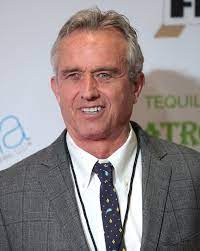
He is showing himself a serious candidate with his measured stance on stopping the Ukraine war
It is clear that despite the relentless propaganda, the U.S. proxy war against Russia in Ukraine is lost, with the failed Ukrainian “spring offensive” meeting its demise due to overwhelming Russian firepower and the futility of Ukraine’s U.S.-ordered suicide charges against impregnable Russian defenses. Biden’s debacle in Ukraine may be added to his humiliating departure from Afghanistan.
byEDITORSeptember 3, 2023
By Ricard C. Cook / Original to ScheerPost
The U.S. today is facing catastrophe with the leading 2024 election candidates of both the Democratic and Republican parties being fatally compromised at a moment when our foreign policy is on the verge of collapse.
I believe that we can assess that President Joe Biden has less than a 25 percent chance of remaining in office until the election only 14 months from now. According to an Associated Press-NORC Center for Public Affairs poll, 77 percent of respondents, including 69 percent of Democrats, say Biden is too old to run for office again. Further, I would make a 50 percent assessment that Biden will face an impeachment inquiry for his alleged financial crimes within three to six months. These developments could force Biden to step down. But Vice President Kamala Harris appears to have a zero percent chance either of guiding the country to safety abroad or becoming the Democratic Party’s 2024 nominee.
We can further assess that ex-President Donald Trump has less than a 10 percent chance of avoiding prison time. But Trump has no credible Republican opponent ready to step in, with Mike Pence having no support, Ron DeSantis slipping, and Vivek Ramaswamy only a curiosity. The other candidates appear to be running for a VP or cabinet position or just publicity.
It is clear that despite the relentless propaganda, the U.S. proxy war against Russia in Ukraine is lost, with the failed Ukrainian “spring offensive” meeting its demise due to overwhelming Russian firepower and the futility of Ukraine’s U.S.-ordered suicide charges against impregnable Russian defenses. Biden’s debacle in Ukraine may be added to his humiliating departure from Afghanistan.
The loss of Ukraine will explode the myth of U.S. full-spectrum dominance and discredit NATO. China can only be emboldened. The Russia-China showcase institution of BRICS just doubled in size, with Saudi Arabia, Iran, and several other countries becoming full members. The loss of the U.S. dollar as the world’s reserve currency is on the way to happening, which will cause the mechanism to disappear by which the U.S. has maintained global military hegemony since World War II. Europe is on the verge of rebellion against U.S. overlordship due to the deindustrialization resulting from the Ukraine war and U.S. culpability in cutting off Europe from Russian energy sources.
…………………………………………………………….. Meanwhile, the Biden administration and Congress continue to pour billions of dollars into Ukraine as they pressure that unfortunate country into losing hundreds of thousands of lives in a war where the main beneficiaries are the holders of stocks and bonds in the U.S. military-industrial complex. Also profiting are members of Congress, starting at the top, who themselves own stock or receive campaign contributions from rich donors or directly from the weapons suppliers.
…………………………………………………………….Who then will be our next president, the individual we will be asking to face this mess?
………………………………………………………………………..The most credible candidate remaining on either side may be Robert F. Kennedy, Jr., whose standing is rising daily. Even though only about 20 percent of Democratic voters favor him over Biden, his numbers will rise dramatically as Biden fades into oblivion
………………………………He is showing himself a serious candidate with his measured stance on stopping the Ukraine war
…………………………………………..I believe we can make an assessment of a 40-50 percent chance at present of Robert F. Kennedy, Jr., winning the Democratic Party nomination. If he does, I would assess his chances of winning the presidency at 90 percent.
Chancellor Scholz dismisses talk of keeping nuclear energy option open in Germany
German Chancellor Olaf Scholz dismissed a suggestion by a junior coalition
partner that the country should keep open the option of using its closed
nuclear power plants, declaring that atomic energy is a “dead horse” in
Germany.
Germany switched off its last three nuclear reactors in April,
completing a process that received wide political support after Japan’s
Fukushima nuclear reactor disaster in 2011. But some argued for a rethink
after energy prices spiked because of the war in Ukraine. Among those who
advocated a reprieve were members of the Free Democrats, a pro-business
party that is part of Scholz’s governing coalition.
Daily Mail 2nd Sept 2023
Top prosecutors back compensation for those sickened by US nuclear weapons testing.
Niagara Gazette, SUSAN MONTOYA BRYAN | Associated Press 4 Sept 23
ALBUQUERQUE, N.M. — New Mexico Attorney General Raúl Torrez and 13 other top prosecutors from around the U.S. are throwing their support behind efforts to compensate people sickened by exposure to radiation during nuclear weapons testing.
The Democratic officials sent a letter Wednesday to congressional leaders, saying “it’s time for the federal government to give back to those who sacrificed so much.”
The letter refers to the estimated half a million people who lived within a 150-mile (240-kilometer) radius of the Trinity Test site in southern New Mexico, where the world’s first atomic bomb was detonated in 1945. It also pointed to thousands of people in Idaho, Colorado, Nevada, Utah, Arizona, Montana and Guam who currently are not eligible under the existing compensation program.
The U.S. Senate voted recently to expand the Radiation Exposure Compensation Act as part of a massive defense spending bill. Supporters are hopeful the U.S. House will include the provisions in its version of the bill, and President Joe Biden has indicated his support.
“We finally have an opportunity to right this historic wrong,” Torrez said in a statement………………………………………………………..
The attorneys general who signed onto Torrez’s letter are from Arizona, Colorado, Connecticut, Delaware, Maryland, Minnesota, Nevada, New York, Pennsylvania, Oregon, Rhode Island, Vermont and the District of Columbia.
The attorneys mentioned the work of a team of researchers who mapped radioactive fallout from nuclear weapons tests in the U.S., starting with the Trinity Test in 1945. The model shows the explosions carried out in New Mexico and Nevada between 1945 and 1962 led to widespread radioactive contamination, with Trinity making a significant contribution to exposure in New Mexico. Fallout reached 46 states as well as parts of Canada and Mexico.
“Without any warning or notification, this one test rained radioactive material across the homes, water, and food of thousands of New Mexicans,” the letter states. “Those communities experienced the same symptoms of heart disease, leukemia, and other cancers as the downwinders in Nevada.”………………………………………….. more https://www.niagara-gazette.com/news/top-prosecutors-back-compensation-for-those-sickened-by-us-nuclear-weapons-testing/article_1458a962-4903-11ee-94c0-7b044542b2ae.html
German Chancellor Scholz speaks out against new nuclear power, Deutschlandfunk reports
September 2, 2023 https://www.reuters.com/business/energy/german-chancellor-scholz-speaks-out-against-new-nuclear-power-deutschlandfunk-2023-09-01/
FRANKFURT, – German Chancellor Olaf Scholz said he is against a new nuclear power debate in the country, in an interview released late on Friday with German radio station Deutschlandfunk.
“The issue of nuclear power is a dead horse in Germany,” said Scholz, leader of Germany’s social democrats (SPD).
Scholz’s coalition partner, the free democrats (FDP), recently demanded Germany should keep an nuclear option.
For new nuclear power plants to be built, significant time and investment would be required, Scholz said, estimating at least 15 billion euros ($16.16 billion) would have to be spent per power plant over the next 15 years.
On the widely debated topic of an industrial electricity price cap in Germany, the chancellor expressed doubt how this could be funded, naming options including taxpayer money and debt.
($1 = 0.9282 euros)
Reporting by Emma-Victoria Farr; Editing by Leslie Adler and Josie Kao
The UK Government’s seventh Energy Secretary in the space of four years has “a huge amount of catching up to do” to kickstart a renewables revolution.
The UK Government’s seventh Energy Secretary in the space of four years
has been warned she has “a huge amount of catching up to do” to
kickstart a renewables revolution.
Herald 31st Aug 2023
UK Government’s investment in Sizewell C nuclear plant passes £1bn
UK Government’s investment in Sizewell C nuclear plant passes £1bn. The
UK Government has confirmed that it will funnel an additional £341m into
the Sizewell C nuclear power plant, on top of £870m already announced to
date.
Edie 29th Aug 2023
https://www.edie.net/uk-governments-investment-in-sizewell-c-nuclear-plant-passes-1bn/
Young Vietnamese Diplomat Envisions Nuclear-Free World
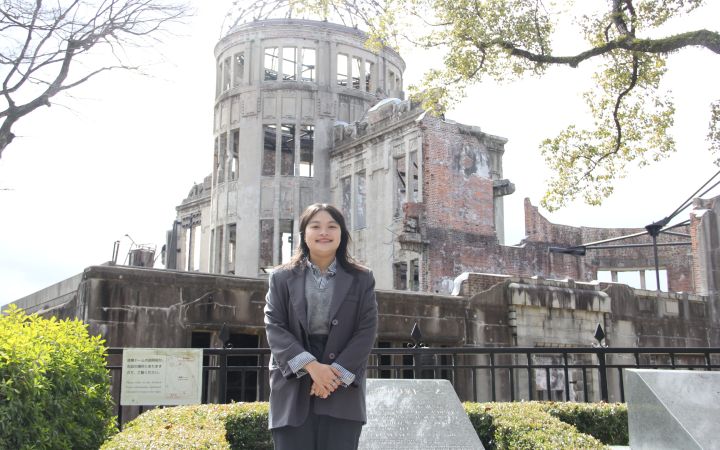
She is proud that Viet Nam has ratified the Treaty on the Prohibition of Nuclear Weapons and is currently at accession level with the NPT.
- Lê Nguyen An Khanh is a young diplomat with the Ministry of Foreign Affairs, Viet Nam. She is passionate about the non-proliferation of nuclear weapons and world peace.
- UNITAR Division for Prosperity trains government officials in Asia to learn about international nuclear disarmament processes and build their communication and negotiation skills.
28 August 2023, Hiroshima, Japan – Lê Nguyen An Khanh is a young official from Viet Nam, working at the Department of International Organisations at the Ministry of Foreign Affairs. She believes that diplomats like her have the responsibility to advocate for nuclear disarmament. But it’s not always easy to keep abreast of the intricacies of the field. “We are constantly having [to] research all the issues, of which nuclear disarmament and non-proliferation is a huge part”, she says………………………………………………………………………………….
Lê has had to learn how to take the uncertainties of global politics and turn them into something surmountable. She is proud that Viet Nam has ratified the Treaty on the Prohibition of Nuclear Weapons and is currently at accession level with the NPT. She wants to make sure her country’s voice is heard on the international stage, that it is seen as a world player. (Plus, she enjoys meeting, learning and working with like-minded people from different backgrounds and cultures.)
Being a young diplomat can come with its challenges: her views and opinions may not be granted the same weight as her older, perhaps more experienced, colleagues. But Lê challenges other young diplomats to be passionate and work hard.
“If you work hard enough, stick to your ideals and you are passionate about what you do and want to do in the future, people will recognize you – especially the seasoned diplomats who have already been there. You have to demonstrate that you are willing and have the capability to deliver. [If] you have a passion, you will be able to overcome challenges”. -Lê Nguyen An Khanh, Vietnamese diplomat and 2023 alumna, UNITAR Nuclear Disarmament and Non-Proliferation Training Programme
Looking to the Future
Lê will incorporate into her work all that she learned in the UNITAR training and expects to share her knowledge with colleagues in other departments and ministries as well. She applauds the UNITAR Hiroshima Office for putting together a well-organized and resourced training programme that she calls “an epitome of a good training programme”.
In the next 20 years, Lê says she wants to see more UNITAR offices around the world and for more people to learn about nuclear disarmament and non-proliferation. “I want to see UNITAR bring people from different regions with different cultures, race, genres to show the similar yet different experiences of their lives.”
Her personal goal is to make sure that she contributes to global peace.
Peace is a universal value. Everybody wants peace. I think peace is the motivation for every country to move towards development and stability. It is only when we have peace that we can move forward and make ourselves stronger.” -Lê Nguyen An Khanh, Vietnamese diplomat and 2023 alumna, UNITAR Nuclear Disarmament and Non-Proliferation Training Programme
About UNITAR
The United Nations Institute for Training and Research (UNITAR) is a dedicated training arm of the United Nations. In 2022, UNITAR trained 396,046 learners around the world to support their actions for a better future. In addition to our headquarters in Geneva, we have offices in Hiroshima, New York and Bonn and networks around the world.
The Division for Prosperity is based in the Hiroshima Office and Geneva. We seek to shape an inclusive, sustainable and prosperous world through world-class learning and knowledge-sharing services on entrepreneurship, leadership, finance and trade, digital technologies, and nuclear disarmament and non-proliferation. We empower individuals from least-developed countries, countries emerging from conflict, and small-island developing states – especially women and young people – to bring about positive change.
United Nations Volunteer Ruhiya Yousuf contributed to this article.
Sizewell C project descends into farce

The Sizewell C development has offered observers an opportunity to monitor in great detail how a modern project costing at least Euros 30bn can and often does fall foul of environmental, financial, operational and political collapse.
By Essex Mag. August 26, 2023 https://www.essexmagazine.co.uk/2023/08/sizewell-c-project-descends-into-farce/
While the German government announces its flagship climate and transformation fund of Euros 212bn to accelerate its green transition programme of building renovation and decarbonising its energy sector between 2024 and 2027, the UK is reduced to scrabbling around the City vainly seeking investors in the increasingly farcical soap opera that is Sizewell C.
The ‘grand project’ – French nuclear incursion into a beleaguered and wilting UK energy sector – has mesmerised government officials and MPs of both major parties for the best part of a decade yet it is no closer today to realisation than it was in 2012.
With announcements on further delays to Hinkley Point C and an embarrassing silence in response to invitations to invest in Sizewell C, the hopes that nuclear power will lead the UK on its ‘world beating’ programme towards net zero carbon by 2050 look more unlikely than ever: even an optimistic start date of 2035 for Sizewell C would only afford the plant a marginal – and hugely expensive – contribution to reducing carbon emissions and only for a few years, barely time to off-set the carbon debt created by its construction.
Compared to the visionary German programme, the UK’s response to the existential climate crisis is weak, lacking in leadership and entirely inconsequential in the face of accelerating climate change impacts which are already leaving some parts of the world uninhabitable.
The Sizewell C development has offered observers an opportunity to monitor in great detail how a modern project costing at least Euros 30bn can and often does fall foul of environmental, financial, operational and political collapse.
Government has been beguiled by nuclear power to the exclusion of all else, removing subsidies for green sources of electricity generation while finding hundreds of millions of pounds to incentivise nuclear power. The regulators, constrained by the antiquated and redundant regulators’ code of practice, have turned blind eyes to the obvious – eroding coastlines, storm surges, floods and the future inaccessibility of lethal nuclear waste for transporting to a (currently mythical) geological disposal facility, the huge loss of life sea-water-cooled plants have on the marine environment and fish stocks and the idiocy and irresponsibility of discharging huge amounts of radioactivity to the environment when their health costs are unknown – in their attempts show their eagerness to do the government’s bidding on shoe-string budgets.
Pete Wilkinson, TASC’s Deputy Chairperson and co-founder of Greenpeace UK and Friends of the Earth, said today, ‘HMG is besotted by a Boris Johnson-inspired nuclear fantasy, the regulators are ignoring their obligations, EDF is out of control, respecting nothing but their own agenda, bullying local people, ignoring the absence of a Sizewell C contracted water supply, threatening the imposition of a desalination plant to cover their own inadequacies, and local authorities have been desperate to show their central government overlords that they are shoring up a broken and discredited policy. The Labour Party are no better as it cowers before trades union demands for Labour to secure a small number of well-paid jobs at over £30millon a pop and support an unworkable, dangerous and hugely costly distraction to the climate change crisis which threatens to engulf us.’
‘Peaceful Atom’ Sparks Fierce Debate In Kazakh Village Slated To Host Nuclear Power Plant
By Petr Trotsenko, August 28, 2023 Radio Free Europe
ULKEN, Kazakhstan — Plans are under way to build a nuclear power plant (NPP) scheduled to be online by 2035, to supply Kazakhstan’s soaring energy needs.
In Ulken, where the plant is likely to be built, opinions among the village’s 1,500 residents on what a nuclear future for their impoverished lakeside village would look like are split.
Ulken is located 330 kilometers northwest of Almaty on the shores of Lake Balkhash. The village was created in the 1980s to house workers for a planned hydroelectric power plant. That project was unfinished when the Soviet Union collapsed and high-rise apartments are the only completed constructions from the period.
Officially, Ulken is a village, but it feels like an urban settlement. There are no houses here, only apartments. There is no livestock, and no gardens grow in the rocky soil…………………………………………………………………………….
Khairulina wants to increase the population of Ulken, renovate the village, and give life to the abandoned apartments. For these reasons she supports the construction of an NPP. “If the project starts, civilization will come,” she said. The villager is concerned for the environment, but said, “We are not afraid of environmental problems, now everything is made with modern technology.”
Fishermen in Ulken are largely against the NPP project because they fear that Lake Balkhash will be affected and that fishing there could eventually be banned.
It’s not difficult to find fishermen. In front of one abandoned apartment, fish hang in the breeze.
The owner of the property is a young man named Rinat. The 34-year-old fisherman has devoted half of his life to the profession and works the lake every day. Rinat firmly opposes the construction of an NPP.
“The lake sustains us,” he said. “This year the water level in the Balkhash dropped severely, and the fish population decreased. If an NPP is built, there will be no water left in the lake,” Rinat claimed.
At the grocery store, I met another resident, Aleksei Losev. The 35-year-old moved to Ulken six years ago to live with his future wife. He’s not a fisherman, but does not expect anything good from the construction of the NPP.
“On one hand I support its construction, because new jobs will be created, people will come from abroad, and the village will develop. On the other hand, it’s about ecology,” he said, before referencing a troubled Soviet-era NPP in western Kazakhstan that is currently being decommissioned. “Three kilometers from Aqtau there is the Manghystau NPP. The environmental situation there is bad. Why? Wastewater! Both fish and seals are dying…. It will be the same here,” he said……………………………………………………………………………….
In the small assembly hall of the Ulken high school where the August 21 meeting to discuss the NPP took place, it was standing room only. Environmental activists who had travelled from Almaty for the meeting unfurled posters calling to put a stop to the project as residents chanted, “we support the peaceful atom!”
When the discussion on the planned NPP got under way it was clear that there would be little constructive conversation. The emotions of the crowd boiled over.
“We are against the nuclear power plant, it will destroy Balkhash Lake!” activists shouted.
“You’re not a nuclear specialist, how do you know it will be harmful? You don’t live in Ulken” responded some residents.
“It is not only an Ulken problem, this topic should be discussed by all of Kazakhstan!” the activists countered.
…………………………………………………………………… Another local man hoped to work in the future energy sector.
“We residents have been waiting for this construction for 40 years,” he said. “We started with the construction of the power station, we spent days without heat and electricity, we went through many different events together. Ulken needs this energy, this is the center of Kazakhstan. Our region is seismologically stable! There are 15 nuclear power plants in Japan, which has an earthquake every month. Energy is scarce and very expensive in our country. We all need electricity. We support the peaceful atom!” he said.
People in the hall clapped and someone asked, “What about solar energy?” nobody seemed to hear the question amid chants of “Peaceful atom! Peaceful atom!”
Then environmentalist Svetlana Mogilyuk spoke. Like many others, Svetlana came to Ulken to take part in the discussion.
“Dear residents, we have now listened very carefully to what was said,” Mogilyuk said. “No basic, truthful information was provided to you. In contrast to the claim that nuclear energy is not harmful to health, there are qualified studies showing that nuclear energy is still harmful! Numerous studies also confirm that children who live near nuclear power plants are more likely to develop leukemia, and deaths from cancer increase by 24 percent.”
As she made these claims, her microphone cut off. She continued without it.
“Nuclear power plants are harmful, they are accompanied by radioactive emissions. Citizens! You are now being told a lie! Hearings must be accompanied by basic information! You must understand that apart from the NPP, you have other opportunities, you have the opportunity to develop other types of electricity. They will be no less powerful, no less effective, but safer!”
……………………………………………………………………… many in Kazakhstan feel the construction of an NPP is a done deal for the government and that far more depends on its decision than the prospects for locals of a small village on the banks of the Balkhash. https://www.rferl.org/a/kazakhstan-nuclear-power-plant-debate-construction/32563042.html
Swedish government removes nuclear power promise from website.
Climate minister accused of ‘exceeding her powers’ by announcing need for 10 new reactors.
The Swedish government has quietly walked back an announcement
that it would build at least 10 nuclear reactors by 2040 as part of its
plan to ditch fossil fuels.
Romina Pourmokhtari, Sweden’s climate and
environment minister, announced earlier this month that Sweden needed to
double electricity production in the next two decades in order to meet its
climate goals. An accompanying statement said that “Sweden will need
three times as much nuclear power in 20 years”.
But the statement was
quickly taken down from the government website and replaced with one that
makes no mention of the ten new reactors. Daniel Liljeberg, state secretary
to the minister for energy, business and industry, said there is no
official target matching Ms Pourmokhtari’s statement. Mr Liljeberg told the
Swedish daily Aftonbladet the government has not established targets or
assessments at that level of detail.
Insiders say Ms Pourmokhtari
“exceeded her powers” when she announced publicly that the government’s
aim was to put at least ten conventional reactors into operation during the
2030s and 2040s, Aftonbladet reported. Environmental experts had criticised
the government announcement, saying the new reactors would be too expensive
and not meet needs fast enough. The plans marked a dramatic change from the
country’s current capacity for nuclear power, where six reactors currently
account for around 30 per cent of its electricity production. In June,
Sweden’s coalition government adopted a new energy target, changing it to
“100 per cent fossil-free” electricity from “100 per cent
renewable”, giving the green light to push forward a new energy strategy
relying on expanding its nuclear power network.
Telegraph 26th Aug 2023
1 This Month
23-25 October – on Zoom – World BEYOND War’s annual global conferenc


Shut down the radiation-damaged Heysham nuclear reactors now
To see nuclear-related stories in greater depth and intensity – go to https://nuclearinformation.wordpress.com

Say No to NASA’s Reckless Nuclear Reactor on the Moon
Say No to NASA’s Reckless Nuclear Reactor on the Moon
-
Archives
- October 2026 (180)
- September 2026 (339)
- August 2026 (330)
- July 2026 (355)
- June 2026 (287)
- May 2026 (306)
- April 2026 (356)
- March 2026 (251)
- February 2026 (267)
- January 2026 (308)
- December 2025 (358)
- November 2025 (359)
-
Categories
- 1
- 1 NUCLEAR ISSUES
- business and costs
- climate change
- culture and arts
- ENERGY
- environment
- health
- history
- indigenous issues
- Legal
- marketing of nuclear
- media
- opposition to nuclear
- PERSONAL STORIES
- politics
- politics international
- Religion and ethics
- safety
- secrets,lies and civil liberties
- spinbuster
- technology
- Uranium
- wastes
- weapons and war
- Women
- 2 WORLD
- ACTION
- AFRICA
- Atrocities
- AUSTRALIA
- Christina's notes
- Christina's themes
- culture and arts
- Events
- Fuk 2022
- Fuk 2023
- Fukushima 2017
- Fukushima 2018
- fukushima 2019
- Fukushima 2020
- Fukushima 2021
- general
- global warming
- Humour (God we need it)
- Nuclear
- RARE EARTHS
- Reference
- resources – print
- Resources -audiovicual
- Weekly Newsletter
- World
- World Nuclear
- YouTube
-
RSS
Entries RSS
Comments RSS

