Scottish independence would end the UK’s nuclear delusion.
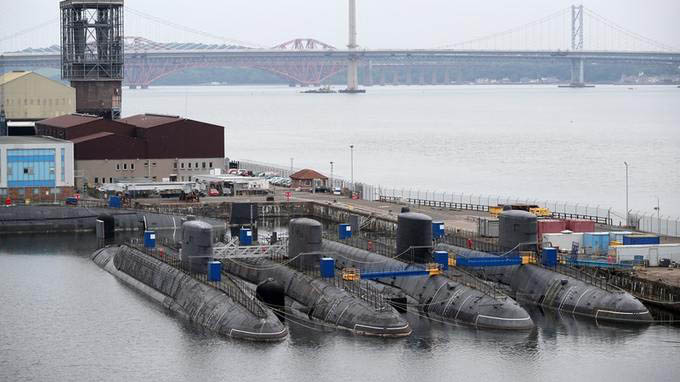
The oncoming submarine crisis is not the only threat to the UK’s ability to maintain its nuclear weapon capability. The recent upsurge in the aspiration for Scottish independence should remind us that we are in a unique position with the potential not only to rid ourselves of these horrific weapons, but also to undermine the ability of the UK to persist with them since there is no credible alternative to the Clyde bases elsewhere the UK.
29th September, By David Mackenzie
LAST week a UK nuclear weapon Vanguard-class submarine returned to its base in Faslane, covered in algae and barnacles, reportedly after a patrol that lasted more than six months.
This prompted the pro-navy (and pro-nuclear-weapon) magazine Navy Outlook to publish a long article discussing the increase in the length of patrols and suggesting that this is down to the difficulty, due to refits and maintenance problems arising from skill shortages, of maintaining the pattern of always having one boat on patrol at all times. The article acknowledges that there is now great pressure on the submariners and that risks are being taken to maintain the patrol pattern.
The four Vanguard-class boats are now more than 30 years old and the replacement Dreadnought- class is already well behind schedule, so the question arises as to whether the current submarines can be patched and crewed sufficiently to close the potential gap in availability.
The Dreadnought programme is seriously hampered by a shortage of assembly space at Barrow and delays to the Derby unit where the reactor cores will be built. The UK Government refuses to say when it expects the new boats to be ready. The stretching of the patrol length to six months and beyond suggests that the crisis point may not be far away and that in the interim more and more risks will be taken with material and personnel.
The oncoming submarine crisis is not the only threat to the UK’s ability to maintain its nuclear weapon capability. The recent upsurge in the aspiration for Scottish independence should remind us that we are in a unique position with the potential not only to rid ourselves of these horrific weapons, but also to undermine the ability of the UK to persist with them since there is no credible alternative to the Clyde bases elsewhere the UK.
When the UK was setting up Polaris, its first system for the submarine launching of nuclear weapons, the Ministry of Defence conducted a study to determine what sites would be suitable for two essential items – a port for berthing the submarines and a nearby but separate armaments depot for storing the warheads and loading them onto the missiles in the submarines.
The study rejected all the projected locations in England and Wales (including Falmouth, Milford Haven, Portland, Devonport, Barrow, and completely new “greenfield” sites). So we have the submarines based at Faslane and the warhead storage and management facility at Coulport. The Clyde sites offer deep water access and a ready route to the Atlantic. Two other locations outwith the UK have been raised – one is moving the bases to King’s Bay in Georgia, US.
This would rip away the last tissue of pretence that the UK system is an independent one. Also mooted has been the sharing of the French facilities on Île Longue near Brest but this is seen as politically beyond the pale. In short, there is no feasible alternative to the Clyde bases. This analysis is accepted by the UK defence establishment. This makes Scottish independence a critical threat to the UK’s nuclear weapons.
It has also been pointed out that the increasing fragility of the UK nuclear weapon system may have prompted the projected return of US nuclear weapons to the US base at Lakenheath in Suffolk. If the UK is seen as an increasingly wobbly part of the Nato nuclear fabric this may represent a belt-and-braces tactic.
The third shaky-nail factor is the growing worldwide movement for the complete elimination of nuclear weapons. The Treaty on the Prohibition of Nuclear Weapons (TPNW), which came into force as UN law in January 2021, has acquired huge worldwide support – to date 69 ratifications, 93 signatures and the regular support of around 130 states on the floor of the UN General Assembly, to say nothing of such strong supporters as Ireland, Austria, Pope Francis and The Elders. Meanwhile, financial institutions are disinvesting from nuclear weapons, frequently ascribing their stance to the TPNW.
The nuclear war threat is like an open petrol can that is kept close to an open fire on a shoogly table. This is a uniquely dangerous moment.
Yet there is an overwhelming desire for prohibition from the majority of UN member states, especially from those who would suffer the most from the climatic effects of an exchange of nuclear weapons.
We can hope that these three factors will enable a fundamental rethink of the UK’s nuclear posturing.
We can certainly hope that Scotland will take its own clear stance on the matter with worldwide support.
David Mackenzie is secretary of Secure Scotland
Ottawa yet to decide whether reprocessing spent nuclear fuel should be allowed in Canada
MATTHEW MCCLEARN, (September 26, 2023)
More than two years after it provided tens of millions of dollars to a company seeking to reprocess spent nuclear fuel, the Canadian government has yet to decide whether the practice should be allowed on Canadian soil.
Reprocessing involves extracting uranium and plutonium from irradiated fuel to make new fuel. In March, 2021, the government provided Moltex Energy with $50.5-million to support development of a reprocessing facility (known as Waste To Stable Salt, or WATSS) and a reactor that would burn fuel it produced. Moltex plans to construct both at New Brunswick Power’s Point Lepreau station, on the northern shore of the Bay of Fundy.
Currently reprocessing is not conducted in Canada. With the notable exception of Japan, it’s done almost exclusively by countries that have nuclear weapons programs. It’s controversial: Critics warn reprocessing increases proliferation risks, and that Canada would set a bad precedent by pursuing it………………………………….
Documents released this summer under the Access to Information Act to Susan O’Donnell, an activist on nuclear issues and researcher at the University of New Brunswick, and provided to The Globe, show that the CANDU Owners Group (which represents utilities such as New Brunswick Power that operate Canadian-designed reactors) drafted a reprocessing policy and distributed it among government and industry officials.
The documents also reveal that Moltex warned the government last year the company would have difficulty raising money until the government clarified that reprocessing will be allowed……………………….https://www.theglobeandmail.com/business/article-moltex-canada-nuclear-waste-trudeau-letter/
European Commission is ‘willing to consider’ subsidies for nuclear technology, says von der Leyen.

euro news, By Jorge Liboreiro, 26/09/2023 –
Ursula von der Leyen has welcomed the idea of industrial subsidies in the field of nuclear energy, a highly divisive topic in the European Union.
Speaking in the Czech Republic, a country that receives more than a third of its electricity from its nuclear power plants, the president of the European Commission said each member state was free to pave its own path towards climate neutrality.
“And this is why we’re always willing to consider state aid, of course, provided the conditions are right. But this is important.”
As the chief enforcer of competition rules, the European Commission has the power to approve and reject the public money that governments inject into their national industries, which can take the form of grants, discounted prices and lower taxation, among others…………………………….
Notably, the Act’s original draft excludes nuclear technology from its list of “strategic projects” and features only passing mentions of “advanced technologies (that) produce energy from nuclear processes with minimal waste” and “small modular reactors,” which are still under development.
“We support cutting-edge nuclear technology under our Net-Zero Industry Act to boost innovation and cross-border cooperation,” von der Leyen said in Prague.
The act is undergoing negotiations between member states and the European Parliament, where there is a push for nuclear to be listed as a “strategic project.”
But getting there won’t be easy: nuclear is an extremely divisive, even emotional topic across the EU, with most countries bitterly split into pro- and anti-nuclear factions.
The pro-nuclear group is passionately led by France, a country that obtains about 70% of its electricity from its vast network of reactors and is supported by the likes of the Czech Republic, Bulgaria, Hungary, Poland, Romania and Slovakia. They argue nuclear is a low-carbon technology that can run 24 hours a day and decrease external dependencies.
By contrast, Germany, the bloc’s industrial powerhouse, has adopted an uncompromising anti-nuclear stance, with the backing of Spain, Portugal, Austria, Denmark and Luxembourg. They believe promoting nuclear energy amounts to green-washing due to the carbon footprint of uranium extraction and the long-lasting radioactive waste.
Both sides have formed alliances and are trying to bring in additional countries to solidify the qualified majority that is required to approve energy and climate legislation……………………….
Over the past decade, the Commission has green-lighted state aid related to nuclear power plants in Hungary, Belgium and the United Kingdom, when the country was still a member. The UK case was contested by Austria before the European Court of Justice, which eventually ruled that subsidies for nuclear energy were compatible with EU law. https://www.euronews.com/my-europe/2023/09/26/european-commission-is-willing-to-consider-subsidies-for-nuclear-technology-says-von-der-l
Democrat congressman Adam Schiff funneled millions to defense contractors after taking donations

The earmarks Adam Schiff delivered for donors
The Democratic congressman for years secured earmarks for defense companies while taking campaign donations from top corporate brass and Washington lobbyists.
Politico, By CHRISTOPHER CADELAGO, 09/25/2023
Adam Schiff is unapologetically touting his commitment to earmarks for local causes — like homelessness and drug treatment programs — as he seeks the Senate seat long held by Dianne Feinstein. The 12-term House Democrat and darling of the anti-Trump left is even calling out his closest rival in the race, Rep. Katie Porter, for her opposition to pork-barrel spending.
But Schiff has offered an incomplete and potentially misleading account of his record on earmarks. A close examination of that record reveals that he secured generous earmarks for corporate beneficiaries early in his career, including at times for recipients who were also major donors to his political campaigns………………
A POLITICO review of congressional earmarks and political contributions found that in addition to the money for homelessness and drug treatment, Schiff also steered millions to for-profit companies and raised tens of thousands for his House reelection campaigns from corporate executives and people connected to them. The review was mostly limited to publicly available data from the brief three-year window when corporate earmarks were disclosed……………………………………………………………
Several of Schiff’s earmarks would be barred under reforms adopted in 2010. Among them, Schiff secured millions in funding for Smiths Detection and Phasebridge, Inc., defense companies based in his district. He steered $6 million to Smiths Detection for military warfare sensors between 2003 and 2006 and earmarked another $3 million to Phasebridge that was developing a radar frequency distribution system for the Navy in 2004………………………………………………………………………………………………more https://www.politico.com/news/2023/09/25/adam-schiff-earmarks-001177—
Pentagon exempts Ukraine operations from potential government shutdown

The decision means that training on American tactics and equipment can move forward uninterrupted if lawmakers don’t reach a funding deal by the end of the month.
Politico By LARA SELIGMAN, 09/21/2023
The Pentagon will exempt its Ukraine operations from a potential shutdown if lawmakers can’t agree on a deal to fund the government by the end of the month, allowing key training and other activities in support of Kyiv’s forces to move ahead uninterrupted, according to a Defense Department spokesperson.
Washington is more resigned to the looming government shutdown every day. As the Sept. 30 deadline approaches, congressional leaders showed little progress this week in moving a stopgap funding bill to avert that scenario. The House was in chaos on Thursday as a group of GOP hardliners tanked a vote that could have offered a path to fund the government.
But if lawmakers fail to reach an agreement and government appropriations lapse, DOD has decided to continue activities supporting Ukraine, DOD spokesperson Chris Sherwood told POLITICO Thursday — just hours after Ukrainian President Volodymyr Zelenskyy met with Defense Secretary Lloyd Austin, Joint Chiefs Chair Gen. Mark Milley and other senior leaders at the Pentagon.
“Operation Atlantic Resolve is an excepted activity under a government lapse in appropriations,” Sherwood said, referring to the named operation for DOD’s activities in response to the Russian invasion.
The move means that the U.S. military’s activities related to the war, such as training of Ukrainian soldiers on American tactics and equipment, as well as shipments of weapons to Kyiv, will continue despite any potential shutdown.
As recently as Tuesday, Sherwood had said the shutdown could halt those activities, as POLITICO first reported.
It’s good news for Zelenskyy, as U.S. and European officials worry that international support for continuing to aid Ukraine could be waning. Zelenskyy also pleaded his case with lawmakers on Capitol Hill on Thursday morning before heading to the White House to meet with President Joe Biden.
The Biden administration is also expected to announce a new package of military aid for Ukraine later on Thursday, including additional air defenses and artillery.
During the White House meeting, Biden announced a new $325 million package of aid for Ukraine, including more air defenses, artillery and additional cluster munitions. He also said that the first of the U.S. Army’s M1 Abrams tanks pledged to Kyiv are expected to arrive on the battlefield next week.
Typically, when the government shuts down, all military activities stop unless they are deemed critical to national security. ……………………………………………………………………………………. more https://www.politico.com/news/2023/09/21/pentagon-exempts-ukraine-operations-from-shutdown-00117482
Building Irish nuclear energy plants ‘does not make economic sense’, Eamon Ryan,Green Party leader
Irish Examiner, 24 Sept 23
Green Party leader says the construction of nuclear plants would be too expensive for a country the size of Ireland
Building nuclear energy plants in Ireland does not make economic sense and would result in people paying even higher electricity bills, Eamon Ryan has said.
The Green Party leader said constructing nuclear plants here to bolster wind and solar energy production would be too expensive for a country the size of Ireland.
It comes after Fianna Fáil MEP Billy Kelleher called on politicians and the public to take their “emotions” out of the nuclear energy debate and seriously consider building power plants here……………………….
He said there has been “an explosion” in the rollout of solar panels across the country, with 10% of energy coming from solar on some sunny days in July this year.
“Also, battery technology is improving, and long-term storage is improving. So that gives you balancing capability and also interconnection…………………………………….
Interconnector with Spain
The environment minister added that he is looking at the viability of an interconnector with Spain “so if it’s calm and not sunny in Ireland, solar from the south can be pulled up and that’s much cheaper”.
He stressed the potential Ireland has to become a world leader in sustainable energy.
“I think our issue will be probably by 2030 we’ll have a surplus of wind, about 30 terawatt hours, and how we use that surplus and store it to give us the balancing capability is going to be one of the big developments in the next 10 years,” he said……………………… https://www.irishexaminer.com/news/politics/arid-41233219.htm
“Republicans for Ukraine”s Refreshingly Honest Ukraine War Ad
CAITLIN JOHNSTONE, SEP 25, 2023 https://www.caitlinjohnst.one/p/bill-kristols-refreshingly-honest?utm_source=post-email-title&publication_id=82124&post_id=137366801&utm_campaign=email-post-title&isFreemail=true&r=1ise1&utm_medium=email
The Bill Kristol-led group “Republicans for Ukraine” has released a TV ad to help drum up GOP support for Washington’s proxy war against Russia, and it’s surprisingly honest about what this war is really about: advancing US strategic interests using Ukrainians as sacrificial pawns.
Here’s a transcript:
“When America arms Ukraine, we get a lot for a little. Putin is an enemy of America. We’ve used 5% of our defense budget to arm Ukraine, and with it, they’ve destroyed 50% of Putin’s Army. We’ve done all this by sending weapons from storage, not our troops. The more Ukraine weakens Russia, the more it also weakens Russia’s closest ally, China. America needs to stand strong against our enemies, that’s why Republicans in Congress must continue to support Ukraine.”
“Republicans for Ukraine” was launched last month by “Defending Democracy Together”, another Kristol-led narrative management operation which is funded by oligarchs like Pierre Omidyar. Kristol, who as a neoconservative thought leader played a pivotal role in pushing for the 2003 invasion of Iraq, tweeted on Saturday that the ad “will air on the Sunday shows tomorrow in DC.”
One of the dumbest things the empire asks us to believe is that this war simultaneously (A) was completely unprovoked and (B) just coincidentally happens to massively advance the strategic interests of the government accused of provoking it. From the moment Russia invaded Ukraine in February 2022 westerners were aggressively hammered over and over and over again by the mass media with the uniform propaganda message that this was an “unprovoked invasion”, but ever since then we’ve also been receiving these peculiar messages from US empire managers and spinmeisters that this war is helping the United States crush its geopolitical enemies and advance its interests abroad.
This bizarre two-step occurs because the US-centralized empire needs to convey two self-evidently contradictory messages to the public at all times:
1. that the US is an innocent little flower who just wants to help its good friends the Ukrainians protect their democracy from the murderous Russians who invaded solely because they are evil and hate freedom, and
2. that it’s in the interest of Americans to continue this war.The second point is required because the message that the US is merely an innocent passive witness to the violence in Ukraine necessarily causes certain political factions to ask, “Okay, so what are we doing there then? Why are we pouring all this money into something that has nothing to do with us?” So another narrative is required to explain that backing this proxy war also just so happens to be a massive boon to US strategic interests abroad while creating American jobs manufacturing weapons at home.
And of course this war advances US strategic interests. Of course it does. Only an idiot would believe the US is pouring weapons into another country because it loves the people who live there and wants them to be free, and that it is only by pure coincidence that this happens to kill a lot of Russians, bolster NATO, and advance US energy interests in Europe. It doesn’t benefit normal Americans at home, but it absolutely does serve the interests of the globe-spanning empire that’s centralized around Washington. That’s why the empire deliberately provoked it.
Empire managers were openly discussing the ways a war in Ukraine would directly benefit the US empire long before the invasion. In 2019 a Pentagon-funded Rand Corporation paper titled “Extending Russia — Competing from Advantageous Ground” detailed how the empire can use proxy warfare, economic warfare and other Cold War tactics to push its longtime geopolitical foe to the brink without costing American lives or sparking a nuclear conflict. The US Army-commissioned paper mentioned Ukraine hundreds of times, and explicitly discussed how a war there could be used to promote sanctions against Moscow and attack Russia’s energy interests in Europe.
In December of 2021 John Deni of NATO propaganda firm The Atlantic Council authored a piece for The Wall Street Journal titled “The Strategic Case for Risking War in Ukraine,” subtitled “An invasion would be a diplomatic, economic and military mistake for Putin. Let him make it if he must.” Deni argued that “there are good strategic reasons for the West to stake out a hard-line approach” against Moscow and refuse to negotiate or back down over Ukraine, because if doing so provokes Russia to invade it would “forge an even stronger anti-Russian consensus across Europe,” “result in another round of more debilitating economic sanctions that would further weaken Russia’s economy,” and “sap the strength and morale of Russia’s military while undercutting Mr. Putin’s domestic popularity and reducing Russia’s soft power globally.”
The minds on the inside of the empire were talking about how this war would benefit the US before the invasion, and they’ve been talking about how much it benefits the US ever since. As the Washington Post’s David Ignatius put it this past July: “these 18 months of war have been a strategic windfall, at relatively low cost (other than for the Ukrainians). The West’s most reckless antagonist has been rocked. NATO has grown much stronger with the additions of Sweden and Finland. Germany has weaned itself from dependence on Russian energy and, in many ways, rediscovered its sense of values. NATO squabbles make headlines, but overall, this has been a triumphal summer for the alliance.”
The managers of the empire are getting everything they want out of this war. In public they rend their garments and cry crocodile tears and call it a terrible criminal atrocity, but every now and then they look at the camera and flash it a quick Fleabag-style grin.
They knew exactly what they were doing when they provoked this war, and they know exactly what they’re doing by keeping it going.
And they’re loving every minute of it.
Another reason to oppose expanding nuclear power

Another reason to resist the expansion of nuclear power; the Price Anderson Act (PAA) was passed originally in 1957 to promote the nuclear industry by providing a shield from liability in the event of an accident or unforeseen disaster.
Without any public hearings, the renewal of the PAA was inappropriately buried in the National Defense Authorization Act before Congress. Nuclear power plants are so risky private insurance companies will not insure them. Corporations involved with nuclear power self-insure by contributing to a fund now estimated at $13 billion. If there is a Fukushima-like event, with damages in the hundreds of billions of dollars, either those who lose their homes and businesses would have no redress, or Congress would have to come up with a huge source of funding. The PAA provides immunization from liability for any damages above $13 billion. Taxpayers will likely foot the bill.
Contact your Congressmember to find out if they are aware of this and urge them to oppose continuation of nuclear power! There is too much at risk.
Tory MP inexplicably asks for nuclear powered frigates
By George Allison, September 24, 2023 https://ukdefencejournal.org.uk/tory-mp-inexplicably-asks-for-nuclear-powered-frigates/
In a recent parliamentary query, Conservative MP Andrew Rosindell raised eyebrows with a question about converting Royal Navy warships from diesel power… to nuclear power.
For smaller surface vessels like frigates, the benefits of nuclear power do not outweigh the significant costs and potential environmental concerns. Furthermore, integrating such systems into existing fleet designs would pose significant engineering and logistical challenges.
Rosindell asked the Secretary of State for Defence, “what his Department’s projected spending on nuclear powered surface vessels for the Royal Navy is in the (a) 2023-24, (b) 2024-25 and (c) 2025-26 financial year; and if he will make a statement.”
Not stopping there, he further inquired about the Defence Department’s plans, asking “what his Department’s timeline is for converting the remaining diesel-powered Royal Navy surface fleet to nuclear power.”
In a straightforward response, James Cartlidge, the Minister of State for the Ministry of Defence, clarified, “The Royal Navy has never had any surface vessels that are nuclear powered and there is no programme or intention to convert the current fleet to be nuclear powered in future.”
Thus, the notion of the Royal Navy converting its frigates into nuclear-powered surface vessels remains firmly off the table for the foreseeable future, there are no plans to add warp cores or hyperdrive engines either..
Nearly 10 million Ukrainians have fled to EU – commissioner
https://www.rt.com/news/583216-eu-number-ukraine-refugees/ 21 Sep 23
The collective bloc is the biggest host of those leaving the country, according to Thierry Breton’s numbers
The EU migration crisis is a challenge that should be handled not by a single European country or region, but by the entire bloc as it deals with millions of asylum seekers, particularly from Ukraine, Thierry Breton, EU Commissioner for Internal Market, has said.
Speaking to Sud Radio on Monday, the official suggested that migration – which has recently been on the rise, especially in Italy – “affects us all,” including southern and eastern countries. “We have welcomed … almost 10 million Ukrainian refugees,” he said, adding that the Czech Republic stands out in terms of the number of people it has hosted.
……… In early March 2022, shortly after the start of the conflict between Moscow and Kiev, the EU for the first time in its history invoked the Temporary Protection Directive, which can be used only in exceptional circumstances to deal with a “mass influx of refugees.”
The legislation guarantees Ukrainians access to accommodation, welfare, and healthcare and gives them the right to enter the labor market, and enroll children in educational institutions.
In terms of absolute numbers, Russia accommodates the most Ukrainian refugees (1.27 million), followed by Germany (1.09 million), and Poland (968,000), according to Statista.
Breton’s comments come as some 7,000 migrants swarmed the small Italian island of Lampedusa last week, which itself has a population of less than 7,000 people. Local mayor Filippo Mannino said that the crisis had reached a “point of no return,” while the UN Refugee Agency described the situation as “critical,” adding that moving people off the island was “an absolute priority.”
According to official data, more than 127,000 refugees have arrived in Italy as of September this year, double the number for the same period in 2022.
Sizewell nuclear investment may prove radioactive

Alistair Osborne, Tuesday September 19 2023
Don’t all rush at once. The government is giving private punters
“their first chance to come forward and qualify to invest in Sizewell
C” — the £30 billion-plus nuke, offering guaranteed cost overruns,
prettily located on a Suffolk flood plain. How’s it their first chance? The government’s adviser, Barclays, has been trying to drum up support
for this project for more than a year.
And what’s all this stuff about
qualifying? Ministers really aren’t that fussed where the money comes
from, as long as it’s not from the likes of China, Russia, Iran or the
home of Kim Jong-un’s exploding ballistic missiles.
That the government is desperate for someone to stick a few quid into Sizewell has been clear for yonks. So it’s a bit odd to find new energy secretary Claire Coutinho
making such a hoo-ha about “opening applications for partners to register
their interest” or demanding that they have “experience in delivering
major infrastructure projects”.
Indeed, as pointless announcements go, it
looks up there with the endless relaunches by her predecessor Grant Shapps
of Great British Nuclear: an organisation so far as useful as his Great
British Railways, which still seems to be stuck in a siding.
The key question? What sort of return would investors require and for what risk?
There’s talk that the government its trying to thrash out a price with
potential funders including Brookfield, Stonepeak and Abu Dhabi’s
Mubadala and that Coutinho’s formal process will enable her to harden
things up.
But getting a decision looks tricky when campaigners have just
won leave to appeal the decision to build Sizewell. And, unless it comes up
with giveaway terms, it’s hard to see how the government won’t end up
having to fund most of the equity itself. Investors know how easy it is to
get burnt with nuclear fuel.
Times 19th Sept 2023
https://www.thetimes.co.uk/article/investment-that-may-prove-radioactive-qrwz35cst
Conflating councils with communities causes confusion in nuclear dump areas
The Nuclear Free Local Authorities have written to the senior director at Nuclear Waste Services with responsibility for community engagement in the GDF search areas asking him to make it plain in future that it is only local Councils that can choose to withdraw from plans to developing a nuclear waste dump in their area, rather than local communities.
Councillor David Blackburn, Chair of the NFLAs English Forum, has written to Simon Hughes, Director for Siting and Community Engagement at the NWS, to point out that previous statements made by staff and NWS publications have erroneously claimed that communities can choose to withdraw from the process at any time, when government and company guidance clearly states that it is only higher-level local Councils, which are engaged in the process, and Nuclear Waste Services itself that can do so.
Commenting Councillor Blackburn said: “Current practice conflates councils with communities because the so-called Community Right of Withdrawal can infact only be exercised by councils not by communities. The continued practice of claiming the contrary has led to great frustration amongst residents of the communities effected by the proposals, as it also conveys to the outside world the impression that these residents must be happy with the process or surely they would have exercised their ‘right to withdraw’?”
Councillor Blackburn has asked Mr Hughes to ensure that, in future, company statements and publications convey the true facts. He concluded: “Nuclear Waste Services has stated that it wants an open and honest dialogue with communities and stakeholders. I would suggest that one small step they could take to build trust would be to ensure that in future staff members dealing with the media, addressing public meetings, or publishing online or written materials make plain that it is NOT infact the Community which can exercise the Right to Withdrawal, but rather only the company or the Relevant Principal Local Authorities which can do so.”
Global South won’t back Kiev as West demands – WSJ
A push-back against Western influence is reportedly prompting countries to reject the pro-Ukraine agenda
https://www.rt.com/russia/582948-kiev-support-un-wsj/ 17 Sept 23
Western officials have overestimated the willingness of neutral nations to join anti-Russia policies in support of Ukraine, according to The Wall Street Journal.
“It’s clear that the West overall has been surprised by the pretty widespread reluctance by many of the countries in the so-called Global South… to come on board,” Jan Techau of the consulting firm Eurasia Group told the newspaper, as quoted on Thursday.
He cited “animosity toward the US and Europe” in some parts of the world and the desire of rising powers, such as Brazil and South Africa, to “assert their independence”, the article said.
The WSJ detailed purported successes and failures of Western diplomacy to rally the support of neutral nations for what it called “a fair peace settlement for Ukraine” ahead of next week’s gathering of world leaders at the UN General Assembly.
Ukrainian President Vladimir Zelensky has been internationally promoting his “peace formula” with Western backing. It includes Ukraine regaining control over all former territories, war reparations from Russia, and a tribunal for the Russian leadership. Moscow has dismissed the Zelensky plan as being detached from reality.
The newspaper noted that many “emerging countries” have resisted demands for reparations and a tribunal, while “the international willingness to call out Russia publicly has diminished.” In particular, the final statement of the G20 leaders after the summit in India last week did not condemn Russia or even call the conflict a war “against Ukraine.”
The newspaper asserted that the G20 meeting was a “success for the West too,” because Russian President Vladimir Putin and Chinese President Xi Jinping did not attend the event in person.
“Factually, Russia is much more isolated than before,” a senior European official told The WSJ.
At the upcoming UN General Assembly meeting, non-Western participants are likely “to shift the global focus onto their priorities: global inequality and debt relief,” the report predicted.
Moscow has described the Ukraine crisis as part of a Western proxy war against Russia. It has also accused the US of mismanaging the global economy for selfish goals, while trying to preserve its dominance and resisting the emergence of a multipolar world.
UK launches search for private investment in Sizewell C nuclear project
Reuters. September 18, 2023
LONDON, Sept 18 (Reuters) – Britain on Monday opened the search for private investment in the Sizewell C nuclear project, inviting potential investors to register their interest.
………. The government, the Sizewell C Company and EDF, the project’s lead developer, are looking for companies with substantial experience in the delivery of major infrastructure projects,” a statement from the Department for Energy Security and Net Zero said.
The British government announced last year that it would support Sizewell C with around 700 million pounds ($895 million) while taking a 50% stake during its development phase. https://www.reuters.com/business/energy/uk-launches-search-private-investment-sizewell-c-nuclear-project-2023-09-18/
Israel’s nuclear commission head refuses to side by High Court – in the case of a constitutional crisis
Brig.-Gen. (res.) Moshe Edri, unofficially affiliated with the ruling Likud party, has not committed to siding with the court in case of a constitutional crisis.
By JERUSALEM POST STAFF SEPTEMBER 17, 2023 https://www.jpost.com/breaking-news/article-759427
The head of Israel’s Atomic Energy Commission (IAEC) as of Sunday has yet to address a request by other members of the commission to adhere to the High Court of Justice in the case that the government refuses to respect any of its rulings, N12 reported on September 17.
Brig.-Gen. (res.) Moshe Edri, unofficially affiliated with the ruling Likud party, was asked by his fellow IAEC members to announce along with other Israeli security establishment heads to “choose the kingdom over the king,” if Prime Minister Benjamin Netanyahu’s government does not respect a potential High Court ruling on the reasonableness standard amendment to Basic Law: The Judiciary.
Edri, who formerly headed the Defense Ministry’s Special Measures Division, has been acting as IAEC director-general since July 2022.
Nuclear scientists are against Israel’s judicial reform
Senior nuclear scientists in the Israel Atomic Energy Commission are considering resigning in protest against the government’s judicial reform plan, Channel 13 reported two months ago.
The groups of scientists, dozens as per the report, are still discussing whether or not to resign.
These scientists are reportedly targeted across the globe due to the nature of their occupation and have had security detail attached following Iranian threats on their lives.
The report continues, adding that any decision is unlikely to be taken as a united group, but rather as individuals.
1 This Month
23-25 October – on Zoom – World BEYOND War’s annual global conferenc


Shut down the radiation-damaged Heysham nuclear reactors now
To see nuclear-related stories in greater depth and intensity – go to https://nuclearinformation.wordpress.com

Say No to NASA’s Reckless Nuclear Reactor on the Moon
Say No to NASA’s Reckless Nuclear Reactor on the Moon
-
Archives
- October 2026 (180)
- September 2026 (339)
- August 2026 (330)
- July 2026 (355)
- June 2026 (287)
- May 2026 (306)
- April 2026 (356)
- March 2026 (251)
- February 2026 (267)
- January 2026 (308)
- December 2025 (358)
- November 2025 (359)
-
Categories
- 1
- 1 NUCLEAR ISSUES
- business and costs
- climate change
- culture and arts
- ENERGY
- environment
- health
- history
- indigenous issues
- Legal
- marketing of nuclear
- media
- opposition to nuclear
- PERSONAL STORIES
- politics
- politics international
- Religion and ethics
- safety
- secrets,lies and civil liberties
- spinbuster
- technology
- Uranium
- wastes
- weapons and war
- Women
- 2 WORLD
- ACTION
- AFRICA
- Atrocities
- AUSTRALIA
- Christina's notes
- Christina's themes
- culture and arts
- Events
- Fuk 2022
- Fuk 2023
- Fukushima 2017
- Fukushima 2018
- fukushima 2019
- Fukushima 2020
- Fukushima 2021
- general
- global warming
- Humour (God we need it)
- Nuclear
- RARE EARTHS
- Reference
- resources – print
- Resources -audiovicual
- Weekly Newsletter
- World
- World Nuclear
- YouTube
-
RSS
Entries RSS
Comments RSS

