Australia’s Prime Minister gets his climate policies from Creation Science
 Maurice Newman Rejects Climate Change, Because God. In Other Words, by Tom Cummings, 24 April 14 “…….Newman rejects the findings of thousands of scientists from hundreds of organisations scattered across 195 countries, because of the analysis of one man: Roy Spencer.
at left, Australia’s Prime Minister, Tony Abbott.

Dissension in Taiwan politics over nuclear power
 Premier, DPP head fail to reach consensus over nuclear plant, Focus Taiwan Taipei, April 21 (CNA) Premier Jiang Yi-huah and the leader of the main opposition Democratic Progressive Party (DPP) failed to reach a consensus on the future of the controversial fourth nuclear power plant during a meeting Monday.
The premier said he could not unilaterally announce the halt of the construction of the plant, and the two disagreed on whether a referendum on the project should follow the threshold set in Taiwan’s Referendum Act or use another formula.
Jiang supported maintaining the law’s requirement of a 50 percent turnout for a referendum to be valid, while DPP Chairman Su Tseng-chang favored dropping the turnout threshold and having the vote decided by a simple majority.
During the nearly 90-minute meeting, Su expressed the hope that the Executive Yuan would stop the plant’s construction by issuing an executive order……..http://focustaiwan.tw/news/aipl/201404210044.aspx
America’s loyalty to the nuclear industry, rather than to sick, irradiated navymen
Is America Abandoning its Bravest Heroes Yet Again?, WhoWhatWhy By Karen Charman on Apr 21, 2014Reason for Navy Cover-up?“………..Because U.S. military personnel are prevented from suing the government, their only recourse is to go after TEPCO. But given the interests involved, the outcome for the Operation Tomodachi victims remains very much in doubt. Robert Alvarez, the nuclear investigator and former DOE deputy assistant secretary, points out that about a quarter of a million U.S. soldiers were subjected to open air nuclear weapons testing in the 1940s, 50s and 60s.
“If you use the treatment of atomic veterans who were involved in atmospheric testing as a benchmark, the government did everything it could to downplay the hazards, because from the military perspective, the mission is all important,” he says.
“Right now, the United States government and Japan are closing ranks because of their nuclear-related relationships,” he says. Although Japan’s 54 power-generating nuclear reactors are currently offline, the country still has the third largest number of nuclear reactors in the world.
But more important, Alvarez says, is the “extraordinary co-dependence” with Japan on nuclear-energy-related matters. “Because the U.S. has lost much of its capability in designing and building reactors, we have to depend on the Japanese and the French if we’re going to build any reactors or fabricate fuel or do anything to service the existing reactor fleet,” he explained. “We’re dependent on companies that are now owned by Japan and France.”
The case of the ill Operation Tomodachi veterans shines a spotlight on the intersection of competing interests between victims of radiation exposure, the nuclear power industry, and the U.S. government and its unwavering commitment to nuclear technology for both military and civilian use. So far, by denying the harm from the radiation U.S. military personnel were exposed to as they helped Japan clean up after the devastating earthquake and tsunami in March 2011—a position that supports the Japanese government and nuclear industry—the U.S. government is doing what it has almost always done: protect nuclear interests rather than its victims.
As the number of ill Operation Tomodachi veterans climbs, it remains to be seen whether their sacrifice will be acknowledged or if they, like so many others, will be left to fend for themselves. http://whowhatwhy.com/2014/04/21/america-abandoning-bravest-heroes-yet/#sthash.YiyEeRT1.dpuf
North Wales doesn’t mind nuclear power – just don’t want the wastes
 North Wales nuclear waste burial plan North Wales News
Anglesey Apr 16, 2014 By Gareth Wyn-Williams Nuclear waste from across the British Isles could potentially be shipped and stored on Anglesey as part of new plans unveiled by the Government.
But the resulting fallout from the proposals has already generated a storm of objections on the island, with one politician saying that residents should make every effort to stop it turning into a “nuclear waste depository”.
The UK Government’s Energy and Climate Change department is looking for communities to come forward and “volunteer themselves” in order to establish a new site from scratch, that would store nuclear waste from all over Britain.
And it is understood that Anglesey is one of the sites under consideration by the UK Government, with a public meeting set to take place to discuss the matter later this year.
Any communities that agree to the deal, have been promised “substantial” economical benefits.
But Anglesey’s Assembly Member, Rhun ap Iorwerth, says that residents across the island, must strongly reject any proposals to establish any such sites here.
He said: “This is quite separate from arguments for and against nuclear power generation at Wylfa newydd.
“This is about the threat of using Anglesey as a nuclear waste depository……http://www.dailypost.co.uk/news/north-wales-news/north-wales-nuclear-waste-burial-6995133
Koch brothers and fossil fuel lobbies out to kill renewable energy
 Koch Brothers, Conservatives & Oil Companies Lobby States Using Renewable Energy Sources: Alternative, Solar Power And Environmentalism Gaining Popularity Latin Post, By Shawn Raymundo (staff@latinpost.com) 20 April 14, As more and more states are beginning to utilize solar energy and adapt other clean green energy solutions
 , conservative lobby groups and oil tycoons have aggressively started pushing back against alternative energy.
The Koch brothers, anti-tax activist Grover Norquist and a number of powerful companies in the nation have started running campaign ads in Arizona, Kansas and North Carolina that paint renewable energy as a greedy bad guy, according to the Los Angeles Times.
With the help of solar power companies, environmentalists are battling back against big oil companies and their lobbyists over states that have implemented two types of energy policies: net metering and renewable energy requirements.
Net metering allows homeowners or businesses that have solar panels installed on roofs to sell back extra electricity to the power grid at attractive rates. The other policy requires utility companies to generate at least 10 percent of renewable energy, the Times reported. The majority of states in the U.S. have begun operating under at least one of the two policies if not both. The only states to not use net metering or generate power from renewable energy are Alabama, Idaho, Mississippi and Tennessee.
South Dakota and Texas are the only two states without metering programs but generate a percentage of their power from renewable energy, according to the Times………
The power industry fears that as more people install solar panels, less money is being paid to maintain transmission lines, substations and computer systems that many people rely on……
Edison Electric Institute, an advocacy group for the power industry, warned power companies that renewable energy policies could irrevocably damage the industry. The institute issued a report that stated, “it may be too late to repair the utility business model” if electric companies do not take action.
Christine Harbin Hanson, a spokeswoman for Americans for Prosperity, the advocacy group funded by billionaire industrialists Charles and David Koch, told the Times in an email that “state governments are starting to wake up” and challenge renewable energy polices.
“These green energy mandates are bad policy,” Hanson said. http://www.latinpost.com/articles/10814/20140420/koch-brothers-conservatives-oil-companies-lobby-states-using-renewable-energy-sources-alternative-solar-power-and-environmentalism-gaining-popularity.htm
U.S. Republican Senator Rand Paul said: Nuclear Iran is Not a Threat to Israel

 Rand Paul: Nuclear Iran Not a Threat to U.S., Israel, Washington Free Beacon, Endorsed Bilderberg conspiracy theories before winning Senate seat BY: Alana Goodman April 18, 2014
Sen. Rand Paul (R., Ky.) denied that a nuclear Iran would pose a national security threat to the United States or Israel in a 2007 radio interview with talk show host and conspiracy theorist Alex Jones.
“Even our own intelligence community consensus opinion now is that they’re not a threat. Like my dad [Rep. Ron Paul] says, [the Iranians] don’t have an Air Force, they don’t have a Navy,” said Paul, according to a recording of the interview. “You know, it’s ridiculous to think they’re a threat to our national security.”
“It’s not even that viable to say they’re a national threat to Israel,” Paul added. “Most people say Israel has 100 nuclear weapons, you know.”
The future senator, who was working on his father’s presidential campaign at the time, also came out against military action, saying Republicans “all want to invade Iran next.”
“I tell people in speeches, I say, you know we’re against the Iraq War, we have been from the beginning,” said Paul. “But you know we’re also against the Iran war—you know the one that hasn’t started yet.”……….. http://freebeacon.com/politics/rand-paul-nuclear-iran-not-a-threat-to-u-s-israel/
$Millions spent on Uranium Processing Facility (UPF) “just gone”
 Irresponsible spending on nuclear weapons infrastructure http://thehill.com/blogs/congress-blog/economy-budget/203685-irresponsible-spending-on-nuclear-weapons-infrastructure By Eric Tamerlani 17 April 14 Hundreds of millions of tax dollars have been wasted on U.S. nuclear weapons infrastructure—again. The National Nuclear Security Administration (NNSA) wasted about $600 million on the design of the Uranium Processing Facility (UPF) in Oak Ridge, Tennessee.
The waste was confirmed by Bruce Held, NNSA administrator. In an April 8 House Armed Services Strategic Forces Subcommittee hearing chaired by Rep. Mike Rogers (R-Ala.), Held said that half of the $1.2 billion spent on designing the UPF is “just gone.”
Responsible for maintaining the nuclear weapons arsenal and laboratories that support the arsenal, NNSA is a federal civilian contracting agency that oversees major construction contracts. A major contract is defined by the Government Accountability Office (GAO) as having a value over $750 million.
NNSA’s major contracts are on GAO’s “High Risk List,” susceptible to fraud, waste, abuse and mismanagement. When it comes to big construction jobs, NNSA seems to have more money than sense. To their credit, NNSA has improved on managing projects less than $750 million; several smaller projects were completed on time and on budget. Unfortunately, the UPF is among the latest examples of NNSA’s failure to responsibly manage large contracts.
Half the money spent on designing the facility is gone with nothing to show for it. The start of UPF’s construction has been delayed by at least 10 years. According to Held, the facility may not be finished until 2038—“well after most people who are today working at Oak Ridge would be long retired.” Each representative and senator on the Appropriations Energy and Water subcommittees should wonder how a federal agency with several major contracts could let one project slip so perilously out of control. When mismanagement leads to exorbitant waste and abuse of the taxpayer, it is time to take a closer look. Rep. Rogers was right: it is awful.
Nuclear weapons facilities have operated on an assumption that government objectives are better met by the skill and expertise of private industry. Facilities would be owned by the government, and industry would be contracted to operate the facilities. That relationship has worked in some other functions of the Energy Department, particularly the Office of Science, but the model seems to have failed the UPF project.
The management and operating contractor for the UPF was Babcock and Wilcox Technical Services Y-12 (B&W), which has since been replaced on the project. NNSA would oversee B&W as the private contractor carried out the majority of the work to design and build the UPF. B&W was free to achieve the NNSA’s performance goals as they saw fit, which is in line with the thinking that government defers to the expertise of industry.
In the process, B&W subcontracted UPF’s design to four other companies and then failed to consolidate or supervise the subcontractors’ work. This led to an untenable design which was scrapped and over half a billion tax dollars were paid to a handful of companies for nothing the government could use. More rigorous performance standards for contractors have since been put in place. However, more can be done. A peer review process could be used at NNSA. Private engineers and managers from other contractors across the nuclear weapons complex could critique each other’s plans, under NNSA direction, before embarking on large construction projects. This would provide assessment of projects from companies that work for NNSA but are not working on the project being considered.
Additionally Congress could place the U.S. Army Corps of Engineers in charge of supervising all major NNSA construction projects until NNSA has a better track record with the GAO. The Corps has helped other parts of the government with fledgling construction responsibilities and they could teach the NNSA a thing or two.
The Friends Committee on National Legislation opposes all nuclear weapons and the facilities that support their modernization. However, you don’t have to be a Quaker or pacifist to realize the millions our government throws down the drain on the UPF and other mismanaged projects at NNSA is poor public policy.
Demanding accountability from federal contractors, requiring independent performance evaluation from across the complex, and supplementing industry expertise with the Army Corps of Engineers protects taxpayers from waste and abuse and certifies the NNSA can be effective at overseeing large projects that it delegates to industry.
Tamerlani is the program assistant for Nuclear Disarmament at the Friends Committee on National Legislation.
Obama does what he can to promoter solar energy
Obama to challenge private companies to boost solar power use WP, By Juliet Eilperin and Katie Zezima, April 16 E-mail the writers
President Obama will challenge companies Thursday to expand their use of solar power, part of his ongoing effort to leverage the power of his office to achieve goals that have been stymied by Congress. The new initiative comes as the White House is hosting a Solar Summit aimed at highlighting successful efforts on the local level to speed the deployment of solar energy…….
“Now is the time for solar,” said Anya Schoolman, executive director of theCommunity Power Network, a Washington-based nonprofit group that helps communities build renewable energy projects. She will be honored at the summit Thursday.
“The costs are affordable, in reach of middle America and above. We know how to do it now, we know how to scale it, and we kind of just need people to let it go and encourage it,” she said.
In an effort to make it easier for state, local and tribal governments to expand their solar portfolios, the Energy Department is launching a $15 million-dollar “Solar Market Pathways” program………
States are starting novel ways to help commercial tenants access solar energy. In Connecticut, the state set up a green bank with taxpayer dollars. When a building owner wants to access capital for solar projects, the state puts a tax lien on the building and gives the owner a loan that must be paid back over 20 years, said Jessica Bailey of theConnecticut Clean Energy Finance and Investment Authority.…
Rhone Resch, president and chief executive of the Solar Energy Industries Association, a trade group, said solar is no longer an “afterthought” in the renewable energy conversation, accounting for nearly 30 percent of new electric in 2013.
“Without question, the Obama administration has been the most solar-friendly ever,” Resch said. http://www.washingtonpost.com/national/health-science/obama-to-challenge-private-companies-to-boost-solar-power-use/2014/04/16/76bd2b20-c5a3-11e3-bf7a-be01a9b69cf1_story.html
Czechs’ nuclear expansion plan goes out with a whimper
 Czechs pull plug on nuclear expansion, The Economist Apr 16th 2014 by B.C. | PRAGUE More than five years of international intrigue went out with a whimper on April 10th as Czech utility company ČEZ officially cancelled the planned expansion of the Temelín nuclear power plant (120 km south of Prague in the South Bohemia region)—the project undone by a collapse in market electricity prices and hard-learned lessons from a botched state energy scheme in years past.
The plan had called for adding two reactors to the existing two at Temelín (a second Czech nuclear plant, Dukovany, operates four reactors). The price tag was an estimated $15 billion, and the project made less and less sense as the wholesale price of electricity fell. Prices are now less than half what they were when bidding on the contract began in 2009. For much of that time the tender process was viewed through a cold war lens with the two final bidders being the American firm Westinghouse (now a division of the Japanese conglomerate Toshiba) and a consortium leadby Russia’s state-owned Atomstroyexport. The American and Russian ambassadors openly lobbied on behalf of their favoured firms and the companies themselves tried to outdo one another by signing highly contingent contracts with local suppliers to sweeten their offers…….
“There is absolutely no appetite from the state to get involved in something new like this now,” said David Marek, chief economist with Patria Finance, a Prague-based investment bank…….. the widespread perception that the Temelín project was doomed to be a financial failure, saw ČEZ stock surge on the announcement that the nuclear project was cancelled. Such are power politics. http://www.economist.com/blogs/easternapproaches/2014/04/power-plant-failures
69% of Japanese want nuclear power to be phased out
 Japan’s Profound Ambivalence Over Nuclear Energy , TIME, Per Liljas, 14 April 14 Prime Minister Shinzo Abe has unveiled a pro-nuclear blueprint for the country’s energy future around the three-year mark of the disaster at Fukushima, a move that most Japanese appear to disagree with, even those who returned to Fukushima to rebuild their lives ……On a national level, too, there is a lack of consensus. Produce from Fukushima, even from villages
  unconnected to the disaster, does not inspire confidence among consumers despite official O.K.s. And nobody can agree on the future of Japan’s nuclear-energy sector…….“They want to restart the reactors because of money, but it’s irresponsible, Japan is too unsafe to have nuclear power,” says activist Kaori Echigo, before taking to a podium in front of the parliament building in Tokyo and leading a crowd in the chanting of anti-nuclear slogans. The crowd at these gatherings, which have been held weekly since the disaster, has dwindled to a few hundred. But the last time a reactor was restarted, in 2012, thousands came onto the streets—as they are likely to do again if Abe goes ahead with his plan.
A poll by the Tokyo Shimbun newspaper last month found that 69% of respondents wanted nuclear power to be phased out. That number could rise even higher if Japan makes it through another summer without blackouts…….Spread out through the village are fields covered with black plastic bags, each one filled with contaminated topsoil that has been collected from the surroundings. Watanabe says she feels life is coming back to Tamura when she sees children in the streets, but then remembers that they are only allowed half an hour’s outdoor playtime per day because of radiation fears.
“I don’t want my grandchildren to grow up here,” she says. “I don’t know which health problems they may get.” Even that old saw about marrying somebody from Tamura means nothing now. “I want my grandchildren to get married” Watanabe adds, “and I don’t know which suitors would ever come here.” http://time.com/59096/fukushima-nuclear-daiichi-japan-tamura/
Likely political and economic damage to Abe’s government as result of pro nuclear decision
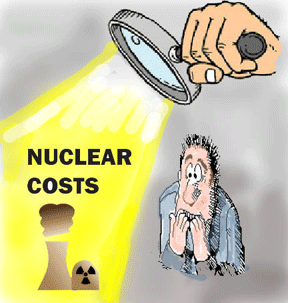 Tokyo’s decision on nuclear power plants ‘may backfire’
It could cost PM Abe politically and set back his economic policies: analysts Business Times BY ANTHONY ROWLEY, 14 April 14, IN TOKYO JAPANESE Prime Minister Shinzo Abe has entered a high-stakes gamble with the decision announced last Friday to restore nuclear power to the nation’s menu of electricity generation sources in the wake of the Fukushima nuclear meltdown three years ago.
The controversial decision goes against the non-nuclear policy adopted by the Democratic Party of Japan government before Mr Abe’s Liberal Democratic Party returned to power at the end of 2012 and could backfire in a number of ways, analysts say.
With polls showing a significant proportion of Japanese remaining opposed to the restart of the nation’s 50 or so nuclear reactors that have been idled since the Fukushima disaster, the political price of restoring nuclear power could be high for Mr Abe, some claim.
At the same time, there could be economic consequences such as setting back the policy being pursued by the Bank of Japan (BOJ) under pressure from Mr Abe to replace deflation with annual inflation of 2 per cent. So far much of the progress towards this target has been driven by “imported inflation” in fuel costs…..(subscribers only) http://www.businesstimes.com.sg/premium/world/tokyos-decision-nuclear-power-plants-may-backfire-20140414
Japan’s return to nuclear power will not be easy or soon
Japan reverses its withdrawal from nuclear power, DW 13 April 14 The Japanese government has decided not to phase out nuclear power. But a fast turnaround in energy policy is also not possible, even if only a third of the nuclear reactors will be restarted again. Japan’s conservative government has drawn different conclusions from the Fukushima disaster than did the German government, which chose to phase out nuclear power. Its new energy plan, which Shinzo Abe’s Liberal Democratic Party (LDP) cabinet approved on Friday (11.04.2014), calls nuclear power the country’s most important power source…….
But the nuclear power plants will have to meet tighter safety requirements. The government wants to allow the operation of power plants classified as safe by the reformed Nuclear Supervisory Authority. The first two reactors could gain approval before summer.
A majority of Japanese oppose nuclear power, according to polls. But this has had no effect on any elections since the Fukushima disaster. With the new energy plan the government satisfies the wish of the economy to use nuclear power as reliable energy source.
The new policy also allows the construction of new nuclear reactors. The government will determine the necessary amount of nuclear power, the paper says. But analysts doubt that it is possible to push through the construction of new reactors. They would have to be build at places where nuclear power plants already exist due to public reluctance.
The energy market is to be liberalized by the end of the decade and that could make the construction of new reactors too expensive. And the future of the decommissioned reactors also looks bleak.
Since last summer the eight electricity suppliers asked the Nuclear Supervisory Authority for permission to restart only 17 of the 48 reactors. Another 14 reactors are heavily disputed politically. There is widespread public rejection of any attempt by operator Tepco to restart Fukushima 2. The Hamaoka nuclear complex with three reactors is located in a heavily populated area in an earthquake zone. The remaining 17 reactors won’t ever go in operation again because security retrofitting won’t pay off due their age……..http://www.dw.de/japan-reverses-its-withdrawal-from-nuclear-power/a-17563405
Against public opinion Japanese government goes for nuclear power
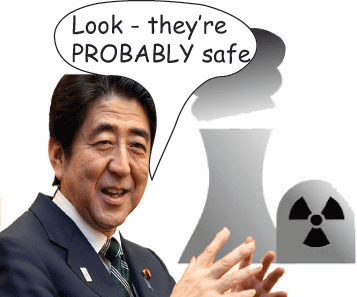 Japanese govt. abandons nuclear-free future in face of public opposition RT.com: April 11, 2014 The Japanese government has overturned its predecessor’s energy plan that would see all of the country’s nuclear power plants closed by 2030. The move – which has been opposed by the public – has been forced by spiraling energy costs.
Approved by the Liberal Democratic Party, which was not in power in 2011 when the Fukushima nuclear accident occurred, nuclear power has been described in the 20-year-plan as an “important baseload power source” – meaning its steady output will be fundamentally relied on for steady electricity generation.
“We aim to opt for an energy supply system which is realistic, pragmatic and well balanced,” Trade and Industry Minister Toshimitsu Motegi told the media on Friday.
Motegi said that the exact role of nuclear power in the energy mix would be decided once the state of its beleaguered energy industry would become clear in three or four years, but stressed that nuclear energy offered “security”.
A March survey showed that 59 percent of Japanese opposed the re-start of nuclear reactors, and only 12 percent had “no” or “minimal concerns” about the potential for another serious nuclear accident in Japan.
All 48 of Japan’s nuclear reactors are currently offline.
The government has ordered energy companies to spend over $16 billion upgrading its outdated and seismically vulnerable facilities to avoid a repeat of the worst nuclear accident since the Chernobyl accident in 1986.
This comes on top of the projected $100 billion cost of clearing-up the pollution and radioactive remains of the damaged Fukushima facility itself. …….
he reintroduction of nuclear may be too costly to solve the country’s energy shortfall.
Reuters recently compiled a report saying that it would make no economic sense to revive two-thirds of the country’s plants under the current stringent operating criteria.
“I think it is unavoidable that the Japanese utilities will write off most of their nuclear ‘assets’ and move on. Given the slim realistic prospects for a major nuclear share, the challenge will be flexibility and the whole baseload concept flies out of the window,” Mycle Schneider, a Paris-based energy consultant told the news agency.
The government’s energy plan also reserves a bigger role for renewable sources, which it says will double from the current 10 percent of the overall energy mix in the next sixteen years.
While green energy has widespread public support, this may be another plan that will require extra subsidy from government coffers flushed out by the 2011 natural disaster and the subsequent attempts to rectify previous mismanagement of the energy industry. http://rt.com/news/japan-nuclear-plan-fukushima-992/
Renewable energy future in Poland, with new law
 Poland approves renewable energy bill, Climate Spectator Reuters 9 Apr, Poland’s government approved a long-awaited draft law on Tuesday that lays out new long-term subsidies for renewable energy, aiming to cut costs to consumers as well as help the coal-reliant country meet EU climate targets……http://www.businessspectator.com.au/news/2014/4/9/policy-politics/poland-approves-renewable-energy-bill
Japan’s nuclear energy policy dangerously adrift
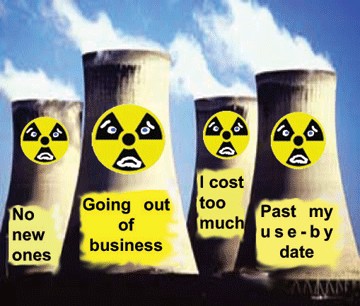 In the Wake of Fukushima: Japan’s Nuclear Energy Policy Impasse 60% of Japan’s 48 viable nuclear reactors,are not as yet being considered for application to the Nuclear Regulation Agency (NRA) for restart By Andrew Dewit Global Research, April 07, 2014
Asia-Pacific Journal Japan’s energy policy regime appears dangerously adrift in the context of accelerating climate change. The core problem is agency. On the one hand, Japanese PM Abe Shinzo and the nuclear village appear obsessed with nuclear power restarts and 20th century paradigms of the power economy. On the other hand, Japan’s anti-nuclear civil society lacks the political vehicle to force a combined nuclear pullout plus drastic reduction of greenhouse gas emissions. Some anti-nuclear forces do not yet understand the urgent need to reduce emissions, and are content to burn coal, despite of the patent threat of climate change. This is precisely what Japan has done in the wake of 3.11. The Abe cabinet is focused on getting restarts and a nuclear-based energy plan. Yet the scope for restarts is surprisingly limited and – incredible in this era of multiple crises and revolutions – the draft new energy plan lacks concrete numbers.1 The country needs better leadership on smart growth, in the context of what McKinsey specialists refer to as a “resource revolution”2 and MIT economists depict as “the second machine age.”3
Nuclear Is Probably No Longer Baseload
All of Japan’s 48 viable nuclear reactors are at present offline, and have been since September of 2013. The Abe cabinet is keen to restart as many of these as possible. But regulatory rules, public opinion and other factors constitute significant barriers to achieving even a third of Japan’s pre-Fukushima 30% reliance on nuclear power. That will mean nuclear will no longer be a “baseload” source of electricity, capable of supplying a reliable load to the grid at all times.
Indeed, an Asahi Shimbun survey of the utilities themselves indicates that fully 60% of Japan’s 48 viable nuclear reactors, meaning 30 reactors, are not as yet being considered for application to the Nuclear Regulation Agency (NRA) for restart. And of these 30 reactors, it appears that at least 13 are write-offs due to age, proximity to a seismic fault, and other factors that render them incapable of satisfying the new safety standards of the NRA.4 For that reason, at present there are only 17 reactors for which restart applications have been filed.
Of these, it appears – even to Japanese supporters of nuclear power – that perhaps only 8 will finally get approval and be restarted. Highly regarded energy specialist Tom O’Sullivan, of Mathyos Japan, concludes this on the basis of a survey of “various established Japanese policy institutes that are close to Japan’s industrial interests.” O’Sullivan notes that “[t]his level of restarts would only amount to 56 TWh of power output or 6% of Japan’s total power requirements and thus may not constitute a baseload power supply.”5
Reuters conducted its own analysis, using a broader set of questionnaires and interviews of over a dozen experts, along with input from the 10 firms that operate nuclear capacity. One suspects these operators painted as optimistic a picture of their restart prospects as possible. Even so, the result of this survey led Reuters’ expert journalists, Mari Saito, Aaron Sheldrick and Kentaro Hamada, to conclude that at best there will be 14 nuclear restarts at some point in time. They add that there is great uncertainty about the remaining 34 nuclear reactors. Their conclusion is that nuclear energy “will eventually make up less than 10 percent of Japan’s power supply.”6
Part of the reason nuclear appears not likely to recover its status as base-load power are the NRA’s new safety rules, in tandem with maintenance schedules and other factors that make a very shrunken fleet unreliable. But another large reason for this likely outcome is the stubbornness of the opposition to nuclear power………. http://www.globalresearch.ca/in-the-wake-of-fukushima-japans-energy-policy-impasse/5376899?utm_source=rss&utm_medium=rss&utm_campaign=in-the-wake-of-fukushima-japans-energy-policy-impasse
1 This Month
23-25 October – on Zoom – World BEYOND War’s annual global conferenc


Shut down the radiation-damaged Heysham nuclear reactors now
To see nuclear-related stories in greater depth and intensity – go to https://nuclearinformation.wordpress.com

Say No to NASA’s Reckless Nuclear Reactor on the Moon
Say No to NASA’s Reckless Nuclear Reactor on the Moon
-
Archives
- October 2026 (180)
- September 2026 (339)
- August 2026 (330)
- July 2026 (355)
- June 2026 (287)
- May 2026 (306)
- April 2026 (356)
- March 2026 (251)
- February 2026 (267)
- January 2026 (308)
- December 2025 (358)
- November 2025 (359)
-
Categories
- 1
- 1 NUCLEAR ISSUES
- business and costs
- climate change
- culture and arts
- ENERGY
- environment
- health
- history
- indigenous issues
- Legal
- marketing of nuclear
- media
- opposition to nuclear
- PERSONAL STORIES
- politics
- politics international
- Religion and ethics
- safety
- secrets,lies and civil liberties
- spinbuster
- technology
- Uranium
- wastes
- weapons and war
- Women
- 2 WORLD
- ACTION
- AFRICA
- Atrocities
- AUSTRALIA
- Christina's notes
- Christina's themes
- culture and arts
- Events
- Fuk 2022
- Fuk 2023
- Fukushima 2017
- Fukushima 2018
- fukushima 2019
- Fukushima 2020
- Fukushima 2021
- general
- global warming
- Humour (God we need it)
- Nuclear
- RARE EARTHS
- Reference
- resources – print
- Resources -audiovicual
- Weekly Newsletter
- World
- World Nuclear
- YouTube
-
RSS
Entries RSS
Comments RSS

