Jamaica passes Bill to regulate ionising radiation, prohibit building of nuclear reactor
Bill to regulate radiation and nuclear practice passed, Jamaica Star 21 July 15 A Bill seeking to create a legal framework for the regulation of activities, practices, apparatuses and facilities involving ionising radiation and nuclear technology was passed by the Senate on Friday.
The Bill entitled, the Nuclear Safety and Radiation Protection Act, 2015, was piloted by Minister of Justice, Senator Mark Golding.
The objectives of the Bill are to protect people and the environment from exposure to ionizing radiation to the maximum extent that is reasonably practicable, taking into account social and economic factors, and recognising the need for the use of ionizing radiation for beneficial purposes; and to protect radioactive sources from misuse that may result in harm to people or the environment. ……..
This Bill seeks to create a robust framework for the regulation of activities, practices, apparatus and facilities involving ionising radiation and nuclear technology, in keeping with international standards and best practices,” the Minister explained.
The Bill, which was approved by the House recently, also prohibits: building, importing, exporting or operating a research reactor………http://jamaica-star.com/latest/article.php?id=235
USA’s reputation at stake, if Congress votes against Iran nuclear deal
 White House: Congressional vote against Iran nuclear deal would be ‘devastating’ By Dave Boyer – The Washington Times – Friday, July 17, 2015
The White House said Friday that Congress would devastate the U.S. leadership role in the world if lawmakers vote to reject the Obama administration’s historic nuclear deal with Iran.
“For the United States, because of a congressional action, to isolate our country on such an important issue, would be devastating to our standing in the world,” said White House press secretary Josh Earnest. “If Congress killed this agreement, it would have a terrible impact.”
The U.S. struck the deal in cooperation with Russia, China, Germany, France and the United Kingdom.
Republicans and some Democrats are expressing serious concerns about the agreement, which will lift economic sanctions against Tehran in exchange for imposing limits on Iran’s nuclear program. President Obama said it’s the best way to ensure that Iran cannot build a nuclear weapon for at least the next 10 years.
Mr. Earnest said international sanctions “would collapse” if the U.S. kills the agreement.
“Iran would still obtain the financial benefits of sanctions relief,” he said. “Iran will get all the benefits of this deal without having to give up anything.”
Such action by Congress would “allow Iran to get off scot-free,” Mr. Earnest said……….
The president’s spokesman also said the administration isn’t trying to disregard Congress by requesting the U.N. Security Council to approve the agreement before Congress can review it. Congress has 60 days to debate the accord.
UK’s plan for Hinkley C nuclear power station runs into more and more trouble
 UK’s proposed Hinkley C nuclear power plant faces resistance on all sides http://www.greenpeace.org/international/en/news/Blogs/nuclear-reaction/uks-proposed-hinkley-c-nuclear-power-plant-fa/blog/53534/
The plans for new nuclear reactors at Hinkley in the UK are too expensive, too late, won’t help cut greenhouse gas emissions, violate EU competition law, and will distort Europe‘s energy markets. On 6 July 2015, Greenpeace Energy, together with German and Austrian energy utilities, filed a legal challenge in the European Courts against the EU Commission’s decision to rubberstamp billions of euros in state subsidies for new nuclear reactors at the Hinkley nuclear power plant in the UK.
The filing argues these massively subsidised reactors will influence energy prices in Europe and grossly distort competition.
In a similar filing, the Austrian government submitted a complaint to the European Court against the European Commission for failing to properly implement EU law when it approved the UK’s nuclear welfare package. As Austrian Chancellor Werner Faymann said in a statement, nuclear power “is not an innovative technology and is therefore not worthy of subsidy.”
In short, the Hinkley reactors threaten to block the road to a safe, clean renewable future. “The EU Commission’s decision threatens to have negative consequences for our environmentally sound production plants,” says Dr. Achim Kötzle, Managing Director of Stadtwerke Tübingen on behalf of the eight municipal utilities in the action.
Here’s the situation:
The price of the electricity generated by the new Hinkley C reactors has been guaranteed by the British government for 35 years. This means that, no matter the fluctuations in the price of electricity, Hinkley owner EDF will always get its money.
With renewable energy getting cheaper all the time, and the Hinkley reactors not expected to be in operation before the middle of the next decade, you can see why EDF wanted to fix its prices.
Figures commissioned by Greenpeace Energy (an organisation independent of Greenpeace) show that this is a gift to EDF of some 108 billion euros of public funds. In addition, the British government has made guarantees of more than 20 billion to investors in the construction of the new nuclear plant. As Sönke Tanger, Managing Director of Greenpeace Energy says: “We are taking legal action against these exorbitant nuclear subsidies because they appear to be ecologically and economically senseless and signify serious disadvantages for other energy providers, for renewables, and for consumers.”
The approval of this state funding of nuclear reactors also sets a bad example for the rest of Europe. If Hinkley succeeds, countries such as Poland, the Czech Republic and Hungary are likely to follow.
There are also huge doubts about the European Nuclear Reactor (EPR) technology EDF wishes to build at Hinkley C. The ones being built in Finland and France are massively over budget, years behind schedule, and have experienced huge technical problems.
Why wait ten years (at least) for new expensive and unsafe nuclear reactors when renewable energy projects are ready to go right now? Hinkley C must be stopped before it irreparably damages our future.
Bureau d’audiences publiques sur l’environnement (BAPE) – no go ahead for uranium mining in Quebec
 BAPE cites ‘uncertainties’ and ‘low acceptability’ in report on future of uranium mining in Quebec, Montreal Gazette, PRESSE CANADIENNEJuly 17, 2015 By Stéphanie Marin
The Bureau d’audiences publiques sur l’environnement (BAPE) concluded that would be inappropriate to give the green light to uranium mining in Quebec right now. Their findings were presented to the provincial government on Friday afternoon.
According to the BAPE, there are too many uncertainties and unanswered questions regarding the risks posed by uranium mining to human health and the environment.
“These uncertainties are compounded by the radioactivity of uranium residues, which may remain problematic for thousands of years,” the agency wrote in its 600-page report, dated May 2015 and entitled “The challenges of the uranium industry in Quebec.”
The report noted that social acceptability is also an issue for uranium mining.
“Because of the uncertainty and sometimes significant gaps and limitations in scientific and technological knowledge, we are very far from reaching a social and political consensus and there is very low acceptability in Quebec.”
And in areas where the potential mines would be located, “the rejection of the uranium industry is almost unanimous.”
The city of Sept-Îles, which is near a uranium mining project, has been the scene of many protests in recent years. In 2009, 20 doctors resigned from a Sept-Îles hospital to protest the construction of a uranium mine on the North Shore.
The BAPE notes that the Institut national de santé publique du Québec states that the presence of a uranium mine could create additional exposure to radiation for people living nearby.
Quebec’s environment minister asked the BAPE to address the mining industry in March 2014. Uranium mines are considered different from other mines because they emit radiation……….http://montrealgazette.com/news/quebec/bape-cites-uncertainties-and-low-acceptability-in-report-on-future-of-uranium-mining-in-quebec
Language of USA’s Republicans give away their desire to bomb Iran
Who cares if no Republican has read the full text of the deal, which won’t be given to Congress for days?
 Many of the Republicans’ statements on Iran in the past few months have just a word salad of insults – “evil”, “malevolent”, “corrupt”, “terrorists”, “the devil” – as though there were a contest to see how many despicable adjectives they could fit into one paragraph.
Republicans hate the Iran nuclear deal because it means we won’t bomb Iran Trevor Timm, Guardian 14 July 2015
The Administration’s agreement with Iran would curtail the latter’s nuclear program. The only people who can hate that are the kind who just love war As soon as President Obama announced the historic nuclear agreement between the US and Iran on Tuesday, Republican presidential candidates raced to see who could get out the most hyperbolic, foaming-at-the-mouth condemnation of the potential for peace.
Republicans frontrunner Jeb Bush was first out of the gate, more than 24 hours before the deal was actually signed. He boasted on his YouTube channel: “History is full of examples of when you enable people or regimes who don’t embrace democratic values you get a bad result…it’s called appeasement.” Continue reading
Confusing that Republicans support uneconomic thorium nuclear reactors
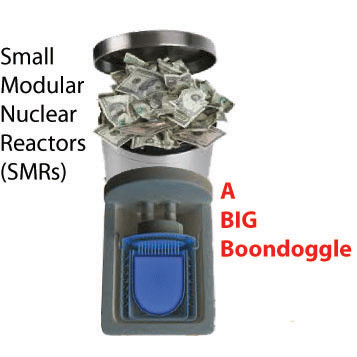 Why GOP support for subsidized nuclear energy is confounding Bangor Daily News, By Peter Bradford, July 11, 2015,
Two unusual bills promoting nuclear power were introduced in the Maine Legislature this session. One, from Sen. Eric Brakey, R-Auburn, would have fast tracked Maine’s path to a reactor using thorium to create a uranium isotope different from those that fuel nearly all of today’s power reactors. The other, from the office of Gov. Paul LePage, would have exempted “small modular reactors” from the referendum process Maine requires for other nuclear power plants.
Neither bill passed as proposed.
Still, what on earth is going on here? No license applications for these designs have ever been filed at the Nuclear Regulatory Commission. No one knows what they would cost or how reliably they would operate.
New, conventional reactors being built at customer expense in South Carolina and Georgia will have to charge well over twice the prevailing and projected market price of electricity in New England. No private company wants to build or finance a reactor under anything resembling New England power market rules. Large subsidies will be essential to the development of new reactors, including thorium and small modular reactors.
When it comes to much smaller subsidies for solar energy, LePage has vetoed legislation that would have added a surcharge amounting to less than one-tenth of a percent to Maine electric bills. He asserted that the legislation “unilaterally selects solar above other solutions that have proven to be more cost effective.” He is equally dismissive of support for wind energy or energy efficiency.
What is it about taxpayer subsidy and big government cronyism that pose such an irresistible attraction for conservatives only when directed to nuclear power? Like a reverend preaching temperance from a barstool, LePage vetoes and disparages government support for proven technologies while embracing an unproven and subsidy-addicted reactor technology as a solution to Maine’s electricity needs.
Subsidies for today’s reactors pale beside past nuclear largesse. Reactors — including thorium reactors — and nuclear fuel enrichment facilities were invented in government laboratories and given to private industry in combination with massive incentives to build power plants. The federal government made unique commitments to own and dispose of the waste fuel while limiting liability for serious accidents. States were preempted from any safety judgements about nuclear power. When electric industry restructuring threatened nuclear profitability in the 1990s, a multibillion-dollar surcharge was added to customer electric bills to cushion the impact on investors. A Congressional Research Service Report estimates that half of all federal energy expenditures on energy research and development have gone to nuclear power………….
given Maine’s experience with past nuclear mirages, the state should not anoint any single technology without an even-handed evaluation of the alternatives.
Peter Bradford chaired the Maine and New York utility regulatory commissions and was a member of the U.S. Nuclear Regulatory Commission. He is an adjunct professor at Vermont Law School. http://bangordailynews.com/2015/07/11/the-point/why-gop-support-for-subsidized-nuclear-energy-is-confounding/
EPA’s Clean POwer plan is still being lobbied by the nuclear industry
The nuclear industry is still lobbying for a bailout in EPA’s Clean Power Plan. Maybe you should be lobbying too. GreenWorld, Michael Mariotte, 14 July 15
The final language of the EPA’s Clean Power Plan (CPP) is supposed to be released next month, which means most of the text (and more importantly, the concepts behind it) is already completed.And, more specifically, it isn’t stopping the nuclear power industry from pushing for changes that would benefit new reactors in particular, although it still holds out some fading hope for help for its older, uneconomic and obsolete reactors as well.*Edison Electric Institute and utility CEOs and representatives from American Electric Power Co. Inc., DTE Energy, Berkshire Hathaway Energy and Duke Energy Corp.That’s a lot of heavyweight nuclear utilities right there. A bunch of other industry groups got to make their case as well……….
- *MJ Bradley & Associates and electric utilities that are members of its Clean Power Plan Initiative, including the CEOs or senior executives of Dominion, National Grid, NextEra, Exelon, PSEG, Pacific Gas and Electric Co. and Calpine Corp.
- As evidence, E&E Publishing Friday published a story headlined White House opens doors to eleventh-hour pleas on Clean Power Plan. Among the bevy of recent visitors pleading their cases were:
- But that isn’t stopping industry, and the occasional environmental group, from continuing to press their cases for changes from the draft proposal.
- Oh, and NEI thinks power uprates at existing reactors should be considered “new” as well.We, however, are expecting something quite different, and you should be too: if the CPP is meant to be the nation’s first climate change roadmap, then it should be pointing the path to a nuclear-free, carbon-free energy future, not figuring out how to do more of the same failed policies of the past……….
- Fertel and NEI’s ultimate goal is to make sure the U.S. nuclear fleet doesn’t continue its recent downward trend. “He noted that currently nuclear is about 20 percent of the electricity mix in the U.S. ‘Our goal is that it never drop below 20, that it pick up and maybe be more than that, but that it’s in the 20 to 20+ range as we go forward. So that’s what we are expecting.’”
- While the public comment period ended December 1, 2014, and since unlike giant utilities and the occasional big green group the public doesn’t get access to EPA officials or the White House, we thought we’d give the public another chance to comment anyway. You can send your e-mail to President Obama and EPA Administrator Gina McCarthy here, and let them know that we expect the final version of the Clean Power Plan to contain no help for nuclear whatsoever……… http://safeenergy.org/2015/07/13/the-nuclear-industry-is-still-lobbying/
South Africa’s Democratic Alliance refutes government denials over a nuclear deal.

 DA slams nuclear deal July 10 2015 IOL By ANA The DA refutes government denials over a nuclear deal.
Cape Town – South Africa’s inking of two memoranda of understanding with Russia’s state nuclear energy company Rosatom made it clear a deal for a new reactor was already in the pipeline despite government’s denials, the Democratic Alliance said on Friday.
DA energy spokesman Gordon Mackay said he had written to Energy minister Tina Joemat-Petterson following Thursday’s announcement of the agreement on the sidelines of the Brics summit in the southern Russian city of Ufa to demand that she release further details of it.
“That these MOUs reportedly speak of cooperation in order to provide training for five categories of specialists for the South African nuclear industry is the clearest indication yet that Rosatom is the preferred bidder,” Mackay said
“Signing MOUs of this nature, while a competitive bid process is underway, smacks of gross impropriety on behalf of Minister Joemat-Pettersson and can be seen as nothing more than a crude attempt by the Zuma administration to bolster Rosatom’s bid over potential rivals.”
Government on Thursday denied Russia was the preferred bidder for a deal that would increase South Africa’s nuclear power capacity………http://www.iol.co.za/business/news/da-slams-nuclear-deal-1.1883599#.VaBBpF-qpHw
USA Regulators to decide on future of Diablo Canyon Nuclear Facility
California law forbids building more nuclear plants in the state until the federal government comes up with a long-term solution for dealing with the radioactive waste.
The commission has called two hearings in San Luis Obispo on Aug. 5 to take public comments on issues that should be covered in an environmental impact study on the license renewal project. A draft of the study will likely take a year to complete, according to a schedule the commission sent PG&E in April. A final decision on the license renewal likely won’t arrive before mid-2017, according to the schedule.
Feds to decide whether state’s last nuclear plant stays or goes, SF Gate, By David R. Baker, July 8, 2015 Federal regulators have restarted the process of deciding whether California’s last nuclear power plant, Diablo Canyon, will remain open for decades. And like most everything else in Diablo’s long, contentious history, the move is sure to provoke a fight.

The Nuclear Regulatory Commission has reported that it would once again begin processing a request from plant owner Pacific Gas and Electric Co. to renew Diablo’s operating licenses, set to expire in 2024 and 2025. That request has been on hold since shortly after Japan’s 2011 Fukushima disaster rekindled fears of nuclear danger.
PG&E applied in 2009 to renew Diablo’s licenses for 20 years, arguing that California would need the plant near San Luis Obispo to combat climate change. The commission’s license extension process takes years to complete — hence, PG&E’s early application……….
The license renewal process, which will include public hearings and testimony, will also give the plant’s vocal opponents another chance to make their case.
Spying an opening Activists who never wanted Diablo in the first place have been pushing hard to close it, particularly after California’s only other commercial nuclear plant — San Onofre, north of San Diego — shut down in 2012.
They argue that PG&E has consistently underestimated earthquake threats to the plant, and that PG&E has a long record of snafus at Diablo, such as replacing the steam generators and vessel heads without first conducting a necessary seismic test. PG&E, in contrast, says the plant boasts a solid safety record.
“Our point is, this is a pattern with them,” said Jane Swanson, with Mothers for Peace. “They keep screwing up — and this is a nuclear plant.” Continue reading
Russia’s nuclear industry to “educate” South Africans
Nuclear deal – 200 South Africans to be “educated” during excursions to Russia http://www.biznews.com/briefs/2015/07/09/nuclear-deal-200-south-africans-to-be-educated-during-excursions-to-russia/ ALEC HOGG JULY 9, 2015 Cape Town – The Department of Energy announced in a statement on Thursday that it has signed two memoranda of understanding with Russian state nuclear energy corporation Rosatom at the 7th summit of the Brics (Brazil, Russia, India, China and South Africa) countries in the Russian city of Ufa.
According to the first document, Russia and South Africa aim to implement several joint projects for education in the nuclear power industry.
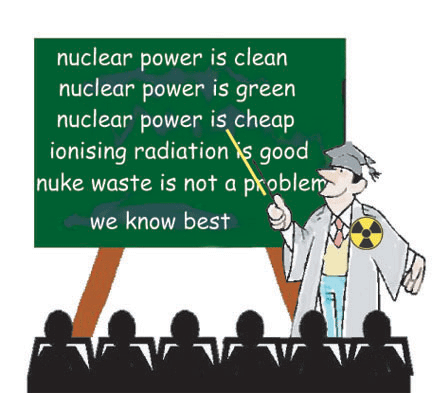
The countries will cooperate to provide training for five categories of specialists for the South African nuclear industry: nuclear power plant personnel, engineers and construction workers, staff for operations not related to the power industry, personnel for nuclear infrastructure, students and teachers.
There will also be education programmes for 200 South African candidates at Russian universities and educational organisations. This memorandum stipulates the development of educational materials and scientific literature on nuclear power, student exchange programmes for students of various levels of training, organisation of internships and summer courses, student competitions and teacher training.
The second memorandum signed in Ufa stipulates joint efforts of the parties to promote nuclear power in South Africa, increasing the awareness of local residents of modern nuclear technologies used in the power industry and in other industries, and ensuring public acceptance of nuclear power.
In particular, the parties have agreed to work out a plan for the implementation of a joint communication programme to be launched in South Africa. This will involve the organisation of round tables and other events aimed at promoting nuclear power and modern nuclear technologies.
A nuclear energy information centre in South Africa is also under consideration. “The parties seek to exchange information and best practices in the nuclear industry by organising working visits and international conferences and exhibitions,” said the Department of Energy. Source: http://www.fin24.com/Economy/Rosatom-seeks-to-educate-SA-on-nuclear-power-20150709
Game Over for UK’s Hinkley Point Nuclear power project?
The UK Government is now said to be deeply concerned about the future of the Hinkley project following revelations about problems at the similar reactor being built at Flamanville
Nuclear needs a blank cheque Now that it is plain that nuclear power has failed miserably to compete with renewable energy even on the somewhat skewed playing field represented by the (proposed) Hinkley C deal, nuclear supporters are trying to engineer a ‘blank cheque’ to be given to nuclear developers
nuClear News, July 15 http://www.no2nuclearpower.org.uk/nuclearnews/NuClearNewsNo75.pdf There is a growing chorus of critics calling for Hinkley Point C to be scrapped altogether, according to the Sunday Times.
It would be one of the most expensive man-made objects ever built in the world. At a cost of £24.5bn it would tie British households into paying for astonishingly expensive electricity subsidies until 2060. The world has changed since 2010 when Hinkley was first named as a site for new reactors. The price of renewables has plummeted.
Washington State Senate passes Bill on Small Modular Nuclear Reactors – calls them “clean”
 Small modular reactor bill passes state Senate BY ANNETTE CARY Tri-City HeraldJune 30, 2015 A bill to support the manufacturing of small modular reactors in Washington state passed the state Senate 31-12 on Tuesday as the Legislature wrapped up its work.
As of 8 p.m. Tuesday, however, the House had yet to consider it…………….
There is interest in the Tri-Cities for positioning the community as a center for assembling or manufacturing the small nuclear plants to be shipped around the world, including to Asia. The reactors are proposed to be manufactured in modules and then shipped to where they will be used, with additional modules added as demand for electricity production increases…….
Added to the bill is a requirement that the state Department of Commerce and the Office of the Superintendent of Public Instruction prepare a joint report to the Legislature by Dec. 1 with recommendations for a clean-energy education program.
The program would be required to include grants both for clean-energy ambassadors and for professional development for teachers.
The clean-energy ambassadors would visit classrooms to introduce students to clean energy science and technology. They could cover solar and wind power, small modular reactors and opportunities for nuclear waste cleanup technology careers…….
Certified science teachers could receive grants to help them pursue professional development opportunities in clean-energy science and broaden their exposure to the field.
“One way to ensure that young people understand nuclear energy is to introduce them to our many great scientists, engineers and others who work in the nuclear field,” Brown said. “It’s also one of the best ways to guarantee that the next-generation of Washington job-seekers is prepared for opportunities in emerging nuclear and other clean-energy fields.”…….http://www.tri-cityherald.com/2015/06/30/3632808_small-modular-reactor-bill-passes.html?rh=1
Nuclear industry keen to save US government’s Export-Import Bank
 Why the US nuclear industry is eager to save this obscure, government-run bank The US nuclear industry has looked abroad for business as demand in the US has fallen. But without the Export-Import Bank’s backing, some say it would be harder for US companies to seal nuclear deals abroad.
Christian Science Monitor, By Jared Gilmour, Staff writer JULY 2, 2015 WASHINGTON — Tucked away in an unassuming building two blocks from the White House is a government-run bank. It helps US companies sell products abroad,……..
Until recently, the bank was relatively low-profile……the Export-Import Bank’s loans and loan guarantees are critical for another domestic industry that has fallen on hard times: US nuclear power. If the bank’s charter isn’t reauthorized, the industry and a host of other business interests say the effects could be devastating for US companies’ overseas prospects……..
Nuclear looks abroad For years, the US nuclear industry has struggled domestically. Cheap natural gas and coal have largely crowded the low-carbon power source out of the market. The recession also put a damper on demand for new US power generation. Safety concerns have made matters worse for US nuclear, and those worries flared up anew after Japan’s Fukushima disaster in 2011. http://www.csmonitor.com/Environment/Energy/2015/0702/Why-the-US-nuclear-industry-is-eager-to-save-this-obscure-government-run-bank
In France, nuclear power has lost its glow

 France Loses Enthusiasm for Nuclear Power, Scientific American, Nuclear’s share of electricty will drop from 75 percent to 50 percent by 2025 due to loss of know-how and requirements for more renewable sources By Umair Irfan and ClimateWire | June 29, 2015“……..
A ‘once formidable institution’ declines….nuclear plants, by their nature, are big bets and take years to build. Laponche explained that the French nuclear industry anticipated 1,000 TWh of demand, but domestic needs have yet to top 600 TWh, leaving an oversupply. With the economic downturn and increasing energy efficiency, French electricity demand has remained level or declined in some instances.
Now, some of France’s reactors are showing wrinkles—France’s oldest reactor, Fessenheim 1, started operations in 1977—and officials need to decide whether to invest in costly safety upgrades to keep them operating or to decommission them, another expensive prospect that leaves open the possibility that fossil fuels may rise to meet the shortfall.
New reactors also are struggling. Areva’s third-generation nuclear reactor, EPR, is now under construction at four sites: two in China, one in France and one in Finland. All four are behind schedule, and the French and Finnish reactors have seen their costs more than double, suffering from quality control and management problems.
“The cost of construction of new nuclear is extraordinarily expensive,” said Antony Frogatt, a senior research fellow at Chatham House, an international affairs think tank. He observed that there are ways to extend the lives of existing reactors, but upgrades get progressively more expensive, and certain components, like reactor pressure vessels, cannot be replaced, so renewed operating licenses are only prolonging the inevitable.
And while France has reduced nuclear waste, it hasn’t eliminated the need to dispose of it. No country with nuclear power has a viable underground repository for waste, and proposed sites in France face public opposition, despite more widespread support for nuclear power.
On the other hand, France is the second largest renewable energy producer and consumer in Europe. Wavering solar and wind power don’t play well with baseload nuclear plants that prefer to run at full blast, so the French must find a way to cope with this imbalance if they are to meet the European Union’s directive to generate 20 percent of their electricity from renewables by 2020…….
To sum up, it’s a shrinking client base [for nuclear power] and a competitive market,” said Mycle Schneider, an independent international energy consultant. “The financial and economic situation is devastatingly bad.”
The New York Times reported that Areva hasn’t been profitable since 2010, accrued €4.8 billion in losses in 2014 and may lay off up to 6,000 workers. EDF may take over parts of Areva’s business…….
Future of Britain’s Hinkley Point Nuclear Facility is increasingly uncertain
there is growing talk in the U.K. of whether the government should cut and run from nuclear.
In a speech to the House of Commons last week, Labour MP Paul Flynn questioned whether Whitehall would have made the same decision if it knew what it knows now about the cost of nuclear.
“Nuclear power was promised as an energy source that would be too cheap to meter. It is now too expensive to generate,”
While the European public has largely turned against nuclear since the Fukushima accident in Japan in 2011, the British have been shielded by a “skilled public relations operation,”
 Trouble ahead for UK’s nuclear hopes Britain’s push for new reactors is coming under fire. Politico Sara Stefanini 25/6/15, The next generation of reactors in the U.K. has been in the works for a decade, but now a looming challenge in the European Court of Justice attacking nuclear subsidies, growing technical problems and cost overruns are casting doubt on the idea of using nuclear to meet emissions reduction targets……..
the future of Hinkley Point C looks increasingly uncertain, as the first EPR projects in France and Finland have been hampered by delays, cost overruns and safety concerns, and as the Austrian government prepares to challenge the European Commission on its approval of the U.K.’s state aid. Continue reading
1 This Month
23-25 October – on Zoom – World BEYOND War’s annual global conferenc


Shut down the radiation-damaged Heysham nuclear reactors now
To see nuclear-related stories in greater depth and intensity – go to https://nuclearinformation.wordpress.com

Say No to NASA’s Reckless Nuclear Reactor on the Moon
Say No to NASA’s Reckless Nuclear Reactor on the Moon
-
Archives
- October 2026 (160)
- September 2026 (339)
- August 2026 (330)
- July 2026 (355)
- June 2026 (287)
- May 2026 (306)
- April 2026 (356)
- March 2026 (251)
- February 2026 (267)
- January 2026 (308)
- December 2025 (358)
- November 2025 (359)
-
Categories
- 1
- 1 NUCLEAR ISSUES
- business and costs
- climate change
- culture and arts
- ENERGY
- environment
- health
- history
- indigenous issues
- Legal
- marketing of nuclear
- media
- opposition to nuclear
- PERSONAL STORIES
- politics
- politics international
- Religion and ethics
- safety
- secrets,lies and civil liberties
- spinbuster
- technology
- Uranium
- wastes
- weapons and war
- Women
- 2 WORLD
- ACTION
- AFRICA
- Atrocities
- AUSTRALIA
- Christina's notes
- Christina's themes
- culture and arts
- Events
- Fuk 2022
- Fuk 2023
- Fukushima 2017
- Fukushima 2018
- fukushima 2019
- Fukushima 2020
- Fukushima 2021
- general
- global warming
- Humour (God we need it)
- Nuclear
- RARE EARTHS
- Reference
- resources – print
- Resources -audiovicual
- Weekly Newsletter
- World
- World Nuclear
- YouTube
-
RSS
Entries RSS
Comments RSS

