$1.8B in tax-payer loans for USA nuclear plant – as its costs soar

 Energy Department guarantees $1.8B in loans for GA nuclear plant, The Hill, By Devin Henry – 06/24/15 The Department of Energy (DOE) will guarantee $1.8 billion in loans for the operators of two new nuclear reactors under construction at a power plant in Georgia, the department announced on Wednesday.
The government had previously provided $6.5 billion in loan guarantees for the Vogtle Electric Generating Plant project, the country’s first new nuclear facility to be licensed and begin construction in more than 30 years. Wednesday’s step, officials said, will allow the project to be fully-financed………….
Construction at the Vogtle plant has been plagued by delays, and the Associated Press reportedWednesday that cost overruns have threatened the $2.7 billion in savings project executives have said they would secure since state regulators approved construction in 2009. Operators expect to spend at least $7.5 billion on the project. …http://thehill.com/policy/energy-environment/245975-energy-department-guarantees-18b-in-loans-for-ga-nuclear-plant
Clearly, South Africa can’t afford nuclear power
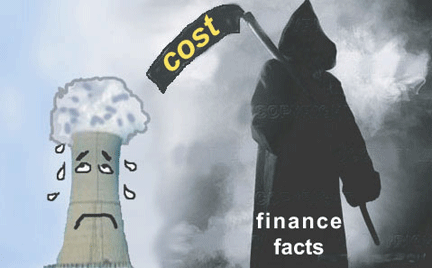 The South African government has said it will not go ahead with nuclear power if the expected construction cost is more than $6500/kW, equivalent to about R130bn per reactor. However, the latest cost estimates are about 25% higher than this. This means that if the South African government sticks to its promise, the tender will fail.
Why South Africa should steer clear of nuclear, By Steve Thomas, Professor of Energy Policy at University of Greenwich Business Tech By The Conversation June
21, 2015 It would be sensible to acknowledge that a nuclear programme is not viable for resolving South Africa’s energy crisis. Rather, the country should be focusing its attention on how to end electricity blackouts and speed up energy efficiency and renewable energy programmes.
Building new nuclear energy capability will cost the country billions of US dollars. It is doubtful that South Africa can afford this.
In addition, nuclear power entails a different but also serious set of risks to climate change. These include the risk of reactor accidents, the danger of weapons proliferation and the hazards of radioactive waste……
Price of nuclear
UK’s energy policy in a shambles as govt seeks China funding for new nuclear reactors

 Nuclear adviser attacks ‘perverse’ idea of Chinese building UK reactors Prof Dieter Helm also identifies security pitfalls as unions accuse government of sacrificing safety for free-market ideology over Hinkley Point C plant, Guardian, Terry Macalister, 19 June 15, A leading energy academic and government adviser has called on ministers to take an equity stake in the planned new Hinkley Point C nuclear plant in Somerset, saying it would not make sense to prefer Chinese money.
The comments from Dieter Helm, professor of energy policy at Oxford University, came as trade union leaders accused the government of letting political beliefs override practical and safety issues in the nuclear sector. In a paper entitled British Energy policy – What Happens Next? , Helm said the British government should issue debt or specific nuclear guaranteed bonds, that could cut the cost of capital from 10% to 2%.
“It is a no-brainer,” said Helm. “Add in the military and security issues of letting Chinese state-owned companies into the heart of the British nuclear industry, and it seems positively perverse to prefer Chinese government money to British government money in so sensitive a national project.”
Helm usually champions free-market methods and is on the economic advisory committee at the Department of Energy and Climate Change.
Meanwhile the attack on government nuclear policy from the GMB union came after comments from Amber Rudd, the energy and climate change secretary, left the door open to Chinese state companies building and operating a new plant at Bradwell, in Essex.
Gary Smith, the union’s national secretary for energy, said the Conservatives seemed ready to allow Beijing to use its own equipment and supply chain in return for funding the new stations at Bradwell and Hinkley Point.
“Energy policy is a shambles because the government is driven by ideology. It will do anything to bring in private or Chinese state money to build British energy infrastructure rather than have it (debt) on George Osborne’s balance sheet,” he said.
This would extend to the Chinese being allowed to ship over large amounts of equipment from Chinese factories, potentially affecting British nuclear safety and as well as hitting UK jobs, he said. Smith noted that an eminent Chinese nuclear scientist, He Zuoxiu, had raised concerns about the safety of his country’s atomic equipment………….http://www.theguardian.com/business/2015/jun/18/nuclear-adviser-attacks-chinese-uk-reactors-dieter-helm-hinkley
It’s time that UK civil servants spoke out on the poor prospects for new nuclear power
The public has been ‘protected’ from the truth of Fukushima Many people are gravely disturbed by the prospect of new nuclear power. That is particularly so among Treasury civil servants. We are in an extraordinary situation, where there is still public support in spite of Fukushima.
One of the main reasons for that is that the British public were ‘protected’ by a skilled public relations operation from knowing the terrible cost of Fukushima – between $100 billion and $250 billion.
 Civil servants must speak out: ‘the time has gone for nuclear power’, Ecologist, Paul Flynn MP 18th June 2015 Despite the PR spin the truth about nuclear power is clear, says Paul Flynn. Current projects are plagued with technical failures, cost escalations and long delays – while renewables power ahead. As tin-eared ministers refuse to get the message, it’s time for civil servants to speak out direct to the public.
Nuclear power was promised as an energy source that would be too cheap to meter. It is now too expensive to generate.
If we were planning a nuclear policy from scratch, would we choose to do a deal with two French companies, one of which is bankrupt, while the other, Électricité de France, has a debt of €33 billion?
Would we also collaborate with a country with a dreadful human rights record – China, whose national investment department is coming into the arrangement – and with Saudi Arabia, with its atrocious record on human rights, where people are executed on the street? Continue reading
It is really in the interest of Republicans to act against climate change
As climate change unfolds around the globe, climate disasters will give undemocratic forces the justification they seek to commandeer resources, declare martial law, interfere with the market economy, and suspend democratic processes. This means that Americans who care about political freedom shouldn’t hold back when it comes to supporting climate scientists and acting to prevent the threats they have so clearly and fulsomely documented.
To do otherwise can only increase the chances that authoritarian forms of governance will come out ahead in a future in which our children and grandchildren, including those of the climate deniers, will all be the losers, as will our planet and so many of the other species on it. Recognizing and emphasizing this aspect of the climate equation may offer some hope of enabling more moderate Republicans to step back from the brinkmanship of denial.
 Climate Deniers Are Quickly Bringing About Their Own Worst Nightmare How climate denial became second nature to the new Republican Party, The Nation Naomi Oreskes June 16, 2015 “……As unlikely as it might seem today, in the first half of the 20th century the Republicans were the party that most strongly supported scientific work, as they recognized the diverse ways in which it could undergird economic activity and national security. The Democrats were more dubious, tending to see science as elitist and worrying that new federal agencies like the National Science Foundation and the National Institutes of Health would concentrate resources in elite East Coast universities.
India’s new nuclear insurance pool will not cover its research reactors
 India’s research reactors not under nuclear insurance pool— By IANS | Jun 18, 2015 http://www.freepressjournal.in/indias-research-reactors-not-under-nuclear-insurance-pool/ Chennai: India’s research reactors will not be covered under the newly set-up nuclear insurance pool as they are owned by the union government, a top official of the Bhabha Atomic Research Centre (BARC) has said.
“The Rs.1,500 crore ($234 million) India Nuclear Insurance Pool is mainly for power plants operated by Nuclear Power Corporation of India Ltd (NPCIL). The reactors operated by research institutions do not come under the insurance pool,” BARC director Sekhar Basu told IANS. Basu is also a member of the Atomic Energy Commission and a director in NPCIL.
“The research reactors are very small. Further the research institutions are owned by the central government. And governments do not generally take out an insurance policy on its properties,” Basu added.
BARC’s two operational test reactors are the 100 MW and a very low-power Advanced Heavy Water Reactor (AHWR).
Basu said what is applicable to BARC applies equally to the research reactors operated by the Indira Gandhi Centre for Atomic Research (IGCAR) at Kalpakkam, around 80 km from here.
The IGCAR operates two small research reactors – fast breeder test reactor (FBTR) and Kamini.
According to Basu, the upcoming 500 MW prototype fast breeder reactor (PFBR) expected to go on stream this year would come under the insurance cover once it starts the nuclear fission process.
The government-owned Bharatiya Nabhikiya Vidyut Nigam Ltd (BHAVINI) is setting up the country’s first indigenously designed 500 MW PFBR at Kalpakkam.
A breeder reactor is one that breeds more material for a nuclear fission reaction than it consumes. The PFBR will be fuelled by a blend of plutonium and uranium oxide, called MOX fuel.
The central government recently announced the setting up of the Rs.1,500-crore India Nuclear Insurance Pool to be managed by national reinsurer GIC Re.
The GIC Re, four government-owned general insurers and also some private general insurers have provided the capacity to insure the risks to the tune of around Rs.1,000 crore and the balance Rs.500 crore capacity has been obtained from the British Nuclear Insurance Pool.
The losses or profits in the pool would be shared by the insurers in the ratio of their agreed risk capacity.
Foreign nuclear plant suppliers were reluctant to sell their plants to India citing the provisions of Civil Liability for Nuclear Damage Act (CLND) 2010 that provides the right of recourse to NPCIL against the vendors under certain circumstances for compensation in case of an accident.
The insurance pool was formed as a risk transfer mode for the suppliers and also NPCIL.
All the 21 operating nuclear power plants in India owned and operated by NPCIL are expected to come under public liability insurance cover from next month onwards, a senior official of New India Assurance Company Ltd told IANS, preferring anonymity.
The insurance cover would also extend to the 1,000 MW nuclear power plant at Kudankulam in Tamil Nadu built with Russian equipment.
“We are planning to issue a single policy covering all the 21 nuclear power units of NPCIL including the one in Kudankulam. The premium will be paid by NPCIL and the policy will be issued in its name,” he said.
According to him, the final premium has not been arrived at but it will be between Rs.100 crore and Rs.150 crore.
He said the proposed policy would cover the liability towards public as a consequence of any nuclear accident in the plants covered under the policy and also the right of recourse of NPCIL against the equipment suppliers.
UK Treasury not happy with the Hinkley Nuclear power deal – especially after warnings on EPR safety
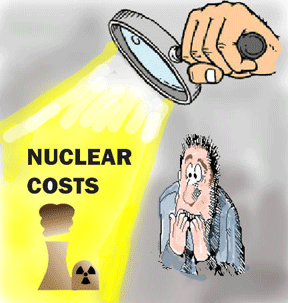 French reactor problems cast doubt on UK nuclear power plant, Ft.com Jim Pickard, Chief Political Correspondent, 14 June 15 Problems with a reactor in northern France have triggered deep concern in the British government about the future of the UK’s first new nuclear power station for 20 years at Hinkley Point in Somerset.
EDF Energy, the French state-owned company behind Hinkley, has suffered a five-year delay and escalating costs at its flagship Flamanville project in Normandy.
The £7bn French scheme — designed to showcase new atomic technology — is based on an “EPR” European pressurised reactor, the same model that will be used in Hinkley. Further concerns mounted last week when a leaked report from France’s nuclear safety watchdog highlighted faults in Flamanville’s cooling system. That followed a warning in April by the French Nuclear Safety Regulator that there was an excessive amount of carbon in the steel of the reactor vessel.
EDF’s struggles in France have prompted worries at a senior level of the Treasury about the £24bn Hinkley scheme.“I think there are serious questions about the technology,” said one Treasury figure.
The Treasury has struck an agreement promising to pay a guaranteed price for energy generated by Hinkley for 35 years.It has also promised to guarantee £16bn of debt towards the project — but it has inserted conditions to ensure that taxpayers are not left on the hook if the technology fails.
Instead the agreement stipulates that it will be shareholders and not the government that retains the “principal exposure to the viability of the EPR technology” — until EDF can prove the success of its other projects such as Flamanville………
there are growing suspicions in Westminster and within the industry that the Treasury has been dragging its heels over supporting the project. One source close to EDF said he believed there had been “briefings from people at the Treasury” against the deal.
Some civil servants believe the government struck an overgenerous “strike price” to buy energy from Hinkley’s two reactors for 35 years. “I think Treasury officials would not be disappointed if Hinkley never happened,” said one Whitehall source. “They have been foot-dragging for at least a year.”
One Tory figure said: “I think the Treasury don’t really want that deal to work.”……….http://www.ft.com/intl/cms/s/0/b8741dd0-1048-11e5-bd70-00144feabdc0.html#axzz3d4bv74Km
Public can comment on designated “potential conditions.” for Ontario nuclear waste dump
Canada opens comment period on nuclear dump proposed for Lake Huron http://www.voicenews.com/articles/2015/06/14/news/doc557af82e523ff381884332.txt , June 14, 2015 By Jim Bloch
As a result, the agency has extended the timeline for a final decision by Minister of the Environment Leona Aglukkaq on the Environmental Assessment of the dump by 90 days. The deadline is now Dec. 2.
“It is interesting that the Minister of the Environment’s decision on the nuclear waste dump is being postponed from Sept. 3 until December, which falls after the federal election in October,” said Beverly Fernandez, founder of the Canadian organization Stop the Great Lakes Nuclear Dump.
Critics of nuclear power were aghast at the Joint Panel’s decision in May to endorse the dump.
Western Michigan native Kevin Kamps works as a nuclear waste specialist for the Maryland-based Beyond Nuclear, an anti-nuclear group that supports renewable energy and nuclear disarmament. Kamps condemned the Joint Panel’s decision to endorse the dump, calling OPG’s proposal “insane” and labeling it “a declaration of war against the Great Lakes.”
Kamps is expected to speak about ways to stop the dump at 7 p.m. June 16 at the Donald Dodge Auditorium at the St. Clair County Administration Building, located at 200 Grand River Ave. in Port Huron.
Rs 1,500 crore insurance pool for nuclear liability, India
India launches Rs 1,500 crore insurance pool for nuclear liability, 14 June 2015 New Delhi | Agency: dna The government has finally launched an insurance pool of Rs. 1,500 crore, a mandatory requirement under the Civil Liability for Nuclear Damage Act by filling in the gap of Rs 500 crore through the British Nuclear Insurance Pool.
Several held up projects such as the long-pending Gorakhpur Haryana Anu Vidyut Pariyojna (GHAVP) are now expected to move forward after setting up of the insurance pool.
Clauses in the CLND Act, which give the operator the Right to Recourse and allow it to sue the suppliers in case of any accident, were seen as being a major hindrance to the growth of the nuclear industry. These concerns led to the formation of the Indian nuclear insurance pool……..
India’s stated requirement that no inspector will be allowed to inspect our plants will be fully met, said union minister of state (Independent Charge) Atomic Energy and Space, Dr Jitendra Singh.
He assured that the government is not contemplating any alterations in the Nuclear Liability Act (passed in 2010 during UPA-II tenure) in any manner………..http://www.dnaindia.com/india/report-india-launches-rs-1500-crore-insurance-pool-for-nuclear-liability-2095312
AREVA and EDF need to clean up their organisational mess ASAP – says France’s nuclear watchdog

 French nuclear watchdog urges quick resolution of Areva rescue plan, Reuters, PARIS | BY MICHEL ROSE AND BENJAMIN MALLET 12 June 15 Areva’s (AREVA.PA) financial situation is worrying, the head of France’s ASN nuclear watchdog said on Thursday, urging the loss-making nuclear company and utility EDF (EDF.PA) to wrap up a rescue plan for Areva as soon as possible.
The French government last week approved EDF’s plan to take a majority stake in Areva’s nuclear reactor business and gave the two state-owned companies a month to do a deal.
“Areva’s current financial situation, it could get better, (it) can be considered as preoccupying in terms of safety,” ASN Director Pierre-Franck Chevet told Reuters in an interview.
“That’s why we have formally asked to hear them … to ask what kind of organisation they are putting in place to fulfils the commitments they have made in terms of safety for the incoming period,” he added, noting a meeting was scheduled by the end of June.
An EDF spokeswoman declined to comment, while an Areva spokeswoman pointed to comments made by Areva Chairman Philippe Varin on Wednesday, that safety remained an absolute priority.
ASN, an independent regulatory authority, last year imposed on Areva a requirement to recondition radioactive waste stored at its La Hague facility in northern France, which could cost several billion euros and which must be provisioned for, Chevet said.
However the watchdog has no power on the merger per se and its only remit is safety. It can shut down a nuclear plant if it sees a safety issue or fine companies for any transgressions……..http://uk.reuters.com/article/2015/06/11/uk-france-nuclear-asn-idUKKBN0OR2EU20150611
Trans Pacific Partnership would give corporations, including nuclear ones, power over government laws
Under the existing deals with this parallel legal system for foreign corporations, a Swedish company has sued Germany because the German government decided to phase out nuclear power after the Fukushima disaster,
 Rep. John Conyers:Why the TPP Is a Terrible Deal for Most Americans, Conyers in the House, 12 June 15 Trade agreements boost economic growth, while destroying lives and livelihoods. By John Conyers, Jr. “…………. Economic growth—our raw output of goods and services—is a questionable measure of our success or well-being as a nation. Growth, in some cases, runs counter to priorities that matter deeply to our people. As a short-term measure of national production, GDP often tends to increase as rates of crime, pollution, and household debt rise. Both Hurricane Sandy and the BP Deepwater Horizon disaster arguably boosted economic growth because of the activity associated with cleanup and rebuilding.
Government advisory panel recommends shutdown of South Korea’s oldest nuclear reactor
Korea panel backs closure of oldest nuclear reactor
* Application deadline to extend lifespan is June 18, 2015
* KHNP says no decision has yet been made
* Panel hopes closure to build decommissioning technology (Adds more quote and details)
By Meeyoung Cho SEOUL, June 12 (Reuters) – South Korea is expected to shut down its oldest nuclear reactor, the Kori No. 1 unit on the country’s southeastern tip, after a government-led energy advisory panel recommended it be permanently closed.The panel’s decision meant operator Korea Hydro & Nuclear Power Co Ltd (KHNP) was unlikely to seek a second extension for the nearly 40-year-old plant, whose operating permit expires in June 2017, government and industry sources said…….http://www.reuters.com/article/2015/06/12/nuclear-southkorea-idUSL3N0YY21O20150612
Desperate for public support, UK govt plans to make nuclear reactors look pretty!
‘Beautiful’ nuclear power stations can win over sceptics, says Energy Secretary Amber Rudd The Independent 7 June 15 Britain’s new nuclear power stations and other energy infrastructure projects must be designed to look beautiful to garner essential public support, the Energy Secretary, Amber Rudd, has said…..flood defences will need to be built to protect buildings, along with weather-resistant transport, waste and water services, as climate change makes weather conditions increasingly extreme.

Ann Robinson, of the uSwitch price comparison website, welcomed Ms Rudd’s call to visual arms. “I think she’s absolutely right. We’re a small island and it’s important to do things in a sensitive way. Public acceptability is important and the key to that is making the infrastructure as attractive as possible.”
Ms Robinson added: “A lot of these projects can be controversial and Amber Rudd is proposing to give people more say in local developments. Against this backdrop, it’s increasingly important that projects fit in with their surroundings.”……..http://www.independent.co.uk/news/uk/politics/beautiful-nuclear-power-stations-can-win-over-sceptics-says-energy-secretary-amber-rudd-10301365.html
in Fukushima Prefecture, Japan’s govt to nationalise private site for nuclear waste dump
 Ministry to nationalize Fukushima site to bury radioactive waste, Asahia Shimbun June 06, 2015 By YU KOTSUBO/ Staff Writer FUKUSHIMA--The Environment Ministry said it will nationalize a privately owned site in Fukushima Prefecture to dispose of radioactive waste generated by the 2011 nuclear disaster there.
The decision effectively makes the government responsible for safety of the site.
Environment Minister Yoshio Mochizuki met with Fukushima Governor Masao Uchibori, Tomioka Mayor Koichi Miyamoto and Naraha Mayor Yukiei Matsumoto on June 5, and told them that the government will purchase a site in Tomioka to bury the radioactive waste. A transportation route to the site runs through Naraha.
The material to be buried includes “designated waste,” whose concentration of radioactive materials exceeds 8,000 becquerels per kilogram.
“We made the decision to secure the safety of the project,” Mochizuki said during the meeting held at a Fukushima prefectural government office.
Mochizuki sweetened the deal by pledging to take measures to promote the local economy, including a provision of grants that can be used freely by local governments. The nationalization and the economic promotion measures had been requested by the local governments………
The government is also facing difficulties in determining disposal sites in other prefectures because of strong opposition from local residents……http://ajw.asahi.com/article/0311disaster/fukushima/AJ201506060036
Meltdown in France’s nuclear dream – taxpayers to cop the costs
External factors may have precipitated the crash of Areva, but the cause is internal. Areva and the French nuclear industry is controlled by engineers and state officials and the market comes as an afterthought.
The problems of time and cost overruns in China, Finland and now in France at Flamanville are self-made and part of the “esprit de corps” arrogant attitude of the organisation.
Now, 13 years later, the problem needs to be addressed and risks costing billion of euros and thousands of jobs
 France’s Nuclear Industry Dream Faces Melt-Down At Expense Of State Coffers, Tax Payers Forbes, Marcel Michelson, 3 June 15 France has decided to rescue its Areva nuclear energy company once again, this time by combining the nuclear power station creation business with state-controlled power operator EDF , its biggest client.
Only a few years back, in 2010, Areva’s finances had been restored by the forced sale of its transport and transmission activities to industrial group Alstom and electrical engineer Schneider . Meanwhile, GE of the United States controls the Alstom power activities as part of its own rescue recapitalisation.
The rest of Areva includes uranium mines, nuclear waste recycling, transport, storage and some alternative energy activities.
For all intents and purposes, Areva is dead. Continue reading
1 This Month
23-25 October – on Zoom – World BEYOND War’s annual global conferenc


Shut down the radiation-damaged Heysham nuclear reactors now
To see nuclear-related stories in greater depth and intensity – go to https://nuclearinformation.wordpress.com

Say No to NASA’s Reckless Nuclear Reactor on the Moon
Say No to NASA’s Reckless Nuclear Reactor on the Moon
-
Archives
- October 2026 (160)
- September 2026 (339)
- August 2026 (330)
- July 2026 (355)
- June 2026 (287)
- May 2026 (306)
- April 2026 (356)
- March 2026 (251)
- February 2026 (267)
- January 2026 (308)
- December 2025 (358)
- November 2025 (359)
-
Categories
- 1
- 1 NUCLEAR ISSUES
- business and costs
- climate change
- culture and arts
- ENERGY
- environment
- health
- history
- indigenous issues
- Legal
- marketing of nuclear
- media
- opposition to nuclear
- PERSONAL STORIES
- politics
- politics international
- Religion and ethics
- safety
- secrets,lies and civil liberties
- spinbuster
- technology
- Uranium
- wastes
- weapons and war
- Women
- 2 WORLD
- ACTION
- AFRICA
- Atrocities
- AUSTRALIA
- Christina's notes
- Christina's themes
- culture and arts
- Events
- Fuk 2022
- Fuk 2023
- Fukushima 2017
- Fukushima 2018
- fukushima 2019
- Fukushima 2020
- Fukushima 2021
- general
- global warming
- Humour (God we need it)
- Nuclear
- RARE EARTHS
- Reference
- resources – print
- Resources -audiovicual
- Weekly Newsletter
- World
- World Nuclear
- YouTube
-
RSS
Entries RSS
Comments RSS

