The financial folly of South Africa’s nuclear power plan
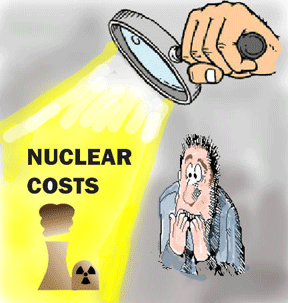
 Why South Africa should not build eight new nuclear power stations, Mail &Guardian, 05 NOV 2015 HARTMUT WINKLER South Africa has plans to build new power stations despite many calling for no nuclear energy in the country. t has been an eventful year in South Africa, characterised by power cuts, parliamentary confrontations about wasteful expenditure and student fee protests. There has, however, been a massive elephant in the room that has impacted all these issues but enjoyed surprisingly scarce attention. The idea, vigorously driven by government, is for the country to build nuclear plants with an expected price tag of one trillion rand.
This equates to 4 000 times the controversial costs to upgrade President Jacob Zuma’s Nkandla residence and 400 times the shortfall the tertiary education sector will experience in 2016 because of the freeze in university fee increases………
In South Africa too the need for the continued inclusion of nuclear power in the energy mix was being reexamined. Continue reading
Drastic risks to UK’s security, jobs, in the Hinkley Point C boondoggle
It is clear that this unprecedented handover of power and money to Chinese hands will prompt a justified reaction from those thousands of UK steel workers whose jobs are about to disappear due in part to the global dumping of steel by China.
Will the remnants of the steel industry and its workers see a fraction of the £76 billion to be spent by the Chancellor on his nuclear boondoggle? Not likely.
The nuclear option can and has been criticised in so many ways that the UK Government should think long and hard before proceeding with what many UK citizens will rightly consider an unpatriotic and unethical waste of money. It may even constitute a real and potent danger to our current lifestyle in Britain.
The Hinkley Point C boondoggle: a dangerous waste of money http://reneweconomy.com.au/2015/the-hinkley-point-c-boondoggle-a-dangerous-waste-of-money-57108 By Alex Russell and Peter Strachan on 2 November 2015 The UK Government’s pursuit of a new nuclear plant at Hinkley Point C represents not just a colossal waste of money, but could also be real danger to the UK’s national security, write Professors Alex Russell and Peter Strachan of Robert Gordon University. “Let us hope that the Prime Minister and Chancellor’s actions do not lead to the radicalisation of unemployed steel workers who are now being joined by unemployed renewable industry personnel.”
The Conservative government, arguably, has completely lost the plot in continuing to pursue its so called energy policy that depends so heavily on building a new fleet of nuclear power stations to keep the lights on in Britain. The government want to have 16 GW of new nuclear power stations built in the UK all using EDF’s troubled Generation-III design, of which Hinkley Point C (3.2 GW) is only the first installment.

With this project is George Osborne seeking an entry in the Guinness Book of Records as the first Chancellor of the Exchequer to commission the world’s most expensive nuclear power station? The Chancellor says the project represents good value for money. But the facts suggest otherwise. Further, and with the recent signing of a new nuclear accord as part of the State Visit of the President of China, not enough attention appears to have been given to national security issues.
Economic madness All in all, Hinkley Point C will cost an estimated £76 billion, for up to 3.2 GW of new generation capacity. Building costs are now estimated by EDF, the owner, at £24.5 billion. As a sobering thought, even offshore wind looks cheap when compared to the full commercial costs of this project.
This apparent blank cheque for new nuclear build is all the more surprising coming at a time when the Treasury has slashed support for onshore wind and solar power and other low carbon projects. Continue reading
USA’s budgetary tug of war between nuclear weapons and radioactive trash clean-up
The clean-up work, which includes a mixture of radioactive and chemical wastes, “is the largest environmental remediation ever undertaken by mankind and the most technically challenging”
One reason for the Energy Department’s struggles is a budgetary tug of war within the agency. One part of the department maintains the US’s atomic arsenal, and another is in charge of cleaning up the contamination from nuclear work. Funds for both come from the same pot, and in a shift from the 1990s, an increasing portion is going towards ensuring the readiness of the weapons arsenal

 Toxic remnants of US nuclear program http://www.theaustralian.com.au/business/wall-street-journal/toxic-remnants-of-us-nuclear-program/story-fnay3ubk-1227591352430m JOHN R. EMSHWILLER, GARY FIELDS THE WALL STREET JOURNAL NOVEMBER 03, 2015
About 70km southeast of San Francisco, in an 320ha mini-city built to create atomic bombs, there’s a contaminated building slated for eventual demolition.
Mark Costella, a facilities manager at the Energy Department’s Lawrence Livermore National Laboratory, would prefer to tear down the structure, but doesn’t have the tens of millions of dollars needed.
Instead, he is spending $US500,000 ($700,000) to fix the roof.
These are the kinds of contradictions at the heart of the complicated, expensive and struggling effort to clean up the US’s 70-year-old nuclear weapons program.
The Energy Department’s clean-up operation is wrestling with reduced budgets, tens of billions of dollars in ballooning cost estimates and 2700 structures on its to-do list. Officials said more than 350 additional unneeded facilities controlled by other programs in the Energy Department are probably eligible for transfer to the clean-up operation. But that office said its funds were limited and it was not accepting any more projects, no matter their significance.
That means some of the nation’s toughest threats are now on the backburner, possibly for decades, while relatively low-priority work moves forward.
Dirty and decaying structures where weapons work and other nuclear activities were carried out — some the size of several football fields and old enough to qualify for Social Security — are clustered in federal sites from South Carolina to California. Some are within easy walking distance of people’s homes. Continue reading
What’s happening? USA’s weapons program and nuclear waste clean-up funds come from the same kitty!
 Q&A: What’s Next for America’s Nuclear-Waste Clean-Up, http://blogs.wsj.com/washwire/2015/11/02/qa-whats-next-for-americas-nuclear-waste-clean-up/ WSJ, By GARY FIELDS and JOHN R. EMSHWILLER
The Senate and House are expected as early as this week to take up the defense authorization bill President Barack Obama vetoed last month and try to push a version of it through again. Buried in the bill is a proposal that could dramatically re-order nuclear-weapons clean-up activities, a decades-long effort that is costing taxpayers hundreds of billions of dollars
The proposal is five paragraphs, barely noticeable in the 1,000-plus-page document. But, if implemented, its effects could be felt in communities around the country. Here’s a Q&A:
What is the problem?
Creating America’s nuclear arsenal left thousands of structures around the U.S. tainted with radioactive and chemical contamination. Over the past quarter century, the Energy Department clean-up office has disposed of about 2,800 of them with a like number still to do. However, for various reasons some of the dirtiest and most dangerous buildings aren’t yet on that clean-up list and might not be added for decades.
How many structures are in this sort of limbo?
An Energy Department inspector general’s report this year put the number at over 350. Among them is Alpha 5 in Tennessee. Larger than ten football fields, it produced uranium for the Hiroshima bomb but is now a decaying structure of radioactive and chemical contamination where “the speed of degradation is far outpacing” maintenance funding, said an Energy Department report.
Why aren’t these places getting addressed?
The issue, as with many things, is money. The Energy Department’s money for the weapons program and the clean-up effort come from the same the same kitty. A quarter century ago, with the end of the Cold War, more money for the first time started flowing into clean-up than weapons. In recent years that situation has reversed. Plus, much of the money available to the clean-up operation is committed at various sites and there isn’t enough money to take to address some of these other buildings–even if they are more in need of attention than some of the structures being dealt with.
What are Congress and the administration doing?
The energy secretary has appointed a working group to review clean-up priorities. The provision in the vetoed defense bill would require buildings such as Alpha 5 to be added to the clean-up operation within three years—a timetable the Obama administration says isn’t possible.
Strong vote by Scottish Labour against renewal of trident nuclear missile system
 Scottish Labour votes against renewal of Trident nuclear weapon system, Ft.com
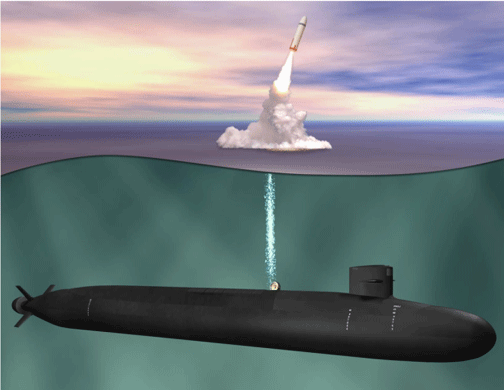
 Mure Dickie in Perth, 1 Nov 15 Scottish Labour has voted emphatically against renewing the Trident nuclear weapon system, offering a major boost to supporters of unilateral disarmament in the UK party, including its leader, Jeremy Corbyn. Party members and union delegates to a conference in Perth both voted by 70 per cent to 30 to abandon plans to maintain a “massively expensive” and “militarily useless” submarine-launched ballistic nuclear missile system.
Ian Murray, Labour’s only MP in Scotland and a member of the UK shadow cabinet, said the more than two-thirds majority meant disarmament was now formal policy for the Scottish party. That would mean it must be considered by UK Labour policy planners and could be included as part of Labour’s platform for the Scottish parliamentary elections next May. “It should be in the manifesto,” Mr Murray said.
The vote highlights uncertainty about Labour’s policy on Trident since Mr Corbyn’s election and will be portrayed by the Scottish National party as evidence of deep divisions between him and the UK party’s mainstream.
But many Scottish Labour members praised the decision of Kezia Dugdale, the Scottish party’s new leader and an opponent of unilateral disarmament, to allow delegates to choose to debate and vote on Trident and other issues.
The vote came after a vigorous and often passionate debate in which opponents of Trident renewal stressed what many called the fundamental immorality of nuclear weapons while supporters focused on the threat that scrapping them would pose to thousands of well-paid jobs.
Union representatives were divided on whether to back Trident renewal, with many fearing that promised defence industry diversification would not deliver equivalent employment for highly skilled workers…….. delegate Stephen Low said scrapping nuclear weapons would free money to be spent in more economically productive ways.
“I’d rather have pie in the sky on my horizon than a mushroom cloud,” Mr Low said. “You get a lot of bang for your buck with Trident . . . but you don’t get that many jobs.”
Defence policy is decided by the UK party, but Bill Butler, a candidate for the party in next May’s Scottish parliamentary election, said it could help build momentum for nuclear disarmament……..http://www.ft.com/intl/cms/s/0/fb106dec-809b-11e5-84dc-31c8b3b18e5f.html#axzz3qGtjP1GJ
British MPs slam £25billion nuclear power station plan
 MPs attack ‘desperate’ £25bn Hinkley nuclear power station plan http://www.thisismoney.co.uk/money/news/article-3298926/MPs-attack-desperate-25bn-Hinkley-nuclear-power-station-plan.html By NEIL CRAVEN, FINANCIAL MAIL ON SUNDAY, 1 November 2015 A group of MPs have slammed a plan to build a £25billion nuclear power station, as opposition to the Government’s nuclear energy policy gathers steam.
An Early Day Motion that calls the plan to build at Hinkley Point, in Somerset, as ‘an act of desperation’ has been signed by 16 MPs in just 10 days.
Paul Flynn, MP for Newport West, which lies across the Bristol Channel from the planned site, has tabled the motion.
It says that similar reactors in France and Finland have suffered ‘catastrophic delays and financial losses’.
Experts also say the plan could cost billions more than expected and produce electricity that is far more expensive than market rates.
French energy firm EDF and China Nuclear Power Corporation agreed last month to build the plant. But criticism has come from all sides.
Chancellor George Osborne’s father-in-law Lord Howell of Guildford described the scheme as ‘one of the worst deals ever’ for British consumers and industry.
Urgent need for transparency on South Africa’s Integrated Energy Plan (IEP)
IEP 2015 must be tabled urgently: DA http://www.iol.co.za/news/politics/iep-2015-must-be-tabled-urgently-da-1.1938828#.Vjab-dIrLGg November 1 2015 By ANA Reporter Cape Town – The Democratic Alliance on Sunday urged Energy Minister Tina Joemat-Petterson to urgently table the integrated energy plan (IEP) 2015 so that it can be scrutinised in Parliament.
The IEP 2015 presently before Cabinet indicated that government planned not one but up to three R1 trillion nuclear deals by 2050, all the while acknowledging that procurement of nuclear could in fact be delayed until at least 2020, if not later, DA spokesman Gordon Mackay said in a statement.
“The DA therefore calls on Energy Minister Joemat-Petterson to table this IEP as a matter of urgency and allow Parliament to scrutinise this document and address the key issues within this plan.”
According to reports in the Sunday Times on Sunday morning, the proposed IEP nuclear-generating capacity would be expanded to between 12 and 20 times South Africa’s current installed nuclear capacity of 1830 MW, he said.
This effectively meant the energy department envisioned a series of large-scale nuclear deals over the next 20 years, despite ongoing and significant concerns on affordability by National Treasury and uncertainty as to the impact on the cost of electricity for ordinary South Africans, particularly the poor.
The purpose of the IEP was to provide a roadmap of the future energy landscape for South Africa to guide future energy infrastructure investments and policy development by providing a thorough analysis of competing technologies for the provision of sustainable and cost-effective electricity.
“Far from being a thorough assessment of competing technologies however, the IEP is nothing more than a slavish confirmation of the inevitability of the nuclear new build program and is the product of political interference by the ANC government into the terrain of energy planning,” Mackay said.
The IEP therefore failed to provide an assessment of a potential energy mix which excluded nuclear, despite the international energy landscape where major nuclear nations, such as Germany, France, and the US, were all reducing their reliance on nuclear in favour of cleaner and cheaper renewables and gas.
Further, the IEP argued for an energy mix biased towards a combination of large scale nuclear and large scale decentralised renewables, despite general international consensus that the two technologies were largely incompatible due to the variable nature of renewables electricity generation. “Furthermore, the scope for gas in the IEP has deliberately been limited in order to produce a ‘nuclear heavy’ energy roadmap. The IEP is way too conservative on the scope of gas within in the energy mix. Internationally, a number of gas producers are coming online and numerous new gas finds are being made across Africa. This will result in an increased availability of natural gas and the subsequent decrease in the price of natural gas,” he said.
Government should have used the IEP to aggressively pursue gas as an alternative energy form, which was far safer, cleaner, cheaper, and more job friendly compared to the use of the potentially politically motivated and unaffordable nuclear build programme.
“The DA remains fundamentally opposed to costly, secretive nuclear deals which have the real potential to destroy any prospects of future economic growth and job creation, and as such will not support government’s latest and unimpressive solution to the energy crisis in the form of the integrated energy plan,” Mackay said.
South Africa’s flawed and problematic Nuclear Environmental Impact Assessment (EIA)
 New nuke build: EIA problematic and flawed http://gctca.org.za/new-nuke-build-eia-problematic-and-flawed/BY GAVIN, ON OCTOBER 28TH, 2015 As South Africa contemplates building nuclear power stations along the coast, the Environmental Impact Assessment (EIA) consultants, GIBB, are holding public meetings to discuss their recently released draft report. The proposed nuclear builds are in Thyspunt (80 km outside Port Elizabeth) and Duynefontein (next to Koeberg, 30 km outside Cape Town).
“Thyspunt is the preferred site for Nuclear 1,” says Gary Koekemoer from NoPEnuke, “and no public meetings were scheduled for the Nelson Mandela Bay area thereby excluding 1.1-million citizens from this process. Further, it is our view that the current EIA process is fundamentally flawed with key information excluded.”
This EIA is the third draft published over eight years and was made available for scrutiny by GIBB consultants at the end of September. “The draft is a 40,000 page document and a quick count of words in the appendices making up the specialists’ reports alone showed that one would have to read around 90,000 words a day just to skim read it all before the public meetings were held,” says Peter Becker from the Koeberg Alert Alliance.
Widespread dissatisfaction has been expressed from many stakeholders around the limited time period allowed for public participation.
At the meetings, GIBB condensed their findings into a simplified scoring system for risks with ratings of Low, Moderate, High, or Fatally Flawed. “The scoring system is inadequate,” says Dr. Piet Human, project leader at the Bantamsklip Organisation. “The scores do not have a scientific or quantitative basis; what is ‘high’ for one may be ‘medium’ for another scientist. This subjectivity is then further compounded by the scores given by GIBBS.”
Becker describes a hypothetical scenario: “If the consultants found that there was a 51% chance that the new nuclear plant would explode catastrophically in the first year of operation, this would not result in a scoring of Fatally Flawed. Their recommendation in this case would be ‘Project can be authorised but with strict conditions and high levels of compliance and enforcement’.”
Bantamsklip was one of the three proposed nuclear sites alongside Thyspunt and Duynefontein but has now been excluded from this Nuclear 1 EIA. However, it remains a viable site for subsequent nuclear builds. A petition of over 10,000 signatures opposing the nuclear build was handed to the GIBB consultants at the Gansbaai meeting.
“We have only had time to look at one specialist report thus far,” continues Dr. Human, “and we reviewed the Social Impact Assessment which is problematic. The technical, scientific and professional credibility of the report is questionable as it uses outdated data, excludes HIV and Gender Related Issues (a new requirement for all large-scale EIA’s in South Africa), and does no comparative analysis of the three sites nor uses recent experiences with large projects such as Medupi.”
The biggest concerns of those in attendance at the meetings included the risk of a catastrophic nuclear accident and the evacuation plan, the environmental impact of radiation leaks into the sea, land or groundwater, the economic impact to the regions concerned owing to the negative perceptions of a nuclear facility in proximity to large-scale business concerns, costs (and the accompanying corruption), political instability and the risk of terrorism, and the massive problem of accumulating high level nuclear waste.
“The decision to build a nuclear plant must be taken with extreme care,” says Koekemoer. “We are concerned that in the gold rush of unsubstantiated promises of development and jobs we have been blinded to Thyspunt’s true value and potential as a significant local and global heritage area.
“Nuclear is not necessary,” he continues. “Renewables are making a significant contribution to our region. In our haste we are only servicing vested interests and it is a decision our grandchildren would shake their heads at.”
Becker concludes, “The GIBB consultants have a legal responsibility to put all the pertinent facts before the decision makers in a complete, unbiased and quantified way in the EIA report. Failing to do so can lead to criminal prosecution in their personal capacities.” There is concern from stakeholders that GIBB is trying to push through this flawed EIA with only token public participation.
The Sea Vista meeting for public participation in St Francis Bay will take place in early November, dates are not yet finalised. The Humansdorp meeting has been rescheduled due to public demand for more time needed and meetings in Nelson Mandela Bay have also been requested but are unconfirmed at this stage.
Submissions may be emailed to nuclear1@gibb.co.za. The full draft EIA report can be found at http://projects.gibb.co.za/en-us/projects/eskomnuclear1reviseddrafteirversion2 and more information can be found at http://koebergalert.org, http://bantamsklip.org andhttp://noPEnuke.co.za.
The Nuclear Free Local Authorities (NFLA) – Hinkley Point C nuclear agreement wrong, and not finalised
 21st October 2015 NFLA notes only a participation agreement between China, UK and EDF is being agreed today for Hinkley Point C. Many hurdles still remain. NFLA calls instead for investment in renewables and decentralised energy. The Nuclear Free Local Authorities (NFLA) notes with dismay the announcement to sign an initial participation agreement between the Chinese and UK Governments and EDF over the proposed construction of a new nuclear power station at Hinkley Point, and future plans for new nuclear reactors at Sizewell and Bradwell.
 0161 234 3244 or 07771 930196.
2016 GOP presidential field is a hotbed of science denial
Watch 2 GOP Presidential Candidates Call Out Their Party for Denying Science http://www.motherjones.com/environment/2015/10/graham-pataki-climate-change-cnbc-debate Real talk on climate change and vaccines. —By Jeremy Schulman | Wed Oct. 28, 2015 The —especially when it comes to the most high-profile candidates. Jeb Bush once called himself a global warming “skeptic.” According to one prominent climate scientist, Texas Sen. Ted Cruz’s declaration that the planet has stopped warming is “a load of claptrap…absolute bunk.” And then there’s Donald Trump, who has called climate change a “hoax” and also used last month’s GOP debate to falsely suggest that vaccines cause autism.
Still, Graham took a thinly veiled shot at President Barack Obama’s climate policies. “I just want a solution that would be good for the economy, that doesn’t destroy it,” he said. (Watch his statements above.)
Trident nuclear deterrent – Scottish Labor to vote on this
Scottish Labour to vote on abolishing Trident nuclear deterrent, Guardian, Severin Carrell, 31 Oct 15
Delegates back potentially divisive debate at conference on Sunday, as Jeremy Corbyn attacks SNP record The Scottish Labour party is to vote on abolishing Britain’s nuclear deterrent after delegates voted heavily in favour of a debate on the Trident missile system.
The decision to debate cancelling Trident’s replacement at Scottish Labour’s annual conference this weekend came as activists applauded calls from Jeremy Corbyn for the party to embrace “the sunshine of socialism”.
On Friday, delegates overwhelmingly backed calls from constituency parties to hold a potentially divisive vote on Trident’s renewal on Sunday: the party’s leadership is split on the issue, with unions and MSPs at loggerheads.
In his first speech to Scottish Labour as leader of the UK party, Corbyn attacked the Scottish National party’s track record in government in the runup to next May’s Holyrood elections, insisting only Labour had a vision for a more equalScotland……..
The Scottish Labour debate on Trident will present party leaders with a significant political challenge whichever way it goes, so they are putting heavy emphasis on the merits of the party reaching an open, democratic decision…….
While delegates to Labour’s UK conference saw Trident as a less important issue, and failed to debate it, scrapping Trident has risen much further up the political agenda on the Scottish left.
Voting to scrap Trident would appeal to many Scottish leftwing voters, helping Labour take on the SNP in the Holyrood elections,……
The wording of the Trident motion will not be finalised until Saturday and it remains unclear whether delegates to the Perth conference will vote to abolish it, but party leaders are bracing themselves for a heavy vote against Trident’s renewal……http://www.theguardian.com/politics/2015/oct/30/scottish-labour-conference-votes-debate-trident-nuclear-deterrent-renewal
USA environmental groups demand changes to Trans Pacific Partnership
They demanded that the enforcement mechanisms be strong and meaningful and that the rights of foreign investors to challenge domestic environmental laws be struck out.
Several green groups outline demands for Pacific trade pact, The Hill,
By Timothy Cama and Vicki Needham – 10/29/15 More than a dozen environmental and conservation groups on Thursday laid out eight pages of demands that they say lawmakers must use to judge the strength of the Trans-Pacific Partnership (TPP) trade agreement.
The groups, led by the Sierra Club, are sending a letter to members of Congress well in advance of an expected vote on the sweeping Asia-Pacific deal that was completed nearly a month ago with 11 other nations, according to the document first obtained by The Hill. The groups are urging a “no” vote on the 12-nation deal if the TPP doesn’t address their concerns.

The letter is a last-ditch effort from environmentalists, who feel that significant parts of what they demanded in TPP were not incorporated into the deal, despite the Obama administration’s efforts to highlight protections for wildlife and conservation.
The White House has said it would release the TPP text within 30 days of TPP’s conclusion, a deadline that is fast approaching.
But a vote on the TPP isn’t expected until at least early next year. Once the text is released there will be a 60-day period before President Obama can sign the deal, which covers 40 percent of global growth. …..
The greens’ demands are meant to allay their concerns about the agreement, chiefly that it would give foreign corporations too much power to challenge U.S. environmental protections and that international trade of fossil fuels would be greatly increased.
Negotiators included a chapter in the agreement to protect the environment, but as the detailed text of the pact has not been released publicly and only outlines have, greens said they cannot fully judge if their concerns have been met.
“The environment chapter should be judged by whether its provisions are strong enough to have a meaningful impact on the ground in TPP countries and whether the obligations will be enforced,” the groups wrote in their Thursday letter.
“We are also concerned that any potential benefits of the environment chapter will be overwhelmed by the negative impacts of other provisions in the pact,” they said, referring to their concerns about the agreement’s provisions on foreign investment, plant and animal food safety and coherence to regulations, among other pieces.
Green groups’ initial reaction to the agreement has been very negative, aligning with how environmentalists generally view free-trade agreements.
“The Trans-Pacific Partnership would empower big polluters to challenge climate and environmental safeguards in private trade courts and would expand trade in dangerous fossil fuels that would increase fracking and imperil our climate,” Sierra Club Executive Director Michael Brune said in a statement when the initial details were released in October.
“The TPP’s environment chapter might look nice on the surface but will be hollow on the inside, and history gives us no reason to believe that TPP rules on conservation challenges such as the illegal timber or wildlife trade will ever be enforced,” he said…..
They demanded that the enforcement mechanisms be strong and meaningful and that the rights of foreign investors to challenge domestic environmental laws be struck out.
Additionally, the groups want the agreement to avoid invalidating current United States rules on subjects like restricting exports of fossil fuels, product labeling or environmental protections. http://thehill.com/policy/finance/258539-greens-outline-demands-for-pacific-trade-pact
South Africa’s govt questioned on costs of nuclear power programme
Nuclear build programme under fire http://www.iol.co.za/business/news/nuclear-build-programme-under-fire-1.1936163#.Vi_xstIrLGg October 27 2015 By Siyabonga Mkhwanazi Johannesburg – Energy Minister Tina Joemat-Pettersson faces another round of tough questions in Parliament today on the nuclear build programme.
Joemat-Pettersson has hardly escaped questions on the nuclear build programme in Parliament since it was announced by President Jacob Zuma three years ago.
She will be part of the economics cluster of ministers responding to questions on a range of issues, including nuclear, in the National Council of Provinces in the next two days.
Tomorrow Economic Development Minister Ebrahim Patel will also answer questions on South Africa’s controversial nuclear programme.
The opposition parties have been asking Joemat-Pettersson to come clean on the project.
One of the key questions has been on the funding for nuclear power when the government has not given an indication where the money will come from.
In his medium-term budget policy statement last week, Finance Minister Nhlanhla Nene was non-committal on the funding for nuclear energy.
However, he told journalists ahead of the statement that preparatory work had started, but did not indicate the detailed work that had been undertaken.
He said R200 million had been committed to the preparatory work.
A few weeks ago the Department of Energy said the procurement process had been postponed to the end of this financial year. This was due to outstanding work, including the funding model for nuclear.
The shifting of the deadline for the procurement process came after Joemat-Pettersson said in her budget vote speech in May that procurement would start during the second half of this year.
She also said the winning company would be announced before the end of the year.
It has been said the nuclear build programme will cost between R500 billion and R1 trillion. But the government has been coy on costs, saying this would disrupt the bidding process.
It said it would wait for the bidders to reveal their prices first, in the bidding phase, before any figure could be made public.
The department also said despite the delay in the procurement process, it would stick to the deadline of 2030 to complete the construction of the nuclear reactors.
Joemat-Pettersson has also been accused of keeping the information on the nuclear build programme out of Parliament.
Opposition parties have warned that they could not afford to have such a massive programme kept under wraps.
Today it will be their turn to turn up the heat on Joemat-Pettersson on the programme.
The government has insisted that it will build nuclear power plants that will be within its means and easy to afford.
One of the key questions to Patel is on job creation, localisation and long-term benefits of the reactors to the country.
Japanese Prefecture Kyoto moves to replace nuclear with gas and renewables, in pact with Alaska
 Kyoto advances nuclear-free agenda with Alaska LNG pact, Japan Times, BY ERIC JOHNSTON KYOTO, 25 OCT 15, – The Kyoto Prefectural Government signed an agreement with Alaska last month to explore the possibility of importing liquid natural gas from the state to Maizuru, a port city on the Sea of Japan.
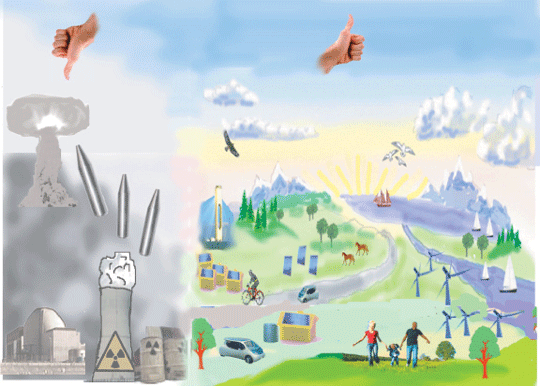
While daunting financial and bureaucratic challenges mean it will still be a while before Alaskan LNG flows to Kyoto, the agreement represents a step forward for Kyoto to achieve a larger goal: ending prefectural dependence on nuclear power by 2040.
The strategy, as outlined by Kyoto Gov. Keiji Yamada, calls for building up LNG facilities at Maizuru and installing new LNG pipelines in the Kansai region. The prefecture envisions Maizuru supplying not only Kyoto, but other prefectures in the region with gas to replace Fukui Prefecture’s nuclear power plants as a major source of electricity.
Kyoto is not alone in seeking to replace atomic power with a combination of LNG imports and renewable energy. As of the end of 2014, more than 600 local governments nationwide had declared their intent to be nuclear-free, although not all of have set specific dates like Kyoto, and many lack a strategic plan for achieving that goal.
Yamada listed several reasons why the prefecture needs to end its usage of nuclear power, which comes mostly from 11 Kansai Electric Power Co. reactors in neighboring Fukui……..
Kyoto and Hyogo, along with Osaka Gas, Kepco, and the Ministry of Economy, Trade and Industry, agreed in early September to formally research the cost of building an LNG pipeline from Maizuru to Sanda, Hyogo Prefecture, that could then supply other parts of Kansai and likely lead to other localities needing less nuclear power. http://www.japantimes.co.jp/news/2015/10/25/national/kyoto-advances-nuclear-free-agenda-alaska-lng-pact/#.Vi0_ztIrLGh
Uranium industry in Niger from AREVA to Chinese companies
 One uranium mine in Niger says a lot about China’s huge nuclear-power ambitions, Business Insider, 25 Oct 15, ARMIN ROSEN “………the ambitions of the nuclear powers in Niger are still playing out today as Niger’s remote and inhospitable northern desert environment contains the world’s fifth-largest recoverable uranium reserves, some 7% of the global total.
A fourth mine, in a place called Azelik, near the mostly ethnic Tuareg city of In’gall, is currently much smaller than the other three sites.
Like Imouraren, it’s currently shuttered as a partial result of the uranium price dip. But because of its ownership and a checkered recent history, it’s an instructive guide to the future of Niger’s uranium and the global nuclear energy industry at large.
Niger’s Azelik uranium mine, owned and operated by Chinese companies, is at the geographic and economic fringes of a continent-wide wave of Chinese investment, goods, and people. Continue reading
1 This Month
23-25 October – on Zoom – World BEYOND War’s annual global conferenc

To see nuclear-related stories in greater depth and intensity – go to https://nuclearinformation.wordpress.com

Say No to NASA’s Reckless Nuclear Reactor on the Moon
Say No to NASA’s Reckless Nuclear Reactor on the Moon
-
Archives
- October 2026 (160)
- September 2026 (339)
- August 2026 (330)
- July 2026 (355)
- June 2026 (287)
- May 2026 (306)
- April 2026 (356)
- March 2026 (251)
- February 2026 (267)
- January 2026 (308)
- December 2025 (358)
- November 2025 (359)
-
Categories
- 1
- 1 NUCLEAR ISSUES
- business and costs
- climate change
- culture and arts
- ENERGY
- environment
- health
- history
- indigenous issues
- Legal
- marketing of nuclear
- media
- opposition to nuclear
- PERSONAL STORIES
- politics
- politics international
- Religion and ethics
- safety
- secrets,lies and civil liberties
- spinbuster
- technology
- Uranium
- wastes
- weapons and war
- Women
- 2 WORLD
- ACTION
- AFRICA
- Atrocities
- AUSTRALIA
- Christina's notes
- Christina's themes
- culture and arts
- Events
- Fuk 2022
- Fuk 2023
- Fukushima 2017
- Fukushima 2018
- fukushima 2019
- Fukushima 2020
- Fukushima 2021
- general
- global warming
- Humour (God we need it)
- Nuclear
- RARE EARTHS
- Reference
- resources – print
- Resources -audiovicual
- Weekly Newsletter
- World
- World Nuclear
- YouTube
-
RSS
Entries RSS
Comments RSS

