Shaky consensus in Britain’s parliament, about Trident nuclear weapons system
Nuclear consensus comes under pressure in Commons vote, Ft.com John McDermott, Political Correspondent, 24 Nov 15 The fragility of Britain’s cross-party consensus on nuclear weapons was revealed on Tuesday in a sour debate on the renewal of the Trident deterrent, which Michael Fallon said would cost at least £6bn more than planned.
The defence secretary confirmed that the price tag for four new submarines to replace the Vanguard Class had risen to £31bn from £26bn, not including a £10bn contingency fund. David Cameron, prime minister, acknowledged on Monday that their delivery could take five years longer than planned.
The debate was meant to showcase divisions in Jeremy Corbyn’s Labour party, meaning that concerns about the cost and timing of the government’s new plans were often replaced by squabbles and polemics.
Outside the Commons, however, senior defence figures raised questions about the Strategic Defence and Security Review, which Mr Cameron announced in parliament on Monday………http://www.ft.com/cms/s/0/62c6e428-92cd-11e5-bd82-c1fb87bef7af.html#axzz3sTiS5XiU
Londan Mayor Boris Johnson scathing about £18bn cost of Hinkley nuclear plan
 Boris Johnson attacks ‘disgraceful’ spending on Hinkley – just a month after David Cameron hailed the ‘flagship’ deal, Independent 21 Nov 15
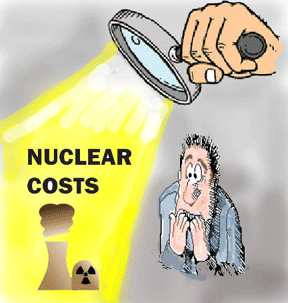
Mayor of London said the estimated £18bn cost of Britain’s first nuclear power station in two decades was an ‘extraordinary amount of money’ Boris Johnson has attacked the £18bn cost of Britain’s first nuclear power station in two decades as “a disgrace” – just one month after David Cameron announced the deal and hailed it as a “flagship project of cooperation” between China and the UK.
Work on the Hinkley Point C in Somerset is set to begin within weeks after Mr Cameron announced that a deal had been struck between French firm EDF and state-owned China General Nuclear Power (CGN) in October.
China pledged £6bn investment – a third of the total cost, with EDF funding the remaining £12bn, while the Government has agreed a “strike price” – a guaranteed price paid for electricity generated by Hinkley Point of £92.50 per megawatt hour for 35 years.
However the huge cost of the plant will ultimately be paid for by consumers through their bills.
Asked by Baroness Jones, a Green party London Assembly member who is fiercely opposed to nuclear power, whether he supported the building of Hinkley Point C despite its cost, Mr Johnson said: “I’m totally with you on that one – it’s a disgrace……http://www.independent.co.uk/news/uk/politics/boris-johnson-attacks-disgraceful-spending-on-hinkley-just-a-month-after-david-cameron-hailed-the-a6742281.html
Hillary Clinton promises, if elected, renewable energy power enough for all homes
Clinton promises ‘enough clean energy to power every home in America’ The Hill, By Bradford Richardson – 11/21/15 If elected president, Democrat Hillary Clinton says she can create enough green energy to power every home in America by the end of her second term.
The Democratic presidential front-runner said her plan to subsidize alternative sources of energy would not entail a middle-class tax hike…….http://thehill.com/policy/energy-environment/261023-clinton-promises-enough-clean-energy-to-power-every-home-in-america
New York State demands NRC not to relicense Indian Point nuclear station
 New York asks federal regulators not to relicense Indian Point nuclear plant http://www.cnbc.com/2015/11/16/new-york-asks-federal-regulators-not-to-relicense-indian-point-nuclear-plant.html New York state has asked federal nuclear power regulators not to relicense Entergy’s Indian Point nuclear power plant because the aging facility poses a risk to residents of New York City and the surrounding areas.
“The NRC should, on an expedited basis, deny Entergy’s application for relicensing of the Indian Point Facilities,” the administration of New York Gov. Andrew Cuomo said in a letter to the Nuclear Regulatory Commission on Monday.
Diablo Canyon nuclear plant – the industry’s last stand in California

 Nuclear power’s last stand in California: Will Diablo Canyon die?, SF Chronicle, By David R. Baker
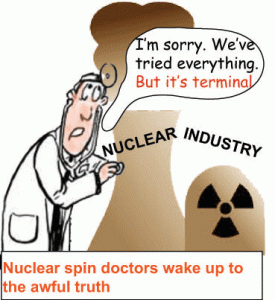
The first of its two operating licenses from the federal government expires in 2024, the second a year later. Federal regulators are weighing whether to renew those licenses and keep Diablo humming through 2045. PG&E, however, appears to be having second thoughts.
And any extension will involve a fight. The plant sits within a maze of earthquake faults, all of them discovered after construction began in 1968. Seismic safety fears have dogged the nuclear industry in California for more than 50 years, forcing PG&E to abandon plans for one of its first reactors…… Continue reading
Obama Administration enables nuclear industry to pitch itself as climate change solution
 Politico blasted today’s summit: ”The nuclear crowd is certainly excited for the attention and the summit will also let them feel like part of Team Climate, given the industry’s sense of being the unloved stepchild of the whole enterprise.
Hopefully Politico is right and today’s event is really just another cheerleading event for a floundering industry that is grasping at any means to stay afloat and not a true commitment of the limited time and financial resources we have to a technology that cannot deliver carbon emission reductions in an expedient and affordable manner.
 Who’s asking for (and getting) even more taxpayer bailouts? Hint: they’ve done it before http://blog.cleanenergy.org/2015/11/06/whos-asking-for-and-getting-even-more-taxpayer-bailouts-hint-theyve-done-it-before/ November 6th, 2015 Once again the nuclear power industry is the culprit and once again, the Obama Administration, like numerous previous Administrations, is the enabler — obliging an industry to the detriment of U.S. taxpayers by continuing to push an “all of the above” energy policy.
On the heels of the wise rejection of the Keystone XL pipeline today, another polluting player in the energy sector received some significant bolstering. This afternoon the “White House Summit on Nuclear Energy” was held for the flailing nuclear power industry, which has been rocked by several early closures of nuclear plants and major debacles at all the under-construction nuclear projects here in the U.S. (TVA’s Watts Bar 2 in Tennessee, Southern Company’s Vogtle 3 & 4 in Georgia and SCANA’s V.C. Summer 2 & 3 in South Carolina). The industry and its proponents, such as the Nuclear Energy Institute and Third Way, which not surprisingly helped organize and participated in today’s pep rally, misleadingly claim that carbon emission reductions, such as required by the EPA’s Clean Power Plan and being discussed at the upcoming U.N. climate conference in Paris, can only happen if nuclear power is expanded.

Political bias in UK’s defence chief’s criticism of Jeremy Corbyn’s nuclear weapons policy
 Corbyn accuses defence chief of political bias in nuclear row, BBC News, 9 Nov 15 Jeremy Corbyn has accused the chief of the defence staff of political bias after he criticised the Labour leader’s anti-nuclear stance.
Mr Corbyn called on the defence secretary to “take action” against Sir Nicholas over his comments.
In a statement, the Labour leader said: “It is a matter of serious concern that the chief of the defence staff has today intervened directly in issues of political dispute.
“It is essential in a democracy that the military remains politically neutral at all times.
“By publicly taking sides in current political arguments, Sir Nicholas Houghton has clearly breached that constitutional principle. Accordingly, I am writing to the defence secretary to ask him to take action to ensure that the neutrality of the armed forces is upheld.”
- Mr Corbyn, a leading member of the Campaign for Nuclear Disarmament, sparked a row with his shadow cabinet at his party’s annual conference when he revealed that would never press the “nuclear button” – and he has since praised Scottish Labour’s rejection of Trident.Mr Corbyn has said he was elected Labour leader on a platform of opposing Trident renewal and that he is committed to “promoting an international nuclear weapons convention which would lead to a nuclear-free world”……..http://www.bbc.com/news/uk-34759626
Not much real help to nuclear lobby from White House
Obama tweaks $12.5 billion in nuclear power loans, Washington ExaminerBy JOHN SICILIANO • 11/6/15 The Obama administration announced Friday that it will supplement its $12.5 billion loan guarantee program to build and license new nuclear reactors, but very little new money is being made available.
The announcement was made during a nuclear energy summit held at the White House Friday to discuss the role of nuclear power in producing zero-emission energy to combat climate change.
 The Energy Department will be “supplementing its existing solicitation that makes up to $12.5 billion in loan guarantees available to support innovative nuclear energy projects,” according to a White House fact sheet.
That means the administration will allow nuclear plant developers to use government loans to cover the costs of more items related to power plant development, including licensing costs, compared with the previous policy that provided loan backing solely for the construction of the plant itself.
“The solicitation states that eligible projects can include construction of advanced nuclear reactors, small modular reactors, uprates and upgrades at existing facilities, and front-end nuclear facilities,” the White House said.
Putting the costs of licensing a new plant in the new plan addresses the new, small modular power plants that the administration has attempted to jumpstart a market for, but with little success…….
The only problem: None are being built, and no licenses have been granted by the federal government to build one.
The administration said it has invested $452 million over six years to help reduce the engineering costs associated with certification and licensing activities for the reactors, and expects a design license won’t be submitted to the Nuclear Regulatory Commission until just before President Obama leaves office.
The Energy Department, also, is establishing what it calls the Gateway for Accelerated Innovation in Nuclear, which is sort of a one-stop shop for pushing new nuclear reactor designs toward commercialization, the White House said.http://www.washingtonexaminer.com/obama-tweaks-12.5-billion-in-nuclear-power-loans/article/2575815
Nuclear lobby convincing USA govt of its climate change credentials ?
One major consideration is convincing investors to back new nuclear…...
The Clean Air Task Force is working with other industry and environmental groups to launch the Nuclear Innovation Alliance, which aims to improve investing for advanced nuclear in the United States. A formal rollout is scheduled for later this month

White House summit boosts industry’s sagging spirits Jean Chemnick and Hannah Northey, E&E reportersE&E Daily: Friday, November 6, 2015 The nuclear industry hopes today’s White House summit is the start of a more proactive effort by the Obama administration to put reactors into the U.S. push to meet its international climate change targets.
The summit comes as the days tick down to the Nov. 30 start of the U.N. climate conference in Paris aimed at producing a post-2020 emissions agreement. President Obama has staked out a large role in helping to broker a Paris deal. Continue reading
Nuclear industry sulking because Obama is not doing enough for them
Obama’s Green Push Comes At Expense Of Nuclear Power, Daily Caller 6 Nov 15 The nuclear power industry supports President Barack Obama’s plan to force coal plants to close, but a pending Supreme Court case threatens to cause huge problems for nuclear plants.
Currently the Federal Energy Regulatory Commission (FERC) is embroiled in a Supreme Court battle over a program called demand response, which seeks to cut energy use by compensating retail customers who reduce consumption during peak power grid operation. FERC is forcing energy companies to participate, a move that opponents argue exceeds their legal mandate. According to Utility Dive, demand response keeps wholesale energy prices low, cutting into profits in the nuclear and coal industry……….
The court case puts the coal and nuclear power industries on the same side……..
In the wake of these closures, the industry has been lobbying the administration to increase government assistance to nuclear power, arguing the nuclear industry holds the key to cleaner air………http://dailycaller.com/2015/11/05/obamas-green-push-comes-at-expense-of-nuclear-power/
Pitfalls and huge costs make South Africa’s nuclear programme untenable
The nuclear build is a very risky exercise with numerous potential pitfalls. And there are alternatives. The shortfall in the projected nuclear capacity can be covered by a 50% larger than planned renewable energy investment. Wind and solar energy plants have been operationalised on schedule, and solar panel prices continue falling. The intermittence of renewable energy availability is considered manageable. Finally, energy saving strategies have yet to be fully explored.
 Why SA must abandon nuclear ambitions, The nuclear build is a very risky exercise with numerous potential pitfalls. And there are alternatives. Tech Central, By Hartmut Winkler, 6 Nov 15 It has been an eventful year in South Africa, characterised by power cuts, parliamentary confrontations about wasteful expenditure and student fee protests. There has, however, been an elephant in the room that has impacted all these issues but enjoyed surprisingly scarce attention. The idea, vigorously driven by government, is for the country to build nuclear plants with an expected price tag of R1 trillion.
This equates to 4 000 times the controversial costs to upgrade President Jacob Zuma’s Nkandla residence and 400 times the shortfall the tertiary education sector will experience in 2016 because of the freeze in university fee increases. Continue reading
Virginia nuclear power plant owner Dominium seeks 80 year lifespan for reactors !!

 Dominion plans to extend Surry nuclear reactors to 80-year lifespan BY JOHN RAMSEY Richmond Times-Dispatch, 6 Nov 15 Dominion Virginia Power today will formally seek a second license extension for its Surry nuclear power plant, becoming the first utility in the U.S. to try to push the operating range for nuclear reactors to 80 years.
If successful, the utility’s pair of reactors in Surry County would be eligible to operate past 2050.
At a White House summit on nuclear energy this afternoon, Dominion executives will deliver a letter to the federal Nuclear Regulatory Commission confirming plans to apply for the extension.
The Surry plant, located on the south bank of the James River in southeastern Virginia, saw its first reactor open in December 1972 and its second in May 1973……
As of today, no nuclear plants in the country have been granted the second 20-year extension Dominion is seeking.
USA’s Environment Protection Agency helping nuclear industry out of its financial crisis
 Nuclear Power: Dead in the Water it Poisoned, CounterPunch, by JOHN LAFORGE NOVEMBER 5, 2015 “……..As the nuclear industry struggles against financial collapse, government regulators seem to have capitulated to political pressure to weaken radiation exposure standards after accidents and thereby save the industry hundreds of billions of dollars.
On April 15, the EPA issued new Protective Action Guides (PAGs) for dealing with large-scale radiation releases — like Fukushima. The proposed PAGs represent a preemptive government bailout, because they would save reactor owners the nine-figure costs of currently required decontamination following large radiation releases. Eerily, the new PAGs seem to presume the premeditated inevitability of catastrophic releases that the industry can’t afford to withstand. The likelihood of such events was cold-bloodedly conceded by NRC Commissioner James Asselstine who testified to Congress in 1986: “[W]e can expect to see a core meltdown accident within the next 20 years, and it … could result in off-site releases of radiation … as large as or larger than the releases … at Chernobyl.”[48]
Now that Fukushima has tripled down on Commissioner Asselstine’s radiation roulette wager, real players in big electricity are running for the exits. Unlike Congressional hogs feeding at utility lobbying buffets, or commercial television executives who devour utility advertising checks, Wall Street isn’t buying bank-busting liabilities like Fukushima which will cost Japan a minimum of $350 billion and which is relentlessly salting the entire Pacific Ocean with long-lived radioactive materials.
Big investors must smirk at sloganeering about “safe reactor designs” spouted in documentary hoaxes like “Pandora’s Promise.” They read headlines from Japan and recall the stinging deception purveyed by Lewis Straus of the Atomic Energy Commission who said electricity from reactors would be “too cheap to meter.” And they can’t forgetForbes’ 1985 denunciation of nuclear power as industry’s “largest managerial disaster.”
Only add to Forbes’ prescient epitaph that nuclear is also history’s broadest and most and persistent health and environmental catastrophe.
Notes……. http://www.counterpunch.org/2015/11/05/nuclear-power-dead-in-the-water-it-poisoned/
Time to stop Tokyo 2020 Olympics plan: instead deal with Fukushima nuclear disaster
Murata is not opposed to the Tokyo Olympic Games per se, but finds them a major distraction to what needs to be done immediately — namely, gathering the best minds and expertise from around the world and, with the full support of the Japanese government, doing everything humanly possible to bring Fukushima No. 1 truly “under control.” This will help to ensure the Pacific Ocean is no longer used as an open sewer for Fukushima-produced radiation, and also address the ongoing pain and distress of the residents of Fukushima Prefecture and beyond.

Time has come for an ‘honorable retreat’ from Tokyo 2020 over Fukushima, BRIAN VICTORIA
Kyoto http://www.japantimes.co.jp/community/2015/11/04/voices/time-come-honorable-retreat-tokyo-2020-fukushima/#.VjvGN9IrLGh
Dear Olympics minister Toshiaki Endo, Let me begin this message by offering you my sincerest condolences. Condolences for what? For the death of the belief that a trouble-free 2020 Tokyo Olympics would serve to showcase Japan’s economic revival.
Up to this point, the exact opposite has been the case, due to the scrapping of plans for a very expensive new National Stadium, the scuttling of the Olympic logo amid charges of plagiarism and newspaper headlines alleging, for example, that “Japan’s Olympics fiascoes point to outmoded, opaque decision-making.” Even more recently, Japan sports minister Hakubun Shimomura offered to resign over the Olympic stadium row.
Among these developments, the charge alleging “outmoded, opaque decision-making” is perhaps the most troubling of all, because it suggests that both of the major setbacks the 2020 Olympics has encountered are systemic in nature, not merely one-off phenomena. If correct, this indicates that similar setbacks are likely to occur in the future. But how many setbacks can the 2020 Olympics endure?
At this point it may be apt to recall the warning of 13th-century Zen master Dogen: “If there is the slightest difference in the beginning, the result will be a distance greater than heaven is from Earth.”
One lesson to be learned from Dogen’s words is that in order to understand the mess you are in now, you should reflect on how you got into it in the first place. When this is done, the “beginning” becomes clear, i.e., Prime Minister Shinzo Abe’s 2013 statement to the International Olympic Committee that the situation at the crippled Fukushima No. 1 nuclear plant was “under control.” The prime minister went on to tell the Diet, “The effect of radioactive substances in the nearby waters is blocked within 0.3 sq. km of the plant’s harbor.”
One needs only to look at recent stories describing the torrential downpours in the Fukushima area to know that this claim, if it were ever true, is clearly no longer valid. Even Tepco stated: “On Sept. 9 and 11, due to typhoon No. 18 (Etau), heavy rain caused Fukushima No. 1 drainage rainwater to overflow to the sea.” This is not to mention the high probability that relatively decontaminated areas have been contaminated once again by the heavy rains carrying radioactive particles lodged in the nearby mountains down onto the plains. Nor does it take into account that no one knows the location or condition of the melted fuel in reactors 1, 2 and 3.
At this point it may be apt to recall the warning of 13th-century Zen master Dogen: “If there is the slightest difference in the beginning, the result will be a distance greater than heaven is from Earth.”
One lesson to be learned from Dogen’s words is that in order to understand the mess you are in now, you should reflect on how you got into it in the first place. When this is done, the “beginning” becomes clear, i.e., Prime Minister Shinzo Abe’s 2013 statement to the International Olympic Committee that the situation at the crippled Fukushima No. 1 nuclear plant was “under control.” The prime minister went on to tell the Diet, “The effect of radioactive substances in the nearby waters is blocked within 0.3 sq. km of the plant’s harbor.” Continue reading
Malaysian govt prepares way for nuclear power, but big hurdles remain
Government prepares Act to pave way for nuclear programme http://www.theedgemarkets.com/my/article/government-prepares-act-pave-way-nuclear-programme By Ben Shane Lim / theedgemarkets.com | November 5, 2015 KUALA LUMPUR : The government is preparing to table a new Nuclear Energy Act that will pave the way for the country to adopt nuclear power into the energy mix by 2028.
The Act could be tabled in Parliament by next year, said Energy, Green Technology and Water Minister Datuk Seri Maximus Ongkili. However, Ongkili stressed that planning for nuclear power is still at a very early stage and not high on the ministry’s list of priorities.
“The original plan was to have nuclear make up 10% of generation capacity. This would diversify our energy sources. But since the unfortunate incident at Fukushima, [Japan], we are taking more time to study it,” Ongkili told reporters on the sidelines of the Fifth Korea-Malaysia Energy Cooperation Workshop here today.
The low commodity prices have also reduced the incentive to develop the nuclear programme swiftly. Not only are oil and gas prices low, coal is also at record low prices, noted Ongkili.
According to the 2014 Energy Sector Outlook report by the Energy Commission, there are plans to introduce nuclear power to the national grid by 2024. Ongkili said however, that deadline has since moved to 2028, noting that 13 years are plenty of time to study and develop a nuclear programme.
Normally, it takes 10 years to develop a nuclear power plant. “Dealing with the nuclear waste is one of the main issues we need to think about,” he added.For now, the government will place more focus on the renewable energy sector, which is targeted to make up 23% of generation capacity by 2020, said the minister.
Apart from the Nuclear Energy Act, Ongkili said the government plans to set up the institutional infrastructure necessary for the nuclear programme.
Environmental and safety issues aside, getting public support for a nuclear programme might be a challenge going forward, especially if it is more expensive than conventional power sources.
After all, with the removal of electricity subsidies and the introduction of the fuel cost pass-through mechanism, consumers will bear the full brunt of higher generation costs. Also not helping the case for nuclear power is the fact that Malaysia is able to produce its own natural gas.
1 This Month
23-25 October – on Zoom – World BEYOND War’s annual global conferenc

To see nuclear-related stories in greater depth and intensity – go to https://nuclearinformation.wordpress.com

Say No to NASA’s Reckless Nuclear Reactor on the Moon
Say No to NASA’s Reckless Nuclear Reactor on the Moon
-
Archives
- October 2026 (160)
- September 2026 (339)
- August 2026 (330)
- July 2026 (355)
- June 2026 (287)
- May 2026 (306)
- April 2026 (356)
- March 2026 (251)
- February 2026 (267)
- January 2026 (308)
- December 2025 (358)
- November 2025 (359)
-
Categories
- 1
- 1 NUCLEAR ISSUES
- business and costs
- climate change
- culture and arts
- ENERGY
- environment
- health
- history
- indigenous issues
- Legal
- marketing of nuclear
- media
- opposition to nuclear
- PERSONAL STORIES
- politics
- politics international
- Religion and ethics
- safety
- secrets,lies and civil liberties
- spinbuster
- technology
- Uranium
- wastes
- weapons and war
- Women
- 2 WORLD
- ACTION
- AFRICA
- Atrocities
- AUSTRALIA
- Christina's notes
- Christina's themes
- culture and arts
- Events
- Fuk 2022
- Fuk 2023
- Fukushima 2017
- Fukushima 2018
- fukushima 2019
- Fukushima 2020
- Fukushima 2021
- general
- global warming
- Humour (God we need it)
- Nuclear
- RARE EARTHS
- Reference
- resources – print
- Resources -audiovicual
- Weekly Newsletter
- World
- World Nuclear
- YouTube
-
RSS
Entries RSS
Comments RSS

