Public opinion in North Korea about nuclear weapons
 Ask a North Korean: what do you think about nuclear weapons? http://www.theguardian.com/world/2015/oct/23/ask-a-north-korean-nuclear-weapons
In an ongoing series, NK News poses a reader’s question to a North Korean defector. This week, pride in the government’s atomic exploration, Guardian, Je Son Lee for NK News, part of the North Korea network
Friday 23 October 2015 When I was still living in North Korea, the regime had a successful nuclear test. People were very proud of it, and afterwards we had a town hall meeting where my neighbours talked about how the US would no longer be able to boss us around.
Most North Koreans are very aware of the fact that other countries make fun of them, and look down on the DPRK, but many think it’s because the country is poor.
North Koreans are generally very curious about how they are perceived internationally, and reports are circulated among communities of discrimination and abuse suffered abroad – such as in China – which generate a feeling of self-consciousness.
Therefore, people in the DPRK have become very proud when they hear that the country has become a nuclear state. When they hear news like this, they think: “Our nation may still be poor. But we can [still] be one of the most powerful and influential nations in national defence.”
Justification
North Korea invests heavily in education, especially in teaching people about Japanese imperial rule and the era following independence.
The Japanese committed atrocities against unarmed, innocent Koreans, and Kim Jong-un’s government frequently highlights these acts of brutality when it justifie the possession of nuclear weapons.
Thanks to frequent reminders in school textbooks and history classes, North Koreans show more hostility toward Japanese than Americans.
Pictures and graffiti of Japanese and American soldiers committing acts of violence are painted on the buildings of kindergartens, schools and offices. If you had grown up being brainwashed and exposed to this from a young age, how would you feel? North Koreans begin to realise the importance of protecting their country.
This justifies the nuclear programme and weapons, but the government doesn’t teach its people about the negative sides and ordinary citizens have no way of finding out how dangerous they can be.
Of course, some North Koreans may hold different opinions on this issue. But from what I’ve seen, North Koreans are in favour of their government’s nuclear programme for one reason: they think it will protect them from powerful countries such as the US and Japan, and means they won’t have to go back to the time when Koreans had to suffer under the US military and Japanese imperialism.
Editing and translation by Elizabeth Jae. A version of this article first appeared on NK News, North Korea News
Sheer folly of UK government’s super costly nuclear deal with China, while cutting renewable energy
These nuclear power plans are bizarre in every way. Hinkley Point will be the most expensive plant in the world, at £24bn. To pay for it, monumental subsidies lasting until 2060 will dwarf any PFI ever devised. Osborne begs the Chinese to pay for this and for HS2 as well on a never–never bill for our grandchildren,
 This nuclear power deal with China is one of the maddest ever struck http://www.theguardian.com/commentisfree/2015/oct/21/nuclear-power-deal-china-uk Polly Toynbee
The decision to allow China to build nuclear power stations in the UK is sheer folly, especially at a time when Cameron is shutting the door on renewable energy.
UK nuclear deal is a golden handout to China
 China bags gold with UK nuclear power station deal, Scotsman, SCOTT MACNAB 22 October 2015 DAVID Cameron has signalled a new “golden era” in the UK’s relationship with China after a deal was struck to build the first new UK nuclear power station in a generation.
The Prime Minister held talks with Chinese president Xi Jinping yesterday at Downing Street as part of a four-day state visit by the head of the People’s Republic.
About £40 billion of investment in the UK has been announced by China including a £660 million deal with Falkirk-based Alexander Dennis to build electric buses.
But the growing closeness between the two nations has prompted concerns over the UK’s nuclear security and China’s human rights record.
Concerns have been raised about giving China such a central role in UK energy generation. Aside from Hinkley Point, two other stations at Sizewell in Suffolk, and Bradwell in Essex, are set to follow. The plant at Bradwell will be Chinese-designed, and will provide China with its first western showcase for its nuclear technology.
However, the security services, as well as senior United States strategists, are among those to have voiced fears about the extent of the nuclear technology which China will now be getting its hands on. : http://www.scotsman.com/news/uk/china-bags-gold-with-uk-nuclear-power-station-deal-1-3924084#ixzz3pc0qK547
Will Canada now oppose depleted uranium weapons?

 Will Canada’s election deliver Real Change on its depleted uranium weapons policy? http://www.bandepleteduranium.org/en/canadas-liberal-party-opposed-depleted-uranium The Liberal Party opposed depleted uranium weapons during the 2015 election, will Canada’s new government break from the stance of the Harper government on DU?
Under Harper’s government, Canada failed to join the Arms Trade Treaty and dragged its heels on the Convention on Cluster Munitions, all the while claiming leadership on disarmament issues in spite of strong evidence to the contrary. Wereviewed their position in February this year. Can we expect the situation to improve under Trudeau’s leadership?
Prior to the election Mines Action Canada (MAC) undertook informal polling of all the main parties on a range of humanitarian disarmament topics, including on DU weapons. Canada has historically abstained on UN General Assembly resolutionson DU, even though it no longer has the weapons in service – an in-depth ICBUW briefing on Canada’s position on DU is available in English and French.
MAC posed the same DU question to all the main parties – Harper’s Conservatives failed to respond to any of the questions.
“The use of depleted uranium weapons has come under international scrutiny in recent years due to significant concerns about the long term health consequences of their use. If your party forms the next government, what will Canada’s policy be on the use of depleted uranium weapons? What will be Canada’s position on providing technical and financial assistance in order to aid decontamination of affected states and reduce the risks to civilians?”
The response from the Liberal Party was short and to the point:
“The Liberal Party of Canada opposes the use of depleted uranium munitions.”
“Le Parti libéral du Canada s’oppose à l’utilisation de munitions à l’uranium appauvri.”
While the Liberal’s tone was clearly welcome, it failed to elaborate on how it would fulfil this opposition if elected. Nor did their very short answer make any mention of assistance for decontamination. Nevertheless, it could be seen as a sign that Canada’s policy may change in the coming months and ICBUW urges its Canadian supporters to seek clarification on the Liberal position once the election excitement has subsided.
The first big test of the Liberal’s position will come in October 2016, when a sixth UN General Assembly resolution on DU will be tabled. A vote in favour from Canada would be a welcome development, and would help to reinforce the norms on transparency and assistance that the resolutions have been helping to build since 2007.
UK government confirms that it is now subsidising nuclear industry, and cutting renewables
 Government finally admits it is subsidising nuclear – while cutting help for renewables, Guardian, Damian Carrington, 22 Oct 15 The official admission blows a hole in already bewildering UK energy plans, which back the failed and expensive over the cheap and successful.
The government confirms that it is not continuing the ‘no public subsidy policy’ [for nuclear power] of the previous administration.
That little footnote, tucked away at the end of the announcement of Wednesday’s French-Chinese deal to build a new nuclear power station at Hinkley point, detonates an atomic bomb under the UK government’s already bewildering energy policy and leaves ministers hunkered down in a nuclear bunker.
Just the day before, energy minister Andrea Leadsom said: “It is vital that industries over time stand on their own two feet. I don’t think anyone here would advocate an industry that only survives because of a subsidy paid by the billpayer.” She was justifying 87% cuts to subsidies for solar power, just as they are on the verge of becoming cheaper than gas.
The contradiction does not need spelling out. Nuclear power has had 60 years to stand on its own two feet. The admission it still needs subsidy (after five years of ministers denying precisely that) shows that traditional nuclear power can barely crawl. Whether this admission strengthens the EU challenge against the UK that it is providing illegal state aid remains to be seen.
Ministers argue that big nuclear power stations are key to energy security. Thespooks disagree, saying having a Chinese-run nuclear power station in the UK for half a century is a hostage to fortune.
Ministers also say they are committed to cutting carbon from the UK energy supply, but that protecting consumers from higher energy bills is vital. Not many would disagree, so why are ministers all but banning new onshore wind farms, the cheapest form of green energy?
It was a manifesto commitment, says the government, presumably included to appease the minority of people who oppose wind farms. On Wednesday night, the House of Lords disagreed and voted down the Conservative’s anti-wind rules.
It’s a mess. But don’t worry, say ministers, we will shortly be announcing new policies – a “reset”. Except this explodes the most precious of all commodities in the energy system: investor confidence.
“A reset is unnecessary and would create delays to investment and increase political risks,” say the energy policy experts Prof Rob Gross and Prof Jim Watson. Over 1,000 jobs have already been culled in the solar industry, with warnings of many more to come, while Leadsom was warned on Tuesday that the UK arm of an international energy company had suffered a credit rating downgrade following the government’s planned cuts to renewable subsidies…..http://www.theguardian.com/environment/damian-carrington-blog/2015/oct/22/hinkley-point-uk-energy-policy-is-now-hunkering-in-a-nuclear-bunker
UK govt trumpets nuclear deal with China, silently wages war on renewable energy
 Solar subsidies are slashed, but the sun always seems to shine on nuclear, Guardian, 20 Oct 15
Two events this week will throw the government’s contradictory attitudes to spending on green and atomic power into sharp relief. A glaring anomaly of British energy policy will be on display this week: the government will loudly trumpet a nuclear deal with China, and then will come a no-fanfare end to a controversial solar subsidy consultation.
President Xi Jinping will probably sign a heads of agreement with David Cameron that will allow the government to say that a new plant at Hinkley Point in Somerset is on its way.
The groundwork for the deal was done by George Osborne on his recent trip to Beijing, with the chancellor determined to roll away any obstacles that could halt China becoming a major investor at Hinkley – and beyond.
The chief developer of the new nuclear reactors in the south-west – the first for 20 years – is EDF, which has also been trying to woo state-owned Chinese companies to invest in the £24.5bn scheme.
Only by promising to allow the Chinese to build their own replacement plant at Bradwell in Essex have Osborne and Cameron finally won Beijing’s support for Hinkley. After that it will be up to EDF to press the final investment button and for construction to start in earnest…….
At the same time the Conservative government has been waging what looks like a determined war against solar and other renewables, highlighted by a proposed 87% cut in subsidies from 1 January on rooftop solar panel installations.
More than 1,000 jobs have been lost in the past 10 days as three major solar installers have closed their doors in anticipation that ministers will bring burgeoning demand for small solar schemes to an abrupt halt.
Unlike the warm words of encouragement and firm policy help for nuclear, there has been a relentlessly negative attack on the solar industry, which ministers have suddenly decided should now stand on its own feet. There have been constant references to hard-pressed bill payers, with the intermittent nature of solar and wind being highlighted by the Department of Energy and Climate Change against the advantages of constant power from nuclear.
These generalisations hide a different truth. Renewable energy is largely a new UK private-sector success story, where costs are falling fast and which deserves considered and time-limited support. Nuclear power is a mature technology run by state-owned companies from France and China where costs seem to constantly rise and where 35-year price commitments at double the cost of existing wholesale power should not be being given.
With power capacity margins falling so low that many warn the lights could go out this winter, you have to conclude that the government lacks competence as well as vision……http://www.theguardian.com/business/2015/oct/18/solar-subsidies-slashed-but-sun-shines-on-nuclear
Jeremy Corbyn now vice-president of Campaign for Nuclear Disarmament
 Jeremy Corbyn named vice-president of Campaign for Nuclear Disarmament, Guardian, Matthew Taylor, 17 Oct 15
Labour leader due to address CND conference, described by organisers as the most important gathering of anti-nuclear activists in a generation. Jeremy Corbyn, the Labour party leader, is to accept a new role as vice-president of the Campaign for Nuclear Disarmament as figures show a sharp upturn in support for the organisation.
 Corbyn, who is currently vice-chair of CND, will accept the position during a two-day conference in London on Saturday. His acceptance of the role underlines his opposition to nuclear weapons in the face of criticism from within the shadow cabinet.
The Labour leader has long opposed nuclear weapons and said last month that he would tell defence chiefs never to use the Trident nuclear weapons system if he became prime minister…….
Kate Hudson, general secretary of the CND, welcomed the move and said the conference would be the most important gathering of anti-nuclear activists in a generation.
“[The] conference takes place at a moment when, for the first time in a generation, the opportunity not to replace Trident collides with a massive popular upsurge against the criminal waste and sheer anachronism of nuclear weapons,” she said.
“Austerity has led many more to question the need to spend £100bn on replacing a nuclear weapons system that doesn’t tackle the real security threats we face. Terrorism, climate change, pandemics and cyberwarfare require a fresh approach.”
CND has seen a big increase in support since Corbyn launched his election campaign. The organisation was attracting about 30 new members a month in June but now has a sign-up rate of more than 200 a month.
A spokesman said the support was still gathering pace, with more than 100 new members joining in the last seven days and thousands of non-paying supporters signing up since the summer……
The UK has four Trident ballistic missile submarines, and a final decision about whether to replace them is due to be taken in 2016. Previously both the Labour and Tory leaderships were committed to replacing the fleet, a project that is likely to cost well over £100bn over its 30-year lifespan. But now Corbyn has committed Labour to a review of its Trident policy, to be headed by Eagle.
Hudson welcomed Labour’s stance and said the anti-nuclear campaign would continue to gather momentum in the coming months. “Our own organisation has experienced its own surge in membership and we’re preparing for a major national Stop Trident demo ahead of the parliamentary decision in 2016,” she said. http://www.theguardian.com/politics/2015/oct/17/jeremy-corbyn-vice-president-campaign-nuclear-disarmament
Sweden shutting down 2 nuclear reactors
 Sweden’s Oskarshamn 1 and 2 reactor units to close World Nuclear News, 14 October 2015 German utility Eon has decided that units 1 and 2 of the Oskarshamn nuclear power plant in Sweden will be shut down permanently. Unit 3 is unaffected by the decision, which was announced today by OKG AB, of which the EOn group is the major shareholder…..The announcement followed an extraordinary shareholders’ meeting held earlier today and is in line with the “policy decision” EOn communicated in July. According to that policy, EOn said unit 1 would close between 2017 and 2019 and unit 2 by 2020……
There will be no future investments at unit 2 and the reactor will not be restarted. Operation of unit 1 will proceed in accordance with the established plan, meaning a decision on its shutdown will be made when the time schedule for the decommissioning phase has been prepared. The exact date when the unit will be permanently shut down is thus not yet established……
Earlier this month, the European Court of Justice ruled that Sweden can continue to tax nuclear power production, deciding that the levy does not fall within the scope of two European Council Directives and is therefore a national, rather than European Commission, matter. OKG AB had first contested the tax in 2009 in the Swedish courts….
Britain fawns over Xi Jinping – preparatory to China taking over UK’s nuclear industry
Why is Xi Jinping getting a royal reception in Britain? eji insight, Mark O’Neill, 15 Oct 15 “………..Britain wants to become the preferred European country for Chinese investment, state and private, and London the city where Chinese firms build their European headquarters and do business in renminbi.
Top of the agenda is Hinckley Point C, Britain’s first new nuclear power station for several decades, with a total cost of 24.5 billion pounds (US$37.9 billion). It will be the first of three such new plants.
For months, there have been intensive talks between Electricite de France (EDF) Energy, China National Nuclear Corp. and China General Nuclear Corp. Early this month, Vincent de Rivaz, head of EDF Energy, said he hoped the two Chinese firms would take a 40 per cent stake in the project, with an agreement to be signed during Xi’s visit. The project is backed by the governments of Britain, France and China.
But EDF and the two Chinese firms have been arguing over their respective shares and the financial burden they will take on.The next nuclear project is Bradwell in Essex with 1,000 megawatts; China is expected to take the lead role and take a majority stake.
The two plants are very capital-intensive, requiring enormous investment before the investors receive a return.
In western countries, nuclear plants are controversial and are vulnerable to a second Fukushima disaster.
These would be the first nuclear stations built by China in a western country and make it a front-line competitor with Areva, the world’s largest builder of nuclear power stations. Areva posted a loss of 4.8 billion euros (US$5.5 billion) last year.
China may take an equity stake in the ailing French firm. Osborne has promised a taxpayer guarantee of 2 billion pounds if Xi puts Chinese money into the Hinckley project………http://www.ejinsight.com/20151015-why-xi-jinping-getting-royal-reception-britain/
Second nuclear reactor started at Sendai, despite public opposition
 Japan restarts second nuclear reactor despite public opposition, Guardian, 15 Oct 15
Number-two reactor at Sendai has gone on line more than four years after a quake-sparked tsunami swamped a plant at Fukushima. Japan on Thursday restarted a second nuclear reactor after a shutdown triggered by the 2011 Fukushima crisis, as the government pushes to return to a cheaper energy source despite widespread public opposition.
Utility Kyushu Electric Power said it restarted the number-two reactor at Sendai, about 1,000 kilometres (620 miles) southwest of Tokyo at 10.30am (0130 GMT).
The same power plant’s number-one reactor was restarted in August, ending a two-year nuclear power hiatus. Engineers will now spend several days bringing the newly restarted reactor up to operational level before running it commercially from November…….
But the public is largely opposed to atomic energy after the Fukushima crisis sent radiation over a wide area and forced tens of thousands from their homes – many of whom will likely never return – in the worst nuclear accident since Chernobyl in 1986…….http://www.theguardian.com/world/2015/oct/15/japan-restarts-second-nuclear-reactor-despite-public-opposition
Overwhelming costs of Britain’s Trident nuclear submarines – cannot be measured
The Conservative government has not given an up-to-date estimate of the program costs. Previously, it has said the submarines would cost between £11 billion and £14 billion at 2006 prices and estimated an overall cost of up to £20 billion when infrastructure and other costs are wrapped in……….
The Labour Party, the main opposition party, has previously been committed to a credible nuclear deterrent, but the recent election of the left-winger Jeremy Corbyn as the party leader has thrown that policy into confusion…….
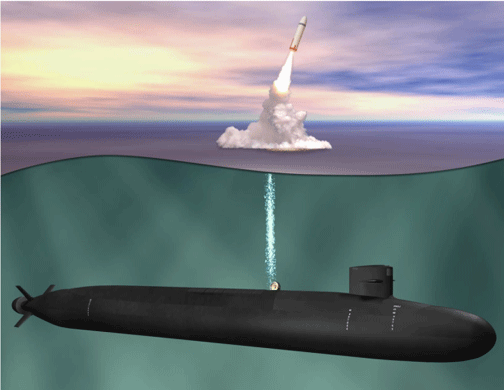 Nuclear Sub Project Poses UK’s Biggest Financial Challenge, Defense News By Andrew Chuter October 15, 2015 LONDON — Britain’s nuclear submarine effort is a monster-sized undertaking that keeps the Ministry of Defence’s top civil servant awake at night, the official admitted to the Parliamentary Public Accounts Committee Wednesday.
Jon Thompson, the permanent undersecretary at the MoD and the man responsible for keeping defense spending in check, told lawmakers that renewing Britain’s nuclear deterrent was the biggest project the ministry was ever going to tackle.
“The project I worry about the most in relation to future financial risk is the nuclear enterprise. It’s a significant element of the overall equipment plan … it most keeps me awake at night,” he told the committee during a session examining the MoD’s progress in improving financial management.
The defense nuclear enterprise covers the equipment, infrastructure and people required to deliver the UK deterrent and nuclear powered submarines, including the new Astute-class hunter killer boats and Trident missile boats. Continue reading
Nuclear energy falls from France’s pride and joy, to its expensive source of woe
 Tale of woe in French nuclear sector, Ft.com, October 13, 2015, Michael Stothard Broken government promises, multibillion-euro delays and a key national champion rescued from the brink of failure: it has been a torrid year for the proud French nuclear industry.
Problems came to a head in August when Areva, the designer and builder of nuclear reactors around the world, was forced to strike a multibillion-euro rescue package deal with rival group EDF and the French government. It had been hit by foreign competition, the downturn in global nuclear demand following the 2011 Fukushima disaster and cost overruns. It had not sold a new reactor since 2007. It urgently needed to be put back on a “sound footing” to keep nuclear a “strength for our country,” said Manuel Valls, French prime minister, before the deal to sell much of the company to EDF………
The country is also a torchbearer for nuclear power as part of the European energy mix when many countries have retrenched following Fukushima. “There’s no doubt the global nuclear industry, including in France, is challenged and it is asking itself some profound questions since Fukushima,” says Jean-Marc Ollagnier, chief executive of Accenture’s resources operating group.
But for French nuclear the past five years have been a tale of technical problems and cost overruns that brought Areva to its knees and called into question the country’s ability to deliver on next generation technology.
These construction problems highlight the complexity of the EPR projects, and have led some to question if there is demand for these larger reactors, given their cost and size. The questions come at the same time as internal political ones, as France attempts to reduce its reliance on nuclear power.
President François Hollande, due to a deal struck between the anti-nuclear Green party and his ruling pro-nuclear Socialist party, has promised to reduce nuclear in the French energy mix from 75 to 50 per cent by 2025…….. Even if no plants are shut down for political reasons in the lead-up to 2025 there are still decisions to be made, all of which are likely to be expensive.
The grand carénage, increasing the life expectancy of the 30-year-old plants from their current 40 years to 50 years, is expected to cost EDF around €55bn, should it ever win political approval. Closing one nuclear plant has already proved difficult. Decommissioning Fessenheim, France’s oldest reactor on the German border, was promised by the government to happen by 2016. This year it was delayed until Flamanville comes online in 2018, leaving the government accused of breaking its promises……..http://www.ft.com/intl/cms/s/0/58036178-68f8-11e5-a57f-21b88f7d973f.html#axzz3oU6siWHM
‘New Nuclear” lobby wants to weaken USA’s safety regulations
 What a con!
Even if they did get rid of the safety regulations, ‘new nuclear’ wouldn’t be ready in time to affect climate change.
And that’s even if ‘new nuclear’ could affect climate change. Which it can’t.. The Nuke lobby conveniently forgets the entire chain from mining to waste burial – all of which is highly greenhouse gas emitting.
The ‘new nuke’ lobby pretends they’ve solved the radioactive trash problem, which they haven’t.
The sad part is – all that money going to a dead end technology – when it could be furthering good design, energy efficiency, and renewable energy development.
Allison Macfarlane sounds like a person of integrity. I bet that the new nuke, and the old nuke lobbies were glad to have her off the head of the NRC.

Advanced Nuclear Industry to Regulators: Give Us a Chance, MIT Technology Review, Richard  Martin, October 13, 2015 Entrepreneurs argue that reactor technology innovation is limited by regulatory barriers. The U.S. Nuclear Regulatory Commission has licensed one new nuclear plant in the last 35 years. Yet there are now nearly 50 companies in the U.S. and Canada researching and developing advanced nuclear power technologies, according to Third Way, a Washington, D.C.-based research organization focused on energy, climate change, and national security. These companies are backed by more than $1.3 billion in private capital from individual investors like Bill Gates and from major venture capital funds .
Several of those companies were on the MIT campus in Cambridge, Massachusetts, last week for the Solve Conference , participating in a workshop called “Building a Scalable, Safe New Nuclear Reactor Design.” Among the companies represented were Transatomic Power, TerraPower, Moltex Energy, Tri-Alpha Energy, and Terrestrial Energy.
Several of those companies were on the MIT campus in Cambridge, Massachusetts, last week for the Solve Conference , participating in a workshop called “Building a Scalable, Safe New Nuclear Reactor Design.” Among the companies represented were Transatomic Power, TerraPower, Moltex Energy, Tri-Alpha Energy, and Terrestrial Energy.
Many of these new entrants view the NRC’s prolonged and expensive licensing process as a barrier to innovation. It can take a decade or more, and hundreds of millions of dollars, just to get a license for a prototype reactor from the NRC.
 This, says Allison MacFarlane, who was NRC chairman from 2012 to 2015 and is now the director of the Center for International Science and Technology Policy at George Washington University, is the way it should be. The long time lines, safety concerns, and high capital cost of building nuclear plants all require a regulatory process that is thorough, painstaking, and costly. “Nuclear is a different beast,” MacFarlane said at Solve……
The undermanned NRC has indeed embarked on a reform program, but unfortunately it’s not the sort of reform the advanced reactor community is seeking…..a February NRC presentation on Project Aim 2020, the agency’s internal strategic plan, foresees that the number of new reactors seeking licenses will be “down significantly” by 2020. …
MacFarlane is unmoved. “The problem is not the NRC,” she said at the conference. “It’s the economics” of nuclear power.
She has a point. As long as the price of power from natural gas plants hovers at all-time lows, it will be hard for any form of new nuclear reactors to be built….. http://www.technologyreview.com/news/542411/advanced-nuclear-industry-to-regulators-give-us-a-chance/
Nuclear deal approved by Iran Parliament

 Iran parliament approves nuclear deal with world powers http://www.abc.net.au/news/2015-10-13/iran-parliament-approves-nuclear-deal-with-world-powers/6851478 Iran’s parliament has approved a historic nuclear deal with world powers, effectively ending debate among politicians over the agreement and paving the way for its formal implementation.
The motion to approve the Joint Comprehensive Plan of Action was passed with 161 votes in favour, 59 against and with 13 abstentions, the official IRNA news agency and other media said.An early tally of the vote said 250 of Iran’s 290 MPs were present, with the numbers suggesting 17 members who attended did not vote at all.
The nuclear agreement between Iran and six world powers was struck on July 14 after almost two years of diplomacy but lawmakers in the United States, and Tehran insisted on voting on it. The deal, which will lift nuclear-related sanctions on Iran in return for curbs on its atomic activities — the Islamic republic denies seeking a bomb — received a rocky ride in the US and Iran.
Members of the US Congress failed in September to torpedo the deal. In Tehran ultraconservative lawmakers repeatedly warned of holes in the text of the agreement and criticised president Hassan Rouhani for suggesting MPs were deliberately delaying the deal.
In selling the agreement to sceptics, Mr Rouhani’s government said its negotiators protected the future of Iran’s nuclear programme while ensuring sanctions, that have ravaged its economy, would end. However, as late as Sunday, parliament was the scene of fiery clashes over the deal. Ali Akbar Salehi, head of Iran’s Atomic Energy Agency, went on the attack for the government after he and other officials were accused by lawmakers of having capitulated to the West.
So-called red lines for the talks were laid down by Iran’s supreme leader, Ayatollah Ali Khamenei, and the Supreme National Security Council that he oversees. Tuesday’s motion, titled Iran’s Plan for Reciprocal and Proper Action in Implementing JCPOA, allows the government to proceed, IRNA reported. Iranian officials have said sanctions should be lifted by the end of the year or January 2016 at the latest.
However Iran also has to satisfy the International Atomic Energy Agency, the UN nuclear watchdog, of the exclusively peaceful nature of its atomic program.
The IAEA faces a December 15 reporting deadline to resolve what it had termed “ambiguities” over Iran’s past nuclear activities.
In South Africa, nuclear plans might not proceed: parliament approval is necessary

 Nuclear build plans need Parliament’s approval, MPs told http://www.bdlive.co.za/business/energy/2015/10/13/nuclear-build-plans-need-parliaments-approval-mps-told BY LINDA ENSOR, 13 OCTOBER 2015, IT WAS “HIGHLY IMPROBABLE” THAT GOVERNMENT WOULD PROCEED WITH THE NUCLEAR BUILD PROGRAMME WITHOUT IT FIRST BEING APPROVED BY PARLIAMENT, TREASURY DIRECTOR-GENERAL LUNGISA FUZILE TOLD PARLIAMENT’S FINANCE COMMITTEE ON TUESDAY.
All expenditure had to be reflected in the medium-term expenditure framework, which was subject to parliamentary approval and possible amendment, Mr Fuzile said in reply to questions by Democratic Alliance finance spokesman David Maynier. Mr Maynier was concerned about a comment made by President Jacob Zuma in August that the nuclear procurement would have been completed by the end of the current financial year.
The committee met to discuss the Treasury’s annual report.
Concern over government’s intentions mounted after it signed cooperation agreements with Russia, China, France and the US and seemed to be on the verge of clinching a deal with Russian energy company Rosatom. Energy Minister Tina Joematt-Pettersson has strongly rejected any suggestion that a deal has been concluded. There have also been public demands for greater transparency in the entire procurement process.
Mr Fuzile stressed that the process of finalising plans was still at its “very early stages”. The 2010 integrated resource plan included nuclear energy as one of the sources of power indicating that SA was open to the idea of nuclear. The government had been gearing itself up to understand nuclear better, Mr Fuzile said.
The Treasury had completed some work on the costing and financing models for a nuclear programme but it was classified information that the cabinet had not seen yet. Officials had discussed what elements of the work could be communicated in the public interest but to do this would require that it be declassified.
Mr Maynier has failed in his attempts to get information on the nature of the studies undertaken by the Treasury and their contents. Committee chairman Yunus Carrim emphasised the importance of the issue being discussed. “We have to know what the costs are,” he said and undertook to expedite arrangements to have a joint sitting with the energy committee.
Energy committee chairman Fikile Majola has committed himself to holding public hearings on the nuclear build programme, which opponents say will be too costly, especially given SA’s low growth prospects.
Mr Carrim noted that the African National Congress had decided at its national general council meeting at the weekend that a cost-benefit analysis be undertaken of the nuclear proposals.
1 This Month
23-25 October – on Zoom – World BEYOND War’s annual global conferenc

To see nuclear-related stories in greater depth and intensity – go to https://nuclearinformation.wordpress.com

Say No to NASA’s Reckless Nuclear Reactor on the Moon
Say No to NASA’s Reckless Nuclear Reactor on the Moon
-
Archives
- October 2026 (160)
- September 2026 (339)
- August 2026 (330)
- July 2026 (355)
- June 2026 (287)
- May 2026 (306)
- April 2026 (356)
- March 2026 (251)
- February 2026 (267)
- January 2026 (308)
- December 2025 (358)
- November 2025 (359)
-
Categories
- 1
- 1 NUCLEAR ISSUES
- business and costs
- climate change
- culture and arts
- ENERGY
- environment
- health
- history
- indigenous issues
- Legal
- marketing of nuclear
- media
- opposition to nuclear
- PERSONAL STORIES
- politics
- politics international
- Religion and ethics
- safety
- secrets,lies and civil liberties
- spinbuster
- technology
- Uranium
- wastes
- weapons and war
- Women
- 2 WORLD
- ACTION
- AFRICA
- Atrocities
- AUSTRALIA
- Christina's notes
- Christina's themes
- culture and arts
- Events
- Fuk 2022
- Fuk 2023
- Fukushima 2017
- Fukushima 2018
- fukushima 2019
- Fukushima 2020
- Fukushima 2021
- general
- global warming
- Humour (God we need it)
- Nuclear
- RARE EARTHS
- Reference
- resources – print
- Resources -audiovicual
- Weekly Newsletter
- World
- World Nuclear
- YouTube
-
RSS
Entries RSS
Comments RSS

