Michael Douglas wants presidential candidates to start talking about nuclear weapons.
 Tribeca: Michael Douglas Calls for Presidential Candidates to Talk Nuclear Weapons http://www.hollywoodreporter.com/news/tribeca-2016-michael-douglas-nuclear-887171 The actor is working on a doc about a San Fernando Valley family who grew up near a Boeing plant which had a nuclear accident in the 1950s. “[It] basically poisoned the whole neighborhood. The whole family has thyroid cancer,” says Douglas. 4/23/2016 by Ashley Lee
At a 2016 Tribeca Film Festival discussion before the immersive closing-night film the bomb, Douglas said the world is “on the advent of a new Cold War advancement in nuclear weapons — the U.S. is talking about a trillion dollars to spend, the Russians have their new missiles out,” he explained. “It’s just very difficult to believe. … Maybe, just maybe, we can look at a new generation to look at what I think is the most serious issue that we have on the planet right now.”
Even more so, “we’ve got elections coming up this year. Once we get through these primaries and once more attention is brought to just how this arms race is continuing now, there should be a huge discussion coming this fall,” said the actor and longtime advocate of nuclear non-proliferation. “It looks like it’s gonna be [Donald] Trump and Hillary Clinton, with diametrically different opinions on this important issue — one who wants to nuke ‘em, and somebody else.”
Command & Control director Robert Kenner added, “If Donald Trump is the Republican nominee, I think there will be more discussion on nuclear weapons because he is the best argument for abolition that we can make.”
As seen in action flicks like Pacific Rim and Independence Day, Hollywood tends to portray nuclear weapons onscreen as the ultimate and necessary arsenal, and Douglas said that won’t change anytime soon. “Not in Hollywood — we’re based on a business of balances, commerce with filmmaking. Commerce has to win out,” said the actor. “Any movie where the message gets ahead of the drama … unless you’re doing documentaries, you can’t get ahead of yourself. They’re not interested.”
Still, Douglas said he’s working on a documentary “about a young man living in the San Fernando Valley who grew up near a Boeing plant which had a nuclear accident in the 1950s and basically poisoned the whole neighborhood. The whole family has thyroid cancer.”
The panel — also featuring Command & Control author Eric Schlosser, Emma Belcher of the MacArthur Foundation and the bomb filmmaker Smriti Keshari — discussed that nuclear weapons and climate change are the two most important global issues, and because of the visual proof of climate change that’s emerged, the world has begun responding with urgency.
“The terrifying thing about the nuclear issue is … you’re really gonna have to wait for a dirty bomb. It’s gonna make 9/11, Paris, Brussels, everything a miniscule amount before the amount of people who are going to be killed [by a nuclear bomb],” said Douglas. “The only optimism I see, is of these two major issues, the two most important in the world, we can eliminate nuclear weapons. It’s really easy. … We as humans can do something about it — we actually can, it’s within our grasp.”
Douglas began his activism against nuclear weapons after making The China Syndrome, James Bridges’ 1979 film co-starring Jane Fonda and Jack Lemmon about a cover-up of safety hazards at a nuclear power plant. To prepare for its finale, the shoot included consultations with General Electric quality assurance experts who “gave us a breakdown of the most logical accident that might happen at a power plant,” the actor and producer recalled. “That power plant was the ultimate villain — it’s a horror picture.
“Thirteen days after the movie came out, Three Mile Island happened in Pennsylvania,” said Douglas, as news outlets ran split-screen footage of the real-life tragedy and the film. “It was an epiphany for me, the closest thing to a religious experience I might have ever had.”
France gives €3bn bailout to EDF’s Hinkley nuclear plant

 France gives €3bn lifeline to Hinkley nuclear plant, Sunday Times, Robin Pagnamenta, Energy Editor, 24 Apr 16, A decision on the proposed nuclear power station will not be taken until after an EDF shareholders’ meeeting Erance has thrown its support behind EDF, the French electricity company, and its plan to build the £18 billion nuclear power station at Hinkley Point, Somerset, by supplying a €3 billion lifeline.
President Hollande’s administration has agreed to put in the money towards a proposed €4 billion (£3 billion) cash-raising the company is proposing by issuing new shares. EDF said last night that the confirmation of the fundraising made it possible for the company to proceed with investments including Hinkley Point C by putting it on a “solid financial footing”……http://www.thetimes.co.uk/article/union-threats-force-edf-to-delay-hinkley-decision-0zf56xjms
£18bn Hinkley Point nuclear power station plan headed for a’grinding halt’?

 £18bn Hinkley Point nuclear power station plan could be ‘coming to a grinding halt’ Controversial power station is a key part of the Government’s plan to ‘make sure the lights stay on’, Independent John Lichfield, Ian Johnston 22 April 2016 London“The French electricity giant EDF has thrown the British government’s energy strategy into disarray by reportedly delaying – possibly until next year – a decision on whether it will build a new £18bn nuclear power station at Hinkley Point in Somerset.
Jean-Bernard Lévy, the head of EDF, has bowed to pressure from unions and senior company engineers and agreed to seek a fresh opinion from the company’s union-management consultative council, the respected French newspaper Le Figaro reported.EDF said it could not immediately confirm the report. Sources in the company told the French newspaper that the consultation process would take several months and that no decision on whether to go ahead with its involvement in Hinkley Point – expected to supply eight per cent of British slectricity by 2025 – would be made before next year.
Environmental campaign group Greenpeace claimed the delay could be “a sign that the entire project is coming to a grinding halt”, adding that the UK should back renewable energy “as a more reliable alternative” to nuclear power.
“The firm has been under enormous pressure from both the British and French governments to announce early next month a definite commitment to build, and largely finance, the two new generation nuclear reactors at Hinkley. The French economy minister Emmanuel Macron told the Andrew Marr Show on BBC TV that their agreement was now certain.
However senior engineers and unions at the largely state-owned French company fear the project could destroy the struggling business. They have demanded a delay of at least two years to allow uncertainties about the experimental high-pressure water reactors planned for Hinkley to be resolved……..
Although China has agreed to invest £6.2bn in Hinkley Point, EDF has failed to find other backers, leaving it responsible for two thirds of the cost. Problems with the bulding of similar high-pressure water reactors in Finland and Normandy have led EDF unions and senior executives to recommed a three-year delay – until a new generation of technology become available.
But Paris and London are reported to have applied intense pressure on EDF to go ahead immediately.The British government would face huge embarrassment if Hinkley Point, intended as the first of three new mega power stations, was abandoned or postponed.
In October last year, China agreed, amid much fanfare in London and Beijing, to invest £6.2bn in the project…….John Sauven, director of Greenpeace, which has campaigned against the reactor, told The Independent: “Delays to EDF making a decision about whether to invest in Hinkley are nothing new. So much so that it’s been 14 months since it was first said that the decision would be coming imminently.
But this latest delay from EDF is different.”President Hollande, the French Economy Minister and EDF’s chief executive have all very publicly promised the UK government a final decision before the 12 May. Backtracking on this pledge now is symbolic of the utter mess that EDF is in.
“But even if they could agree a finance package, it could be declared illegal state aid by the European Commission. This may now be the sign that the entire project is coming to a grinding halt and the UK government urgently needs to back renewable energy as a more reliable alternative.”……http://www.independent.co.uk/news/uk/18bn-hinkley-point-nuclear-power-station-plan-could-be-coming-to-a-grinding-halt-a6997131.html
‘New Nuclear” lobby working to weaken powers of USA’s Nuclear Regulatory Commission (NRC)
Edwin Lyman, senior scientist for the Union of Concerned Scientists’ Global Security Program, said the timing of the legislation is “premature.” Lyman told Congress to consider that the legislation might pose an unfair burden on taxpayers and put Americans at increased risk.
The legislation would also eliminate language that requires NRC’s Atomic Safety and Licensing Board Panel to hold a hearing on new applications.
“That’s inherently dangerous technology that needs tough questions to be asked about it,” said Sen. Ed Markey (D-Mass.). “I don’t think the public is going to be happy if they’re told ‘no hearings’ on this dangerous technology.”

Advanced reactor bill raises ‘red flags‘ Hannah Hess, E&E reporter E&E Daily: Friday, April 22, 2016
The Nuclear Regulatory Commission’s head of operations yesterday tried to sell lawmakers on a strategy to license the latest nuclear technology.
But Victor McCree had to contend with lawmakers who have their own plan to lay the groundwork for advanced reactors, and it goes beyond the administration’s comfort zone……
Eight days ago, EPW Chairman Jim Inhofe (R-Okla.) teamed up with Whitehouse and Sens. Mike Crapo (R-Idaho) and Cory Booker (D-N.J.) to introduce legislation to reform the licensing process and restructure how NRC is funded.
But a hearing of the Clean Air and Nuclear Safety Subcommittee revealed concerns about safety and security, including NRC’s own fears that the legislation could handcuff regulators (E&E Daily, April 14).
The bill would change NRC to develop “technology-inclusive regulatory framework” — defined as using methods of evaluation that are flexible and predictable, such as risk-informed and performance-based techniques.
Critics warn that lawmakers didn’t properly explain those terms, which could lead to less rigorous standards for the approval of novel nuclear power technologies.
The legislation would also eliminate language that requires NRC’s Atomic Safety and Licensing Board Panel to hold a hearing on new applications.
“That’s inherently dangerous technology that needs tough questions to be asked about it,” said Sen. Ed Markey (D-Mass.). “I don’t think the public is going to be happy if they’re told ‘no hearings’ on this dangerous technology.”
NRC concerns
McCree, who assumed NRC’s top career post last fall, cautioned that the bipartisan legislation would require “significant time and resources” over several years in areas where the agency’s internal planning process was well underway.
Current performance metrics allow fluidity at NRC to “account for emerging safety or security issues, changes in licensee plans and the like,” McCree said. “As written, the proposed requirements would limit the NRC’s flexibility in this area.”
At the Obama administration’s request, NRC earmarked $5 million for work on advancing small modular reactor (SMR) licensing practices in its fiscal 2017 budget proposal. Both House and Senate proposed spending bills include language to address this issue.
McCree said NRC staff expect to complete the first draft of their own strategy for licensing non-light-water reactor technologies soon and will discuss it in a public meeting in June.
NRC is also in the process of a downsizing measure, popular on Capitol Hill, that aims to streamline the agency.
Testifying on behalf of the U.S. Nuclear Infrastructure Council, where he now is chairman of a task force on advanced reactors, Merrifield encouraged the committee to press for further staffing cuts below NRC’s Project Aim 2020. ….NRC’s budget for fiscal 2017 would cut an equivalent of 90 full-time employees, surpassing the Project Aim goal, for a total reduction of roughly 280 full-time workers since fiscal 2014 …….
One thing senators and the nuclear industry agree on is that the commission’s current licensing process, with a design and certification that can cost billions of dollars and stretch for up to a decade, is one of the biggest obstacles for SMRs and advanced reactor designs that use coolants other than water.
“You have a situation in which it is very hard to get early investment in these new technologies,” Crapo said.
Ashley Finan, policy director of the Nuclear Innovation Alliance, one of four industry witnesses who testified in support of the Senate legislation, presented charts showing the big money and time hurdles the private sector sees with the current NRC process.
“The investors and innovators have made it very clear that their most immediate and pressing concern is regulatory uncertainty,” Finan said……
Because advanced nuclear reactor companies rely primarily on investors, the bill seeks to change the model……
The Nuclear Infrastructure Council wants language added that would provide early stage engagement with no or limited cost to the developer, with an “appropriate cost share,” perhaps 50-50, for later stages of the licensing process.
“Fewer resources are not good for the agency in protecting against a terrorist attack,” said an animated Markey, demanding any of the witnesses to refute his claim.
Bill ‘premature’
Edwin Lyman, senior scientist for the Union of Concerned Scientists’ Global Security Program, said the timing of the legislation is “premature.”
Lyman told Congress to consider that the legislation might pose an unfair burden on taxpayers and put Americans at increased risk.
The history of the failed Next Generation Nuclear Plant project, a prototype of a modular high-temperature gas-cooled reactor, is an illustrative example, he said.
Mandated by the Energy Policy Act of 2005, the project was suspended after the Energy Department decided in 2011 not to proceed into the detailed design and license application phases. DOE’s decision cited the reluctance of vendors, owners and operators, and customers to commit to substantial upfront cost sharing.
“The main problem is the cost and difficulty of obtaining the necessary analyses and experimental data to satisfy regulatory requirements and ensure that new reactors can operate safely,” Lyman said. “This is a fundamental issue we think Congress needs to address through oversight of the budget for nuclear energy [research and development].”….. http://www.eenews.net/stories/1060036081
Washington Post and New York Times in the arms of the nuclear lobby?

 Trampling Science to Boost Nuclear Power, FAIR, By Jim Naureckas 20 Apr 16, When the Washington Post and New York Times are making the same corporate-friendly point, it’s safe to assume that some PR agency somewhere is earning its substantial fees.
In this case, the subject is the need for nuclear power—and, for the Post editorial board (4/18/16), for fracking as well. Standing in the way of this in the Post’s version is favorite target Bernie Sanders, while the Times business columnist Eduardo Porter (4/19/16) blames the “scientific phobias and taboos” of “progressive environmentalists.”
“While campaigning in New York, Mr. Sanders has played up his opposition to nuclear power,” the Post editorialists wrote, citing his contention that the Indian River nuclear plant, 25 miles from Manhattan, is a “catastrophe waiting to happen.” Sanders’ “criticism came as little surprise,” the Post declared; “he had already promised to phase out nuclear power nationwide by steadily retiring existing reactors.”
“If we are serious about global warming, we will ignore Mr. Sanders’ sloganeering,” the paper urged. “Nuclear accounts for about a fifth of the country’s electricity, and it is practically emissions-free.”
In reality, nuclear power is not emissions-free; the process of mining and enriching uranium fuel, along with constructing nuclear plants, operating backup generators during reactor downtime, disposal of nuclear waste and eventual decommissioning of plants all contribute to greenhouse gas emissions. According to an analysis published by the journal Nature (9/24/08), nuclear power does produce 14 times less in greenhouse gas emissions than coal, and seven times less than natural gas—but twice as much as solar cells and seven times as much as onshore wind farms. For halting climate change, in other words, there are more serious options than nuclear.
The Post went on:
Shutting down that much clean electricity generation would put the country into a deep emissions hole. Mr. Sanders argues that he will invest heavily in renewables. Yet every dollar spent to replace one carbon-free source with another is a dollar that could have been spent replacing dangerous and dirty coal plants. Under Mr. Sanders’ vision, either the country would fail to maximize emissions cuts, or it would waste huge amounts of money unnecessarily replacing nuclear plants.
Sanders actually favors “a moratorium on nuclear power plant license renewals in the United States”—in other words, as the Post had earlier described it more accurately, “phas[ing] out nuclear power nationwide by steadily retiring existing reactors.” So it’s not a question of using money to replace a nuclear plant that could have gone to replacing a coal plant; the nuclear plants need to be replaced with something when they reach the end of their useful lives.
And if you put that money into renewables rather than into a new nuclear plant, you can reduce emissions more quickly. The investment bank Lazard analyzes the “levelized cost of energy”—the cost of building and operating an electrical plant per unit of electricity produced. In its latest report (11/15), the bank found that nuclear’s LCOE ranged from $97 to $136 per megawatt-hour, while wind costs between $32 and $77; utility-scale photovoltaic solar was priced between $50 to $70. Note that these costs for nuclear do not include the decommissioning of obsolete plants, which can add $1 billion–$4 billion to the lifetime cost, nor the cost of accidents like the Fukushima meltdown, which is expected to cost Japan some $300 billion (Renewable Energy World,4/28/16).
The Post concluded that the best bet would be to put a tax on carbon, then “let the market find the fastest and most efficient road to slowing the warming of the planet.” The irony is that if you had a truly market-driven energy system, there’d be no need for a moratorium on nuclear licenses; if you didn’t have thePrice-Anderson Act capping industry liability for nuclear accidents—requiring it to pay less than 2 cents on the dollar of the projected costs—it’s unlikely that another plant would ever be built………
The Times column offered some pre-emptive criticism of its own analysis: “Highlighting the left’s biases may seem like a pointless effort to apportion equal blame along ideological lines.” It’s not pointless at all, though: It’s a great way to sell pro-corporate policies under the guise of objective truth.
Jim Naureckas is the editor of FAIR.org. He can be followed on Twitter:@JNaureckas. http://fair.org/home/trampling-science-to-boost-nuclear-power/
France’s nuclear corporation EDF warned on legal action over the Hinkley nuclear project debacle
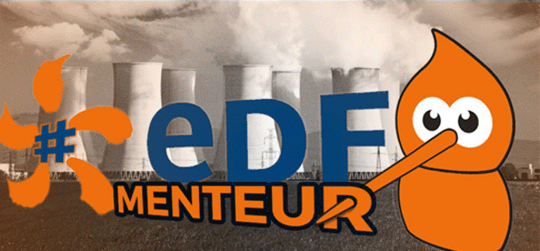 Pressure rises on EDF board over Hinkley Point nuclear plant, FT.com, 19 Apr 16, Michael Stothard in Paris A group of managers at French utility EDF have sent a letter to its board of directors warning they could all face legal action if the company pushes ahead with its contentious Hinkley Point C nuclear project in the UK.
The letter, dated April 19 and seen by the Financial Times, said that if a board decision in favour of Hinkley Point led to the “destruction of the value” at EDF its directors could be held personally responsible……….
French president François Hollande is also meeting ministers at the Élysée Palace on Wednesday to discuss financing options for Hinkley Point. The French state has an 85 per cent stake in EDF.
The letter by the group of EDF managers highlights the internal battle that has raged within the company over Hinkley Point, with chief financial officer Thomas Piquemal resigning last month because of concerns that the UK project could threaten the company’s future…….
Two other nuclear projects in France and Finland using the same reactor technology proposed for Hinkley Point are both severely delayed and billions over budget…….. http://www.ft.com/intl/cms/s/0/d6d16bd0-0628-11e6-9b51-0fb5e65703ce.html#axzz46IzsG72i
EDF’s minority shareholders want French govt to be forced to buy them out.
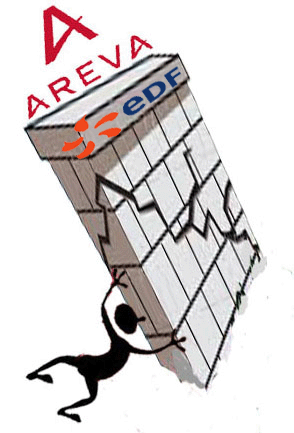 EDF staff investors demands France buys out minorities in nuclear dispute
Staff shareholder group says state abuses majority
* Minorities say EDF used as government policy tool
* EAS fears Hinkley Point will crimp future dividends (Adds detail on dividend, EDF no comment)
Reuters By Geert De Clercq PARIS, April 19 An EDF employee shareholders group has asked the AMF market regulator to force the French state to buy out the utility’s minority shareholders, in a dispute over its plans to build nuclear plants in Britain.
In a letter to the AMF, seen by Reuters on Tuesday, EDF Actionnariat Salarie (EAS) asks the market regulator to consider requiring the state to launch a so-called public withdrawal bid.
EAS alleges that the government is abusing its position as a majority shareholder by forcing EDF to go ahead with building nuclear plants in Britain, which EAS says is too risky for EDF and will prevent it from paying dividends in coming years……..
HINKLEY POINT CONSEQUENCES
EAS argues that in pushing EDF’s 18 billion pound (22.8 billion euros) project to build two reactors at Hinkley Point, in Britain, the government defends the interests of the country’s nuclear industry rather than those of EDF, at the expense of its minority shareholders…….
Hinkley Point is crucial for the survival of reactor builder Areva and France’s many smaller nuclear companies, in an industry that employs about 200,000 people. With three quarters of its power generated by nuclear, France needs no more reactors, and export prospects are limited after the 2011 Fukushima disaster.
“While the state only owns 85 percent of EDF’s capital, it behaves as if it is the sole proprietor and uses the company as a lever for its industrial policy,” EAS said.
It also said the UK project will prevent EDF from paying a dividend for at least seven years……..
On Wednesday, the government will discuss EDF’s finances ahead of an EDF board meeting on Friday. Sources close to the company said the board will review financing options but will not decide on Hinkley Point. (1 euro = 0.7906 pounds) (Editing by Alexander Smith) http://www.reuters.com/article/edf-nuclear-shareholders-idUSL5N17M5CN
UK energy secretary admits energy supply would be OK even if Hinkley nuclear cancelled or delayed
Minister admits lights would stay on even if Hinkley nuclear plant is delayed Guardian, Damian Carrington, 19 Apr 16 UK energy secretary admits for the first time that any delays or cancellations to new nuclear reactors would not compromise national energy supply. The UK’s energy secretary has admitted for the first time that the lights would stay on if new nuclear reactors at Hinkley were cancelled or delayed.
Amber Rudd has previously said that “energy security has to be the number one priority” and that new gas and nuclear power would be “central to our energy-secure future”.
But in a letter released on Tuesday in reply to MPs on the energy and climate change select committee, which asked what contingency plans were in place if Hinkley is delayed or cancelled, she said: “While we have every confidence the deal will go ahead, we have arrangements in place to ensure that any potential delay or cancellation to the project does not pose a risk to security of supply for the UK. I am clear that keeping the lights on is non-negotiable.”
She also said that delays to the troubled plant could risk the UK missing its targets to cut carbon emissions, and that alternatives could cost more but would not represent a “significant increase” in cost in the short term.
The final decision by French-state owned company EDF to go ahead with Hinkley has been repeatedly delayed and the billion of pounds of state subsidies and the feasibility of the giant project have been widely criticised. Last week one of the UK’s major investors, Legal and General, called Hinkley “a total waste of money”………
A report from the government’s National Infrastructure Commission in March found that “smart power – principally built around three innovations, interconnection, storage, and demand flexibility – could save consumers up to £8bn a year by 2030, help the UK meet its 2050 carbon targets, and secure the UK’s energy supply for generations.”
Angus MacNeil, chair of the energy and climate change committee, said: “[Rudd’s] letter shows the government has had to finally concede the need for a Plan B on Hinkley, although the detail is sketchy. New capacity must be brought online in a way that is compatible with our decarbonisation targets. That means limiting the role of fossil fuels and maximising the use of smarter low carbon options to meet demand.”……..
ohn Sauven, Greenpeace’s UK director said: “There is absolutely no reason that the UK could not meet our decarbonisation targets if the government dropped Hinkley and gave renewable energy businesses a fraction of political and financial support that nuclear and fossil fuel companies enjoy.” http://www.theguardian.com/environment/2016/apr/19/minister-admits-lights-would-stay-on-even-if-hinkley-nuclear-plant-is-delayed
Ukraine – insecure, corrupt, – on Chernobyl anniversary – the nuclear danger
For security reasons, Australia has suspended uranium sales to Russia. It seems extraordinary that Australia should now enter into a deal with even more unsafe and unstable Ukraine, in its present war and political crisis.
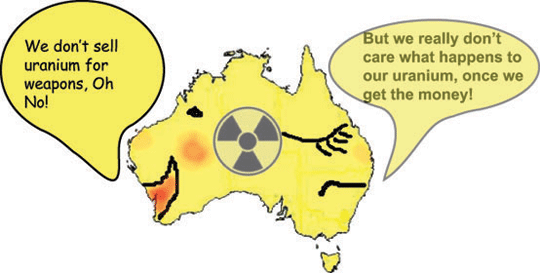
 Four big reasons not to sell uranium to Ukraine https://independentaustralia.net/environment/environment-display/fourbig-reasons-not-to-sell-uranium-to-ukraine,8895 Noel Wauchope 18 April 2016 As the 30th anniversary of the Chernobyl disaster approaches, Noel Wauchope outlines just a few compelling reasons why the Coalition Government’s uranium deal with Ukraine may have further disastrous consequences.
WHAT AMAZINGLY insensitive timing! As the anniversary of the Chernobyl nuclear catastrophe approaches, Australia makes a deal (at the Nuclear Security Summit) to sell uranium to Ukraine.
This is such a bad idea for so many reasons — it’s hard to know which to pick first!
Economics: simply because uranium exporting is not really economically worthwhile.
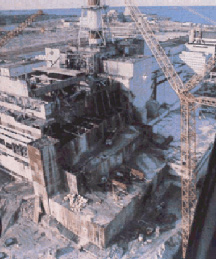 Chernobyl’s plight: because Ukraine’s Chernobyl radioactive disaster is continuing. (We supplied uranium for that other catastrophe — Fukushima.)
Insecurity: Ukraine’s dangerous nuclear industry due to civil war, ageing reactors, risks of smuggling and terrorism.
Political crisis: Ukraine’s notoriously corrupt and unstable political regime.
Let’s check those four reasons.
Economics
The global uranium industry is in a declining state. Price reporting companies describe repeated low and falling uranium prices. Australia’s uranium industry now accounts for 0.2 per cent of national export revenue — and that’s not counting profits that go overseas, due to the high degree of foreign ownership of companies mining uranium in Australia.
Chernobyl’s plight
The 30th anniversary of Ukraine’s Chernobyl nuclear accident is on 26 April 2016. Ukraine is still suffering from, and struggling with, the legacy of that radioactive catastrophe. The conservativeWorld Health Organisation (WHO) estimates the radiation caused deaths at 4,000 — based on itsreport ‘Health Effects of the Chernobyl Accident and Special Health Care Programmes’. The 2016 TORCH (The Other Report on Chernobyl) Report amplifies this discussion (summary here) but all sources agree that no conclusive figure can be given.
The legacy of the accident includes the struggle to contain the radioactivity of the shattered reactor.
Insecurity
This issue of nuclear security is another irony in this uranium sales deal. Julie Bishop and Ukraine President used the meeting of the Nuclear Security Summit in New York to discuss the sale. The focus of the Summit was the need to protect radioactive materials from dangerous zones, and from the risk of terrorists obtaining them.
You couldn’t pick a more dangerous zone than Ukraine
Ukraine’s Zaporizhia nuclear facility is Europe’s largest and is only 200 kilometres from the conflict zone in eastern Ukraine. Already there have been sabotage events that affected its nuclear programme.
All of these events have led to an additional emergency shutdown of the electrical network of two units at thermal power plants – the Dnieper and Uglegorskaya – and the emergency unloading by 500 MW of nuclear power plants in Ukraine. This includes Zaporozhskaya NPP and the South Ukrainian NPP. I want to stress that such emergency unloading of a nuclear plant – it is very dangerous. ~ Senior Ukrainian energy official Yuriy Katich.
Some commentators have described nuclear plants in the region as pre-deployed nuclear targets and there have already been armed incursions during the recent conflict period.
Bankwatch recently listed 10 reasons why Ukraine’s nuclear power stations are a security danger for Europe. These include Ukraine’s ageing reactors – some already having exceeded their planned lifespan – and restrictions on the nuclear regulator’s ability to inspect reactors. Bankwatch regards Ukraine as a huge financial risk to Europe:
The European Commission, the European Parliament, and EU governments – particularly in neighouring countries that could be affected by the Ukrainian government’s reckless nuclear adventure – need to demand Ukraine complies with its international obligations, especially when EU public money is involved.
Petro Poroshenko’s Government is responding to Bankwatch’s criticism with a lawsuit against Bankwatch’s member group National Ecological Centre of Ukraine (NECU), in an attempt to silence criticism and avoid public scrutiny. Organisations in five European countries have joined in a campaign for transparency about Ukraine’s nuclear programme.
Even Ukraine’s own Progress Report to the Nuclear Security Summit admits some safety problems, listing over 1400 sources of ionising radiation that are not under regulatory control.
Ukraine now has a messy and competitive nuclear power system, in which Western companiesAREVA and Westinghouse compete in marketing and upgrading nuclear reactors and lobby to sell nuclear fuel. But Russia actually controls the fuel supply, providing nuclear fuel to 13 out of Ukraine’s 15 reactors.
Ukraine is just next door to Moldova, the heart of a 2014 nuclear smuggling gang. With Ukraine’s secretive nuclear arrangements, and inadequate regulatory system, the possibility of theft of radioactive materials is a real one in Ukraine.
Political crisis
Oligarchs are reported to control 70 per cent of the state’s economy. The country has been described as a “cleptocracy” —with so much intrigue amongst corrupt politicians and oligarchs that it’s called “Ukraine’s Deep State”.
President Petro Poroshenko himself is a very successful businessman, whose business assets have increased over the past year. Before the last election, Poroshenko pledged to sell his company Roshen but now refuses to do so. He also owns a major TV channel. His private assets are larger than those of any other European leader. Poroshenko is currently involved in a real estate scandal.
Along with lawmaker and business partner Ihor Kononenko, Poroshenko is co-owner of the International Investment Bank. Kononenko is accused of being involved in a laundering scheme that moves money from Ukrprominvest (a group founded by Kononenko and Poroshenko) to the British Virgin Islands through offshore companies Intraco Management Ltd and Ernion. Economy Minister Aivaras Abromavicius, who worked to expose political corruption, resigned in disgust on 3 February, saying:
“Neither me nor my team have any desire to serve as a cover-up for the covert corruption, or become puppets for those who, very much like the “old” government, are trying to exercise control over the flow of public funds”.
Aivaras claimed that Prime Minister Mr Yatsenyuk and Mr Poroshenko were blocking reforms aimed at tackling corruption. Ukraine Prime Minister Arseniy Yatsenyuk resigned suddenly on 11 April, under pressure from Poroshenko, who has replaced him with close associate, Volodymyr Groysman. Several reformers from Ukraine’s previous government are departing after declining to serve under Mr Groysman.
The West is watching the Ukrainian regime carefully. The IMF has been providing a $17.5 billion support scheme to cash-strapped Ukraine but has put it on hold, due to the corruption and instability of the regime.
Early this month, the Netherlands held a referendum regarding a potential Ukraine-EU treaty on closer political and economic ties. A whopping 61 per cent (2.509 million people) voted against Ukraine’s association with the EU. European nations, as well as many Ukrainians share in loss of confidence in the government, following this referendum as well as revelations of scandals in the Prosecutor General’s Office.
All this concern came to a head with the revelations of the Panama Papers, in which President Poroshenko figures largely. Unlike Iceland’s President, Poroshenko has no intention of resigning. The West has been very quiet about the allegations against him — presumably they support anyone who is opposed to Russia’s Putin.
Poroshenko claims that his financial arrangements have all been legal. But not everyone agrees with that. Igor Lutsenko, a member of Verkhovna Rada, Supreme Council of Ukraine, outlines how Poroshenko violated Ukrainian law in setting up the British Virgin Islands firm.
For security reasons, Australia has suspended uranium sales to Russia. It seems extraordinary that Australia should now enter into a deal with even more unsafe and unstable Ukraine, in its present war and political crisis.
No doubt the federal parliament’s influential Joint Standing Committee on Treaties (JSCOT) will examine the planned deal, that Julie Bishop signed up to in New York with Ukrainian Energy and Coal Industry Minister Volodymyr Demchyshyn.
JSCOT recently warned against the agreement to sell uranium to India but its recommendations were ignored by the Coalition Government. Here’s hoping that there will be scrutiny on the Ukrainian agreement and that the government will pay attention.
USA Democrats probing oil companies’ campaign against action on climate change
Dem AGs mounting Big Tobacco-style probe of oil companies, industry fights back By Jennifer G. Hickey April 12, 2016 FoxNews.com Democratic officials’ campaign against fossil fuel companies is entering a new phase as state attorneys general launch investigations that mirror the Justice Department’s landmark case against “Big Tobacco,” probing claims that oil companies misled the public about the risks of global warming — a charge industry representatives adamantly reject.
Massachusetts and the U.S. Virgin Islands are the latest to announce probes, specifically into whether ExxonMobil was up-front regarding what it knew about climate change.
“Fossil fuel companies that deceived investors and consumers about the dangers of climate change should be held accountable. That’s why we have joined in investigating ExxonMobil,” Massachusetts Attorney General Maura Healey said in announcing the inquiry.
The announcements follow a similar investigation by New York Attorney GeneralEric T. Schneiderman, who subpoenaed Exxon’s financial records and emails last November. Schneiderman has indicated ExxonMobil is not the only energy company in his office’s crosshairs, vowing to prosecute any that committed fraud to maximize profit at the public’s  expense “to the fullest extent of the law.”
Yet industry representatives and their allies say what’s really going on is a coordinated attempt to silence climate change skeptics while punishing the industry itself for society’s use of fossil fuels, all based on spurious claims of a cover-up. Exxon representatives say the accusations against the oil giant are “laughable” and “not credible,” blasting recent news reports that assert the industry tried to mislead the public about global warming dangers. …….. http://www.foxnews.com/politics/2016/04/12/dem-ags-mounting-big-tobacco-style-probe-oil-companies-industry-fights-back.html
Plymouth needs an unbiased Nuclear Committee to advise on decommissioning Pilgrim Nuclear Power Station
 Rash of resignations from the Nuclear Matters Committee Forget the nuclear power plant, the town’s Nuclear Matters Committee is decommissioning itself. Wicked Local Plymouth By Frank Mand
fmand@wickedlocal.com Apr. 14, 2016
PLYMOUTH – Forget the nuclear power plant, the town’s Nuclear Matters Committee is decommissioning itself.
Long-time member and chair Jeff Berger resigned last year, or at least thought he had. According to the town clerk it’s not official. Committee member Rich Grassie followed shortly thereafter, to devote his energy to another project.Chairman Rich Rothstein offered his letter of resignation earlier this year, and then committee member Heather Lightner did the same.
The full committee is supposed to have nine-members so today – including Berger who is technically still on the committee – they barely have enough members to reach a quorum (five) and hold a meeting.
So does the Nuclear Matters Committee still matter?
Brian Sullivan, a senior fellow at the American Leadership and Policy Foundation who writes a column on safety issues, including nuclear power topics, for the Old Colony Memorial, says it couldn’t have happened at a worse time.
“We in Plymouth are at a critical juncture when it comes to the decommissioning of the Pilgrim Nuclear Power Station,” Sullivan told the Old Colony last month. “Unfortunately, we are suffering a brain-drain at the same time.”
Sullivan suggests the resignations might be due to the committee’s lack of independence.
“We know from his recent commentary,” Sullivan said, “that former NMC Chairman Jeff Berger is pleased to now be able to speak out without having to be concerned about political reservations.”
It may not be that simple though………
Lightner, one of the newest members and the last to resign is also the most skeptical of those who recently resigned about the committee’s continued relevance.
“Although the Nuclear Matters Committee has a wealth of knowledge related to nuclear power and nuclear engineering, the committee is seriously lacking a diverse membership,” Lightner told the Old Colony. “If the NMC is to continue and bring value to the town, it must include more members who can speak to environmental issues, economic factors and development, and health and safety as part of the decommissioning conversation and decision-making process.”
Lightner would also like to see the selectmen, who appoint all committee members, limit the number of members who are associated with the nuclear industry or Entergy in particular and institute term limits to encourage new ideas and a balanced decommissioning discussion.
“Otherwise, the NMC should be dissolved,” Lightner said. “Perhaps the best plan is to appoint a brand new, more diverse group focused specifically on decommissioning, which could then advise the Entergy Working Group and Board of Selectmen.”
But even the town seems to be moving away from the committee…….http://plymouth.wickedlocal.com/article/20160414/NEWS/160418679/?Start=2
Hillary Clinton calls Donald Trump “reckless” on nuclear policy
Clinton blasts Trump’s ‘dangerous’ nuclear talk, Politico By NICK GASS 04/14/16 Hillary Clinton ratcheted up her attacks on Donald Trump’s national security expertise Thursday with a blistering New York Daily News op-ed in which she laid out her nuclear proposals and called his statements perhaps the “most reckless” from “any major presidential candidate in modern history.”Referring to Trump’s frequent insistence that the United States needs “unpredictability” from a commander in chief and that he would not take the nuclear option “off the table,” Clinton said Trump would risk a dangerous arms race in East Asia and in the Middle East. The Republican front-runner said late last month that he would consider withdrawing U.S. forces from both countries and suggested that both nations should arm themselves with nuclear weapons.
“Trump’s policies would reverse decades of bipartisan consensus. Even letting friendly nations go nuclear would make it harder for us to prevent rogue regimes from doing the same,” the former secretary of state wrote in the Daily News, which on Wednesday endorsed her over Bernie Sanders.
Clinton also noted that the terrorists involved in last month’s Brussels attacks had been monitoring a Belgian nuclear scientist and nuclear plant, calling it “a chilling warning that ISIS may be pursuing the sabotage of a nuclear site or acquisition of material to make a dirty bomb.”……….http://www.politico.com/blogs/2016-dem-primary-live-updates-and-results/2016/04/hillary-clinton-trump-national-security-221942
Hillary Clinton unsuited to task of confronting climate change, too enmeshed in corporate thinking
So let’s forget the smoking guns for the moment. The problem with Clinton World is structural. It’s the way in which these profoundly enmeshed relationships—lubricated by the exchange of money, favors, status, and media attention—shape what gets proposed as policy in the first place…….
At the center of it all is the canonical belief that change comes not by confronting the wealthy and powerful but by partnering with them.
The Problem With Hillary Clinton Isn’t Just Her Corporate Cash. It’s Her Corporate Worldview.
Clinton is uniquely unsuited to the epic task of confronting the fossil-fuel companies that profit from climate change. The Nation By Naomi Klein Twitter APRIL 6, 2016
But that’s not all. There is also a lot more money from sources not included in those calculations. For instance, one of Clinton’s most prominent and active financial backers is Warren Buffett. While he owns a large mix of assets, Buffett is up to his eyeballs in coal, including coal transportation and some of the dirtiest coal-fired power plants in the country.
Then there’s all the cash that fossil-fuel companies have directly pumped into the Clinton Foundation. In recent years, Exxon, Shell, ConocoPhillips, and Chevron have all contributed to the foundation. An investigation in theInternational Business Times just revealed that at least two of these oil companies were part of an effort to lobby Clinton’s State Department about the Alberta tar sands, a massive deposit of extra-dirty oil. Leading climate scientists like James Hansen have explained that if we don’t keep the vast majority of that carbon in the ground, we will unleash catastrophic levels of warming.
During this period, the investigation found, Clinton’s State Department approved the Alberta Clipper, a controversial pipeline carrying large amounts of tar-sands bitumen from Alberta to Wisconsin. “According to federal lobbying records reviewed by the IBT,” write David Sirota and Ned Resnikoff, “Chevron and ConocoPhillips both lobbied the State Department specifically on the issue of ‘oil sands’ in the immediate months prior to the department’s approval, as did a trade association funded by ExxonMobil.”
Did the donations to the Clinton Foundation have anything to do with the State Department’s pipeline decision? Did they make Hillary Clinton more disposed to seeing tar-sands pipelines as environmentally benign, as early State Department reviews of Keystone XLseemed to conclude, despite the many scientific warnings? There is no proof—no “smoking gun,” as Clinton defenders like to say. Just as there is no proof that the money her campaign took from gas lobbyists and fracking financiers has shaped Clinton’s current (and dangerous) view that fracking can be made safe.
It’s important to recognize that Clinton’s campaign platform includes some very good climate policies that surely do not please these donors—which is why the fossil-fuel sector gives so much more to climate change–denying Republicans.
Still, the whole funding mess stinks, and it seems to get worse by the day. So it’s very good that the Sanders camp isn’t abiding by Krugman’s “guidelines for good behavior” and shutting up about the money in a year when climate change has contributed to the hottest temperatures since records began. This primary isn’t over, and Democratic voters need and deserve to know all they can before they make a choice we will all have to live with for a very long time……..
The mission of the Clinton Foundation can be distilled as follows: There is so much private wealth sloshing around our planet (thanks in very large part to the deregulation and privatization frenzy that Bill Clinton unleashed on the world while president), that every single problem on earth, no matter how large, can be solved by convincing the ultra-rich to do the right things with their loose change. Naturally, the people to convince them to do these fine things are the Clintons, the ultimate relationship brokers and dealmakers, with the help of an entourage of A-list celebrities.
So let’s forget the smoking guns for the moment. The problem with Clinton World is structural. It’s the way in which these profoundly enmeshed relationships—lubricated by the exchange of money, favors, status, and media attention—shape what gets proposed as policy in the first place…….
At the center of it all is the canonical belief that change comes not by confronting the wealthy and powerful but by partnering with them.
Viewed from within the logic of what Thomas Frank recently termed “the land of money,” all of Hillary Clinton’s most controversial actions make sense. Why not take money from fossil-fuel lobbyists? Why not get paid hundreds of thousands for speeches to Goldman Sachs? It’s not a conflict of interest; it’s a mutually beneficial partnership—part of a never-ending merry-go-round of corporate-political give and take.
Books have been filled with the failures of Clinton-style philanthrocapitalism. When it comes to climate change, we have all the evidence we need to know that this model is a disaster on a planetary scale. This is the logic that gave the world fraud-infested carbon markets and dodgy carbon offsets instead of tough regulation of polluters—because, we were told, emission reductions needed to be “win-win” and “market-friendly.”
If the next president wastes any more time with these schemes, the climate clock will run out, plain and simple……http://www.thenation.com/article/the-problem-with-hillary-clinton-isnt-just-her-corporate-cash-its-her-corporate-worldview/
Bernie Sanders understands what needs to be done about climate change
The Problem With Hillary Clinton Isn’t Just Her Corporate Cash. It’s Her Corporate Worldview.
Clinton is uniquely unsuited to the epic task of confronting the fossil-fuel companies that profit from climate change. The Nation By Naomi Klein Twitter APRIL 6, 2016
“…….. If we’re to have any hope of avoiding catastrophe, action needs to be unprecedented in its speed and scope. If designed properly, the transition to a post-carbon economy can deliver a great many “wins”: not just a safer future, but huge numbers of well-paying jobs; improved and affordable public transit; more liveable cities; as well as racial and environmental justice for the communities on the frontlines of dirty extraction.
Bernie Sanders’s campaign is built around precisely this logic: not the rich being stroked for a little more noblesse oblige, but ordinary citizens banding together to challenge them, winning tough regulations, and creating a much fairer system as a result.
Sanders and his supporters understand something critical: it won’t all be win-win.
Sanders and his supporters understand something critical: It won’t all be win-win. For any of this to happen, fossil-fuel companies, which have made obscene profits for many decades, will have to start losing. And losing more than just the tax breaks and subsidies that Clinton is promising to cut. They will also have to lose the new drilling and mining leases they want; they’ll have to be denied permits for the pipelines and export terminals they very much want to build. They will have to leave trillions of dollars’ worth of proven fossil-fuel reserves in the ground.
Meanwhile, if solar panels proliferate on rooftops, big power utilities will lose a significant portion of their profits, since their former customers will be in the energy-generation business. This would create opportunities for a more level economy and, ultimately, for lower utility bills—but once again, some powerful interests will have to lose (which is why Warren Buffett’s coal-fired utility in Nevada has gone to war against solar).
A president willing to inflict these losses on fossil-fuel companies and their allies needs to be more than just not actively corrupt. That president needs to be up for the fight of the century—and absolutely clear about which side must win. Looking at the Democratic primary, there can be no doubt about who is best suited to rise to this historic moment.
The good news? He just won Wisconsin. And he isn’t following anyone’s guidelines for good behavior. http://www.thenation.com/article/the-problem-with-hillary-clinton-isnt-just-her-corporate-cash-its-her-corporate-worldview/
France suggests UK’s Hinkley Point nuclear project could still be postponed
Hinkley Point nuclear project could still be postponed http://www.theweek.co.uk/60778/hinkley-point-nuclear-project-could-still-be-postponed
Delaying £18bn development is ‘up for discussion’, says France’s Segolene Royal Plans to build the world’s most expensive nuclear power station at Hinkley Point, near Somerset, could hit further delays, a French government official has hinted. Speaking during a radio interview this week, ecology minister Segolene Royal was asked whether the £18bn project, which is two-thirds funded by French state-backed energy giant EDF, would be postponed. She responded by stating simply that it is “still under discussion”, says The Guardian.
“There’s an agreement between France and Britain so things should go ahead. But the trade unions are right to ask for the stakes to be re-examined,” Royal said.
In particular, there should be “further proof” that the venture would not affect investment in renewable energy, she added.
Last week, the Financial Times reported that a group of senior engineers at EDF had circulated a white paper among executives calling for a delay of at least two years to overcome deficiencies in design and the “very low” competency of fellow state-owned reactor supplier, Areva. Board member and employee director Christian Taxil has also publicly called for the plans to be postponed.
Supporters for the deal include the British government, which has staked its reputation on Hinkley Point as the core part of its carbon-light energy strategy for future decades, and French economy minister Emmanuel Macron, who has said it will almost certainly get approval at an EDF investor meeting next month.
The incentives for the company are long-term and come in the form of an energy price guarantee that is almost three times current wholesale prices. A new agreement also offers £20bn protection against a future UK government pulling the plug.
The FT reports that 100 EDF engineers also responded to their colleagues concerns by issuing an open letter stating that the company can “build and deliver the two Hinkley Point reactors on time”.
1 This Month
23-25 October – on Zoom – World BEYOND War’s annual global conferenc

To see nuclear-related stories in greater depth and intensity – go to https://nuclearinformation.wordpress.com

Say No to NASA’s Reckless Nuclear Reactor on the Moon
Say No to NASA’s Reckless Nuclear Reactor on the Moon
-
Archives
- October 2026 (160)
- September 2026 (339)
- August 2026 (330)
- July 2026 (355)
- June 2026 (287)
- May 2026 (306)
- April 2026 (356)
- March 2026 (251)
- February 2026 (267)
- January 2026 (308)
- December 2025 (358)
- November 2025 (359)
-
Categories
- 1
- 1 NUCLEAR ISSUES
- business and costs
- climate change
- culture and arts
- ENERGY
- environment
- health
- history
- indigenous issues
- Legal
- marketing of nuclear
- media
- opposition to nuclear
- PERSONAL STORIES
- politics
- politics international
- Religion and ethics
- safety
- secrets,lies and civil liberties
- spinbuster
- technology
- Uranium
- wastes
- weapons and war
- Women
- 2 WORLD
- ACTION
- AFRICA
- Atrocities
- AUSTRALIA
- Christina's notes
- Christina's themes
- culture and arts
- Events
- Fuk 2022
- Fuk 2023
- Fukushima 2017
- Fukushima 2018
- fukushima 2019
- Fukushima 2020
- Fukushima 2021
- general
- global warming
- Humour (God we need it)
- Nuclear
- RARE EARTHS
- Reference
- resources – print
- Resources -audiovicual
- Weekly Newsletter
- World
- World Nuclear
- YouTube
-
RSS
Entries RSS
Comments RSS

