Nuclear split between Clinton and Sanders
 New York nuclear plant’s future further divides Sanders and Clinton
Sanders says Indian Point facility is ‘a catastrophe waiting to happen’, but former New York senator says he’s late to the issue and site simply needs more oversight, Guardian, Alan Yuhas 8 Apr 16. The Indian Point Energy Center, a controversial and ageing nuclear plant near New York City, has split the Democratic presidential candidates .
As campaigning continued before the New York primary on 19 April, Bernie Sanders called the facility “a catastrophe waiting to happen”. Hillary Clinton said only that it needed more oversight.
A senior member of the Union of Concerned Scientists told the Guardian “the whole New York metropolitan area is potentially imperiled by an accident at Indian Point”.
Last week, the company that runs Indian Point revealed that 227 bolts holding the interior of a nuclear reactor at the site have “degraded” or gone missing. In February, the plant reported that a radioactive material, tritium, had leaked into groundwater.
The plant, about 40 miles north of midtown Manhattan on the eastern bank of the Hudson river, has a 40-year history of accidents, fires and complaints. Governor Andrew Cuomo ordered an investigation into February’s “unacceptable” leak. He has called for the plant to close.
“In my view, we cannot sit idly by and hope that the unthinkable will never happen,” Sanders said in a statement. “It makes no sense to me to continue to operate a decaying nuclear reactor within 25 miles of New York City where nearly 10 million people live.”
The Vermont senator elaborated on his stance, calling for the US to phase out nuclear plants along with more polluting resources such as fossil fuels.
“Nuclear power is and always has been a dangerous idea because there is no good way to store nuclear waste,” he said………
The disagreement between Sanders and Clinton mirrors their stances on fracking for natural gas. The senator has called for a ban, citing growing evidence that drilling causes earthquakes. The former secretary of state has called for intense regulation of the industry.
“I want the federal government to regulate much more toughly than we have in the past,” she said on Monday.
In 2014 Cuomo signed a law that banned fracking in New York. http://www.theguardian.com/environment/2016/apr/07/bernie-sanders-hillary-clinton-indian-point-nuclear-plant
Bernie Sanders’ strategy for phasing out nuclear power
Bernie Sanders Wants to Phase Out Nuclear Power, Mother Jones, What would replace it?—By Ben Adler Tue Apr. 5, 2016“………The aging nuclear fleet in the US is becoming increasingly uneconomical. “As reactors get older, they get more expensive to maintain. It’s not competitive with renewables or natural gas,” says Matthew McKinzie, a nuclear energy expert and advisor to the Natural Resources Defense Council Action Fund. “By mid-century, we might have 20 reactors operating.”
Getting older nuclear plants in good enough shape to get relicensed can be expensive, as environmental and safety standards have been raised since the plants were built. Renewables advocates argue that the money could be put to better uses…….
HOW THE NUCLEAR PHASEOUT FITS INTO SANDERS’ BIGGER PLAN
Sanders’ critics are right to note that under the current set of policies in place in the US, renewables won’t account for a majority of our energy portfolio for at least another two decades, so it’s not safe to assume that a retired nuclear plant would be replaced by clean energy. In that context, lopping 20 years off the life of a nuclear reactor may very well mean higher carbon emissions than if you relicensed it.
But Sanders’ desire to phase out nuclear power makes a lot more sense in the context of his broader climate and energy plan. He would make fossil fuels more expensive through a carbon tax, and make major investments in clean energy, so renewables would be better poised to replace power lost from shuttered nuclear plants.
The sticking point, of course, is that even if Sanders got to the White House, he wouldn’t get a cooperative Congress, so his larger climate plan would not be enacted. In that case, deciding whether to relicense nuclear plants would be a trickier matter.
The Sanders campaign declined to comment directly on what Sanders would do if he were president and found himself in that situation, offering only this emailed statement from spokesman Karthik Ganapathy: “Sen. Sanders knows there are lots of reasons why nuclear power is a bad idea. Whether it’s the exceptional destructiveness of uranium mining, the fact that there’s no good way to store nuclear waste or the lingering risk of a tragedy like Fukushima or Chernobyl in the US, the truth is: nuclear power is a cure worse than the disease. Safer, cleaner energy sources like wind and solar will help us meet America’s energy needs while protecting the health of our people and combatting the threat of climate change.”
Those views put Sanders right in line with environmental groups like the Sierra Cluband Greenpeace, which oppose nuclear power across the board……http://www.motherjones.com/environment/2016/04/grist-bernie-sanders-wants-to-phase-out-nuclear-power-plants
Close Indian Point nuclear station, wean off nuclear power – Bernie Sanders
Bernie Sanders calls for closing Indian Point nuclear facility, wean off nuclear energy http://www.utilitydive.com/news/bernie-sanders-calls-for-closing-indian-point-nuclear-facility-wean-off-nu/416842/ By Robert Walton | April 5, 2016
Dive Brief:
- Presidential candidate Bernie Sanders is calling for Indian Point, the controversial nuclear plant near New York City, to be closed down over safety concerns, just weeks ahead of the state’s Democratic primary, NBC News reports.
- Sanders will face fellow candidate Hillary Clinton, who has been critical of the plant but has called for making it safer rather than closing it down entirely.
- Sanders is the only presidential candidate calling for an end to nuclear power; he wants the United States to grow its renewable resources like wind and solar instead.
Dive Insight:
Entergy’s Indian Point nuclear facility has become an issue in the Presidential race, with Democratic candidate Bernie Sanders saying the plant is too near New York City to be safely operated.
“I am very concerned that the Indian Power nuclear power reactor is more than ever before a catastrophe waiting to happen,” Sanders said in a statement issued yesterday. “In my view, we cannot sit idly by and hope that the unthinkable will never happen. We must take action to shut this plant down in a safe and responsible way. It makes no sense to me to continue to operate a decaying nuclear reactor within 25 miles of New York City where nearly 10 million people live.”
New York Gov. Andrew Cuomo (D) has pushed to shutter the facility over safety concerns, and in February called for an investigation into the plant after monitoring weeks showed it was leaking contaminated water. Entergy has maintained the plant is safe and the power is essential to the region.
But while Cuomo supports Entergy’s continued operation of other nuclear units in the state, Sanders has established himself as the only candidate calling for the United States to move entirely away from nuclear power.
“Even in a perfect world where energy companies didn’t make mistakes, nuclear power is and always has been a dangerous idea because there is no good way to store nuclear waste,” he said in his statement. “That is why the United States must lead the world in transforming our energy system away from nuclear power and fossil fuels.”
Sanders will face Hillary Clinton in the New York Democratic primary later this month. Clinton, who lives less than 20 miles from the plant, has been critical of the facility but does not want to see it shut down and instead has called for improving operations at the facility.
Lawmakers want Entergy to pay its fair share of tax
Westchester OKs Indian Point tax deal http://www.lohud.com/story/news/local/westchester/2016/04/05/westchester-oks-indian-point-tax-deal/82635322/ Mark Lungariello, mlungariel@lohud.com
Entergy agrees to pay almost $4 million for 2015, but some lawmakers wanted a more equitable deal running through 2024.
The owners of Indian Point Energy Center will pay Westchester County more per year in a new tax deal approved Monday, although some lawmakers questioned if the company is really paying its fair share under the agreement.
The county Board of Legislators approved in a 12-4 vote a new payment in lieu of taxes, or PILOT, for the two active nuclear reactors and an adjacent building at Indian Point in Buchanan. The land is property-tax exempt and the plant’s owner, Entergy, instead pays a set fee negotiated with the municipality.
The new deal runs through 2024, with Entergy’s payment increasing annually by the lesser amount of the New York state tax cap or 2 percent. Under the deal, the company agreed to pay almost $4 million to Westchester backdated for 2015 after paying $3.1 million in the final year of its last PILOT.
Legislator Catherine Parker, a Rye Democrat, voted against the PILOT after a public hearing during which no members of the public spoke.
“We want to make sure that we have an equitable situation for the taxpayer and for the entity,” she said.
Legislature Chairman Michael Kaplowitz, a Somers Democrat who also voted against the measure, had sought to renegotiate the terms so that the PILOT was tied more directly to the county’s annual tax increase or decrease.
The expired PILOT, he said, was agreed to during an uncertain time for nuclear facilities. Under that agreement, Indian Point’s owner paid $3.4 million in 2003 but that payment decreased to a low of $2.6 million in 2007 before bouncing back up.
Entergy bought Unit 2 from Con Edison and Unit 3 from NYPA. Unit 1 is no longer in use. The company has separate PILOTs already approved by the town of Cortlandt, the village of Buchanan and the Hendrick Hudson school district.
Donald Trump – very good at contradicting himself on nuclear and fossil fuel issues
Trump contradicts himself on nuclear weapons – as it happened, Guardian, Alan Yuhas, 4 Apr 16, “……
- Donald Trump suggested that Japan and South Korea should build nuclear weapons or pay protection fees to the US – and then said his greatest fear is the proliferation of nuclear weapons.
- “Maybe they would be better off if they defended themselves from North Korea,” he said in one interview. “I think if somebody gets nuclear weapons that’s a disaster,” he said in another……..
- The senator also defended his claims that Clinton receives millions in donations from fossil fuel interests, although employees of the industry have given her about $308,000 and him about $54,000. He cited a Greenpeace study that links the contributions of lobbyists, fundraisers and Super Pacs to the industry………http://www.theguardian.com/us-news/live/2016/apr/03/donald-trump-ted-cruz-republicans-wisconsin-sanders-clinton-live
Only Bernie Sanders has taken a principled position on nuclear weapons
The new nuclear arms race , LA Times, 3 Apr 16 Doyle McManus Contact Reporter
“………Sen. Bernie Sanders has said he thinks the modernization plan is a waste of money. Hillary Clinton has suggested that she’s worried about the cost, but hasn’t taken a firm position. Sen. Ted Cruz has said he wants to spend more money on defense, including nuclear weapons.
And Donald Trump? When conservative radio host Hugh Hewitt asked Trump for his position on the nuclear triad last year, the businessman was flummoxed.
“For me, nuclear is just the power,” Trump replied. “The devastation is very important to me.”
We deserve better answers. It’s a matter of survival.
doyle.mcmanus@latimes.com http://www.latimes.com/opinion/op-ed/la-oe-0403-mcmanus-nuclear-danger-20160403-column.html
TIME analyses Donald Trump’s ill-informed opinions on nuclear security
Trump Wants to Free the Nuclear Genie, TIME, Mark Thompson @MarkThompson_DC March 30, 2016 Policy would mark a major, and dangerous, shift in U.S. foreign policy
As the world’s leaders gather Thursday in Washington for a two-day Nuclear Security Summit dedicated to keep such weapons in check, Republican presidential candidate Donald Trump is once again shaking things up: he argues that U.S. allies should build their own nuclear weapons so they no longer have to rely on an impoverished America’s atomic umbrella.
It’s amazing his defense of campaign manager Cory Lewandowski, charged with grabbing a reporter Mar. 8, is getting more attention than his suggestion that it may be time for Japan and South Korea to outfit themselves with nuclear arms to counter the threat posed by North Korea.
“Every President since Harry Truman has tried to stop other nations from going nuclear,” says Joseph Cirincione, president of the Ploughshares Fund, a non-profit group dedicated to reducing the threat posed by nuclear weapons. “John F. Kennedy started the effort to get the Non-Proliferation Treaty because Japan and Germany—countries we had just defeated in war—were researching nuclear weapon programs. We stopped them, and South Korea and dozens of other nations. And now Trump wants give them the bomb? This is insane.”
Trump actually backed into this mess. “Biggest problem, to me, in the world, is nuclear, and proliferation,” he told the New York Times last Friday. But he made clear on Tuesday that letting Japan and South Korea develop their own nuclear deterrent may be the best way to handle North Korea. “At some point we have to say, you know what, we’re better off if Japan protects itself against this maniac in North Korea, we’re better off, frankly, if South Korea is going to start to protect itself,” he told CNN. “Wouldn’t you rather, in a certain sense, have Japan have nuclear weapons when North Korea has nuclear weapons?”
Trump doubled down Wednesday, when he refused to say he wouldn’t use a nuclear weapon somewhere in Europe or the Middle East. “I’m not going to take it off the table,” he told MSNBC’s Chris Matthews. To do so, he suggested, would weaken U.S. deterrence. “Why are we making them?” he asked of the nation’s thousands of atomic weapons. Then he made a rhetorical U-turn: “I’m not going to use nuclear, but I’m not taking any cards off the table.”
Trump’s approach to nuclear matters seems to be a work in progress. He appeared ignorant about the bomber, submarine and ICBM legs of the U.S. nuclear triad in a December debate. Tuesday, he cited his purchase of “thousands” of South Korean televisions—“because I am in the real estate business, you know, in my other life”—to suggest South Korea is smart and rich enough to build its own nuclear arsenal. And he mentioned an uncle, John G. Trump, who was a professor at MIT, to lend credence to his nuclear insights.
Like many of Trump’s proposals, there’s a certain initial logic to his push to free the nuclear genie in east Asia. He cites the $19 trillion U.S. debt as the key reason for surrendering the U.S. nuclear shield over east Asia. “We can’t afford it anymore,” he told CNN Tuesday. “It’s very simple.”
But the entire U.S. nuclear arsenal accounts for only about 10% of the Pentagon’s annual $600 billion budget—and nearly all of that nuclear spending would have to continue to deter China and Russia. The added cost to tuck Japan and South Korea under the U.S. nuclear umbrella is minimal. The far bigger costs are the conventional, non-nuclear forces the U.S. has in both countries. There are about 53,000 military personnel (39,000 onshore and 14,000 afloat in nearby waters), 43,000 dependents, and 5,000 Pentagon civilian employees in Japan (the $1.6 billion that Tokyo pays Washington annually for their presence foots only a portion of their cost). Seoul pays about half as much to support the nearly 30,000 U.S. troops based on South Korean soil.
But the ultimate downside to Trump’s stance is so great that his arguments collapse. The first is that the U.S. benefits greatly in terms of trade from a stable east Asia, something a regional nuclear-arms race could throw into a tailspin. The U.S. has been the key guarantor of stability in the region since World War II. The economic benefits Americans get from such trade eclipses by far the cost of U.S. military support in the neighborhood…….http://time.com/4276960/trump-wants-to-free-the-nuclear-genie/
Obama expresses the widely held concerns of national leaders, about Donald Trump’s nuclear comments
Obama Rebukes Donald Trump’s Comments on Nuclear Weapons, NYT, By MARK LANDLER APRIL 1, 2016 WASHINGTON — President Obama on Friday questioned Donald J. Trump’s fitness for office after statements from the Republican front-runner that the United States and its allies should move away from decades of constraints on the use of nuclear weapons. “We don’t want somebody in the Oval Office who doesn’t recognize how important that is,” Mr. Obama said.
Speaking to reporters at the end of a summit meeting devoted to nuclear security, the president said the comments by Mr. Trump reflected a person who “doesn’t know much about foreign policy or nuclear policy or the Korean Peninsula or the world in general.”
Mr. Obama has not hesitated to criticize Mr. Trump for contributing to a coarse tone and circuslike atmosphere on the campaign trail. But his criticism of the candidate’s comments on nuclear proliferation was not about public language or personal style, but about one of the gravest responsibilities of an American president. It carried an extra edge because it involved an issue that Mr. Obama has made a central goal of his presidency.
He said world leaders and other participants at the conference had expressed concerns about Mr. Trump’s comments during private conversations with him at the summit meeting, which gathered more than 50 world leaders to discuss ways to reduce the threat of a nuclear attack, whether from the leakage of nuclear fuel or the theft of a bomb by a terrorist group………http://www.nytimes.com/2016/04/02/world/middleeast/obama-nuclear-security-summit-iran.html?_r=0
Warns of persistent threat of nuclear terrorism
US President Barack Obama holds nuclear summit, focusing on Islamic State and North Korea APRIL 2, 2016 Anna Caldwell in Washington DC news.com.au News Corp Australia Network US President Barack Obama has warned of a persistent threat of terrorists getting their hands on nuclear materials despite progress in reducing such risks, and called on world leaders to do more to safeguard nuclear facilities.
Obama cited concerns about groups such as al-Qaeda and Islamic State trying to obtain nuclear materials, saying this was no time for the international community to be complacent.
Obama was hosting more than 50 world leaders for his fourth and final summit focused on efforts to lock down vulnerable atomic materials to prevent nuclear terrorism……
US President Barack Obama has warned of a persistent threat of terrorists getting their hands on nuclear materials despite progress in reducing such risks, and called on world leaders to do more to safeguard nuclear facilities.
“There is no doubt that if these madmen ever got their hands on a nuclear bomb or nuclear material, they would certainly use it to kill as many people as possible,” he told a global nuclear security summit in Washington DC.
Obama cited concerns about groups such as al-Qaeda and Islamic State trying to obtain nuclear materials, saying this was no time for the international community to be complacent.
Obama was hosting more than 50 world leaders for his fourth and final summit focused on efforts to lock down vulnerable atomic materials to prevent nuclear terrorism…….http://www.news.com.au/world/us-president-barack-obama-tells-world-leaders-to-stand-against-north-koreas-nuclear-strength/news-story/80c17b166c9c1974b042b04d9af7eda8
Donald Trump and Ted Cruz agree on undoing Obama’s climate action work
Trump, Cruz vow to undo Obama environmental work, The Hill, By Devin Henry – 03/30/16 GOP presidential candidates Donald Trump and Ted Cruz are pledging to undo several Obama administration climate efforts and block future work on global warming if elected this fall.
In responding to a survey from the American Energy Alliance, both candidates said they would undo major Obama-era Environmental Protection Agency rules on clean water and power plant carbon emissions, with Trump saying, “under my administration, all EPA rules will be reviewed.”
“The observed temperature evidence does not support the claims that carbon dioxide is dangerous,” Cruz wrote in his questionnaire.
The two said they would also reassess the Obama administration’s finding that carbon dioxide and greenhouse gases are harmful to the public. That decision is the basis for EPA rule-making on greenhouse gas emissions. …….
Both candidates have previously said they doubt the science behind climate change and have promised to undo what Obama has done on the issue. http://thehill.com/policy/energy-environment/274671-trump-cruz-vow-to-undo-obama-environmental-work
White House says Donald Trump’s nuclear policy is ‘catastrophic’,
White House says ABC News, 1 Apr 16Key points:
- Trump suggests Asian allies should develop nuclear weapons
- White House says US should focus on preventing nuclear proliferation
- Trump’s team calls abortion comments “simple misspeak”
A major nuclear summit in Washington DC is discussing the threat of terrorism and North Korea.
But it was Mr Trump’s comments raising the prospect of returning fire with a nuke if the Islamic State group was to attack the US that raised concerns.
“I’m afraid this kind of talk in an election is bluntly irresponsible and is detrimental to our and all of our allies’ security posture,” US Energy Secretary Ernest Moniz said.
The Republican frontrunner also declared that, as president, he would withdraw troops from South Korea and Japan and allow those two countries, as well as others like Saudi Arabia, to develop nukes.
It drew a scathing rebuke from the US deputy national security advisor Ben Rhodes. The entire premise of American foreign policy as it relates to nuclear weapons for the last 70 years has been focused on preventing the proliferation of nuclear weapons,” said Mr Rhodes, one of President Barack Obama’s closest aides.
“That has been the position of bipartisan administrations, of everybody who has occupied the Oval Office.
“It would be catastrophic for the United States to shift its position and indicate that we somehow support the proliferation of nuclear weapons.”……….http://www.abc.net.au/news/2016-04-01/donald-trump-white-house-says-nuclear-policy-catastrophic/7290854
Donald Trump would contemplate dropping nuclear bomb on Europe
Donald Trump Has Refused To Rule Out Dropping A Nuclear Weapon On Britain‘I’m not taking any cards off the table’ Ned Simons Assistant Political Editor, The Huffington Post UK , 31 Mar 16
Donald Trump has refused to rule out dropping a nuclear weapon on Europe.
In a Town Hall interview with MSNBC’s Chris Matthews on Wednesday evening, the frontrunner in the race to become the Republican president said he would be “the last one to use nuclear weapons”.
But when pressed by Matthews if he would attack Europe or the Middle East with nukes if he felt it necessary, Trump said he was “not going to take it off the table”.
Matthews, who was clearly astounded by Trump’s comments, told the Republican: “The trouble is when you said that, the whole world, David Cameron in Britain heard it, the Japanese who we bombed in 1945 heard it, they are hearing a guy running for president of the United States maybe using nuclear weapons. Nobody wants to hear that about an American president.”
Trump asked the MSNBC host in reply: “Then why are we making them?”
Democratic frontrunner Hillary Clinton told MSNBC’s Rachel Maddow on Wednesday Trump was “in over his head” when it came to foreign policy with his “national security ad-libbing”.
Clinton said she did not think Trump “even studies or cares to understand” foreign policy……..http://www.huffingtonpost.co.uk/entry/donald-trump-has-refused-to-rule-out-dropping-a-nuclear-weapon-on-britain_uk_56fcd9cce4b0c5bd919ab4de
Nine Mile Point Nuclear Station desperate for money: call for taxpayer funding
 Nine Mile Point nuclear plant faces financial peril, exec says, syracuse.com, By Tim Knauss | tknauss@syracuse.com 31 Mar 16 SCRIBA, N.Y. — Nine Mile Point Nuclear Station is “losing a lot of money” and could someday face an early closure like its Oswego County neighbor, the FitzPatrick plant, unless state officials develop price supports for Upstate nuclear plants, a top company official said Wednesday.
The pending shutdown of FitzPatrick has dominated headlines, but the larger Nine Mile Point station next door suffers similar financial hardships, said Joseph Dominguez, executive vice president of plant owner Exelon Corp.
Dominguez said the 1,900-megawatt Nine Mile Point facility no longer makes enough money to cover operating expenses. He declined to say how steep its losses are………
state officials scramble to implement new subsidies that would reward Upstate nuclear plants for generating carbon-free power and provide them with millions in additional revenue.
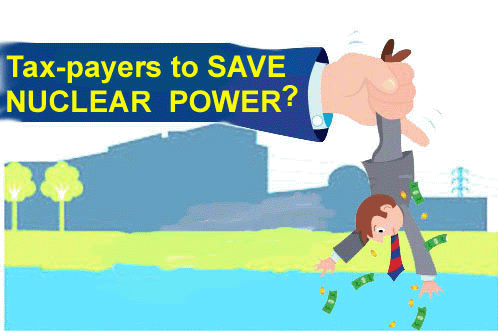
Gov. Andrew Cuomo in December ordered state regulars to establish so-called “zero emission” subsidies for Upstate nuclear plants for a 15-year period. Cuomo has committed to cutting carbon emissions 40 percent by 2030. If nuclear reactors shut down and are replaced by natural gas-fired plants, carbon emissions would increase.
But Cuomo’s plan is opposed by some advocates of renewable energy, who say forcing utility ratepayers to pay more for nuclear power is a waste of resources that should be devoted to cleaner technologies like wind and solar power.
Details of the nuclear price supports have not been worked out. But the staff of the Public Service Commission estimated last month that current wholesale electric prices are about $15 per megawatt-hour lower that what Upstate nuclear plants need to survive. If utility ratepayers have to make up that difference, the cost could be $300 million a year or more, even with FitzPatrick closed……..
Most recently, state Sen. Patty Ritchie proposed $100 million in the state budget to keep FitzPatrick operating until permanent nuclear price supports are in place.
FitzPatrick’s owner, Entergy Corp., has rejected such efforts and stays on course to close the plant.
Dominguez, of Exelon, said FitzPatrick is just one of four Upstate reactors at risk of shutting down -“ including the two at Nine Mile Point and Exelon’s other Upstate facility, the Ginna nuclear plant in Wayne County.
“We appreciate the focus that the legislators are putting on FitzPatrick, but it’s really an issue that’s broader than FitzPatrick,” he said. “It’s four units up there. A limited one-time budget fix for one plant frankly isn’t going to do it. You’re just going to end up with another plant that’s going to be in jeopardy within months, or at most years.”…….http://www.syracuse.com/news/index.ssf/2016/03/nine_mile_point_nuclear_plant_faces_financial_peril_exelon_exec_says.html
South Africa and the madnessof its nuclear build programme
 The madness of the nuclear build programme http://www.rdm.co.za/politics/2016/03/29/the-madness-of-the-nuclear-build-programme
Nuclear vendors are loathe to submit to a competitive tendering process based on a long-term, fixed-priced contract ANTON EBERHARD 29 MARCH 2016 IT IS time for the gloves to come off. The onus is on those who support the procurement of nuclear power stations to demonstrate that this initiative is not corrupt and will not be ruinous for the economy.
We face a possible credit rating downgrade to junk, which will make us all poorer: it will cost a lot more to service our debt, there will be less money for social programmes, the rand will fall even further, and inflation will rise.
Yet some still promote a huge nuclear programme that is not needed, that is more expensive and risky than alternative energy sources, that is hard to finance, and that will create contingent liabilities for the Treasury when we can least afford them.
SA does not need to procure large chunks of new power now. Electricity demand is not growing: it’s falling, and is lower than it was a decade ago. Depressed economic activity is partly the reason, but it’s not the most important one.
Electricity and economic growth data no longer track each other. The size of SA’s economy has continued to increase, albeit slowly, but electricity consumption has headed in the opposite direction. Countries such as Australia have seen a similar decoupling of energy and economic growth.
Could electricity demand in SA rebound if economic growth revives? Do we need to cater for depressed electricity demand as a result of Eskom supply constraints? Possibly. But we also need to recognise that there are profound changes to the energy-intensity of our economy, as smelters and mines close. The structure of our economy is changing. A fourfold increase in electricity prices in the past decade has accelerated energy-efficiency investments and energy conservation.
Official electricity demand forecasts and plans are obsolete. If demand for electricity were to reignite, it would fire off a lower base, and the rate of growth would be lower. When we project demand forward to 2030 or beyond, it’s obvious that we need a lot less power than was forecast in the Integrated Resource Plan of 2010 (the basis for the 9600MW nuclear commitment).
But we also need to replace old coal power plants, and compensate for the decline in the performance of Eskom’s existing power stations. I’ve taken all these arguments into account, and calculate that we need about 17GW of new electricity generating capacity by 2030. Some may calculate a slightly different number, but the required capacity will be close to this.
We have already ordered more power than we need by 2030. The new Eskom Medupi and Kusile coal power stations will add 9.6GW; its Ingula pumped storage scheme, 1.3GW. Two peaking power stations — Desisa and Avon, ordered by the Department of Energy — will add 1GW.
Contracted industrial co-generation and the department’s coal independent power producers (IPPs) will each add 1GW, with plans for more. In addition, 92 projects, totalling 6,347MW, have been contracted in the first four rounds of the department’s renewable energy IPP programme. Granted, this is intermittent power and will need to be complemented by gas power plants that the department plans to procure this year. More than 3GW are in the pipeline.
In the meantime, SA has negotiated 2.5GW of hydro power from the Inga 3 development in the Democratic Republic of Congo, and is considering further hydro imports from the region.
Together, these power procurements exceed what we need in the next 15 years.
Our cheapest sources of power are now wind and solar energy. The Department of Energy has awarded long-term, fixed-price contracts for wind energy as low as 57c/kWh, far below Eskom’s average cost of supply. Renewable energy combined with gas power can offer reliable base load supply at less than R1/kWh. Imported hydro and coal IPPs will also beat this.
I challenge any nuclear power vendor to sign a long-term power contract at less than R1/kWh. Whenever I ask them what nuclear power will cost in the country, they say “it depends”, and “it will need to be negotiated”.
This is the point: nuclear vendors are loathe to submit to a competitive tendering process based on a long-term, fixed-priced contract in which they take the risks of construction time and cost overruns. But all the other energy technology providers are prepared to do so. This has been the basis of the success of the IPP programme that has delivered such spectacular investment outcomes and price certainty for consumers. So why would we opt for a nuclear procurement programme that aims only to select a strategic partner, with subsequent price negotiations that have uncertain outcomes?
Nuclear power plants are also hard to finance. A couple of years ago in Davos, President Jacob Zuma was asked how 9,600MW of nuclear power would be financed. His answer, remarkably, was: “I’ll speak to my finance minister.”
He would have had that conversation by now and it will be clear that there is no fiscal space to finance a programme that will cost more than a half-a-trillion rand, when we raise just more than a trillion rand annually in taxes to fund all SA’s needs. Debt financing is now the fastest-growing component of the national budget and interest payments are more than twice the spend on higher education.
Our traditional mechanisms for funding power investments are also constrained. Eskom’s balance sheet is stressed, and it is struggling to raise sufficient debt on private capital markets to complete Medupi and Kusile. It has no possibility of raising finance for even one nuclear power station.
The private sector will not finance a nuclear plant in SA. The only possibility is funding from nuclear vendor countries. France will struggle: its nuclear company, Areva, is technically bankrupt and its latest UK nuclear contract — at £92.50/MWh (R2/kWh) — would be unaffordable for us.
Russia will not be able to finance all of its nuclear ambitions. China is a possibility, but financing will need to be backed by a long-term contract with an agreed electricity tariff, and the government will have to provide a sovereign guarantee and insurance cover, which will add contingent liabilities to the Treasury that will hasten a credit rating downgrade.
Eskom’s management recently expressed interest in further investments in large coal and nuclear projects. Its big coal, big nuclear, and big networks strategy is Neanderthal. Why would SA want to go down this route? It’s irrational. SA’s economic situation is precarious. The government now needs to act in concert and remove uncertainty about this nuclear folly. We don’t need it, it is too expensive, and we cannot afford it.
• Eberhard is a professor at the University of Cape Town’s Graduate School of Business
Donald Trump’s terrifyingly dangerous policies on nuclear weapons proliferation
Trump’s nuclear views are terrifying , USA Today, Mira Rapp-Hooper March 29, 2016
He’d ditch ‘predictable’ U.S. policies that have kept nuclear arms races in check for decades. The contours of Donald Trump’s foreign policy are becoming disturbingly clear. Newspapers have labeled his thinking on international affairs “isolationist” and “unabashedly non-interventionist,” yet those terms fail to capture the more alarming elements of his philosophy. Trump apparently is prepared to abandon the United States’ most important alliances, even at the risk of those countries acquiring nuclear weapons. In other words, he is prepared to end the decades-long U.S. policy of extended deterrence — protecting close partners against nuclear attack and thereby limiting the spread of nuclear weapons. Moreover, the presidential candidate gives little indication that he understands the implications of these radical policies for global security and stability.
One theme running through Trump’s foreign policy is his disdain for U.S. alliances and allies. In recent news media interviews, he has called U.S. treaties “one-sided,” labeled NATO “obsolete” and repeatedly called on South Korea and Japan to contribute more to U.S. basing costs overseas. Trump appeared surprised in a New York Times interview to learn that allies do pay a substantial portion of U.S. overseas basing costs, with none more supportive than Japan. Yet he also seemed unmoved by this information, insisting that allies should pay no less than a full 100% of U.S. overseas costs. A refusal to do so would force a President Trump to begin withdrawing troops, he told The Times. When told this might cause South Korea and Japan to acquire their own nuclear weapons, Trump demonstrated a flippant comfort, stating that the U.S. “may very well be better off.”
It hardly bears noting that abandoning U.S. treaty commitments and acquiescing to nuclear proliferation are completely at odds with decades of U.S. foreign policy……..
To understand why Trump’s views on extended deterrence are terrifying, one must examine his other positions on nuclear policy and strategy. In a December GOP debate, the candidate appeared to be unfamiliar with the nuclear triad, made up of the intercontinental ballistic missile, submarine-launched ballistic missiles, and bombers that can deliver nuclear weapons to their targets. Just days ago, he refused to rule out the use of a nuclear weapons against the Islamic State terrorist group. ……….
Perhaps most unsettling, Trump repeatedly insists that the United States must be more “unpredictable” in its national security policy — a chilling assertion, particularly when uttered in such close proximity to such irresponsible nuclear policies. Trump’s naiveté about the world’s most dangerous weapons leads one to infer that he might not have considered the fact that a nuclear Japan and South Korea could lead to dangerous arms racing with China and North Korea, proliferation by other states in East Asia and regional instability that invites major crises……..
this prospective commander in chief’s views are not just irresponsible: They are cataclysmically dangerous.
Mira Rapp-Hooper is a senior fellow with the Asia-Pacific Security Program at theCenter for a New American Security. Her Ph.D. dissertation, “Absolute Alliances,” was on the role of extended deterrence in international politics. http://www.usatoday.com/story/opinion/2016/03/29/donald-trump-nuclear-weapons-treaties-nato-terrifying-column/82341964/
1 This Month
23-25 October – on Zoom – World BEYOND War’s annual global conferenc

To see nuclear-related stories in greater depth and intensity – go to https://nuclearinformation.wordpress.com

Say No to NASA’s Reckless Nuclear Reactor on the Moon
Say No to NASA’s Reckless Nuclear Reactor on the Moon
-
Archives
- October 2026 (160)
- September 2026 (339)
- August 2026 (330)
- July 2026 (355)
- June 2026 (287)
- May 2026 (306)
- April 2026 (356)
- March 2026 (251)
- February 2026 (267)
- January 2026 (308)
- December 2025 (358)
- November 2025 (359)
-
Categories
- 1
- 1 NUCLEAR ISSUES
- business and costs
- climate change
- culture and arts
- ENERGY
- environment
- health
- history
- indigenous issues
- Legal
- marketing of nuclear
- media
- opposition to nuclear
- PERSONAL STORIES
- politics
- politics international
- Religion and ethics
- safety
- secrets,lies and civil liberties
- spinbuster
- technology
- Uranium
- wastes
- weapons and war
- Women
- 2 WORLD
- ACTION
- AFRICA
- Atrocities
- AUSTRALIA
- Christina's notes
- Christina's themes
- culture and arts
- Events
- Fuk 2022
- Fuk 2023
- Fukushima 2017
- Fukushima 2018
- fukushima 2019
- Fukushima 2020
- Fukushima 2021
- general
- global warming
- Humour (God we need it)
- Nuclear
- RARE EARTHS
- Reference
- resources – print
- Resources -audiovicual
- Weekly Newsletter
- World
- World Nuclear
- YouTube
-
RSS
Entries RSS
Comments RSS

