In USA’s Presidential campaign – Republican climate denialism is at fever pitch
 Dahr Jamail | As Climate Disruption Advances, UN Warns: “The Future Is Happening Now” TruthOut, , 02 May 2016 By Dahr Jamail, Truthout “……… Report Denial and Reality
The ongoing Republican presidential campaigning means that anthropogenic climate disruption (ACD) denial is reaching a fever pitch.
Republican presidential candidates Sen. Ted Cruz (R-Texas) and front-runner Donald Trump both vowed to undo several Obama administration policy efforts aimed at mitigating ACD impacts.
Meanwhile, former governor of Alaska and vice presidential candidate Sarah Palin claimed that ACD was “bogus” and a myth that scientists and policy makers “are peddling” in order to advance political agendas.
Also on the denial front, the group Media Matters cataloged the questions asked during both the Republican and Democratic presidential debates, and found that of the 1,477 questions asked by the various networks to the candidates, only 22 of them (approximately 1.5 percent) were about ACD. Of all the networks that hosted debates, the one that asked the most ACD-related questions was the Spanish-language network (Univision, which is US-based).
Back to reality, recent polling shows that the vast majority of Americans now believe that ACD is real and ongoing, and that the US government needs to do something about it.
Meanwhile, scientists in a global coalition known as Climate Feedback have begun working together with the aim of sorting fact from fiction in US media ACD coverage.
According to Michael Levitin, the group’s communications coordinator, the new group will use a web platform to verify facts and annotate online articles and include their comments on top of the original story. They will then use a rating system so readers are able to judge the stories’ scientific credibility.
“Recognized by NASA, the UN Framework Convention on Climate Change and California Gov. Jerry Brown, among others, Climate Feedback is already improving journalistic standards by flagging misreported climate science in mainstream outlets,” Levitin said…….http://www.truth-out.org/news/item/35860-as-climate-disruption-advances-un-warns-the-future-is-happening-now
Hinkley nuclear project for UK and France political reasons: let’s stop pretending otherwise
The real point of this story is that nuclear power is not commercially viable but has become a state-sponsored technology. There is nothing wrong with state supported technology. But we could save a lot of time and money by not pretending that it is something else.

 Lets Stop Pretending Nuclear Power Is Commercially Viable http://oilprice.com/Alternative-Energy/Nuclear-Power/Lets-Stop-Pretending-Nuclear-Power-Is-Commercially-Viable.html By Leonard Hyman & William Tilles
Sat, 30 April 2016, First its new president, Jean-Bernard Levy, said French state utility EDF would delay a decision on its joint French-Chinese nuclear project in the UK, Hinkley Point. That was over a year ago. Then the CFO of EDF, Thomas Piquemal, quit reportedly because he opposed the project on fi-nancial grounds. That was a short time ago. Then after a leaked memos, the French gov-ernment just announced that EDF would be raising more money and the Hinkley decision would now come in September.
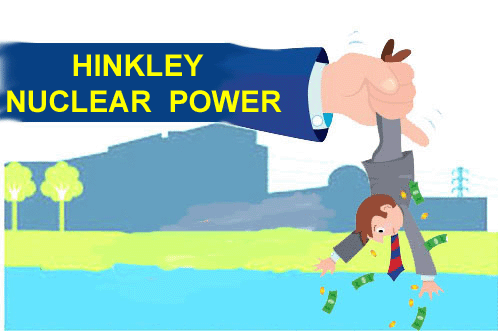
Now for the finances. These British nuclear units will cost roughly £18 billion ($27 billion). EDF has already sold a 35 percent share to the Chinese state nuclear company. However EDF still has to find more outside investors and get its ownership of the plant below 50 percent or it will have to consolidate Hinkley Point on its books and show all of the project’s debt on its own balance sheet.
If we were gamblers we would not wager that EDF will take the obvious first step towards restor-ing its financial health and cancels the Hinkley project. Of course, if David Cameron loses the Brexit vote (a referendum to take the UK out of the European Union) and is ejected from Number Ten Downing Street, a new Prime Minister might take a more skeptical view of Hinkley Point.
The real point of this story is that nuclear power is not commercially viable but has become a state-sponsored technology. There is nothing wrong with state supported technology. But we could save a lot of time and money by not pretending that it is something else.
Australia’s nuclear submarine boondoggle – a crippling waste of tax-payers’ money
4. BUT WAIT THERE’S MORE So we spend $2,000 each. That just gets us the big lumps of steel. If you actually want to use them, you’re paying more. It could be another $2,000 to $4,000 per Australian….
OPTIONS The great thing about the way the acquisition will work is there should be the opportunity to cut back from 12 when the inevitable delays and cost blowouts happen. From here we can’t save the whole $2000 but maybe we can save some, for better uses.

 Sub standard: why the $2,000 we are each spending on submarines will probably be a terrible waste http://www.news.com.au/technology/innovation/design/sub-standard-why-the-2000-we-are-each-spending-on-submarines-will-probably-be-a-terrible-waste/news-story/6922de6f6a72657c669fdc1a1248916f APRIL 30, 2016, Jason Murphy news.com.au@jasemurphy AUSTRALIA is spending $50 billion to buy submarines. The biggest whack of money we’ve ever spent on a Defence project. It comes out at $2000 per person. And it’s probably a shocking idea.
1. STRATEGY The strategic rationale for submarines is that an island needs trade lanes to stay open. Yep, we do. But the kind of war where a country lays siege to another whole country — think German U-Boats blockading Britain — is no longer likely at all.
Our non-nuclear submarines would have been handy in the past. And the generals are always “fighting the last war” strategically. Which is fine. But it would be better if we didn’t have to give them $2000 to do so.
2. AVAILABILITY We are buying 12 boats. Except — here’s the thing — you can’t use them all at once. Subs need a lot of maintenance. Take the Collins Class submarines, of which we have six. Best-case scenario — if things are going splendidly — is they spend half the time in the water, half in maintenance. But those subs have big problems. Some recent years we’ve managed to have basically just one in the water on average.
3. COST BLOWOUTS The Joint Strike Fighter aircraft program, which we bought into, is now many billions of dollars over Budget. Possibly hundreds of billions (reports vary). And it is hardly alone.
We consistently underestimate how complex defence equipment is because we, naturally, compare it to a vehicle. But not only is our new submarine custom-made (unlike my station wagon) it is also cutting edge technology.
It has to do many things perfectly. A submarine is a fortress, an IT hub, a weapons system, a vehicle and a temporary home all in one. Making all the things fit in together is hard. (Recently Spanish submarine builders had to send their sub back to the drawing board after they accidentally made it 75 tons too heavy and it was going to sink.)
When you face the inevitable problems you can either compromise or just spend that bit more to make it work. And if you cut corners on Defence equipment, you risk losing personnel and very expensive equipment… So of course you spend a bit more. And that’s how such laughably enormous cost blowouts happen.
4. BUT WAIT THERE’S MORE So we spend $2,000 each. That just gets us the big lumps of steel. If you actually want to use them, you’re paying more. It could be another $2,000 to $4,000 per Australian over the next 45 years. All that maintenance is expensive. And so are the crews.
The Navy has had enormous problems actually finding and training crew for submarines. A cook on a submarine can be paid an amazing $200,000 per year. Other personnel get more. Living in a big steel tube for 80 days with only other men for company is rubbish, apparently.
5. ENOUGH IS ENOUGH! Australia is the 52nd biggest country in the world by population, 13th by size of economy, and sixth by land area. We spend 13th most on defence. And we are ramping up by $26 billion per year over the next 10 years.
It is a lot, given we have no land borders, the natural advantage of being surrounded by a giant moat, and are strategically not on the way to anywhere much (sorry NZ).
The main reason anyone would attack us is in the context of a global or regional conflict is we have a large military they might fear.
Our spending has an effect on our neighbours. Indonesia is not a rich country, but they have indicated they are also thinking about expanding their submarine fleet. Would limiting our spending help forestall a local arms race?
OPTIONS The great thing about the way the acquisition will work is there should be the opportunity to cut back from 12 when the inevitable delays and cost blowouts happen. From here we can’t save the whole $2000 but maybe we can save some, for better uses.
USA Republicans – half of them accept the science of climate change
 Half of U.S. Conservatives Say Climate Change Is Real, Bloomberg, Trump and Cruz reject global warming, while more Republicans see it as a threat.Eric Roston eroston
The new survey results, “Politics & Global Warming 2016,” suggest a growing gap between what most registered Republican voters understand to be true and what the party leadership says it believes, particularly on the presidential campaign trail this year.
Liberal-to-moderate Republicans say climate change is real in much higher numbers than the party’s right wing does. More than 70 percent of GOP moderates say they know the world is warming, up 10 percentage points from two years ago. But only half of these Republicans, and just 26 percent of conservative Republicans, identify the problem as caused mostly by human activities (PDF)…….
The survey confirms that while only liberal Democrats put climate change near the top of their agenda, it remains a litmus test for credibility among many registered voters. Respondents were more likely to pick a candidate who strongly supports fighting climate change, 43 percent to 14 percent. They also reported feeling less likely to vote for an opponent to climate policy.
The issue is generational as well as partisan, according to Sheril Kirshenbaum, director of the University of Texas-Austin Energy Poll. Younger Americans are much likelier to understand climate change—but that doesn’t mean they’ll vote…..
Climate change is also the most divisive of the 23 issues—a fact the researchers will look at in more detail next week, when it reports on what each presidential candidates’ supporters think about the issue. http://www.bloomberg.com/news/articles/2016-04-27/half-of-u-s-conservatives-say-climate-change-is-real
Vattenhall nuclear corporation in financial trouble, opposes nuclear risk premium, seeks to abolish Swedish tax

 Vattenfall CEO says Germany’s proposed nuclear risk premium ‘too high’ Stockholm (Platts)–28 Apr 2016
* Plan ‘disproportionate’ to utilities’ economic strength
* Nuclear, hydro taxes in Sweden should be abolished
The CEO of Swedish utility Vattenfall, which has large stakes in Germany’s Brunsbuttel and Krummel nuclear plants, said the additional amount German nuclear power producers would have to pay for decommissioning and spent fuel storage under a proposed plan is “disproportionate to the economic strength of the utilities.”
The German Commission on the Review of the Financing of the Nuclear Phaseout, or KFK, recommended to the German government that nuclear utilities pay a so-called risk premium of Eur23.3 billion ($26.4 billion) into a fund for decommissioning reactors and final storage of spent fuel, which would be administered by the state.
That payment would be on top of the almost Eur40 billion in provisions that utilities have set aside to finance decommissioning and storage.
……NUCLEAR TAX Turning to its Swedish nuclear operations, Hall again called on the government to abolish the capacity tax on nuclear power. The tax is based on the amount of electricity reactors can generate, not on actual generation.
Hall and other Swedish nuclear utility executives have said that the tax, coupled with low electricity prices, is making nuclear power unprofitable. As a result, Vattenfall plans to shut two reactors ahead of the end of their technical lifetimes………http://www.platts.com/latest-news/electric-power/stockholm/vattenfall-ceo-says-germanys-proposed-nuclear-26430524
So-called “charity” nuclear front group lobbies UK govt to fund Small Nuclear Reactors

UK think tank urges nuclear innovation, World Nuclear News, 28 April 2016 A think tank [Alvin Weinberg Foundation] has urged the British government to spend money earmarked for nuclear R&D on ensuring that at least three advanced reactors including at least one small modular reactor (SMR) and a Generation IV design have completed regulatory assessment by the early 2020s.
Weinberg Next Nuclear’s report, Next Steps for Nuclear Innovation in the UK….. The latest study follows a report by the same foundation, The Need for Nuclear Innovation, published in November 2015. Later that month, the UK government announced plans to invest £250 million ($377 million) over five years in a nuclear R&D program to include a competition to identify the best value SMR for the country. The initial phase of the competition was launched in March, with a call for initial expressions of interest.
The first phase of the competition, which will also lead to the development of an SMR Roadmap to set out the policy framework and assess the potential for possible pathways for SMRs in the UK, will run until late 2016. Individual reactor designs will not be assessed at this stage……
At least one of the reactors supported should be a Generation IV design that could use fuel made from previously used reactor fuel and from the UK’s plutonium stocks. It suggests that SMRs and “micro-reactors” – reactors of less than 20 MWe capacity – will be cheaper to construct than large reactors….
Finally, the report proposes that UK regulators cooperate with their peers in other countries, citing US and Canadian regulatory practices where proposed reactor designs are discussed with developers before the formal regulatory process begins. It calls for a three-way collaboration to be established with the aim of establishing international standards for the safety of advanced reactors……
Weinberg Next Nuclear is part of the Alvin Weinberg Foundation. The report was prepared with the sponsorship of Terrestrial Energy, Urenco and Moltex Energy, with Weinberg Next Nuclear retaining sole editorial control.http://www.world-nuclear-news.org/NP-UK-think-tank-urges-nuclear-innovation-2804167.html
Westinghouse keen to fleece UK tax-payers with Small Modular Nuclear Reactors
Westinghouse is engaging its UK stakeholders in its SMR offering to the country’s government, the company announced today. Mark Menzies, member of parliament for the Fylde constituency where the company’s Springfields site is located, said that he had already formally registered his support for Westinghouse’s proposal to produce SMRs for the UK market. He said that feedback from stakeholders would be essential for as the proposal, which could see SMR pressure vessels sourced and manufactured in the UK, to move forward. http://www.world-nuclear-news.org/NP-UK-think-tank-urges-nuclear-innovation-2804167.html
USA Federal regulators approve permit for new nuclear reactor in New Jersey
 Permit for a new nuclear reactor in N.J. OK’d by feds, By Bill Gallo Jr. | For NJ.com 28 Apr 16, Federal regulators have OK’d a key permit that would be needed for the construction of a new nuclear reactor in New Jersey, officials said Thursday.
The Nuclear Regulatory Commission’s Atomic Safety and Licensing Board, following numerous reviews, found that PSEG Nuclear met all safety and environmental requirements needed for the Early Site Permit.
That permit is not a green light for the utility to build a new reactor at its generating site at Artificial Island along the Delaware River in Lower Alloways Creek Township.
The permit will be good for 20 years. It does not, however, mean that PSEG Nuclear is ready to put a shovel into the ground. Many federal, state and local approvals would still be needed.
“This is an important final step to have the ESP issued,” said Joe Delmar, spokesman for PSEG Nuclear. “It provides us with a 20-year window to pursue a construction and operating license.” PSEG Nuclear has said during the application process that it was not ready to build another plant, but wanted to be prepared…..
The decision for the permit does not have to go before the full NRC board of commissioners.
This is only the fifth Early Site Permit ever issued by the NRC, according to Sheehan. In 2007 the agency enacted the rule that allowed utility companies to bank approval for a new plant until they, the utility, decided to build……
PSEG Nuclear currently operates three reactors —€” Salem 1, Salem 2 and Hope Creek. The plants, three of the four nuclear rectors now operating in New Jersey, comprise the second-largest nuclear generating complex in the U.S. Only the Palo Verde plant in the Arizona desert generates more power.
All three of the PSEG Nuclear reactors have been granted 20-year licenses extensions.
The utility has chosen a site north of its Hope Creek reactor on Artificial Island as the site where a new plant could be constructed. If another plant is built the utility has already said it would build a second access road to the Island from the mainland.
Depending on the size of the reactor, a new plant could cost upwards of $15 billion, according to some estimates. Any new reactor would also require the construction of a cooling tower to cut down on the amount of water drawn for cooling purposes from the Delaware River.
Currently, PSEG Nuclear’s Hope Creek plant has a cooling tower, but its Salem 1 and Salem 2 units do not. Those two reactors, when operating at full power, draw in and return to the Delaware River approximately three billion gallons of water a day.
Environmentalists oppose any plans for a new reactor at the Island.
“It’s unnecessary, not needed and there are real safety issues we are concerned about,’ Jeff Tittel, executive director of the New Jersey Sierra Club, said Thursday.
He said the project would require the filling in of hundreds of acres of sensitive wetlands and because of its location where the Delaware River and Delaware Bay meet, any new plant would be vulnerable to storm surge and a rising sea level.
Tittel said the high cost of building a nuclear plant would likely be borne by ratepayers and there are cheaper sources of electricity. He pointed to renewable energy sources such as wind power are becoming less expensive as are gas-fired generating plants.
Aside from environmental and economic concerns, Tittel sees a safety threat……. Bill Gallo Jr. may be reached at bgallo@njadvancemedia.com. Follow Bill Gallo Jr. on Twitter @bgallojr. Find NJ.com on Facebook. http://www.nj.com/salem/index.ssf/2016/04/permit_for_a_new_nuclear_reactor_in_nj_okd_by_feds.html
Series of earthquakes is delaying Japan’s ‘nuclear revival’

 Japan’s Worst Quake Since 2011 Seen Delaying Nuclear Starts http://www.bloomberg.com/news/articles/2016-04-26/japan-s-worst-quake-since-fukushima-seen-delaying-nuclear-starts Stephen Stapczynski sstapczynski
-
Earthquakes on southern island of Kyushu kill 49 people
-
Japan lawyer group renews call for shutdown of Sendai reactors
A series of earthquakes, including amagnitude-7.3 tremor that struck about 119 kilometers (74 miles) from the Sendai nuclear facility on the southern island of Kyushu this month, destroyed hundreds of homes, snapped bridges and left at least 49 people dead. It has also revived an effort to halt the plants’ operations.
“Nuclear is under a magnifying glass now, so even the smallest problem can create big delays,” Michael Jones, a Singapore-based gas and power analyst at Wood Mackenzie Ltd. said in an e-mail. “Fukushima has changed everything, and earthquakes and volcanoes are only making things worse.”
Transport Disruptions
Trains and highways were damaged in the Kyushu earthquake and if there is a nuclear accident from another earthquake or volcanic eruption, evacuations may be difficult, Datsugenpatsu Bengodan, a group of lawyers working to wean Japan off nuclear power said in an April 19 statement. The group said Kyushu Electric Power Co.’s Sendai No. 1 and 2 reactors, which were the first to restart under post-Fukushima safety rules last year, should be shut.
An e-mail to Japan’s Nuclear Regulation Authority outside of normal business hours wasn’t immediately answered.
“Given this is the largest earthquake in over a century in Kyushu that has caused significant damage to infrastructure, it could slow down the pace of restarts,” said Tom O’Sullivan, founder of Mathyos, a Tokyo-based energy consultant. “It may now be even more imperative that emergency evacuation procedures are thoroughly tested.”
A nuclear accident at Sendai would require the evacuation of about 5,000 people in the surrounding 5 kilometers and more than 200,000 would need to seek immediate shelter within a 5- to 30-kilometer radius, according to a local government simulation from 2014.
The NRA, Japan’s nuclear regulator, said on April 18 that it sees no need to shut the two Sendai reactors. A high court on April 6 upheld a ruling that the Sendai reactors can withstand seismic damage and don’t pose a risk to the surrounding area.
A local court issued an injunction in March preventing the operation of Kansai Electric Power Co.’s Takahama No. 3 and 4 reactors, questioning whether evacuation plans and tsunami prevention measures — which had been endorsed by the government — were robust enough.
The earthquake near Japan’s only operating reactors “may boost the nation’s anti-nuclear sentiment,” Joseph Jacobelli, an analyst at Bloomberg Intelligence, said in an April 22 note. “Technical and political obstacles mean even those units approved for restart are returning at a snail’s pace.”
Ukraine will have to move beyond nuclear power, but when?

 Thirty years after Chernobyl, what chance of a post-nuclear Ukraine? Ecologist, Jan Haverkamp & Iryna Holovko 26th April 2016“………A move towards clean, renewable energy sources – such as wind, water, sun, biomass and geothermal – would seem a logical route, especially given the potential savings in health costs and increase in energy independence.
Here, in these countries most afflicted by Chernobyl, economic realities make this switch to a clean energy future inevitable: the old centralised energy economy is collapsing, slowly but surely, and an awareness movement is growing.
In Ukraine, future-oriented enterprises will choose independence from the politically and economically unstable conglomerates that dominate the country’s energy sector. The question is: are these companies getting the space they need to start Ukraine’s energy [r]evolution?
The [r]evolution is inevitable – but not when it happens
Clearly, Ukraine currently faces several fundamental choices for the future. These choices relate to political contexts and preferences, but none of them is as inevitable as the need for an energy [r]evolution.
We are not asking anyone to experiment with unknown technologies. The techniques for a clean energy future exist, and Ukraine has even built up experience with them. Technically, then, the next step is an evolution. But one that means a revolutionary departure from a highly unstable energy politics that rely on centralisation of access to gas, oil, coal and nuclear power, and the energy policy and planning paradigms associated with it.
Ukraine has significant potential for the development of renewable energy sources. Asresearch for The Solutions Project by Mark Jacobson and his team at Stanford University shows, Ukraine could cover its entire energy demand in 2050 with wind, solar and water and a 32% decrease in primary energy need.
However, the fact that Ukraine currently enjoys only 1 GW of installed capacity from renewable sources signals that energy policy is yet to undergo fundamental change, and the obstacles are many.
The staying power of old energy structures should not be underestimated. Ukraine’s electricity market is a political battlefield, and not only due to interference of oligarchs and dependency on Russia for coal, nuclear fuel and technology. The market is virtually completely regulated, and regulation has become a political tool…….
Twelve of these reactors were built in the 1980s, and are now in need for large safety upgrades if they are to be operated with a lifetime extension beyond 30 years.
Risky business: ageing nuclear plants starved of investment……..
The necessary safety upgrades (for life-time extension, but also in reaction to the Fukushima catastrophe – Ukraine participated in the EU post-Fukushima nuclear stress tests) are thus weakened or postponed, and there are even indications that there is a lack of money for operational costs.
At the same time, Ukraine’s nuclear fleet faces an increased security risk due to political instability. The risks for terrorist or insurgent attack on nuclear infrastructure are currently higher than in peace time, meaning further upgrades are necessary.
In addition, most of the upgrading work is dependent on Russian technological input. Delays in the implementation of upgrades are not only caused by lack of finance, but also by unforeseen technical complications and problems with tender procedures. On top of that, Energoatom is bleeding funds on an unrealistic nuclear new build programme in Khmelnytksy, western Ukraine.
The political position of Ukraine’s increasingly risky nuclear sector is strengthened by the rhetoric that only lifetime extension of the ‘independent’ ageing nuclear fleet can fill the gap left by lost coal resources in the east.
The nuclear sector’s dependency on Russia has been masked by swapping the tenders for upgrading and new builds from Russian companies to a Czech-based company Skoda JS (a deal that is part of anti-corruption investigations in Switzerland), which is actually Russian-owned, and by tests at the Yuzhnoukrainsk nuclear power station with the use of Westinghouse nuclear fuel (produced in Sweden), partly in reaction to delivery problems with Russian fuel in the last few years.
The fact that economic control over technology and a large proportion of fuel will always come from Russia remains off the table…… the awareness that a lot of the corruption in Ukraine is related to the centralised nature of the old energy carriers is growing, and we see an increasing amount of courageous small and medium investors seeing efficiency and renewables as chances for job and income creation…….. http://www.theecologist.org/essays/2987610/thirty_years_after_chernobyl_what_chance_of_a_postnuclear_ukraine.html
USA Dept of Energy – new funds for nuclear energy development
Department of Energy Announces New Awards for Advanced Nuclear Energy Development
April 26, 2016 WASHINGTON, D.C. – Building on the President’s all-of-the-above energy strategy, the Department of Energy today awarded more than $5 million to undergraduate and graduate students in pursuit of nuclear engineering degrees and other nuclear science and engineering programs relevant to nuclear energy. The awards include 57 undergraduate scholarships and 33 graduate-level fellowships for students at American colleges and universities…….
France’s tax-payers €3bn to save debt-ridden nuclear corporation EDF
State pays €3bn to bail out EDF http://www.connexionfrance.com/france-edf-electricity-areva-nuclear-investment-bail-out-view-article.html April 24, 2016THE GOVERNMENT has agreed to bail out struggling electricity company EDF to the tune of €3billion, months after it agreed a similar capital injection for nuclear energy giant Areva.
On Friday, EDF announced a €4billion capital investment programme, and the state – which owns an 85% stake in the company – has agreed to pay 75% of the cost.
The electricity giant has been fighting to bring its massive debts under control in the face of weak European electricity prices. It has also invested in several major projects, including a new British nuclear power plant at Hinkley Point.
The government said it would accept EDF shares as its dividend in 2016 and 2017, rather than cash. “The State reaffirms its confidence in the management of the company and all its employees for the success of EDF as part of a quality social dialogue,” argued the Ministries of Economy and Finance in a joint statement.
In return, EDF said it would aim to reduce its costs by €1billion in 2019 compared to 2015, and shave €2billion off its investment plans over the next three years. It had originally planned to make €700million in savings over three years. The group also plans to raise €10 billion by selling off gas, coal and oil interests.
USA Republicans now liking renewable energy – for financial, not climate, reasons
Republicans Are Warming Up to Renewable Energy , Bloomberg, Joe Ryan April 21, 2016
- Some Republicans embrace renewables as Paris accord signed
-
They argue that jobs and cost cuts make renewables attractive
-
“……..The leading Republican candidates for president, Donald Trump and Sen. Ted Cruz, reject any role of humans in global warming, as do most party leaders. But a small and growing number of once-skeptical Republicans is embracing wind and solar. They see the clean energy sources delivering cheap electricity, bolstering America’s energy independence and fueling economic development in impoverished rural areas.
-
In turn, renewables are adding jobs in North Carolina, Georgia and Texas and other conservative states, creating a formidable clean-energy constituency in a party whose energy mantra was “drill, baby drill.”…..
- Past SupportSupport for clean energy is not new for all U.S. Republicans. Some conservative state lawmakers in Iowa, Texas and elsewhere have long promoted it. When he was governor of Texas, George W. Bush pushed through legislation requiring utilities to buy renewable power, leading to widespread development of wind farms.Republican enthusiasm is based largely on economics, not climate science, and does not necessarily translate into support for the Paris agreement or other efforts to curb greenhouse gases.
- Wind and solar farms are often built on farmland, which is typically flat, cheap and treeless. That has provided rental income for farmers and created a groundswell of construction jobs. Wind and solar companies employed nearly 300,000 people in the U.S. in 2015, roughly four times more than the coal industry. All of the top 10 wind-energy producing congressional districts are represented by Republicans, according to The American Wind Energy Association.“It gives us a real leg up on economic development,” said Iowa Governor Terry Branstad, a Republican whose state ranks third nationally in wind energy.A push for renewables, meanwhile, is bubbling up from within party ranks……..
-
Government Subsidies
Meanwhile, clean energy has become less reliant on the government subsidies that fueled its growth, making it a less problematic issue for Republicans.
The average long-term contract price for wind power paid by utilities has dropped 60 percent since 2009, falling in some instances below $20 per megawatt hour. Those prices, which include subsidies, are on par with off-peak power prices in some regions, BNEF analyst Nathan Serota said. The solar price drop has been even steeper, falling 65 percent with contracts as low as $37 per megawatt hour, Serota said.
A Texas Believer
Drew Darby, a Texas state Republican representative whose district encompasses nine counties at the edge of oil country, said the proliferation of cheap wind power since the state spent more than $7 billion on new transmission lines has made him a believer.
“Republicans all over the country ought to be paying attention to what Texas did,” Darby said in an interview……..http://www.bloomberg.com/news/articles/2016-04-20/party-of-drill-baby-drill-slowly-warming-to-wind-solar-power
Michael Douglas wants presidential candidates to start talking about nuclear weapons.
Tribeca: Michael Douglas Calls for Presidential Candidates to Talk Nuclear Weapons http://www.hollywoodreporter.com/news/tribeca-2016-michael-douglas-nuclear-887171 The actor is working on a doc about a San Fernando Valley family who grew up near a Boeing plant which had a nuclear accident in the 1950s. “[It] basically poisoned the whole neighborhood. The whole family has thyroid cancer,” says Douglas. 4/23/2016 by Ashley Lee
At a 2016 Tribeca Film Festival discussion before the immersive closing-night film the bomb, Douglas said the world is “on the advent of a new Cold War advancement in nuclear weapons — the U.S. is talking about a trillion dollars to spend, the Russians have their new missiles out,” he explained. “It’s just very difficult to believe. … Maybe, just maybe, we can look at a new generation to look at what I think is the most serious issue that we have on the planet right now.”
Even more so, “we’ve got elections coming up this year. Once we get through these primaries and once more attention is brought to just how this arms race is continuing now, there should be a huge discussion coming this fall,” said the actor and longtime advocate of nuclear non-proliferation. “It looks like it’s gonna be [Donald] Trump and Hillary Clinton, with diametrically different opinions on this important issue — one who wants to nuke ‘em, and somebody else.”
Command & Control director Robert Kenner added, “If Donald Trump is the Republican nominee, I think there will be more discussion on nuclear weapons because he is the best argument for abolition that we can make.”
As seen in action flicks like Pacific Rim and Independence Day, Hollywood tends to portray nuclear weapons onscreen as the ultimate and necessary arsenal, and Douglas said that won’t change anytime soon. “Not in Hollywood — we’re based on a business of balances, commerce with filmmaking. Commerce has to win out,” said the actor. “Any movie where the message gets ahead of the drama … unless you’re doing documentaries, you can’t get ahead of yourself. They’re not interested.”
Still, Douglas said he’s working on a documentary “about a young man living in the San Fernando Valley who grew up near a Boeing plant which had a nuclear accident in the 1950s and basically poisoned the whole neighborhood. The whole family has thyroid cancer.”
The panel — also featuring Command & Control author Eric Schlosser, Emma Belcher of the MacArthur Foundation and the bomb filmmaker Smriti Keshari — discussed that nuclear weapons and climate change are the two most important global issues, and because of the visual proof of climate change that’s emerged, the world has begun responding with urgency.
“The terrifying thing about the nuclear issue is … you’re really gonna have to wait for a dirty bomb. It’s gonna make 9/11, Paris, Brussels, everything a miniscule amount before the amount of people who are going to be killed [by a nuclear bomb],” said Douglas. “The only optimism I see, is of these two major issues, the two most important in the world, we can eliminate nuclear weapons. It’s really easy. … We as humans can do something about it — we actually can, it’s within our grasp.”
Douglas began his activism against nuclear weapons after making The China Syndrome, James Bridges’ 1979 film co-starring Jane Fonda and Jack Lemmon about a cover-up of safety hazards at a nuclear power plant. To prepare for its finale, the shoot included consultations with General Electric quality assurance experts who “gave us a breakdown of the most logical accident that might happen at a power plant,” the actor and producer recalled. “That power plant was the ultimate villain — it’s a horror picture.
“Thirteen days after the movie came out, Three Mile Island happened in Pennsylvania,” said Douglas, as news outlets ran split-screen footage of the real-life tragedy and the film. “It was an epiphany for me, the closest thing to a religious experience I might have ever had.”
France gives €3bn bailout to EDF’s Hinkley nuclear plant
 France gives €3bn lifeline to Hinkley nuclear plant, Sunday Times, Robin Pagnamenta, Energy Editor, 24 Apr 16, A decision on the proposed nuclear power station will not be taken until after an EDF shareholders’ meeeting Erance has thrown its support behind EDF, the French electricity company, and its plan to build the £18 billion nuclear power station at Hinkley Point, Somerset, by supplying a €3 billion lifeline.
President Hollande’s administration has agreed to put in the money towards a proposed €4 billion (£3 billion) cash-raising the company is proposing by issuing new shares. EDF said last night that the confirmation of the fundraising made it possible for the company to proceed with investments including Hinkley Point C by putting it on a “solid financial footing”……http://www.thetimes.co.uk/article/union-threats-force-edf-to-delay-hinkley-decision-0zf56xjms
1 This Month
23-25 October – on Zoom – World BEYOND War’s annual global conferenc

To see nuclear-related stories in greater depth and intensity – go to https://nuclearinformation.wordpress.com

Say No to NASA’s Reckless Nuclear Reactor on the Moon
Say No to NASA’s Reckless Nuclear Reactor on the Moon
-
Archives
- October 2026 (149)
- September 2026 (339)
- August 2026 (330)
- July 2026 (355)
- June 2026 (287)
- May 2026 (306)
- April 2026 (356)
- March 2026 (251)
- February 2026 (267)
- January 2026 (308)
- December 2025 (358)
- November 2025 (359)
-
Categories
- 1
- 1 NUCLEAR ISSUES
- business and costs
- climate change
- culture and arts
- ENERGY
- environment
- health
- history
- indigenous issues
- Legal
- marketing of nuclear
- media
- opposition to nuclear
- PERSONAL STORIES
- politics
- politics international
- Religion and ethics
- safety
- secrets,lies and civil liberties
- spinbuster
- technology
- Uranium
- wastes
- weapons and war
- Women
- 2 WORLD
- ACTION
- AFRICA
- Atrocities
- AUSTRALIA
- Christina's notes
- Christina's themes
- culture and arts
- Events
- Fuk 2022
- Fuk 2023
- Fukushima 2017
- Fukushima 2018
- fukushima 2019
- Fukushima 2020
- Fukushima 2021
- general
- global warming
- Humour (God we need it)
- Nuclear
- RARE EARTHS
- Reference
- resources – print
- Resources -audiovicual
- Weekly Newsletter
- World
- World Nuclear
- YouTube
-
RSS
Entries RSS
Comments RSS

