Experts concerned in debate on Wisconsin lifting moratorium on new nuclear stations
Energy Experts Are Split On Whether Wisconsin Should Lift Ban On New Nuclear Power Plants Earlier This Month, Assembly Passed A Bill That Would Make It Easier To Bring Nuclear Facilities To State WPR, By Scottie Lee Meyers Wednesday, January 27, 2016 Energy experts are taking different sides on whether Wisconsin should pass new legislation that would allow for the construction of new nuclear power plants.
Earlier this month, the state Assembly passed a measure that would effectively lift Wisconsin’s ban on new nuclear power plants by eliminating two essential clauses. The clauses stipulate that nuclear power would be proven to be a cheaper source of energy to residents and requires a federal repository site for spent nuclear waste. ……..
energy experts like Al Gedicks, of the Wisconsin Resources Protection Council, said they would rather see the state invest in renewable energy systems. While Gedicks said he agrees that nuclear energy is better than coal, natural gas and oil in terms of overall greenhouse gas emissions, he worries that nuclear plants take years to construct and get operating — years we can’t afford to spend when faced with such devastating consequences of climate change. Moreover, he said he fears extreme weather incidents could disrupt radioactive waste stored at nuclear power plants.
Gedicks also believes the bill would open the door to Wisconsin itself becoming a federal repository site.
“If you lift the restriction on no nuclear power plants without a waste disposal site, you are setting up the state of Wisconsin to become if not the first, then certainly the second nuclear waste repository,” he said.
Wisconsin already was targeted by the U.S. Department of Energy as a potential repository site to compliment Yucca Mountain back in the 1980s, according to Gedick. But massive opposition, including from four tribal nations, eventually led for the federal agency to look elsewhere. Soon after, Wisconsin implemented the moratorium.
Gedick said Wisconsin could remain an attractive location for a waste dump site because of granite rock formations in the northern part of the state.
“Wisconsin was high on the list in the 1980s and it is still high on the list now,” Gedlick said. “We are essentially going into this blindfolded because we haven’t had a discussion on whether this is what the citizens of Wisconsin want if they lift that nuclear power moratorium.”…… http://www.wpr.org/energy-experts-are-split-whether-wisconsin-should-lift-ban-new-nuclear-power-plants
The nuclear revolving door: Former Labour MP appointed boss of nuclear industry trade body
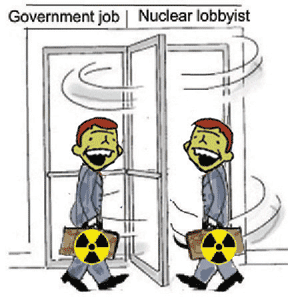
STV News 27 Jan 16 A former Labour MP has been appointed chief executive of the trade body for the civil nuclear industry.Ex-MP for Rutherglen and Hamilton West Tom Greatrex will take up the post at the Nuclear Industry Association next week, succeeding Keith Parker.
Mr Greatrex was an opposition spokesman on energy until he lost his seat in last May’s general election.
He said: “I am delighted to be joining the Nuclear Industry Association at such an exciting time……http://news.stv.tv/west-central/1340504-former-labour-mp-appointed-boss-of-nuclear-industry-trade-body/
North Carolina Environment Chief aims to restrict solar power, promote nuclear power!

 NC environmental chief backs restriction on solar farms, incentives for nuclear plants. WRAL.com By Laura Leslie 28 Jan 16 RALEIGH, N.C. — The solar industry has blossomed in North Carolina since lawmakers granted solar farms tax breaks nine years ago as part of renewable energy standards that require utilities to get a portion of their power from renewable sources.
Brian O’Hara, senior vice president of Chapel Hill-based Strata Solar, said the state and other stakeholders have already drafted a model ordinance to help local officials negotiate. He said the solar industry wasn’t consulted about the proposed state permit.
Chatham County homeowner Sharon Garbutt, who lives 17 miles from the Shearon Harris nuclear plant in southwest Wake County, told the panel
South Afric a’s nuclear corporation in a mess
Step one: Sort out the mess at the nuclear corporation, Times Live The Times Editorial | 28 January, 2016
Power struggles, factionalism and claims of impropriety at state institutions have become so commonplace they are losing their shock value. “…….The latest public entity to be affected is the Nuclear Energy Corporation of SA, which is involved in two court actions over allegations of corporate governance breaches.
Phumzile Tshelane, the corporation’s chief executive and a supporter of the Zuma administration’s nuclear ambitions, is centrally involved in both cases.
The Nuclear Energy Corporation, meanwhile, is reportedly in disarray.
According to Business Day, it has yet to finalise its financial statements for the 2014-2015 financial year and is without a full board.
Several independent directors resigned, or left after their terms ended last year, after reportedly clashing with Energy Minister Tina Joemat-Pettersson. It would be tempting to dismiss the ructions at the corporation as just another public entity gone awry.
But the fact is that this is the institution that will play a key role in the government’s controversial plan to procure eight nuclear power reactors at a cost, experts warn, that could exceed R1-trillion.
Moreover, the government has decided to go ahead with the procurement and proceed to the next step, which is to invite tenders, even though the nuclear building programme has not been properly costed.
Surely the mess at the nuclear corporation needs to be sorted out before we take a single step further down the nuclear road.http://www.timeslive.co.za/thetimes/2016/01/28/Step-one-Sort-out-the-mess-at-the-nuclear-corporation
EDF in a’panic’ over decision to be made on UK’s Hinkley nuclear power station
 Hinkley Point: EDF set for decision on nuclear plant amid claims of board ‘panic’, The Independent, Sources in France say decision on whether to give the green light to controversial project would be made on Wednesday Geoffrey lean , 24 Jan 16
- The final decision on whether to build Britiain’s first nuclear power station in decades is set to be made by energy giant EDF this week, amid claims of “panic” among the French firm’s board over the viability of the £18bn project.
- Sources in France said the decision on whether to give the green light to its controversial plant at Hinkley Point, Somerset – on which ministers are depending to “kick-start a major new generation of nuclear power stations” – would be made on Wednesday. But the largely state-owned company refused to comment, or even to confirm or deny that the meeting is taking place.
This secrecy reflects the extreme sensitivity about the decision with practicalities and politics pulling in opposite directions. The project suffered a serious blow last week when French regulators delayed a decision on what to do about safety flaws in a similar reactor. But cancelling it would be a huge humiliation for British ministers, and could cause a cross-Channel diplomatic row.
- The “final investment decision” by EDF’s board – repeatedly delayed over the past two years – is the project’s only remaining hurdle.
Last October the government persuaded China to invest heavily in the plant, filling a funding shortfall, and the Energy Secretary Amber Rudd is awaiting the decision before signing a deal to allow the company to charge double the present price for the electricity generated from Hinkley’s twin reactors. Three similar European Pressurised Reactor (EPR) projects are planned for Britain if it succeeds…….
- there are signs of last minute jitters. Union leaders are reportedly warning the company of “financial, industrial and legal risks” in the project, while the French financial journal Boursier.com has suggested that there is “panic on board”.
Last week the French nuclear regulator delayed until the end of the year a decision on what to do about “very serious” weaknesses detected in the pressure vessel of a similar EPR being built at Flamanville, Normandy. The same fault – which could lead to a nuclear accident – was detected in the vessels for the Hinkley reactors, which had been built and will now have to be replaced.
- The Flamanville plant is five years behind schedule and its cost has trebled, while the only other EPR being built in Europe, in Finland, is almost a decade late, and the cost has more than doubled. Two other EPRs being built in China are also thought to be over-running while the cost of Hinkley has already soared.
EDF’s share price has plunged to record lows, and the company is considering selling billions of pounds of assets to fund building Hinkley. On top of all that, Austria is taking Britain to the European Court, alleging it is subsidising the plant illegally.Some British experts believe that, faced with all these difficulties, EDF will defer a final decision again. http://www.independent.co.uk/news/uk/home-news/hinkley-point-edf-set-for-decision-on-nuclear-plant-amid-claims-of-board-panic-a6830456.html
Wisconsin won’t get nuclear power, whether or not they lift the moratorium
 Tom Still: Repeal nuclear moratorium — but don’t expect new power plants in Wisconsin, Madison.com TOM STILL | Wisconsin Technology Council president, 24 Jan 16
It’s hard to find a more knowledgeable advocate of nuclear energy than Michael Corradini, a professor of engineering physics at UW-Madison, a past president of the American Nuclear Society and a longtime advisor to governments at home and abroad.
But if you ask Corradini whether a bill lifting a 1983 moratorium on building nuclear plants in Wisconsin will make a tangible difference any time soon, his answer is a starkly practical “no.”
The reasons for his pessimism reflect the reality of the costs of building such a plant in a state where incentives to do so are virtually non-existent. Barriers include the low global cost of oil and natural gas, decades of planning and approval time, continued opposition by most environmental groups and a state regulatory structure that doesn’t allow owners of a nuclear plant to recover costs in any reasonable amount of time.
Toss in the fact that energy demand in Wisconsin is relatively stagnant – the result of conservation efficiencies as well as economic trends – and the prospects for a “next-generation” nuclear power plant popping up in the Badger state are dimmer than a candle in a coal mine……..
- Some utility companies are adopting wind and solar power more quickly than others as they strive to stay a step ahead of current regulations, not to mention those they may face if President Obama’s Clean Power Plan and international standards take hold. Costs are falling for wind and solar, although low oil and gas costs are slowing adoption in some cases.
- Breakthroughs in energy storage technologies can help smooth out the bumps in intermittent energy sources such as wind and solar. Mechanical, thermal, compressed air and other technologies can make it possible to efficiently store electricity produced when the wind is blowing and the sun is shining…….. http://host.madison.com/wsj/business/tom-still-repeal-nuclear-moratorium-but-don-t-expect-new/article_4af610da-8dbc-55e7-a720-1ffb0f82f3af.html
Trans Pacific Partnership lets corporations override environmental laws
the TPP would give foreign corporations like TransCanada broad power to demand compensation for policies that do not conform to their “expectations.”
In other words, any time our government takes an “unexpected” step to protect our air, our water, our economy, or the health of our families from dangerous projects like Keystone XL, corporations could use that as a reason to ask a tribunal to order the government to pay.
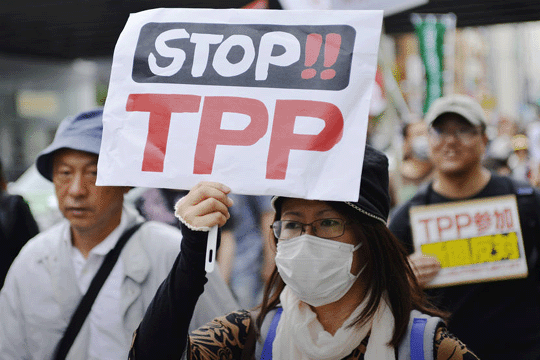
TPP provisions would undermine environmental efforts http://www.msnbc.com/msnbc/opinion-tpp-provisions-would-undermine-environmental-efforts?utm_content=buffer4500f&utm_medium=social&utm_source=twitter.com&utm_campaign=buffer 01/21/16 03 By Michael Brune For years the Sierra Club has warned that international trade deals could be used by corporations to undermine U.S. environmental protections. Now the Canadian oil company TransCanada is attempting to do exactly that in response to President Obama’s rejection of its Keystone XL tar sands pipeline.
This dispute won’t be settled in a normal court of law, though. Instead, it will be argued in a trade tribunal with no accountability to any domestic legal system — a private legal system that is outside U.S. law. No judge will hear the case. Instead, three private lawyers will issue a binding ruling that cannot be appealed. Many of these tribunal lawyers actually rotate between rendering judgments and representing corporations in their cases against governments. Therefore, it’s no great surprise when corporations come out on top and ordinary people either foot the bill or lose environmental and health protections.
This is unfair and unjust, pure and simple. We should be doing all we can to defend the environmental and health safeguards that keep us safe — not make them even more vulnerable to corporate attacks. Why would we want to lower our environmental standards to a lowest-common denominator dictated by the expectations of corporations who have proven they’d put profits before people?
Furthermore, at a time when virtually the entire world just agreed at the Paris climate talks that we must keep dirty fuels in the ground to avoid climate disaster, giant fossil fuel corporations see toxic trade agreements like the TPP as a way to trump the health and environmental protections that can keep dirty fuels in check and promote clean energy.
Luckily, opposition to the TPP is steadily growing, just as it did for the Keystone XL pipeline. Environmental groups, labor unions, public health advocates, and an array of diverse constituencies are voicing their opposition, whether because of investor-state dispute settlement provisions or one of the sweeping deal’s other controversial provisions. Many members of Congress from both parties are already saying no to the TPP.
We’ve seen what can happen when we come together to say no to a bad idea. We defeated the Keystone XL pipeline, and we can defeat the Trans-Pacific Partnership. We need a new model of trade that puts the health and safety of people before the profits of big corporations that are already polluting our air and water.
Michael Brune is the executive director of the Sierra Club, the nation’s largest grassroots environmental organization. Brune is the author of “Coming Clean — Breaking America’s Addiction to Oil and Coal.”
Washington State Bill Calls Nuclear “CLEAN”!
Bill includes nuclear in Washington plan for clean power, Tri City Herald, 22 Jan 16
Sen. Sharon Brown wants nuclear to be included to maximum extent possible
Sen. John McCoy says no reason to call out nuclear above all other power sources
Bill passed out of committee 5-1

BY ANNETTE CARY acary@tricityherald.com A bill that would promote nuclear power in Washington state as a clean power source was passed out of a Senate committee this week, but with some opposition.
Sen. Sharon Brown, R-Kennewick, the lead sponsor of the bill, proposed the legislation to maximize the use of nuclear power in the state’s carbon reduction strategy. She is particularly interested in the possibilities for small modular reactors.
The legislation would require any state plan submitted to the U.S. Environmental Protection Agency related to its Clean Power Plan or any rule adopted by the state under the federal plan provide for the use of nuclear generation to the maximum extent allowed. Small modular reactors are specifically mentioned.
The reactors are proposed to be manufactured in factory and then shipped in modules to where they would be used, with more modules added as needed.
EPA set carbon pollution limits for the nation’s existing power plants in August in a rule called the Clean Power Plan. It set plans for individual states to reduce carbon pollution from existing plants and requires them to submit plans to ensure they meet carbon emission goals……..
Washington state law does not include any provisions against nuclear power, said Sen. John McCoy, D-Tulalip.
“Nuclear is part of the power mix,” he said. “The issue is, ‘Do we move nuclear to the top of the list and only support nuclear?’ The answer is no.”
It requires too much water and requires that uranium be mined, he said. He also pointed out that the nation has no repository for storing used nuclear fuel, he said. But it should still be considered part of the overall mix of energy for the state.
He voted against passing the bill out of committee, with Brown and four other senators in favor……..
However, a representative of the Oregon and Washington chapters of Physicians for Social Responsibility, Charles Johnson, said operation of a NuScale small modular reactor would require a vote of the people.
In 1981, state residents passed an initiative requiring voter approval before bonds are issued for energy production projects with a capacity of 250 megawatts or more. NuScale is proposing 50 megawatt reactors that could be linked together in groups of up to 12 to generate 600 megawatts.
“It is premature for us to decide to add this to the Clean Power Plan,” Johnson said. http://www.tri-cityherald.com/news/local/hanford/article56194035.html
How the tax payer funds the nuclear industry – to keep it alive
The many ways of counting subsidies
Among the goodies routinely given away, according to the Concerned Scientists, are:
- Subsidies at inception, reducing capital costs and operating costs.
- Accounting rules allowing companies to write down capital costs after cost overruns, cancellations and plant abandonments, reducing capital-recovery requirements,
- Recovery of ‘stranded costs’ (costs to a utility’s assets because of new regulations or a deregulated market) passed on to rate payers.
Yes, you read that last item correctly. Even when the energy industry receives its wish to be rid of regulation, it is entitled to extra money because of the resulting rigors of market pressures.
The ongoing environmental disaster at Fukushima is a grim enough reminder of the dangers of nuclear power. But nuclear does not make sense economically, either. Continue reading
Senior Tories agree with Jeremy Corbyn on ditching Trident nuclear weapons system
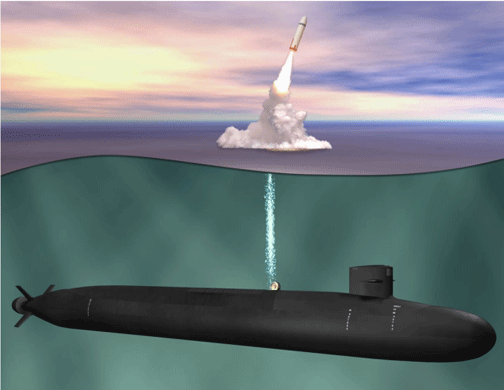
 Not just Jeremy Corbyn – senior Tories also think ditching Trident might be a good idea https://tompride.wordpress.com/2016/01/18/not-just-jeremy-corbyn-senior-tories-also-think-ditching-trident-might-be-a-good-idea/18 Jan 2016 by Tom Pride
Perhaps the Cameron government should be more careful before labelling Jeremy Corbyn a national security ‘threat’ just for saying Trident should be scrapped. Because there are several influential people in the Tory Party who think Trident should be scrapped too.
Former Conservative Defence Secretary Michael Portillo agrees with Jeremy Corbyn:
“Our independent nuclear deterrent is not independent and doesn’t constitute a deterrent against anybody that we regard as an enemy. It is a waste of money and it is a diversion of funds that might otherwise be spent on perfectly useful and useable weapons and troops. But some people have not caught up with this reality.”
And Tim Montgomerie – who has been called one of the most influential Tories outside the cabinet – has also floated ditching Trident (from the Times last March): In fact, in 2009 Montgomerie praised the willingness of the Tory Party to discuss the scrapping of Trident as “tough thinking”.
Veteran Tory MP and former Tory Party chairman David Davis has alsoquestioned the affordability of Trident.
And before he was Prime Minister, David Cameron himself refused to rule outscrapping Trident.
But it’s not just senior Tories who agree with Corbyn.
Field Marshal Lord Bramall, General Lord Ramsbotham, General Lord Ramsbotham and General Sir Hugh Beach have denounced Trident as “irrelevant”.
And in 2009, that well-known hotbed of radical socialism, the Daily Telegraphdiscussed reasons why Trident should be scrapped.
Even the Daily Mail has in the past pondered getting rid of Britain’s nuclear deterrent.
OK. I think I’ve just about got the hang of this Trident discussion thing now.
Scrapping Trident is only a threat to national security when it’s not being proposed by a Tory?
Oh shit. Our nuclear deterrent runs on Windows XP. No, really, it does.
Don’t store nuclear waste near Great Lakes – 92,000 petition Canada
 92,000 petition Canada not to store nuclear waste near Great Lakes, Phys Org, January 21, 2016 Ninety-two-thousand people have pressed Ottawa to reject a proposal to store nuclear waste in an underground vault near the Great Lakes, fearing a spill would contaminate this source of drinking water for 40 million in Canada and the United States.

A 6,000-page petition signed by opponents of local utility Ontario Power Generation’s proposal to store waste in a deep limestone vault to be drilled beneath the world’s largest operating nuclear power plant on the Bruce Peninsula, more than 200 kilometers northwest of Toronto, was delivered to Environment Minister Catherine McKenna, her office confirmed Thursday.
McKenna is expected to rule on the project in March after an independent review panel in May 2015 recommended that it be approved………
any risk of contamination of the largest group of freshwater lakes, created by retreating glaciers 14,000 years go, and containing more than 20 percent of the world’s surface fresh water, is too great.
Cities and towns in the United States and Canada, including Chicago and Toronto, have passed 184 resolutions opposing the building of a nuclear waste repository here.
“No scientist, nor geologist can provide us with a 100,000-year guarantee that this nuclear waste dump will not leak and contaminate the Great Lakes,” Beverly Fernandez, who spearheaded the campaign against the storage facility, told AFP.
“So when we found out that OPG was trying to locate this nuclear waste right besides the Great Lakes—the drinking water for 40 million people in two countries—we felt compelled to do something,” she said http://phys.org/news/2016-01-petition-canada-nuclear-great-lakes.html#jCp
EDF Directors might delay UK Hinkley nuclear decision yet again
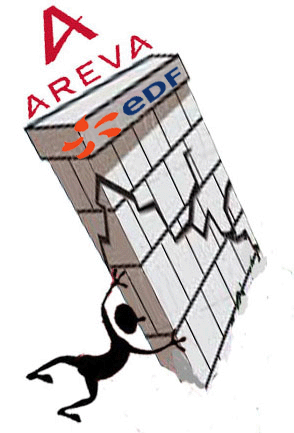 Hinkley Point – Edf to decide whether to build nuclear power station next week By Central Somerset Gazette January 19, 2016 A DECISION on whether a nuclear power station is built at Hinkley Point could be announced next week.
Reports in the French press indicate that the board of directors of the French state electricity generator EDF will meet on January 27 to make a final investment decision on the construction of two nuclear reactors at Hinkley Point near Bridgwater.
The final investment decision on the project has been delayed due to the lengthy negotiations with Chinese partners.
However even now there are concerns that the board might defer the decision for the ninth time……….
EDF is also locked in negotiations surrounding a complex deal to buy a French nuclear reactor builder, Areva, and in the disposal of it’s stake in eight current British nuclear power stations, five in the US, one in Finland and a number of Polish coal fired plants
Preparation of the site stopped last year when negotiations over the financing of the power station stalled.
Campaigners opposed to the building of Hinkley Point C are sceptical that the project will ever see the light of day.
Stop Hinkley spokesperson Roy Pumfrey said: “I’ll believe it when I see it. This is the ninth time EDF has said a final investment decision is imminent. Just last October the chairman of EDF, Jean-Bernard Levy, said work would be starting before the end of 2015. It would be completely reckless of the Board to give the go-ahead to this £25 billion project when the company is in such a parlous state.” http://www.centralsomersetgazette.co.uk/8203-Hinkley-Point-Edf-decide-build-nuclear-power/story-28559932-detail/story.html
Nuclear industry survived only because of ‘liability cap’
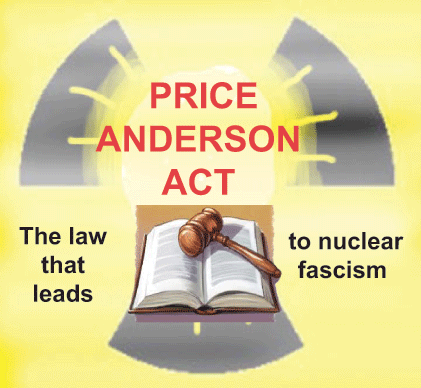
After 60 years of nuclear power, the industry survives only on stupendous subsidies, Ecologist, Pete Dolack 4th January 2016 Without ‘liability caps’ the industry would have been dead long ago
The British government, for instance, currently foots more than three-quarters of the bill for radioactive waste management and decommissioning, and for nuclear legacy sites. A report prepared for Parliament estimates that total public liability to date just for this program is around £50 billion, with tens of billions more to come.
Liability caps for accidents are also routine. In the US the Price-Anderson Act, in force since 1957, caps the total liability of nuclear operators in the event of a serious accident or attack to $10.5 billion. If the total is higher, as it surely would be, taxpayers would be on the hook for the rest.
As a further sweetener, the Bush II / Cheney administration, in 2005, signed into law new nuclear subsidies and tax breaks worth $13 billion. The Obama administration, attempting its own nuclear push, has offered an additional $36 billion in federal loan guarantees to underwrite new reactor construction, again putting the risk on taxpayers, not investors.
The Vermont Law School paper aptly sums up this picture with this conclusion: [page 69]
“If the owners and operators of nuclear reactors had to face the full liability of a nuclear accident and meet the alternatives in competition that is unfettered by subsidies, no one would have built a nuclear reactor in the past, no one would build a reactor today, and anyone who owned one would exit the nuclear business as quickly as they could.”
If we had a rational economic system, they surely would.http://www.theecologist.org/News/news_analysis/2986749/after_60_years_of_nuclear_power_the_industry_survives_only_on_stupendous_subsidies.html
Pro nuclear Bill moves to Wisconsin Senate
Nuclear options, ISTHMUS, 21 Jan 16 January 21, 2016 (Wisconsin) “…….Under current law, state regulators are barred from approving new nuclear power plants unless there is a federal facility to store nuclear waste and the new plant is not a financial burden for ratepayers. No such federal facility exists. A proposal from Rep. Kevin Petersen (R-Waupaca) removing those provisions made it through committee with bipartisan support last month and passed in the Assembly on Jan. 12.
Now, it moves on to the Senate. A spokeswoman for Senate Majority Leader Scott Fitzgerald did not respond to an Isthmus request for comment on the status of the bill. Gov. Scott Walker has said he supports lifting the moratorium………
Alliant Energy spokesman Scott Reigstad says the company is focusing on transitioning its energy generation mix away from large, coal-fired plants and ramping up natural gas generation, which produces 50% to 60% less carbon. Alliant also owns wind farms and hydroelectric dams and has seen growth in customer-owned renewables, like solar panels.
Madison Gas and Electric recently launched a renewable energy initiative, Energy 2030, which aims to supply 30% of its retail energy sales from renewable sources by 2030. The plan makes no mention of nuclear power, says Dana Brueck, MGE spokeswoman.
Environmental groups agree on the need to cut carbon emissions. But many say renewable energy sources like wind and solar offer a cheaper option for generating power.
“If we want to reduce customers’ bills, energy efficiency is the answer,” says Mitch Brey, organizer for renewable energy advocacy group RePower Madison. He says that instead of exploring nuclear options, the Legislature should focus on reducing the state’s dependency on coal. Wisconsin is one of the biggest coal consumers in the nation — more than 60% of the net electricity generation came from burning the fossil fuel in 2013, according to the U.S. Department of Energy.
Renewable energy is also safer than nuclear power, say environmentalists, who fear the prospect of nuclear catastrophes like those that occurred at Chernobyl, Three Mile Island and Fukushima.
“There’s a saying that when you have a solar spill, it’s called a sunny day,” says Elizabeth Ward, a program coordinator with the Sierra Club-John Muir Chapter.
Ward says nuclear power plants are unlikely to help Wisconsin meet the EPA’s Clean Power Plan goals by the 2030 deadline. Facilities are costly and time-consuming to construct, and utility companies have no plans to build in the near future.
“There’s no way we could see a proposal, approval and construction of a nuclear power plant by that time,” she says.
Ward also warns of a possible “unintended consequence” of the legislation. She believes if the moratorium is lifted, it would “strongly signal” to the U.S. Department of Energy that Wisconsin is open to storing nuclear waste. President Barack Obama halted plans to store spent nuclear fuel at Yucca Mountain in Nevada, but the DOE has also identified Wisconsin’s Wolf River Batholith as a possible site for a repository.
“That does not bode well,” Ward says……….
Nuclear power: high costs, massive subsidies – some details
After 60 years of nuclear power, the industry survives only on stupendous subsidies, Ecologist, Pete Dolack 4th January 2016 It’s a global phenomenon
“………….Numerous research papers paint a fuller picture. A Congressional Research Service report found that nuclear power had received $74 billion for research and developmentby the US government for the period 1948 to 1998, more than all such money given for fossil fuels, renewables and energy efficiency combined.
A report by the venture-capital firm DBL Investors, Ask Saint Onofrio, reports that nuclear energy cumulatively has received four times more subsidies than solar energy in California, and that nuclear subsidies were higher than solar in 2011 and all previous years. Nuclear has received $8.2 billion in subsidies in California, while providing the state with 3% of its power in 2012.
The uneconomical state of nuclear power is a global phenomenon, not limited to any one place. A comprehensive study prepared for the Green Party of Germany’s Heinrich Böll Stiftung, The Economics of Nuclear Power: An Update, reports:
“Up to now, nuclear power plants have been funded by massive public subsidies. For Germany the calculations roughly add up to over €100 billion and this preferential treatment is still going on today. As a result the billions set aside for the disposal of nuclear waste and the dismantling of nuclear power plants represent a tax-free manoeuvre for the companies.
“In addition the liability of the operators is limited to €2.5 billion – a tiny proportion of the costs that would result from a medium-sized nuclear accident.”
The paper later says: “Successive studies by the British government in 1989, 1995, and 2002 came to the conclusion that in a liberalised electricity market, electric utilities would not build nuclear power plants without government subsidies and government guarantees that cap costs. In most countries where the monopoly status of the generating companies has been removed, similar considerations would apply.”
Yet new plants are being built, with new subsidies
Significant cost overruns are the norm in building nuclear power plants, and it isn’t investors who are on the hook for them. Three nuclear projects are under construction in the United States and two in Western Europe, a group that features an assortment of cost overruns and generous guarantees:
- The two new Vogtle reactors in Georgia are already $3 billion over budget although their completion date is three and a half years away. The largest owner, Southern Company, has received $8.3 billion in federal loan guarantees. Overruns at this plant are not unprecedented; the two existing reactors cost $8.7 billion instead of the promised $600 million, resulting in higher electricity rates.
- The Watts Bar 2 nuclear reactor in Tennessee, which received its license to operate in October, has seen its cost rise to $6.1 billion from $2.5 billion. (This is technically a restart of a unit on which construction was suspended in 1985.) The existing reactor at this site has a history of safety problems.
- The Summer 2 and 3 reactors being built in South Carolina have already caused rate payers there to endure a series of rate increases. Cost overruns just since 2012 havetotaled almost $2 billion.
- In October 2013, British authorities approved a new nuclear reactor at Hinkley Point, England, that features subsidies designed to give the owner, Électricité de France, aguaranteed 10% rate of return on the project. Power from the plant will be sold at a fixed price, indexed to the consumer inflation rate.
In other words, The Independent reports, “should the market price fall below that [agreed-upon] level the Government would make up the difference.” The agreed-upon fixed price set by the Cameron government at the time was double the wholesale pricefor electricity. Since then the gap has only widened. - Olkiluoto-3 in Finland was supposed to have cost €3 billion, but is 10 years behind schedule and €5 billion over budget.
High costs despite high subsidies
There would at least be a small silver lining in this dark picture if the electricity produced were cheap. But that’s not the case. From the mid-1970s to the mid-1990s, the cost of producing electricity from nuclear power in France tripled and in the United States the cost increased fivefold, according to the Vermont Law School paper [page 46].
Then there are the costs of nuclear that are not imposed by any other energy source: What to do with all the radioactive waste? Regardless of who ultimately shoulders these costs, the environmental dangers will last for tens of thousands of years.
In the United States, there is the fiasco of the Yucca Mountain nuclear waste dump in Nevada. The US government has collected $35 billion from energy companies to finance the dump, which is the subject of fierce local opposition and appears to have no chance of being built.
Presumably, the energy companies have passed on these costs to their consumers but nonetheless are demanding the government take the radioactive waste they are storing at their plants or compensate them. As part of this deal, the US government made itself legally responsible for finding a permanent nuclear waste storage facility.
And, eventually, plants come to the end of their lives and must be decommissioned, another big expense that energy companies would like to be borne by someone else.
As the Heinrich Böll Stiftung study says, [page 17], “there is a significant mismatch between the interests of commercial concerns and society in general. Huge costs that will only be incurred far in the future have little weight in commercial decisions because such costs are ‘discounted’. This means that waste disposal costs and decommissioning costs, which are at present no more than ill-supported guesses, are of little interest to commercial companies.
“From a moral point of view, the current generation should be extremely wary of leaving such an uncertain, expensive, and potentially dangerous legacy to a future generation to deal with when there are no ways of reliably ensuring that the current generation can bequeath the funds to deal with them, much less bear the physical risk. Similarly, the accident risk also plays no part in decision-making because the companies are absolved of this risk by international treaties that shift the risk to taxpayers.” http://www.theecologist.org/News/news_analysis/2986749/after_60_years_of_nuclear_power_the_industry_survives_only_on_stupendous_subsidies.html
1 This Month

22 June – Virtual Event –Climate Change: New Data, New Debate

Monday, June 22, 2026 2:30 p.m. – 3:15 p.m. CT
YouTube. Register here

Protect Sazan Island from the Trump family! https://secure.avaaz.org/campaign/en/protect_sazan_island_from_the_trump_family_loc/?bqFCVab&v=174511&cl=22707147157&_checksum=5e9dde668860e8231c33699735e16a1fbf22ab2cb01da50c999fe8732b9775ef&utm_source=email&utm_medium=blast_email&utm_campaign=174511
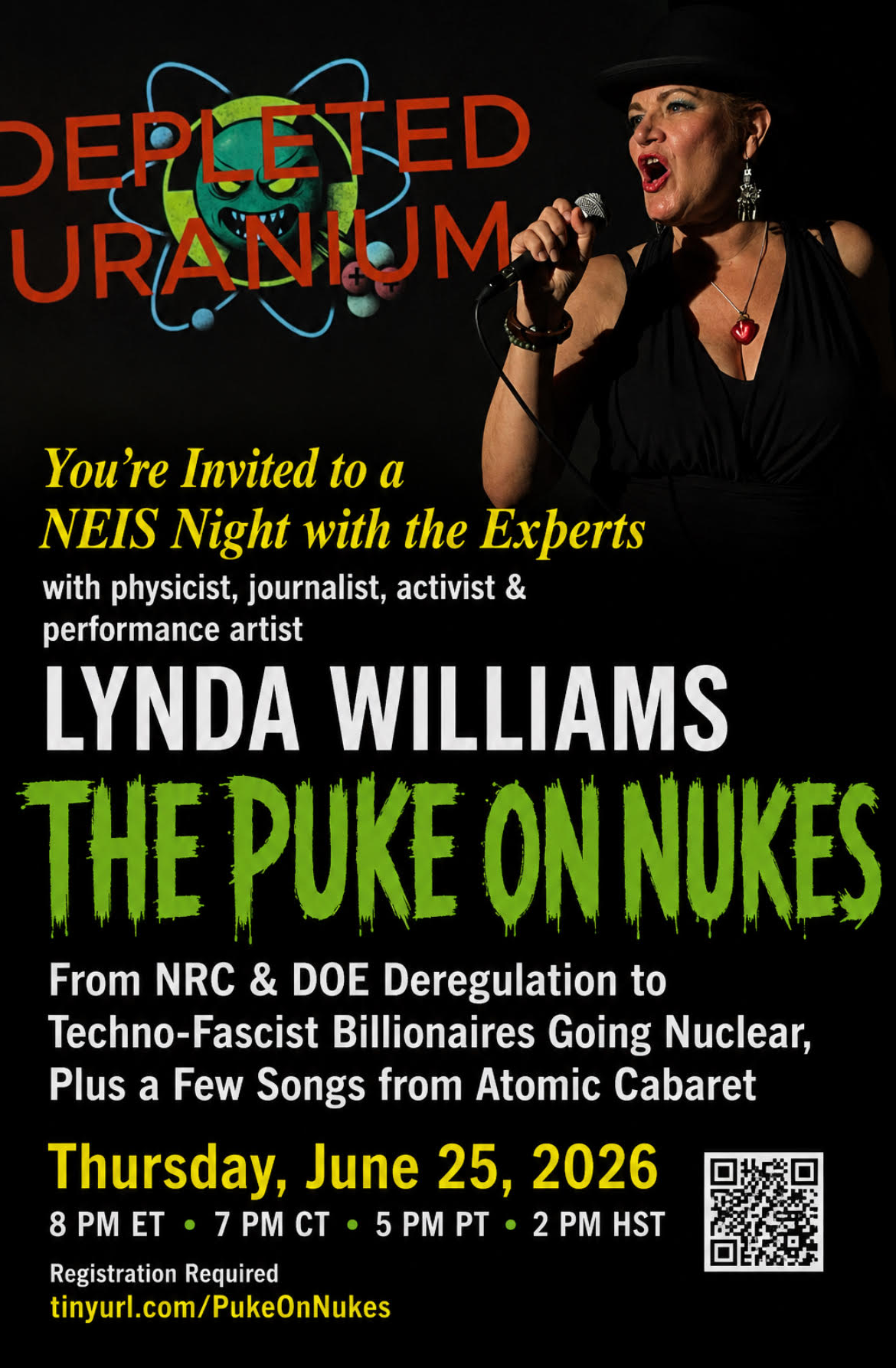
25 June- THE PUKE ON NUKES
Thursday, June 25, 2026
7pm Central Time (8pm ET, 6pm MT, 5pm PT) UTC – 5
From NRC & DOE Deregulation to Techno-Fascist Billionaires Going Nuclear, Plus a Few Songs from Atomic Cabaret REGISTER
26 June – Radiation Trainwreck at the NRC / Join the Protect Better Campaign – https://us02web.zoom.us/meeting/register/4ZlZ5_qLSHGiLSCg8FF6Bg#/registration


Cuba Is Not a Failed State – It Is a Besieged State
PETITION: “Global Appeal to Endorse Palestinian Right of Return of Refugees”
To see nuclear-related stories in greater depth and intensity – go to https://nuclearinformation.wordpress.com
-
Archives
- June 2026 (193)
- May 2026 (306)
- April 2026 (356)
- March 2026 (251)
- February 2026 (268)
- January 2026 (308)
- December 2025 (358)
- November 2025 (359)
- October 2025 (376)
- September 2025 (257)
- August 2025 (319)
- July 2025 (230)
-
Categories
- 1
- 1 NUCLEAR ISSUES
- business and costs
- climate change
- culture and arts
- ENERGY
- environment
- health
- history
- indigenous issues
- Legal
- marketing of nuclear
- media
- opposition to nuclear
- PERSONAL STORIES
- politics
- politics international
- Religion and ethics
- safety
- secrets,lies and civil liberties
- spinbuster
- technology
- Uranium
- wastes
- weapons and war
- Women
- 2 WORLD
- ACTION
- AFRICA
- Atrocities
- AUSTRALIA
- Christina's notes
- Christina's themes
- culture and arts
- Events
- Fuk 2022
- Fuk 2023
- Fukushima 2017
- Fukushima 2018
- fukushima 2019
- Fukushima 2020
- Fukushima 2021
- general
- global warming
- Humour (God we need it)
- Nuclear
- RARE EARTHS
- Reference
- resources – print
- Resources -audiovicual
- Weekly Newsletter
- World
- World Nuclear
- YouTube
-
RSS
Entries RSS
Comments RSS
 nuclear-news