Georgia State panel to do detailed probe of costs of Nuclear Plant Vogtle
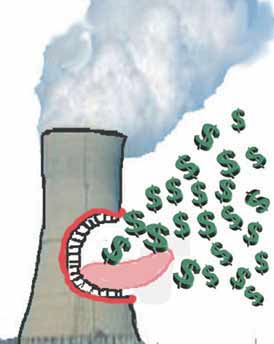 State panel to review Plant Vogtle costs http://chronicle.augusta.com/news/business/2016-02-02/state-panel-review-plant-vogtle-costs By Walter Jones ATLANTA, 4 Feb 16 — Electricity customers and the public will get a detailed look at what’s to blame for cost overruns in the construction of two nuclear reactors slated for power generation after a divided Public Service Commission voted Tuesday to begin its examination.The detailed probe of what Georgia Power has spent is expected to take 14 months to examine the delays that have added nearly $1 billion to the Plant Vogtle expansion.
South Korea’s President Park under pressure from nuclear weapons lobby
Pressure For South Korea To ‘Go Nuclear’ For Defense Against North’s Arsenal, Forbes, Donald Kirk , CONTRIBUTOR , 4 Feb 16
North Korea’s success in conducting a fourth nuclear test has ignited calls for South Korea also to produce nuclear warheads as a “defensive” measure that could heighten the balance of terror that already threatens the Korean peninsula.
South Korean nuclear physicists and engineers have been tinkering with developing nuclear warheads since 1970 but have been frustrated by U.S. insistence that the South abide by the nuclear non-proliferation treaty, which the South signed under U.S. pressure in 1975. The most they can do, under a deal reached with the U.S. last year, is to enrich uranium up to 20% — way above the 4% level for nuclear energy but far below the level for nuclear warheads……..
Calls for South Korea to develop a nuclear arsenal are heard in public, in the media and in political gatherings. The conservative Chosun Ilbo, South Korea’s biggest-selling newspaper, articulated the argument in an editorial reflecting the widespread view that China will do nothing to stop North Korea from exploding more warheads and firing more missiles – and that sanctions against the North will be weak and ineffective……..
At the same time, South Korea would have to abrogate the agreement signed by both Koreas in 1991 for denuclearizing the Korean peninsula – a deal that the North violated from the outset.
‘The U.S. has passed the buck for taming North Korea to China,’ said Chosun Ilbo. “China is doing nothing. Seoul now faces a real need for public discussion of the development of its own nuclear weapons.”
GlobalSecurity.org, a website that specializes in such issues, traced South Korea’s recurring interest in developing its own nukes back to the presidency of Park Chung-hee, father of the current president, Park Geun-hye……..
The current President Park has said her government will abide by the 1991 denuclearization agreement, but she faces rising demands at least for a review of longstanding policy……http://www.forbes.com/sites/donaldkirk/2016/02/04/pressure-mounts-in-south-korea-for-its-own-nukes-to-combat-north-koreas-nuclear-arsenal/#3e42677c345f
South Africa: CORRUPTION GOES NUCLEAR – Jacob Zuma, the Guptas and the Russians


Zuma’s 9 600MW nuclear procurement programme and its accompanying contracts are tainted with alleged vested interests of the most deplorable kind.
If the country has any hope of having a rational, legal, and transparent evaluation of the need for nuclear energy, the procurement process has to start afresh.
This however can only occur under new leadership, which places the country’s interests ahead of its own.
If this does not occur, the future of South Africa will consist of a dark and discontented nuclear winter.
Zuma, the Guptas and the Russians — the inside story
Part 1: In pursuit of satisfying his insatiable greed — Jacob Zuma will liberate us from our constitutional democracy, and destroy the chance of a ‘better life for all’ Zuma, the Guptas and the Russians — the inside story RAND DAILY MAIL LILY GOSAM 02 FEBRUARY 2016
I wish to make it clear from the outset that this piece is not about arguing the merits or demerits of nuclear energy. It is whether Zuma’s decision for nuclear energy is based on sound economic principles for the good of the country, or for some other purpose.
Zuma’s (rabid) pet project
On 9 of December 2015 (and hours before Nene was fired), Zuma’s cabinet approved the 9 600 MW nuclear procurement programme (nuclear programme). This paves the way for nuclear vendors to present proposals in March 2016 to build 6 to 8 nuclear reactors, at an estimated cost of between R800-billion and R1.6-trillion ($50-billion to $100 billion)[5] [6] [7.
The nuclear programme, however, glows with controversy. According to Peter Attard Montalto (an emerging market economist at Nomura), the nuclear programme is Zuma’s “pet project”, and is highly interwoven with politics and the succession issue[8]. His analysis is supported by a Mail and Guardian [M&G] source who said that the programme was regarded as one of Zuma’s “presidential legacy projects” [9]. Professor William Gumede, of Democracy Works, added that the programme is being implemented essentially from a purely patronage point of view[10]. While Andrew Feinstein, executive director of Corruption Watch UK (and former ANC MP), said simply, “I fear that the corruption in this deal might dwarf the arms deal” (News24)[11].
A nuclear procurement process in a constitutional democracy should be transparent, logical, considered, legal, participatory, and unbiased.
Yet Zuma has assumed personal control of the nuclear programme, and it has been characterised by: secret meetings; undisclosed documents and classified financial reports; deceit; aggressive campaigning; damage control exercises; illegality; use of apartheid (‘national key-point’) legislation[12]; sidestepping of Eskom’s technical and financial oversight; destruction of oversight organs of state; disregarding of industry experts; refusal of public consultation; ignoring of the ANC’s national executive committee (NEC) and ANC resolutions; and the removal of any government opponents, the most notable of whom was Nene…………
Below exposes the reasons why Zuma is so hell bent on forcing the Russian 9 600 MW programme through, irrespective of: the evidence against it (from independent and government sources); the laws that stand in his way; the people that advise against it; and the grave concerns of his own party.
Radioactive plant-feed
Nuclear reactors require uranium to function, in particular low-enriched uranium (LEU). But first one must mine the uranium, and for South Africa’s 9 600MW nuclear programme, plus the existing Koeberg Nuclear Plant, the demand for uranium would steadily increase as the nuclear power plants come online. Luckily South Africa is said to have 6% of global identified resources of uranium (or 970 000 tons), the seventh highest share in the world [OECD-NEA, 2013][62].
With a 9 600MW nuclear deal, local uranium reactor demand would grow from the current 290 tons of Uranium (Ut) per year, to eventually 3300 Ut per year, once all the reactors are operational [OECD- Nuclear Energy Agency, 2014][63]. That’s a dramatic 11 times increase in local demand for uranium.
And as it just so happens, in 2010 the Guptas (a family well-known for their backing of Zuma), along with Zuma’s son, Duduzane, emerged as buyers of a South African uranium mine — the Dominion Rietkuil Uranium Project — amid claims that Zuma intervened to ease state funding for the project (according to amaBhungane – M&G’s investigative arm)[64].
[For summaries of the Guptas’ influence with Zuma and his family, read Verashni Pillay’s 2013 M&G article, or Franz Wild’s 2015 Bloomberg article. There are also excellent standalone articles on the Guptas dealings with the state, such as the Sunday Times piece by Sabelo Skiti on how Eskom allegedly went to extraordinary lengths to make sure the Gupta family landed a R4-billion coal deal, or M&G’s amaBhungane articles on a former Gupta associate allegedly involved in R835-million Transnet kickbacks]
All mine
Uranium One Incorporated (Uranium One) — a public company in Canada — owned a number of uranium mines around the world, including a uranium and gold mine in the North West province, South Africa[65] [66]. The local mine was called the Dominion Rietkuil Uranium project, which proved to be a disappointment to the company and so it was mothballed in late 2008.
Uranium One’s global uranium holdings attracted the attention of Rosatom, which from 2009 onwards began buying up the company’s shares through one of its many wholly-owned subsidiaries. (Rosatom would eventually indirectly secure 51% ownership of Uranium One in 2010, and 100% in 2013, after which it was delisted[67])[68].
As Rosatom (through its subsidiary) was buying into Uranium One, the company sold the South African Dominion Rietkuil Uranium project. Reporters picked up on Uranium One’s “low-key announcement” in April 2010 of the sale of the mine to an undisclosed party[69] [70]. The mine was sold for $37.3-million, at a loss to the company of $242-million (based on the company’s interim financial statements)[71]. Thus the mine was sold for about 14% of its reported value.
One month later, in May 2010, the media got wind that the mine — which would come to be known as Shiva Uranium — was bought by Oakbay Resources and Energy Limited (a Gupta-controlled company) together with minority shareholders, which consist of companies within companies (like a Russian nesting doll), including indirectly the ANC’s MK war veterans and its women’s group[72], and the black economic empowerment group Mabengela Investments (Mabengela).
Mabengela is headed by Zuma’s son Duduzane and Rajesh “Tony” Gupta (the youngest of three Gupta brothers). 45% of Mabengela is owned by Duduzane Zuma; 25% by Rajesh “Tony” Gupta (the youngest of the three Gupta brothers); 20% by an array of Gupta employees, former business partners and friends; and the last 10% is owned by an obscure offshore company, with its sole owner a Dubai resident with discernible traces in South Africa[73] [M&G]. The M&G wrote that Mabengela appears to be the vehicle for the Zuma family’s empowerment by the Gupta family[74].
(The North West province — where the mine is situated — is governed by Supra Mahumapelo, the province’s premier, and he is said to be a member of the so-called “premier league”, which consists of premiers loyal to Zuma. The other premier-league provinces are the Free State and Mpumalanga[75]. For the 2014/15 period, the auditor-general found the number of “clean audits” — that is, financial statements that present a fair and accurate picture and comply with accepted accounting principles — for the departments and public entities in Mpumalanga and the North West came to 24% and 4% respectively, while 32% of the Free State’s audits were deemed clean[76] [77]. This excludes financial statements by departments not submitted on time, or at all[78].
amaBhungane and the Sunday Times uncovered that the Guptas had expected the Public Investment Corporation (PIC) to facilitate funding for the Uranium mine purchase. (The state-owned PIC is the country’s largest institutional investor, with more than R750-billion — as at 2010 – in civil servants’ pensions under its management[79]).
……….At the time of the purchase of the Dominion Rietkuil Uranium mine, journalist Brendan Ryan [Fin24] pondered, “Who in their right mind would buy one of the most notorious dogs in the entire South African mining sector — the failed Dominion Uranium mine — and do it at a time when uranium prices are still depressed? That’s the $64 000 question following news that the Gupta family — the ultimate controlling shareholder in Shiva Uranium — has bought Dominion for $37.3-million. It’s either the steal of the century — given that developers Uranium One wrote off an investment of $1.8-billion when they shut Dominion down in October 2008 — or it’s a classic case of throwing good money after bad.”[93]
Unbeknownst to Ryan, at the time, was that Zuma and his benefactors had set the course for a large-scale nuclear programme.
Atomic timeline: 2000 to 2010
In the early 2000’s, Zuma — then South African deputy president — met the Guptas for the first time, as a guest at a business function held by a Gupta company, Sahara Computers[94].
In 2005, during the power struggle between Zuma and Thabo Mbeki for the presidency, the Guptas were said to have sided with Zuma, even after he had been fired as deputy president. The Guptas had tried to court Mbeki, but did not get far. (The Guptas claim that they were friends with Mbeki as much as they are friends with Zuma). The Guptas don’t mind telling whoever cares to listen that they were there for Zuma when his days were dark [Business Day][95].
Early in 2007, Eskom approved a plan to expand South Africa’s overall electricity capacity by the year 2025. The plan included the construction of 20 000 MW of new nuclear capacity, consisting of up to 12 nuclear reactors. France’s Areva and the United States’ Westinghouse were contenders[96].
In December 2007, Zuma was elected as ANC president[97].
Six month’s later, in June 2008, Duduzile and Duduzane, Zuma’s daughter and son joined the board of the Gupta-controlled company, Sahara Computers[98] [99]. (Duduzile resigned from the position in 2010[100]. Duduzane and Gupta family members are directors of at least 11 of the same companies, as at December 2015 [Timeslive][101].)
In September 2008, Mbeki resigned as South African president.
In December 2008, Eskom abandoned the 20 000MW nuclear plan for being unaffordable in the wake of the 2008 global financial crisis and the renewed appreciation for coal production[102] [103] [104][Professor J. van Wyk of Political Sciences]
Zuma was inaugurated as South African president in May 2009. In November 2009, the Guptas’ formed a new company, which would come to be known as Oakbay Resources and Energy Limited[105](Oakbay).
One month later, in December 2009, Zuma declared at the United Nations Climate Change Conference in Copenhagen that South Africa was going to reduce its carbon emissions by 34% by 2020[106]. His announcement took both local and international commentators by surprise, but it revealed Zuma’s nuclear ambitions.
Four months after that, in April 2010, the Guptas, Duduzane Zuma, and other investors bought the mine — soon to be called Shiva Uranium — with Zuma allegedly ensuring state assistance. The Guptas and Duduzane then jumped into action, refurbishing the uranium and gold plant “very aggressively”[107] to make the plant operational for production. They also possessed due diligence studies and a comprehensive bankable feasibility study (a document required to raise capital)[108] [109]……..
In August 2010, Zuma met with his Russian counterpart, Dmitry Medvedev, during his first official visit to Russia. Zuma was accompanied by 11 cabinet ministers and more than 100 South African business people[112].
During the trip, Zuma concluded a deal with Medvedev for Rosatom to supply 40% of Koeberg’s enriched uranium needs until 2017 to 2018[113] [114]. The Head of Rosatom told reporters that the company hoped to eventually control 45% of the low-enriched uranium (LEU) market in South Africa[115].”Our share of the market in South Africa will rise,” he said…………….
Gupta and Gupta-linked companies involved in mining – including Shiva Uranium – have several times run into trouble with regulatory requirements, as well as those on environmental compliance[226] [227][TimesLive]. Due to changes in environmental and mining legislation, Zwane is in charge of enforcing those regulations[228] [229]………..
South Africa has become one of the leading destinations for renewable energy investment, so said a 2015 research report by the Energy Research Centre UCT. The Renewable Energy Independent Power Producers Project (REIPPP) is a joint private-public initiative for renewable energy generation, mainly from wind, solar PV and concentrated solar power. Since its inception, the REIPPP has been hailed an unprecedented success. The programme is unique in that for projects to qualify, developers must contribute to the reduction of socio-economic inequity, through community ownership and economic development benefits[237].
As of October 2015, 92 projects had been selected as part of the REIPPP, mobilising private investment of R193-billion, and with a combined capacity of 6 327MW. In addition, 37 out of the 92 projects had been completed by then and they contributed 1 827MW of power to the national electricity grid (this is equivalent to one Koeberg nuclear power station), while also providing social upliftment[238] [239] [240][241]. In June 2015, the energy department issued a determination to procure a further 6 300 MW for the project[242]. The national treasury expected the REIPPP to eventually contribute 17 000 MW of electricity capacity to the grid by 2022[243].
Yet, in October 2015, just when bidding by renewable power producers was set to start for the additional capacity[244], Brian Molefe — now CEO of Eskom — halted the process, with the non-issuance of budget quotes for the programme. He said it was a temporary measure taken to protect the financial sustainability of Eskom. Effectively, he was saying Eskom could not afford to support new REIPPP connections as well as energy purchases. He added that, “very soon a lasting solution will be found to address this matter” [Fin24][245] [246] [247]. (As of writing, no reports on Eskom’s future commitment to the REIPPP could be located.)
On Wednesday, 9 of December 2015, Zuma held a cabinet meeting to discuss key government programmes and decisions. Amongst them was the nuclear procurement programme for 9 600 MW, which was then approved by cabinet (but excluded the then Cooperative Governance and Traditional Affairs minister Gordhan, who was off sick) [Carol Paton of Business Day uncovered cabinet’s decision][248].
Just hours after the meeting, and to the cabinet’s great consternation and surprise (according to Jeff Radebe, who is a cabinet member, an ANC NEC member, and minister of the presidency)[249], they heard along with the rest of the public that Zuma had fired Nene, and replaced him with a parliamentary backbencher, David van Rooyen. The move was met with shock and disbelief in all sectors at home and abroad[250].
Two days later, on Friday, 11 of December 2015, the post-cabinet media briefing by Radebe and accompanying press statement made no mention of the fact that the 9 600MW nuclear deal had been approved[251] [252] [253]. It was only on Monday, 14 December 2015, after Gordhan had taken the helm of treasury that cabinet’s decision was publically confirmed by him.
Uranium enrichment
“Global uranium demand is predominantly driven by its use in nuclear power generation plants,”[254]declared Oakbay, the majority shareholder in Shiva Uranium. But uranium cannot be used as fuel to run nuclear reactors until it has been converted into low enriched uranium (LEU)[255] [256].
The World Nuclear Organisation states that Eskom procures its conversion, enrichment and fuel fabrication services from world markets, and that nearly half of its enrichment is from Russia. However, historically, South Africa has sought self-sufficiency in its fuel cycle[257].
In the 1970s the Apartheid government established a uranium enrichment company, which later, in 1999, was restructured to become Necsa (currently under the management of Zuma’s “lynchpins” Seekoe and CEO Tshelane). But actual enrichment operations ceased in 1995, and the only two conversion plants were both demolished. Much of the high-enriched uranium (HEU) is still stored away. (Some say there’s a 250kg cache[258]).
With the prospect of 9 600MW of nuclear power, local enrichment operations are again a priority. ………
Uranium is not the only commodity with dubious links to the nuclear programme.
In July 2013, John Helmer (a provocative American journalist who focuses on the Russian business sector) flagged a strange deal with a company Nemascore which had links to Zuma’s associates ……….
Stacked deck
Overall, the tendering process for the 9 600MW nuclear build programme will include 80% South African sourced construction companies, engineers, waste management system suppliers, security systems providers, cabling, cement, steel, finance, transport, IT firms, mining, and more[286] [287].
Which on the face of it sounds wonderful, but not when one considers it is for a nuclear programme that has already been declared by government and independent studies to be unnecessary and unaffordable, will ultimately result in 10 to 50 times higher electricity costs than we are paying now, and already exhibits alarming signs of fixed tendering through devious means[288]……..
Zuma is the bomb
Besides LEU, enrichment plants can also produce high enriched uranium (HEU), which is used in nuclear weaponry.
In March 2012, at a Nuclear Security Summit in Seoul, Zuma stated on the subject of HEU, “…South Africa has adopted a policy on the benefication of our mineral resources, including uranium.”[293] What Zuma meant by “benefication” was that SA has a policy of enriching Uranium and does not want to limit its options by foreswearing the production or use of HEU [IOL]. Officials further explained that Zuma was not only keeping SA’s options open for producing HEU in the future, but also defended its decision to hold on to its existing stock of HEU from the nuclear weapons programme of the Apartheid government [IOL]………..
Conclusion
Zuma’s 9 600MW nuclear procurement programme and its accompanying contracts are tainted with alleged vested interests of the most deplorable kind.
If the country has any hope of having a rational, legal, and transparent evaluation of the need for nuclear energy, the procurement process has to start afresh.
This however can only occur under new leadership, which places the country’s interests ahead of its own.
If this does not occur, the future of South Africa will consist of a dark and discontented nuclear winter. http://www.rdm.co.za/politics/2016/02/02/zuma-the-guptas-and-the-russians–the-inside-story
South Africa’s Zuma and the get rich plan about uranium
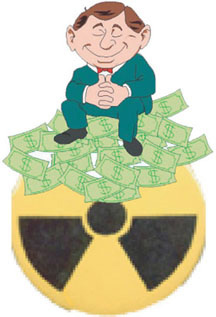 Zuma, the Guptas and the Russians — the inside story RAND DAILY MAIL LILY GOSAM 02 FEBRUARY 2016 “……..Below exposes the reasons why Zuma is so hell bent on forcing the Russian 9 600 MW programme through, irrespective of: the evidence against it (from independent and government sources); the laws that stand in his way; the people that advise against it; and the grave concerns of his own party.
Radioactive plant-feed Continue reading
USA govt funds “new nukes’

Energy Department Funds Two Advanced Nuclear Programs MIT Technology Review, 21 Jan 16, In the latest sign of the U.S. government’s determination to help push nuclear power technology beyond conventional reactors, the Department of Energy is providing $80 million in funding to two advanced reactor programs. At $40 million each in matching funds over the next five years, the grants will go to X-energy, a little-known Maryland-based startup that is developing a new version of a pebble-bed reactor, and to Southern Company, the Atlanta-based utility that is working with TerraPower on molten-salt reactors. ……https://www.technologyreview.com/s/545586/energy-department-funds-two-advanced-nuclear-programs/
New doubts hang over future of Britain’s Hinkley Nuclear Plan

 New threat to Hinkley nuclear plant cash,Sunday Times, Danny Fortson 31 January 2016 BRITAIN could withdraw financial support for the controversial £18bn nuclear power station at Hinkley Point, Somerset, if a similar plant being built by France’s EDF is not running by 2020, The Sunday Times can reveal.
The condition, attached to a Treasury loan guarantee, raises fresh questions about the future of Britain’s first new atomic power plant in a generation.
Last week EDF, which is 84% owned by the French state, postponed a board meeting in Paris to approve Hinkley Point, amid concerns about the heavily indebted company’s ability to fund the project. The plant will be financed by EDF and its Chinese partner CGN, with the backing of a 35-year contract to sell power to households at above-market rates.
The arrangement hinges on a Treasury agreement to guarantee up to 17 billion pounds in loans…. (registered readers only) http://www.thesundaytimes.co.uk/sto/business/energy_and_environment/article1662807.ece?CMP=OTH-gnws-standard-2016_01_30
Will the government listen to 92,000 Petitioners against Great Lakes Nuclear Dump?
Group opposed to nuclear waste facility presents petition containing
92,000 signatures, January 31, 2016 By Jim Bloch, The Voice, Ontario As a single individual, it’s often hard to imagine that you can affect national events. But if you join together with 92,000 others, your impact can grow.
That’s the hope of Beverly Fernandez, founder of Stop the  , the nonprofit organization dedicated to derailing the plans of Ontario Power Generation to bury 200,000 cubic yards of low- and intermediate-level nuclear waste in a 2,200-foot-deep repository in Kincardine, Ontario, within a mile of Lake Huron.
On Jan. 19, Fernandez, on behalf of STGLND, delivered a petition containing more than 92,000 signatures and more than 31,000 comments to new Minister of the Environment and Climate Change Catherine McKenna.
“The signatures and comments send a very clear message to the Canadian government,” Fernandez said. “OPG’s nuclear waste burial and abandonment plan poses unacceptable risks to the drinking water of 40 million Canadians, Americans and Indigenous Peoples and must be rejected.”
McKenna is scheduled to make a decision about the proposal by March 1. ……….
“This petition stands alongside the more than 22 million people represented by 184 resolutions opposed to OPG’s plans to bury and abandon nuclear waste, some of which will stay toxic for 100,000 years,” said the letter to McKenna.
Resolutions opposing the nuclear waste facility have been passed by nearly every city, township and county in the Blue Water Area, as well as the Michigan Senate. Continue reading
Takahama town tries to stop its heavy dependence on the nuclear industry
 Town tries to shift away from heavy dependence on nuclear plant, Japan Times, 31 Jan 16 JIJI TAKAHAMA, FUKUI PREF. – In the wake of the disastrous nuclear accident in northeastern Japan nearly five years ago, the Fukui Prefecture town of Takahama has been seeking ways to reduce its heavy dependence on a nuclear power plant for its livelihood.
“It is true that we’ve depended on the nuclear industry,” said a local official responsible for community buildings in the municipality, home to Kansai Electric Power Co.’s Takahama nuclear plant.
The town and the nuclear power station have “become inseparable” since the plant’s No. 1 reactor started operations in 1974, according to the official.
The plant has provided jobs for the community, with the much of the town’s economy geared towards providing services for those who work at the facility.
On Friday, the plant’s No. 3 reactor was brought back online after a hiatus of nearly four years, becoming the third reactor in the nation to restart operations under the country’s new safety standards compiled after the March 2011 accident at Tokyo Electric Power Co.’s Fukushima No. 1 nuclear power plant. Kansai Electric plans to reactivate the No. 4 reactor at the plant in late February.
In fiscal 2014, which ended in March last year, the town’s revenues related to the nuclear plant, including subsidies and fixed-asset tax income, totaled ¥5,072 million, accounting for 51 percent of its total general-account revenue.
However, the Fukushima No. 1 plant accident changed the town’s way of thinking.
“We’ve come to think seriously that the town must not depend solely on the nuclear industry,” the town official said. “We are now aiming to reshape the town into a community that does not rely on nuclear power.”
As part of its effort, the town is looking to its beaches with their beautiful landscapes and pristine waters…… http://www.japantimes.co.jp/news/2016/01/31/national/town-tries-shift-away-heavy-dependence-nuclear-plant/#.Vq5u4tJ97Gh
Why the Nuclear Lobby and Australian Politicians want Australia as world’s radioactive trash dump
from CaptD 31 Jan 16 The first reason is MONEY and I mean BIG Money. Politicians are always gear for Nuclear  Payback*
* http://www.urbandictionary.com/define.php?term=Nuclear+payback
Those that support nuclear power because nuclear power somehow supports them; no matter what the health implications or other “costs” are for others.
The “other” reason is that the Nuclear Industry and their Utilities are desperate to create a radioactive waste dumping site for waste is that they are going to want to site Small Modular Reactors (SMRs) very soon, which companies like SD’s General Atomic are now working on. Since CA has a law that says no more nuclear reactors, until a waste site is developed, the lack of a disposal site is the biggest roadblock they face preventing them from deploying SMRs in CA.

I believe that most Utilities will want to phase out Nat. Gas fired Peaker plants and install SMR’s “because they don’t emit CO2.” That is, unless they are going to be making big money using nat. gas like SDG&E will be, since they already have a contract to import Nat. Gas from Mexico (which Sempra owns a share of, so they will be kind of buying Nat. Gas from themselves) for use in their two new state of the art Billion Dollar Peaker Plants that the CPUC just approved for them (despite the fact that the cost of Wind and Solar generation continues to drop almost monthly)!
SCE just had the CPUC decide against approving a Nat. Gas Peaker plant for them, so you can bet that they are now getting “very excited” about installing one or more SMR’s at San Onofre, since the grid wiring connection is already in place and they are going to be guarding that “nuclear waste” site for decades to come.
http://www.kpbs.org/news/2016/jan/08/oceanside-takes-stand-relocating-san-onofres-nucle/
BTW: All waste facilities should be run by the Government, that way they will always be responsible for it, since Big Waste Corp.’s can go out of business any time they want as as everybody knows Radiation is FOREVER since 50 or more than 100 years is forever to everyone living today.
Pierce County, USA not happy with DOE plan for a deep bore feasibility study for nuclear waste
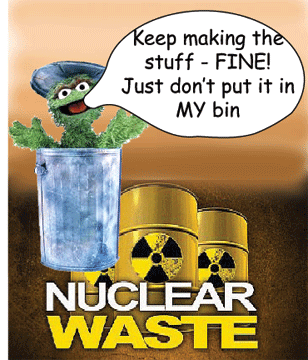 Rocky road for nuclear waste bore hole study, http://bismarcktribune.com/news/state-and-regional/rocky-road-for-nuclear-waste-bore-hole-study/article_7698d465-0316-5031-83e9-bc727d3592b9.html By Lauren Donovan, 29 Jan 16 A plan to explore deep ancient rock in Pierce County for its potential to store nuclear waste hit a bumpy road if not a rock wall in its first introduction to state officials Thursday.
The State Board of University and School Lands heard from the Energy and Environmental Research Center at Grand Forks that its team was awarded $35 million by the federal Department of Energy to drill 16,000 feet down into crystalline rock to learn whether the rock could suitably store spent nuclear fuels.
John Harju, project liaison, said the bore hole is for study purposes only, no waste would be stored there and that such storage isn’t even yet legal under federal rules.
Harju said the bore hole would be an opportunity to analyze rock core that’s rarely ever been looked at for minerals or geothermal properties. The chance to go that deep, into the oldest rock on the planet, “may never present itself again,” Harju said.
The issue was presented to the land board because EERC is proposing to drill on 20 acres of state-owned land about 15 miles south of Rugby.
Pierce County commissioners were at the meeting and said they were startled to read about the project before anyone from EERC even came to the county.
Commissioner Duane Johnston said, if the issue had come up at a local zoning meeting, “half the county would have been there to say no.” Commission chairman Dave Migler said it was tough to take calls from residents and not have much information to share. “It’d be nice to be in the loop,” he said.
While there was no formal application on the table, land board members didn’t hesitate to weigh in with worries that a federal project could become a federal mandate.
In the end, it was far from clear how the EERC would proceed with getting approval to use public land for the project in Pierce County, or perhaps anywhere in the state.
Afterward, Harju said he was a little surprised by his reception. “Plan B? We don’t have one. If the project is not able to proceed, the DOE will have to evaluate” alternatives, he said.
The five-year project was awarded to the Battelle Memorial Institute of Ohio, along with EERC and Schlumberger, a familiar drilling service company in the Bakken. The crystalline rock formation underlies much of the continent.
Bernie Sanders calls for total phaseout of nuclear energy

Protest repressed in India, as government panders to France, USA
the international nuclear industry has faced its worst crisis globally. The industry is looking at India as a big market where they can compensate for their losses and revive their fortunes. India has become an attractive market for global nuclear corporations

France Peddles Unsafe Nuclear Reactors to India, Drawing Protest , 29 January 2016 By Kumar 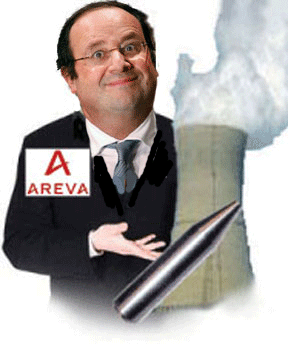 Sundaram, Truthout | News Analysis On January 26, French President François Hollande was the chief guest for India’s Republic Day ceremony, where India showcases its military hardware in a colonial-era parade in its capital. Meanwhile, in Jaitapur on India’s western coast, farmers and fisherfolk were protesting against Hollande’s visit, arguing that the nuclear reactors that India is importing from France threaten their lives, livelihoods and the local ecology.
The Joint Declaration: Localizing Risk, Siphoning Off Profit
In a joint declaration issued on January 25 in New Delhi, the two governments reaffirmed their commitment to go ahead with a long-pending nuclear deal. As per the declaration, the intense negotiations to finalize the commercial agreement are expected to conclude by the end of this year, and the construction of six European pressurized reactors (EPR) imported from France is to begin by early 2017.
The new twist in the declaration is the “maximum localization” of the project and “technology transfer” for the same. Although the government of Indian Prime Minister Narendra Modi seems to have proudly included these new terms and added a “Made in India” tag on the Jaitapur project, it actually means that the French industry would be transferring the burden of its most controversial reactor design at a time of its worst crisis.
The safety vulnerabilities of the reactor pressure vessel (RPV) – the huge iron core where radioactive fission takes place – came under serious questions, raised by France’s own nuclear safety regulator Autorité de Sûreté Nucléaire (ASN) in April 2015. Later in 2015, Areva, the French reactor builder, had to ask the US Nuclear Regulatory Commission to suspend certification review for EPR design. The United States has been postponing certification for EPR since 2007. The Finnish regulator has taken Areva to court on this issue, and Finland has canceled the order for its second EPR. Just two days after the publication of ASN’s report, Modi reaffirmed the EPR deal from France during his visit to Paris in April 2015. It is exactly this controversial component – the RPV – that an Indian private company L&T will now be building, with no experience in the nuclear sector at all.
The current phase of negotiations on Jaitapur is about the price of reactors, which remains a major sticking point. Although the former chief of India’s Atomic Energy Commission promised a tariff of a maximum of 10 US cents per unit for the electricity produced in Jaitapur, independent experts have claimed it will be much higher (20 to 30 cents per unit). This means the government of India would use taxpayers’ money to keep the price competitive. If we go by the cost of EPRs in the United Kingdom, each Indian reactor may cost as much as $8.9 billion. Two reactors in Jaitapur’s first phase will cost as much as India’s total expenditure on science and technology (including the departments of space, science and technology, biotechnology, and research for the entire country). A diplomatic cable revealed by WikiLeaks quoted the general manager of the Nuclear Power Corporation (NPCIL), saying that India is paying a “high” price for Jaitapur………….
The Indian government has managed to acquire land for the project by pressuring farmers and luring a handful of landlords. Despite land acquisition, the farmers in Jaitapur continue to resist. Most villagers either work on others’ land or provide rural services to the agrarian community and do not get any compensation when villages are dislocated for “development” projects. Tabrez Soyekar, a young fisherman, was killed in an indiscriminate police shooting in April 2011, during a peaceful protest. Hundreds of activists and eminent citizens, including the former Navy chief of India and retired justice of the Supreme Court of India, were detainedduring a protest march.
Thirteen village councils in Jaitapur passed unanimous resolutions against the project as recently as November 2015. It is utterly hypocritical for both countries to laud each other’s democratic credentials for international diplomacy if the democratically elected village councils are neglected violently……..
Independent energy experts in India, including a former top official in the Ministry of Power, have argued for a decentralized energy framework that would suit India better, as the majority of its population still lives in villages scattered across the country and transmission losses in centralized Indian grids are staggering.
The 2015 World Nuclear Industry Status Report concludes that, after the Fukushima accident, the international nuclear industry has faced its worst crisis globally. The industry is looking at India as a big market where they can compensate for their losses and revive their fortunes. India has become an attractive market for global nuclear corporations, where the government is mortgaging its financial and environmental health to welcome them. This includes channeling the accident liability to the public; undermining environmental, geological and safety laws; and ignoring the measured advice of independent experts.
Besides Jaitapur, massive and intense anti-nuclear protests have arisen in Koodankulam, Mithi Virdi and Kovvada, where Russian and US corporations are setting up nuclear power plants. Local communities in other places like Chutka, Fatehabad and Mahi Banswara have also been agitating against the nuclear projects. The government has resorted to brutal crackdowns and repression against these consistently peaceful protests. More than 8,000 people in Koodankulam are facing fabricated police cases under colonial-era sedition laws and charges of waging war against the Indian state. The police have killed, arrested and harassed villagers indiscriminately, including women and children. They surrounded the Idinthakarai village in 2012 and disrupted its vital supply lines that deliver goods, including food and milk for children and medicines, to force the village to surrender. One of the first steps that the new government under Modi took in 2015 was to come up with a “confidential” report by the Intelligence Bureau, naming Greenpeace, the Coalition for Nuclear Disarmament and Peace, and other anti-nuclear and environmentalist organizations “anti-national.”http://www.truth-out.org/news/item/34627-france-peddles-unsafe-nuclear-reactors-to-india-drawing-protest
Japan: secret use of consumer’s money to fund pro nuclear political campaign
Utilities secretly buy tickets for pro-nuclear minister’s fund-raisers http://ajw.asahi.com/article/behind_news/politics/AJ201401270057 January 27, 2014 THE ASAHI SHIMBUN
Using money paid by consumers, nuclear plant operators have secretly bought tickets worth several million yen a year for fund-raising parties of Akira Amari, a pro-nuclear Cabinet minister, since 2006, The Asahi Shimbun learned.
The utilities have kept each ticket purchase at 200,000 yen ($2,000) or less to prevent their names from appearing in the political fund reports of Amari, the minister in charge of economic revitalization, sources said.
It was already reported that directors of electric power companies have made individual donations to the ruling Liberal Democratic Party, but the utilities were found for the first time to have bought fund-raising party tickets with electricity fees paid by consumers.
Amari, an LDP lawmaker with economic and industrial interests, exerts strong influence on energy policy and advocates reactivating idled nuclear reactors.
In July, he sought Niigata Governor Hirohiko Izumida’s approval of Tokyo Electric Power Co.’s application for safety screening in preparation for restarting two reactors at its Kashiwazaki-Kariwa nuclear plant.
Amari’s office told The Asahi Shimbun it handles and reports political funds appropriately. It declined to discuss details beyond those entered in reports.
Nine regional utilities that operate nuclear plants bought tickets for Amari’s parties in 2006, when he became minister of economy, trade and industry, according to senior officials of electric power companies. The electric power industry falls under the jurisdiction of that minister.
The companies together spent about 1 million yen for each party. Their share was determined based on the size of company operations, the sources said.
The arrangement was maintained for the following years, and affiliates of the utilities sometimes joined.
TEPCO dropped out of the framewor
Crapo’s crap nuclear amendment passed by USA Senate
 Senate overwhelmingly approves Crapo nuclear energy legislation http://www.clearwatertribune.com/news/online_only_news/senate-overwhelmingly-approves-crapo-nuclear-energy-legislation/article_0ceb9f8e-c6c2-11e5-b5cf-871b59e94614.html
Washington, D.C. – The U.S. Senate today approved overwhelmingly legislation written by Idaho Senator Mike Crapo that would increase nuclear research efforts at the Idaho National Laboratory and other national labs through new partnerships between the public and private sectors. The vote of 87 to 4 to approve the amendment makes it a part of a larger energy policy reform bill before the Senate.
Crapo, along with Senators Jim Risch, Sheldon Whitehouse, (D-Rhode Island), Cory Booker (D-New Jersey) and Orrin Hatch (R-Utah), Mark Kirk (R-Illinois) and Dick Durbin (D-Illinois) originally introduced the Nuclear Energy Innovation Capabilities Act (NEICA), which was the foundation of the Crapo amendment voted on today. The legislation, S. 2461, directs the U.S. Department of Energy (DOE) to prioritize partnering with private innovators on new reactor technologies and the testing and demonstration of reactor concepts. Under the agreement today, the Nuclear Regulatory Commission (NRC) would report to Congress on any barriers that would prohibit the licensing of new reactors within a four-year time period……….. (registered readers only )
Psychology and Culture: the Pitfalls for Nuclear Deterrence
The nuclear deterrence game: Promises and pitfalls , BY AT EDITOR on JANUARY 29, 2016 in ASIA TIMES NEWS & FEATURES By Michael Rühle ………….Perhaps the most common mistake in thinking about nuclear deterrence is the belief that the larger your nuclear arsenal, the more credible your deterrent. This is way too simplistic. Since a state will only take nuclear risks in defense of existential interests, an opponent may still resort to force if he concludes that the issue at stake is not existential to the defender.
That’s why allies of nuclear powers constantly need to be reassured by their protector that he considers their security a truly vital interest. Or, as former British Defense Secretary Denis Healy aptly noted, during the Cold War it took only 5% credibility to deter the Soviet Union but 95% to assure one’s allies.
 Psychology. A stable deterrence regime requires all actors to adhere to a “rational” cost-benefit calculus. Thus, nuclear deterrence cannot work against actors that are “irrational” to begin with, e.g. suicidal fanatics.
Deterrence may also fail when rationality evaporates, for example, when ideological beliefs make certain leaders adopt risky offensive strategies.
However, the most likely scenario in which rationality could disappear is defensive. Since humans fear suffering losses more than they value gains, the fear of losing something valuable will make leaders take far greater risks than the opportunity of changing the status quo in their favor.
Hence, as much as one would want to have the upper hand in a crisis, one should still avoid pushing a nuclear adversary into a corner.
 Culture. Deterrence may be a universal concept, but its practical application may well be culture-specific. For example, a culture which attaches great value to sacrifice or martyrdom will be much harder to deter by the prospect of military punishment than a “post-heroic” society. This is not to say that certain states cannot be deterred, yet their cost-benefit calculus might be so different as to render the defender’s deterrence message ineffective.
To ensure that an adversary understands one’s deterrence message, one needs to have a fairly good grasp of his “strategic culture”: historical experiences, values, core beliefs, and military traditions. Obtaining such a thorough understanding of one’s adversary is extremely difficult. But simply hoping that an impressive nuclear arsenal will deter just by its mere existence would be a dangerous gamble. In the deterrence business, ignorance isn’t bliss — it might well be fatal.
Michael Rühle heads the Energy Security Section of NATO’s Emerging Security Challenges Division http://atimes.com/2016/01/the-nuclear-deterrence-game-promises-and-pitfalls/
1 This Month
22 June – Virtual Event –Climate Change: New Data, New Debate

Monday, June 22, 2026 2:30 p.m. – 3:15 p.m. CT
YouTube. Register here

Protect Sazan Island from the Trump family! https://secure.avaaz.org/campaign/en/protect_sazan_island_from_the_trump_family_loc/?bqFCVab&v=174511&cl=22707147157&_checksum=5e9dde668860e8231c33699735e16a1fbf22ab2cb01da50c999fe8732b9775ef&utm_source=email&utm_medium=blast_email&utm_campaign=174511

25 June- THE PUKE ON NUKES
Thursday, June 25, 2026
7pm Central Time (8pm ET, 6pm MT, 5pm PT) UTC – 5
From NRC & DOE Deregulation to Techno-Fascist Billionaires Going Nuclear, Plus a Few Songs from Atomic Cabaret REGISTER
26 June – Radiation Trainwreck at the NRC / Join the Protect Better Campaign – https://us02web.zoom.us/meeting/register/4ZlZ5_qLSHGiLSCg8FF6Bg#/registration


Cuba Is Not a Failed State – It Is a Besieged State
PETITION: “Global Appeal to Endorse Palestinian Right of Return of Refugees”
To see nuclear-related stories in greater depth and intensity – go to https://nuclearinformation.wordpress.com
-
Archives
- June 2026 (193)
- May 2026 (306)
- April 2026 (356)
- March 2026 (251)
- February 2026 (268)
- January 2026 (308)
- December 2025 (358)
- November 2025 (359)
- October 2025 (376)
- September 2025 (257)
- August 2025 (319)
- July 2025 (230)
-
Categories
- 1
- 1 NUCLEAR ISSUES
- business and costs
- climate change
- culture and arts
- ENERGY
- environment
- health
- history
- indigenous issues
- Legal
- marketing of nuclear
- media
- opposition to nuclear
- PERSONAL STORIES
- politics
- politics international
- Religion and ethics
- safety
- secrets,lies and civil liberties
- spinbuster
- technology
- Uranium
- wastes
- weapons and war
- Women
- 2 WORLD
- ACTION
- AFRICA
- Atrocities
- AUSTRALIA
- Christina's notes
- Christina's themes
- culture and arts
- Events
- Fuk 2022
- Fuk 2023
- Fukushima 2017
- Fukushima 2018
- fukushima 2019
- Fukushima 2020
- Fukushima 2021
- general
- global warming
- Humour (God we need it)
- Nuclear
- RARE EARTHS
- Reference
- resources – print
- Resources -audiovicual
- Weekly Newsletter
- World
- World Nuclear
- YouTube
-
RSS
Entries RSS
Comments RSS
 nuclear-news