America’s NRC changing nuclear fee structure to help Small Nuclear reactors: Shillenberger delighted
 NuScale Power LLC is expected to be the first company in the U.S. to submit a small modular reactor design application to the NRC by the end of the year, with project commercialization by 2024. NuScale’s reactor modules would each generate 50 megawatts (95 ECR, 5/17/16).
The NRC is implementing a variable annual fee schedule for these reactors including a minimum fee, a variable fee and a maximum fee based on the reactor’s cumulative licensed thermal power rating, which is the total heat output for all modules at a nuclear power plant. …..
Safety Concerns from Environmentalists
The Union of Concerned Scientists, a nonprofit organization focused on scientific research of environmental issues, opposes different fees for small modular reactors because the safety risk of these reactors is still unclear, it said.
“It’s not clear that the relative risk of SMRs and the effort needed to license and regulate them is proportional to the power rating,” Ed Lyman, a senior scientist at the Union of Concerned Scientists, told Bloomberg BNA May 23. He said this is especially true “since SMR applicants are requesting exemptions that require significant technical analysis, such as reducing emergency planning zone size and weakening security requirements.”
Also, Lyman disagreed with the statement that the SMRs would require less regulatory oversight. “NRC inspections of a multi-module SMR bundled unit may be more complex and entail more labor than inspections of a single large reactor with the same power rating,” he said.
Similarly, Tim Judson, executive director of the Nuclear Information Resources Service, said he thinks that reduced fees for SMRs would ultimately impact NRC safety inspections.
“Smaller reactors means there would be several times more reactors requiring inspections and oversight for the same amount of power. Basing the fees on the generation capacity seems like it’s likely to starve the agency of resources to do its job,” he told Bloomberg BNA May 23.
TVA Submits Early Site Permit for SMR
The Tennessee Valley Authority submitted an early site permit application for the potential to construct and operate multiple small modular reactor units at its Clinch River site near Oak Ridge, Tenn. TVA is the first in the nuclear industry to submit any such application related to SMR technology to the NRC, TVA said in a May 13statement.
The utility, which currently operates three nuclear plants in the South, has not decided what company it would purchase the SMR technology from, a TVA spokeswman told Bloomberg BNA May 23.
To contact the reporter on this story: Rebecca Kern in Washington atrkern@bna.com
To contact the editor responsible for this story: Larry Pearl atlpearl@bna.com
Lithuania, and environmentalists not happy with Belarus’ nuclear power plan
 Minsk Letter: Belarus goes ahead with nuclear power, Irish Times, Kieran Cooke in Minsk, 24 May 16,
“…….Though Chernobyl is in Ukraine, it’s estimated that the prevailing winds resulted in up to 70 per cent of the radioactivity being deposited on Belarus, much of it in the southern region of the country, close to the Ukrainian border.
Undeterred by the legacy of Chernobyl – many here still suffer from cancers and other diseases as a result of what ranks as the world’s worst nuclear accident – Belarus is now building its own nuclear power plant……
The government – for more than 20 years under the firm grip of president Alexander Lukashenko – claims that more than 60 per cent of the country’s 9.5 million approve of the nuclear facility, though no nationwide poll has ever been taken…..
Government critics say no proper public hearings have been held about the plant, and that those who dare to raise objections have been harassed or arrested……..
Russian reliant
Critics point out that Belarus will still be reliant on Russia. A Russian state nuclear company has designed and is responsible for much of the construction. Russia will also supply the plant’s nuclear fuel – and deal with the waste.
Neighbouring Lithuania, always suspicious of a government in Minsk it sees as a remnant of the old Soviet order, is deeply concerned about what’s going on. It points out that the plant at Ostrovets is only 20km from the Lithuanian border and only 50km from Vilnius, the capital.
Officials in Vilnius say Belarus has not answered questions about the safety of Ostrovets and is in contravention of international agreements on nuclear facilities. The government in Minsk firmly denies the accusations.
Svetlana Alexievich, the Belarus author and winner of the 2015 Nobel prize for literature for her work on interviewing Chernobyl victims and other writings, has described the nuclear fallout from Chernobyl as an unimaginable disaster for her country.
Back at the new nuclear plant, due to become operational in two years, we are being bombarded with data. So many thousands of tons of concrete, so many tons of steel are being used in its construction.
“What happens if a missile is fired at the plant?” asks one journalist.
“Then we are all in trouble,” comes the reply. http://www.irishtimes.com/news/world/europe/minsk-letter-belarus-goes-ahead-with-nuclear-power-1.2658040
Japan’s Abe government intent on 2020 Olympics, pretending that Fukushima is OK now
Fukushima Flunks Decontamination, CounterPunch, 20 May 16. by ROBERT HUNZIKER Japan’s Abe administration is pushing very hard to decontaminate land, roads, and buildings throughout Fukushima Prefecture, 105 cities, towns, and villages. Thousands of workers collect toxic material into enormous black one-ton bags, thereby accumulating gigantic geometric structures of bags throughout the landscape, looking evermore like the foreground of iconic ancient temples.
Here’s the big push: PM Abe committed to the 2020 Tokyo Olympics, which shall be a crowning achievement in the face of the Fukushima disaster. Hence, all stops are pulled to repopulate Fukushima Prefecture, especially with Olympic events held within Fukushima, where foodstuff will originate for Olympic attendees.
The Abe government is desperately trying to clean up and repopulate as if nothing happened, whereas Chernobyl (1986) determined at the outset it was an impossible task, a lost cause, declaring a 1,000 square mile no-habitation zone, resettling 350,000 people. It’ll take centuries for the land to return to normal.
Fukushima: Living with a Disaster
Still and all, is it really truly possible to cleanse the Fukushima countryside? Already, workers have accumulated enough one-ton black bags filled with irradiated soil and debris to stretch from Tokyo to LA. But, that only accounts for about one-half of the job yet to be done. Still, in the face of this commendable herculean effort, analysis of decontamination reveals serious missteps and problems.
Even though the Abe government is encouraging evacuees to move back into villages, towns, and cities of Fukushima Prefecture, Greenpeace nuclear campaigner Heinz Smital claims, in a video – Fukushima: Living with Disaster d/d March 2016: “Radiation is so high here that nobody will be able to live here in the coming years.”
Greenpeace has experts on the ground in Fukushima Prefecture March 2016, testing radiation levels. The numbers do not look good at all. Still, at the insistence of the Abe government, people are moving back into partially contaminated areas. In such a case, and assuming Greenpeace is straightforward, it’s a fair statement that if the Abe government can’t do a better job, then something or somebody needs to change. The Olympics are coming……
Throughout the prefecture, decontamination is only partially carried out. For example, decontamination is confined within a 20-meter radius of private plots and along the roads as well as on farmland, leaving vast swaths of hills, valleys, riverbanks, streams, forests, and mountains untouched. Over time, radiation contamination runoff will re-contaminate many previously decontaminated areas.
Alarmingly, Greenpeace found large caches of hidden buried toxic black bags. Over time, it is likely the bags will rot away with radioactivity seeping into groundwater.
At Fukushima City, 60 km from the plant, Greenpeace discovered unacceptable radiation levels with spot readings as high as 4.26, 1.85, 9.06 μSv. According to Greenpeace: “These radiation levels are anything but harmless.”…..http://www.counterpunch.org/2016/05/20/fukushima-flunks-decontamination/
Thailand’s “Nuclear Energy for Peace Bill” – George Orwell would love it!
Cheers, doubts as nuclear energy bill gets NLA nod PRATCH RUJIVANAROM PRAPASRI OSATANON
THE NATION May 21, 2016 Move seen as facilitating the construction of nuclear power plant in the country.
“We have cases of radioactive material and nuclear waste smuggling into Thailand and we need the regulatory body to control this activity. Moreover, the information disclosure about nuclear energy is still a problem,” Tara said.
He noted that the bill would also help facilitate nuclear power plant construction in Thailand, despite the nation still not being ready yet for this kind of energy.
“We have a very low budget compared to European countries to build nuclear power plants, so I’m afraid our nuclear power plants will have a safety problem and may cause harmful effects to the environment and people,” he said.
Chulalongkorn University’s Faculty of Science lecturer Jessada Denduangboripant said he was pleased the bill had passed.
“We have cases of radioactive material and nuclear waste smuggling into Thailand and we need the regulatory body to control this activity. Moreover, the information disclosure about nuclear energy is still a problem,” Tara said…..
Exelon nuclear corporation pressing for tax-payer funding at State and Federal level, USA
 Exelon presses for help at state, federal levels, E & E, Jeffrey Tomich, E&E reporter EnergyWire: Friday, May 20, 2016 The nation’s largest nuclear operator put on the full-court press yesterday in Washington, D.C., and Springfield, Ill., for policies to keep some its struggling plants afloat amid increasing competition from wind energy and a glut of cheap shale gas that’s depressing energy prices.
The case for helping preserve Exelon Corp.’s endangered nuclear plants — the Clinton and Quad Cities plants in Illinois and the R.E. Ginna and Nine Mile Point plants in New York — isn’t new.
Chicago-based Exelon has threatened for more than two years to shut money-losing plants in an effort to prod state lawmakers to act. In New York, Democratic Gov. Andrew Cuomo’s administration has come to the rescue with an evolving plan to help existing plants survive the downturn in energy markets (EnergyWire, March 18). In Illinois, Exelon is proposing a similar remedy, but it remains to be seen if the General Assembly will come to the rescue.
Earlier this month, Exelon’s chief executive, Chris Crane, said he has authority from the board to shut the “distressed assets” if lawmakers don’t approve a proposal requiring up to $290 million a year in subsidies from Illinois consumers to keep them profitable.
The company offered a revamped proposal on May 5 and gave the Legislature until the end of the month to pass it (EnergyWire, May 6). If not, the 1,087-megawatt Clinton plant would be closed when its obligation to run ends a year from now, Crane said. The Quad Cities plant is required to run an extra year, but unless the bill passes or the plant clears this year’s PJM Interconnection capacity auction for 2018-19, it, too, will be shut down.
If Exelon’s nuclear proposal isn’t complex and controversial enough, it is woven into a sweeping, 316-page energy bill that would rewrite Illinois energy policy……
Exelon said the two plants have lost a combined $800 million over the last six years, and they are projected to lose another $500 million over the next five years.
“We are unable to sustain those type of economic losses any longer,” Tim Hanley, the company’s senior vice president of nuclear projects, told the committee……
Exelon’s claims were challenged, however, by consumer groups including AARP and by the Illinois attorney general, as well as by Illinois industrial energy users and downtown Chicago building owners. The same groups opposed the nuclear proposal a year ago.
Cara Hendrickson, an assistant attorney general, told committee members the measure was nothing more than “another nuclear bailout, dressed up differently.” …..http://www.eenews.net/stories/1060037598 Twitter: @jefftomich Email: jtomich@eenews.net
USA Energy secretary Ernest Moniz keen to get tax-payer funding for Exelon nuclear power
 Fifteen to 20 nuclear units in US ‘at risk’ of shutdown: industry official Washington (Platts)–19 May 2016 Some 15 to 20 nuclear power units in the US are “at risk” of being shut over the next five to 10 years due to economic challenges such as low power prices, competition from natural gas-fired generation and subsidized renewables, a nuclear industry official said Thursday.
Marvin Fertel, president and CEO of the Nuclear Energy Institute, did not name any of the reactors considered to be most at risk in his remarks at a US Department of Energy summit on the future of nuclear power. He did say that small, single-unit nuclear power plants are the most economically challenged.
Two such plants, Dominion’s Kewaunee in Wisconsin and Entergy’s Vermont Yankee, have closed for economic reasons since 2013. Entergy’s FitzPatrick in New York and Pilgrim in Massachusetts are scheduled to be shut in 2017 and 2019, respectively, due to such factors, the company has said. The Omaha Public Power District said last week it is recommending to the district’s board of directors that its Fort Calhoun plant in Nebraska be shut because other generating options are less costly…….
Fertel noted that Exelon’s two-unit Quad Cities nuclear plant in Illinois, which the company has said is losing money and will be shut in the next few years without further legislative and market support, “……
Secretary of Energy Ernest Moniz, who spoke immediately before Fertel at the summit, agreed in his remarks that continued operation of some operating nuclear power plants is at risk.
Moniz said that DOE’s Quadrennial Energy Review currently underway is assessing the future of the existing nuclear fleet in a subcommittee chaired by former deputy secretary of defense John Deutch, and is considering how nuclear plant operators might be compensated for the various benefits of their generation. Those issues will be “at the heart of the analysis work going on right now in developing this QER,” he said.
“I’m expecting an excellent report” from the subcommittee on what can be done to sustain operation of existing nuclear units, Moniz said. “This question of valuation [of nuclear generation] is one that is absolutely central. It’s one that we’re certainly paying attention to.”……. http://www.platts.com/latest-news/electric-power/washington/fifteen-to-20-nuclear-units-in-us-at-risk-of-21497100
Illinois General Assembly split on the idea of bailing out Exelon’s financially distressed nuclear station
Bill to help Clinton nuclear plant on back burner Bloomington Pantograph Dan Petrella dan.petrella@lee.net SPRINGFIELD, 20 May 16 — It remains unclear whether the Illinois General Assembly will act before the scheduled end of its spring session on legislation that Exelon Corp. says is essential to the future of its financially struggling nuclear power plants in Clinton and near the Quad Cities.
Near the end of a committee hearing Thursday that lasted more than three hours, Democratic Sen. Mattie Hunter of Chicago, chairwoman of the Senate Energy and Public Utilities Committee, said the measure won’t be coming to the Senate floor for a vote anytime soon.
Exelon has said that it will shut down the Clinton Power Station next year “if adequate legislation is not passed that properly values nuclear power for its economic, environmental and reliability benefits during the spring Illinois legislative session scheduled to end May 31.”…….
“It appears our committee is split,” Hunter said. “I don’t know if we even have enough votes to get it passed anyway.”…..
Exelon’s proposal also faces stiff opposition from groups like AARP Illinois, the Illinois Public Interest Research Group and the Illinois attorney general’s office. Opponents say a shift in the way customers are charged could result in wide month-to-month variations in power bills. http://www.pantagraph.com/news/state-and-regional/bill-to-help-clinton-nuclear-plant-on-back-burner/article_4f2fcbbf-84bd-52a5-a2e0-991c7e7fda74.html
New York’s proposed Clean Energy Standard a financial gift to the nuclear industry
 A gift to the nuclear power industry, The River Reporter May 18, 2016 — State officials are in the midst of a round of meetings regarding the state’s proposed Clean Energy Standard (CES), which will determine how much renewable electricity will be distributed to customers by utilities in years to come. The proposed plan calls for the state to generate 80% of electricity from renewable power by 2050, which is certainly a laudable goal.
Incredibly, however, the proposed CES mandates that rate-payers keep the state’s four nuclear power plants alive by paying higher-than-market prices for the expensive electricity produced by the plants.
As Jessica Azulay, program director of Alliance for a Green Economy, wrote in a memo, “The proposed Clean Energy Standard also includes a gift to nuclear corporations operating in Upstate New York. Due to low electricity prices, declining demand, competition from wind power, and rising nuclear costs, New York’s four upstate reactors have been struggling economically. Two are on the verge of closure unless they receive a financial lifeline. Tucked into the ‘Clean Energy Standard’ is that lifeline. In addition to requiring that utilities and ESCOs [Energy Supply Companies] purchase renewable energy, the policy would mandate that utilities buy 4.6% of the electricity they deliver in 2017 from nuclear reactors ‘facing financial difficulty.’ By 2020, utilities would be required to buy 15.7% of electricity from unprofitable nuclear plants.”….
while proponents call nuclear power a form of clean energy because it doesn’t release any carbon into the air while electricity is being generated, the process of collecting uranium to power the nuclear plants could hardly be considered clean.
Again, according to Azulay, the mining of uranium is largely unregulated and there are over 15,000 abandoned uranium mines in this country that have not been cleaned up. She says, “After mining, uranium is processed into uranium dioxide ore at a mill; milling generates vast amounts of radioactive and toxic tailings that are deposited on the ground or in open ponds. The fuel is then enriched in an energy-intensive process. By the time fuel is delivered to a reactor for use, approximately 25,000 pounds of mining waste (rock, mill tailings, and depleted uranium) have been generated for each pound of nuclear fuel.”
Nuclear power plants are not the answer to present or future energy needs, and New York State taxpayers should not be asked to pay for those that become unprofitable. Comments regarding the CES are due by June 6, and a sample comment and submission instructions can be found at www.allianceforagreeneconomy.org/nukes-are-not-clean. http://www.riverreporter.com/editorial/4302/2016/05/18/gift-nuclear-power-industry
‘Generation IV’ nuclear companies desperate for tax-payers’ money
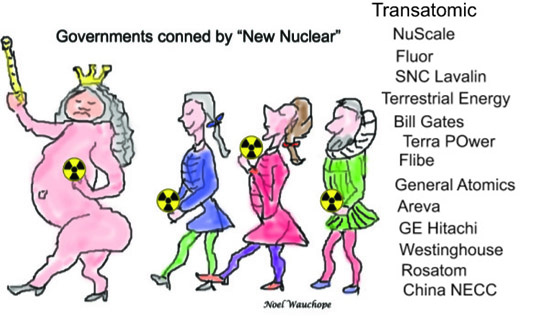
 Nuclear Firms: More Federal Money for Advanced Reactors. Bloomberg BNA, By Rebecca Kern May 17 — Nuclear companies said in a Senate hearing that continued support from Congress is needed to further develop and commercialize advanced nuclear reactors, several of which are getting some Department of Energy funding.
“Successful completion of the DOE cost-share program depends on sustained congressional support and continued appropriations,” John Hopkins, chairman and chief executive officer of NuScale Power LLC, an advanced nuclear reactor company, said at a May 17 Senate Energy and Natural Resources hearing on advanced reactors. “We appreciate your past support and we ask that you continue to prioritize small modular reactor programs in a tight budgetary environment.”……
NuScale has been receiving cost-share grants from the DOE since 2013 and expects to submit its first-of-a-kind small modular reactor licensing application to the Nuclear Regulatory Commission by the end of 2016, Hopkins said……
John Gilleland, chief technical officer of TerraPower LLC—a nuclear design company developing a generation-four reactor—also said there is a need for more government funding….
TerraPower is working with the China National Nuclear Corporation, an economic corporation overseen by the Chinese government, to develop a 1,200 megawatt electric liquid sodium-cooled fast reactor that uses depleted uranium as fuel in the metallic form. They hope it will be commercially deployable in the 2020-2030 time frame, Gilleland told Bloomberg BNA May 17.
Support for Advanced Nuclear Bills
Jacob DeWitte, co-founder and chief executive officer of Oklo, an advanced reactor start-up company, lauded the work done by the committee to pass the Energy Policy Modernization Act (S. 2012) in late April (76 ECR, 4/20/16). The bill included language from a bill sponsored by Sen. Mike Crapo (R-Idaho) that would establish a National Nuclear Innovation Center between the Energy Department and the NRC to establish capabilities for the private sector to test and demonstrate advanced reactor concepts.
He also supported S. 2795 introduced by Sen. James Inhofe (R-Okla.) that would promote the development of advanced nuclear technologies, which is being marked-up by the Senate Environment and Public Works committee this week…..
Also, Rep. Bob Latta (R-Ohio) has introduced H.R. 4979 which would direct DOE and the NRC to work together on an advanced nuclear reactor framework. This bill will be marked up by the House Energy and Commerce committee this week (92 ECR, 5/12/16)……
To contact the reporter on this story: Rebecca Kern in Washington atrkern@bna.com
To contact the editor responsible for this story: Larry Pearl atlpearl@bna.com http://www.bna.com/nuclear-firms-federal-n57982072580/
USA House and Senate committees approve bills favouring “new nuclear” companies
 environmental groups raised concerns with H.R. 4979 in a May 17 letter to the House Energy and Commerce Committee, saying changes to the NRC’s licensing framework could lead to safety concerns.
 Ed Lyman, a senior scientist at the Union of Concerned Scientists, said he had concerns with requiring the Energy Department to split the costs of advanced reactor development, because this ultimately would be borne by taxpayers.
House, Senate Panels OK Advanced Nuclear Reactor Bills Bloomberg BNA, By Rebecca Kern May 18 — House and Senate committees approved two bills May 18 that would create a new licensing framework at the Nuclear Regulatory Commission for the review of advanced reactors.
During separate hearings, the House Energy and Commerce Committee favorably reported out the Advanced Nuclear Technology Development Act (H.R. 4979), and the Senate Environment and Public Works Committee approved the Nuclear Energy Innovation and Modernization Act (S. 2795)………
NuScale Power LLC will be the first company to submit a licensing application to the NRC by year-end for its advanced small modular reactor that is 50 megawatts and can be transported by rail, truck or barge (95 ECR, 5/17/16).
The bills will next go to the House and Senate floors, although no schedules for votes have been announced.
Dan Schneider, the Energy and Commerce’s press secretary, told Bloomberg BNA May 18 that the committee members look forward to working with the co-sponsors of S. 2795 once the House passes H.R. 4979 to work out differences between the bills.
Environmentalists Cite Concerns
Confronting nuclear proponents on the real costs of “new nuclear” – US Senate hearing
Hearing on new reactors turns into colloquy on subsidies Hannah Northey, E&E reporter E&E Daily: Wednesday, May 18, 2016 A Senate hearing focused on the challenges of building the nation’s next-generation nuclear fleet yesterday quickly pivoted to concerns about cost and competition from cheap natural gas, with senators needling each other over energy subsidies…….
senators on the panel repeatedly turned back to the question of cost and whether the developers could make their projects compete financially.
Sen. Martin Heinrich (D-N.M.) said he was having a hard time reconciling the closure of nuclear power plants, including units in Illinois that had lost hundreds of millions of dollars in past years, with the industry’s push for new reactor designs. Heinrich asked witnesses what cost per kilowatt-hour they were targeting to ensure the advanced technologies would be competitive in the marketplace…….
Independent Sen. Angus King of Maine also questioned the industry’s math, noting that it could cost $7 million per megawatt to build an advanced reactor, whereas the costs for wind and natural gas are substantially lower……
The senator went on to ask Kuczynski whether a “level playing field” also meant scrapping federal support for the nuclear industry in the form of the Price-Anderson Act — a 1957 law that created a $12 billion pot of money to cover injuries and property damage during accidents.
When Kuczynski said the industry doesn’t view the law as a subsidy, King was quick to respond.
“It walks like a duck, it talks like duck, it’s a duck. It’s a subsidy,” King said. “If you had to buy that insurance, it would cost you a fortune, is that not correct?” http://www.eenews.net/stories/1060037434
Republican U.S. Sen. Lamar Alexander opposes wind power
 Pro-Nuclear GOP Senator Urges Tennessee to Reject Wind Farm, abc news,By ERIK SCHELZIG, ASSOCIATED PRESS NASHVILLE, Tenn. — May 19, 2016, Republican U.S. Sen. Lamar Alexander is urging his fellow Tennesseans to oppose what he calls an “unsightly” wind farm near the Cumberland Mountain State Park.
The longtime supporter of nuclear power argued on the Senate floor this week that the 23 wind turbines Apex Clean Energy wants to install are “massive” and would spoil the “natural beauty of our state.”
“We should not allow anyone to destroy the environment in the name of saving it,” said Alexander, arguing that wind energy is being fueled by “billions in wasteful taxpayer subsidies” to out-of-state companies.
Apex countered that the $130 million project will emit no pollution and create no hazardous waste as it provides a safe energy alternative near wildlife and natural areas…….
The wind farm near Crossville, about 100 miles east of Nashville, is projected to power 20,000 homes. It is located on a privately-owned 1,800-acre site behind a limestone quarry, though the turbines would be visible from Interstate 40.
“This project will help bring about cleaner, healthier air, reduce pollution, and create economic growth and jobs in Cumberland County,” Chandler said……http://abcnews.go.com/US/wireStory/pro-nuclear-gop-senator-urges-tennessee-reject-wind-39229291
New York Public Service Commission hearing on nuclear power stations
New York weighs future of Indian Point, upstate nuclear power plants Thomas C. Zambito, The Journal News May 17, 2016 “……..“Work with us to plan this just transition,” anti-nuclear activist Manna Jo Greene, the environmental director for the Beacon-based Clearwater, urged workers who crowded an Albany-area hearing held by the state Public Service Commission. “The handwriting is on the wall.”
The hearing was one of 22 being held across the state this month as the Public Service Commission weighs Gov. Andrew Cuomo’s proposal to establish clean energy standards so the state can continue reducing its carbon emissions.
Cuomo wants the state to rely on renewable energy sources for 50 percent of its electricity by 2030. While he’s advocated Indian Point’s shutdown, he’s pushing for the commission to offer financial incentives that would aid three upstate nuclear power plants – two in Oswego and a third near Rochester.
The owners of the James A. FitzPatrick nuclear power plant in Scriba say they will shut the plant’s doors in January 2017 and lay off half of the plant’s 600 workers.
Cuomo’s proposal envisions keeping the upstate nuclear plants open to act as a “bridge” until the state is able to rely on renewable energy sources for its electricity.
Several anti-nuclear speakers cast Cuomo’s effort to save the upstate plants as a “bailout” that shouldn’t be borne by ratepayers.
“Right now the nuclear industry, even though it’s over 50 years old still is unable to support itself,” said Susan Shapiro, a Rockland County attorney who works with the Indian Point Safe Energy Coalition. “It’s received more bailouts from the federal government than any other industry and it continues to receive bailouts from taxpayers.”…….
The Public Service Commission is scheduled to hold a vote on Cuomo’s proposals next month. http://www.lohud.com/story/tech/science/environment/2016/05/17/new-york-indian-point/84511734/
EDF hoping to extend life of nuclear reactors, postpone decommisson costs
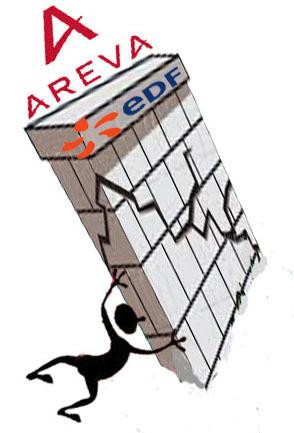 EDF sees French energy plan shaping nuclear depreciation schedule http://uk.reuters.com/article/uk-edf-nuclear-idUKKCN0YA211 PARIS | BY GEERT DE CLERCQ 19 May 16.The French government’s energy investment plan due in July will be a key indicator for whether and for how long EDF will extend the depreciation period of its nuclear plants, an executive said on Thursday.
EDF hopes to get nuclear energy regulator ASN’s authorisation to extend the lifespan of its nuclear plants to 50 years from 40, and already wants to extend the depreciation period on these assets, which would boost bottom-line profit.
Early this year ASN said it expects to give generic guidelines on French nuclear plant life extensions by 2018, but said extensions could not be taken for granted and that they would be decided reactor by reactor.
The government’s long-awaited multi-year energy investment plan (PPE) – implementing the August 2015 energy transition law – will not specify reactor lifespan, but should set targets for the share of nuclear in France‘s power mix.
President Francois Hollande has vowed to reduce that share from 75 percent to 50 by 2025, but has taken no concrete steps towards that goal.
“The PPE, and notably its nuclear chapter, expected early July, will figure largely in our decision about the accounting lifespan of our nuclear reactors,” EDF nuclear chief Dominique Miniere told reporters.
In 2003, EDF extended the depreciation schedule for its reactors in its accounts to 40 years from 30 – six years before the ASN authorised the move.
CEO Jean-Bernard Levy said in April EDF plans to extend the depreciation period by the closing of first-half results.
Miniere said the PPE should signal how many of EDF’s 58 reactors can keep operating, which will determine over what period reactors and related maintenance costs can be depreciated.
He said life extension would also impact EDF’s 23 billion euros (1 billion pounds) worth of decommissioning and nuclear waste provisions.
“Delaying reactor decommissioning also means delaying provisions,” he said. Miniere said 80 percent of EDF’s 58 reactors were built between 1980 and 1990. From 2020, many need to close or get approval operate another decade.
Miniere said every reactor has annual maintenance costs of about 50 million euros, or about 3 billion euros per year for EDF’s fleet.
Extending EDF’s reactors by 10 years and incorporating safety lessons learned from the Fukushima disaster will boost that to 4-4.2 billion euros per year in the 2014-2025 period, a total of just over 50 billion, after which costs will ease to 4.2-3 billion euros per year, he said. (Reporting by Geert De Clercq, editing by David Evans)
France’s President Hollande backs Hinkley nuclear project, despite near bankruptcy of EDF
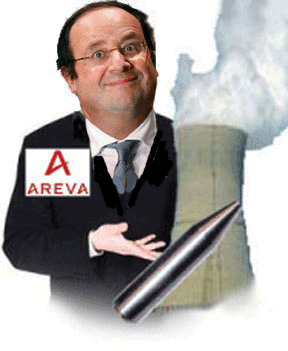 Hollande renews support for Hinkley Point nuclear reactors http://www.theguardian.com/uk-news/2016/may/17/hollande-renews-support-edf-hinkley-point-nuclear-reactors
French president backs project despite fears that £18bn price tag could bankrupt EDF, which is 85% state-owned François Hollande has renewed his support for the controversial nuclear project planned by the French energy company EDF at Hinkley Point in Britain.
“I am in favour that this project goes ahead,” the French president told Europe 1 radio on Tuesday.
“It’s very important to understand that we need a high-performance, highly secure nuclear industry in France, and that we cannot let others take over terrain, including on exports, that has been French up to now,” he said.
A final decision on the plan to build two new-generation nuclear reactors at Hinkley Point in south-west England was due this month, but was delayed after unions at EDF demanded a review of the costs.
A joint project between EDF and China General Nuclear Power Corporation, it carries a projected price tag of £18bn ($26bn, €23bn) that will make it one of the world’s most expensive nuclear power plants.
Unions at EDF, which is 85% state-owned, fear it could bankrupt the company, which is already saddled with more than €37bn of debt.
Last month, the management agreed to consult the internal committee which has brought in outside experts to review the financial implications of the project.
Hollande said the review would be completed “in the coming weeks”.
There have been dissenting voices over Hinkley Point within the French government.
On Friday, France’s environment minister Ségolène Royal, who is also mother to Hollande’s children, told the Financial Times that she was worried about the “colossal sums” involved in the project and questioned whether it should go ahead
Ratings agencies Standard and Poor’s and Moody’s both lowered their forecasts for EDF last week, saying efforts to streamline the company were insufficient.
Hollande restated his vow to restructure and boost financing at EDF and rival energy giant Areva, “because they are the future”.
“The French nuclear industry has 200,000 employees. It represents our energy independence,” Hollande told Europe 1.
“EDF and Areva are public companies on which we should rely. But at the same time, we must give them new support.”
CGN, which is due to cover a third of the costs, said on Monday that it would not go ahead with the project if EDF pulls out.
1 This Month
23-25 October – on Zoom – World BEYOND War’s annual global conferenc

To see nuclear-related stories in greater depth and intensity – go to https://nuclearinformation.wordpress.com

Say No to NASA’s Reckless Nuclear Reactor on the Moon
Say No to NASA’s Reckless Nuclear Reactor on the Moon
-
Archives
- October 2026 (149)
- September 2026 (339)
- August 2026 (330)
- July 2026 (355)
- June 2026 (287)
- May 2026 (306)
- April 2026 (356)
- March 2026 (251)
- February 2026 (267)
- January 2026 (308)
- December 2025 (358)
- November 2025 (359)
-
Categories
- 1
- 1 NUCLEAR ISSUES
- business and costs
- climate change
- culture and arts
- ENERGY
- environment
- health
- history
- indigenous issues
- Legal
- marketing of nuclear
- media
- opposition to nuclear
- PERSONAL STORIES
- politics
- politics international
- Religion and ethics
- safety
- secrets,lies and civil liberties
- spinbuster
- technology
- Uranium
- wastes
- weapons and war
- Women
- 2 WORLD
- ACTION
- AFRICA
- Atrocities
- AUSTRALIA
- Christina's notes
- Christina's themes
- culture and arts
- Events
- Fuk 2022
- Fuk 2023
- Fukushima 2017
- Fukushima 2018
- fukushima 2019
- Fukushima 2020
- Fukushima 2021
- general
- global warming
- Humour (God we need it)
- Nuclear
- RARE EARTHS
- Reference
- resources – print
- Resources -audiovicual
- Weekly Newsletter
- World
- World Nuclear
- YouTube
-
RSS
Entries RSS
Comments RSS

