India’s nuclear insurance policy aims to transfer liability risk from nuclear suppliers
 India’s first insurance cover to NPCIL aims to transfer liability risk from nuclear suppliers, International Business Times (IBT) July 3, 2016 By Prabha K S National Power Corporation of India Ltd (NPCIL), the government-owned nuclear power generation company, received India’s first insurance policy that may offset liability risks seen as a bottleneck by foreign nuclear plant suppliers, reported IANS.
The policy, according to the report, will be applicable to all the plants of NPCIL. It covers their liability to the public in the event of accidents specified in the policy and the power plant’s “right of recourse against the equipment suppliers.”
The reinstatement premium will be decided after a claim is filed based on the insurer’s capacity to undertake further risks, said the official……He also added that the policy is devoid of ‘policy excess’, defined as the first amount uncovered by the policy and hence liable to be paid by the company……
The announcement comes after NPCIL paid Rs. 50,000 to each of the six workers who suffered burn injuries at the Kudankulam nuclear plant in May 2014 on successful intervention by National Human Rights Commission, as reported by the Indian Express.
NPCIL is currently mired in allegations of misleading people about the safety of the Kovvada plant in Andhra Pradesh.
Earlier, General Electric chairman Jeffrey Immelt also expressed reservations on building a nuclear plant in India, citing the liability law. http://www.ibtimes.co.in/indias-first-insurance-cover-npcil-aims-transfer-liability-risk-nuclear-suppliers-685317
New India Assurance Company Ltd to insure nuclear reactors
Nuclear plants insured http://www.thehindu.com/news/national/nuclear-plants-insured/article8804348.ece, 4 July 16 India’s first insurance policy covering public liability to an atomic power plant operator has been issued to Nuclear Power Corporation of India Ltd (NPCIL) but the reinstat-ement of insurance value post a claim will be decided later, industry officials said.
“We recently got the insurance policy covering all our atomic power plants. The total premium came around Rs. 100 crore for a risk cover of Rs. 1,500 crore,” S.K. Sharma, Chairman and Managing Director, NPCIL, said.
The policy complies with all the provisions of the Civil Liability for Nuclear Damage Act (CLND), said a known insurance industry official.
The Central government had announced in June 2015 the setting up of the Rs. 1,500-crore India Nuclear Insurance Pool to be managed by national reinsurer GIC Re.
The insurance policy was issued by the country’s largest non-life insurer New India Assurance Company Ltd.
The policy would cover the liability towards public as a consequence of any nuclear accident in the plants covered under the policy and also the right of recourse of NPCIL against equipment suppliers. The insurance coverage will be for all the NPCIL’s plants— like a floater cover.
Queried about the reinstatement premium, the official said it would be decided post a claim based on the capacity — to underwrite the risk — available with the insurers.
Complications in who pays for costs of Germany’s nuclear phase-out
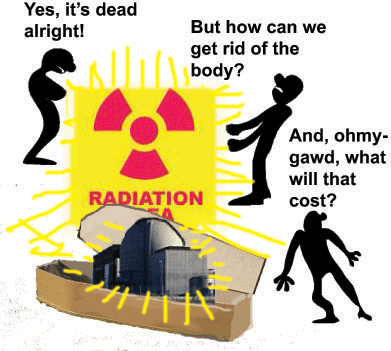 Who pays for Germany’s nuclear phase-out?,DW Hilke Fischer 1 July 16 Germany’s decision a few years ago to phase out nuclear power was an abrupt move. But it still remains unclear who foots the bill for shutting down the nation’s nuclear plants, as utilities seek damages from the state. Months after a Tsunami resulted in a nuclear disaster at the Fukushima Daiichi plant in Japan, Germany’s coalition government, led by Chancellor Angela Merkel, decided to phase out nuclear power in the country.
Immediately after Fukushima, eight of 17 functioning nuclear plants were shut down, and the government’s decision established a timeline of taking the remaining plants offline by 2022.
Five years later, it’s gradually becoming clear how much this hasty exit could cost. Feeling dispossessed by the move, major utilities have filed a raft of lawsuits claiming damage payments from the government amounting to around 20 billion euros ($22.3 billion).
An eagerly awaited ruling
Complying with the government’s nuclear moratorium, Germany’s biggest energy provider Eon had to shut down its power plants Isar 1 and Unterweser. The company has therefore sued both the federal government as well as the state governments of Bavaria and Lower Saxony, seeking damage payments to the tune of around 380 million euros. The state court of Hanover is expected to deliver its ruling on the case on Monday, July 4………..
the energy companies take issue not only with the moratorium. They – RWE, Eon and Vattenfall – have also lodged numerous cases at the constitutional court in Karlsruhe against the government’s entire policy mandating an accelerated exit from nuclear power……..
State responsible for disposal costs?
Lodging cases before the constitutional court is a pressure tactic, said Green Party politician Oliver Krischer in March. “It’s to obtain concessions over the financing of nuclear waste disposal,” he remarked, pointing to the nuclear commission the government had set up to advise it on how to allocate the costs of storage and disposal of nuclear waste as well as the decommissioning of the power stations.
At the end of April, the commission presented its recommendations: The companies have to bear the costs of decommissioning the nuclear power plants. Furthermore, Eon, RWE, Vattenfall and EnBW are to pay 23.3 billion euros into a fund to manage the storage and disposal of nuclear waste.
In return, the state is to take on all the residual financial risks associated with radioactive waste management. A number of scientists and economists argue that the costs would be much higher than the 23.3 billion euros, and that the taxpayers would be on the hook for those cost overruns.
Germany’s parliament is expected to vote on the recommendations after the summer break, and should it approve them, they would come into force at the end of the year. http://www.dw.com/en/who-pays-for-germanys-nuclear-phase-out/a-19372796
Brexit – the ‘coup de grace’ for Britain’s new nuclear?
 Brexit curse hits nuclear power, new London runway, Ecologist, Paul Brown 29th June 2016 Following the vote to leave the EU, the UK’s energy and climate change policy faces major challenges, writes Paul Brown, with new nuclear power and a third London runway at Heathrow runway looking like the first casualties. …..Plans for four giant nuclear reactors to be built in Englandby the French are almost certain to be scrapped because opposition among trade unions in France has hardened since last week’s vote……. time is rolling by and Électricité de France (EDF) is due to make a ‘final investment decision’ in September to build two 1,650 MW nuclear reactors at Hinkley Point in southwest England. They were expected to be followed by two more to the east of London.
Time for the ‘coup de grace’
The Hinkley decision, already postponed repeatedly, has been in doubt for months because of the parlous financial state of EDF and the increasing opposition of a group of French trade unions, whose members fear that the building of nuclear power stations in the UK would divert much-needed investment away from home.
There are also question marks about whether the nuclear design is viable at all, since construction delays and cost over-runs have dogged the prototypes, and none is yet producing electricity.
The backlash against the British decision to leave the EU will not affect the decision, according to the immediate reaction from EDF and the French government, but the chances of the scheme being given the go-ahead in September now seem remote.
Mycle Schneider, an independent nuclear and energy industry analyst based in Paris, says that the Brexit vote would hand EDF “the perfect occasion to pull the plug on Hinkley Point without losing face”. He believes that the Brexit vote represents a “disaster” for EDF’s plan, and that a decision to press ahead with Hinkley Point is unimaginable at the moment……
Can’t pay, won’t pay?
Until the Brexit vote, the UK government was committed to building 10 new nuclear power stations as part of its ‘low carbon’ plan for the energy sector. The programme always seemed improbable, given the state of the nuclear industry worldwide, but getting private investors to support such a policy now seems even less likely.
One of the unlooked-for side-effects of the decision is to take the UK outside theEuratom Treaty that safeguards nuclear materials from misuse. Since the UK has the largest stock of plutonium in the world, and a large trade in nuclear materials with Europe, the US and Japan, this creates serious problems over who now regulates the industry. http://www.theecologist.org/News/news_round_up/2987861/brexit_curse_hits_nuclear_power_new_london_runway.htm
Brexit could result in Britain’s unilateral nuclear disarmament.
 Nuclear Brexit Bulletin of the Atomic Scientists , 30 June 16, HUGH GUSTERSON Hugh Gusterson is a professor of anthropology and international affairs at George Washington University. His expertise is in nuclear culture, international security, and more
For those who favor disarmament, this would be good. For those who hoped Britain’s departure from the European Union would restore its glory on the world stage, it presumably would not…..
Insofar as pundits have speculated about the international security implications of Brexit, they have pointed out that British diplomats will be so focused on renegotiating trade agreements with the rest of the world that they will devote fewer resources to the turmoil in the Middle East and simmering tension with Russia, and that Britain will therefore be a less reliable ally for the United States. (This partly explains why Russian President Vladimir Putin greeted Brexit with a grin.) They assume, though, that Britain will remain strongly committed to NATO.
One problem with this assumption is that the UK may no longer exist as a country within a few years. It looks likely that, if Brexit proceeds, Scotland will withdraw from the United Kingdom, and there is a possibility that Northern Ireland will follow suit……
In the Brexit referendum, every single district in Scotland voted to remain in the EU, and a decisive majority of Scots—62 percent—voted to stay. It now looks as if the only way they can remain in the EU is to secede from the United Kingdom and apply for EU membership as a separate nation. A poll taken after the Brexit vote found that 59 percent of Scots say they would now vote for independence from Great Britain. Nicola Sturgeon, the shrewd and charismatic leader of the Scottish National Party, has stated her interest in moving toward a second referendum on Scottish independence.
For 30 years, the Scottish National Party said that an independent Scotland would stay out of NATO. It narrowly reversed that position in 2012, but it remains adamantly opposed to the stationing of any nuclear weapons in Scotland. That could be a problem since all of Britain’s nuclear weapons are stationed in Scotland. …..
A British parliamentary report in 2012, written in response to increasing concerns that Scotland might secede from the United Kingdom, concluded that finding a suitable base to replace Faslane and Coulport would be “highly problematic, very expensive, and fraught with political difficulties.” For one thing, it would take 10 to 20 years to construct a new base. And according to a 2014 study, doing so would cost English taxpayers about £3 billion (or some $4 billion at today’s exchange rate, almost certainly an underestimate)—on top of the £20 billion it will already cost to replace the four decaying nuclear submarines. This money will be particularly hard to find if British GDP declines sharply, as predicted, following disengagement from the European single market.
That is assuming a suitable new site could even be found, but the three sites that have been discussed in the media all have significant problems……..
It is becoming evident that, in addition to all the negative consequences of Brexit opponents warned about, there will be additional unforeseen and unintended consequences that will only become clear over time. In a supreme irony, one of those consequences may be that the English nationalist vote strips Britain of its status as a nuclear power. http://thebulletin.org/nuclear-brexit9620
Brexit vote- the finish for Hinkley nuclear power plan?
Brexit vote is ‘final nail in the coffin’ for £18billion Hinkley Point nuclear power station plans, says energy expert
Brexit vote could spell end for long-delayed Hinkley power station project
Energy expert Dr Paul Dorfman voiced concerns about £18billion scheme
He said French-owned EDF ‘extremely unlikely’ to invest in current climate
Dorfman said there were too many political uncertainties for the company
By STEPHANIE LINNING and SAM TONKIN FOR MAILONLINE, 29 June 2016 The UK’s Brexit vote is the ‘final nail in the coffin’ for an £18billion project to build a new power station at Hinkley Point, a leading energy expert says.
Dr Paul Dorfman, an Honorary Senior Research Fellow at the Energy Institute, University College London, said EDF, a majority French-owned company, is ‘extremely unlikely’ to invest given the current economic climate.
The long-delayed project was due to have Hinkley Point power station producing 7 per cent of the UK’s electricity by 2017. But, if built, the earliest date it could now start doing so is 2025.
Even that looks a remote possibility according to Dr Dorfman, who told MailOnline Brexit was ‘the final nail in the coffin’ for Hinkley Point.
He said: ‘It gives everybody the chance to slip out without losing any more face.
‘How is France going to invest in the UK if the UK is no longer part of the union?
‘Not only that but the French nuclear industry has huge financial problems and unions are screaming that they don’t want it [Hinkley Point].’
Dr Dorfman, a member of the European Nuclear Energy Forum, also believes the knock-on effect would see plans for a third reactor at Sizewell power station in Suffolk ditched too.
‘If Hinkley fails, which it will do, then Sizewell will go the same way.’ he said. ‘That will have serious implications for the UK energy industry.’……..http://www.dailymail.co.uk/news/article-3663424/Nuclear-power-station-likely-18billion-casualty-Brexit-vote-says-government-advisor.html
An end to debating nuclear power: Diablo Canyon agreement wraps it up
Diablo Canyon agreement should put an end to debate about nuclear power http://www.sacbee.com/opinion/california-forum/article85614127.html
PG&E concluded Diablo Canyon nuclear plant is not economical
Nuclear power can’t compete with solar, wind in new wholesale market
21st century approach emphasizes flexibility, distributed generation
BY S. DAVID FREEMAN
The agreement between PG&E, Friends of the Earth, organized labor and other environmental organizations is the final chapter in the tumultuous history of nuclear power in California.
It began in the 1960s, when Chet Holifield, then chairman of the Congressional Joint Committee on Atomic Energy, envisioned nuclear power plants dotting the Pacific Coast every 50 miles. That dream never came true, but as Sacramento citizens will recall, we did build Rancho Seco. And Southern California Edison and PG&E completed large nuclear power plants of their own.
I helped bury Rancho Seco when I was general manger of the Sacramento Municipal Utility District in 1990. And contrary to the dire predictions, the lights stayed on, the rates didn’t go up and SMUD has behaved rather well ever since.
The other large nuclear plants, San Onofre in Southern California and Diablo Canyon in San Luis Obispo created their own controversies. Their costs spiraled out of control to the tune of billions of dollars that triggered massive rate increases. In fact, it is fair to conclude that these cost overruns at the nuclear plants triggered the deregulation policies the state adopted more than 20 years ago.
Nuclear power plants epitomize the 20th century approach to electricity production: the plants take lots of time and money to build, and generate immense amounts of electricity, but their inherent design requires them to be operated around the clock (except for refueling and repair pauses).
By contrast, the 21st century approach to electricity production emphasizes flexibility, distributed generation and seeks to reduce overall demand. In 2030, California law will require that 50 percent of electricity be from renewables like wind and solar. That power must be used when available, except for the amount stored. On most days for many hours, these renewable resources will provide 100 percent of the electricity needed. In those hours, a “must run” nuclear plant would crowd out that renewable energy and actually cause us to waste it.
This new concern is called “overcapacity.” It is a shorthand way of saying a large base load of must-run power, like from Diablo Canyon, just doesn’t fit into the power supply of the future. That was the conclusion reached not by me, but by PG&E.
Adapting to change is a challenge for environmental leaders as well as the electric utilities. Nuclear power, in decades past, was heralded as the alternative to burning dirty coal and other fossil fuels to generate electricity. There was no apparent alternative. Three Mile Island, Chernobyl and Fukushima had not yet happened. We didn’t have the sophisticated, affordable and powerful renewable technologies we have today.
Now we know better about nuclear power. It is dangerous and extremely expensive. No nuclear plant would ever have been built in America without giant subsidies from the federal government. The highly radioactive spent fuel is piling up at each reactor site.
After 50 years of looking, we must conclude there is no safe place to store it. Nuclear proliferation in the age of terror is a real threat, and the fuel in power plants can be exploited for bombs. America’s goal of eliminating nuclear weapons must start with ending nuclear power plants.
Whether or not you think nuclear power is a problem, it is economics that explains PG&E’s willingness to leave nuclear power behind. This is the kind of clear-eyed acceptance of change that today’s world requires of successful executives. By seizing the future rather than clinging to the past, PG&E’s leaders are setting an example their colleagues throughout the utility industry should study and emulate.
The Diablo Canyon agreement should put an end to the debate about nuclear power. It provides a template for a timely transition for all the nuclear and fossil fueled plants to an all-renewable future.
S. David Freeman is the former general manager of SMUD, chairman of the Tennessee Valley Authority and other utilities. Contact him at greencowboysdf@gmail.com.
Brexit might help UK to develop nuclear projects
 5 ways Brexit would transform European energy, Politico, Sara Stefanini , 24 June 16 Central and Eastern Europeans would lose a powerful ally, while nuclear and renewable investors would face an uncertain world.
A British vote to leave the European Union would force broad changes to the bloc’s energy policy, weakening its climate policy and removing a crucial Central European energy ally — but it could also give London far more freedom to pursue nuclear projects.
The U.K. is often an energy outlier in the EU, advocating nuclear power and shale gas sources shunned by others. And it tends to build alliances broadly aimed at keeping interference from Brussels to a minimum.
But both sides have a lot to lose.
A Brexit could undercut long-term climate policies in Brussels and London, and the EU would lose the U.K.’s pro-free market voice, which has historically helped tone down some more statist schemes coming from European capitals.
Here are the five ways that a Brexit would impact Europe’s energy and climate forecast:…….
4. The freedom to subsidize — maybe
One area the European Commission tries to avoid is state aid, particularly for energy projects.
But even when the Commission gives a green light, there’s the danger that another EU country might try to interfere. That’s what happened with Hinkley Point. Brussels approved a state aid plan in 2014, but Austria, backed by Luxembourg,challenged the decision in the European Court of Justice eight months later…….
Environmental advocates worry it would give the U.K. room to continue rolling back support for renewables in favor of other fuels.
“One of the reasons why the government has had to have a more sensible policy on these issues is because state aid disciplines have stopped it from throwing money at gas-powered stations and fracking and nuclear,” said Nick Mabey, chief executive of the environmental analysis group E3G……..http://www.politico.eu/article/uk-brexit-renewable-energy-hinkley-nuclear-interconnectors-gas-climate-emissions-paris/
Diablo Canyon Nuclear Power Plant can and should close today
 Lies, damned lies and the nuclear industry! Media With Conscience News, Ace Hoffman 26 June 16
 Three important nuclear power events occurred in the past seven days — one in Nebraska and two in California — which together show just how doomed and unworkable nuclear power really is.
In Nebraska, the Omaha Public Power District (OPPD) Board of Directors unanimously decided to shut down Fort Calhoun Nuclear Power plant because its cost of operation could not be justified against the current and expected future price of natural gas, solar and wind power (but mainly natural gas). Certainly natural gas prices are at an unnatural low compared to the price of oil and nuclear power, and that might change over the coming years, but natural gas prices cannot go up too much if they are to stay competitive with renewable energy prices — which are going to continue to plummet over the next few decades.
Solar panels thinner than a human hair have been developed in the labs. They don’t use many natural resources to make. Solar panels as flexible as a human hair have also been developed. They can be placed virtually anywhere. Wind turbine output keeps going up for the exact same land requirements, which of course, are already minimal to begin with. Power requirements of all the major household appliances keep coming down as better motors, coolers and pumps are developed. The future is bright for renewables, and getting brighter.
All this spelled doom for Fort Calhoun, a “small” (478 megawatts, the smallest operating reactor in the United States) lone reactor that cost about $178 million dollars to build when construction began in 1966, and now costs over $250 million annually to operate. It was “simply an economic decision” to close the facility according to the operators.
Being so old and run-down, it went offline yesterday suddenly, for a turbine issue, (its speed controller failed). But no matter how often a nuclear power plant goes offline without warning, regulators and operators still assure the public they are necessary for “baseload capacity.”
Lies, damned lies and the nuclear industry strike out again
In California, an apparently momentous decision was made regarding Diablo Canyon’s pair of massive nuclear reactors (~1,100 megawatts each), which first went online in the mid-1980s and were originally scheduled to close by this year, but were granted a 10-year extension a few years ago for no apparent reason at all.
After years of threatening to try to extend their license another 20 years to 60 years and beyond, its operator, Pacific Gas & Electric (PG&E) announced that they would only run out their current license (good to 2024 and 2025 for units 1 and 2, respectively) and then be shut down permanently. The decision was made in cooperation with several environmental organizations (FoE, NRDC and A4NR) in some sort of secret backroom arrangement — an arrangement which has some good points, but has some very bad points, too.
First and foremost among the good points is, of course, that the plant will shut down. And second is that it will be replaced with renewable energy and increased energy conservation.
But first and foremost among the bad points is not only that it will take 10 more years, and not only that the decision is potentially reversible, but also that the aforementioned environmental groups apparently have lost interest in shutting the plant down earlier. That means another two million pounds of high-level nuclear waste will be generated in the meantime, with their approval. And worst of all, it means that if the San Andreas earthquake fault does what it’s been threatening to do for decades, and is actually considered late in doing, southern California will be ruined financially and environmentally. Not to mention the dozens of other faults that could shake the plant to smithereens any day of the week.
Additionally, while Fort Calhoun’s operators have promised to help the employees of that plant find other work (probably installing solar panels on rooftops, making new interconnections to the power grid, building wind turbines and so forth), Diablo Canyon has promised to take more than a third of a billion dollars of ratepayer money to do the same. As if it was the ratepayers who chose to make the workers work in a dying industry with high-paying jobs. As if there aren’t other nuclear power plants around the country that are having trouble finding workers, for those who want to stay in a dying industry. And as if there won’t be plenty of renewable energy jobs they can find for themselves.
In short, the deal stinks so badly, one activist in the Diablo Canyon area described it as being “sold down the river.”
n both cases, a major part of the decision was based on the fact that the electricity generated by Fort Calhoun and Diablo Canyon (and virtually every other nuclear power plant in the country) can be replaced immediately with other power sources, without the lights going out or reliability of the grid falling below set point levels. This is as it must be: Nuclear power plants require the rest of the grid to be operating or they themselves must shut down.
That’s why, when a massive power outage struck the northeastern United States in 2003, all the nuclear power plants in the area automatically shut down and could not help keep the grid up. They require about 30 megawatts of continuous power to operate, and as much as 100 megawatts during restart once they shut down for any reason. It took many days for the nuclear power plants to come back online even after the rest of the grid was restored. So much for the reliability of the “baseload” power system!
Diablo Canyon can and should close today. Even its owners have now admitted that its electricity output can be replaced entirely by renewables (although that might take a couple of years to accomplish, it would free up about 1500 workers (1200 PG&E employees, 200 subcontractors, and miscellaneous high-paid executives) to start installing solar panels and wind turbines. Its total output could be replaced in a matter of months.
Meanwhile, the nuclear waste at San Onofre is no longer being generated (SanO closed permanently in 2013 after a leaky steam generator could not be repaired). But the lies and damned lies continue spewing forth unabated from that complex as well. Last night, the quarterly Citizen’s Engagement Panel met once again, supposedly to engage with citizens but in fact, to push the utility’s agenda of cheap, ineffective, dangerous solutions to its nuclear waste problem — which it will have for 500,000 years unless something is done about it.
The meeting was attended by some high-powered outsiders from the Department of Energy and a former Nuclear Regulatory Commission chairman, Dr. Allison Macfarlane. Earlier in the day several localized meetings were held with these outsiders for additional discussions. It all looks very cooperative on paper, but in reality it’s nothing but the regular dog-and-pony shows the nuclear industry and the NRC have been putting on for decades.
Time was, speakers at an NRC hearing were sworn in, swore to tell the truth, the whole truth, and nothing but the truth. That ended about 20 years ago, and now we have a non-governmental body making nonsense plans and decisions which will affect the local population for decades to come, will solve nothing, will obstruct real solutions (more on that in a moment), and will push the utilities’ agenda down everybody’s throats (literally, when the waste escapes its escarpments)………http://mwcnews.net/focus/analysis/59553-nuclear-industry.html
Pentagon’s nuclear-powered spending: a $trillion and climbing
Behold the Pentagon’s Amazing, Nuclear-Powered ATM, Mother Jones
 When the going gets tough, the world’s toughest military sends out RFPs.
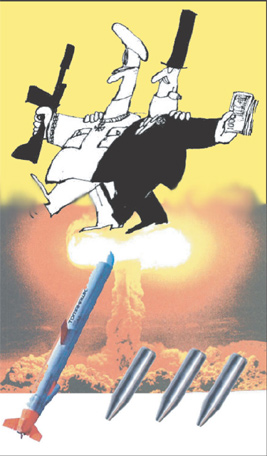
ANDREW COCKBURNJUN. 24 “………creating and maintaining an effective fighting force becomes a secondary consideration, reflecting a relative disinterest—remarkable to outsiders—in the actual business of war, as opposed to the business of raking in dollars for the Pentagon and its industrial and political partners. A key element of the strategy involves seeding the military budget with “development” projects that require little initial outlay but which, down the line, grow irreversibly into massive, immensely profitable production contracts for our weapons-making cartels……
ongoing and dramatic programs to invest vast sums in meaningless, useless, or superfluous weapons systems are the norm. There is no more striking example of this than current plans to rebuild the entire American arsenal of nuclear weapons in the coming decades, Obama’s staggering bequest to the budgets of his successors.
These nuclear initiatives have received far less attention than they deserve, perhaps because observers are generally loath to acknowledge that the Cold War and its attendant nuclear terrors, supposedly consigned to the ashcan of history a quarter-century ago, are being revived on a significant scale. The US is currently in the process of planning for the construction of a new fleet of nuclear submarines loaded with new intercontinental nuclear missiles, while simultaneously creating a new land-based intercontinental missile, a new strategic nuclear bomber, a new land-and-sea-based tactical nuclear fighter plane, a new long-range nuclear cruise missile (which, as recently as 2010, the Obama administration explicitly promisednot to develop), at least three nuclear warheads that are essentially new designs, and new fuses for existing warheads. In addition, new nuclear command-and-control systems are under development for a fleet of satellites (costing up to $1 billion each) designed to make the business of fighting a nuclear war more practical and manageable.
This massive nuclear buildup, routinely promoted under the comforting rubric of “modernization,” stands in contrast to the president’s lofty public ruminations on the topic of nuclear weapons. The most recent of these was delivered during his visit—the first by an American president—to Hiroshima last month. There, he urged“nations like my own that hold nuclear stockpiles” to “have the courage to escape the logic of fear, and pursue a world without them.”
In reality, that “logic of fear” suggests that there is no way to “fight” a nuclear war, given the unforeseeable but horrific effects of these immensely destructive weapons. They serve no useful purpose beyond deterring putative opponents from using them, for which an extremely limited number would suffice. During the Berlin crisis of 1961, for example, when the Soviets possessed precisely four intercontinental nuclear missiles, White House planners seriously contemplated launching an overwhelming nuclear strike on the USSR. It was, they claimed, guaranteed to achieve “victory.” As Fred Kaplan recounts in his book Wizards of Armageddon, the plan’s advocates conceded that the Soviets might, in fact, be capable of managing a limited form of retaliation with their few missiles and bombers in which as many as three million Americans could be killed, whereupon the plan was summarily rejected.
In other words, in the Cold War as today, the idea of “nuclear war-fighting” could not survive scrutiny in a real-world context. Despite this self-evident truth, the US military has long been the pioneer in devising rationales for fighting such a war via ever more “modernized” weapons systems. ……..
The drive to develop and build such systems on the irrational pretense that nuclear war fighting is a practical proposition persists today. One component of the current “modernization” plan is the proposed development of a new “dial-a-yield” version of the venerable B-61 nuclear bomb. Supposedly capable of delivering explosions of varying strength according to demand, this device will, at least theoretically, be guidable to its target with high degrees of accuracy and will also be able to burrowdeep into the earth to destroy buried bunkers. The estimated bill—$11 billion—is a welcome boost for the fortunes of the Sandia and Los Alamos weapons laboratories that are developing it.
The ultimate cost of this new nuclear arsenal in its entirety is essentially unknowable. The only official estimate we have so far came from the Congressional Budget Office, which last year projected a total of $350 billion. That figure, however, takes the “modernization” program only to 2024……..
Assiduously tabulating these projections, experts at the Monterey Center for Nonproliferation Studies peg the price of the total program at a trillion dollars. In reality, though, the true bill that will come due over the next few decades will almost certainly be multiples of that. For example, the Air Force has claimed that its new B-21 strategic bombers will each cost more than $564 million (in 2010 dollars), yet resolutely refuses to release its secret internal estimates for the ultimate cost of the program.
To offer a point of comparison, the F-35 Joint Strike Fighter, the tactical nuclear bomber previously mentioned, was originally touted as costing no more than $35 million per plane. In fact, it will actually enter service with a sticker price well in excess of $200 million.
Nor does that trillion-dollar figure take into account the inevitable growth of America’s nuclear “shield.”……..http://www.motherjones.com/politics/2016/06/pentagon-budget-nuclear-spending
Illinois nuclear plant shutdown situation – defacto radioactive dump
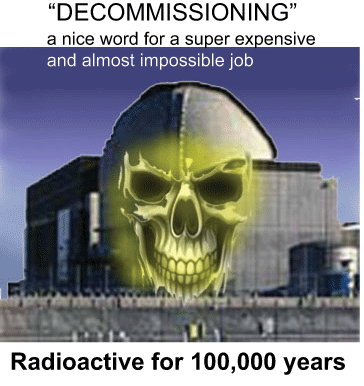 Nuclear plant shutdown in Illinois could offer lessons for SLO County Power plant in Zion, Illinois, closed nearly 2 decades ago because of an employee’s mistake. Tribune, 26 June 16
Community leaders say storage of spent nuclear fuel is preventing redevelopment of desirable lakefront property
They are leading a push to obtain federal financial compensation for communities that become de facto storage sites for waste BY STEPHANIE FINUCANE sfinucane@thetribunenews.com. Nearly 20 years after the shutdown of a nuclear power plant in the small community of Zion, Illinois, the city’s finance director describes the local economy in a single word: struggling.
“We’ve lost about $18 million communitywide,” said David Knabel, referring to the annual property tax that used to be generated by the power plant. “That tax burden got shifted to businesses and residents.”
Since the plant closed, property tax rates rose 143 percent, according to city documents. That’s made it tough to attract new employers.
“With the tax rate going through the roof … who wants to buy a house or bring businesses in?” asked Knabel.
Yet Zion isn’t blaming the nuclear power plant. As local pastor and City Commissioner Mike McDowell pointed out, that was a business decision.
The city is upset, though, that it’s become a long-term storage site for highly radioactive spent fuel — something it never signed on for.
Officials say the spent fuel is preventing redevelopment of the prime lakefront property where the plant was built, and they’re looking to the federal government for financial relief.
“We can’t get the federal government to move it,” said McDowell, “and at this point, we’re not being compensated for the impact.”……..
Once the decommissioning is complete, the property will be returned to Exelon Corp., the parent of Zion’s operator, Commonwealth Edison.
Officials in the city of Zion don’t know when that will be, nor do they know how much of the property could be permanently off-limits because of the spent fuel storage facility.
Like reactor communities across the nation — including San Luis Obispo County — the citizens of Zion did not expect to store spent nuclear fuel indefinitely. They believed the federal government would make good on its commitment to accept the waste, which at one time was destined for Yucca Mountain, Nevada. That plan fell apart, however, and the federal government has yet to identify an alternative site for permanent storage.
Zion is leading a push for federal legislation that would provide financial compensation to communities that have become de facto storage sites for spent fuel………http://www.sanluisobispo.com/news/local/article86054762.html
Senator Mark Rubio showing a little anxiety about who will carry the nuclear codes
 Rubio: I hope I can trust whoever wins with the nuclear codes, The Hill By Rebecca Savransky, 26 June 16 Sen. Marco Rubio (R-Fla.) on Sunday avoided directly saying whether he’d trust presumptive Democratic presidential nominee Hillary Clinton with the nuclear codes.
“Once you assume the office, no matter who holds that office, I think that the reality and the gravity of it always weighs on these people,” Rubio said on CBS’s “Face The Nation.”
“It’s a very difficult issue to face. So I would hope that I can trust no matter who wins with the nuclear codes.”
The Florida senator has said previously he doesn’t think presumptive GOP presidential nominee Donald Trump could be trusted with the nuclear codes……..http://thehill.com/blogs/blog-briefing-room/news/284944-rubio-i-hope-i-can-trust-whoever-wins-with-the-nuclear-codes
The nuclear power door is only just still open in Sweden
 Sweden’s deal leaves door to nuclear power open, but only just, Reuters STOCKHOLM, JUNE 23 | BY DANIEL DICKSON AND NERIJUS ADOMAITIS Sweden has agreed to cut taxes on nuclear power generators and allow for the construction of new reactors but policymakers have yet to work out how that fits with a commitment to using 100 percent renewable energy……..
Spokeswomen for the Energy Minister Ibrahim Baylan and for the Green Party, a junior member of the ruling coalition……….the target is formulated as electricity production… that means all production in Sweden is renewable,” Lise Nordin, Green Party energy policy spokeswoman and member of the parliament, told Reuters.
While the agreement allows power generators “in theory” to build new reactors, in reality they would be too costly, she added.
“The probability that new nuclear power will be built is zero,” Nordin said……..http://uk.reuters.com/article/sweden-nuclearpower-idUKL8N19E2VM
Donald Trump’s dangerous posturing increases risk of nuclear terrorism
Trump’s “program” for defeating ISIS in Syria and Iraq, combining torture with mass bombings which would decimate civilians — not to mention his musings about using nuclear weapons against ISIS or in a European ground war. The net effect is a mushroom cloud of radioactive ignorance from a man incapable of better.
Given the gravity of nuclear proliferation and the menace of nuclear terrorism, this dangerous posturing underscores the seriousness of the job he seeks. In any area, but particularly this one, the presidency must be reserved for those who are knowledgeable and stable.
This captures the fatal contradiction between the Republicans’ report on national security and their nominee
 No Time For Trump, Part Two: Nuclear Proliferation, ISIS And The Threat Of Nuclear Terrorism, Huffington Post, Richard North Patterson 06/21/2016 Twelve days ago, Paul Ryan and the House Republicans introduced a report on national security harshly critical of President Obama. “America,” they warned, “faces the highest terror threat level since 9/11.”
Let’s take them at their word. And so, a question. Of all the threats we face, what fear most haunts our national security community?
It is not massacres like those in Orlando or San Bernardino, as monstrous as they are. It is a threat which, while more remote, would be infinitely more devastating: a nuclear attack — including by terrorists like ISIS and Al Qaeda.
This existential danger drives America’s efforts to curb the spread of nuclear weapons, and to keep our country safe from a nuclear holocaust. And here lies the irony in the Republicans’ warning. For it is yet another compelling reason that a man as ignorant, irresponsible, unstable and unprepared as Donald Trump should never become president.
True, Trump’s nativist scapegoating of all Muslims — including millions of loyal Americans, many of whom have served our military — increases the danger of more mass slaughters like Orlando, breeding alienation while attacking those whose vigilance could help prevent such horrors. But his xenophobia and lack of basic knowledge also enhances the most terrible prospect of all — nuclear terrorism.
While the nuclear threat is horrifying to contemplate, its greatest dangers are little understood, or even discussed in public. In recent years, the public’s worry about nuclear proliferation has focused most particularly on Iran — a frequent subject of Trump’s crude and self-preening attacks on Obama’s supposed “weakness” in confronting threats to America. But it is unlikely that Iran would start a nuclear war: however aggressive, its regime has a return address, and a reprisal could annihilate Tehran.
That is why nuclear terrorism by non-state actors is America’s ultimate nuclear nightmare.
As debilitating as the mass slaughters we have suffered can be, only terrorism by nuclear means has the potential to destroy our economy, our security, our system of civil liberties, our commitment to democratic ideals, and our very trust in each other. In short those things which, at our best, make us who we are.
This is why countries which could spawn nuclear terrorism are the greatest threats to our way of life. It is why Pakistan — not Iran — is the most dangerous place on earth. It is why our next president must have sound judgment, a stable temperament, and a sophisticated understanding of the of nuclear threat posed by Al Qaeda and, more recently, ISIS. It is why that president cannot — must not — be Donald Trump.
The facts which make this so are as little-known as they are sobering.
To start, Al Qaeda has long been obsessed with acquiring nuclear weapons, and Pakistan has always been its focus. Just before 9/11, bin Laden met in Afghanistan with a Pakistani nuclear scientist and an engineer, drawing up specifications for an Al Qaeda bomb. And after 9/11, bin Laden announced Al Qaeda’s intention to kill 4 million Americans in reprisal for the Muslim deaths he attributed to the United States and Israel, and issued a fatwa calling for the use of nuclear arms against the West.
Bin Laden is dead. Al Qaeda is not. And a new force has emerged with the same apocalyptic desires — ISIS.
Granted, perpetuating nuclear terrorism would require a high degree of organizational and logistical sophistication. But intelligence officials believe that ISIS is scouring Iraq for nuclear and radioactive materials for use outside the country. Indeed, it is known that they have already seized lower-grade nuclear materials from Mosul University. And the tragic attacks in France and Belgium have a disturbing nuclear coda…….
Trump’s “program” for defeating ISIS in Syria and Iraq, combining torture with mass bombings which would decimate civilians — not to mention his musings about using nuclear weapons against ISIS or in a European ground war. The net effect is a mushroom cloud of radioactive ignorance from a man incapable of better.
Given the gravity of nuclear proliferation and the menace of nuclear terrorism, this dangerous posturing underscores the seriousness of the job he seeks. In any area, but particularly this one, the presidency must be reserved for those who are knowledgeable and stable.
This captures the fatal contradiction between the Republicans’ report on national security and their nominee…….http://www.huffingtonpost.com/richard-north-patterson/no-time-for-trump-part-tw_b_9625282.html
Historic nuclear free agreement between Pacific Gas and Electric and Friends of the Earth

 Diablo Canyon nuclear plant to be shut down, power replaced by renewables, efficiency, storage
California, world’s sixth largest economy, going nuclear-free http://www.foe.org/news/news-releases/2016-06-diablo-canyon-nuclear-plant-to-be-shut-down June 21, 2016 BERKELEY, CALIF. –
An historic agreement has been reached between Pacific Gas and Electric, Friends of the Earth, and other environmental and labor organizations to replace the Diablo Canyon nuclear reactors with greenhouse-gas-free renewable energy, efficiency and energy storage resources. Friends of the Earth says the agreement provides a clear blueprint for fighting climate change by replacing nuclear and fossil fuel energy with safe, clean, cost-competitive renewable energy.
The agreement, announced today in California, says that PG&E will renounce plans to seek renewed operating licenses for Diablo Canyon’s two reactors — the operating licenses for which expire in 2024 and 2025 respectively. In the intervening years, the parties will seek Public Utility Commission approval of the plan which will replace power from the plant with renewable energy, efficiency and energy storage resources. Base load power resources like Diablo Canyon are becoming increasingly burdensome as renewable energy resources ramp up. Flexible generation options and demand-response are the energy systems of the future.
By setting a certain end date for the reactors, the nuclear phase out plan provides for an orderly transition. In the agreement, PG&E commits to renewable energy providing 55 percent of its total retail power sales by 2031, voluntarily exceeding the California standard of 50 percent renewables by 2030.
“This is an historic agreement,” said Erich Pica, president of Friends of the Earth. “It sets a date for the certain end of nuclear power in California and assures replacement with clean, safe, cost-competitive, renewable energy, energy efficiency and energy storage. It lays out an effective roadmap for a nuclear phase-out in the world’s sixth largest economy, while assuring a green energy replacement plan to make California a global leader in fighting climate change.”
A robust technical and economic report commissioned by Friends of the Earth served as a critical underpinning for the negotiations. The report, known as “Plan B,” provided a detailed analysis of how power from the Diablo Canyon reactors could be replaced with renewable, efficiency and energy storage resources which would be both less expensive and greenhouse gas free. With the report in hand, Friends of the Earth’s Damon Moglen and Dave Freeman engaged in discussions with the utility about the phase-out plan for Diablo Canyon. NRDC was quickly invited to join. Subsequently, International Brotherhood of Electrical Workers Local 1245, Coalition of California Utility Employees, Environment California and Alliance for Nuclear Responsibility partnered in reaching the final agreement. The detailed phase out proposal will now go to the California Public Utility Commission for consideration. Friends of the Earth (and other NGO parties to the agreement) reserve the right to continue to monitor Diablo Canyon and, should there be safety concerns, challenge continued operation.
The agreement also contains provisions for the Diablo Canyon workforce and the community of San Luis Obispo. “We are pleased that the parties considered the impact of this agreement on the plant employees and the nearby community,” said Pica. “The agreement provides funding necessary to ease the transition to a clean energy economy.”
Diablo Canyon is the nuclear plant that catalyzed the formation of Friends of the Earth in 1969. David Brower left the Sierra Club and founded Friends of the Earth over a disagreement about nuclear power and the Diablo Canyon plant specifically. The plant was the first issue on the organization’s agenda and it has been fighting the plant ever since. This agreement is not only a milestone for renewable energy, but for Friends of the Earth as an organization.
For more information, see the final, signed Joint Proposal and the Joint Letter to the State Lands Commission.
===========================================================================
Growing list of reactor closures and looming closures
The average age of the U.S. nuclear power fleet is 35 years. That’s the equivalent of about 70 human years so it’s no surprise that a growing number of reactors are falling off the perch:
- Dominion’s Kewaunee in Wisconsin and Entergy’s Vermont Yankee have closed for economic reasons since 2013. Both plants were licensed to keep operating into the 2030s.
- Southern California Edison permanently shut down the last two operating reactors at the San Onofre plant in California in 2013, after steam generators replaced in a US$700 (€628m) million upgrade failed, only a couple of years after their installation.
- In February 2013 Duke Energy announced that the Crystal River nuclear plant in Florida would be permanently shut down, following a botched attempt to repair the concrete containment dome.
- Entergy’s FitzPatrick plant in New York will be closed in 2017, and Entergy’s Pilgrim plant in Massachusetts is slated to be closed in 2019, but could close sooner.
- Exelon’s Oyster Creek plant in New Jersey is scheduled to be permanently shut down by December 2019.
Matt Crozat from the Nuclear Energy Institute said that “several nuclear power plants around the country are vulnerable to weak market conditions, particularly smaller facilities in competitive markets.” Marvin Fertel from the same organization said on May 19 that 15‒20 reactors in the U.S. are at risk of being shut over the next 5‒10 years due to economic challenges such as low power prices, and competition from gas and renewables. He said that small, single-unit plants are the most vulnerable.
It can now be said with certainty that new build (five reactors are under construction) will be outpaced by closures this decade in the U.S., and it’s highly likely that the pattern will repeat itself in the 2020s. BP’s recently-released ‘Energy Outlook: 2016 Edition’ projects a 13% decline in nuclear power generation in North America from 2014‒2035 (and a 29% fall in the EU).
1 This Month
23-25 October – on Zoom – World BEYOND War’s annual global conference

To see nuclear-related stories in greater depth and intensity – go to https://nuclearinformation.wordpress.com
-
Archives
- October 2026 (149)
- September 2026 (339)
- August 2026 (330)
- July 2026 (355)
- June 2026 (287)
- May 2026 (306)
- April 2026 (356)
- March 2026 (251)
- February 2026 (267)
- January 2026 (308)
- December 2025 (358)
- November 2025 (359)
-
Categories
- 1
- 1 NUCLEAR ISSUES
- business and costs
- climate change
- culture and arts
- ENERGY
- environment
- health
- history
- indigenous issues
- Legal
- marketing of nuclear
- media
- opposition to nuclear
- PERSONAL STORIES
- politics
- politics international
- Religion and ethics
- safety
- secrets,lies and civil liberties
- spinbuster
- technology
- Uranium
- wastes
- weapons and war
- Women
- 2 WORLD
- ACTION
- AFRICA
- Atrocities
- AUSTRALIA
- Christina's notes
- Christina's themes
- culture and arts
- Events
- Fuk 2022
- Fuk 2023
- Fukushima 2017
- Fukushima 2018
- fukushima 2019
- Fukushima 2020
- Fukushima 2021
- general
- global warming
- Humour (God we need it)
- Nuclear
- RARE EARTHS
- Reference
- resources – print
- Resources -audiovicual
- Weekly Newsletter
- World
- World Nuclear
- YouTube
-
RSS
Entries RSS
Comments RSS

