Pro nuclear lobbying destroying nuclear safety principle in Japan

 40-year safety principle erodes in pro-nuclear lobbying, Asahi Shimbun By MASANOBU HIGASHIYAMA/ Staff Writer June 21, 2016 Cries of disapproval rang out from the spectators’ gallery when Shunichi Tanaka, chairman of the Nuclear Regulation Authority (NRA), announced the decision to allow two aging reactors to continue running for 20 more years.
“Don’t you know that the operating period is 40 years, in principle?” someone shouted at Tanaka at the NRA meeting on June 20.
In the name of safety, the law on nuclear reactor regulations was revised after the 2011 Fukushima nuclear disaster to limit the operating period of a reactor to 40 years, in principle. The idea was to phase out old reactors because of the difficulties in taking safety measures for such aging equipment.
When Tanaka assumed the post of NRA chairman in September 2012, he said at a news conference, “The designs (of reactors) of 40 years ago are insufficient to maintain their safety.”
But through lobbying by pro-nuclear politicians, this 40-year cutoff point is now seen as the time when utilities should seek approval for extending their reactor operations.
The NRA even gave special treatment to Kansai Electric Power Co. in its application for the 20-year operating extensions of the No. 1 and No. 2 reactors at the Takahama nuclear power plant in Fukui Prefecture. These two reactors have already been in operation for 40 years. …..http://www.asahi.com/ajw/articles/AJ201606210073.html
USA’s Department of Evil Nuclear Promotion, – I mean of Energy
 DOE plan targets 200 GW of nuclear capacity by mid-century, Utility Dive By Robert Walton | June 21, 2016 “…….DOE’s “Vision and Strategy for the Development and Deployment of Advanced Reactors,” calls for at least two advanced reactor concepts to be developed, have reached technical maturity and completed licensing reviews, by 2030…….
Coal companies must not get away with not paying for mine cleanups
 Hold coal companies accountable for toxic mine cleanup, 18 June 16 http://act.credoaction.com/letter/bonding_comments Coal companies are supposed to pay for the toxic cleanup of their mines.
But recent bankruptcies — including of the world’s largest coal company Peabody Energy — combined with an antiquated federal policy called self-bonding, could stick us with the bill for billions of dollars in toxic mine cleanup costs.
President Obama’s Office of Surface Mining is currently taking comments on a plan to strengthen these mine cleanup laws.1 This is an important opportunity to speak out in favor of holding coal companies accountable and making sure that coal giants like Peabody aren’t let off the hook for their toxic mess.
Submit a comment before the June 20th deadline: Don’t let coal companies off the hook for toxic mine cleanup.
“Self-bonding” allows coal companies to forgo private cleanup insurance if they possess sufficient financial resources. This policy is, in effect, a massive subsidy to the coal industry, allowing them to reap substantial savings over buying insurance on the open market, and trusting that coal companies will act in good faith to clean up their mess in a timely manner.
Federal regulators have continued to extend self-bonding privileges to coal companies even as they lack the assets to cover their cleanup responsibilities. Wyoming even went so far as to reduce Peabody Energy’s cleanup obligation by $138 million shortly before the company filed bankruptcy.2
Making self-bonding even worse, coal companies have effectively used the savings extended to them to fund an all-out assault on science and federal climate policies. Bankruptcy filings from Peabody Energy reveal the company has funded at least two dozen groups at the heart of the climate denial machine, and — even as the company has declared bankruptcy — will spend almost half a million dollars this year on a legal challenge to President Obama’s Clean Power Plan.3
The four largest coal companies alone have $2.7 billion in outstanding mine cleanup costs, and no insurance to defray the costs.4, 5 Three of them have filed for bankruptcy in the last year, threatening to leave billions in cleanup – on top of the $4 billion worth of mine cleanup the coal industry has already abandoned.
Last summer, more than 90,000 CREDO activists urged the Obama administration to hold Peabody Energy accountable for its cleanup. Now, the administration is considering a plan to strengthen self-bonding rules, so it’s vital to speak out in this moment.
It’s long past time to fix this broken system which has allowed coal companies to foist their toxic cleanup responsibility onto the public — while denying the dirty reality of their dirty product. Submit a comment now.
- “Office of Surface Mining Reclamation and Enforcement Seeks Public Comment on a Petition Regarding Self-Bonding for Coal Mines,” OSMRE, 5/18/16
- “Faced with massive cleanup bill, state lowers Peabody Energy self-bonds by $138 million,” Casper Star Tribune, 4/30/16
- “Court Documents Show Coal Giant Peabody Energy Funded Dozens Of Climate Denial Groups,” DeSmog Blog, 6/13/16
- “The U.S.’s Biggest Coal Company Can’t Pay To Clean Up Its Own Mines,” ThinkProgress, 6/8/2015
- “Regulators Fear $1 Billion Coal Cleanup Bill,” New York Times, 6/6/2016
New radiation guidelines for U.S. Environmental Protection Agency would endanger public health
 How much radiation is OK in an emergency? By Rebecca Moss The New Mexican, 19 June 16
New guidelines proposed by the U.S. Environmental Protection Agency would significantly increase the amount of radiation that people can ingest in the days and years following a radiological accident — levels far higher than existing limits set by the Safe Drinking Water Act of 1974.
Watchdog groups, academics and even some EPA officials worry the change could severely compromise public health. The agency’s proposal, released in early June and open for public comment until July 25, suggests a two-tiered system to advise the public when water is too dangerous for consumption after a radiological release — an event ranging from an accident at a nuclear power plant, such as the 1979 reactor meltdown at the Three Mile Island plant in Pennsylvania, to a roadside spill of Cold War-era transuranic waste from Los Alamos to a deliberate act of terrorism. The agency has capped the proposed limits at 500 millirems per year for people over 15, and no more than 100 millirems for younger children, the elderly, and pregnant or nursing women.
The new emergency guidelines are at least 25 times higher than the current guidelines, which cap public consumption of radiation at 4 millirems per year. Opponents of the proposal say it will allow radiation exposure equivalent to 250 chest X-rays each year without medical need or consent……
The EPA proposal has significant ramifications for New Mexico, home to two nuclear weapons research laboratories and the nation’s only permanent underground repository for radioactive waste, all of which were built near underground aquifers.
New Mexico’s highways pose concerns under the new EPA proposal because truck transportation of nuclear waste to the Waste Isolation Pilot Plant near Carlsbad will resume if the now-shuttered underground storage facility reopens, as planned, by the year’s end. When operations restart at the waste site, which has been closed since a radiation leak in February 2014, U.S. 62-180, Interstate 25, Interstate 40 and U.S. 285 would once again be used to transport nuclear waste to WIPP from Los Alamos, as well as from out-of-state defense sites.
In the first decade of the waste plant’s opening, at least 900 trucks carrying transuranic waste traveled those roads to reach the Carlsbad facility. The New Mexico Environment Department documented 29 accidents between 2002 and 2013, though none led to a spill.
Proposals by the U.S. Energy Department show the federal government also plans to store some foreign plutonium at WIPP, after the material has been processed at a facility in South Carolina. Continue reading
USA nuclear plants going down like ninepins. Diablo next?
Closing Diablo would make California entirely nuke-free
Along with most nukes around the world, the only other remaining west coast reactor, WPPS2 on Washington’s Hanford military reservation, is also losing massive amounts of money.
Should California follow suit at Diablo, its conversion to a wholly green-powered economy would accelerate, likely leading Los Angeles to become the world’s first Solartopian megalopolis.
Ironically, with citizen action, a big push in that direction could now come from a state commission’s decision to enforce environmental protections signed into law by California’s most pro-nuke governor.
 Because they can’t evenly compete with renewable energy or gas, a tsunami of shut-downs has swept away a dozen U.S. reactors since October, 2012. Dozens more teeter at the brink, including two at Indian Point, just north of Manhattan, and Ohio’s rapidly crumbling Davis-Besse reactor near Toledo.
5 More U.S. Nukes to Close, Will Diablo Canyon Be Next? http://ecowatch.com/2016/06/17/diablo-canyon-meeting/ Harvey Wasserman | June 17, 2016 A rising tsunami of U.S. nuke shut-downs may soon include California’s infamous Diablo Canyon double reactors. But it depends on citizen action, including a statewide petition.

Five U.S. reactor closures have been announced within the past month. A green regulatory decision on California’s environmental standards could push the number to seven.
The focus is now on a critical June 28 California State Lands Commission meeting. Set for Sacramento, the hearing could help make the Golden State totally nuke free, ending the catastrophic radioactive and global warming impacts caused by these failing plants. A public simulcast of the Sacramento meeting is expected to gather a large crowd at the Morro Bay Community Center near the reactor site. The meeting starts at 10 a.m., but environmental groups will rally outside the community center starting at 9 a.m.
The three State Lands Commissioners will decide whether to require a legally-mandated Environmental Impact Report under the California Environmental Quality Act (CEQA). If ordered, a public scoping process will begin, allowing interested groups and individuals to weigh in on the environmental impacts of operation of two nuclear reactors on California’s fragile coastline. Continue reading
America’s unnecessary $1 trillion nuclear missile splurge
 America Already Has More Than Enough Nuclear Missiles. FP.com BY ADAM SMITH, JUNE 17, 2016But Republicans are pushing a $1 trillion nuclear modernization program, which would not only bankrupt the Pentagon but could spark a global nuclear arms race. This summer, Congress has been tying itself up in knots, trying to decide how to adequately fund U.S. national defense priorities, given the limits imposed by sequestration. But the difficult reality is that, however we choose to address immediate challenges, any rational attempt to plan for America’s future security must begin with a clear-eyed reassessment of the costs, trade-offs, and dangers of the trillion-dollar plan Washington is undertaking to modernize the U.S. nuclear weapons complex. That reassessment should include an effort to eliminate the new nuclear cruise missile.
The truth is that the United States can retain a credible nuclear deterrent with significantly fewer nuclear weapons and fewer delivery systems, at a fraction of the cost.
Instead, and with little debate, Congress has embarked on a plan to modernize all of these systems and increase these capabilities at an estimated total cost of $1 trillion over 30 years. This effort largely results fromdecisions made before the advent of the Budget Control Act and an ideological commitment to nuclear weapons by the Republican majority, which recently described them as our national security priority and “the foundation of all our defense efforts” in its security strategy. That plan means purchasing new nuclear weapons production facilities and labs, refurbishing warheads, land-based ballistic missiles, ballistic missile submarines, building new strategic bombers and nuclear-capable fighter aircraft, and, to top it all off, a new nuclear cruise missile.
These expenses will soon constitute a huge proportion of the U.S. defense budget: Yearly nuclear modernization costs will soon balloon and then more than double in the ensuing years, requiring at least $40 billion annually between 2024 and 2036, or nearly 10 percent of defense costs………
Now is the time for serious oversight and a realistic approach to these issues in order to stop an emerging arms race and avoid wasting billions of dollars we cannot afford. http://foreignpolicy.com/2016/06/17/nuclear-missiles-triad-congress-budget/
Alarm at the push to bail out Central New York nuclear plants
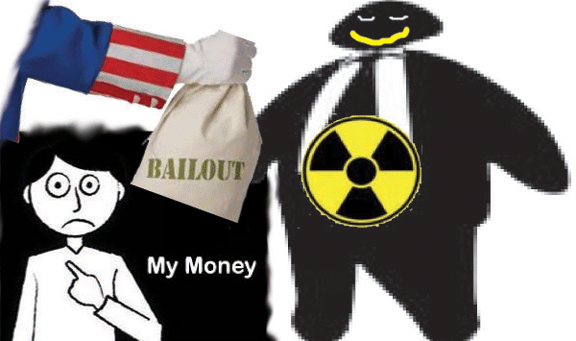 Critics sound alarm over rush to bail out Central New York nuclear plants, Syracuse.Com, By Tim Knauss | tknauss@syracuse.com , 17 June 16 SYRACUSE, N.Y. – The state’s frantic effort to save Upstate nuclear plants is drawing cheers from Oswego County. But it’s also raising alarms from critics who worry that key decisions about state energy policy are being rushed without enough public debate.
Exelon Corp.’s recent threat to close the Nine Mile 1 and Ginna nuclear reactors if it doesn’t get a subsidy from utility ratepayers by September has drawn barbed complaints from business, municipal and green energy advocates.
Critics point out that Exelon is asking the state Public Service Commission to determine how much of a subsidy the company’s nukes could get before the commission has even determined to what extent nuclear power should be subsidized.
Exelon “appears to be attempting an end run around the commission-established process,” wrote Albany attorney Michael Mager, who represents 60 large commercial and industrial utility customers in PSC rate proceedings. “The last thing that New York needs now is some ‘backroom deal.’ ”
Utility ratepayers could be on the hook for hundreds of millions in higher energy bills if the nuclear subsidies are approved – money that many renewable energy advocates would prefer to see spent on wind or solar power……..
A sudden focus on nuclear issues
The New York state energy plan, issued last year after much deliberation and 100,000 comments from the public, set an ambitious goal to make half of New York’s power from renewable energy by 2030. The plan barely mentioned nuclear power.
But hard times at Upstate’s nuclear plants – and hardball tactics by the owners – have suddenly forced Albany leaders to place a value on nuclear’s role in meeting the goals. Exelon’s recent ultimatum is the latest instance of brinksmanship during the past year from New York’s two nuclear operators.
Entergy Corp. last September threatened to close its 850-megawatt FitzPatrick plant in Scriba. After weeks of negotiations with Gov. Andrew Cuomo, punctuated by a war of words, Entergy made good on the threat and scheduled the shutdown for January 2017.
Now a similar warning has come from Exelon, the nation’s largest utility company, which owns the two-unit Nine Mile Point Nuclear Station near Oswego and the Ginna reactor in Wayne County.
Exelon has suggested in regulatory filings at the PSC that it is looking for a 12-year agreement that guarantees revenue of about $1 billion a year for its three Upstate reactors, an increase over what it makes now selling power in the wholesale market. The company did not estimate how much of a subsidy that would require…….
Based on current wholesale prices, two anti-nuclear groups estimated that subsidizing the two Nine Mile units and the Ginna plant would cost at least $190 million a year. In a filing with the PSC, the Alliance for a Green Economy and the Nuclear Information and Referral Service said their estimate was conservative……..http://www.syracuse.com/news/index.ssf/2016/06/critics_sound_alarm_over_rush_to_bail_out_central_new_york_nuclear_plants.html
Woes of France’s nuclear company AREVA, as it splits into three
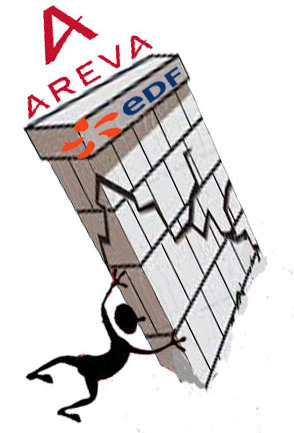
 French firm involved in Hinkley Point C unveils restructure plan Areva, a 10% equity participant in the Somerset scheme, reveals plans to split into three to stem losses and isolate Finnish project, Guardian, Terry Macalister, 16 June 16, Areva, one of the French companies at the heart of the controversial Hinkley Point C nuclear project, has unveiled plans to break itself up into three parts in a bid to stem huge losses.
The 87% state-owned atomic engineering and uranium mining company is hoping to raise €9bn (£7bn) from the government and from selling off assets after running up losses of €2bn last year.
Areva, a 10% equity participant in the £18bn planned new Hinkley scheme, is also using the split to isolate financial commitments to a hugely delayed project at Olkiluoto in Finland……
EDF, which is also part-owed by the French state, has its own massive debt problems and had refused to buy part of Areva, as ministers wanted, unless it could take the business without any financial commitments for the Olkiluoto 3 scheme.
Areva, which is providing the same European pressurised water reactor for Olkiluoto as is planned for Hinkley, is currently in a standoff over competing legal claims with the Finnish utility TVO relating to the project in Finland…….
A formal decision to go ahead with the investment at Hinkley has been put off until September amid internal opposition at EDF from unions and others about the wisdom of taking on such a major financial commitment……..https://www.theguardian.com/business/2016/jun/15/french-firm-involved-in-hinkley-point-c-unveils-restructure-plan
French company EDF manages to postpone closure of Fessenheim nuclear plant
French power company stalls nuclear plant closure http://www.dw.com/en/french-power-company-stalls-nuclear-plant-closure/a-19336521
The Fessenheim plant will not be closed until EDF is given a new assesment for damages compensation, the electric company has said. This pushes back plans to shut down the 40-year-old plant for at least a year. The fight over the plan to close France’s oldest operational nuclear power station took another turn on Thursday. The operators of the Fessenheim Nuclear Power Plant near the German and Swiss borders want a new assessment of the damages they will be awarded before they begin the process of shutting down the reactors.
The news came at the same time French nuclear watchdog ASH said one of Fessenheim’s reactors had to be shut down temporarily due to irregularities in a steam generator.
Opposition to Fessenheim began even before it was built in the 1970s, but has ramped up in recent years due to a number of minor safety breaches in the past decade. Leading the charge has been anti-nuclear power Germany, particularly the state of Baden-Württemberg, whose border lies a mere 1.5 kilometers (0.93 miles) from the reactors.
President Francois Hollande had promised to shut the plant by the end of 2016, but now EDF, France’s majority state-owned electrical company, wants a new appraisal of how much the government should pay it in damages for losses incurred as a result of the shut down. They say the 100 million euros ($114 million) offered by the government is far too little.
Observers say that a realistic timeline for the plant to go offline would be 2018, but to that end EDF has given no official date for its end of operations.
USA’s Pro Nuclear Energy Secretary Moniz announces $82 Million for Nuclear Energy Research
 Feds Announce $82 Million for Nuclear Energy Research, Sci Tech Today, 16 June 16 US Energy Secretary Ernest Moniz has announced $82 million for nuclear energy projects in 28 states……The Idaho-based Snake River Alliance describes itself as Idaho’s nuclear watchdog and clean energy advocate.
“Nuclear waste is certainly a place where we want as much research as possible,” said Wendy Wilson, the group’s interim executive director, about Tuesday’s announcement. “If they put that much money into renewables that are here today, we could have really safe and clean energy.”
Donald Trump, Orlando massacre, and nuclear weapons policy
 Trump’s Gun And Nuclear Arms Race: Both Wedge Issues Clinton Could Use To Peel Away Moderate Republicans, Huffington Post, Dave R. Jacobson Co-Authored by Maclen Zilber, 15 June 16 “……Just imagine how the world would be if, on January 20, 2017, billionaire Donald Trump raised his right hand, took the oath of office at his inauguration, and was sworn in as America’s 45th President.
Now visualize how Trump would respond, as President, to a horrific tragedy as the one we witnessed this past weekend at Pulse nightclub in Orlando, Florida……
Given his past comments, Trump’s answer would probably be more guns, bigger guns, “the classiest guns you’ve ever seen.”
Rather than enacting tougher laws to make it more difficult for terrorists, like Mateen, to purchase guns through additional background checks, Trump has made it clear he would like less oversight, not more, on gun purchases. He says the current background checks on the books are sufficient and also supports the use and sale of military grade weaponry, the type of weapons that are necessary to carry out such a large-scale mass shooting.
Trump sees nuclear weapons the same way he sees guns. For both, he believes more is better.
In Trump’s mind, giving more people guns will prevent further acts of carnage. At least that’s what he said after the terror attacks in Paris. Likewise, Trump believes nuclear proliferation is inevitable, and that’s why he’d prefer that more of America’s allies have nukes, rather than not. Giving them these capabilities, Trump suggests, will help to minimize the risk of nuclear war……..
Perhaps what Trump fundamentally misunderstands, is that by allowing more nations to stockpile nuclear arsenals, he will help to spur a domino effect where bordering countries of those nuclear armed nations will feel compelled to build up their own cache of nukes, thus creating a world-wide ripple effect.
……. When it comes to who voters trust to oversee America’s nuclear arsenal, according to a recent May FOX News poll, 49% of registered voters trust Clinton to do a better job of making decisions about using nuclear weapons, compared to 38% for Trump. Some of the nation’s top national security experts, such as Republican and former Defense Secretary Robert Gates, have criticized Trump’s calls for more nukes around the globe……..
Trump’s failure in response to the Orlando catastrophe coupled with his spine-chilling approach to nukes are both wedge issues that can start to peel away some of the very traits that give him strength, and Hillary Clinton has every moral and political justification to begin hammering away at them. Who knows, Trump is so impulsive and rash that if he begins feeling the heat over these issues, he may well switch his position on them (one could only hope!).http://www.huffingtonpost.com/dave-r-jacobson/trumps-gun–nuclear-arms_b_10457068.html
Japan’s Upper House Election
 Upper House Election 2016 / Nuclear power a nonissue for opposition in Fukui, Japan News The Yomiuri Shimbun, 15 June 16 This is the fourth installment of a series.
Reconstruction Minister Tsuyoshi Takagi, 60, from the House of Representatives’ Fukui Constituency No. 2, held a policy briefing meeting on June 5 in Tsuruga, Fukui Prefecture, that was seen as a rally for restarting nuclear power plants.
“We need to set a clear course on issues such as restarting nuclear plants and the future of Monju,” said Fukui Gov. Issei Nishikawa, 71, calling for operations to be resumed at reactors that have been deemed safe.
Joining him on the stage were heads of the municipalities of Tsuruga, Mihama, Oi and Takahama, which all host nuclear power plants. House of Councillors President Masaaki Yamazaki, 74, who is seeking a fifth term representing the Fukui constituency, was also in attendance.
After remarks by the local municipal leaders, Yamazaki asked the crowd for their support in the upcoming upper house election. His policy pamphlets and other materials addressing the issue of nuclear power state, “I promote an optimal energy mix based on safety and local development.”
Tsuruga sits on Wakasa Bay, a stretch of coastline that is home to the fast-breeder reactor Monju and 10 commercial nuclear reactors, not counting those slated for decommissioning. It is called “Nuclear Ginza” after the busy area in Tokyo.
Lawsuits seeking the suspension of operations and other issues have hindered efforts to restart the reactors in the wake of the March 2011 disaster at Tokyo Electric Power Company Holdings Inc.’s Fukushima No. 1 nuclear power plant.
Currently, no reactors are operating in the area……….
In contrast, Tatsuhiro Yokoyama, secretary general of the Fukui branch of the Japanese Trade Union Confederation (Rengo), almost never mentions nuclear power in his speeches on the street.
Yokoyama, 51, is supported by the Democratic Party, the Japanese Communist Party and the Social Democratic Party.
“Lawmakers from the Liberal Democratic Party cannot say no to Prime Minister Shinzo Abe. I want a Diet that listens to our voices,” he said in a June 8 speech near JR Tsuruga Station.
Yokoyama repeatedly criticized legislation related to national security and Abenomics, but he made no mention of nuclear power…….http://the-japan-news.com/news/article/0003009889
US Energy Secretary Moniz announces more money for nuclear industry
Feds Announce $82 Million for Nuclear Energy Research abc News, By KEITH RIDLER, ASSOCIATED PRESS BOISE, Idaho — Jun 14, 2016, U.S. Energy Secretary Ernest Moniz has announced $82 million for nuclear energy projects in 28 states as part of the government’s plan to reduce carbon emissions.
Moniz said Tuesday that the 93 research projects will help scientists innovate with nuclear technologies that can eventually enter the commercial market. He made the announcement while  visiting the Department of Energy’s Idaho National Laboratory in eastern Idaho…..
Much of the money announced Tuesday is heading for universities, about $36 million for 49 university-led projects. Fifteen universities also will receive nearly $6 million for research reactor and infrastructure improvements…….
The funding includes $21 million for joint projects involving the Office of Nuclear Energy and the Office of Environmental Management for nuclear waste immobilization. Collaboration between those two entities is part of Moniz’s plan to combine the Energy Department’s advanced nuclear research and remediation efforts……
The Idaho-based Snake River Alliance describes itself as Idaho’s nuclear watchdog and clean energy advocate.
“Nuclear waste is certainly a place where we want as much research as possible,” said Wendy Wilson, the group’s interim executive director, about Tuesday’s announcement. “If they put that much money into renewables that are here today, we could have really safe and clean energy.”
In Idaho, nuclear waste is a touchy subject involving federal court battles between the state and federal government over concerns the state was becoming a nuclear waste repository.
Currently, research on spent nuclear fuel the Energy Department wants to do at the Idaho National Laboratory is being prevented by a 1995 agreement prohibiting such shipments into Idaho until 900,000 gallons of high-level liquid radioactive waste stored at the site is converted to a solid form and shipped out of the state.
USA Congress Republicans denounce a carbon tax
13 June 2016 by dana1981On Friday, the US House of Representatives voted on a Resolution condemning a carbon tax. As The Hill reported:
The oil industry is scared of a carbon taxExxonMobil officially supports a carbon tax, but the company did not comment on the House Resolution prior to the vote. Meanwhile, the American Petroleum Institute, which is a key lobbying group of the oil industry, including ExxonMobil, publicly supported the anti-carbon tax resolution, as did Koch Companies Public Sector, LLC. Senator Sheldon Whitehouse (D-RI) suspects that the Resolution itself originated from the oil industry:
Since 2009, ExxonMobil has contributed at least $1.7 million to members of Congress who voted in favor of the resolution, according to an analysis by ClimateTruth.org. There are some indications that GOP leadership pressured House Republicans to vote for the Resolution. They certainly succeeded: of the 8 Republicans who are members of the bipartisan Climate Solutions Caucus, whose purpose is to craft optimal climate changepolicies, 7 voted for the Resolution. Only Rep. David Jolly (R-FL) withstood the pressure, voting “Present.” Ultimately, 231 of the 246 Republican members of the House (94%) expressed their unwillingness to consider a carbon tax by voting for the Resolution. Why the House Republicans are wrongIt’s odd that not a single House Republican voted against the Resolution, because as long as the revenue is returned to taxpayers (also known as “revenue neutrality”), many conservatives support a carbon tax. This concept is supported by free market, libertarian, and conservative think tanks like the R Street Institute, the Niskanen Center, and the American Enterprise Institute (AEI). AEI resident scholar Aparna Mathur said of the vote:
Polls show that about half of Republican voters support a carbon tax if revenues are rebated to taxpayers. It’s also supported by the non-partisan grassroots organization Citizens’ Climate Lobby (CCL), whose advisory board includes Ronald Reagan’s former Secretary of State, George Shultz. CCL issued a point-by-point response to the carbon tax “pitfalls” listed in the House resolution……..http://www.skepticalscience.com/grand-oil-party-republicans-denounce-carbon-tax.html |
Donald Trump’s strange nuclear negotiating ideas
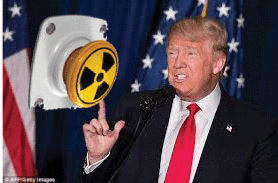 The Trump Files: Donald’s Nuclear Negotiating Fantasy http://www.motherjones.com/politics/2016/06/trump-files-donald-trumps-nuclear-negotiating-fantasy
The billionaire was once convinced he could cut a magnificent nuclear weapons deal with the Soviet Union.
MAX J. ROSENTHAL, JUN. 10, 2016 In the 1980s, Donald Trump became a global symbol of wealth and success who wasplanning to build the tallest skyscraper in the world. But the one deal he reallywanted to cut was an arms reduction treaty with the Soviet Union that would take nuclear missiles off the Cold War’s battlefield. It’s now clear that Trump knowsquite literally nothing about nuclear weapons, but then he fantasized going toe-to-toe with the Russkies at the nuclear bargaining table.
“It’s something that somebody should do that knows how to negotiate and not the kind of representatives that I have seen in the past,” he told the Washington Post in 1984. “It would take an hour-and-a-half to learn everything there is to learn about missiles…I think I know most of it anyway.”
Three years later, growing even more alarmed about Libya and other rogue nations getting the bomb, he told author Ron Rosenbaum that he was indeed working with the Reagan White House on nukes. “I’m dealing at a very high level on this,” he said.
Trump was frightened about the spread of nuclear technology—he seemed at one point during the interview to suggest the United States should bomb France to keep it from selling nuclear know-how—and worried about the deal-making skills of American officials. “They have no smiles, no warmth; there’s no sense of them as people,” Trump complained. “Who the hell wants to talk to them? They don’t have the ability to go into a room and sell a deal. They’re not sellers in the positive sense.”
In the 1980s, Donald Trump became a global symbol of wealth and success who wasplanning to build the tallest skyscraper in the world. But the one deal he reallywanted to cut was an arms reduction treaty with the Soviet Union that would take nuclear missiles off the Cold War’s battlefield. It’s now clear that Trump knowsquite literally nothing about nuclear weapons, but then he fantasized going toe-to-toe with the Russkies at the nuclear bargaining table.
“It’s something that somebody should do that knows how to negotiate and not the kind of representatives that I have seen in the past,” he told the Washington Post in 1984. “It would take an hour-and-a-half to learn everything there is to learn about missiles…I think I know most of it anyway.”
Three years later, growing even more alarmed about Libya and other rogue nations getting the bomb, he told author Ron Rosenbaum that he was indeed working with the Reagan White House on nukes. “I’m dealing at a very high level on this,” he said.
Trump was frightened about the spread of nuclear technology—he seemed at one point during the interview to suggest the United States should bomb France to keep it from selling nuclear know-how—and worried about the deal-making skills of American officials. “They have no smiles, no warmth; there’s no sense of them as people,” Trump complained. “Who the hell wants to talk to them? They don’t have the ability to go into a room and sell a deal. They’re not sellers in the positive sense.”
“I used to laugh when I thought back on Trump and me in [the 21 Club] talking nukes,” Rosenbaum wrote for Slate this year. “I’m not laughing anymore.”
1 This Month
23-25 October – on Zoom – World BEYOND War’s annual global conference

To see nuclear-related stories in greater depth and intensity – go to https://nuclearinformation.wordpress.com

Say No to NASA’s Reckless Nuclear Reactor on the Moon
Say No to NASA’s Reckless Nuclear Reactor on the Moon
-
Archives
- October 2026 (149)
- September 2026 (339)
- August 2026 (330)
- July 2026 (355)
- June 2026 (287)
- May 2026 (306)
- April 2026 (356)
- March 2026 (251)
- February 2026 (267)
- January 2026 (308)
- December 2025 (358)
- November 2025 (359)
-
Categories
- 1
- 1 NUCLEAR ISSUES
- business and costs
- climate change
- culture and arts
- ENERGY
- environment
- health
- history
- indigenous issues
- Legal
- marketing of nuclear
- media
- opposition to nuclear
- PERSONAL STORIES
- politics
- politics international
- Religion and ethics
- safety
- secrets,lies and civil liberties
- spinbuster
- technology
- Uranium
- wastes
- weapons and war
- Women
- 2 WORLD
- ACTION
- AFRICA
- Atrocities
- AUSTRALIA
- Christina's notes
- Christina's themes
- culture and arts
- Events
- Fuk 2022
- Fuk 2023
- Fukushima 2017
- Fukushima 2018
- fukushima 2019
- Fukushima 2020
- Fukushima 2021
- general
- global warming
- Humour (God we need it)
- Nuclear
- RARE EARTHS
- Reference
- resources – print
- Resources -audiovicual
- Weekly Newsletter
- World
- World Nuclear
- YouTube
-
RSS
Entries RSS
Comments RSS

