Political scandal hangs over South Africa’s nuclear energy plans
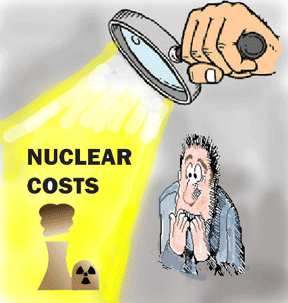 How the state capture controversy has influenced South Africa’s nuclear build , Sunday Times, 29 May 16 South Africa is facing a critical decision that could see it investing about R1 trillion – or US$60 billion to $70 billion – in a fleet of new nuclear power stations. Proponents argue that it will greatly increase electrical base-load capacity and generate industrial growth. But opponents believe the high cost would cripple the country economically.
What should be an economic decision has now been clouded by controversy, with political pressure to push through the nuclear build and the increasingly apparent rewards it would bring to politically linked individuals.
The nuclear expansion programme needs to be considered exceptionally carefully given that the required financial commitment is roughly equal to the total South African annual tax revenue. Loan repayments could place a devastating long-term burden on the public and on the economy as a whole……..
South Africa has had remarkable success with speedy, cost-effective installation of renewable energy power plants. In addition to this, technologies for harvesting South Africa’s plentiful wind and solar energy resources are rapidly becoming cheaper, raising the question of whether the country should not invest more in these options rather than in going nuclear.
The argument that nuclear energy provides a stable base load, independent of weather conditions, is mitigated by improvements in energy storage technologies……
 Zuma and the Russians The nuclear debate gained a political dimension when President Jacob Zuma and his Russian counterpart, Vladimir Putin, started to develop an unusually close relationship. It culminated in an announcement that the Russian nuclear developer, Rosatom, had been awarded the potentially highly lucrative contract to build the new reactors. The agreement was later denied.
Rosatom was considered the preferred contender, with other bidders only there to lend the process legitimacy, according to some observers. The lack of transparency surrounding the process, coupled with a history of corruption in South African mega-projects like the arms deal, has made the whole scheme seem suspicious to the broader public.
A thickening plot
A crucial thread in this saga involves the Shiva uranium mine, about 30km north-west of Pretoria, the country’s executive capital. It originally belonged to a company called Uranium One, a subsidiary of Russia’s Rosatom. It was sold in 2010 to Oakbay Resources, a company controlled by members of the politically connected Gupta family and the president’s son, in a deal that greatly surprised economists.
The mine was deemed unprofitable and thus unattractive to other mining companies. But it was still considered worth a whole lot more than the R270 million paid by Oakbay. The mine would, however, become highly profitable if it became the uranium supplier to the new nuclear power stations. Oakbay and its associates therefore have a very strong incentive for this nuclear build to happen.
 It is here that the nuclear build drama feeds into the recent major controversy surrounding alleged state capture, meaning a corrupt system where state officials owe their allegiance to politically connected oligarchs rather than the public interest. This was highlighted by the shock dismissal of Finance Minister Nhanhla Nene, a reported nuclear build sceptic, but also by subsequent allegations of ministerial positionsbeing offered to people by members of the Gupta family.
Political, legal and civil opposition
The nuclear build’s association with the Zuma faction in the ruling African National Congress (ANC) will be a political hot potato for decades to come. ……
A negative nuclear outlook
Building these plants is a risky business proposition, especially for Rosatom, which is implicated in the developing scandal. The recent political mood swing against state capture and a likely credit rating downgrade add to the risk.
Rosatom has suggested a nuclear build financing option that effectively amounts to it providing a loan. It is, however, conceivable that a future government may not honour debt repayments if there is a view that the construction deal was secured irregularly.
The narrow public support base and downright hostility in some quarters to a nuclear build has already effectively stalled local nuclear construction plans. The level of controversy, high costs and potential for further disruption mean that the planned implementation could only proceed under severe social strain.
Such a scenario could very well cost the ruling ANC the 2019 national elections. And the party is becoming increasingly aware of this. As such, it is posited that the nuclear build will not happen any time as soon as planned.
– Hartmut Winkler, Professor of Physics, University of Johannesburg http://www.timeslive.co.za/sundaytimes/opinion/2016/05/27/How-the-state-capture-controversy-has-influenced-South-Africa%E2%80%99s-nuclear-build
Hinkley nuclear project’s future is in doubt – French unions not happy with Hinkley plan


 Hinkley Point: French unions put nuclear plant’s future in doubt By Jake Morris & Chris Cook BBC Newsnight 27 May 2016
The future of the planned new nuclear power plant at Hinkley Point remains in doubt as key French unions still oppose the project, BBC Newsnight has learned.
EDF, which would build the plant, had delayed a decision on the project in Somerset until the summer while it consulted French union representatives.
The company, which is 85% French state-owned, had hoped to win support from a committee of workplace representatives.
But the committee said staff had not been reassured about the plant’s costs.
Trade union representatives hold six of the 18 seats on EDF’s board.
‘Several reservations’
Jean-Luc Magnaval, secretary of the Central Works Committee that EDF consulted with, told Newsnight that staff feared the cost of the project would cripple EDF.
He said: “We have reservations about several aspects of the project: organisation, supply chain, installation, and procurement.
“The trade unions are unlikely to give their blessing to the project in its current state.
“We are not reassured by the documents we have received. We have been given a marketing folder, not the full information we require.
“We got the documents on 9 May – we are sending EDF a request for more explanations.”…….
EDF chief executive Vincent de Rivaz also told MPs on the committee that he did not know when a final decision on the project would be made…….
While one third of the £18bn capital costs of the project are being met by Chinese investors, Hinkley Point would remain an enormous undertaking for the stressed French company……..http://www.bbc.com/news/business-36394601
Nuclear energy has no place in New York State renewable energy plan
 “The proposed Clean Energy mandate also includes a proposal to support emissions-free upstate nuclear power.”
The inclusion of nuclear power in the New York State renewable energy plan is drawing national attention.
“Hitting on state taxpayers to pay for steadily rising nuclear costs while wind and solar energy are less and less expensive makes no sense in a 21st Century economy,”
the inclusion of nuclear power in the state plan would take resources away from true clean, green energy.
Long Island as a Nuclear Park, CounterPunch, by KARL GROSSMAN MAY 27, 2016 “……..PSEG has had a very sorry record as THE Long Island utility.
This bad record is continuing with intensity.
Last month, for example, PSEG took a blow at solar energy on the island asking the state Public Service Commission to “minimize” and “later eliminate” benefits received by homeowners and business owners utilizing solar energy. PSEG wants to hike the charge to solar customers for being connected to the grid and reduce what they get for sending electricity into it.
“We should encourage homeowners and business owners to invest in rooftop solar systems—but PSEG wants to penalize them,” says Gordian Raacke, executive director of Renewable Energy Long Island. ‘This runs counter to the idea of getting more renewable energy into the grid and of the New York State energy plan which seeks to get half of the state’s electricity from renewable sources by 2030.”…….
And regarding nuclear power, a fundamental focus of LIPA was to lead in bringing safe, clean, renewable—and not nuclear—energy to Long Island. This was in keeping with its formation being instrumental in stopping LILCO’s plan to build many nuclear power plants on the island with Shoreham the first.
Another U.S. utility that’s been as bullish on nuclear power—and still is: PSEG.
In the 1970s, PSEG embarked on a plan to build a line of “floating” nuclear power plants in the Atlantic Ocean off New Jersey with the last just south of Long Island. Millions were spent before this scheme was jettisoned………
What the state is calling a “50 by 30” plan, advanced by Andrew Cuomo, is formally titled a “Clean Energy Standard.” As the Department of Public Service explained in a statement: “Governor Cuomo directed the Public Service Commission to design and enact a new Clean Energy Standard mandating that 50 percent of all electricity consumed in New York by 2030 come from clean and renewable energy sources.” However, the next line in the statement is: “The proposed Clean Energy mandate also includes a proposal to support emissions-free upstate nuclear power.” That component of the state plan drew strong criticism at the public hearing.
“Nuclear energy is neither clean nor renewable,” testified Pauline Salotti, vice chair of the Green Party of Suffolk County. “No way should it be considered renewable.”
Raacke said New York should not seek to “prop up nuclear power” and spoke of the Shoreham “nuclear folly” that went on “for years” on Long Island and the successful struggle against it. He objected to a “revisit to that past in the plan.”…..
The boosting of “upstate nuclear power” in the state plan follows Andrew Cuomo’s support for the continued operation of nuclear power plants in upstate New York despite his opposition to the Indian Point nuclear power plants downstate, 26 miles north of New York City, which he’s been demanding be shut down. ……
The Syracuse Post Standard, in an article by Tim Knauss headlined “Cuomo’s Renewable Energy Plan Includes Boost for Upstate Nuclear Plants,” quotes Syracuse attorney Joe Heath, counsel to the Onondaga Nation, as opposing this. Said Heath: “We should…not think that nukes are the answer.”
The upstate nuclear plants that Cuomo is backing—and that his plan claims produce renewable energy—include the long-troubled Nine Mile Point and FitzPatrick nuclear plants in Scriba, although the current owner of FitzPatrick want to close it this year because, says Entergy, it is not financially viable to operate……
The inclusion of nuclear power in the New York State renewable energy plan is drawing national attention. “Cuomo is mistaken to squander his political clout on beating the dead horse that nuclear power has become in the State of New York,” says Paul Gunter, director of the Reactor Oversight Project for the organization Beyond Nuclear.
“Hitting on state taxpayers to pay for steadily rising nuclear costs while wind and solar energy are less and less expensive makes no sense in a 21st Century economy,” declares Gunter. “It’s time to offer retraining to the nuclear work force to install renewable energy, expand state-of-the-art energy storage systems like Tesla’s PowerWall and make energy efficiency and conservation part of every home, business and industry in the state.” Moreover, says Gunter, the inclusion of nuclear power in the state plan would take resources away from true clean, green energy.
Karl Grossman, professor of journalism at the State University of New York/College of New York, is the author of the book, The Wrong Stuff: The Space’s Program’s Nuclear Threat to Our Planet. Grossman is an associate of the media watch group Fairness and Accuracy in Reporting (FAIR). He is a contributor to Hopeless: Barack Obama and the Politics of Illusion. http://www.counterpunch.org/2016/05/27/long-island-as-a-nuclear-park/
Japanese government to announce a shift away from nuclear power?

 Japan Nuclear Power Outlook Bleak Despite First Reactor Restart Japan to cut emphasis on nuclear in next energy plan http://www.dw.com/en/japan-to-cut-emphasis-on-nuclear-in-next-energy-plan/a-19289705
Japan is rethinking its energy diet and could announce a shift away from nuclear power as soon as next year. Scrapping nuclear would mean more renewable energy generation, but also a heavier reliance on coal.
Japan will cut its reliance on nuclear power after releasing an updated energy plan next year, the Reuters news agency reported on Friday, citing three people with knowledge of the matter.
The Japanese remain strongly opposed to nuclear power after the 2011 Fukushima disaster, and a shift in energy policy would reflect that widespread aversion. But it would also likely usher in a new era of dependence on coal-fired power plants.
Japan will never go back to nuclear energy.
Burning coal is less expensive than producing nuclear power, but a recent decision by Japan’s environment ministry to drop its opposition to coal-fired power plants has raised questions about the industry’s ability to lower its greenhouse gas emissions.
Is coal the way to go?
Japan is one of several Asian countries that are expanding their coal portfolios faster than natural gas, which is viewed as another big potential source of growth in the energy sector.
Renewables are also on the upswing, and Tokyo’s decision to move away from nuclear power would definitely see it boost its reliance on renewable energy.
A target set by Japan’s energy ministry that would have seen nuclear energy make up a fifth of the country’s electricity was widely criticized. Another target, which foresaw nuclear accounting for 10-15 percent of electricity by 2030, was also nixed.
A shift away from nuclear energy, while publicly popular, wouldn’t be without risk, according to experts.
“There is a real risk that investment in coal or fossil fuel power generation within five to 10 years will become a stranded asset, which means that they’re no longer a viable investment,” the head of the International Renewable Energy Agency (IRENA), Adnan Z. Amin, told Reuters. “You’re seeing in more and more countries around the world a determination to move out of coal.”
Illinois Attorney General slams nuclear bailout legislation
 Attorney General Rips Exelon Legislation http://www.wandtv.com/story/32061349/attorney-general-rips-exelon-legislation May 26, 2016
Madigan says the measure (Senate Bill 1585) would allow Exelon and its subsidiary ComEd to rack up billions of dollars in spending and profit paid for by consumers.
“It’s outrageous that Exelon and ComEd are again requesting a bailout when they are both profitable companies,” Madigan stated. “The legislature has more important matters to address than padding ComEd and Exelon’s profits.”
Exelon has argued it needs the legislation in order to keep operating the Clinton plant. Lawmakers like Senator Chapin Rose, (R) Mahomet, and Representative Bill Mitchell, (R) Forsyth, have said hundreds of jobs are on the line in central Illinois should the plant be closed. Schools say they will lose millions of dollars in property taxes.
Exelon has threatened to close the plant in 2017 if the legislation, which changes some regulations, is not passed by the legislature by the end of the legislative session this month.
Exelon and its allies rally for a bailout of nuclear power, despite its known dangers
 Illinoisans Sound Off On Exelon/ComEd Bill As Report Unveils Dangers At Their Local Nuclear Sites http://www.progressillinois.com/news/content/2016/05/24/illinoisans-sound-over-exeloncomed-legislation With the end of the regular Illinois legislative session looming, supporters of an Exelon and ComEd energy proposal were at the State Capitol Tuesday to advocate for the measure.
Exelon workers and their allies were among those rallying for the controversial Next Generation Energy Plan. Without the legislation, Exelon has warned that it will have to shutter its Clinton and Quad Cities nuclear power plants, which are reportedly struggling financially.
State Sen. Chapin Rose (R-Mahomet), whose district includes the Clinton nuclear plant, supports the legislation. …
Illinois AFL-CIO President Michael Carrigan added: “We cannot afford to see a nuclear plant close.”
But Illinois Attorney General Lisa Madigan says the legislation is essentially a bailout for Exelon and its subsidiary ComEd.
“It’s outrageous that Exelon and ComEd are again requesting a bailout when they are both profitable companies,” Madigan said in a statement about her opposition to the legislation, SB 1585. “This proposal would force consumers to pay more only to boost the companies’ profits further. The legislature has more important matters to address than padding ComEd and Exelon’s profits.”
Abraham Scarr with the Illinois Public Interest Research Group (PIRG) also weighed in on the energy legislation Tuesday. He told consumers not to believe “the hype” around the bill:
ComEd and Exelon want you to believe their ‘Next Generation Energy Plan’ will put Illinois on the path to a clean energy future. Don’t believe the hype. They claim their bill will jump start solar, but the solar industry opposes it. They claim their new rate structure helps consumers, but consumer advocates oppose it. They ask for ‘equal footing’ with wind and solar, without counting the $5.58 billion Illinois ratepayers have already poured into their nuclear fleet.
The ComEd-Exelon bill prioritizes private profits over public good. Demand charges, the nuclear bailout, the grossly overpriced micro-grid proposal and many other policies all aim to deliver more, and more consistent, revenue for ComEd and Exelon.
It is time to transition to a clean, renewable energy economy and do so in a way that is fair to consumers and to the communities most impacted by our energy system. But instead of rising to these challenges, the ComEd-Exelon bill seeks to forestall this transition and wring as much profit from ratepayers as possible while delivering little in return.
In other news, Exelon’s Illinois nuclear facilities were mentioned in a new report released Tuesday by Greenpeace.
The environmental group analyzed “near misses or accident precursors at U.S. nuclear power plants over the past decade.” The report adds that “risk analysts have determined” these events to be “precursors to a meltdown.”
The incidents were reported to the U.S. Nuclear Regulatory Commission. From 2004 through 2014, NRC recored “61 events and 102 conditions at US nuclear plants that were near misses to a meltdown,” the report says.
All but three of Exelon’s 11 nuclear reactors in Illinois are reported to have had “near misses” over that decade, according to the research.
“As legislators and the governor move to decide Illinois energy future and whether to bailout three of Exelon’s aging and financially failing reactors, they should well consider the potential safety risks of staying with nuclear power, and whether or not the federal regulators are doing their job to adequately protect Illinois from enormous economic and environmental harm,” Dave Kraft, director of the Chicago-based Nuclear Energy Information Service, an anti-nuclear group, said in reaction to the new Greenpeace report. SOURCES News links: Journal Gazette & Times-Courier
Illinois the perfect illustration of the plight of the nuclear and coal industries
 Where Free Wind Meets Cheap Gas in U.S., Power Dynamics Changing
-
Illinois could lose more than 10 percent of power capacity
-
Exelon, Dynegy asking legislature to save aging plants
-
For a snapshot of the woes of the U.S coal and nuclear industries, take a look at Illinois.
Following a four-year drop in electricity demand, power companies there announced the closing of coal and nuclear plants that account for more than 10 percent of generating capacity. The shutdowns come amid a fourfold increase in cheap wind from neighboring states and growing competition from generators burning low-cost natural gas.
- Exelon Corp., the operator of 11 nuclear reactors in Illinois, and Dynegy Inc., which has 10 coal-fired plants in the state, are asking lawmakers to bail out their money-losing assets to prevent further job-cutting, closures
- “You’ve got free wind power coming from the west and cheap gas coming from the east and that’s not a good place to be for coal and nuclear power plants,” said Travis Miller, a utility analyst for Morningstar Inc., an investment research firm.
- Illinois isn’t alone. The power industry upheaval is playing out in more than a dozen states that deregulated their electricity markets, opening their borders to competition, over the past two decades. In those locations, owners of aging generators are particularly vulnerable as the average wholesale power price has dropped by about half since 2008. In response, electricity providers in places like Ohio and New York are asking for millions of dollars to keep their units running.
Nowhere has the confluence of market forces produced such a profound dislocation as in Illinois. Continue reading


Donald Trump will pull the US out of the UN global climate accord, push coal, oil
 Trump to undo climate agenda, push coal, THE AUSTRALIAN BY VALERIE VOLCOVICI AND EMILY STEPHENSON AAP MAY 27, 2016
Donald Trump, the presumptive Republican presidential nominee, has promised to roll back some of America’s most ambitious environmental policies, actions that he said would revive the ailing US oil and coal industries and bolster national security.
Among the proposals, Trump said he would pull the US out of the UN global climate accord, approve the Keystone XL oil pipeline from Canada, and rescind measures by President Barack Obama to cut US emissions and protect waterways from industrial pollution……..
It was Trump’s first speech detailing the energy policies he would advance if elected president. He received loud applause from the crowd of oil executives.
The comments painted a stark contrast between the New York billionaire and his Democratic rivals for the White House, Hillary Clinton and Bernie Sanders, who advocate a sharp turn away from fossil fuels and towards renewable energy technologies to combat climate change.
Trump slammed both rivals in his speech, saying their policies would kill jobs and force the US “to be begging for oil again” from Middle East producers.
Trump’s comments drew quick criticism from environmental advocates, who called his proposals “frightening”.
“Trump’s energy policies would accelerate climate change, protect corporate polluters who profit from poisoning our air and water, and block the transition to clean energy that is necessary to strengthen our economy and protect our climate and health,” said Tom Steyer, a billionaire environmental activist.
But industry executives cheered the stance……..
Until Thursday, Trump had been short on details of his energy policy. He has said he believes global warming is a hoax, that his administration would revive the US coal industry, and that he supports hydraulic fracturing – an environmentally controversial drilling technique that has triggered a boom in US production……http://www.theaustralian.com.au/news/latest-news/trump-would-approve-keystone-pipeline/news-story/3ad66f7f374ab34cddf3d1a48fd14a56
UK governmnet not deciding on Hinkley nuclear station anytime soon
No deadline set for final decision on Hinkley nuclear plant Energy minister tells MPs that no time limit has been set for EDF to make a final investment decision on the much-delayed nuclear plant, Guardian, Damian Carrington 24 May 16
The UK has set no deadline for the final go-ahead to the much-delayed Hinkley Point C nuclear plant, energy minister Andrea Leadsom told a committee of MPson Tuesday.
The head of the company aiming to build the new reactors, French state-owned EDF, told the same hearing he could not give a date for the decision nor confirm that it would start generating electricity in 2025, as previously pledged.
If built, the £18bn plant would generate 7% of the UK’s electricity and is a central plank of the government’s energy policy. EDF originally promised UK customers they would be cooking their Christmas turkeys with power from Hinkley by 2017. But the schedule has repeatedly slipped, amid concerns over the cost and difficulty of the project, which has led to questions about how the UK would keep the lights on without Hinkley……..
The energy secretary, Amber Rudd, said in April that a failure to build Hinkley would not mean the lights going out… http://www.theguardian.com/environment/2016/may/24/edf-no-deadline-set-for-final-decision-on-hinkley-nuclear-plant
America’s NRC changing nuclear fee structure to help Small Nuclear reactors: Shillenberger delighted
 NuScale Power LLC is expected to be the first company in the U.S. to submit a small modular reactor design application to the NRC by the end of the year, with project commercialization by 2024. NuScale’s reactor modules would each generate 50 megawatts (95 ECR, 5/17/16).
The NRC is implementing a variable annual fee schedule for these reactors including a minimum fee, a variable fee and a maximum fee based on the reactor’s cumulative licensed thermal power rating, which is the total heat output for all modules at a nuclear power plant. …..
Safety Concerns from Environmentalists
The Union of Concerned Scientists, a nonprofit organization focused on scientific research of environmental issues, opposes different fees for small modular reactors because the safety risk of these reactors is still unclear, it said.
“It’s not clear that the relative risk of SMRs and the effort needed to license and regulate them is proportional to the power rating,” Ed Lyman, a senior scientist at the Union of Concerned Scientists, told Bloomberg BNA May 23. He said this is especially true “since SMR applicants are requesting exemptions that require significant technical analysis, such as reducing emergency planning zone size and weakening security requirements.”
Also, Lyman disagreed with the statement that the SMRs would require less regulatory oversight. “NRC inspections of a multi-module SMR bundled unit may be more complex and entail more labor than inspections of a single large reactor with the same power rating,” he said.
Similarly, Tim Judson, executive director of the Nuclear Information Resources Service, said he thinks that reduced fees for SMRs would ultimately impact NRC safety inspections.
“Smaller reactors means there would be several times more reactors requiring inspections and oversight for the same amount of power. Basing the fees on the generation capacity seems like it’s likely to starve the agency of resources to do its job,” he told Bloomberg BNA May 23.
TVA Submits Early Site Permit for SMR
The Tennessee Valley Authority submitted an early site permit application for the potential to construct and operate multiple small modular reactor units at its Clinch River site near Oak Ridge, Tenn. TVA is the first in the nuclear industry to submit any such application related to SMR technology to the NRC, TVA said in a May 13statement.
The utility, which currently operates three nuclear plants in the South, has not decided what company it would purchase the SMR technology from, a TVA spokeswman told Bloomberg BNA May 23.
To contact the reporter on this story: Rebecca Kern in Washington atrkern@bna.com
To contact the editor responsible for this story: Larry Pearl atlpearl@bna.com
Lithuania, and environmentalists not happy with Belarus’ nuclear power plan
 Minsk Letter: Belarus goes ahead with nuclear power, Irish Times, Kieran Cooke in Minsk, 24 May 16,
“…….Though Chernobyl is in Ukraine, it’s estimated that the prevailing winds resulted in up to 70 per cent of the radioactivity being deposited on Belarus, much of it in the southern region of the country, close to the Ukrainian border.
Undeterred by the legacy of Chernobyl – many here still suffer from cancers and other diseases as a result of what ranks as the world’s worst nuclear accident – Belarus is now building its own nuclear power plant……
The government – for more than 20 years under the firm grip of president Alexander Lukashenko – claims that more than 60 per cent of the country’s 9.5 million approve of the nuclear facility, though no nationwide poll has ever been taken…..
Government critics say no proper public hearings have been held about the plant, and that those who dare to raise objections have been harassed or arrested……..
Russian reliant
Critics point out that Belarus will still be reliant on Russia. A Russian state nuclear company has designed and is responsible for much of the construction. Russia will also supply the plant’s nuclear fuel – and deal with the waste.
Neighbouring Lithuania, always suspicious of a government in Minsk it sees as a remnant of the old Soviet order, is deeply concerned about what’s going on. It points out that the plant at Ostrovets is only 20km from the Lithuanian border and only 50km from Vilnius, the capital.
Officials in Vilnius say Belarus has not answered questions about the safety of Ostrovets and is in contravention of international agreements on nuclear facilities. The government in Minsk firmly denies the accusations.
Svetlana Alexievich, the Belarus author and winner of the 2015 Nobel prize for literature for her work on interviewing Chernobyl victims and other writings, has described the nuclear fallout from Chernobyl as an unimaginable disaster for her country.
Back at the new nuclear plant, due to become operational in two years, we are being bombarded with data. So many thousands of tons of concrete, so many tons of steel are being used in its construction.
“What happens if a missile is fired at the plant?” asks one journalist.
“Then we are all in trouble,” comes the reply. http://www.irishtimes.com/news/world/europe/minsk-letter-belarus-goes-ahead-with-nuclear-power-1.2658040
Japan’s Abe government intent on 2020 Olympics, pretending that Fukushima is OK now
Fukushima Flunks Decontamination, CounterPunch, 20 May 16. by ROBERT HUNZIKER Japan’s Abe administration is pushing very hard to decontaminate land, roads, and buildings throughout Fukushima Prefecture, 105 cities, towns, and villages. Thousands of workers collect toxic material into enormous black one-ton bags, thereby accumulating gigantic geometric structures of bags throughout the landscape, looking evermore like the foreground of iconic ancient temples.
Here’s the big push: PM Abe committed to the 2020 Tokyo Olympics, which shall be a crowning achievement in the face of the Fukushima disaster. Hence, all stops are pulled to repopulate Fukushima Prefecture, especially with Olympic events held within Fukushima, where foodstuff will originate for Olympic attendees.
The Abe government is desperately trying to clean up and repopulate as if nothing happened, whereas Chernobyl (1986) determined at the outset it was an impossible task, a lost cause, declaring a 1,000 square mile no-habitation zone, resettling 350,000 people. It’ll take centuries for the land to return to normal.
Fukushima: Living with a Disaster
Still and all, is it really truly possible to cleanse the Fukushima countryside? Already, workers have accumulated enough one-ton black bags filled with irradiated soil and debris to stretch from Tokyo to LA. But, that only accounts for about one-half of the job yet to be done. Still, in the face of this commendable herculean effort, analysis of decontamination reveals serious missteps and problems.
Even though the Abe government is encouraging evacuees to move back into villages, towns, and cities of Fukushima Prefecture, Greenpeace nuclear campaigner Heinz Smital claims, in a video – Fukushima: Living with Disaster d/d March 2016: “Radiation is so high here that nobody will be able to live here in the coming years.”
Greenpeace has experts on the ground in Fukushima Prefecture March 2016, testing radiation levels. The numbers do not look good at all. Still, at the insistence of the Abe government, people are moving back into partially contaminated areas. In such a case, and assuming Greenpeace is straightforward, it’s a fair statement that if the Abe government can’t do a better job, then something or somebody needs to change. The Olympics are coming……
Throughout the prefecture, decontamination is only partially carried out. For example, decontamination is confined within a 20-meter radius of private plots and along the roads as well as on farmland, leaving vast swaths of hills, valleys, riverbanks, streams, forests, and mountains untouched. Over time, radiation contamination runoff will re-contaminate many previously decontaminated areas.
Alarmingly, Greenpeace found large caches of hidden buried toxic black bags. Over time, it is likely the bags will rot away with radioactivity seeping into groundwater.
At Fukushima City, 60 km from the plant, Greenpeace discovered unacceptable radiation levels with spot readings as high as 4.26, 1.85, 9.06 μSv. According to Greenpeace: “These radiation levels are anything but harmless.”…..http://www.counterpunch.org/2016/05/20/fukushima-flunks-decontamination/
Thailand’s “Nuclear Energy for Peace Bill” – George Orwell would love it!
Cheers, doubts as nuclear energy bill gets NLA nod PRATCH RUJIVANAROM PRAPASRI OSATANON
THE NATION May 21, 2016 Move seen as facilitating the construction of nuclear power plant in the country.
“We have cases of radioactive material and nuclear waste smuggling into Thailand and we need the regulatory body to control this activity. Moreover, the information disclosure about nuclear energy is still a problem,” Tara said.
He noted that the bill would also help facilitate nuclear power plant construction in Thailand, despite the nation still not being ready yet for this kind of energy.
“We have a very low budget compared to European countries to build nuclear power plants, so I’m afraid our nuclear power plants will have a safety problem and may cause harmful effects to the environment and people,” he said.
Chulalongkorn University’s Faculty of Science lecturer Jessada Denduangboripant said he was pleased the bill had passed.
“We have cases of radioactive material and nuclear waste smuggling into Thailand and we need the regulatory body to control this activity. Moreover, the information disclosure about nuclear energy is still a problem,” Tara said…..
Exelon nuclear corporation pressing for tax-payer funding at State and Federal level, USA
 Exelon presses for help at state, federal levels, E & E, Jeffrey Tomich, E&E reporter EnergyWire: Friday, May 20, 2016 The nation’s largest nuclear operator put on the full-court press yesterday in Washington, D.C., and Springfield, Ill., for policies to keep some its struggling plants afloat amid increasing competition from wind energy and a glut of cheap shale gas that’s depressing energy prices.
The case for helping preserve Exelon Corp.’s endangered nuclear plants — the Clinton and Quad Cities plants in Illinois and the R.E. Ginna and Nine Mile Point plants in New York — isn’t new.
Chicago-based Exelon has threatened for more than two years to shut money-losing plants in an effort to prod state lawmakers to act. In New York, Democratic Gov. Andrew Cuomo’s administration has come to the rescue with an evolving plan to help existing plants survive the downturn in energy markets (EnergyWire, March 18). In Illinois, Exelon is proposing a similar remedy, but it remains to be seen if the General Assembly will come to the rescue.
Earlier this month, Exelon’s chief executive, Chris Crane, said he has authority from the board to shut the “distressed assets” if lawmakers don’t approve a proposal requiring up to $290 million a year in subsidies from Illinois consumers to keep them profitable.
The company offered a revamped proposal on May 5 and gave the Legislature until the end of the month to pass it (EnergyWire, May 6). If not, the 1,087-megawatt Clinton plant would be closed when its obligation to run ends a year from now, Crane said. The Quad Cities plant is required to run an extra year, but unless the bill passes or the plant clears this year’s PJM Interconnection capacity auction for 2018-19, it, too, will be shut down.
If Exelon’s nuclear proposal isn’t complex and controversial enough, it is woven into a sweeping, 316-page energy bill that would rewrite Illinois energy policy……
Exelon said the two plants have lost a combined $800 million over the last six years, and they are projected to lose another $500 million over the next five years.
“We are unable to sustain those type of economic losses any longer,” Tim Hanley, the company’s senior vice president of nuclear projects, told the committee……
Exelon’s claims were challenged, however, by consumer groups including AARP and by the Illinois attorney general, as well as by Illinois industrial energy users and downtown Chicago building owners. The same groups opposed the nuclear proposal a year ago.
Cara Hendrickson, an assistant attorney general, told committee members the measure was nothing more than “another nuclear bailout, dressed up differently.” …..http://www.eenews.net/stories/1060037598 Twitter: @jefftomich Email: jtomich@eenews.net
USA Energy secretary Ernest Moniz keen to get tax-payer funding for Exelon nuclear power
 Fifteen to 20 nuclear units in US ‘at risk’ of shutdown: industry official Washington (Platts)–19 May 2016 Some 15 to 20 nuclear power units in the US are “at risk” of being shut over the next five to 10 years due to economic challenges such as low power prices, competition from natural gas-fired generation and subsidized renewables, a nuclear industry official said Thursday.
Marvin Fertel, president and CEO of the Nuclear Energy Institute, did not name any of the reactors considered to be most at risk in his remarks at a US Department of Energy summit on the future of nuclear power. He did say that small, single-unit nuclear power plants are the most economically challenged.
Two such plants, Dominion’s Kewaunee in Wisconsin and Entergy’s Vermont Yankee, have closed for economic reasons since 2013. Entergy’s FitzPatrick in New York and Pilgrim in Massachusetts are scheduled to be shut in 2017 and 2019, respectively, due to such factors, the company has said. The Omaha Public Power District said last week it is recommending to the district’s board of directors that its Fort Calhoun plant in Nebraska be shut because other generating options are less costly…….
Fertel noted that Exelon’s two-unit Quad Cities nuclear plant in Illinois, which the company has said is losing money and will be shut in the next few years without further legislative and market support, “……
Secretary of Energy Ernest Moniz, who spoke immediately before Fertel at the summit, agreed in his remarks that continued operation of some operating nuclear power plants is at risk.
Moniz said that DOE’s Quadrennial Energy Review currently underway is assessing the future of the existing nuclear fleet in a subcommittee chaired by former deputy secretary of defense John Deutch, and is considering how nuclear plant operators might be compensated for the various benefits of their generation. Those issues will be “at the heart of the analysis work going on right now in developing this QER,” he said.
“I’m expecting an excellent report” from the subcommittee on what can be done to sustain operation of existing nuclear units, Moniz said. “This question of valuation [of nuclear generation] is one that is absolutely central. It’s one that we’re certainly paying attention to.”……. http://www.platts.com/latest-news/electric-power/washington/fifteen-to-20-nuclear-units-in-us-at-risk-of-21497100
1 This Month
22 June – Virtual Event –Climate Change: New Data, New Debate

Monday, June 22, 2026 2:30 p.m. – 3:15 p.m. CT
YouTube. Register here

Protect Sazan Island from the Trump family! https://secure.avaaz.org/campaign/en/protect_sazan_island_from_the_trump_family_loc/?bqFCVab&v=174511&cl=22707147157&_checksum=5e9dde668860e8231c33699735e16a1fbf22ab2cb01da50c999fe8732b9775ef&utm_source=email&utm_medium=blast_email&utm_campaign=174511
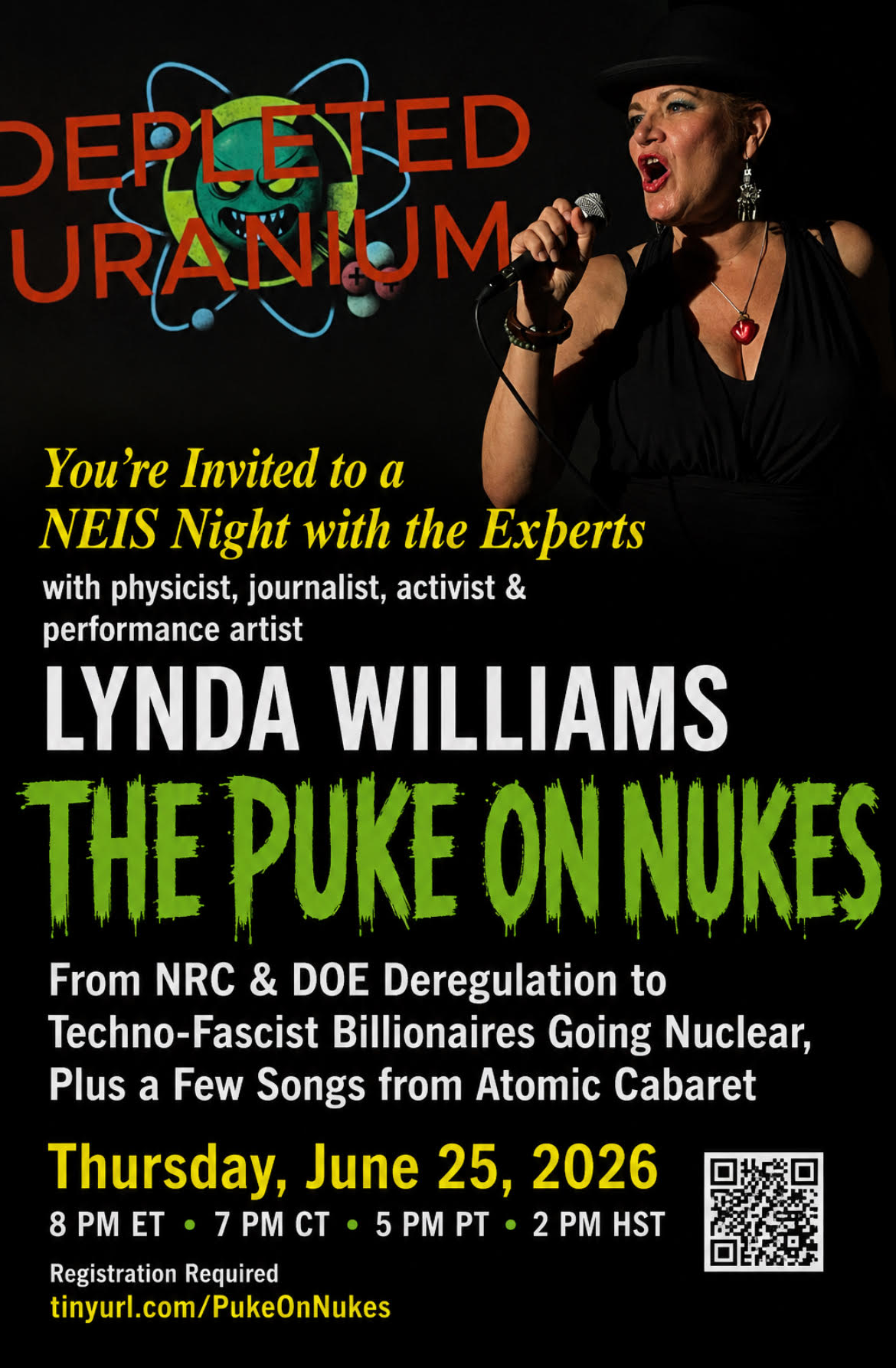
25 June- THE PUKE ON NUKES
Thursday, June 25, 2026
7pm Central Time (8pm ET, 6pm MT, 5pm PT) UTC – 5
From NRC & DOE Deregulation to Techno-Fascist Billionaires Going Nuclear, Plus a Few Songs from Atomic Cabaret REGISTER
26 June – Radiation Trainwreck at the NRC / Join the Protect Better Campaign – https://us02web.zoom.us/meeting/register/4ZlZ5_qLSHGiLSCg8FF6Bg#/registration


Cuba Is Not a Failed State – It Is a Besieged State
PETITION: “Global Appeal to Endorse Palestinian Right of Return of Refugees”
To see nuclear-related stories in greater depth and intensity – go to https://nuclearinformation.wordpress.com
-
Archives
- June 2026 (193)
- May 2026 (306)
- April 2026 (356)
- March 2026 (251)
- February 2026 (268)
- January 2026 (308)
- December 2025 (358)
- November 2025 (359)
- October 2025 (376)
- September 2025 (257)
- August 2025 (319)
- July 2025 (230)
-
Categories
- 1
- 1 NUCLEAR ISSUES
- business and costs
- climate change
- culture and arts
- ENERGY
- environment
- health
- history
- indigenous issues
- Legal
- marketing of nuclear
- media
- opposition to nuclear
- PERSONAL STORIES
- politics
- politics international
- Religion and ethics
- safety
- secrets,lies and civil liberties
- spinbuster
- technology
- Uranium
- wastes
- weapons and war
- Women
- 2 WORLD
- ACTION
- AFRICA
- Atrocities
- AUSTRALIA
- Christina's notes
- Christina's themes
- culture and arts
- Events
- Fuk 2022
- Fuk 2023
- Fukushima 2017
- Fukushima 2018
- fukushima 2019
- Fukushima 2020
- Fukushima 2021
- general
- global warming
- Humour (God we need it)
- Nuclear
- RARE EARTHS
- Reference
- resources – print
- Resources -audiovicual
- Weekly Newsletter
- World
- World Nuclear
- YouTube
-
RSS
Entries RSS
Comments RSS
 nuclear-news