After huge public protest Chinese town halts nuclear waste project
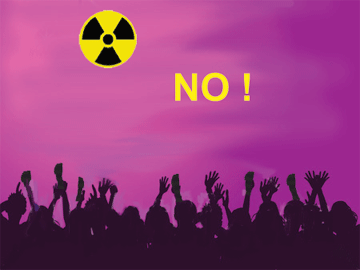
 Chinese town suspends nuclear waste project, DW, 10 Aug 16 A city in the eastern part of China has said it’s suspending preliminary work on a nuclear waste processing plant after days of protests by local residents over health concerns. No final decision has been made yet. The Chinese city of Lianyungang in the eastern province of Jiangsu announced Wednesday it would suspend preparations for a possible Sino-French nuclear waste processing project after thousands of local residents had taken to the streets to protest the plan.
The protesters had called for the project to be canceled altogether on health grounds, clashing with police.
French nuclear fuel group Areva agreed in 2012 to cooperate with state-run China National Nuclear Group (CNNC) to build a reprocessing facility in China, without stating any specific location…….
The $12.05-billion (10.81-billion-euro) waste processing project had been scheduled to get off the ground in 2020 to be completed by 2030, but its future is now unclear.
The project had been opposed by US authorities saying it would harm efforts to limit the spread of materials that could be used in weapons.
The Lianyungang protests highlighted local opposition to nuclear projects across China, which is increasing its atomic power capacity on a huge scale and encouraging state-run firms to build plants abroad.……http://www.dw.com/en/chinese-town-suspends-nuclear-waste-project/a-19462414
Following $1 billion subsidy, Exelon buys failing Fitzpatrick nuclear station
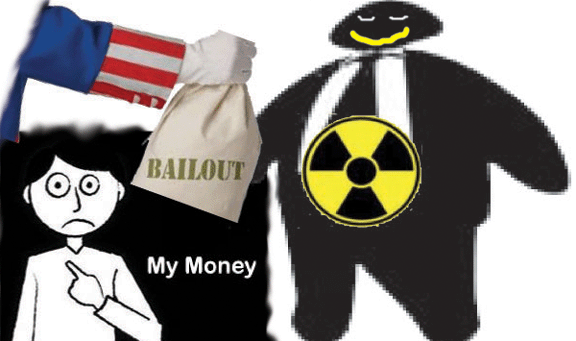 Exelon buys upstate New York nuclear plant http://thehill.com/policy/energy-environment/290879-exelon-buys-upstate-new-york-nuclear-plant Exelon Generation has agreed to buy an upstate New York nuclear power plant that seemed on the verge of closing just last year.
Entergy Corp. will sell its James A. FitzPatrick plant outside of Syracuse to Exelon for $110 million, officials announced on Tuesday. The companies expect regulatory approval by early next year, when Exelon plans to refuel the plant.
In a statement, Exelon President and CEO Chris Crane specifically thanked New York Gov.Andrew Cuomo (D) for his work on the Clean Energy Standard.
“We look forward to bringing Fitzpatrick’s highly-skilled team of professionals into the Exelon Generation nuclear program, and to continue delivering to New York the environmental, economic and grid reliability benefits of this important energy asset,” Crane said.
In a statement announcing the deal Tuesday, Cuomo said the deal is important for both the local economy and the state’s environmental policies.
“This state needs a clean energy policy that is realistic and can be implemented before we destroy this planet and I believe that nuclear plays an important rule in that clean energy policy,” he said, according to a video of his speech from the Syracuse Post-Standard. Entergy in November said it would be forced to close the 838-megawatt FitzPatrick plant by 2017, citing cheap natural gas and state policies that made nuclear plants expensive to operate.
Officials and the nuclear industry had looked for ways to keep the plant operating. The state’s Public Service Commission last week approved a clean energy standard requiring half the state’s electricity to come from renewable sources by 2030, and provided $1 billion over two years to subsidize FitzPatrick and two other nuclear plants in the state.
Exelon and Entergy have been negotiating a potential sale of the plant since last year. Regulatory agencies — including the Public Service Commission and the federal Nuclear Regulatory Commission — still need to sign off on the deal.
Policies of the American Presidential Candidates on the Nuclear Weapons Madness
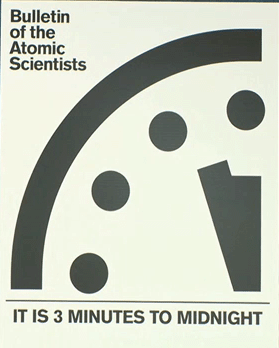 Hiroshima, Presidential Campaigns and Our Nuclear Future Common Dreams, by Robert Dodge, August 06, 2016 “………… the Bulletin of Atomic Scientists has
  moved their Atomic Doomsday Clock representing the apocalyptic countdown to nuclear annihilation to three minutes till midnight. This is the closest it has been since 1953 at the height of the Cold War after the first hydrogen bomb was exploded.
Our quadrennial presidential campaign, either unaware of the current scientific evidence on the heightened risk on the use of nuclear weapons or not caring in presenting a false veil of strength has brought the full spectrum of response to the issue of nuclear weapons.
Candidate Trump has suggested that since we have nuclear weapons he would consider using them in Europe and elsewhere and that he is okay with an arms race in Asia.
Candidate Clinton has indicated she would continue the current policies of the Obama Administration with its trillion dollar buildup.
Only former candidate Sanders proposed working to eliminate nuclear weapons, cancelling the trillion dollar funding of the new arms race and supporting the congressional S.A.N.E., Smarter Approach to Nuclear Expenditures act to reduce nuclear spending by $100 billion over the next 10 years.
President Obama also has an opportunity to lead in the final months of his presidency by declaring a “no first use” policy by the United States and taking our weapons off of hair trigger alert. These symbolic moves would send a signal to the world and provide an opportunity for our next president to build upon in realizing a world without nuclear weapons.
The ongoing existence of nuclear weapons is no longer a political issue, either Democratic or Republican; it is a survival issue. When the leaders refuse to lead, then the people must act…….http://www.commondreams.org/views/2016/08/06/hiroshima-presidential-campaigns-and-our-nuclear-future
The Military Industrial Complex – death merchant of the world
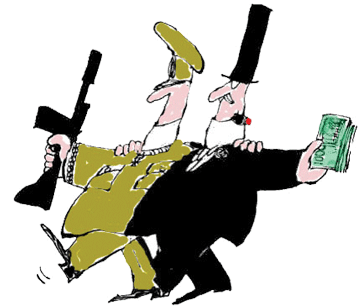 “We are the death merchant of the world”: Ex-Bush official Lawrence Wilkerson condemns military-industrial complex http://www.salon.com/2016/03/29/we_are_the_death_merchant_of_the_world_ex_bush_official_lawrence_wilkerson_condemns_military_industrial_complex/ The military-industrial complex “is much more pernicious than Eisenhower ever thought,” says the retired US colonel BEN NORTON Col. Lawrence Wilkerson is tired of “the corporate interests that we go abroad to slay monsters for.”
“I think Smedley Butler was onto something,” explained Lawrence Wilkerson, in an extended interview with Salon.
In his day, in the early 20th century, Butler was the highest ranked and most honored official in the history of the U.S. Marine Corps. He helped lead wars throughout the world over a series of decades, before later becoming a vociferous opponent of American imperialism, declaring “war is a racket.”
Wilkerson spoke highly of Butler, referencing the late general’s famous quote: “Looking back on it, I might have given Al Capone a few hints. The best he could do was to operate his racket in three districts. I operated on three continents.”
“I think the problem that Smedley identified, quite eloquently actually,” Wilkerson said, “especially for a Marine — I had to say that as a soldier,” the retired Army colonel added with a laugh; “I think the problem is much deeper and more profound today, and much more subtle and sophisticated.”
Today, the military-industrial complex “is much more pernicious than Eisenhower ever thought it would be,” Wilkerson warned. In his farewell address in 1961, former President Dwight D. Eisenhower famously cautioned Americans that the military and corporate interests were increasingly working together, contrary to the best interests of the citizenry. He called this phenomenon the military-industrial complex.
As a case study of how the contemporary military-industrial complex works, Wilkerson pointed to leading weapons corporations like Lockheed Martin, and their work with draconian, repressive Western-allied regimes in the Gulf, or in inflaming tensions in Korea.
“Was Bill Clinton’s expansion of NATO — after George H. W. Bush and [his Secretary of State] James Baker had assured Gorbachev and then Yeltsin that we wouldn’t go an inch further east — was this for Lockheed Martin, and Raytheon, and Boeing, and others, to increase their network of potential weapon sales?” Wilkerson asked.
“You bet it was,” he answered.
“Is there a penchant on behalf of the Congress to bless the use of force more often than not because of the constituencies they have and the money they get from the defense contractors?” Wilkerson continued.
Again, he answered his own question: “You bet.”
“It’s not like Dick Cheney or someone like that went and said let’s have a war because we want to make money for Halliburton, but it is a pernicious on decision-making,” the former Bush official explained. “And the fact that they donate so much money to congressional elections and to PACs and so forth is another pernicious influence.”
“Those who deny this are just being utterly naive, or they are complicit too,” Wilkerson added.
“And some of my best friends work for Lockheed Martin,” along with Raytheon, Boeing and Halliburton, he quipped.
Wilkerson — who in the same interview with Salon defended Edward Snowden, saying the whistle-blower performed an important service and did not endanger U.S. national security — was also intensely critical of the growing movement to “privatize public functions, like prisons.”
“I fault us Republicans for this majorly,” he confessed — although a good many prominent Democrats have also jumped on the neoliberal bandwagon. In a 2011 speech, for instance, Secretary of State Hillary Clinton declared, “It’s time for the United States to start thinking of Iraq as a business opportunity” for U.S. corporations.
Wilkerson lamented, “We’ve privatized the ultimate public function: war.”
“In many respects it is now private interests that benefit most from our use of military force,” he continued. “Whether it’s private security contractors, that are still all over Iraq or Afghanistan, or it’s the bigger-known defense contractors, like the number one in the world, Lockheed Martin.”
Journalist Antony Loewenstein detailed how the U.S. privatized its wars in Iraq and Afghanistan in another interview with Salon. There are an estimated 30,000 military contractors working for the Pentagon in Afghanistan today; they outnumber U.S. troops three-to-one. Thousands more are in Iraq.
Lockheed Martin simply “plans to sell every aspect of missile defense that it can,” regardless of whether it is needed, Wilkerson said. And what is best to maximize corporate interest is by no means necessarily the same as what is best for average citizens.
“We dwarf the Russians or anyone else who sells weapons in the world,” the retired Army colonel continued.
“We are the death merchant of the world.”
UK govt accidentally published list of preferred bidders for funding for Small Modular Nuclear Reactors
 Chinese firm with military ties invited to bid for role in UK’s nuclear future
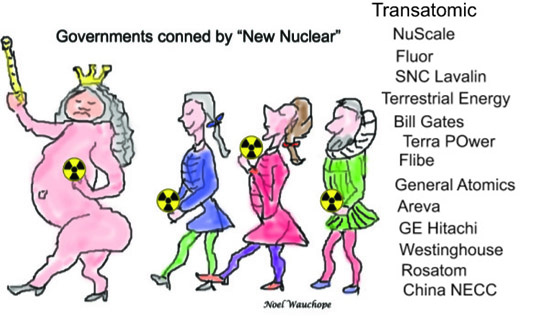
China National Nuclear Corporation on government list of preferred bidders for development funding for next-generation modular reactors, Guardian, Adam Vaughan, 8 Aug 16“……….The list of companies accepted for the competition was published briefly, apparently accidentally, on the website of the new Department for Business, Energy and Industrial Strategy on Friday before being deleted. It reads as a who’s-who of US, British, Japanese and Chinese industry players hoping to develop and build small modular reactors. These are much smaller than conventional nuclear plants with a capacity of less than 300MW – or a 10th of what Hinkley Point C should provide.
They are pitched by industry as a cheaper and quicker way to provide low-carbon energy capacity than conventional big nuclear plants because they could be built in a factory and transported to where their power is needed. The US and UK are racing to be the most attractive home for the first of the new designs to be commissioned.
Last November, George Osbornepromised £250m over five years for a nuclear research and development programme to “revive the UK’s nuclear expertise and position the UK as a global leader in innovative nuclear technologies”. An undisclosed amount of that sum is for a competition to find the best value SMR design for the UK, to “pave the way” towards building one in the UK in the 2020s.
CNNC sits alongside US companies such as NuScale; British ones including Rolls-Royce, Sheffield Forgemasters and Tokamak Energy; Japanese-owned Westinghouse; and the US-Japanese partnership GE-Hitachi, as participants the government considers eligible for phase one of its competition.
CNNC’s chief designer of small nuclear plants visited a conference in London last year to pitch a plan for cooperating with UK industry, and is already partnering with Rolls-Royce. It hopes to build the first SMR in the UK, with future ones sold around the world.
NuScale Power put itself forward for the competition in the spring. Its design, said its managing director, Tom Mundy, “answers the particular needs of the UK’s energy market and the wider UK economy, and we intend to participate fully in the government’s competition”.
The 33 participants will be whittled down in several phases, with the announcement of the eventual winners scheduled for late 2017……
When asked about the list published on Friday, a spokeswoman for the Department of Business, Energy and Industrial Strategy, said: “In March 2016, the government launched the first phase of a competition to identify the best value SMR for the UK. The ambition is to create an opportunity for the UK to become a world leader in SMRs.
“Those companies which are eligible to participate in the competition have been aware for over two months.” https://www.theguardian.com/environment/2016/aug/07/chinese-firm-with-military-ties-invited-to-bid-for-role-in-uks-nuclear-future
Consumer-funded nuclear bail out will have an unprecedented impact on the nuclear power industry
Impacts of NY’s Nuclear Power ‘Bail Out’ and Solar, Wind Boost, Epoch Times, By Tara MacIsaac, Epoch Times | August 3, 2016
It includes what has been called a consumer-funded bail out of upstate New York’s struggling nuclear power plants.
Nuclear energy is treated in the state’s plan as a bridge to a renewable energy future. The commission said nuclear is necessary to maintain stability in the power grid as New York makes the transition toward the standard’s goal of 50 percent renewable energy by 2030.
By subsidizing nuclear power alongside solar and wind, the state is making a bold statement about the value of nuclear reactors as zero-emission energy sources. This could ripple to other states, inspiring similar initiatives to revive the sputtering nuclear industry.
Impacts of the clean energy plan on the nuclear, solar, and wind industries will affect New Yorkers in many ways………
How It Works
Electricity providers will be required to obtain a targeted number of renewable energy credits (RECs) and zero-emissions credits (ZECs) each year.
A REC is created each time 1 megawatt-hour (MWh) of electricity is generated by a renewable resource. RECs can then be sold and traded among providers. ZECs, on the other hand, are related solely to the nuclear plants. These credits are created when zero-emission nuclear power is generated.
So the state awards ZECs to the nuclear companies, which the energy providers must buy from them. The costs of the ZECs that electricity providers purchase will be passed on to the consumer, baked into the supply charges on consumers’ bills.
How It Will Affect Consumers
The nuclear industry is having trouble competing with low natural gas prices. ZECs essentially force state residents and businesses to pay above-market rates for nuclear energy.
But the governor’s office and Public Service Commission Chair Audrey Zibelman suggested a back door may be opened for New Yorkers opposed to supporting nuclear energy.
A press release from Cuomo’s office stated that consumers may be offered a 100 percent renewable energy option. The idea is that consumer demand for 100 percent renewable energy could naturally encourage the development of new renewable energy facilities.
“If it does that,” Zibelman said at the commission hearing on Aug. 1, “then I think it’s fair to say to those customers, if you truly don’t want to buy nuclear, we will allow you not to be required to contribute to that program.
“We’re asking staff to look at that and we’ll see how we can make that happen.”
In addition to providing various options for consumers, Zibelman said clear labeling will be important. “What I would like to know, as a consumer, [is] that if I’m … buying what is a ‘green product’ … are those megawatts really green,” she said. If it’s only 50 percent renewable, for example, the consumer will be told so in clear terms……..http://www.theepochtimes.com/n3/2130861-impacts-of-nys-nuclear-power-bail-out-and-solar-wind-boost/
The power to order a nuclear strike
 Debate Over Trump’s Fitness Raises Issue of Checks on Nuclear Power, NYT By WILLIAM J. BROAD and DAVID E. SANGER AUG. 4, 2016 Hillary Clinton has fueled a debate over whether her rival for the presidency, Donald J. Trump, is fit to command America’s atomic forces. “Imagine him in the Oval Office facing a real crisis,” she said in her address at the Democratic convention last week. “A man you can bait with a tweet is not a man we can trust with nuclear weapons.”
The short answer is no, though history suggests that in practice, there may be ways to slow down or even derail the decision-making process. No one disputes, however, that the president has an awesome authority.
The commander in chief can also order the first use of nuclear weapons even if the United States is not under nuclear attack.
“There’s no veto once the president has ordered a strike,” said Franklin C. Miller, a nuclear specialist who held White House and Defense Department posts for 31 years before leaving government service in 2005. “The president and only the president has the authority to order the use of nuclear weapons.”Washington keeps details of the nuclear chain of command and its workings secret. The spokesman for the National Security Council, Ned Price, refused to say whether any other member of the chain of command could stop a presidential order to use nuclear weapons………..
rather a vast complex of rules and equipment, including careful procedures for the military to authenticate th
e identity of the commander in chief. The president’s emergency satchel — a black briefcase full of war plans, authentication codes and communication devices — follows him (or her) just about everywhere, carried by an aide trained in the procedures.
The president’s authority over nuclear decision-making challenges the Constitution’s clear declaration that only Congress holds the power to declare war. In practice, the arrival of the nuclear age dismantled the traditional rules by rewriting the timelines of war. It would take 12 minutes or less for weapons fired from submarines to reach Washington, and 30 minutes for warheads from most intercontinental missiles. Bombs dropped by aircraft, if they could pierce the country’s air defenses, would take only hours.
As a result, Congress began delegating the powers of nuclear war-fighting to the president, starting with Harry S. Truman — the only president who has ever ordered a nuclear strike against another nation.
….In practice, the arrival of the nuclear age dismantled the traditional rules by rewriting the timelines of war. It would take 12 minutes or less for weapons fired from submarines to reach Washington, and 30 minutes for warheads from most intercontinental missiles. Bombs dropped by aircraft, if they could pierce the country’s air defenses, would take only hours……..http://www.nytimes.com/2016/08/05/science/donald-trump-nuclear-c
The mindless media bashing of Donald Trump is a dangerous mistake
The Danger of Excessive Trump Bashing http://readersupportednews.org/opinion2/277-75/38405-the-danger-of-excessive-trump-bashing , Consortium News 04 August 16
 The prospect of Donald Trump in the White House alarms many people but bashing him over his contrarian views on NATO and U.S.-Russian relations could set the stage for disasters under President Hillary Clinton, writes Robert Parry. Widespread disdain for Donald Trump and the fear of what his presidency might mean have led to an abandonment of any sense of objectivity by many Trump opponents and, most notably, the mainstream U.S. news media. If Trump is for something, it must be bad and must be transformed into one more club to use for hobbling his candidacy.
While that attitude may be understandable given Trump’s frequently feckless and often offensive behavior – he seems not to know basic facts and insults large swaths of the world’s population – this Trump bashing also has dangerous implications because some of his ideas deserve serious debate rather than blanket dismissal.
Amid his incoherence and insults, Trump has raised valid points on several important questions, such as the risks involved in the voracious expansion of NATO up to Russia’s borders and the wisdom of demonizing Russia and its internally popular President Vladimir Putin.
Over the past several years, Washington’s neocon-dominated foreign policy establishment has pushed a stunning policy of destabilizing nuclear-armed Russia in pursuit of a “regime change” in Moscow. This existentially risky strategy has taken shape with minimal substantive debate behind a “group think” driven by anti-Russian and anti-Putin propaganda. (All we hear is what’s wrong with Putin and Russia: He doesn’t wear a shirt! He’s the new Hitler! Putin and Trump have a bro-mance! Russian aggression! Their athletes cheat!)
Much as happened in the run-up to the disastrous Iraq War in 2002-2003, the neocons and their “liberal interventionist” allies bully from the public square anyone who doesn’t share these views. Any effort to put Russia’s behavior in context makes you a “Putin apologist,” just like questioning the Iraq-WMD certainty of last decade made you a “Saddam apologist.”
But this new mindlessness – now justified in part to block Trump’s path to the White House – could very well set the stage for a catastrophic escalation of big-power tensions under a Hillary Clinton presidency. Former Secretary of State Clinton has already surrounded herself with neocons and liberal hawks who favor expanding the war against Syria’s government, want to ratchet up tensions with Iran, and favor shipping arms to the right-wing and virulently anti-Russian regime in Ukraine, which came to power in a 2014 coup supported by U.S. policymakers and money.
By lumping Trump’s few reasonable points together with his nonsensical comments – and making anti-Russian propaganda the only basis for any public debate – Democrats and the anti-Trump press are pushing the United States toward a conflict with Russia.
And, for a U.S. press corps that prides itself on its “objectivity,” this blatantly biased approach toward a nominee of a major political party is remarkably unprofessional. But the principle of objectivity has been long since abandoned as the mainstream U.S. media transformed itself into little more than an outlet for U.S. government foreign-policy narratives, no matter how dishonest or implausible.
Losing History
To conform with the neocon-driven narratives, much recent history has been lost. For instance, few Americans realize that some of President Barack Obama’s most notable foreign policy achievements resulted from cooperation with Putin and Russia, arguably more so than any other “friendly” leader or “allied” nation.
For instance, in summer 2013, Obama was under intense neocon/liberal-hawk pressure to bomb the Syrian military supposedly for crossing his “red line” against the use of chemical weapons after a mysterious sarin gas attack outside Damascus on Aug. 21, 2103.
Yet, hearing doubts from the U.S. intelligence community about the Assad regime’s guilt, Obama balked at a military strike that – we now know – would have played into the hands of Syrian jihadists who some intelligence analysts believe were the ones behind the false-flag sarin attack to trick the United States into directly intervening in the civil war on their side.
But Obama still needed a path out of the corner that he had painted himself into and it was provided by Putin and Russia pressuring Assad to surrender all his chemical weapons, a clear victory for Obama regardless of who was behind the sarin attack.
Putin and Russia helped Obama again in convincing Iran to accept tight restraints on its nuclear program, an agreement that may mark Obama’s most significant foreign policy success. Those negotiations came to life in 2013 (not coincidentally after Secretary of State Clinton, who allied herself more with the bomb-bomb-bomb Iran faction led by Israeli Prime Minister Benjamin Netanyahu, had resigned and was replaced by John Kerry).
As the negotiating process evolved, Russia played a key role in bringing Iran along, offering ways for Iran to rid itself of its processed nuclear stockpiles and get the medical research materials it needed. Without the assistance of Putin and his Foreign Minister Sergei Lavrov, the landmark Iranian nuclear deal might never have happened.
Obama recognized the value of this Russian help but he also understood the political price that he would pay if he were closely associated with Putin, who was already undergoing a thorough demonization in the U.S. and European mainstream media. So, Obama mostly worked with Putin under the table while joining in the ostracism of Putin above the table.
Checking Obama
But Washington’s neocon-dominated foreign policy establishment – and its allied mainstream media – check-mated Obama’s double-talking game in 2013 by aggressively supporting a regime-change strategy in Ukraine where pro-Russian elected President Viktor Yanukovych was under mounting pressure from western Ukrainians who wanted closer ties to Europe and who hated Russia.
Leading neocon thinkers unveiled their new Ukraine strategy shortly after Putin helped scuttle their dreams for a major bombing campaign against Assad’s regime in Syria. Since the 1990s, the neocons had targeted the Assad dynasty – along with Saddam Hussein’s government in Iraq and the Shiite-controlled government in Iran – for “regime change.” The neocons got their way in Iraq in 2003 but their program stalled because of the disastrous Iraq War.
However, in 2013, the neocons saw their path forward open again in Syria, especially after the sarin attack, which killed hundreds of civilians and was blamed on Assad in a media-driven rush to judgment. Obama’s hesitancy to strike and then Putin’s assistance in giving Obama a way out left the neocons furious. They began to recognize the need to remove Putin if they were to proceed with their Mideast “regime change” dreams.
In late September 2013 – a month after Obama ditched the plans to bomb Syria – neocon National Endowment for Democracy president Carl Gershman wrote in The Washington Post that Ukraine was now “the biggest prize” but also was a steppingstone toward the even bigger “regime change” prize in Moscow. Gershman, whose NED is funded by Congress, wrote:
“Ukraine’s choice to join Europe will accelerate the demise of the ideology of Russian imperialism that Putin represents. Russians, too, face a choice, and Putin may find himself on the losing end not just in the near abroad but within Russia itself.”
By late 2013 and early 2014, with Gershman’s NED financing Ukraine’s anti-government activists and journalists and with the open encouragement of neocon Assistant Secretary of State for European Affairs Victoria Nuland and Sen. John McCain, the prospects for “regime change” in Ukraine were brightening. With neo-Nazi and other Ukrainian ultra-nationalists firebombing police, the political crisis in Kiev deepened.
Meanwhile, Putin was focused on the Sochi Winter Olympics and the threat that the games could be disrupted by terrorism. So, with the Kremlin distracted, Ukraine’s Yanukovych tried to fend off his political crisis while limiting the violence.
However, on Feb. 20, 2014, snipers fired on both police and protesters in the Maidan square and the Western media jumped to the conclusion that Yanukovych was responsible (even though later investigations have indicated that the sniper attack was more likely carried out by neo-Nazi groups to provoke the chaos that followed).
A Successful Coup
On Feb. 21, a shaken Yanukovych agreed to a European-brokered deal in which he surrendered some of his powers and agreed to early elections. He also succumbed to Western pressure that he pull back his police. However, on Feb. 22, the neo-Nazis and other militants seized on that opening to take over government buildings and force Yanukovych and other officials to flee for their lives.
The U.S. State Department and its Western allies quickly recognized the coup regime as the “legitimate” government of Ukraine. But the coup provoked resistance from the ethnic Russian populations in Crimea and eastern Ukraine, political uprisings that the new Kiev regime denounced as “terrorist” and countered with an “Anti-Terrorism Operation” or ATO.
When Russian troops – already in Crimea as part of the Sevastopol naval basing agreement – protected the people on the peninsula from attacks by the Ukrainian ultra-nationalists, the intervention was denounced in the West as a “Russian invasion.” Crimean authorities also organized a referendum in which more than 80 percent of the voters participated and favored leaving Ukraine and rejoining Russia by a 96 percent margin. When Moscow agreed, that became “Russian aggression.”
Although the Kremlin refused appeals from eastern Ukraine for a similar arrangement, Russia provided some assistance to the rebels resisting the new authorities in Ukraine. Those rebels then declared their own autonomous republics.
Although this historical reality – if understood by the American people – would put the Ukrainian crisis in a very different context, it has been effectively blacked out of what the American public is allowed to hear. All the mainstream media talks about is “Russian aggression” and how Putin provoked the Ukraine crisis as part of some Hitlerian plan to conquer Europe.
Trump, in his bumbling way, tries to reference the real history to explain his contrarian views regarding Russia, Ukraine and NATO, but he is confronted by a solid wall of “group think” asserting only one acceptable way to see this complex crisis. Rather than allow a serious debate on these very serious issues, the mainstream U.S. media simply laughs at Trump’s supposed ignorance.
The grave danger from this media behavior is that it will empower the neocons and liberal hawks already nesting inside Hillary Clinton’s campaign to prepare for a new series of geopolitical provocations once Clinton takes office. By opportunistically buying into this neocon pro-war narrative now, Democrats may find themselves with buyer’s remorse as they become the war party of 2017.
Investigative reporter Robert Parry broke many of the Iran-Contra stories for The Associated Press and Newsweek in the 1980s. You can buy his latest book, America’s Stolen Narrative, either in print here or as an e-book (from Amazon and barnesandnoble.com).
Nuclear industry revs up for a new political lobbying campaign
Nuclear trade group shakes up leadership http://thehill.com/policy/energy-environment/290405-nuclear-trade-group-shakes-up-leadership By Timothy Cama – 08/04/16
The nuclear power industry’s Washington trade group is shaking up its leadership and consolidating numerous executive positions.
The Nuclear Energy Institute (NEI) said Thursday that it’s consolidating its governmental affairs, communications and policy offices into one operation.
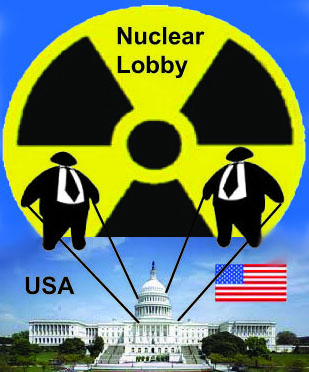
The moves come at a pivotal time for the nuclear industry, when many of the fewer than 100 reactors in the country are closing due to increasing costs and competition from cheap natural gas and only a small handful of new plants are being constructed or even planned.
“The nuclear energy industry is facing one of the most transformational periods in its history. Additionally, 2017 and 2018 lie ahead as a critical window for us,” Marvin Fertel, NEI’s president, said in a statement.
“The new presidential administration will be in place, providing a valuable opportunity to change the dialogue on the importance of nuclear energy to our economic and environmental goals. Given the change in leadership and looking at this pivotal period for our industry, we are acting now to better position NEI to have enduring impact in the political and policy arena.”
Fertel himself is retiring at the end of the year.
The shakeup is happening as the industry has a number of important matters on which they are pressing lawmakers to act. The industry’s congressional allies are expected next year to make a new push to enact nuclear waste legislation that could lead to construction of the Yucca Mountain waste site in Nevada, along with short-term disposal areas.
The industry is also pushing for renewal of a tax credit for newly built nuclear plants that has not yet been used.
The NEI spent about $2.35 million in federal lobbying last year, according to disclosures it provided to Congress.
President Obama pushes for UN call to end nuclear weapons testing, by-passes Congress
 Obama will bypass Congress, seek U.N. resolution on nuclear testing, WP, By Josh Rogin August 4 President Obama has decided to seek a new United Nations Security Council resolution that would call for an end to nuclear testing, a move that leading lawmakers are calling an end run around Congress.
Top administration officials, including Energy Secretary Ernest Moniz, briefed lawmakers and congressional staffers this week about President Obama’s decision to push for the U.N. action this September, to coincide with the 20th anniversary of the Comprehensive Test Ban Treaty, which was adopted in September 1996 but was never ratified by the Senate.
National Security Council spokesperson Ned Price told me that the administration still would like to see the Senate ratify the test ban treaty but is “looking at possible action in the UN Security Council that would call on states not to test and support the CTBT’s objectives. We will continue to explore ways to achieve this goal, being careful to protect the Senate’s constitutional role.”
The administration did not consult Congress before making the decision, and leading Republicans, including those who opposed Obama’s nuclear deal with Iran, are irate that the White House plans another major national security move without their advice or consent……..
The Obama administration has tried for years without success to build Senate support for ratifying the Comprehensive Test Ban Treaty, which has been ratified by 164 countries. The Clinton administration signed the treaty, but the Senate refused to ratify it in 1999. There’s no chance that the current Republican-led Senate would ratify it before Obama leaves office…….
Several lawmakers and staffers acknowledged that another congressional effort to stop Obama’s new U.N. plan would have little chance of success, especially because of the distractions of the election season and the shortage of days lawmakers are in session this fall………
The president’s push for U.N. action on nuclear testing came after months of debate inside his administration over how to advance his nuclear non-proliferation agenda. The president decided to move forward with this item after meeting with his entire National Security Council at the White House. Other nuclear policy changes could be decided and announced in the coming months. https://www.washingtonpost.com/news/josh-rogin/wp/2016/08/04/obama-will-bypass-congress-seek-u-n-resolution-on-nuclear-testing/
Hinkley Nuclear Project : A dramatic turn of events
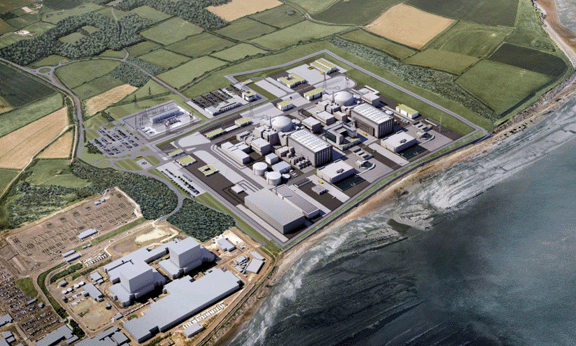
Nu Clear News No 87 5 Aug 16 Hinkley : A dramatic turn of events It has now been a few days since the Government shocked the energy industry by announcing a further review of the Hinkley Point C nuclear power station just a few hours after EDF approved the project.
Although we may never know exactly what has gone on behind the scenes it is clear that EDF had moved its final investment decision forward from September in order to bounce the new UK Government into giving its approval quickly before mounting problems become even more obvious to everyone.
Stop Hinkley spokesperson, Roy Pumfrey said
Much of the media seems to think this is just a temporary pause and that Hinkley Point C will eventually go ahead, but if Theresa May gives this scheme just a cursory glance she will see that we are being asked to buy a pig in a poke.
According to the Financial Times (2) the head of EDF, Jean-Bernard Lévy gave his fellow board members only two days to read 2,500 pages of contracts for a deal which one investment analyst described as “verging on insanity”.
The decision to review the project has been attributed by some to security concerns about Chinese involvement in the sector expressed by Mrs May’s chief of staff, Nick Timothy. The Stop Hinkley Campaign has itself expressed concerns in the past about making nuclear deals with a country with such a poor health and safety record.
Writing on the Conservative Home website last October Timothy said the Hinkley deal could lead to the Chinese designing and constructing a third nuclear reactor at Bradwell in Essex. Security experts – reportedly inside as well as outside government – are worried that the Chinese could use their role to build weaknesses into computer systems which will allow them to shut down Britain’s energy production at will. (5) For those who believe that such an eventuality is unlikely, the Chinese National Nuclear Corporation – one of the state-owned companies involved in the plans for the British nuclear plants – says on its website that it is responsible not just for “increasing the value of state assets and developing the society” but the “building of national defence.” MI5 believes that “the intelligence services of…China…continue to work against UK interests at home and abroad.”
Mandiant, a US company that investigates computer security breaches around the world, looked into the operations of just one Chinese cyber espionage group, believed to be the Second Bureau of the People’s Liberation Army of China, or ‘Unit 61398’. Mandiant found that Unit 61398 has compromised 141 different companies in twenty major industries.
There were 115 victims in the United States and five in the UK. The intellectual property stolen included technology blueprints, manufacturing processes, test results, business plans, pricing documents, partnership agreements, and emails and contact information. Timothy said
evidence like this makes it all the more baffling that the British Government has been so welcoming to Chinese stateowned companies in sensitive sectors. The Government, however, seems intent on ignoring the evidence and presumably the advice of the security and intelligence agencies. But no amount of trade and investment should justify allowing a hostile state easy access to the country’s critical national infrastructure. Of course we should seek to trade with countries right across the world – but not when doing business comes at the expense of Britain’s own national security. http://www.no2nuclearpower.org.uk/nuclearnews/NuClearNewsNo87.pdf
New York State Public Service Commission’s $7.6 billion bailout of uneconomic nuclear power plants
New York Approves $7.6 Billion Bailout Of Nuclear Power Plants, Huffington Post 08/03/2016 Karl Grossman Investigative reporter
The New York State Public Service Commission—in the face of strong opposition—this week approved a $7.6 billion bailout of aging nuclear power plants in upstate New York which their owners have said are uneconomic to run without government support.
New York Governor Andrew Cuomo—who appoints the members of the PSC—has called for the continued operation of the nuclear plants in order to, he says, save jobs at them. The bailout would be part of a “Clean Energy Standard” advanced by Cuomo. Under it, 50 percent of electricity used in New York by 2030 would come from “clean and renewable energy sources”—with nuclear power considered clean and renewable.
“Nuclear energy is neither clean nor renewable,” testified Pauline Salotti, vice chair of the Green Party of Suffolk County, Long Island at a recent hearing on the plan.
“Without these subsidies, nuclear plants cannot compete with renewable energy and will close. But under the guise of ‘clean energy,’ the nuclear industry is about to get its hands on our money in order to save its own profits, at the expense of public health and safety,” declared a statement by Jessica Azulay, program director of Alliance for a Green Economy, based in upstate Syracuse with a chapter in New York City. Moreover, she emphasized, “Every dollar spent on nuclear subsidies is a dollar out of the pocket of New York’s electricity consumers—residents, businesses and municipalities” that should “instead” go towards backing “energy efficiency, renewable energy and a transition to a clean energy economy.”
The “Clean Energy Standard” earmarks twice as much money for the nuclear power subsidy than it does for renewable energy sources such as solar and wind…….
In opposing the New York nuclear subsidy, Dr. Mark Z. Jacobson, professor of civil and environmental engineering and director of the Atmosphere/Energy Program at Stanford University, wrote in an op-ed in Albany Times Union, the newspaper in the state’s capitol, that he was “shocked” by the PSC’s “proposal that the lion’s share of the Clean Energy Standard funding would be a nuclear bailout.” He said “allowing the upstate nuclear plants to close now and replace them with equal energy output” from offshore wind and solar power “would be cheaper and would create more jobs.” The closure of the upstate plants “would jeopardize fewer than 2,000 jobs” while a “peer-reviewed study” he has done “about converting New York State to 100 percent clean, renewable energy -which is entirely possible now—would create a net of approximately 82,000 good, long-term jobs.”
The upstate nuclear power plants to be bailed out under the plan would be FitzPatrick, Nine Mile Point 1 and 2 and Ginna. The money would come over a 12-year period through a surcharge on electric bills paid by residential and industrial customers in New York State…….
Reuters has reported that the nuclear “industry hopes that if New York succeeds, it could pressure other states to adopt similar subsides” for nuclear plants. The headline of the Reuters story: “New York could show the way to rescue U.S. nuclear plants.”
The two Indian Point nuclear power plants 26 miles north of New York City are not now included in the plan but it “leaves the door open to subsidies” for them, says Azulay of Alliance for a Green Economy. This would mean “the costs [of the bailout] will rise to over $10 billion.” ………http://www.huffingtonpost.com/karl-grossman/76-billion-bailout-of-ny-_b_11302708.html
Trump’s loose talk about nuclear weapons – not that far from USA’s official position
 Trump’s nuclear nightmare His loose talk on the ultimate weapon isn’t so different from official doctrine, but it plays into Clinton’s attacks on his temperament, nonetheless, Politico, By Michael Crowley 08/03/16 “…………Trump’s comments about nuclear weapons, which many experts call dangerously glib and uninformed, and which play into the Democratic strategy of portraying him as unfit to handle the nuclear codes.
California abandons nuclear power, New York does the opposite
 These two huge states are both going green. But only one is sticking with nuclear, WP
On Monday, though, New York — also a leader when it comes to greening power supplies — announced a very different route. The state’s Public Service Commission approved a Clean Energy Standard backed by Gov. Andrew Cuomo’s backed Clean Energy Standard. It seeks to get New York to 50 percent renewable electricity by the year 2030 — while also retaining the six nuclear reactors that currently provide more 30 percent of the state’s electricity. (These reactors would not count as part of the renewable 50 percent.)……….
many critics of nuclear energy persist, in the environmental community and elsewhere, and not all observers think New York necessarily made the right move.
“By not making them compete for a place in the low carbon portfolio, the state is almost assuring that the customers are going to pay more than they have to, and that some desirable alternative sources won’t get developed, because nuclear’s place in the picture is locked in,” said Peter Bradford, a former chair of the New York Public Service Commission and an adjunct professor at the Vermont Law School………
All sides will now watch how these two experiments — in New York, and California — play out. Nuclear provides a major stream of what is often termed “baseload” electricity, which is continuous and thus very different from wind and solar, which are much stronger at key times (solar, for instance, in the afternoon) and less available at others. Thus, integrating more wind and solar with less baseload, as California aims to do, presumably puts a greater emphasis on the use of energy efficiency measures (less electricity use over all), or energy storage (using electricity at a different time from when it is generated), to deal with these sources’ intermittency………https://www.washingtonpost.com/news/energy-environment/wp/2016/08/01/why-new-york-state-just-delivered-extremely-good-news-to-the-nuclear-industry/?utm_term=.20097475af56
Hinkley nuclear fiasco is a threat to French company EDF
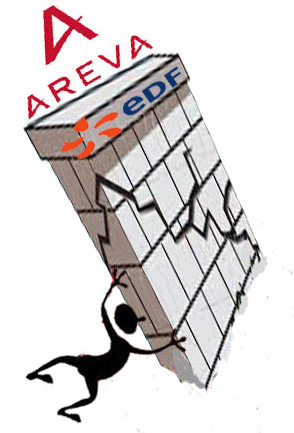 Nu Clear News No 87 5 Aug 16 EDF’s future threatened. Perhaps of more immediate concern is that a go-ahead for Hinkley could threaten the future of the company itself. EDF is a company in a very precarious financial situation. The ratings agency, S&P, postponed a decision to downgrade its credit rating when the UK Government announced the review. (7) EDF has €37 billion of debt. The collapse in energy prices has pushed earnings down 68% in 2015. The Company needs to spend €50 billion upgrading its network of 58 ageing reactors by 2025. It is scrambling to sell €4 billion of new shares and €10 billion of assets to strengthen its balance sheet. EDF is also expected to participate in the €5 billion bailout of Areva, the bankrupt developer of EPR technology, by taking a 75 per cent stake. (8) About the last thing it needs is a new €15 billion millstone around its neck.
Roy Pumfrey said “The EDF Board should take the opportunity presented by this pause to see that its Nuclear SatNav has taken the Company down a dead end; it’s only a matter of time before we hear that voice saying “At the next opportunity, turn round!”‘
He continues: “Perhaps most disappointing if not unexpected has been the reaction of the big UK Union leaders. Whilst confessing themselves ‘baffled’ by the government’s ‘bonkers’ decision, they should ask why the French union leaders representing EDF’s own workers were (and are) solidly and vocally opposed to HPC. This project involves a reactor which many of EDF’s own staff regard as unconstructable, selling off the family silver to fund it and putting EDF and therefore their own livelihoods at risk. UK unions do not seem to appreciate that the fantasy 25,000 jobs on HPC are a conjurer’s trick. Only 30% will be ‘local’, which means 90 minutes drive time from HPC, and with only 5,600 on site on any one day, a job with a particular skill set will only be good for two years at most. That’s assuming that
HPC can be built in an optimistic ten years, even that too long to keep the lights on.”
Over recent months several different alternative to building Hinkley Point C have been detailed (10) Most recently consultancy firm Utilitywise has described the proposed nuclear station as an “unnecessary expense” Energy efficiency measures could save the equivalent amount of electricity along with £12bn
Roy Pumfrey said: “This Government review of Hinkley Point C provides us with a wonderful opportunity to turn Somerset into a sustainable energy hub for England. The alternatives would be better for jobs, better for consumers, would reduce the mountain of dangerous waste we don’t know how to deal with and save Somerset from a decade of disruption caused by one of the biggest construction projects in the world The sooner EDF and the UK Government come to their senses the better. http://www.no2nuclearpower.org.uk/nuclearnews/NuClearNewsNo87.pdf
1 This Month
15 October. Joint Appeal for Nuclear Abolition Day -presentation to the UN on October 15 will be live on UNWebTV
Endorse the Nuclear Abolition Day Appeal
23-25 October – on Zoom – World BEYOND War’s annual global conference

To see nuclear-related stories in greater depth and intensity – go to https://nuclearinformation.wordpress.com
-
Archives
- October 2026 (149)
- September 2026 (339)
- August 2026 (330)
- July 2026 (355)
- June 2026 (287)
- May 2026 (306)
- April 2026 (356)
- March 2026 (251)
- February 2026 (267)
- January 2026 (308)
- December 2025 (358)
- November 2025 (359)
-
Categories
- 1
- 1 NUCLEAR ISSUES
- business and costs
- climate change
- culture and arts
- ENERGY
- environment
- health
- history
- indigenous issues
- Legal
- marketing of nuclear
- media
- opposition to nuclear
- PERSONAL STORIES
- politics
- politics international
- Religion and ethics
- safety
- secrets,lies and civil liberties
- spinbuster
- technology
- Uranium
- wastes
- weapons and war
- Women
- 2 WORLD
- ACTION
- AFRICA
- Atrocities
- AUSTRALIA
- Christina's notes
- Christina's themes
- culture and arts
- Events
- Fuk 2022
- Fuk 2023
- Fukushima 2017
- Fukushima 2018
- fukushima 2019
- Fukushima 2020
- Fukushima 2021
- general
- global warming
- Humour (God we need it)
- Nuclear
- RARE EARTHS
- Reference
- resources – print
- Resources -audiovicual
- Weekly Newsletter
- World
- World Nuclear
- YouTube
-
RSS
Entries RSS
Comments RSS

