Reuters 12th May 2018 , Bulgaria’s government will ask parliament to give it the authority to
negotiate with investors to build the Belene nuclear power project on the
Danube River, the prime minister said on Saturday.
The Black Sea state initially canceled the project, estimated to cost about 10 billion euros,
in 2012 after failing to find foreign investors and bowing to U.S. and
European Union pressure to limit the country’s energy dependence on
Russia, which would have supplied some equipment.
The current government of Prime Minister Boyko Borissov, however, is renewing the search for private
investors to build the plant after an arbitration court ruled in 2016 that
Bulgaria must pay more than 600 million euros ($717 million) in
compensation to Russian state nuclear company Rosatom due to the
cancellation.
https://www.reuters.com/article/us-bulgaria-nuclear-belene/bulgarian-government-to-seek-mandate-for-talks-with-investors-over-nuclear-plant-idUSKCN1ID0TE
May 16, 2018
Posted by Christina Macpherson |
Bulgaria, business and costs, politics |
Leave a comment

 A nuclear deal with the Saudis is a good thing, says former GOP leader Eric Cantor
- Saudi Arabia has been in negotiations with the U.S. and other countries for several years in pursuit of a nuclear energy partnership, with the stated aim of diversifying its energy base.
- Riyadh has found a willing partner in the Trump administration, which has signaled far greater support for a deal than its predecessors.
- Months of escalating tensions between the kingdom and its regional arch-rival Iran have raised the stakes for any future nuclear plans.
Natasha Turak | ………For around five years now, the Saudis have been in informal negotiations with the U.S. and other countries that could sell it nuclear reactors, with the stated aim of diversifying its energy base. In February, the kingdom
recruited an American lobbying firm as an advisor on the legal issues surrounding developing a commercial nuclear program.
But what’s made many observers nervous is Riyadh’s refusal to accept a deal that would forbid it from enriching uranium and reprocessing plutonium — the mechanisms necessary not for nuclear energy, but for developing a weapon.
Saudis find support from Trump
Opposition from U.S. lawmakers on both sides of the political aisle has historically impeded the kingdom’s aims — Section 123 of the U.S. Atomic Energy Act of 1954 mandates that Congress review any sharing of nuclear technology with a foreign country.
Now, however, the Saudis have found a friendlier partner in the Trump administration, which has signaled far greater willingness to strike a deal than its predecessors.
A U.S. trade delegation visited the kingdom in April, led by the Washington-based Nuclear Energy Institute (NEI) and in partnership with the U.S. Departments of Commerce, Energy, and State. It brought with it 20 companies from across the U.S. nuclear supply chain, to promote “the strong interest of U.S. industry to partner in Saudi Arabia’s ambitious nuclear energy program,” according to the delegation’s press release.
……..Months of escalating tensions between Iran and its arch-rival Saudi Arabia raise the stakes for any future nuclear plans. In March, Saudi Crown Prince Mohammed bin Salman told CNBC news that if Tehran was to build a nuclear bomb, so would Riyadh.
U.S. lawmakers and non-proliferation experts have expressed their concern over dual-use technology, and Bin Salman’s unpredictable and aggressive foreign policy has not helped his country’s case……https://www.cnbc.com/2018/05/13/former-gop-leader-eric-cantor-supports-nuclear-deal-with-saudi-arabia.html
May 14, 2018
Posted by Christina Macpherson |
business and costs, politics, USA |
Leave a comment

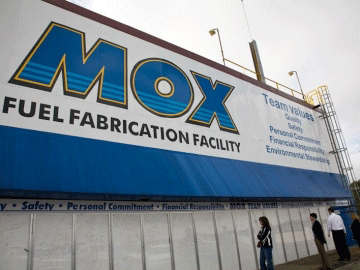
 Trump administration axes project to generate power from plutonium, Timothy Gardner, WASHINGTON (Reuters) 13 May 18 – The Trump administration plans to kill a project it says would have cost tens of billions of dollars to convert plutonium from Cold War-era nuclear bombs and burn it to generate electricity, according to a document it sent to Congress last week.
The Department of Energy submitted a document on May 10 to Senate and House of Representative committees saying that the Mixed Oxide (MOX) project at the Savannah River Site in South Carolina would cost about $48 billion more than $7.6 billion already spent on it. The United States has never built a MOX plant.
Instead of completing MOX, the administration, like the Obama administration before it, wants to blend the 34 tonnes of deadly plutonium – enough to make about 8,000 nuclear weapons – with an inert substance and bury it underground in a New Mexico’s Waste Isolation Pilot Plant (WIPP). Burying the plutonium would cost about $19.9 billion, according to the document, a copy of which was seen by Reuters.
“We are currently processing plutonium in South Carolina for shipment (to WIPP) … and intend to continue to do so,” Energy Secretary Rick Perry said in a letter sent to committee leaders.
Legislation passed in February allows the Energy Department to advance burying the plutonium if it showed that the cost would be less than half of completing MOX……..
Edwin Lyman, a physicist at science advisory group the Union of Concerned Scientists concerned about plutonium getting into the wrong hands, said Perry had made a sensible decision. “MOX was a slow-motion train wreck, and throwing good money after bad simply wasn’t an option.”
Reporting by Timothy Gardner; Editing by Lisa Shumaker https://www.reuters.com/article/us-usa-plutonium-mox/trump-administration-axes-project-to-generate-power-from-plutonium-idUSKCN1IE0LH
May 14, 2018
Posted by Christina Macpherson |
- plutonium, politics, reprocessing, USA |
Leave a comment

 Campaigners slam £1m incentive to store nuclear waste https://www.theguardian.com/environment/2018/may/12/incentive-compensation-nuclear-waste-boreholes-communities
Compensation offered to encourage local communities to allow test boreholes is described as ‘completely inadequate’
MPs from both major parties have attacked the government’s latest incentive to entice communities into volunteering to host Britain’s first deep underground store for nuclear waste as “completely inadequate”.
Ministers have offered up to £1m per community for areas that constructively engage in offering to take part in the scheme, and a further sum of up to £2.5m where deep borehole investigations take place.
The aim is to find a permanent underground geological disposal facility (GDF) that could store for thousands of years the waste from Britain’s nuclear energy and bomb-making programmes. The scheme could involve building stores under the seabed to house highly radioactive material. It is predicted that the UK is likely to have produced 4.9m tonnes of nuclear waste by 2125.
But critics say the inducements offered by the government – part of the consultations it launched this year – to ensure local cooperation are “simply not good enough”, and point to the example of France, which has a similar amount of nuclear waste. It offers around €30m (£26.5m) a year as local support for districts neighbouring the site at Bure, in north-east France, and has also offered €60m in community projects.
“The government’s offer in its consultation is simply not good enough. These communities are being asked to perform an important public service and should be properly recompensed,” said Rebecca Long-Bailey, the shadow business secretary.
However, local campaigners fear that a waste site could affect tourism, on which Cumbria is heavily reliant. “For the sake of a few hundred jobs and a few million pounds, we risk thousands of jobs in the tourism sector, which contributes £2.7bn a year to Cumbria’s economy,” said Geoff Betsworth, chairman of the Cumbria Trust. “Even a 10% dent in tourism would cost £270m a year. The offer of £1m in community benefits, rising to £2.5m when boreholes begin, is absurdly low.”
The government is seeking to dispose of the UK’s nuclear waste underground because current storage facilities are both ineffective and expensive to maintain. A GDF would involve sealing the waste in rock for as long as it remains a hazard.
 The plan was also criticised by the Conservative MP Zac Goldsmith, who said the UK should stop making nuclear waste and stop building new reactors.
“We are still pouring untold billions of taxpayer money into propping up an industry that the free market would have killed off years ago,” he said. “In return, we will be compounding the catastrophe of a nuclear waste build-up, which we are no closer to solving than we were when the industry was born.”
Nina Schrank, energy campaigner at Greenpeace UK, added: “The lack of seriousness with which the UK government treats nuclear legacy issues makes it predictable that their quest for a suitable site has been so unsuccessful that they are looking again at the Irish Sea, which Sellafield turned into one of the most radioactively contaminated seas in the world.”
A government spokesperson said: “The GDF will be a multibillion-pound project that can provide substantial benefits to host communities. This includes skilled employment for hundreds of people for decades to come, spin-off benefits such as infrastructure investment, as well as positive impacts on local service industries that support the facility and its workforce.”
May 14, 2018
Posted by Christina Macpherson |
politics, UK, wastes |
Leave a comment
 Dave Toke’s Blog 10th May 2018, A fake price for the faltering proposed Wylfa nuclear plant will obscure
the fact that the project, backed by Hitachi, will be even more expensive than Hinkley C. Negotiators for the Wylfa project are clamouring for the Government to use taxpayers money and a commitment to pay at least some of
the risks of construction cost overruns to massage the price of the deal
 down compared to Hinkley Point C.
If this is done, then the combined support for Hinkley C and Wylfa projects through loan guarantees, equity
support and risk underwriting could rival the size of bill the UK has to pay the EU for Brexit.
But a carefully contrived fake price produced by giving a massive taxpayer funded handout to the project will obscure this terrible consequence. Hinkley Point C (HPC), scheduled to be built by EDF, is now said to cost around £20 billion, almost exactly the same as the cost of the Hitachi-led Wylfa project.
In fact both of these figures do not appear to include interest charges, and so will be underestimates of the
total mount of money needed to be paid out before the plant is even built. But the interesting thing is that whilst the Hinkley C project is 3.2GW, the Wylfa project is smaller, at around 2.9 GW, which actually makes the Hitachi project even more expensive!
http://realfeed-intariffs.blogspot.co.uk/2018/05/hitachis-wylfa-project-is-even-more.html
May 12, 2018
Posted by Christina Macpherson |
business and costs, politics, UK |
Leave a comment
Nikkei Asian Review 11th May 2018 The British government has proposed to arrange all 2 trillion yen ($18.2
billion) in lending that Hitachi says is needed to build a nuclear power
plant in Wales, as the Japanese side seeks to reduce its risk and encourage
the U.K. to put more skin in the game.
London had previously suggested that it guarantee 1 trillion yen in lending, but to get the project moving it
changed its offer to include approaches such as direct financing in order
to reduce Hitachi’s financial exposure.
The plan also calls for a totalinvestment of 900 billion yen, with Hitachi as well as Japanese and British
public-private interests each taking a one-third stake, and guarantees for
corporate loans. The total cost of the plant, to be built on the Isle of
Anglesey, is expected to swell to 3 trillion yen.
Hitachi Chairman Hiroaki Nakanishi met with Prime Minister Theresa May in London last Thursday to
ask for greater backing. The original plan called for the loans to be
provided by private lending institutions from both countries and guaranteed
equally by each government. State funding would come at a lower cost than
borrowing from private institutions and would demonstrate the U.K.’s
increased involvement as a backer of Hitachi’s nuclear power business,
which would ease raising funds and help secure investors.
The offer reflects the U.K.’s strong desire to proceed with the project, since
bankruptcy could place a burden on British taxpayers. The U.K. government
will submit a formal proposal to the Japanese side soon. Hitachi will then
make a final decision on whether to continue with the project at a board
meeting at the end of the month.
Some at Hitachi and in Tokyo have expressed concern about Japanese interests retaining leadership of the
project with two-thirds control. Hitachi and the U.K. are thought to be
discussing ways to prevent Hitachi’s exposure risk from rising, such as by
raising London’s stake or issuing dual class shares. But the British
Parliament is likely to oppose expanding the government’s stake, which
could throw a wrench in the project’s final shareholding structure or
allocation of costs. Hitachi is also requesting that the electricity’s
purchase price be raised, but the U.K. is opposed. It hopes to satisfy
Hitachi by covering all loans and raising its stake in the project.
https://asia.nikkei.com/Business/Business-Deals/London-offers-18bn-in-loans-for-Hitachi-s-UK-nuclear-plant
May 12, 2018
Posted by Christina Macpherson |
business and costs, politics, UK |
Leave a comment

 What’s Not in NNSA’s Plutonium Pit Production Decision, Santa Fe, NM –May 10, 2018 Contact Jay Coghlan, Nuclear Watch NM, 505.989.7342, c. 505.470.3154, jay@nukewatch.org Scott Kovac, Nuclear Watch NM, 505.989.7342, scott@nukewatch.org
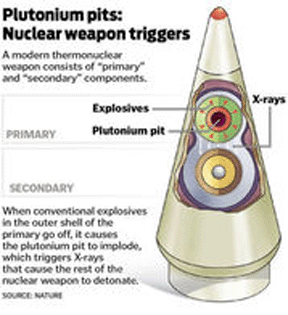
Today the National Nuclear Security Administration (NNSA) announced: To achieve DoD’s [the Defense Department] 80 pits per year requirement by 2030, NNSA’s recommended alternative repurposes the Mixed Oxide Fuel Fabrication Facility at the Savannah River Site in South Carolina to produce plutonium pits while also maximizing pit production activities at Los Alamos National Laboratory in New Mexico. This two-prong approach – with at least 50 pits per year produced at Savannah River and at least 30 pits per year at Los Alamos – is the best way to manage the cost, schedule, and risk of such a vital undertaking.
First, in Nuclear Watch’s view, this decision is in large part a political decision, designed to keep the congressional delegations of both New Mexico and South Carolina happy. New Mexico Senators Tom Udall and Martin Heinrich are adamantly against relocating plutonium pit production to South Carolina. On the other hand, South Carolina Senator Lindsay Graham was keeping the boondoggle Mixed Oxide (MOX) program on life support, and this pit production decision may help to mollify him. This could also perhaps help assuage the State of South Carolina, which is suing the Department of Energy for failing to remove plutonium from the Savannah River Site as promised.
But as important is what is NOT in NNSA’s plutonium pit production decision:
: • There is no explanation why the Department of Defense requires at least 80 pits per year, and no justification to the American taxpayer why the enormous expense of expanded production is necessary.
• NNSA avoided pointing out that expanded plutonium pit production is NOT needed to maintain the safety and reliability of the existing nuclear weapons stockpile. In fact, no production of plutonium pits for the existing stockpile has been scheduled since 2011, and none is scheduled for the future.
• NNSA did not mention that in 2006 independent experts found that pits last a least a century. Plutonium pits in the existing stockpile now average around 40 years old. The independent expert study did not find any end date for reliable pit lifetimes, indicating that plutonium pits could last far beyond just a century.
• NNSA did not mention that up to 15,000 “excess” pits are already stored at the Pantex Plant near Amarillo, TX, with up to another 5,000 in “strategic reserve.” The agency did not explain why new production is needed given that immense inventory of already existing plutonium pits.
• Related, NNSA did not explain how to dispose of all of that plutonium, given that the MOX program is an abysmal failure. Nor is it made clear where future plutonium wastes from expanded pit production will go since operations at the troubled Waste Isolation Pilot Plant are already constrained from a ruptured radioactive waste barrel, and its capacity is already overcommitted to existing radioactive wastes.
• NNSA did not make clear that expanded plutonium pit production is for a series of speculative future “Interoperable Warheads.” The first IW is meant to replace nuclear warheads for both the Air Force’s land-based and the Navy’s sub-launched ballistic missiles. The Obama Administration delayed “IW-1” because the Navy does not support it. However, the Trump Administration is restarting it, with annual funding ballooning to $448 million by 2023, and “IW-2” starting in that same year. Altogether the three planned Interoperable Warheads will cost at least $40 billion, despite the fact that the Navy doesn’t support them. 1
• NNSA’s expanded plutonium pit production decision did not mention that exact replicas of existing pits will NOT be produced. The agency has selected the W87 pit for the Interoperable Warhead, but its FY 2019 budget request repeatedly states that the pits will actually be “W87- like.” This could have serious potential consequences because any major modifications to plutonium pits cannot be full-scale tested, or alternatively could prompt the U.S. to return to nuclear weapons testing, which would have severe international proliferation consequences.
• The State of South Carolina is already suing the Department of Energy for its failure to begin removing the many tons of plutonium at the Savannah River Site (SRS). NNSA’s pit production decision will not solve that problem, even as it will likely bring more plutonium to SRS.
• The independent Defense Nuclear Facilities Safety Board has expressed strong concerns about the safety of plutonium operations at both the Los Alamos National Laboratory (LANL) LANL and SRS, particularly regarding potential nuclear criticality incidents. 2 NNSA did not address those safety concerns in its plutonium pit production decision.
• Politicians in both New Mexico and South Carolina trumpet how many jobs expanded plutonium pit production will create. Yet NNSA’s expanded plutonium pit production decision does not have any solid data on jobs produced. One indicator that job creation will be limited is that the environmental impact statement for a canceled $6 billion plutonium facility at LANL stated that it would not produce a single new Lab job because it would merely relocate existing jobs. Concerning SRS, it is doubtful that pit production could fully replace the jobs lost as the MOX program dies a slow death. In any event, there certainly won’t be any data on the greater job creation that cleanup and renewable energy programs would create. Funding for those programs is being cut or held flat, in part to help pay for nuclear weapons programs.
• Finally, the National Environmental Policy Act (NEPA) requires that major federal proposals be subject to public review and comment before a formal decision is made. NNSA’s decision does not mention its NEPA obligations at all. In 1996 plutonium pit production was capped at 20 pits per year in a nation-wide Stockpile Stewardship and Management Programmatic Environmental Impact Statement (PEIS). NNSA failed to raise that production limit in any subsequent NEPA process, despite repeated attempts. Arguably a decision to produce 80 pits or more per year requires a new or supplemental nation-wide programmatic environmental impact statement to raise the production limit, which the new dual-site decision would strongly augment. This then should be followed by whatever site-specific NEPA documents might be necessary.
Jay Coghlan, Nuclear Watch Director, commented, “NNSA has already tried four times to expand plutonium pit production, only to be defeated by citizen opposition and its own cost overruns and incompetence. But we realize that this fifth attempt is the most serious. However, we remain confident it too will fall apart, because of its enormous financial and environmental costs and the fact that expanded plutonium pit production is simply not needed for the existing nuclear weapons stockpile. We think the American public will reject new-design nuclear weapons, which is what this expanded pit production decision is really all about.
” # # #
May 12, 2018
Posted by Christina Macpherson |
- plutonium, politics, USA, weapons and war |
Leave a comment
Times 11th May 2018 , The environment will have less protection after Brexit because the proposed
new green watchdog will lack the power to hold ministers to account,
conservation groups have said.
Michael Gove, the environment secretary, has
unveiled plans for a new independent statutory body to replace the role of
the European Commission in ensuring compliance with rules on reducing air
and water pollution and protecting wildlife in Britain.
An Environmental Principles and Governance Bill will be published in draft form this autumn
and will establish what the government described as a “world-leading body
to hold government to account for environmental outcomes”. However, unlike
the commission, which can take legal action against the government for
failing to observe environmental laws and impose fines, the new body may
only have the authority to issue advisory notices.
A Whitehall source said that Mr Gove wanted the body to have much stronger powers but that this had
been resisted by Philip Hammond, the chancellor, who is concerned that
tough enforcement of environmental rules could harm economic growth.
https://www.thetimes.co.uk/edition/news/gove-s-new-green-watchdog-will-leave-environment-unprotected-after-brexit-zflnfgv9h
May 12, 2018
Posted by Christina Macpherson |
environment, politics, UK |
Leave a comment
One of the six toes, on one of the feet, of the Yucca Dump Mutant Zombie (see image, right on original), twitched yesterday. By a lopsided vote of 340 to 72, the U.S. House of Representatives voted in favor of “Screw Nevada 2.0,” a reprise of the 1987 “Screw Nevada” bill, that singled out Yucca Mountain for the country’s highly radioactive waste dump-site in the first place
This was the biggest vote on nuclear waste in the U.S. House in 16 years, and seeks to overturn the Obama administration’s wise 2010 cancellation of the unsuitable Yucca Mountain Project. In addition to approving H.R. 3053, the Nuclear Waste Policy Amendments Act of 2018, the House, “in its wisdom” (or lack thereof!), similarly voted down an amendment offered by Dina Titus (Democrat-NV), that would have required consent-based siting for a dump like Yucca, per the 2012 recommendations by the Blue Ribbon Commission on America’s Nuclear Future.
Thank you to everyone who contacted their U.S. Rep. urging opposition to H.R. 3053. Please
check this link for more info., including to see how your U.S. Rep. voted on the Titus amendment, and the overall bill. Then
please thank or “spank” (express your disappointment to) your U.S. Rep., accordingly, and point out:
the high-risk “Mobile Chernobyl” impacts of shipping 110,000 metric tons (an increase from the current legal limit of 70,000) of highly radioactive waste, by truck, train, and/or barge, through
44 states, dozens of major cities, and 330 of 435 U.S. congressional districts, if H.R. 3053 becomes law. In addition to expediting the opening of the Yucca dump, by gutting due process and environmental and safety regulations, H.R. 3053 would authorize centralized interim storage facilities (CISFs, or de facto permanent, surface storage, “parking lot dumps”), as targeted at Holtec/ELEA, NM and WCS, TX. Re: Holtec/ELEA
please continue submitting environmental scoping public comments to the U.S. Nuclear Regulatory Commission by the
May 29th deadline —
see how, and for more info., at this link. And please also contact both your U.S. Senators, urging them to oppose bad, dangerous nuke waste dumps targeted at NM, NV, and/or TX, and the inevitable Mobile Chernobyls they would launch:
call your U.S. Senators via the Capitol Switchboard at (202) 224-3121, and fill out and submit Food & Water Watch’s webform! To learn more about the
Yucca dump scheme,
CISF proposals, and
nuclear waste transport risks, please see the corresponding Beyond Nuclear website sub-sections.
May 12, 2018
Posted by Christina Macpherson |
politics, USA, wastes |
1 Comment
 House hands off nuclear waste storage bill to Senate, https://www.utilitydive.com/news/house-hands-off-nuclear-waste-storage-bill-to-senate/523291/, Iulia Gheorghiu, 11 May 18
Dive Brief:
- The House of Representatives on Thursday passed 340-72 H.R. 3053, sponsored by Rep. John Shimkus, R-Ill., which seeks to restart the process to build a permanent repository for commercial nuclear waste at Yucca Mountain, Nev.
- The bill would also allow the Department of Energy (DOE) to consolidate and store nuclear waste temporarily, as the agency is currently unable to consider interim storage before the development of a permanent repository.
- The legislation has been strongly opposed by the Nevada delegation — Sen. Harry Reid, D-Nev., once referred to the policy to permanently store nuclear waste at Yucca Mountain as the “Screw Nevada bill.” Sen. Dean Heller, R-Nev., called H.R. 3053 “dead on arrival in the Senate” in a statement last June.
Dive Insight:
Opposition in the House came mainly from states that would be most impacted by the transportation of nuclear waste to the permanent storage site, led by Nevada representatives. Earlier this month, Rep. Dina Titus, D-Nev., called the bill “Screw Nevada 2.0” when speaking on the House floor.
On Tuesday, the Rules Committee arranged for only one of the amendments from Nevada’s representatives to be considered on the floor, from Titus. Her substitute amendment, which was rejected 80-332, sought to establish a consent-based siting process to determine a permanent repository. Consent-based siting would have placed an almost-insurmountable barrier to selecting Yucca Mountain as a permanent storage site.
The House bill had bipartisan backing and supported the buildout of interim nuclear storage, a policy that the Obama administration had also supported. Legislative efforts to reach a conclusion on permanent storage at Yucca Mountain have been stalled time and time again. But the bill has also gained momentum as more nuclear reactors near retirement and commercial nuclear waste accumulates.
The biggest challenge for the bill will be Sen. Heller’s block, confirmed Matthew Wald, senior communications adviser for the Nuclear Energy Institute, a trade group. Heller is currently blocking consideration of two Nuclear Regulatory Commission nominees who support Yucca Mountain as a permanent waste repository, according to Roll Call.
As it stands, the DOE is on the hook for a solution to permanent nuclear waste storage. The agency was supposed to begin collecting spent nuclear fuel rods in 1998 and remains responsible for storing them. Nuclear companies had been paying the agency through the Nuclear Waste Fund for the development of a permanent storage site, but the legislative stalls regarding Yucca Mountain have immobilized the DOE.
As a result, the agency is an easy legal target for the nuclear waste storing duties it has failed to perform under contract. Taxpayers pay about $800 million in damages to nuclear companies every year the government does not act, according to an estimate of legal judgments done by NEI.
When looking for the smartest, easiest, most productive solutions, there are better answers than what DOE is currently doing with nuclear waste: “babysitting this stuff in more than 100 different locations,” as NEI’s Wald put it.
A preferable alternative, according to NEI, would be centralizing interim storage for the spent nuclear fuel, much of which is housed on-site at retired nuclear plants. Interest exists among corporate groups to reprocess the spent nuclear fuel or store it temporarily.
The NRC issued a license in 2006 to Private Fuel Storage, LLC, a nuclear power utility consortium, to build temporary above-ground storage for spent nuclear fuel rods in Utah. The consortium needed approval from additional agencies and the operation never took off, although the NRC license is valid until 2026. Utah regulations ultimately made it very difficult to get fuel to the interim storage site, Wald told Utility Dive.
NRC has received other similar licensing requests, including a 2017 proposal for temporary storage in New Mexico from Holtec International.
Holtec sees the passage of H.R. 3050 as a good step towards interim and long-term solutions for nuclear waste storage.
“We believe this is a critical step for the future of nuclear power, including for innovative new reactors such as our SMR-160,” Joy Russell, Holtec’s vice president of corporate business development, wrote Utility Dive in an email.
May 12, 2018
Posted by Christina Macpherson |
politics, USA, wastes |
Leave a comment
 DOE looking ‘very closely’ at Cold War-era law to boost coal, nuclear production, The Hill, BY MIRANDA GREEN – 05/09/18
Energy Secretary Rick Perry confirmed that the Trump administration is looking into using a Cold War-era law to prop up struggling U.S. coal and nuclear power plants.
Speaking to the House committee on Science, Space and Technology Wednesday, Perry named the Defense Production Act as something the Department of Energy (DOE) is “looking very closely at” as a way to secure the nation’s energy grid.
It was reported in April that the Trump administration was considering utilizing the 68-year-old law, which was passed by Congress in the midst of the Korean War, as a way to nationalize the energy industry.
Bloomberg reported that White House aides were looking into how to best implement the policy, which gives the government broad latitude to nationalize private industry in the name of security.
The law could allow the administration to provide help to the industries in the form of loans and loan guarantees or purchase commitments. It could also be used to help specific regions or plants.
Perry’s announcement was the first confirmation that the act is strongly being considered as the administration seeks to help the coal and nuclear industries…….http://thehill.com/policy/energy-environment/386891-doe-looking-very-closely-at-using-cold-war-era-law-to-boost-coal
May 12, 2018
Posted by Christina Macpherson |
politics, USA |
1 Comment
 Britain plays down media report of Hitachi nuclear deal, Susanna Twidale -10 May
  LONDON/TOKYO (Reuters) – Britain’s government on Wednesday played down a media report that it will guarantee Hitachi Ltd’s Horizon Nuclear Power loans for the construction of two reactors in Wales.
British Prime Minister Theresa May met Hitachi Chairman Hiroaki Nakanishi last week in London and asked him to go ahead with the project, conveying the government’s intention to fully guarantee the loans, Japan’s Mainichi newspaper paper said, without citing a source.
“We don’t recognise these reports,” a spokesman for Britain’s Department for Business, Energy and Industrial Strategy (BEIS) said in an emailed statement.
“Nuclear power remains a crucial part of the UK’s energy future but we have always been clear that this must be delivered at the right price for consumers and taxpayers,” he said.
Britain is seeking new ways to fund nuclear projects after criticism over a deal awarded to France’s EDF to build the first nuclear plant in Britain for 20 years, which could cost consumers 30 billion pounds.
“These discussions are commercially sensitive and we have no further details at this time,” the BEIS spokesman said.
Hitachi’s Horizon plans to construct at least 5.4 gigawatts of new nuclear capacity at two sites in Britain – the first at Wylfa Newydd in Wales, and a second at Oldbury-on-Severn in England.
…….. The Mainichi report said Hitachi is still pushing for the British government to take a stake in the project and guarantee electricity prices to ensure it is profitable.
The cost of the Hitachi project in Wales has ballooned to 3 trillion yen (20.2 billion pounds) due to tougher safety measures, the newspaper said. Hitachi declined to comment, when contacted by Reuters.
Reporting by Susanna Twidale, Yoshiyasu Shida and Osamu Tsukimori; Writing by Aaron Sheldrick; Editing by Christian Schmollinger and Alexandra Hudson
https://uk.reuters.com/article/uk-britain-nuclear-hitachi/hitachis-u-k-nuclear-project-to-get-guarantees-from-government-media-idUKKBN1IA0IV?rpc=401&
May 11, 2018
Posted by Christina Macpherson |
politics, UK |
Leave a comment
 Mainichi 9th May 2018 [Machine Translation] The UK government presented to Hitachi about a debt
guarantee for the full amount of borrowing necessary for the project, surrounding Hitachi’s nuclear power plant project to be planned in central UK.
Until now, the Japanese government had a policy of guaranteeing debt from borrowing from Japanese banks. The British government, which had been asked to strengthen support from Hitachi, said it showed stronger involvement in finance.
Based on this, Hitachi is expected to judge continuation of investment within the month. As a loan, 3 megabanks such as
Mitsubishi UFJ Bank and other government-affiliated international cooperation banks are planning to participate from Japan, and it was planned that the Japan Trade Insurance, wholly owned by the government, will guarantee the loans of three lines.
However, in late April, the British government showed Hitachi’s intention to guarantee full debt of both Japanese and English bank loans. Prior to this, Hitachi reported that there is a possibility of withdrawing from business unless UK government’s adequate support is obtained, the UK side seems to have presented as part of the support measures.
If the loan is burned down due to an accident or the like due to the guarantee of debt, there is a possibility that the
British people will eventually bear a burden. Although the burden of Hitachi is not immediately reduced compared with the case where the Japanese government guarantees the debt, the British government owes the risk of the failure of the project, so that the meaning that the British government can continue to support in the future can be expected is there.
https://mainichi.jp/articles/20180509/k00/00m/020/171000c?fm=mnm
May 11, 2018
Posted by Christina Macpherson |
politics, UK |
Leave a comment
Reuters 9th May 2018, Hitachi Ltd’s Horizon Nuclear Power unit has received an assurance from
the British government that it will guarantee loans for the construction of
two reactors in Wales, the Mainichi newspaper reported on Wednesday.
British Prime Minister Theresa May met Hitachi Chairman Hiroaki Nakanishi
last week in London and asked him to go ahead the project, conveying the
government’s intention to fully guarantee the loans, the paper said,
without citing a source.
As the project costs have increased to meet new safety provisions, Hitachi is still pushing for the British government to
take a stake in the project and guarantee electricity prices to ensure it
is profitable, the Mainichi said. The cost of the Hitachi project in Wales
has ballooned to 3 trillion yen ($27.4 billion) due to the tougher safety
measures, the newspaper said.
https://uk.reuters.com/article/uk-britain-nuclear-hitachi/hitachis-u-k-nuclear-project-to-get-guarantees-from-government-media-idUKKBN1IA0IV?rpc=401&
May 11, 2018
Posted by Christina Macpherson |
politics, UK |
Leave a comment
 House approves bill to revive Nevada nuclear waste dump WP, By Matthew Daly | AP May 10 WASHINGTON — The House on Thursday approved an election-year bill to revive the mothballed nuclear waste dump at Nevada’s Yucca Mountain despite opposition from home-state lawmakers.
Supporters say the bill would help solve a nuclear-waste storage problem that has festered for more than three decades. More than 80,000 metric tons of spent fuel from commercial nuclear power plants sit idle in 121 communities across 39 states.
The bill would direct the Energy Department to continue a licensing process for Yucca Mountain while also moving forward with a separate plan for a temporary storage site in New Mexico or Texas.
The House approved the bill, 340-72, sending the measure to the Senate, where Nevada’s two senators have vowed to block it.
“The House can vote all they want to revive #YuccaMountain, but let’s be clear – any bill that would turn Nevadans’ backyards into a nuclear waste dump is dead on arrival,” Democratic Sen. Catherine Cortez Masto tweeted. “Yucca will never be anything more than a hole in the ground.”
……. “The House can vote all they want to revive #YuccaMountain, but let’s be clear – any bill that would turn Nevadans’ backyards into a nuclear waste dump is dead on arrival,” Democratic Sen. Catherine Cortez Masto tweeted. “Yucca will never be anything more than a hole in the ground.”
……..While the fight over Yucca resumes, lawmakers say they hope to make progress on a plan to temporarily house tons of spent fuel that have been piling up at nuclear reactors around the country. Private companies have proposed state-of-the-art, underground facilities in remote areas of west Texas and southeastern New Mexico to store nuclear waste for up to 40 years.
The nuclear industry has said temporary storage must be addressed since the licensing process for Yucca Mountain would take years under a best-case scenario. https://www.washingtonpost.com/politics/federal_government/house-takes-up-bill-to-revive-nevada-nuclear-waste-dump/2018/05/10/87ec7cac-540b-11e8-a6d4-ca1d035642ce_story.html?noredirect=on&utm_term=.68
May 11, 2018
Posted by Christina Macpherson |
politics, USA, wastes |
Leave a comment