Comments sought as Horizon applies to develop nuclear power station at Anglesey, UK
Fishing News 16th Jan 2018, Wylfa Newydd – a nuclear power station on Anglesey. Section 48, Planning
Act 2008 – Regulation 4 Infastructure Planning (Applications: prescribed
forms and procedure), Regulations 2009. Proposed application for
development consent for the Wylfa Newydd Project. Please send any comments
in response to this notice by 13 February 2018. 1.
Notice is hereby given
that Horizon Nuclear Power Wylfa Limited (the “Applicant”) of Sunrise
House 1420 Charlton Court, Gloucester Business Park, Gloucester, GL3 4AE
proposes to apply to the Secretary of State under s37 of the Planning Act
2008 for an order granting development consent (“DCO”) for the
construction, operation and maintenance of a new nuclear power station and
other development, at Wylfa, Anglesey (“Wylfa Newydd Project”).
http://fishingnews.co.uk/publicnotices/horizon-nuclear-power-wylfa-newydd-project/
BBC 16th Jan 2018, Views are being sought on the creation of ecological areas and wetland
habitats to help reduce the possible effects of constructing a planned new
nuclear power station. Horizon Nuclear Power is consulting ahead of its
main application to build £10bn Wylfa Newydd on Anglesey. The company said
it needed additional land to build the wetland and “ecological mitigation”
areas.
http://www.bbc.co.uk/news/uk-wales-north-west-wales-42695692
French company EDF offers Britain a “cheaper”nuclear power plant
Guardian 17th Jan 2018, EDF Energy has claimed it could build a second new nuclear power station in
Britain that would be a fifth cheaper than the £20bn Hinkley Point C
project under construction in Somerset. The French state-owned company said
a new plant at Sizewell on the Suffolk coast would be cheaper because of
replication in construction techniques, existing grid connections and the
exploration of new finance models. In his first major public speech, Simone
Rossi, EDF’s new chief executive, said a Sizewell C project would offer
“a unique opportunity to be significantly cheaper than Hinkley Point C
and competitive with equivalent alternatives”. The Italian executive said
he was confident he could deliver Hinkley on time, with the first power to
be generated by 2025
https://www.theguardian.com/uk-news/2018/jan/17/edf-build-second-nuclear-plant-sizemore-cheaper-hinkley-point
Coal and nuclear industries still pushing for taxpayer bailouts, despite knock-back from Federal Energy Regulatory Commission’s (FERC)
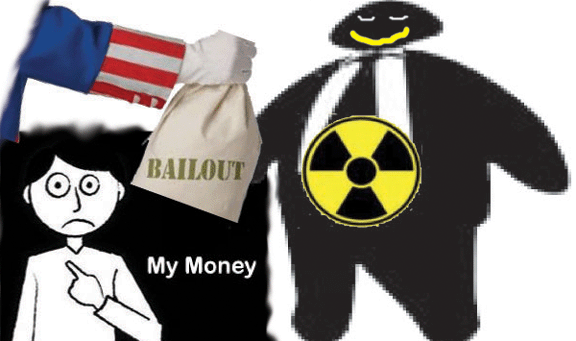
 FERC rejected Perry’s plan, but coal and nuclear are still asking for bailouts http://thehill.com/opinion/energy-environment/368814-ferc-rejected-perrys-plan-but-coal-and-nuclear-are-still-askingBY MARY ANNE HITT, — 01/16/18 This is set to be the year that America decides if it values clean, affordable energy or political cronyism in its electricity markets.
TheFederal Energy Regulatory Commission’s (FERC) recent rejection of Secretary of Energy Rick Perry’s plan to force electricity customers across the country to pay billions of dollars to prop up uneconomic coal and nuclear plants is only the tip of the iceberg in the fossil fuel industry’s bailout efforts.
Today, there are still numerous proposals making their way through state legislatures, public utility commissions, electric market operators, and Congress that will unfairly prop up fossil fuel plants that can’t compete in America’s modern energy markets.
These proposals are rooted in the entitled belief by fossil fuel billionaires that any competition that outperforms their lumbering, polluting power plants — especially clean energy resources like solar, wind, and energy efficiency — is somehow illegitimate.
The proposals themselves have gotten traction recently because over the past decade, clean energy resources have displaced hundreds of coal and nuclear plants as American customers have steadily cut down on their electricity usage and demanded cleaner, safer energy at a lower cost. As a consequence, these new resources have also created a vibrant clean energy economy that employs hundreds of thousands of workers.
Fossil fuel billionaires are fearful that this trend will create a permanent shift away from their dirty and dangerous energy, and are subsequently trying to force electricity customers to pay hundreds of millions, and sometimes billions, of dollars to prop up their plants.
The most egregious example of this political cronyism was Perry’s directive to FERC to create new rules that would have forced electricity customers to pay extra money for the energy produced by uneconomic coal and nuclear plants.
This expensive, foolish directive was rejected by FERC. Despite its failure, however, there are still numerous other proposals which are not as well publicized, but equally costly attempts by fossil fuel billionaires to prop up their plants.
Washington energy lobbyists, for example, have already been busy pushing coal tax credits and the extension of nuclear industry tax incentives in this year’s spending packages.
In Indiana, Sierra Club caught the state’s public utility commission approving a massive bailout of two coal-burning power plants for a local utility, NIPSCO, and is considering legal action to overturn it. The bailout came after uncontested NIPSCO data was revealed which showed that retiring the plants, instead of bailing them out, would save customers as much as $420 million.
In Ohio, FirstEnergy has tried for years, and is still trying, to get the state government to bail out its obsolete coal and nuclear plants that can’t compete with the Midwest’s legion of wind farms. Consumer and environmental advocates have defeated this bailout multiple times, but the utility keeps coming back to try again.
In the Great Plain states, reports show that throughout the region, utilities have been taking advantage of loopholes to force customers to bail out local coal plants to the tune of $300 million over a two year period in the Southwest Power Pool, home to abundant cheap wind power.
Electricity markets that are supposed to be competitive and open to all resources aren’t immune from efforts to rig the system against cleaner energy.
For example, on the same day FERC rejected Energy Department’s misguided proposal, New England’s market operator filed a proposal that would obstruct states’ rights to pursue cost-effective renewable energy projects and make it easier to prop up dirtier, costly power plants that should retire. PJM, which manages the electric system for much of the Mid-Atlantic and Midwest, has also threatened to override public policies for clean energy in order to raise consumer costs and bail out unnecessary power plants, despite a massive surplus of electric capacity.
This recent, ongoing wave of proposals to bailout coal and nuclear plants on behalf of billionaires is a very real threat that will stifle innovation, increase costs, and corrupt democratic processes that have served us well for decades.
The backlash against these bailouts has been overwhelming thus far, but it will only be effective if it can stop all of them in their tracks. A reliable, affordable, and clean energy future hangs on the decisions we make in 2018 and we must choose our decisions wisely.
Mary Anne Hitt is the director of Sierra Club’s Beyond Coal campaign.
Possibility of first strike, and increased nuclear role in USA weapons – leaked draft of USA policy document
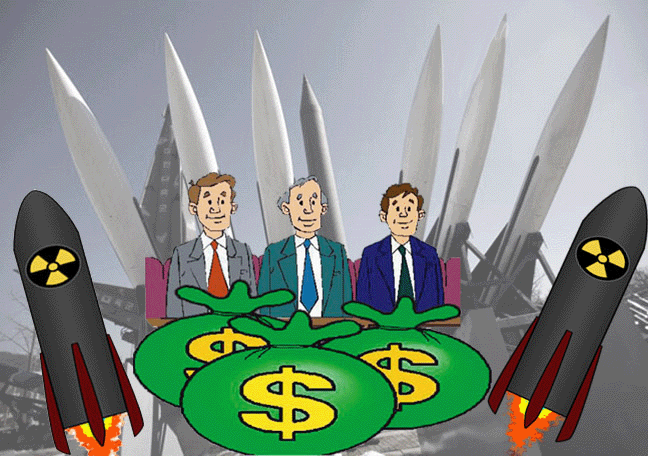 New Trump policy could strengthen role of nuclear weapons, Phil Stewart WASHINGTON (Reuters) 13 Jan 18,- President Donald Trump’s administration could pursue development of new nuclear weaponry and explicitly leave open the possibility of nuclear retaliation for major non-nuclear attacks, if a leaked draft policy document becomes reality.
The Pentagon did not comment on the document, which was published by the Huffington Post website and prompted sharp criticism from arms control experts, who voiced concerns it could raise the risks of nuclear war.
The Defense Department said on Friday it did not discuss “pre-decision, draft copies of strategies and reviews.”
“The Nuclear Posture Review has not been completed and will ultimately be reviewed and approved by the President and the Secretary of Defense,” the Pentagon said in a statement.
One source familiar with the document told Reuters the draft was authentic, but did not say whether it was the same version that will be presented to Trump for approval.
The Republican Trump’s predecessor, Democrat Barack Obama, declared his intent to reduce the role of nuclear weapons in his Nuclear Posture Review in 2010, the last time the policy document was crafted.
The Trump administration’s draft document, said, however, that Obama-era assumptions of a world where nuclear weapons were less relevant proved incorrect.
“The world is more dangerous, not less,” it said.
It more readily embraces the role of nuclear weapons as a deterrent to adversaries, and, as expected, backs a costly modernization of the aging U.S. nuclear arsenal.
The Congressional Budget Office has estimated that modernizing and maintaining the U.S. nuclear arsenal over the next 30 years will cost more than $1.2 trillion.
…….. Kingston Reif, director for disarmament research at the Arms Control Association advocacy group, said the draft document was a departure from long-standing U.S. policy.
“It expands the scenarios under which the United States might use nuclear weapons and therefore increases the risk of nuclear weapons use,” Rief said.
Although it reaffirmed an Obama-era pledge not to use or threaten to use nuclear weapons against non-nuclear weapons states if they joined and adhered to the nuclear Non-Proliferation Treaty, the draft introduced a caveat. The United States reserved the right to alter that assurance, given the evolving threat from non-nuclear technologies…… https://www.reuters.com/article/us-usa-nuclear/new-trump-policy-could-strengthen-role-of-nuclear-weapons-idUSKBN1F202N
Uranium miners keen to pollute Navajo land even more in the Grand Canyon
 Uranium Miners Pushed Hard for a Comeback. They Got Their Wish. NYT, MONUMENT VALLEY, Utah — Garry Holiday grew up among the abandoned mines that dot the Navajo Nation’s red landscape, remnants of a time when uranium helped cement America’s status as a nuclear superpower and fueled its nuclear energy program.
It left a toxic legacy. All but a few of the 500 abandoned mines still await cleanup. Mining tainted the local groundwater. Mr. Holiday’s father succumbed to respiratory disease after years of hacking the ore from the earth.
But now, emboldened by the Trump administration’s embrace of corporate interests, the uranium mining industry is renewing a push into the areas adjacent to Mr. Holiday’s Navajo Nation home: the Grand Canyon watershed to the west, where a new uranium mine is preparing to open, and the Bears Ears National Monument to the north.
The Trump administration is set to shrink Bears Ears by 85 percent next month, potentially opening more than a million acres to mining, drilling and other industrial activity. But even as Interior Secretary Ryan Zinke declared last month that “there is no mine within Bears Ears,” there were more than 300 uranium mining claims inside the monument, according to data from Utah’s Bureau of Land Management office that was reviewed by The New York Times.
The vast majority of those claims fall neatly outside the new boundaries of Bears Ears set by the administration. And an examination of local B.L.M. records, including those not yet entered into the agency’s land and mineral use authorizations database, shows that about a third of the claims are linked to Energy Fuels, a Canadian uranium producer. Energy Fuels also owns the Grand Canyon mine, where groundwater has already flooded the main shaft.
Energy Fuels, together with other mining groups, lobbied extensively for a reduction of Bears Ears, preparing maps that marked the areas it wanted removed from the monument and distributing them during a visit to the monument by Mr. Zinke in May.
Energy Fuels’ lobbying campaign, elements of which were first reported by The Washington Post, is part of a wider effort by the long-ailing uranium industry to make a comeback.
The Uranium Producers of America, an industry group, is pushing the Environmental Protection Agency to withdraw regulations proposed by the Obama administration to strengthen groundwater protections at uranium mines. Mining groups have also waged a six-year legal battle against a moratorium on new uranium mining on more than a million acres of land adjacent to the Grand Canyon.
For the Navajo, the drive for new mines is a painful flashback.
“Back then, we didn’t know it was dangerous — nobody told us,” Mr. Holiday said, as he pointed to the gashes of discolored rocks that mark where the old uranium mines cut into the region’s mesas. “Now they know. They know.”
Supporters of the mining say that a revival of domestic uranium production, which has declined by 90 percent since 1980 amid slumping prices and foreign competition, will make the United States a larger player in the global uranium market.
It would expand the country’s energy independence, they say, and give a lift to nuclear power, still a pillar of carbon-free power generation. Canada, Kazakhstan, Australia, Russia and a few other countries now supply most of America’s nuclear fuel.
……….President Trump has prioritized scrapping environmental regulations to help revitalize domestic energy production. His executive order instructing Mr. Zinke to review Bears Ears said that improper monument designations could “create barriers to achieving energy independence.”
In theory, even after President Barack Obama established Bears Ears in 2016, mining companies could have developed any of the claims within it, given proper local approvals. But companies say that expanding the sites, or even building roads to access them, would have required special permits, driving up costs.
……….
A bill introduced last month by Representative John Curtis, Republican of Utah, would codify Mr. Trump’s cuts to the monument while banning further drilling or mining within the original boundaries. But environmental groups say the bill has little chance of passing at all, let alone before the monument is scaled back next month.
“Come February, anyone can place a mining claim on the land,” said Greg Zimmerman, deputy director at the Center for Western Priorities, a conservation group.
………Fred Tillman, an environmental engineer with the United States Geological Survey, said during a recent visit to the mine that the groundwater flows in the region were too complex to rule out the risk of contamination.
“There are these big unknowns about the potential impacts on cultural resources, on biological resources, on water resources,” Dr. Tillman said.
A senator steps in Even as troubles persist on the ground, the industry pushback has continued.
In court, mining groups led by the National Mining Association have challenged a 20-year moratorium on mining in the Grand Canyon watershed, established in 2012 by the Obama administration. (The Canyon Mine predates the moratorium.)
A federal court of appeals upheld the moratorium last month. But the United States Forest Service has recommended rolling back the protections, meaning the Trump administration could soon reverse them on its own.
The Arizona Chamber of Commerce, which represents mining interests, also backed an effort to defeat a separate proposal that would have permanently banned mining on 1.7 million acres surrounding the Grand Canyon. An Energy Fuels executive testified in Congress against the ban.
And with the help of Republican senators like John Barrasso of Wyoming, the industry has pressed the E.P.A. to withdraw an Obama-era proposalthat would strengthen groundwater protections at uranium mines.
Senator Barrasso has received more than $350,000 in campaign contributions from mining groups over his career. His office did not respond to requests for comment.
The proposal would regulate a mining method called in-situ recovery, which involves injecting a solution into aquifers containing uranium and bringing that solution to the surface for processing — a method criticized by environmentalists as posing wider contamination risks.
……..A town still struggles https://www.nytimes.com/2018/01/13/climate/trump-uranium-bears-ears.html
Nuclear submarines left to rot at Devonport for nearly 30 years.

Plymouth Herald 14th Jan 2018, 13 former Royal Navy subs are awaiting disposal in Plymouth – with a further seven in
Rosyth. The MoD says the submarines are “safely stored” and subject to
rigorous checks. It adds that there has been “no measurable increase in
exposure for local people”.
But the cost of storing and maintaining the laid-up vessels is vast. Over five years – between 2010 and 2015- the total
bill for storing the vessels at the two sites, both owned by Plymouth-based engineering firm Babcock, reached more than £16million.
The estimated cost of the MoD’s submarine dismantling programme, which started in December 2016 and is due to take more than 25 years to complete, have not been released. The MoD says this is due to ongoing commercial negotiations withBabcock – it’s main contractor for the programme – and other key suppliers.
http://www.plymouthherald.co.uk/news/plymouth-news/nuclear-submarines-left-rot-devonport-1043977
UK government national environment strategy ignores nuclear dangers
 Nuclear polluting elephant in the great green room Dr David Lowry http://drdavidlowry.blogspot.com.au/2018/01/nuclear-polluting-elephant-in-great.html
The UK Government launched on 11 January – with a media fanfare- its long delayed 150-page national environmental strategy (for England) titled ‘A Green Future: Our 25 Year Plan to Improve the Environment (https://www.gov.uk/government/publications/25-year-environment-plan).
Prime Minister May asserted in her foreword: “We hold our natural environment in trust for the next generation. By implementing the measures in this ambitious plan, ours can become the first generation to leave that environment in a better state than we found it and pass on to the next generation a natural environment protected and enhanced for the future.
……. We will use this opportunity to strengthen and enhance the protections our countryside, rivers, coastline and wildlife habitats enjoy, and develop new methods of agricultural and fisheries support which put the environment first.”
In his own foreword, Environment Secretary Michael Gove added:“Environment is – at its roots – another word for nature, for the planet that sustains us, the life on earth that inspires wonder and reverence, the places dear to us we wish to protect and preserve. We value those landscapes and coastlines as goods in themselves, places of beauty which nurture and support all forms of wildlife….We will underpin all this action with a comprehensive set of environmental principles. To ensure strong governance, we will consult on plans to set up a world-leading environmental watchdog, an independent, statutory body, to hold Government to account for upholding environmental standards.”
These warm green words are, however, not backed up with the kind of action that recognizes the real environmental priorities with which ministers need to get a grip.
The most egregious omission for action is anything to halt, reverse and deal with nuclear industry radiological pollution and nuclear waste from power generation, spent irradiate nuclear fuel reprocessing and nuclear warhead production.
Chapter 4 is titled’ Increasing resource efficiency and reducing pollution and waste’ but makes zero mention of nuclear waste or radiological pollution, but does expend time and effort addressing far less ecologically damaging no radiotoxic waste pollution. Here is an extract:
- Improving management of residual waste
Since 2000 we have diverted significant quantities of residual waste – i.e. waste that cannot be reused or recycled – from landfill through the development of energy from waste (EfW) facilities. These generally recover energy from the waste to produce electricity. In 2016/17, some 38% of waste collected by Local Authorities went to EfW compared with 16% that went to landfill. More can be done however. We want to make sure that materials ending up in the residual waste stream are managed so that their full value as a resource is maximised and the impact on the environment of treating them is minimised.
We will continue to encourage operators to maximise the amount of energy recovered from residual waste while minimising the environmental impact of managing it, for example by utilising the heat as well as electricity produced. The actions set out in this Plan will help us build on this to ensure that the value of residual waste as a resource is fully realised and that emissions of carbon dioxide during the energy recovery process are kept as low as possible. We must bear in mind that any infrastructure must be able to adapt to future changes in the volume and make-up of residual waste generated and developments in technology. That way, waste is not locked into residual waste treatment processes when it could be reused or recycled. (page 94)
Annex 2 of the two Government reports on Environment 25 titled Government strategies to protect and improve the environment(https://www.gov.uk/government/uploads/system/uploads/attachment_data/file/673160/25-year-environment-plan-annex2.pdf comprises of nearly 50 “strategies and plans for some of the government’s work to protect and conserve the environment,” but contains not one report that addresses environmental protection from radiation or from nuclear industry operations!
However, two days before the 25-year green strategy was issued, the Government quietly released ( to absolutely zero media attention) a 221- page document that explains how it plans to deal with nuclear waste in the UK. Clearly ministers wanted attention on plastic waste policy, but none fon radioactive waste policy.
The report, titled UK’s sixth national report on compliance with the obligations of the Joint Convention on the safety of spent fuel and radioactive waste management states it “considers each of the Joint Convention’s obligations and explains how the United Kingdom addresses them.”https://www.gov.uk/government/uploads/system/uploads/attachment_data/file/672640/20171020_-_UK_Sixth_National_Report_to_the_Joint_Convention.pdf )
Document (The fifth report was published in January 2015.)
Former nuclear weapons launch officers call for restricting Trump’s access to ‘nuclear button’
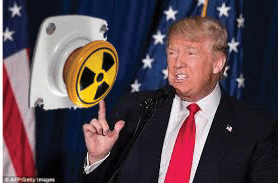 Nuclear launch officers write open letter about President Trump, amid claims cyberhacks could lead to ‘unintended’ nuclear launch http://www.news.com.au/world/europe/nuclear-launch-officers-write-open-letter-about-president-trump-amid-claims-cyberhacks-could-lead-to-unintended-nuclear-launch/news-story/31e82d4451a4d398a7fce3b7e785dbde SEVENTEEN people once responsible for launching the US’s nuclear weapons have revealed a fatal flaw in the launch system. Victoria Craw@Victoria_Craw12 Jan 18 SEVENTEEN former nuclear launch officers have signed an open letter calling for President Trump’s access to the “proverbial red button” be restricted amid fears his “petulant mood swings” could lead to a nuclear strike.
It follows a similar letter calling for restrictions on the nuclear chain of command written while Trump was on the campaign trail. One year into the presidency, the nuclear officers say “the reality of this presidency is worse than we feared.”
“The president has had ample opportunity to educate and humble himself to the grave responsibilities of his office. Instead, he consistently shows himself to be easily baited, stubborn in his ignorance of world politics and diplomacy, and quick to brandish nuclear threats,” the group states.
They claim rising rhetoric against North Korea highlights the clear flaw in the process that could endanger millions around the world — that there are no checks on the President should he decide to order a nuclear strike.
“As former nuclear launch control officers, it was our job to fire nuclear missiles if the president so directed. Once the president orders a launch, we could have missiles leaving their silos in several minutes. They cannot be recalled.
“The missiles would reach their destination — whether Russia, China or North Korea — within 30 minutes. There is no act of greater consequence, and it should not rest in the hands of any one person.”
We and our nation cannot abide being hostages to the mood swings of a petulant and foolish commander-in-chief. No individual, especially Donald Trump, should hold the absolute power to destroy nations. That is a clear lesson of this presidency and one that we, as former stewards of the launch keys, embrace with full conviction,” the group said.
It comes following a warning from UK think tank Chatham House that an “unintended” nuclear strike is possible given heightened tensions and the vulnerability of many systems to cyber attack.
The International Security Department’s Dr Patricia Lewis and Dr Beyza Unalpublished the paper, Cybersecurity Of Nuclear Weapons Systems, which said the nine countries that have nuclear weapons often rely on strategic systems developed at a time when computers were “in their infancy”.
“The most severe consequence of a cyber attack on one or more nuclear weapons systems would be the inadvertent launch of missiles and/or the inadvertent detonation of a warhead that lead to a significant loss of life,” it said.
“Further consequences of such a cyber attack include sector-level impacts, such as in the medical sector, which may have to deal with casualties; disruption of workforces and operations of defence companies or vendors; as well as economic and reputational costs to countries and private companies. Such an event would also increase the likelihood of crisis and conflict.”
The report notes a mind-boggling number of ways cyber attackers could infiltrate a nuclear weapons system without a country being aware of it for years or until it’s too late.
The result could lead to confusion as countries try to ascertain whether they have been subject to a cyber attack or not, how to respond and which weapons to use. The authors claim it could lead to “inadvertent nuclear launches” based on an “unwitting reliance” on false information.
Making the problem worse is the sheer scale of digital infrastructure used to control everything from layouts of facilities to personnel, operational information, communication links, and weather and target information. Data hacks could be used to disrupt missiles once launched and take over nuclear armed submarines, the report claimed.
It comes during a state of heightened nuclear tension following heated rhetoric between the US and North Korea as well as greater Russian military activity and a build-up of NATO forces in Eastern Europe.
Trump supporters claim his refusal to rule out military options has helped achive an about face from North Korea, who is now engaged in a dialogue with the South and is subject to tough UN economic.
However veteran nuclear launch officer, Dr. Bruce Blair, who founded Global Zero to eliminate nuclear weapons said he could no longer watch as President Trump “holds us all hostage to his petulant mood swings.”
“Our weapons have the power to destroy entire nations, including our own nation if he initiates a nuclear war. As a former steward of the nuclear launch keys, I’ve learned about the stability, competence and temperament it takes to hold such a responsibility, and Donald Trump has shown us all he possesses none of those qualities,” he said.
Japanese and British taxpayers at risk as their governments commit to $20 billion loan for Wylfa nuclear project
 Asahi Shimbin 11th Jan 2018, Japan and Britain have agreed to provide the lion’s share of financing for
a nuclear power plant project planned by Hitachi Ltd. on the island of
Anglesey off northwest Wales, sources said.
financial institutions and acquire a stake in Horizon Nuclear Power Ltd., a
British company purchased by Hitachi to operate the plant. The total cost
of the project is estimated at 3 trillion yen.
doing so, they must share the risk if the project suffers a financial loss,
but that tab could eventually be passed on to taxpayers.
http://www.asahi.com/ajw/articles/AJ201801110057.html
Nuclear Liability – UK government sets out new rules for ‘intermediate risks’

 The Department for Business, Energy & Industrial Strategy (BEIS) late last
week published its position on the criteria for determining the new
category of ‘intermediate risk’ nuclear sites that is to be established in
UK law.
Helen Peters, a nuclear expert at Pinsent Masons, the law firm
behind Out-Law.com, said that the changes that BEIS has made to the
criteria are to be welcomed and would enable the government to move forward
with laying the draft Nuclear Installations (Prescribed Sites and
Transport) Regulations in parliament at some point in the near future.
The new regulations once introduced will come into force at the same time as
the amendments to Nuclear Installations Act 1965 which are set out in the
Nuclear Installations (Liability for Damage) Order 2016. These amendments
support the implementation of the 2004 Protocols to the Paris Convention on
nuclear third party liability and the Brussels Supplementary Convention.
The decision on the criteria for intermediate risk sites has been made
further to a consultation in 2016 on the proposed definitions for the
purposes of nuclear liability for low risk nuclear sites, intermediate
sites, relevant disposal sites and the transport of low risk nuclear
matter.
After considering the responses to the 2016 consultation, the
government elected to further consider the definition for intermediate risk
sites. It elected to reconsult on the matter in 2017 because the proposed
revised definition was significantly different to the one set out in the
2016 proposal. The BEIS paper published last week contained the
government’s response (12-page / 101KB PDF) to the feedback it received to
its reconsultation. A new liability limit of €160 million will apply to
nuclear sites classed as ‘intermediate risk’ once the legislative changes
come into force. As many as 14 nuclear sites could qualify as ‘intermediate
risk’ sites under the new criteria that has been established, BEIS said.
https://www.out-law.com/en/articles/2018/january/uk-government-clarifies-criteria-for-intermediate-risk-nuclear-sites/
USA’s Federal Energy Regulatory Commission makes a fact-based decision against subsidies for coal and nuclear power
Rejection of subsidies for coal and nuclear power is a win for fact-basedpolicymakingSenior Economist and Interim Associate Director of Social Science and Policy, University of Michigan Energy Institute, University of Michigan Energy Secretary Rick Perry has repeatedly expressed concern over the past year about the reliability of our national electric power grid. On Sept. 28, 2017, Perry ordered the Federal Energy Regulatory Commission to revise wholesale electricity market rules to help ensure “… a reliable, resilient electric grid powered by an ‘all of the above’ mix of generation resources.” Perry’s proposal included an implicit subsidy to owners of coal and nuclear power plants, to compensate them for keeping a 90-day fuel supply on-site in the event of a disruption to the grid.
On Jan. 8, FERC issued a statement, supported by all five commissioners, terminating Perry’s proposal. The commissioners held that paying generators to store fuel on-site would only benefit some fuel types. And although coal and nuclear plants are retiring in large numbers, commissioners were not persuaded that this was due to unfair pricing in power markets.
In my view, FERC made an appropriate and well-grounded decision. The commission opted to gather more information and examine many possible approaches to improving reliability, instead of rubber-stamping a directive that had not been fully vetted. The commission’s action is a good example of the kind of evidence-based policymaking that Americans should expect from the federal government………
Look at the evidence
Whether FERC commissioners know it or not, their approach follows many recommendations set forth recently by a national Commission on Evidence-Based Policymaking. This panel was created in 2016 through legislation co-sponsored by House Speaker Paul Ryan and Senator Patty Murray of Washington. Its task was to examine how federal agencies use data, research and evaluation to build evidence, and to strengthen those efforts in order to make better policies……..
FERC’s 5-0 decision shows that the commissioners agreed on their course, and it appears that policymaking based on evidence won the day. This decision had the potential to affect millions of electricity customers, as well as power markets and the environment. FERC deserves congratulations for putting evidence before action. https://theconversation.com/rejection-of-subsidies-for-coal-and-nuclear-power-is-a-win-for-fact-based-policymaking-88832
New Bill in USA Congress for compensation for sick nuclear workers
 Bill to help sick Hanford workers gets new life http://www.king5.com/article/news/local/hanford/bill-to-help-sick-hanford-workers-gets-new-life/281-507019253 [includes excellent video on Hanford]
The language of fascism and Donald Trump
 Challenging Trump’s Language of Fascism TruthOut January 09,
  2018, By Henry A. Giroux, Truthout | News Analysis George Orwell warns us in his dystopian novel 1984 that authoritarianism begins with language. Words now operate as “Newspeak,” in which language is twisted in order to deceive, seduce and undermine the ability of people to think critically and freely. As authoritarianism gains in strength, the formative cultures that give rise to dissent become more embattled along with the public spaces and institutions that make conscious critical thought possible.
Words that speak to the truth, reveal injustices and provide informed critical analysis begin to disappear, making it all the more difficult, if not dangerous, to hold dominant power accountable. Notions of virtue, honor, respect and compassion are policed, and those who advocate them are punished.
I think it is fair to argue that Orwell’s nightmare vision of the future is no longer fiction. Under the regime of Donald Trump, the Ministry of Truth has become the Ministry of “Fake News,” and the language of “Newspeak” has multiple platforms and has morphed into a giant disimagination machinery of propaganda, violence, bigotry, hatred and war. With the advent of the Trump presidency, language is undergoing a shift in the United States: It now treats dissent, critical media and scientific evidence as a species of “fake news.” The administration also views the critical media as the “enemy of the American people.” In fact, Trump has repeated this view of the press so often that almost a third of Americans believe it and support government-imposed restrictions on the media, according to a Poynter survey. Language has become unmoored from critical reason, informed debate and the weight of scientific evidence, and is now being reconfigured within new relations of power tied to pageantry, political theater and a deep-seated anti-intellectualism, increasingly shaped by the widespread banality of celebrity culture, the celebration of ignorance over intelligence, a culture of rancid consumerism, and a corporate-controlled media that revels in commodification, spectacles of violence, the spirit of unchecked self-interest and a “survival of the fittest” ethos.
Under such circumstances, language has been emptied of substantive meaning and functions increasingly to lull large swaths of the American public into acquiescence, if not a willingness to accommodate and support a rancid “populism” and galloping authoritarianism. he language of civic literacy and democracy has given way to the language of saviors, decline, bigotry and hatred. One consequence is that matters of moral and political responsibility disappear, injustices proliferate and language functions as a tool of state repression. The Ministry of “Fake News” works incessantly to set limits on what is thinkable, claiming that reason, standards of evidence, consistency and logic no longer serve the truth, because the latter are crooked ideological devices used by enemies of the state. “Thought crimes” are now labeled as “fake news.”
The notion of truth is viewed by this president as a corrupt tool used by the critical media to question his dismissal of legal checks on his power — particularly his attacks on judges, courts, and any other governing institutions that will not promise him complete and unchecked loyalty. For Trump, intimidation takes the place of unquestioned loyalty when he does not get his way, revealing a view of the presidency that is more about winning than about governing. One consequence is myriad practices in which Trump gleefully humiliates and punishes his critics, willfully engages in shameful acts of self-promotion and unapologetically enriches his financial coffers. ………
With the rise of casino capitalism, a “winner-take-all” ethos has made the United States a mean-spirited and iniquitous nation that has turned its back on the poor, underserved, and those considered racially and ethnically disposable. It is worth noting that in the last 40 years, we have witnessed an increasing dictatorship of finance capital and an increasing concentration of power and ownership regarding the rise and workings of the new media and mainstream cultural apparatuses. These powerful digital and traditional pedagogical apparatuses of the 21st century have turned people into consumers, and citizenship into a neoliberal obsession with self-interest and an empty notion of freedom. ……….
Trump appropriates crassness as a weapon. In a throwback to the language of fascism, he has repeatedly positioned himself as the only one who can save the masses, reproducing the tired script of the savior model endemic to authoritarianism. In 2016 at the Republican National Convention, Trump stated without irony that he alone would save a nation in crisis, captured in his insistence that, “I am your voice, I alone can fix it. I will restore law and order.”……….
There is more at work here than an oversized, if not delusional ego. Trump’s authoritarianism is also fueled by braggadocio and misdirected rage. There is also a language that undermines the bonds of solidarity, abolishes institutions meant to protect the vulnerable, and a full-fledged assault on the environment………
Trump is the master of manufactured illiteracy, and his public relations machine aggressively engages in a boundless theater of self-promotion and distractions — both of which are designed to whitewash any version of the past that might expose the close alignment between Trump’s language and policies and the dark elements of a fascist past.
Trump revels in an unchecked mode of self-congratulation bolstered by a limited vocabulary filled with words like “historic,” “best,” “the greatest,” “tremendous” and “beautiful.” As Wesley Pruden observes:
Nothing is ever merely “good,” or “fortunate.” No appointment is merely “outstanding.” Everything is “fantastic,” or “terrific,” and every man or woman he appoints to a government position, even if just two shades above mediocre, is “tremendous.” The Donald never met a superlative he didn’t like, himself as the ultimate superlative most of all.
Trump’s relentless exaggerations suggest more than hyperbole or the self-indulgent use of language. This is true even when he claims he “knows more about ISIS than the generals,” “knows more about renewables than any human being on Earth,” or that nobody knows the US system of government better than he does. There is also a resonance with the rhetoric of fascism. As the historian Richard J. Evans writes in The Third Reich in Power:
The German language became a language of superlatives, so that everything the regime did became the best and the greatest, its achievements unprecedented, unique, historic, and incomparable…..
Trump’s language, especially his endorsement of torture and contempt for international norms, normalizes the unthinkable, and points to a return to a past that evokes what Ariel Dorfman has called “memories of terror … parades of hate and aggression by the Ku Klux Klan in the United States and Adolf Hitler’s Freikorps in Germany…. executions, torture, imprisonment, persecution, exile, and, yes, book burnings, too.” Dorfman sees in the Trump era echoes of policies carried out under the dictator Pinochet in Chile…………
Trump’s fascistic language also fuels the rhetoric of war, toxic masculinity, white supremacy, anti-intellectualism and racism. What was once an anxious discourse about what Harvey Kaye calls the “possible triumph in America of a fascist-tinged authoritarian regime over liberal democracy” is no longer a matter of speculation, but a reality……..
Trump’s language is not his alone. It is the language of a nascent fascism that has been brewing in the US for some time. It is a language that is comfortable viewing the world as a combat zone, a world that exists to be plundered. It is a view of those deemed different as a threat to be feared, if not eliminated. Frank Rich is correct in insisting that Trump is the blunt instrument of a populist authoritarian movement whose aim is “the systemic erosion of political, ethical, and social norms” central to a substantive democracy. And Trump’s major weapon is a toxic language that functions as a form of “cultural vandalism” that promotes hate, embraces the machinery of the carceral state, makes white supremacy a central tenant of governance, and produces unthinkable degrees of inequality in wealth and power…….
The current struggle against a nascent fascism in the United States is not only a struggle over economic structures or the commanding heights of corporate power. It is also a struggle over visions, ideas, consciousness and the power to shift the culture itself.
Progressives need to formulate a new language, alternative cultural spheres and fresh narratives about freedom, the power of collective struggle, empathy, solidarity and the promise of a real socialist democracy. We need a new vision that refuses to equate capitalism and democracy, normalize greed and excessive competition, and accept self-interest as the highest form of motivation. We need a language, vision and understanding of power to enable the conditions in which education is linked to social change and the capacity to promote human agency through the registers of cooperation, compassion, care, love, equality and a respect for difference…….
In the end, there is no democracy without informed citizens and no justice without a language critical of injustice. http://www.truth-out.org/news/item/43159-challenging-trumps-language-of-fascism
US energy watchdog rejects plan to subsidize coal, nuclear sectors
 https://finance.yahoo.com/news/us-energy-watchdog-rejects-plan-subsidize-coal-nuclear-014834314.html Washington (AFP) – The US energy watchdog terminated Monday a key proposal by President Donald Trump’s administration to subsidize coal and nuclear plants, finding it neither justified nor reasonable.
The decision by the Federal Energy Regulatory Commission (FERC) was handed down in a unanimous verdict by its five members, a majority of whom belong to the president’s Republican Party.
Energy Secretary Rick Perry had in September proposed providing federal aid to nuclear and coal power plants with at least 90 days’ worth of production capacity, arguing the move was necessary to make the national grid more resilient in case of extreme events.
Both sectors have seen their share of the energy market diminish in recent years, losing out to oil, natural gas and renewables — which had all opposed Perry’s plan.
There are currently only two nuclear reactors under construction in the US, in addition to the 99 in service. Coal is also facing a crisis, and Trump made reversing its decline a major campaign pledge.
In announcing its decision, FERC cited an existing department study’s findings that “changes in the generation mix, including the retirement of coal and nuclear generators, have not diminished the grid’s reliability or otherwise posed a significant and immediate threat to the resilience of the electric grid.”
But it sought suppliers to provide within 60 days reports related to resilience concerns and issues the commission had identified.
Will Trump allow irreparable damage to the Grand Canyon, and expand uneconomic uranium mining?
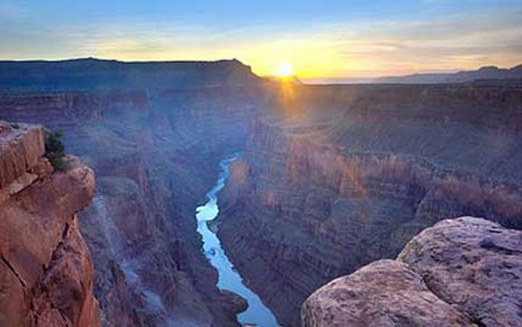 Will Trump Dump on Grand Canyon? Experts Say Risk of Uranium Mining Not Worth Reward
MIRIAM WASSER Phoenix New Times JANUARY 11, 2018 “……… In 2012, President Barack Obama’s administration put a 20-year freeze (called a mineral withdrawal) on all new mining claims in 1 million acres around the Grand Canyon. A handful of mines with valid existing rights, like Canyon Mine, were grandfathered in and permitted to move ahead with operations.
The reason for the withdrawal was simple: Scientists didn’t know enough about the complex hydrology of the area to say whether mining could cause irreparable damage. And with the entire Grand Canyon ecosystem and tourism industry at stake — not to mention the Havasupai who live in the park and the millions of people who live downstream from the Colorado River — there was overwhelming public support for the decision.
Fast-forward to the present day, however, and there are signs that the moratorium may not survive Donald Trump’s presidency.
His administration has spent the last year systematically trying to undermine his predecessor’s environmental policies, an agenda that has included reducing regulations and opening up vast areas of public land for mining, drilling, and fracking.
In the case of uranium, “they’re just doing it because they can,” says Chris Mehl of Headwaters Economics, an independent nonprofit research group that studies western land management. “They’re offering an opportunity for a product that is at or near historic low prices”….
As any economist will tell you, sometimes it’s worth taking a big risk in order to get a big reward. But when it comes to reversing the 2012 withdrawal, the potential benefits seem small and the risks seem huge.
Much has been written about the health and environmental hazards posed by uranium mining near the Grand Canyon; what’s missing is the economic side of the story.
For years, Phoenix New Times has heard that uranium mining in the area is not only environmentally irresponsible, but makes no economic sense. These critics include scientists, conservationists, local politicians, and even leaders in the nuclear power industry. They say that while intuitively, we might think that more mining would be good for the local economy, it turns out this isn’t the case.
Given that the whole point of “revising” the withdrawal is to bolster domestic energy production to create jobs, secure energy independence, and help the economy, New Times decided to investigate the economics of uranium mining in the area.
To do this, we spoke with more than a dozen experts in fields like hard-rock mining, mineral economics, hydrology, environmental law, and nuclear power. We analyzed global uranium market trends and data, learned about unconventional mining techniques, and spoke with local politicians who are familiar with the northern Arizona economy.
We also consulted reports from various federal agencies, think tanks, trade groups, the Government Accountability Office, the World Nuclear Association, and the International Atomic Energy Association’s biennial report about the state of the global uranium market, The Uranium Red Book.
Tellingly, no expert or document made the argument that acquiring uranium from within the 2012 withdrawal is a matter of national security. No one said we needed it to keep the lights on now or in the foreseeable future. The world is flush with uranium that’s cheaper to mine and the U.S. Department of Energy has huge stockpiles of enriched and raw uranium that could be used in a pinch, we were told, again and again.
And finally, no one said that it would do much for the local economy. Some suggested that at best, it could create temporary jobs, though most felt that because of the stop-and-go nature of uranium mining, and the fears mining stokes about a radioactive accident, it would be more likely to cause harm than good.
“When people want to mine [uranium] in the U.S., I think, ‘Really?’ It’s generally not worth it,” says James Conca, a senior scientist at the energy consulting firm UFA Ventures Inc…….http://www.phoenixnewtimes.com/news/heres-who-officially-qualified-for-a-shot-at-trent-franks-seat-10029922
1 This Month

of the week– Nuclear Reactor Information Task Force

14 May – online event From Bombs to Data Centres: the Face of Nuclear Colonialism
To see nuclear-related stories in greater depth and intensity – go to https://nuclearinformation.wordpress.com
-
Archives
- May 2026 (102)
- April 2026 (356)
- March 2026 (251)
- February 2026 (268)
- January 2026 (308)
- December 2025 (358)
- November 2025 (359)
- October 2025 (376)
- September 2025 (257)
- August 2025 (319)
- July 2025 (230)
- June 2025 (348)
-
Categories
- 1
- 1 NUCLEAR ISSUES
- business and costs
- climate change
- culture and arts
- ENERGY
- environment
- health
- history
- indigenous issues
- Legal
- marketing of nuclear
- media
- opposition to nuclear
- PERSONAL STORIES
- politics
- politics international
- Religion and ethics
- safety
- secrets,lies and civil liberties
- spinbuster
- technology
- Uranium
- wastes
- weapons and war
- Women
- 2 WORLD
- ACTION
- AFRICA
- Atrocities
- AUSTRALIA
- Christina's notes
- Christina's themes
- culture and arts
- Events
- Fuk 2022
- Fuk 2023
- Fukushima 2017
- Fukushima 2018
- fukushima 2019
- Fukushima 2020
- Fukushima 2021
- general
- global warming
- Humour (God we need it)
- Nuclear
- RARE EARTHS
- Reference
- resources – print
- Resources -audiovicual
- Weekly Newsletter
- World
- World Nuclear
- YouTube
-
RSS
Entries RSS
Comments RSS
 nuclear-news