Executives from Atlanta-based Southern Company defended their long delayed and way over-budget nuclear construction project, the Vogtle plant, before the Georgia Public Service Commission. But this time, Anthony Quinn won. The Georgia PSC commissioners gave Southern the ok to keep building.
The PSC had a choice: recommend cancellation of the huge project or let it proceed. But cancellation would require still another unpleasant discussion and decision: who foots the bill for the incomplete plant? Not the sort of decisions politicians like to make on their watch.
So the PSC ruled that power-generating alternatives to nuclear, such as combined cycle combustion turbines, would cost more than completing the plant (a conclusion that requires judgment about gas prices). And it made some modifications that will supposedly cut $700 million off what the plant will cost Southern’s consumers (that’s $18 million per year over the projected life of the plant, so no big deal.)
Economists warn decision makers to ignore sunk costs. But those sunk costs apparently did weigh on regulators. Explaining to the governor and to voters that the billions of dollars of plant investment made on their watch is now worthless… well, that’s a decision few regulators would choose to make.
The public reasoning behind today’s Georgia PSC decision involved assumptions about future energy costs, the company’s need for a diverse energy mix, and the desirability of adding low carbon emitting generating resources.
For all the attention this decision received, probably didn’t play a significant role. Nobody we’ve ever met could accurately forecast trends in energy consumption, power technology and costs at the same time over any reasonable planning horizon. To accurately forecast these over the 40-60 year projected life of the Vogtle plant turns an impossible task ridiculous. That is the key to the problem regulators faced today, and the reason why a decision to build a large nuclear plant is so risky.
Two Greentech Media journalists saw today’s PSC decision as an “infusion of hope for large-scale nuclear… and the last chance to prove the viability of the industry” in the U.S. The verdict of the financial community was far more muted. The common shares of Southern Company fell 1 percent.
How will an over-budget, late and marginally economic nuclear power generating facility encourage others to dive into the nuclear new-build game?
Georgia regulators cited other reasons to approve this project, including the need to reduce carbon omissions and to maintain America’s nuclear power generating capability. But the big question is why should the electricity consumers of Georgia, alone, bear the burden of meeting relatively high-cost national energy goals?
Given the size and risks inherent in building new nuclear projects, especially with relatively new designs, shouldn’t the risk be spread throughout the nation? There’s something bizarre about the electricity consumers of Georgia and South Carolina (where an identical project was recently canceled) incurring possibly $25-$50 billion of financial risk for the sake of the nation’s nuclear power generating capability.
Given the size and risks inherent in new nuclear projects, shouldn’t the risk be spread throughout the nation, if—as the regulators imply—the entire nation actually benefits? The electricity consumers in Georgia and South Carolina shouldn’t incur significant financial risk for the sake of the nation’s nuclear capability—especially when no other domestic utility management appears ready to follow suit.
As a supposedly patriotic gesture, we can certainly applaud the sentiment. But the economics remain shaky.
Hinkley Point: the ‘dreadful deal’ behind the world’s most expensive power plant, The Guardian, 21 Dec 17 Building Britain’s first new nuclear reactor since 1995 will cost twice as much as the 2012 Olympics – and by the time it is finished, nuclear power could be a thing of the past. How could the government strike such a bad deal? By Holly Watt Hinkley Point, on the Somerset coast, is the biggest building site in Europe. Here, on 430 acres of muddy fields scattered with towering cranes and bright yellow diggers, the first new nuclear power station in the UK since 1995 is slowly taking shape. When it is finally completed, Hinkley Point C will be the most expensive power station in the world. But to reach that stage, it will need to overcome an extraordinary tangle of financial, political and technical difficulties. The project was first proposed almost four decades ago, and its progress has been glacial, having faced relentless opposition from politicians, academics and economists every step of the way.
Some critics of the project have questioned whether Hinkley Point C’s nuclear reactor will even work. It is a new and controversial design, which has been dogged by construction problems and has yet to start functioning anywhere in the world. Some experts believe it could actually prove impossible to build. “It’s three times over cost and three times over time where it’s been built in Finland and France,” says Paul Dorfman, from the UCL Energy Institute. “This is a failed and failing reactor.”
Others have pointed to the cost. At present, the estimated total bill for Hinkley Point C is £20.3bn, more than twice the London Olympics. To pay for it, the British government has entered into a complex financial agreement with Électricité de France (EDF), the energy giant that is 83% owned by the French government, and China General Nuclear Power Group (CGN), a state-run Chinese energy company. Under this contract, British electricity consumers will pay billions over a 35-year period. According to Gérard Magnin, a former EDF director, the French company sees Hinkley as “a way to make the British fund the renaissance of nuclear in France”. He added: “We cannot be sure that in 2060 or 2065, British pensioners, who are currently at school, will not still be paying for the advancement of the nuclear industry in France.”
Many British observers agree that the deal is ludicrously favourable to EDF – “a dreadful deal, laughable” says Prof Steve Thomas, who works on energy policy at the University of Greenwich. But even insiders at EDF aren’t entirely happy with it. In the months before the EDF board finally signed off the deal in autumn 2016, the finance director resigned, along with Magnin. “The Hinkley Point project remains very risky,” Magnin told me. He is particularly concerned about EDF’s ability to complete the project before the current deadline of 2025. “Why have we reached this point?” asked Magnin. “It is the construction of a house of cards.”
Not everyone has lost faith in the project. When John Hutton was business secretary in 2008, he announced that the government would encourage the “safe and affordable” development of nuclear reactors. Back then, he insisted the plants would be completed “well before 2020”, and wouldn’t receive a penny in subsidies from the British government. Today, despite those earlier promises having been broken, Hutton still lobbies for nuclear: “We’re not just creating power stations,” he told me. “We are making history.”
But the irony of Hinkley Point C is that by the time it eventually starts working, it may have become obsolete. Nuclear power is facing existential problems around the world, as the cost of renewable energies fall and their popularity grows. “The maths doesn’t work,” says Tom Burke, former environmental policy adviser to BP and visiting professor at both Imperial and University Colleges. “Nuclear simply doesn’t make sense any more.”
The story of Hinkley Point C is that of a chain of decisions, taken by dozens of people over almost four decades, which might have made sense in isolation, but today result in an almost unfathomable scramble of policies and ambitions. Promises have been made and broken, policies have been adopted then dropped then adopted again. The one thing that has been consistent is the projected cost, which has rocketed ever upwards. But if so many people have come to believe that Hinkley Point C is fundamentally flawed, the question remains: how did we get to this point, where billions of pounds have been sunk into a project that seems less and less appealing with every year that passes?…..https://www.theguardian.com/news/2017/dec/21/hinkley-point-c-dreadful-deal-behind-worlds-most-expensive-power-plant?CMP=twt_gu
French people support energy transition, survey reveals, Energy Transition by Energiewende Team19 Dec 2017“……… It is often said that the French people strongly support nuclear energy as a jewel of the French industry. However, a survey commissioned by the French office of the Heinrich Boell Foundation and the French Think tank La Fabrique écologique, carried out by the research institute Harris Interactive, shows that the French people would rather like to pull up the anchor and set sail for a new model based on renewable energy.
Indeed, 91 % of interviewees consider the energy transition as “priority issue” (47%) or a “major issue” (44%). 63% see the energy transition as an opportunity rather than as a threat (11 %). But what should energy transition look like, according to them?
A clear preference for the development of renewable energy
The trend is very clear: 83 % of French people think France should prioritize investments in renewable energy. Only 12% of the interviewees prefer that investments go towards the modernization and life extension of nuclear power plants. 66 % of respondents come out against the construction of new nuclear power plants. It shows that the advertising and constantly repeated arguments that nuclear energy – often described as “clean energy” – is the only adequate solution when it comes to fighting climate change is not having the intended effect on French public opinion.
Also surprising is the fact that the actor in which the French people have the most confidence to lead the energy transition is neither the state (trusted by 49% of the interviewees) nor the energy producers and providers like the state owned EDF (trusted by only 46%). Rather, people trust citizen energy cooperatives (trusted by 78%), as well as NGOs and associations (trusted by 66 %).
A positive view of the Energiewende
Another salient point of the survey is the opinion of the French people about the German energy transition. Respondents perceived the German Energiewende much more positively than their economic and political elites……..
Over half of them see the Energiewende as “a good example for the energy transition.” Last but not least, the French people think France should work more closely with Europe (54%) and with Germany (51%) on energy issues……
Troubled $25 Billion Nuclear Project Gets OK to Continue US News, By JONATHAN LANDRUM Jr., Associated Press ATLANTA (AP) 21 Dec 17— Georgia‘s utility regulators are allowing construction to continue on two new nuclear reactors, despite massive cost overruns for the multibillion-dollar project.
Thursday’s unanimous decision by the state’s Public Service Commission will shape the future of the nation’s nuclear industry, partly because the reactors at Plant Vogtle were the first new ones to be licensed and to begin construction in the U.S. since 1978.
The project, co-owned by Georgia Power, Oglethorpe Power, MEAG Power and Dalton Utilities, has been plagued by delays and spiraling costs, compounded when the main contractor filed for bankruptcy. Westinghouse Electric Co., the U.S. nuclear unit of Japan’s Toshiba Corp., filed for bankruptcy in March.
Georgia Gov. Nathan Deal praised the PSC’s decision……
The Sierra Club, meanwhile, slammed the vote, calling the project a disaster. Ted Terry, director of the group’s Georgia chapter, said the project should have been halted……
Officials say the PSC vote means Georgia consumers will pay more for power, starting in 2021……
David Schlissel, a utility consultant and analyst who has previously testified against Vogtle, criticized Thursday’s vote, saying regulators were letting Georgia Power and its parent, the Southern Company, off the hook.
“The commission’s own monitors have identified that Southern mismanaged the project,” he said. “Now the commission is giving them unanimous approval to spend even more money.”
He added, “In Georgia, you apparently have commissioners who are fine having ratepayers shovel money into a bottomless pit.”…….
By May 2015, regulators said there was a “high probability” that construction would be delayed even longer than the three years already announced by the owners, according to an analysis obtained by The Associated Press. Estimates from regulators at that time put the utility company’s costs at $8.2 billion.
The rising construction costs hit an industry already under financial pressure, after 2011 a tsunami in Japan triggered meltdowns at the Fukushima Dai-ichi nuclear plant. Meanwhile, the price of natural gas dropped, lessening the incentive to build new nuclear power.
In South Carolina, Santee Cooper and South Carolina Electric & Gas Co. abandoned the construction of a similar nuclear project in July, blaming the decision primarily on the bankruptcy of lead contractor Westinghouse.
Under state law, Georgia Power’s customers will ultimately reimburse the state-regulated monopoly for the flagship plant as they pay their monthly electricity bills. That law allows Georgia Power to charge its customers now for the interest it pays on the borrowed money needed for the project. Under an older law, the utility had to wait until the plant was operating to collect those interest charges from its customers, a practice that meant the interest owed grew during the construction period.
Cost overruns were also an issue with the original reactors at Vogtle. The cost of building the existing reactors at the site jumped from $660 million to nearly $9 billion by the time they started producing power in the late 1980s.
Kempner: Georgia underdogs confront power, get smacked By Matt Kempner – The Atlanta Journal-Constitution, 21 Dec 17, “……..the Georgia Public Service Commission was holding days of hearings recently, but there was no question where it ultimately would end up: keeping the troubled nuclear expansion of Plant Vogtle alive and giving the monopoly Georgia Power approval to squeeze captive customers for billions of dollars more in cost overruns and extra company profits.
It approved all of Georgia Power’s newly projected spending on the unfinished project, decided in advance that it is all reasonable (though not yet prudent) and set the stage for the company to pocket billions in additional profits because of the delays. ……..
Georgia Power and its contractors busted budgets in every conceivable way. Yet, the company has cautioned that its latest cost projections could still be off. And the PSC’s own staff highlighted Georgia Power’s “mismanagement” of the project and said the expansion is “uneconomic” for ratepayers under cost and risk parameters the company proposed this year……….
In a recent hearing, Prenovitz [opposing the nuclear development] asked company witnesses about Vogtle-related costs that they said they weren’t sure of. Then he started punching numbers into a calculator to help the witnesses along with other figures.
Wise, the PSC’s chairman, wasn’t happy.
“I don’t know if it is your style or your personality or your obstinance or some other adjective or just basically your lack of understanding or that you just don’t even care about the process ….”
Prenovitz told me he doesn’t know if he’ll continue to ask tough questions about Vogtle. Preparing filings can take days. Hearings last for hours. “It’s grueling.”
Two legislative committees on Wednesday unanimously approved a controversial bill that could raise New Jerseyans’ utility bills $41 a year to subsidize the state’s largest energy company.
Public Service Electric & Gas officials say the $320 million subsidy would stave off the premature closure of nuclear plants in Salem County, which will be in the red within two years……..
Stefanie Brand, director of the state’s Division of Rate Counsel that represents utility consumers, said Wednesday that the utility company has not demonstrated are hurting financially “other than bald assertions and ultimatums issued by the company.”
“The Legislature has a duty to to its constituents to test those assertions and not simply succumb to the company’s threats,” she said, adding that the review of its financials described in the legislation falls short of what is required for a thorough analysis.
Congress moves to aid Georgia’s troubled nuclear project, Politically Georgia, By Tamar Hallerman, WASHINGTON — Senators on Wednesday began laying the groundwork to aid the country’s only remaining new nuclear project under construction, the Augusta-area Plant Vogtle, less than a day before Georgia utility regulators are scheduled to rule on its fate.
The leaders of the tax-writing Finance Committee unveiled legislation that would guarantee the project roughly $800 million in federal tax credits, money Vogtle’s operators have long been counting on for their balance sheets.
The language, which Georgia’s congressional delegation has been lobbying hard for this year, would end the 2021 sunset date for the previously-promised nuclear production tax credits. Vogtle’s operators would receive the credits only after the new units go fully into operation.
The extension was needed since the project is not scheduled to be complete until 2022.
It is still unclear when both chambers of Congress will consider the legislation. Nuclear industry lobbyists have been pushing for lawmakers to consider the language as part of a must-pass government spending agreement later this week, but time on Capitol Hill is in short supply before the holiday break. U.S. Sen. Johnny Isakson suggested Tuesday that Congress could wait until January and then make the credits retroactive…..http://politics.blog.myajc.com/2017/12/20/congress-moves-to-aid-georgias-troubled-nuclear-project/
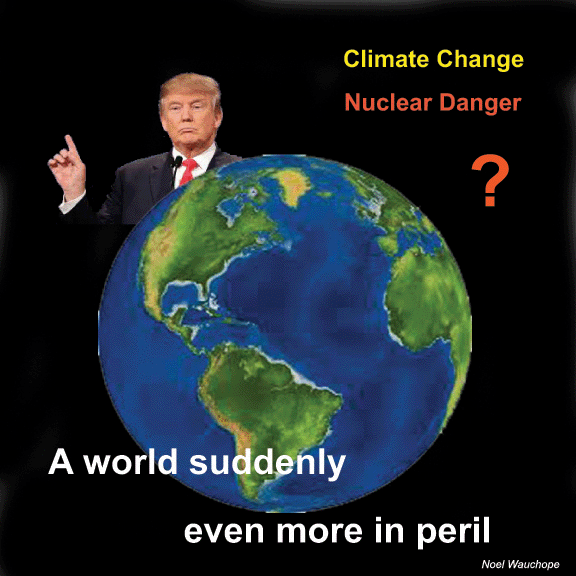
Trump Drops Climate Threats from National Security Strategy, Scientific American, The president claimed yesterday that the true danger to U.S. security is not climate change, but regulations By Jean Chemnick, ClimateWire on December 19, 2017President Trump argued yesterday that the true threat to national security is not climate change but regulations that get in the way of U.S. economic and energy “dominance.”
Trump introduced his first National Security Strategy, in which he broke from the Obama administration in not listing climate change as a chief threat. His remarks at times sounded like an economic address, frequently veering into discussion of tax and trade, industrial deregulation, and a celebration of the stock market. Trump insisted that wealth and national security go hand in hand.
“Economic vitality, growth and prosperity at home is absolutely necessary for American power and influence abroad,” he said in an address that heavily focused on global competition over cooperation……
It was a sentiment that permeated the 56-page security strategy, and in particular the section titled “Embrace Energy Dominance,” which dealt with energy and climate issues…….
A former North Korean soldier told the Japanese daily there have been unconfirmed reports that a director of Bureau 131 was recently removed from his position then executed for allegedly disclosing military secrets.
Bureau 131, or the General Bureau of Atomic Energy, is a subsidiary of the ruling Worker’s party, responsible for construction works on the North’s major nuclear and missile facilities, including the main nuclear test site of Punggye-ri and the Tongchang-ri missile launch pad.
The director is believed to have worked as a specialist at the bureau since its establishment. The Asahi report suggests his sentence may have been delivered due to the delayed timing of the regime’s sixth nuclear test, and the collapse of tunnels following the massive underground blast.
A source told the paper, “It seems he took the blame as the prolonged mining of the nuclear facility pushed back the test date to September when it was initially set for spring.”
North Korea conducted its sixth and largest nuclear test at the Pyunggye-ri nuclear facility on September 3, claiming to have tested a powerful hydrogen bomb.
The artificial explosion reportedly caused buildings and grounds in the vicinity to collapse, and has since triggered a series of landslides and aftershocks.
Updating and cleaning up Dutch nuclear industry could cost state €400m http://www.dutchnews.nl/news/archives/2017/12/updating-and-cleaning-up-dutch-nuclear-industry-could-cost-state-e400m/Updating the Netherlands nuclear industry could cost the state up to €400m, according to a review by four senior civil servants and quoted in Tuesday’s Volkskrant. Officials from the economic affairs, health, environment and finance ministries were asked to assess the cost of the clean-up and update by previous health minister Edith Schippers.
They say the biggest financial hit will come from demolishing the Dodewaard nuclear power station which was shut down in 1997. The government has insisted until now that the bill is paid by the power station’s shareholders, which include Vattenfall, the Volkskrant points out. However, the report indicates civil servants now assume the shareholders will default and put the cost of that project to the state at up to €200m.
A further €100m will be needed to deal with nuclear waste created at the Petten reactor – which makes medical isotopes. That waste is currently stored above ground near the Borselle nuclear power station and the state has paid €200m towards disposing of Petten’s waste over the past 20 years, the report says. In addition, the officials say that a ‘rough estimate’ of €60m to €100m will be needed to build a new reactor at Petten – another issue which the state has always assumed will be privately funded.
Confidential The Volkskrant says the report is notable because it is virtually identical to one sent to parliament in July, although that report did not contain the financial details. At the time, a finance ministry spokesman told the paper the figures were confidential. However, the paper has now been published on the website containing all the documents used during the formation of the current government and was spotted by anti-nuclear power group Laka. Laka spokesman Dirk Bannink said the report shows that the nuclear industry cannot exist without state support. ‘The government has to step in every time,’ he said.
** French state-controlled utility EDF’s CEO Jean-Bernard Levy tells Ouest France daily that EDF can no longer build new nuclear reactors in France without state support.
Asked when EDF could build new reactors at home, Levy says “Henceforth, we cannot build new reactors without adequate regulation providing guaranteed income”. He said that Flamanville was launched at a time of high power prices and that now all power sources, nuclear as well as renewable, need to get the same visibility on sales prices.
** For its project to build two EPRs in Hinkley Point, Britain, EDF has obtained an EU-approved state-guaranteed price of 92.5 pounds per megawatt-hour over 35 years, which is way above current market prices.
** The centrist government of French President Emmanuel Macron is not talking about building new nuclear reactors, but about closing old reactors in order to reduce the share of nuclear energy in French power generation to 50 percent by around 2035 from 75 percent today.
** Asked when the first Areva-designed EPR reactor could start up, Levy said ”that should be in a few weeks in China. The start-up will be gradual, to make sure everything works well.
** Levy said EDF expects to get approval to charge nuclear fuel in its Flamanville reactor at the end of 2018. He said that once operational, Flamanville will be a good showcase to sell nuclear reactors in Asia.
Plans for major nuclear power station in Wales win green light, Office for Nuclear Regulation approves design for new reactor at Horizon Nuclear Power’s plant at Wylfa, Anglesey, Guardian, Adam Vaughan, 13 Dec 17, Plans for a major new nuclear power station in Wales have taken a crucial step forward as UK regulators approved the project.
The Office for Nuclear Regulation and two other government bodies gave the green light on Thursday for the Japanese reactor design for Horizon Nuclear Power’s plant at Wylfa, marking the end of a five-year regulatory process……
Attention will now turn to financing the Hitachi-backed project on the island of Anglesey, which was the site of Britain’s oldest nuclear plant until it closed two years ago.
During a visit by UK ministers to Japan last December, it emerged that London and Tokyo were considering public financing for Wylfa. This would be a significant break with the UK government’s previous approach.
Hitachi has already spent £2bn on development. Last week the consortium said it needed a financial support package by mid-2018 or it could stop funding development.
Japan’s Toshiba has bowed out of the race to build nuclear plants in the UK, confirming last week that a South Korean nuclear firm had been chosen to buy its venture to build a plant in Cumbria.
Critics Of Plant Vogtle Say Georgia Doesn’t Need New Nuclear, WABE, MOLLY SAMUEL • Next week, Georgia regulators will decide on the future of the country’s only nuclear power construction project.
One big issue is how much completing the expansion at Plant Vogtle will cost, after years of delays, rising prices and the bankruptcy of the lead contractor – and how much of that cost Georgia Power ratepayers are likely to bear.
But another question is, does Georgia even need two additional nuclear reactors?………
the demand for energy didn’t grow as much as Georgia Power projected when it began the Vogtle expansion. The Great Recession took a bite out of business growth and the ensuing expected energy need. Increasing use of energy-efficient appliances has made a difference, too, according to energy consultant Matt Cox, CEO of the Greenlink Group.
“Georgia’s GDP has been growing pretty healthily for the past several years while our electricity consumption has not been doing the same,” Cox said.
According to Cox’s calculations, Georgia Power could get by without the Vogtle expansion. He said the company could boost energy efficiency, add more renewables and buy power from other companies.
Cox testified this week at the Georgia Public Service Commission’s hearings on Plant Vogtle on behalf of critics of the project…….
Georgia is the only state in the nation with active nuclear power construction. Earlier this year, South Carolina utilities canceled a similar expansion project. That leaves Vogtle as the only project left of what was supposed to be a “nuclear renaissance.”
“No one in their right mind would start a new nuclear plant from scratch today. It’s twice as expensive as other ways of providing the same energy needs,” said Peter Bradford, a professor at Vermont Law School who served on the U.S. Nuclear Regulatory Commission. He also testified on behalf of Vogtle critics at the hearings this week.
“Even half-finished, it’s not at all clear that it isn’t cheaper to cancel and meet the needs some other way,” he said.
New Jersey’s electric utilities would be required to purchase credits from nuclear power plants to help rescue the industry under new legislation. U.S. News, By MICHAEL CATALINI, Associated Press, 15 Dec 17 TRENTON, N.J. (AP) — New Jersey‘s electric utilities would be required to pay for credits from nuclear power plants under legislation lawmakers unveiled Friday as part of an effort the state’s largest energy company says is needed to rescue a major source of power in the state’s energy grid.
PSEG said that its two nuclear plants account for between 40 and 50 percent of electricity production in New Jersey, but are in danger of becoming financially unviable within two years. They said that would cost the state 1,600 jobs.
The financial rescue effort, which has been done in other states like New York and Illinoisas well, has garnered significant opposition from consumer groups and environmental organizations.
“This bill is a direct subsidy from the ratepayers hidden in gobbledygook,” said New Jersey Sierra Club director Jeff Tittel………….
A TV, radio and online ad campaign has also emerged surrounding the issue in New Jersey, with PSEG financing commercials touting the value of nuclear power and the AARP backing ads showing people concerned over higher utility bills.
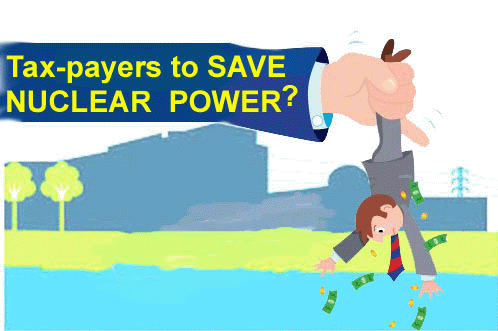
By Mary Barber | Bio | Published: December 12, 2017 The New Jersey State legislature is entertaining a lame duck proposal by the Public Service Enterprise Group (PSEG), the parent company of New Jersey’s largest utility, Public Service Gas & Electric (PSE&G) to subsidize two PSEG nuclear plants and to have it paid for by New Jersey electricity customers – in other words, a customer-funded bailout.
We don’t need a nuclear bailout, especially since the utility acknowledges that its plants are profitable. To approve subsidies for PSEG’s power plants during this time would be misguided because the company hasn’t provided any proof that their facilities are in need of financial assistance to serve customers or what, if anything, customers would get out of the deal.
Where’s the proof?
There is no proof that PSEG needs subsidies. PSEG has refused to release any information or analysis that supports the idea that their nuclear plants are struggling financially. Has PSEG opened its books so independent market analysis can be conducted, or considered how its request will affect people’s electricity bills? Has the legislature considered how this will impact clean energy investments, or jobs and economic development? The answer is no.
Who pays for what?
Bailing out these plants would surely pad PSEG’s bottom line, but what about the customers who would foot the bill?
PSEG has 2.2 million electricity customers throughout New Jersey. If this bill is passed, customers could pay $350 to $400-million dollars a year within the next 10 years. New Jersey residents and businesses will be ill-served if the focus of this debate remains solely on PSEG’s corporate strategy.
To protect customers’ interest in the future, we must consider this bailout in context, not isolation. If the bailout PSEG is requesting is granted solely to support uneconomic nuclear plants, how will that impact state investment in other clean energy alternatives like energy efficiency and solar?
How is PSEG double-dipping?
The New Jersey legislature isn’t the only venue in which PSEG is seeking a bailout. PSEG was one of a few electric utilities that submitted comments in support of U.S. Energy Secretary Rick Perry’s proposed rulecurrently before the Federal Electricity Regulatory Commission (FERC) to prop up aging coal and nuclear plants, rather than allowing market competition.
Secretary Perry’s proposal has attracted nearly universal opposition – from gas, solar and wind companies, Democrat and Republican members of Congress, conservative organizations, environmental and consumer advocacy groups, free-market advocates, and others in the business community. It’s not an exaggeration to say the only groups that support the Department of Energy’s proposal are those in the coal or nuclear industry who stand to benefit or those lobbying on their behalf. In fact, several utility companies that own fossil fuel assets came out against the DOE proposal because they believe in competitive markets.
Where do we go from here?
Let’s slow down. There are legitimate reasons to be concerned about the premature retirement of these plants, including the loss of low carbon-emitting energy sources before the transition to clean energy is complete and the loss of jobs and contributions to the local tax base. But the issues are complex and can’t be considered in a rushed lame duck legislative session.
Before the debate continues, and certainly before there’s any decision on whether or not to provide subsidies, PSEG must provide proof that its plants are in financial distress, and an independent analysis using all available market data must be conducted.
Moving in favor of PSEG’s proposed bailout now would put the state’s economy and energy future on the wrong course. These issues are too complex and too important to be rammed through.







 nuclear-news