South Carolina’s Base Load Review Act, even Florida’s, – a licence for the nuclear industry to rip off the people
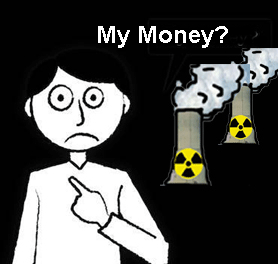
 Lessons from Florida’s nuclear failure, https://www.aikenstandard.com/guest-editorial-lessons-from-florida-s-nuclear-failure/article_d9f06eea-ec33-11e7-9362-eb50c4bd1cba.html 31 Dec 17, It’s a story all too familiar to millions of South Carolina electric ratepayers.Some $381 million in lost construction costs; $1.3 billion to shut down an existing nuclear power plant; $871 million for a nuclear project that never even broke ground. Those and other disasters will cost Florida ratepayers about $6 billion over the next few decades.
Here in South Carolina, Santee Cooper and SCE&G customers could be stuck paying as much as $9 billion over the next six decades for two new nuclear reactors that will never generate electricity unless lawmakers and regulators effectively intervene on their behalf.
In South Carolina, that law led to one massive failure. In Florida it contributed to a handful.
The lesson from Florida is that South Carolinians remain vulnerable until the Base Load Review Act is either repealed or significantly modified. Until then, utilities in the state could theoretically use it to advance other major projects while leaving customers on the hook for the cost.
That shouldn’t be allowed to happen.
Interestingly, Florida never actually repealed its law. Instead, lawmakers added two key words in 2013 that set a much higher bar for getting new projects off the ground – “reasonable” and “feasible.” No nuclear projects have been proposed since then.
It’s almost inconceivable that a law should have to state that building a new nuclear reactor on the backs of millions of ratepayers should be “reasonable” and “feasible.” Any business would be incredibly foolish to pursue such a massive investment that didn’t meet such a minimal standard.
But the BLRA and its Florida equivalent allow, and in fact encourage, utilities to go big by removing any economic risk associated with inherently risky investments.
That was deeply misguided in 2007. It seems unfathomably wrongheaded now in the wake of so many high-profile failures across the Southeast.
In South Carolina, utilities must prove that their nuclear costs were “prudently incurred” before passing them on to customers under the BLRA. SCE&G and Santee Cooper did not likely meet even that low bar.
But work proceeded, customers continued to pay higher rates, and utility executives kept telling lawmakers and regulators that construction on the reactors was proceeding appropriately. That’s certainly not “prudent.”
Lawmakers must now make it a priority when they return to session in January to help SCE&G and Santee Cooper customers recover as much money as possible and avoid paying higher electric bills for decades for a failure that was entirely out of their hands.
They must also undo the law that made that failure possible in the first place. Otherwise – as in Florida – South Carolina’s first nuclear disaster might not be its last.
No comments yet.
1 This Month





PLEASE OPPOSE HR 8255 AND S.3639 – bills would accelerate satellite deployment, with no environmental review or safeguards – https://ncstd5li.quorum.us/campaign/169331/
To see nuclear-related stories in greater depth and intensity – go to https://nuclearinformation.wordpress.com
-
Archives
- October 2026 (81)
- September 2026 (339)
- August 2026 (330)
- July 2026 (355)
- June 2026 (287)
- May 2026 (306)
- April 2026 (356)
- March 2026 (251)
- February 2026 (267)
- January 2026 (308)
- December 2025 (358)
- November 2025 (359)
-
Categories
- 1
- 1 NUCLEAR ISSUES
- business and costs
- climate change
- culture and arts
- ENERGY
- environment
- health
- history
- indigenous issues
- Legal
- marketing of nuclear
- media
- opposition to nuclear
- PERSONAL STORIES
- politics
- politics international
- Religion and ethics
- safety
- secrets,lies and civil liberties
- spinbuster
- technology
- Uranium
- wastes
- weapons and war
- Women
- 2 WORLD
- ACTION
- AFRICA
- Atrocities
- AUSTRALIA
- Christina's notes
- Christina's themes
- culture and arts
- Events
- Fuk 2022
- Fuk 2023
- Fukushima 2017
- Fukushima 2018
- fukushima 2019
- Fukushima 2020
- Fukushima 2021
- general
- global warming
- Humour (God we need it)
- Nuclear
- RARE EARTHS
- Reference
- resources – print
- Resources -audiovicual
- Weekly Newsletter
- World
- World Nuclear
- YouTube
-
RSS
Entries RSS
Comments RSS


Leave a Reply