Populists May Rip Up Sweden’s Nuclear Code of Conduct, Bloomberg, By Jesper Starn,
Five party bi-partisan agreement from 2016 under threat
Energy system will be tested this winter after atomic closures
Sweden’s biggest ever cross-party energy deal was designed to provide stability for utilities for almost three decades, but the 2016 accord is now at risk of being ripped up after next month’s general election.
The Sweden Democrats, which some polls show could emerge as the biggest party, would revoke nuclear-plant closures central to the agreement if they came to power. The Christian Democrats, one of the accord’s co-signers, on Tuesday echoed that view and pressed for key parts of the deal to be renegotiated.
The agreement ended more than 30 years of bickering over nuclear power, extended support for renewable energy and stated that there should be zero emissions impacting the climate by 2045. It effectively boosted the lives of the nation’s six newest reactors until at least 2040, but didn’t address how the capacity of four older Vattenfall AB and EON SE units will be replaced. …….https://www.bloomberg.com/news/articles/2018-08-16/nuclear-revival-talk-could-upend-historic-swedish-energy-accord
Ontario Clear Air Alliance 9th Aug 2018 Unsurprisingly, the Canadian Nuclear Safety Commission (CNSC) has approved
a ten-year extension to the aging Pickering Nuclear Station’s operating
licence, meaning the plant can now operate until 2028.
It took the CNSC less than five weeks to review – and dismiss – dozens of submissions
pointing out the Pickering Station’s terrible location surrounded by
millions of people, the lack of thorough emergency planning despite 50
years of operations, and the absence of plans for better dealing with the
tonnes of radioactive waste stockpiled at the plant with nowhere to go.
Instead, the CNSC came down in favour of submissions such as one made by
Ontario Power Generation that claimed that no one had been harmed by the
massive radiation releases from the Fukushima accident and that “some
radiation” is actually good for you! http://www.cleanairalliance.org/licence/
Nation Cymru 13th Aug 2018, Plaid’s leadership contest is an opportunity to banish the nuclear
elephant in the room. Given the contempt shown by Labour for Wales after
twenty years of rule, and the systematic neglect by successive governments
in London, voters should be turning to Plaid en masse for the first time.
And yet what will they turn to find? A party in the middle of a leadership
contest. But if we must have a leadership contest, let’s turn it into a
positive and clarify, if not solidify, the party’s message and policies
with no compromises. The Plaid leadership contest is an opportunity to
banish the nuclear elephant in the room once and for all. Nuclear power has
to be and needs to be a central part of the debate during the leadership
election.
If not now, when? This issue cannot be allowed to undermine the
party, its current or future leaders any longer; it has become Plaid’s
ball and chain. How can we welcome voters old and new to believe manifesto
promises or have faith in any single AM, MP or Councillor when the party is
simultaneously against and pro one of the biggest issues of our time?
Nuclear power is a great distraction from Plaid Cymru’s progressive
politics and progressive energy policies, a black hole sucking time and
resources Wales doesn’t have, denying communities and the country a real
chance of a sustainable and secure future. How can any party simultaneously
be pro-independence and seriously entertain or endorse any new nuclear
build?
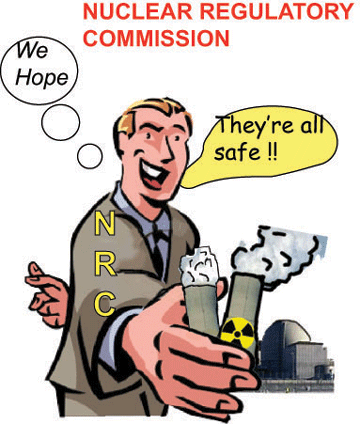
A group of senators recently sent a letter to the Nuclear Regulatory
Commission (NRC) expressing concern over a draft proposed rule on nuclear
power plant decommissioning that has been presented to the commissioners
for review.
The rule includes proposed changes to emergency preparedness,
physical security, cyber security, funding assurance, financial protection
requirements and environmental considerations, among other issues.
Sens. Edward J. Markey (D-MA), Bernie Sanders (I-VT), Kirsten Gillibrand (D-NY),
and Kamala Harris (D-CA) said in their letter to NRC Chair Kristine L.
Svinicki that the rule would limit the general public’s opportunity to
participate in the decommissioning process.
They also wrote that the rule does not adequately address concerns about the long-term storage of spent
nuclear fuel and reduces financial protections, especially in case of an
accident, which increases financial risk for taxpayers and communities.
“By failing to propose a comprehensive set of decommissioning and cleanup
regulations, by automatically approving facilities’ exemptions from
safety, security and emergency planning regulations, and by continuing to
rubber-stamp the industry’s post-shutdown decommissioning activities
report, as currently drafted, this proposed regulation would abdicate the
NRC’s responsibility to ensure the safety of these plants,” the
senators wrote.
“This is more an absence of rulemaking than a rule that
will affirmatively guide plants and communities through the decommissioning
process.”
Transportation Eyed for State Role Nuclear watchdogs concur that the federal government doesn’t need New Mexico’s approval to award a license. But the state could do more to stop the project’s progress if leaders want to.
The cities of Albuquerque and Las Cruces, as well as Bernalillo County, have voted to formally oppose Holtec’s project.
A proposed nuclear storage project in Utah, for example, received a license but never accepted waste after opponents there raised questions about transportation, as well as other concerns.
New Mexico’s attorney general thinks the state can do little to stop Holtec International’s application to temporarily store high-level waste from commercial nuclear reactors, but that doesn’t deter critics of the project.
A state lawmaker and an environmentalist, who oppose the project to store the toxic trash in New Mexico before it is buried forever at Nevada’s Yucca Mountain or another site, said they believe the state—and not just the federal Nuclear Regulatory Commission—can exert some influence over the Holtec project’s future.
New Mexico Attorney General Hector Balderas (D) recently assessed the state’s role in regulating Holtec’s plan to store the radioactive materials in rural southeast New Mexico near the the Waste Isolation Pilot Plant (WIPP). An Energy Department facility that stores a different type of nuclear waste generated from weapons production, WIPP was subject to some state reviews before opening in 1999.
Holtec has an application before the NRC for a temporary place to keep nuclear waste from commercial power plants throughout the U.S. while the federal government develops permanent storage deep underground. There’s no timeline for permanent storage, as work on Yucca Mountain has long been stalled and has been met with
Intense opposition from Nevada lawmakers.
The plan to consolidate used fuel in New Mexico has drawn support for its potential economic impact and criticism for a range of health of safety concerns. Candidates running in November to replace Gov. Susana Martinez (R) have had conflicting views on the project.
But of all the factors that the NRC considers when awarding a license for temporary storage, “state approval is not among them,” said the attorney general’s July 19 letter, released to Bloomberg Environment under New Mexico’s public-records law.
Federal Law Governs Project
State Sen. Jeff Steinborn (D), who requested the attorney general’s opinion, told Bloomberg Environment the answers are “troubling.” Steinborn chairs a legislative committee on radioactive materials that has held hearings on Camden, N.J.-based Holtec’s proposal.
Steinborn said he’s “basically opposed” to the project given unanswered questions on the impacts to the state. He wants New Mexico to take an active role in the license review process and said the state can’t “put its head in the sand.”
Prior litigation shows the NRC can license the temporary storage facilities, said the attorney general’s letter, signed by Assistant Attorney General John Kreienkamp. Federal law pre-empts state laws when it came to nuclear waste regulation, he wrote.
The NRC, though, does provide protection against Holtec abandoning the site by requiring licensees to plan for and financially back eventual decommissioning. State tort law may help if people were injured or sickened by Holtec’s operations, the opinion said. ………
Transportation Eyed for State Role
Nuclear watchdogs concur that the federal government doesn’t need New Mexico’s approval to award a license. But the state could do more to stop the project’s progress if leaders want to, Don Hancock, director of the nuclear waste safety program and administrator at the Albuquerque environmental group Southwest Research and Information Center, told Bloomberg Environment.
Hancock, who opposes the proposal, said Holtec would need New Mexico’s cooperation elsewhere, such as help with moving nuclear waste through the state. A proposed nuclear storage project in Utah, for example, received a license but never accepted waste after opponents there raised questions about transportation, as well as other concerns.
“They do have mechanisms to do it outside the licensing process,” Hancock said of New Mexico officials.
The cities of Albuquerque and Las Cruces, as well as Bernalillo County, have voted to formally oppose Holtec’s project. Gubernatorial candidate Michelle Lujan Grisham (D) has spoken against it, while challenger Steve Pearce (R) said it could boost the state economically……..
states have limited authority to regulate projects such as what Holtec is proposing compared to other kinds of hazardous waste, Geoffrey Fettus, senior attorney at the nonprofit Natural Resources Defense Council, told Bloomberg Environment. Fettus was an assistant attorney general in New Mexico in the 1990s and works on nuclear waste issues.
The Natural Resources Defense Council has recommended giving states more power.
The NRC is starting to review the environmental impacts of the Holtec proposal. The public can request a separate hearing on the plan through Sept. 14, which would put Holtec’s application in front of judges from the commission’s Atomic Safety and Licensing Board Panel.https://www.bna.com/holtec-nuclear-waste-n73014481533/
Why has China’s nuclear expansion programme stalled? By Compelo Staff Writer, 9 Aug 18, Completion of the first EPR and AP1000 reactors in China marks a major milestone, but, as Steve Kidd of East Cliff Consulting explains, the nation’s ambitious nuclear expansion programme is no longer on track. Many of the negative factors which have affected nuclear programmes elsewhere in the world are now also equally applicable in China. Despite many new reactors starting up, it is clear that the programme has continued to slow.
The most obvious sign of this is the lack of approvals for new construction starts. There have been no new approvals for approaching three years, so the number of reactors under construction has been falling sharply. Other indications of trouble are:
uncertainties about the type of reactor to be utilised in the future
the position of the power market
the structure of the industry with its large state-owned enterprises (SOEs)
the degree of support from state planners and the level of public opposition to nuclear plans.
where China now stands with its planned transition to advanced reactors and a fuel reprocessing strategy.
Over-supply and the AP1000 reactor
Start-ups of two imported Gen III reactor designs (Westinghouse AP1000 and the Areva EPR) are now happening at last, but the delays no doubt concerned the regulatory authorities. The problems with the AP1000 (at Sanmen and Haiyang) are the more serious, as this reactor was destined for most of the future sites in China. Although the units at both sites are now ready to enter commercial operation, this is unlikely to bring forward a flood of new approvals. China has suffered a severe dent in its confidence in the AP1000, not helped by Westinghouse’s US bankruptcy. The authorities now no doubt wish to see clear evidence of successful operation before authorising more units. There may be further reactors at the two existing sites, but there are many others that have been “ready to go” for several years now.
Another important reason for the slowdown relates to the size of nuclear programme China needs. Problems of power over-supply in particular regions are now pressing and connected to the continued construction of coal generating stations and the rapid expansion of wind and solar power. There are important questions to be resolved about how many reactors are needed to satisfy power demand and the price that can be paid for their electricity. Nevertheless, most of the Chinese nuclear companies want to build lots of new units and feel they are being held back by the authorities. The rapid expansion of wind and solar generating capacity has reminded the planners that there are alternative means of achieving environmental goals, while the Chinese hydroelectric programme is still enormous.
The shadow of Fukushima
The Fukushima accident still casts a significant shadow over the nuclear sector in China and regulators are clearly very cautious about having a big nuclear programme. Ultimately one person at the top of the regulatory authority has to take responsibility for safety and having 100 reactors in operation is far more burdensome than 20 or 40. South Korea’s apparent turning away from nuclear and the tardiness of Japanese reactor restarts are also unhelpful in inspiring confidence in the region.
China’s nuclear programme is now much harder to assess. The picture up to 2020 is fairly certain, as units under construction come into operation). The 58GW capacity target by end-2020 will be missed by perhaps 5GW, but more serious is another goal – having 30GW under construction by then. This would imply a programme of six reactors a year up to 2025, a similar level to 2015-2020. Almost all will have to be approved before the end of 2020. On recent trends, this looks unlikely and so it may be prudent to assume a programme of only 3-4 units per year beyond 2020. This means nuclear generating capacity of only 90GW or so by 2030, well below previous expectations. Beyond then it is difficult to judge, but the chance of China having a huge nuclear programme by 2050, perhaps consisting of 200-400 reactors, is much less than a few years ago. Estimates that China may move ahead of the USA in nuclear generating capacity by the mid or late 2020s now look wide of the mark. Even if 10-20 US units do eventually shut down by 2030, it could happen after then.
The dent in confidence surrounding the imported Gen III designs has been overcome, to some extent, by China’s development of the Hualong reactor, which satisfies the regulators’ insistence that all approved designs are at the Gen III level. Four units are now under construction in China (plus two in Pakistan). The two units being built by CNNC at Fuqing are on schedule to go online in 2020-2021, but CGN’s pair at Fangchenggang are apparently unlikely before 2021-2022. Whether Hualongs will replace AP1000s at any of its sites in China remains to be seen.
Big questions surround the CAP1400, the larger version of the AP1000, which China has developed, and the extent of the programme for high-temperature gas-cooled reactors (HTGRs) and small modular reactors (SMRs).
Approval of construction of the initial CAP1400s has been long-delayed and surely still awaits the regulator’s satisfaction with the AP1000. It appears that the HTGRs and SMRs will remain as marginal components of the main Chinese nuclear programme, but may offer useful additional export opportunities. The economics of the HTGRs are apparently questionable versus large LWRs, while there are lots of SMR designs around the world without anyone committing to build them.
Economic issues
Perhaps surprisingly, a big issue today affecting the Chinese nuclear programme is its economic viability. With nuclear power only currently representing 3-4% of China’s electricity supply, one would think that there is still plenty of room for dramatic growth. However, the slowing of the Chinese economy and the switch to less energy-intensive activities, together with over-investment in power generation capacity, means that there is now more than can be carried in the grids in some provinces. It cannot therefore be assumed that new nuclear units will run at the 80-90% capacity factors necessary to pay back the funds invested in their construction.
Tariffs that producers receive when they sell power to the grid are also under threat. The central government wishes to liberalise the Chinese power sector and make it more responsive to economic criteria and this may not help nuclear. The rising costs of building Gen III units are also a factor. Reactors may have to load-follow, which is not ideal in the technical or economic sense. Nuclear has to compete against other generation options…………
Power to the people
Many people used to believe that because China is a centrally-planned economy with a strong one-party government, public opinion did not matter much and any opposition to nuclear could be easily overcome. Nothing could be further from the truth. Public opinion matters a great deal in China and politicians fight shy of any issue that could inflame public opinion in any way. The last thing the Chinese government wants is people protesting on the streets – and this has already happened with two proposed fuel cycle plants. Both were quickly cancelled.
One particular public acceptance problem is inland sites for nuclear plants. Having imposed a moratorium on these for now (in fact to slow the nuclear programme down), the government has made a huge problem for itself by giving the impression that these sites are “second best” and maybe not as safe as the coastal sites (where all current Chinese reactors are located).
The threat in China is that nuclear may become no more than a niche, bridging technology, as a route to something better in the future.
This article originally appeared in Nuclear Engineering International.
Rick Perry Rejects Facts in Favor of Coal and Nuclear Bailouts, Union of Concerned Scientists, JEREMY RICHARDSON, SENIOR ENERGY ANALYST | AUGUST 9, 2018
As is typical with this administration, substance and science and evidence are inconsequential compared to ideology, and their attempts to bail out money-losing coal and nuclear plants are no exception. Here’s a quick take on how we got here and what to expect next…….
LET’S SEE WHAT STICKS…
THE ADMINISTRATION DIDN’T EXACTLY HIT THE GROUND RUNNING AFTER THE 2016 ELECTION—NO ONE BOTHERED TO SHOW UP AT THE DEPARTMENT OF ENERGY UNTIL AFTER THANKSGIVING OF 2016, EVEN THOUGH CAREER STAFF WERE READILY AVAILABLE AND PREPARED TO BRIEF THE INCOMING ADMINISTRATION ON THE IMPORTANT WORK OF THE AGENCY. BUT BY THE SPRING, IT HAD BECOME CLEAR THAT ENERGY SECRETARY RICK PERRY WOULD BE THE FRONT-MAN IN LEADING THE CHARGE FOR A FEDERAL BAILOUT OF COAL AND NUCLEAR PLANTS. HIS SHIFTING RHETORIC AND POOR JUSTIFICATIONS FOR USING CONSUMERS’ MONEY TO PROP UP UNECONOMIC COAL PLANTS SUGGESTS THAT HE AND HIS INNER CIRCLE ARE DESPERATE TO FIND AN ARGUMENT THAT STICKS AND SURVIVES LEGAL CHALLENGES.
JULY 2017: A LEAKED VERSION OF THE DRAFT GRID STUDY SUGGESTS THAT DOE CAREER STAFF WERE PUTTING TOGETHER AN UNBIASED REPORT IN SPITE OF TREMENDOUS POLITICAL PRESSURE.
AUGUST 2017: THE FINAL GRID STUDY CONCLUDES THAT CLOSURE OF COAL AND NUCLEAR PLANTS DO NOT THREATEN RESILIENCE AND RELIABILITY, NOT EXACTLY THE CONCLUSION PERRY WAS LOOKING FOR. THE STUDY FINDS THAT THE GRID IS OPERATING RELIABLY WITH HIGH LEVELS OF RENEWABLES AND THAT LOW NATURAL GAS PRICES WERE LARGELY TO BLAME FOR RECENT PLANT RETIREMENTS. BUT, IN A HINT OF THINGS TO COME, IT DOES SUGGEST EXPLORING THE IDEA OF “UTILIZING EXISTING FEDERAL AUTHORITIES UNDER THE FEDERAL POWER ACT … TO ENSURE SYSTEM RELIABILITY AND RESILIENCE” AND HAVING STATES USE REGULATORY AUTHORITY “TO SUPPORT SPECIFIC AT-RISK PLANTS THAT CONTRIBUTE TO SYSTEM RESILIENCE.”
SEPTEMBER 2017: PERRY PUSHES FORWARD. UNDETERRED BY THE CONCLUSIONS OF THE STUDY HE REQUESTED AND EVIDENTLY UNINTERESTED IN FURTHER RESEARCH, PERRY ASKS THE FEDERAL ENERGY REGULATORY COMMISSION (FERC) TO GUARANTEE PROFITS FOR COAL AND NUCLEAR PLANTS UNDER THE GUISE OF ENSURING A RELIABLE AND RESILIENT GRID.
MAY 2018: AN INTERNAL MEMO LEAKS ON MAY 31. IT REVEALS THE ADMINISTRATION’S PLANS TO USE EMERGENCY POWERS, UNDER THE KOREAN WAR-ERA DEFENSE PRODUCTION ACT AND THE FEDERAL POWER ACT, IN ORDER TO BAIL OUT THE MONEY-LOSING COAL AND NUCLEAR PLANTS, WHICH TOOK FERC BY SURPRISE. THE NEW RATIONALE IS THAT THESE PLANTS ARE VITAL FOR NATIONAL SECURITY AND THAT WITHOUT THEM, THE ELECTRICITY SYSTEM WOULD SOMEHOW BE MORE VULNERABLE TO CYBERATTACKS.
JUNE 2018: THE LEAK PROMPTS THE WHITE HOUSE TO RELEASE A STATEMENT ON JUNE 1 DIRECTING PERRY TO “TAKE IMMEDIATE STEPS TO KEEP BOTH COAL AND NUCLEAR PLANTS RUNNING” ON THE BASIS OF NATIONAL SECURITY.
IN SHORT, THE ADMINISTRATION IS PROPOSING TO USE EMERGENCY AUTHORITIES TO FORCE GRID OPERATORS AND CONSUMERS TO BUY ELECTRICITY FROM UNECONOMIC COAL AND NUCLEAR PLANTS. LET’S BREAK DOWN THE ARGUMENTS ONE BY ONE. …….
Led by Secretary Perry, the administration continues to make false and misleading arguments about the purported need for keeping uneconomic plants from retiring early—and this issue will be with us as long as the current president is in office. ……
After U.S. Energy Secretary Rick Perry came to Oswego County last week to praise the state’s support of nuclear power plants, several environmental groups and New York politicians sent a letter to state leaders saying the opposite.
The idea of using public dollars to keep financially struggling nuclear power plants afloat because they don’t emit carbon dioxide was never popular among some environmental groups that consider the facilities dangerous and dirty because of the radiation and nuclear waste they create. So when the New York Public Service Commission (PSC) voted two years ago to bail them with about $8 billion in fees on consumer’s energy bills, they left the door open to a potential compromise.
Then-chair of the PSC Audrey Zibelman said they would look at letting customers opt into a program to buy 100 percent of their energy from clean, renewable sources instead of paying into the system that supports the nuclear subsidies. Jessica Azulay with the Alliance for a Green Economy says it’s time for the state to make good on that promise.
“What this letter does that we filed with the governor and the chair of the Public Service Commission is to try to win the right for consumers to decide that they no longer want to pay this extra money toward nuclear energy and they want to instead adopt 100 percent renewable energy,” Azulay said. “We think that this is a really common sense approach – maybe a first step – in reversing the nuclear subsidies by allowing people to vote with their dollars and really create the pathway for renewable energy to accelerate in New York and phase out the nuclear reactors.”
To date, the nuclear subsidies have cost New York ratepayers about $650 million. A spokesperson for the PSC says the price would be even greater had the plants been allowed to shut down because they could have been replaced with fossil fuels that would have emitted carbon dioxide, setting back the state’s goals to lower carbon dioxide emissions 40 percent by 2030.
Dave Toke’s Blog 7th Aug 2018 So finally the Government has, after I feared so long it would, chosen the
doomsday option to fund new nuclear power stations – one that will be
disastrous for the consumers and taxpayers.
After years of swearing that
they would not offer subsidies to nuclear power, and saying that in the
future the terrible drain of (historical) over-spending on nuclear power
would stop, the Government has gone back to square zero.
Essentially, under
the Government’s proposals for so-called ‘Regulated Asset Base’ (RAB) of
funding nuclear power (described in a recent article in ‘Unearthed’, a
Greenpeace publication), the nuclear developers will have no real limit on
what they can spend to build the power stations. It is a recipe for
national disaster.
No private developer is willing to take the construction
risks of funding nuclear power in the UK, whatever ‘strike price’ is
offered for the electricity that might be generated in future. Doesn’t that
tell you something?
So EDF stepped up to the mark. EDF, the French
state-owned company, may be starting the real part of the construction of
Hinkley C in 2019/2020. The French state will pay for the inevitable cost
overruns that come along with building the plant, combined quite probably,
with an out-of-contract bailout by the British Government when the going
gets tough.
But now the Government is casting around for another nuclear
power plant to be built, – Wylfa or Sizewell C – but neither developer
(Hitachi or now EDF) wants to take the risk of paying the almost inevitable
losses on the project. So enter the Government’s new proposals which will
no doubt be promoted as a simple accountancy trick to lower costs, but hide
the fact that the state will take the losses, to be divided up between us
as taxpayers (loss of guaranteed loans and construction risk guarantees)
and electricity consumers (advance payments on top of electricity bills).
And, note this, whatever ministers may say, the exposure by taxpayers and
consumers in UNLIMITED. http://realfeed-intariffs.blogspot.com/2018/08/new-nuclear-plan-means-that-consumers.html
Trump says firms doing business in Iran to be barred from U.S. as sanctions hit,Babak Dehghanpisheh, Peter Graff, BEIRUT/LONDON (Reuters) 7 Aug 18, – Companies doing business with Iran will be barred from the United States, President Donald Trump said on Tuesday, as new U.S. sanctions took effect despite pleas from Washington’s allies.
Iran dismissed a last-minute offer from the Trump administration for talks, saying it could not negotiate while Washington had reneged on a 2015 deal to lift sanctions in return for curbs on Iran’s nuclear program.
Trump decided this year to pull out of the agreement, ignoring pleas from the other world powers that had co-sponsored the deal, including Washington’s main European allies Britain, France and Germany, as well as Russia and China.
Unearthed 6th Aug 2018 , Consumers could pay for new nuclear power plants years before they are
built. The government is considering using a controversial financing system
to build new nuclear power stations which would see customers charged for
construction costs long before a project has actually been built.
The approach, called the Regulated Asset Base (RAB) model, has been described
as an “open cheque book” for developers, as consumers could be locked
into paying the costs of a project going wrong – like construction taking
longer than planned, or prices spiraling – indefinitely until it’s
complete.
Shadow energy minister Alan Whitehead MP said: “The problem
with this model as applied to new nuclear power stations is that it
transfers all the risk of construction from the developer to the customers,
with the rather wobbly promise of benefits to come in the future.
” Like other public-private finance models, the RAB model has a sticky history.
The government has already supported the use of RAB for the Thames Tideway
Tunnel, a £4.2bn project to revamp 15 miles of sewer lines in North
London, which Thames Water says a RAB model has helped lower costs. Much of
the work around taking a RAB approach to financing nuclear power has been
carried out by Dieter Helm, professor of Energy Policy at the University of
Oxford and a figure respected by government.
Writing in a blog about the
model’s application to nuclear last month, Helm highlighted a number of
open issues – such as which regulator would set the RAB for nuclear
projects, as well as the “very severe lobbying pressures” any regulator
would come under when making its RAB evaluations. Helm concludes that the
RAB may be an efficient approach to financing nuclear power, but still
doesn’t address fundamental issues about its cost competitiveness with
other technology like wind and solar, or what do with all its radioactive
waste. “It is for society to decide whether it wants new nuclear or
not,” he said. “The market cannot decide.”
More than 120 groups push NY to lift broad nuclear subsidies. by Associated Press & CNYCentral , August 7th 2018 ALBANY, N.Y. — Some 130 environmental groups are taking aim at New York’s nuclear subsidies.
The coalition, led by the Alliance for a Green Economy, wrote to Democratic Gov. Andrew Cuomo on Monday urging him to overhaul the subsidies so New Yorkers who would prefer cleaner forms of energy can opt out. Groups including Earthjustice, the Sierra Club and Food and Water Watch signed on to the letter.
Under a two-year-old policy, New York utility customers pay extra each month to support aging upstate nuclear plants. The subsidy could raise as much as $7.6 billion over several years.
The James A. Fitzpatrick nuclear plant in Scriba, in Oswego County, was in danger of closing in 2016 just before the state announced it would subsidize the plants.
U.S. Secretary of Energy Rick Perry toured the plant with Rep. John Katko last week, where the issue of subsidies came up. Katko said he disagrees with Cuomo at times but applauded his effort to keep the FitzPatrick plant open.
President Trump appeared on Sunday to place blame for massive wildfires in California on the state’s environmental laws, including its water and forest management policies, saying that such regulations have made the blazes “so much worse.”
“California wildfires are being magnified & made so much worse by the bad environmental laws which aren’t allowing massive amount of readily available water to be properly utilized,” Trump tweeted. “It is being diverted into the Pacific Ocean. Must also tree clear to stop fire spreading!”
The president’s tweet comes as California continues to face a series of wildfires that have destroyed buildings, homes and left several people dead.
California has seen a spate of highly destructive wildfires in recent years. Fueling those fires, in part, has been a buildup of vegetation in the state, along with long droughts that dried up that vegetation.
The chair of a New Mexico legislative committee that monitors radioactive and hazardous materials in the state says he finds it troubling Attorney General Hector Balderas has concluded the state cannot legally stop a New Jersey-based company from the building a nuclear waste storage facility.
Holtec International, a New Jersey-based company specializing in nuclear storage, has applied to the U.S. Nuclear Regulatory Commission for a license to construct a nuclear waste storage facility about 35 miles (56 kilometers) east of Carlsbad.
The facility, to be located in western Lea County, could eventually store up to 10,000 shipments of spent nuclear fuel, as much as 120,000 metric tons of high-level radioactive waste, from nuclear power plants around the country. It would be stored just below the surface.
The facility is intended to be a temporary storage site, storing nuclear waste only until a permanent storage facility can be built. But opponents fear that it could become permanent because plans for a long-term repository at Yucca Mountain, Nevada, have stalled because of opposition.
Sen. Jeff Steinborn, D-Las Cruces, said Wednesday that New Mexico should have a say about the proposal and that he was disappointed in the attorney general’s opinion, The Hobbs News-Sun reports .
“It’s troubling that a project of this magnitude with this much exposure to the state — I mean exposure in the sense of the hazardous materials involved and long-term ramifications of it being here — that our state would not have a say in being able to approve it or not,” said Steinborn, who chairs interim Radioactive and Hazardous Materials Committee.
Balderas said in a letter last month the state cannot legally stop Holtec International from temporarily storing up to 100,000 metric tons of high-level nuclear waste in New Mexico.
Balderas cited the Atomic Energy Act of 1954, the Nuclear Waste Policy Act of 1982 and two court cases clearly establishing two principles.
“(F)irst, that the NRC has the statutory authority to license and regulate consolidated interim nuclear waste storage facilities, and secondly, that the comprehensiveness of that federal regulatory scheme pre-empts virtually any state involvement,” Balderas wrote.
Traditional owners “locked out” of nuclear waste vote, InDaily, 3 Aug 18 Stephanie Richards The head of the Adnyamathanha Traditional Lands Association says the majority of Adnyamathanha people have been denied a vote on a proposed radioactive waste management facility near the town of Hawker in the Flinders Rangers.
Wallerberdina Station, located approximately 30km northwest of Hawker on Adnyamathanha country, has been shortlisted by the Federal Government for a facility that will permanently hold low-level nuclear waste and temporarily hold intermediate level waste.
It is one of three sites, the other two situated close to Kimba, that were shortlisted by the Federal Government to store nuclear waste.
The selection process is entering its final stages, with a postal ballot beginning on August 20 to measure community support for the three nominated sites.
But ATLA CEO Vince Coulthard said the voting guidelines were disrespectful to traditional owners, as the majority of Adnyamathanha people do not live close enough to the proposed Wallerberdina site to be eligible to vote.
The voting range includes residents of the Flinders Ranges Council and those who live within a 50km radius of the Wallerberdina site.
According to Coulthard, there are approximately 2500 Adnyamathanha people in total but only about 300 Adnyamathanha people who live in the voting range.
Coulthard said about 50 Adnyamathanha people who lived outside the voting range had expressed interest in voting, but when ATLA asked Federal Resources Minister Matt Canavan during a consultation trip to Hawker last week if those people could be granted a vote, Coulthard said Canavan told him that only those living in the prescribed voting range could participate.
“It’s a crazy situation,” Coulthard said.
“This is Adnyamathanha country and it is a very important place to the Adnyamathanha nation.
“People have strong connections to land. There’s a large amount of people, many who don’t live on the land but they go back on a regular basis to travel around the land.”
……… Coulthard said he was disappointed that Canavan had not consulted with all ATLA members during his consultation visit.
He said Adnyamathanha people had been “locked out” from the vote, despite holding native title rights over the land.
“Canavan is saying this will strengthen our culture, that this will be good for us, but what it is actually doing is punishing the environment.
“This is a place where we have gone to get bush tucker, where we have come as traditional owners for thousands of years.
They’ve shown us disrespect and this is very hurtful.”
The proposed site holds sacred meaning for Adnyamathanha people, as it is located close to the Hookina Waterhole and ancient burial sites.
…….. Last month, the Federal Government tripled the incentive package for the community that hosts the nuclear waste repository.
The Government had promised to spend more than $10 million in the district where the facility is built, but under new incentives announced by Canavan, the Government increased funding to $31 million.









 The facility is intended to be a temporary storage site, storing nuclear waste only until a permanent storage facility can be built. But opponents fear that it could become permanent because plans for a long-term repository at Yucca Mountain, Nevada, have stalled because of opposition.


