New Ohio Bill to promote nuclear energy, exclude wind and solar
 Ohio bill would create ‘clean air’ fund to benefit nuclear, excluding wind and solar, ENERGY NEWS NETWORK, April 5, 2019
The draft legislation would create a new surcharge, with proceeds distributed to power plants that “make a significant contribution toward minimizing emissions.”
Legislation to subsidize two FirstEnergy Solutions nuclear power plants in Ohio is about to surface in the Ohio House.
Republican majority leaders have been circulating a proposal that would add up to $300 million annually to electric bills across the state, creating a state “clean air program” with grants administered by political appointees.
About $180 million would be earmarked for the FirstEnergy Solutions nuclear power plants, say analysts who have looked at the legislation. The remaining $120 million could be used to prop up other companies — though it appears those companies would not be owners of wind and solar farms.
The draft legislation, obtained by the Energy News Network, would add a $2.50 per month surcharge to every residential customer’s bill, a $20 per month surcharge to every commercial customer’s bill and a $250 monthly charge to every industrial customer’s bill.
The legislation would also eliminate existing surcharges that commercial and residential customers pay to support energy efficiency and peak reduction programs created by the utilities. Industrial customers can already opt out of these programs.
Customers who want to continue supporting the efficiency programs — on top of the new “clean air” charges — would have to notify the Public Utilities Commission of Ohio in writing.
The statewide aspect of the new proposal is a new twist to create a nuclear subsidy. Two previous legislative bailout efforts limited a nuclear surcharge to Ohio customers in FirstEnergy territory.
The draft legislation, now in its fifth revision according to its title page, doesn’t actually mention the word “nuclear” in its language.
Instead the bill would create the Ohio Clean Air Program, echoing the carbon-free argument that FirstEnergy Solutions lobbyists have been using to describe their nuclear power plants….
The funds generated by the new surcharge would not go directly to a utility or to the state’s general fund. Instead they would flow into a clean air fund to bankroll what the legislation calls the Ohio Clean Air Program.
The Ohio Air Quality Development Authority, whose members are political appointees, would run the program and designate which power plants are a “clean air resource.”
Only power plants designated as a clean air resource would be eligible for grants. Wind and solar installations that receive state tax exemptions and production tax credits would not qualify under the terms of the new legislation………
The development of the bailout legislation parallels an effort by FirstEnergy Solutions to emerge from a federal bankruptcy court debt-free and prepared to reverse its planned shutdowns of the Davis-Besse nuclear plant just east of Toledo and the Perry nuclear power plant northeast of Cleveland — if it can win a subsidy from Ohio lawmakers. FirstEnergy Solutions is running a similar legislative effort in Pennsylvania, where it owns a twin reactor plant near Pittsburgh.
Bankruptcy Judge Alan Koschik of the Northern District of Ohio on Thursday dealt a significant blow to the company’s plans to quickly get out of bankruptcy. He rejected a provision that would have indemnified FirstEnergy Crop., parent of FirstEnergy Solutions, against future costs for environmental cleanup of its former power plant sites. FirstEnergy Solutions said it would revise its plan.
EDITOR’S NOTE: This story has been updated to clarify that existing surcharges for clean energy and efficiency would be eliminated, not just made optional.
https://energynews.us/2019/04/05/midwest/ohio-bill-would-create-clean-air-fund-to-benefit-nuclear-excluding-wind-and-solar/
Democratic presidential candidate Tulsi Gabbard slams decision to sell Saudi Arabia nuclear weapons tech

 ‘How does this serve US interests?’ Gabbard slams decision to sell Saudi Arabia nuclear weapons tech https://www.rt.com/usa/455279-gabbard-saudi-arabia-extremism-isis/ 2 Apr, 2019 Tulsi Gabbard has slammed the US for allowing firms to sell Saudi Arabia nuclear tech despite its history of exporting extremism which inspires Islamic State (IS, formerly ISIS) and Al-Qaeda, which she says the Kingdom supports.
The Hawaiian congresswoman and Democratic presidential candidate took aim at the Kingdom’s history of extremism in a Twitter video that criticized Energy Secretary Rick Perry’s secret authorizations, to six US companies, allowing for the sale of nuclear power technology and assistance to Saudi Arabia, as Reuters revealed last week. Gabbard said the move is “both mind-blowing and inexplicable.”
Saudi Arabia is the “primary exporter of jihadist ideology, Wahhabi Salafist ideology that is the motivation and inspiration for terrorist groups like ISIS and al Qaeda – groups that the Saudis both directly and indirectly support,” Gabbard said.
The kingdom has been tied to Al-Qaeda and extremism in the past, with 15 of the 19 9/11 hijackers coming from Saudi Arabia, according to the CIA. In 2015, one of the alleged hijackers, Zacarias Moussaoui, claimed several members of the Saudi royal family had been listed as Al-Qaeda donors in the database he worked on under orders of Osama bin Laden, US media reported.
WikiLeaks cables from the US State Department from 2009 revealed“donors in Saudi Arabia constitute the most significant source of funding to Sunni terrorist groups worldwide.” In a 2014 email, published by WikiLeaks, then-Secretary of State Hillary Clinton said Saudi Arabia was “providing clandestine financial and logistic support to ISIL and other radical Sunni groups in the region.” It has also supplied weapons to IS in Syria.
Saudi Arabia is reportedly planning to create at least two nuclear power plants, but many are concerned that’s a precursor to developing nuclear weapons, which would further destabilize the region. It was also reported, last year, that Israel was selling Saudi Arabia nuclear secrets
Trump’s protecting of coal or nuclear plants with further subsidies will generate no public benefit.
 Trump administration should forget subsidies for coal, nuclear energy, The Hill, BY JARED WHITLEY, 04/06/19 “……… Energy Secretary Rick Perry recently visited the Vogtle nuclear power plant in eastern Georgia, where he announced that the administration would provide an additional $3.7 billion in loan guarantees to support construction of two reactors. The move leaves the government guaranteeing a full $12 billion of the project’s financing.
The Trump administration appears unwilling to let the market determine the optimal energy mix in this country. In the past two years, it has attempted to prop up failing nuclear and coal-fired power plants several times, offering up various rationales for doing so. Last year it suggestedthese fuel sources were more resistant to cyber threats, an unsure claim. The administration also put forth the argument that subsidizing coal and nuclear plants is necessary for reasons of national security, but the majority of our nation’s natural gas supply is sourced from domestic producers.
Most recently, the administration introduced language in the Economic Report of the President outlining a potential vehicle for a federal bailout. The report discussed a “voluntary reserve program” that would serve to “promote the grid’s resilience.” While all sources would be eligible to be part of a reserve, unsurprisingly the report specifically mentions nuclear and coal plants as assets that could be shown preferentially treatment given they provide alleged “greater resilience benefits.” It is little more than a solution to a problem that doesn’t exist.
The best response from this, or any, administration to the changing mix of energy prices would be benign neglect. Protecting coal or nuclear plants with further subsidies will generate no public benefit.
Wind power restricted in Ohio, while nuclear plants could get subsidy
Nuclear bailout plan should fix wind-farm restrictions https://www.crainscleveland.com/letters-editor/letter-editor-nuclear-bailout-plan-should-fix-wind-farm-restrictions Paul Dvorak, Strongsville, 7 Apr 19, The March 25 article “Bailout chances may be good for FES plants” discussed how a bailout might fix the crumbling Davis-Besse and Perry nuclear plants. One proposal, the article tells, would add $5 per month to the bill of Ohio ratepayers for an unspecified period, or about $300 million per year.
By itself, this is not a good solution to the problem because, aside from being crony capitalism, it just rewards the mismanagement of plant owner FirstEnergy Solutions. Still, it just might get a green light from the Ohio Legislature because FirstEnergy has greased the skids for its passage with generous donations to the re-election of key legislative members. Verify that for yourself at www.votesmart.org.
The Union of Concerned Scientists also voiced objections to the bailout on five grounds: 1) Safety — Davis-Besse, says UCS, has one of the worst safety records in the United States. 2) Transparency — Demonstrate a need for economic support. 3) Flexibility — Financial support should be temporary and adjustable. 4) Strengthened renewable-energy and efficiency standards — FirstEnergy has worked for the opposite. 5) A commitment to impacted communities.
Wind power has the lowest production cost of any generation method, can lower electric bills and make Ohio look like a modern state looking to a bright future. We ignore this reality to our economic peril.
Safety rules relaxed for UK radioactive wastes, due to fears of supply disruption after Brexit
Ministers are under pressure to own up to any potential risks to health and security, after emergency advice was quietly issued to organisations and businesses.
Under the measure, they are being allowed to bust limits if they are unable to export waste because of Brexit – or if they fear they will be unable to obtain the radioactive material they need.
The rules have been relaxed regardless of whether the UK leaves the EU or – as seems increasingly likely – there is an extension to Article 50 until next year or beyond.
Rosie Duffield, a Labour MP and supporter of the People’s Vote campaign for a new Brexit referendum, said it was another example of consequences “nobody voted” for in 2016.
“It is essential that a minister comes to the Commons and makes a statement about the environmental and security risks that storing more waste at industrial or NHS sites pose,” Ms Duffield said.
“It is not acceptable that the rules on something like this can be changed without proper public discussion and accountability.”
The Environment Agency acknowledged the substances were hazardous but insisted there was “no risk to the public or the environment” from the new rules…… https://www.independent.co.uk/news/uk/politics/brexit-radioactive-supply-limit-hospitals-universities-factories-a8856796.html
Nuclear power – a CLEAN energy source – Really?
 (My comment sent to the article below, – comment not appearing there so far).To suggest nuclear power as a cure for climate change is like suggesting cigarette smoking as a cure for obesity. Nuclear power is NOT CLEAN. It involves an entire fuel chain from uranium mining through to deep disposal of radioactive trash. At every point in that chain, (even in the reactor operation itself) carbon is emitted. (The reactor’s operation emits a tiny amount of carbon 14) There are also carbon emissions from all the transport involved.
Meanwhile the nuclear industry continues to emit ionising radiation. You can’t see it, hear it, smell it, feel it. Does that mean that ionising radiation is clean? With evidence from epidemiological research from many sources, and from animal experiments, it’s clear that ionising radiation is a prome cause of cancer, birth defects, heart abnormalities. It’s time that journalists stopped swallowing the lying nuclear industry line.
The debate over whether lawmakers should forestall the shutdowns of two of the state’s five nuclear power plants is one of the most divisive issues of this legislative session. A bill similar to Aument’s was introduced in the House in March.
And it’s made unlikely allies among some critics, which include everyone from liberal consumer advocates to the conservative Americans for Prosperity.
While arguing against a proposal that would raise consumer electricity prices, these critics point out that the companies that own nuclear plants are profitable, even if individual nuclear facilities, such as the Three Mile Island reactor in Dauphin County, are not.
Two of Pennsylvania’s five nuclear power plants are slated to close by 2021, their owners say, if state lawmakers do not help them generate more revenue. That includes Three Mile Island, which neighbors Aument’s Lancaster County district.
A bill Aument introduced Wednesday would amend the state’s clean energy law to designate nuclear power as a clean energy resource, making nuclear companies eligible to sell clean energy credits to electricity companies.
Aument said the goal of his bill is to promote clean energy and “take climate change seriously.” But his proposal has failed to woo environmental groups, which have emerged instead as some of its most vocal critics.
While environmental organizations say they recognize the contributions of nuclear power to reducing carbon emissions, they also say a bill tailored to a specific industry isn’t the same thing as a commitment to clean energy.
“Pennsylvania’s energy sector is one of the dirtiest in the country, and it risks being left behind in the regional marketplace without a comprehensive approach to carbon pollution,” Andrew Williams of the Environmental Defense Fund said in a statement. “The current bill saddles consumers with costs and risks, with no guarantee of securing the carbon reductions Pennsylvania must achieve.”
The New York-based Natural Resources Defense Council made a similar argument in a letter it sent to Pennsylvania lawmakers in February.
“A bill that merely props up uneconomical nuclear plants without putting Pennsylvania firmly on a path to continuing decreases in carbon pollution and a growing clean energy economy is not a climate bill,” the letter reads…….https://www.penncapital-star.com/energy-environment/why-some-environmental-groups-oppose-a-bill-to-help-out-low-carbon-nuclear-plants/
U.S. Congress members angry at Trump govt’s approval of licences for exporting U.S. nuclear know-how to Saudi Arabia.
Scottish National Party demands public inquiry into the decommissioning of nuclear-powered submarines
nuclear-powered submarines, following the publication of a damning report
on how the Ministry of Defence (MoD) has handled the process. The National
Audit Office (NAO) found the MoD still does not know how it will finally
dispose of 20 decommissioned vessels, several of which remain laid up
afloat at Rosyth Dockyard in Fife. The UK now has twice as many submarines
in storage as it does in service, and has not disposed of any of the boats
decommissioned since 1980. The estimated cost of disposing of a submarine
is £96 million, the NAO found, while the MoD has put its total future
liability for maintaining and disposing of the 20 stored and 10 in-service
nuclear-powered boats at £7.5 billion over the next 120 years. SNP defence
spokesman Stewart McDonald has now called on UK Government ministers to be
held to account and “face up to the consequences of their actions”.
Senators from both parties want details on USA nuclear co-operation with Daudi Arabia
 US Senators Seek Details on Nuclear Power Cooperation with Saudi Arabia VOA News, https://www.voanews.com/a/us-senators-seek-details-on-nuclear-power-cooperation-with-saudi-arabia-/4859672.html 3 Apr 19, U.S. senators from both parties on Tuesday asked Energy Secretary Rick Perry for details about recent approvals for companies to share nuclear energy information with Saudi Arabia, with the lawmakers expressing concern about possible development of atomic weapons.
Saudi Arabia has engaged in “many deeply troubling actions and statements that have provoked alarm in Congress,” Senators Bob Menendez, a Democrat, and Marco Rubio, a Republican, told Perry in a letter, a copy of which was seen by Reuters.
The senators said Congress was beginning to re-evaluate the U.S.-Saudi relationship, and they believe Washington should not be providing nuclear technology or information to Saudi Arabia now.
The Trump administration has been quietly negotiating a deal that would potentially help Saudi Arabia build two reactors.
Last week news reports revealed that since November 2017, Perry has authorized so-called Part 810 approvals allowing U.S. companies to share sensitive nuclear information with the kingdom. The approvals were kept from the public and from Congress.
The senators asked Perry to provide them by April 10 with the names of the companies that got the 810 approvals, what was in the authorizations, and why the companies asked that the approvals be kept secret. U.S. Representative Brad Sherman, a Democrat, also asked the Energy Department in a separate letter what was in the approvals.
While 810 agreements are routine, the Obama administration made them available for the public to read at Energy Department headquarters. Lawmakers say the department is legally required to inform Congress about the approvals.
Perry approved the seven recent authorizations as the administration has tried to hash out nonproliferation standards with Saudi Arabia. Such a pact, known as a 123 agreement, would have to be agreed before U.S. companies can share physical exports of materials and equipment to build reactors.
The kingdom has resisted standards on reprocessing spent fuel and enriching uranium, two potential paths to making nuclear weapons.
The United States has been competing with South Korea, France, Russia and China on a potential deal to help build reactors in Saudi Arabia. The kingdom is expected to announce the winner this year.
Lawmakers from both parties have been concerned about Saudi Arabia’s bombing campaigns in Yemen, which is on the brink of famine, and the killing of journalist Jamal Khashoggi, a U.S. resident, last October in the Saudi consulate in Istanbul.
Concern in Congress grew last year after the kingdom’s Crown Prince Mohammed bin Salman told CBS that “Saudi Arabia does not want to acquire any nuclear bomb, but without a doubt if Iran developed a nuclear bomb, we will follow suit as soon as possible.”
Perry has said the 810 approvals were kept from the public for corporate proprietary reasons……….
At another Senate hearing, the five members of the Nuclear Regulatory Commission, including Chairman Kristine Svinicki, would not say whether the NRC raised any concerns over the 810 approvals in a required consultation with the Energy Department.
Svinicki said the NRC’s consulting role on the approvals is narrow and delegated to staff.
Senator Chris Van Hollen, a Democrat who asked the question of the NRC at the hearing, told Reuters in an interview that the commissioners’ lack of knowledge about the approvals was “stunning.”
“It’s kind of scary because we do rely on them to provide input into this process and not a single commissioner knew anything about what input they may or may not have provided.” https://www.voanews.com/a/us-senators-seek-details-on-nuclear-power-cooperation-with-saudi-arabia-/4859672.html
Local Councils in England, Northern Ireland and Wales reject any involvement in nuclear waste dumping.
NFLA 1st April 2019 The Nuclear Free Local Authorities (NFLA) has submitted its comments of the
Radioactive Waste Management’s (RWM) ‘Site Evaluation’ criteria.
These criteria are supposed to assist RWM in the process to deliver a
suitable site for a deep underground radioactive waste repository should
prospective volunteer communities / Councils interested come forward.
The RWM consultation has been mired in two parallel processes that have led to
considerable concern and even anger expressed by a number of Councils,
particularly in Wales and Northern Ireland – these include a letter from
the UK Government that has gone to all Councils in England, Wales and
Northern Ireland seeking ‘expressions of interest’ in taking part in a
process to find a volunteer location for a deep underground repository; and
RWM placing downloadable films on their website considering the regions of
the three nations and generic geology that may be suitable for such a
facility.
A number of Councils, such as Newry, Mourne and Down and
Fermanagh and Omagh Council in Northern Ireland, and Swansea, Ceredigion
and Powys County Councils in Wales, have passed resolutions expressing
their opposition to such a development in their or neighbouring areas.
Anger at UK’s Ministry of Defence over mucking about with submarine nuclear waste disposal
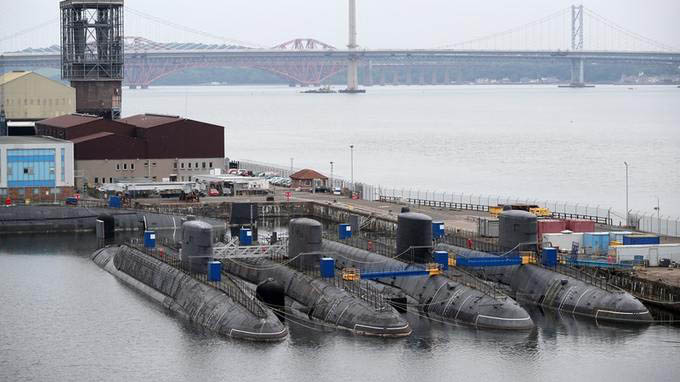
The Ferret. Rob Edwards, 2nd April 2019 Plans by the Ministry of Defence (MoD) to rethink the disposal of radioactive waste from 27 defunct nuclear submarines have come under fierce fire from campaigners.
A recent meeting of local authority advisors was told that the MoD is “considering alternative options for the management of the waste”. This is despite previous decisions made after an exhaustive, 16-year public consultation process.
Those who were involved in the consultations are alarmed that the MoD is thinking of changing what has been agreed – and are pressing for more information. It was “incredibly frustrating”, said one critic.
Since the 1980s seven aged nuclear-powered submarines have been taken out of service and laid up at the Rosyth naval dockyard in Fife. Since the 1990s, thirteen more have been laid up at Devonport naval dockyard in Plymouth, nine of them still containing radioactive fuel.
A further three reactor-driven submarines are due to be retired in the next few years. They will be followed by the four Vanguard-class submarines, currently armed with Trident nuclear missiles and based at Faslane on the Clyde.
The MoD began a public submarine dismantling project in 2000. It announced in 2016 that a nuclear plant at Capenhurst in Cheshire had been chosen as an “interim storage site” for radioactive waste.
A proposal to store the waste on a former nuclear site at Chapelcross near Annan in south west Scotland was rejected after objections from the Scottish Government. The Ferret revealed in December that in the past the MoD has contemplated dumping the submarines on the seabed near Scotland.
Work on dismantling the first “demonstrator” submarine, Swiftsure, began at Rosyth in 2016. The MoD said in December 2018 that over 70 tonnes of radioactive and non-radioactive waste had been removed, and that dismantling of a second submarine, Resolution, would start in 2019.
But now future plans have been thrown into confusion by the MoD reportedly having second thoughts. The change of heart was disclosed by the Nuclear Legacy Advisory Forum (NuLeAF), an expert group working with 113 local planning authorities in England and Wales.
A report posted online for a steering group meeting on 20 March outlined NuLeAF’s role in previous submarine dismantling consultations. “The Ministry of Defence, working with the regulators, has now indicated it is considering alternative options for the management of the waste,” it said.
“It is understood that they are in discussion with the Nuclear Decommissioning Authority who will be managing an engagement process to gain stakeholder input.”…….
Campaigners have reacted angrily. “Given the amount of time, effort and public money that went into the consultation process, it is alarming to hear that the MoD now appear to be changing its mind,” said Jane Tallents, who was an advisor to the MoD’s submarine dismantling project.
“I can only guess that in the three years that they have been dismantling the first submarine they have come across problems not anticipated by all the experts who informed the public during the consultation.”
She and others had urged the MoD to extend its “unprecedented openness” on the submarine dismantling project to other areas of policy-making. “It would be disappointing if the project itself does not come clean and tell us what alternative options they are now looking at.”
Edinburgh-based nuclear consultant and critic, Pete Roche, accused the MoD of undermining its prolonged public consultations. “Communities and environmentalists thought the MoD had pulled off the impossible and come up with a consensus on what to do with nuclear waste from submarines,” he told The Ferret.
“Now it seems they want to pour all this hard work down the drain. This is incredibly frustrating and makes you wonder if banging your head against a wall would be more fruitful than getting involved in these consultation processes.”
In January a group including former naval staff campaigning to “Save The Royal Navy” described the failure to promptly deal with submarine waste as “a national scandal”. Progress had been “painfully slow” because “successive governments have avoided difficult decisions and handed the problem on to their successors,” it argued.
An article on the group’s website warned that maintaining the submarines safely while they awaited dismantling was “a growing drain on the defence budget”. It estimated the total cost of disposing of 27 submarines to be at least £10.4 billion over 25 years………. https://theferret.scot/mod-rethink-nuclear-submarines-waste/
Rewarding failure: Taxpayers on hook for $12 billion Vogtle nuclear boondoggle.

The Hill 2nd April 2019 Rewarding failure: Taxpayers on hook for $12 billion nuclear boondoggle.
Vogtle’s nuclear expansion is billions of dollars over budget, its
completion is far from certain, and the federal government is once again
coming to the rescue. In March, Secretary Perry announced the finalization
of $3.7 billion in taxpayer-backed federal loan guarantees for the Vogtle
project. This came over repeated objections by taxpayer and consumer
watchdog organizations and despite numerous serious hurdles remaining for
the only new nuclear power project still under construction in the United
States. More importantly, these newly-finalized loan guarantees were on top
of $8.3 billion in federal loan guarantees that the project partners,
Southern Company’s Georgia Power, Oglethorpe Power Corporation, and the
Municipal Electric Authority of Georgia (MEAG Power), previously secured,
bringing the total to $12 billion.
China will fall short of its nuclear power generation capacity target for2020
Reuters 2nd April 2019 China will fall short of its nuclear power generation capacity target for
2020, according to a forecast from the China Electricity Council on
Tuesday. Total nuclear capacity is expected to reach 53 gigawatts (GW) next
year, below a target of 58 GW, council vice chairman Wei Shaofeng told the
China Nuclear Energy Sustainable Development Forum in Beijing.
China is the world’s third-biggest nuclear power producer by capacity, with 45.9 GW
installed by end-2018 and 11 units still under construction, but its
reactor building program has stalled since the 2011 Fukushima nuclear
disaster in Japan.
No new approvals have been granted for the past three
years, amid spiraling costs, delays for key projects and safety concerns
about new technologies. Environmental impact assessments for two new
projects in southeast China were submitted to regulators last month,
however, paving the way for a resumption of its atomic energy program.
China to Resume Approving Nuclear Power Plants
SIXTH TONE, Li YouApr 02, 2019 Energy official’s announcement comes after the Fukushima disaster in Japan led to new nuclear power projects in China being halted.
China will begin construction on several new nuclear power projects this year, according to Liu Hua, deputy minister of the Ministry of Ecology and Environment and head of the National Nuclear Safety Administration.
Liu’s announcement — made Monday during the China Nuclear Energy Sustainable Development Forum in Beijing and later reported by Economic Information Daily — marks an end to the country’s three-year halt to approving new nuclear projects. Since the 2011 Fukushima nuclear disaster in Japan, China has been circumspect in approving new projects. From 2016 to 2018, the country did not greenlight a single one…….
treating spent nuclear fuel and disposing of nuclear waste raise concerns for both the environment and public safety. In August 2016, thousands of residents protestedagainst a planned nuclear waste facility in Lianyungang, Jiangsu province, that led to the project being halted. ….https://www.sixthtone.com/news/1003796/china-to-resume-approving-nuclear-power-plants
Nuclear industry is aggressively milking USA States for subsidies, despite Exelon profits

“Please consider,” Gordes implores the reader, “the very basic fact that we have gone from nuclear technology sold in the 70s on the basis of being ‘too cheap to meter’ to one where they have been begging and receiving for what amounts to yet more subsidies. Even with the ‘too cheap to meter’ claim, in its heyday the nuclear industry was the recipient of huge amounts of subsidy in numerous forms.”
Gordes goes on to finish his denunciation of his state’s nuclear policy by imploring the government to rethink their history handouts: “With that, I suggest our leaders and regulators very carefully consider any actions contemplated to further subsidize this technology since that might add to its eventual stranded cost that will hold up newer, lower cost decentralized, modular and more secure options. Even more important is that aging plants may, themselves, present an existential danger to the citizens of the state.”
Meanwhile, energy insiders in Illinois are singing a similar tune. Chicago-based nuclear electric power generation company Exelon won ratepayer-funded subsidies for two nuclear plants in its home state just three years ago, and now it’s back in Springfield to ask for similar monetary support for other cash-strapped nuclear plants that have not yet had the benefit of a bailout. The bill will be voted on by the State of Illinois’ House Public Utilities Committee this week.
While Exelon is lobbying hard for more government support, however, it is receiving a fair amount of scrutiny and backlash. Just this month Monitoring Analytics released a “bombshell report” with the surprising findings that all five of Exelon’s nuclear plants in Northern Illinois are not in dire financial distress, but are in fact profitable, and are projected to continue to be so through 2021–by conservative estimates.
According to the Monitoring Analytics report, Exelon’s five Illinois-based nuclear plants will see a total estimated profit of approximately $472 million this year alone. What’s more, each individual plant will turn its own profit. Even in 2021, when it is anticipated that revenue will begin to decline, altogether the plants are still projected to earn a profit of $228 million–much lower, to be sure, but still a far cry from bankruptcy. The report has thrown doubt upon Exelon’s stance that the subsidy bill up for vote this week, which would legislate a very complex matter with massive consequences for Illinois’ power industry and energy market, is a matter of both urgency and necessity…….. https://oilprice.com/Energy/Crude-Oil/Is-The-Nuclear-Industry-Abusing-Subsidies.html
1 This Month





PLEASE OPPOSE HR 8255 AND S.3639 – bills would accelerate satellite deployment, with no environmental review or safeguards – https://ncstd5li.quorum.us/campaign/169331/
To see nuclear-related stories in greater depth and intensity – go to https://nuclearinformation.wordpress.com
-
Archives
- October 2026 (81)
- September 2026 (339)
- August 2026 (330)
- July 2026 (355)
- June 2026 (287)
- May 2026 (306)
- April 2026 (356)
- March 2026 (251)
- February 2026 (267)
- January 2026 (308)
- December 2025 (358)
- November 2025 (359)
-
Categories
- 1
- 1 NUCLEAR ISSUES
- business and costs
- climate change
- culture and arts
- ENERGY
- environment
- health
- history
- indigenous issues
- Legal
- marketing of nuclear
- media
- opposition to nuclear
- PERSONAL STORIES
- politics
- politics international
- Religion and ethics
- safety
- secrets,lies and civil liberties
- spinbuster
- technology
- Uranium
- wastes
- weapons and war
- Women
- 2 WORLD
- ACTION
- AFRICA
- Atrocities
- AUSTRALIA
- Christina's notes
- Christina's themes
- culture and arts
- Events
- Fuk 2022
- Fuk 2023
- Fukushima 2017
- Fukushima 2018
- fukushima 2019
- Fukushima 2020
- Fukushima 2021
- general
- global warming
- Humour (God we need it)
- Nuclear
- RARE EARTHS
- Reference
- resources – print
- Resources -audiovicual
- Weekly Newsletter
- World
- World Nuclear
- YouTube
-
RSS
Entries RSS
Comments RSS

