Cumbria Trust 2nd April 2019 At the Silloth Town Council meeting held on 11 March 2019 it was
“RESOLVED that a letter be sent to say that Silloth Town Council will not
be volunteering to be a site for a GDF and that we don’t want it in our
area” which was in response to The Radioactive Waste Management –
Consultation on how they will evaluate potential sites for a GDF in the
future in England and Wales.
https://cumbriatrust.wordpress.com/2019/04/02/its-definitely-no-to-a-gdf-from-silloth-town-council/
April 4, 2019
Posted by Christina Macpherson |
opposition to nuclear, politics, UK, wastes |
Leave a comment
As safety board cites quakes, Perry says Nevada nuke sites safe By Gary Martin / Las Vegas Review-Journal, April 2, 2019
|
 WASHINGTON — Energy Secretary Rick Perry acknowledged Tuesday that the Nevada National Security Site — where weapons-grade plutonium is being stored — and the proposed Yucca Mountain nuclear waste repository are located in an area considered a seismic hazard. WASHINGTON — Energy Secretary Rick Perry acknowledged Tuesday that the Nevada National Security Site — where weapons-grade plutonium is being stored — and the proposed Yucca Mountain nuclear waste repository are located in an area considered a seismic hazard.
But he insisted that the facility where the half metric ton of plutonium is being held is secure and that Yucca Mountain would be a safe site to store waste…….
Safety board report
Perry told Cortez Masto the facility was secure. Cortez Masto raised concerns by the Air Force and other entities about the safety of storing plutonium at the facility and opening a nuclear waste repository in a region with current seismic activity.
Cortez Masto grilled Perry on a report first revealed by the Review-Journal in which the Defense Nuclear Facilities Safety Board outlined risks to workers and the “offsite public” because of seismic hazards to structures at the Device Assembly Facility at the security site, located about 90 miles north of Las Vegas.
“This facility continues to operate without accounting for the increase in seismic hazard and without evaluating whether the credited structures, systems and components can perform their safety function during and after a seismic event,” wrote Bruce Hamilton, chairman of the Defense Nuclear Facilities Safety Board, in the board’s report.
The board noted that concerns about seismic hazards at the Device Assembly Facility in Nevada were first raised in 2007.
Earthquake faults near Yucca
Cortez Masto raised the most recent U.S. Geological Survey report, issued in 2008, which lists the area that includes the Nevada security site and nearby Yucca Mountain as one of moderate to high seismic hazard.
Two faults, the Northern Death Valley and the Black Mountains, are located west of the Nevada security site and the proposed nuclear waste storage facility. According to the USGS, one of the strongest recent earthquakes in the state occurred on June 29, 1992, at Little Skull Mountain in the southwest portion of the Nevada security site and about 12 miles east of Yucca Mountain. That earthquake registered magnitude 5.6.
The safety board report noted that the Device Assembly Facility has “high explosives co-located with special nuclear material.”
Cortez Masto said the seismic hazards cited in the report should also be taken into account in the administration’s attempt to restart license hearings on the Energy Department’s application for Yucca Mountain.
Site is unsafe
Sisolak agreed with Cortez Masto in a statement.
“As the Defense Nuclear Facilities Board — a federal safety board — pointed out recently, earthquake risks make the Nevada National Security Site unsuitable for plutonium and make Yucca Mountain unsuitable for nuclear waste,” he said.
Cortez Masto also asked Perry about President Donald Trump’s flip-flop on Yucca Mountain during a campaign event in Nevada last year, where he said he agreed that a nuclear waste dump should not be located in the state if the residents don’t want it.
“What we all have to recognize here is that Yucca Mountain is the law,” Perry answered. “I’m going to follow the law. The president is going to follow the law. His opinion of whether or not the people of Nevada like it or not doesn’t have anything to do with what the statute says.”
Cortez Masto replied that the Obama administration had taken a different approach, preferring a consent-based plan to store nuclear waste in an area where residents didn’t oppose it.
And she told the secretary the 1987 law that focused only on Yucca Mountain to store waste was a decision that “shows extreme political influence was used to scapegoat the state of Nevada.”……….. https://www.reviewjournal.com/news/politics-and-government/as-safety-board-cites-quakes-perry-says-nevada-nuke-sites-safe-1631919/
|
|
April 4, 2019
Posted by Christina Macpherson |
politics, USA, wastes |
Leave a comment
 David Lowry’s Blog 1st April 2019 Last night I submitted my latest (of dozens) of responses to a Government
or nuclear industry sector public consultation on nuclear policy, this time
on the flawed machinations of trying to find site or sites where nuclear
waste can be disposed of.
I strongly complained that previous submissions
had been entirely ignored, which had reduced the incentive to commit to
researching and preparing detailed submission this time. The same complaint
was included in the Cumbria Trust submission, which asserted: “BEIS and its
predecessors have a track record of issuing consultation documents and
choosing to ignore responses that go against their preconceived plans.” My
own submission was very short, but appended the very long evidence I
submitted year ago, which was ignored, with the demand it be heeded this
time.
http://drdavidlowry.blogspot.com/2019/04/nuclear-waste-very-long-term.html
April 4, 2019
Posted by Christina Macpherson |
politics, UK |
Leave a comment
|
Mediapart 1st April 2019 , The public consultation on the extension of the oldest French nuclear
reactors has just ended in general indifference. The debate is impaired
by the technicality of the exchanges, the bureaucracy of the procedures and
the lack of will to make room for the citizens.
Sunday, March 31 closed a debate that did not take place: the public consultation on the improvement
of nuclear reactors 900 megawatts (MW), the oldest, as part of the review
they must undergo at their fortieth year of operation. The stakes are high:
under what conditions can the oldest EDF power stations continue to produce
electricity, even though they are reaching an age originally planned as a
terminal? https://www.mediapart.fr/journal/france/010419/nucleaire-le-debat-qui-n-pas-lieu
|
|
April 4, 2019
Posted by Christina Macpherson |
France, politics |
Leave a comment
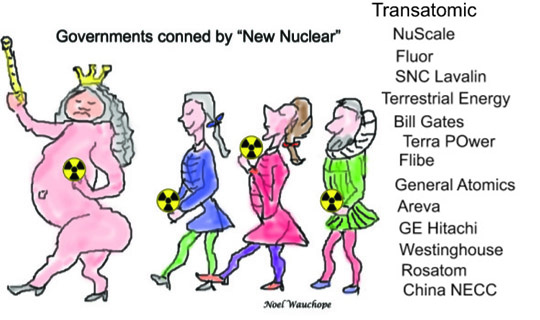
Senate re-introduces bill to help advanced nuclear technology, Legislation was praise by Bill Gates, who has  funded an advanced nuclear company. Ars Technica, MEGAN GEUSS – 4/1/2019,
Last week, a bipartisan group of 15 US senators re-introduced a bill to instate the Nuclear Energy Leadership Act (NELA), which would offer incentives and set federal goals for advanced nuclear energy. A smaller group of senators originally introduced the bill in September of last year, but the Congressional session ended before the Senate voted on it.
Specifically, the bill authorizes the federal government to enter into 40-year power purchase agreements (PPAs) with nuclear power companies, as opposed to the 10-year agreements that were previously authorized. Securing a 40-year PPA would essentially guarantee to an advanced nuclear startup that it could sell its power for 40 years, which reduces the uncertainty that might come with building a complex and complicated power source.
……. In addition to supporting a 40-year PPA to improve the economics of advanced nuclear reactor research from the private market, the bill directs the Department of Energy’s Office of Nuclear Energy to develop a 10-year strategic plan to support advanced nuclear reactor research. The DOE must also “construct a fast neutron-capable research facility” if the bill passes, which Senate materials say “is necessary to test important reactor components, demonstrate their safe and reliable operation, and ultimately license advanced reactor concepts.”
The bill also directs the federal government to make available some “high-assay low-enriched uranium” for research and testing in advanced reactors. Traditional light-water reactors use low-enriched uranium in which the active U-235 isotope constitutes 3 to 5 percent of the nuclear fuel, according to the World Nuclear Association. High-assay low-enriched uranium, on the other hand, pushes enrichment levels to about 7 percent of the fuel and, in some cases, can go as high as 20 percent.
Finally, the bill directs the DOE to create “a university nuclear leadership program” to train the next generation of nuclear engineers.
On Thursday, Microsoft mogul Bill Gates tweeted his support for the bill. Gates is currently the chairman for an advanced nuclear reactor company called Terrapower, which is developing a traveling wave reactor that uses depleted uranium as fuel (depleted uranium is a by-product of uranium enrichment). Terrapower suffered a political setback earlier this year, as US rules against sharing nuclear technology with China forced the company to abandon its plans for conducting preliminary trials of its technology in that country.
Gates praised this new bill, writing “I can’t overstate how important this is.”
…….. NuScale Power, a company that has made significant progress toward building a small modular reactor in Idaho, also praised the bill. In a statement to a market research company called The Morning Consult, chief strategy officer of NuScale Power Chris Colbert said that “the bill would ‘absolutely’ make it easier and more certain to reach deployment.” https://arstechnica.com/science/2019/03/senate-re-introduces-bill-to-help-advanced-nuclear-technology/
April 1, 2019
Posted by Christina Macpherson |
politics, Small Modular Nuclear Reactors |
Leave a comment
|
Trump administration OKs nuclear energy transfers to Saudi Arabia, sparking new battle with Congress
CNBC, MAR 29 2019 Tom DiChristopher
-
- The Department of Energy has authorized seven companies to share nuclear energy information with Saudi Arabia.
- News of the approvals has sparked accusations the Trump administration is doing an end-run around Congress and facilitating secret discussions.
- Veterans of nuclear policy say the authorizations are routine and do not raise immediate concerns about nuclear weapons proliferation
…………..The kingdom is currently reviewing bids from international companies to build two nuclear reactors. Westinghouse is leading the U.S. consortium competing for the contract against companies from China, France, Russia and South Korea.
U.S. companies need so-called Part 810 authorizations from the Energy and State departments to share non-public information as they attempt to convince the Saudis to choose American reactors and other services……..
Congress has sought to hold the kingdom’s powerful crown prince Mohammed bin Salman responsible for Khashoggi’s death. But President Donald Trump has stuck by his allies in Riyadh and cast doubt on the CIA’s assessment that the 33-year-old royal had a hand in the killing.
U.S. nuclear energy exports to Saudi Arabia have become a flashpoint in the dispute. While the Trump administration wants American companies to build the reactors, many lawmakers now say Saudi Arabia cannot be trusted with nuclear technology.
Rep. Brad Sherman, Democrat of California, suggested during a congressional hearing with Secretary of State Mike Pompeo on Wednesday that the transfers could put the Saudis on a path to developing nuclear weapons. He said the “secret” Part 810 authorizations appear to be part of the administration’s efforts to evade Congress and provide substantial nuclear technology and aid to the Saudis.
On Thursday evening, the Department of Energy confirmed that Secretary Rick Perry has issued seven Part 810 authorizations to export nuclear energy technology and services to Saudi Arabia.
The companies that received those authorizations opted not to disclose them to the public, fueling accusations of secret dealings.
Keeping the authorizations secret has only added to the considerable suspicions that Congress has about the Trump administration’s negotiations with the Saudis, said Countryman. He also believes the Trump administration has failed to adequately notify Congress of progress on nuclear cooperation with the kingdom……..
This month, Sen. Marco Rubio, R.-Fla., and Sen. Robert Menendez, D-N.J., asked the Government Accountability Office to review the Trump administration’s negotiations on nuclear energy cooperation with Saudi Arabia.
The senators want the administration to strike a tough 123 Agreement with Saudi Arabia that explicitly prohibits the Saudis from enriching uranium or reprocessing spent nuclear fuel, known as the “gold standard.” They also want Saudi Arabia to implement the International Atomic Energy Agency’s Additional Protocol, which allows the IAEA to conduct inspections to assure a country’s nuclear energy program doesn’t morph into weapons development.
The Saudis have insisted on their right to enrich uranium and pushed back on the Additional Protocol…….. https://www.cnbc.com/2019/03/29/trump-team-and-congress-spar-over-nuclear-energy-transfers-to-saudis.html
|
|
April 1, 2019
Posted by Christina Macpherson |
politics, USA |
Leave a comment
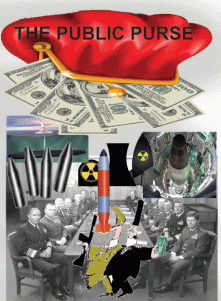 Trump Budget Boosts Nuclear Efforts Arms Control Association, By Kingston Reif April 2019, Consistent with the recommendations of the 2018 Nuclear Posture Review (NPR), the Trump administration’s fiscal year 2020 budget request would continue plans to expand U.S. nuclear weapon capabilities.
The ultimate fate of the request, submitted to Congress March 11, remains uncertain as Democrats, particularly in the House, have signaled strong opposition to several controversial funding proposals. Their concerns include administration plans to develop two additional low-yield nuclear weapons and two conventionally armed, ground-launched missiles currently prohibited by the 1987 Intermediate-Range Nuclear Forces (INF) Treaty.
The budget submission illustrates the rising cost of the nuclear mission and the challenge those expenses may pose to the administration’s other national security priorities.
A Congressional Budget Office report in February estimates that the United States will spend $494 billion on nuclear weapons from fiscal years 2019 through 2028. That is an increase of $94 billion, or 23 percent, from the CBO’s previous 10-year estimate of $400 billion, which was published in January 2017. (See ACT, March 2019.)
The Trump administration’s budget proposal contains increases for several Defense and Energy department nuclear weapons systems. The request does not change the planned development timelines for these programs.
The largest increase sought is for the nuclear weapons account of the Energy Department’s semiautonomous National Nuclear Security Administration (NNSA). The budget request calls for $12.4 billion, an increase of $1.3 billion above the fiscal year 2019 appropriation and $530 million above the projection in the fiscal year 2019 budget request.
The request includes funds for the continued development of two missile systems with ranges prohibited by the INF Treaty, but despite numerous queries by Arms Control Today and other outlets, the Pentagon has yet to divulge the amount.
Defense Department officials told a group of reporters March 13 that the Pentagon is planning to test a ground-launched cruise missile and a ballistic missile by the end of this year.
The announcement came just over a month after the Trump administration announced on Feb. 2 that it would withdraw from the treaty on Aug. 2 unless Russia corrects alleged compliance violations with the agreement. (See ACT, March 2019.)
The budget request for nuclear weapons programs is part of the overall $750 billion request for national defense. That figure includes the Defense Department’s regular budget activities and the Energy Department’s nuclear weapons programs.
New Nuclear Capabilities
The budget request would finish development of a small number of low-yield nuclear warheads for submarine-launched ballistic missiles (SLBMs) and begin studies of a new fleet of sea-launched cruise missiles (SLCMs)…….. https://www.armscontrol.org/act/2019-04/news/trump-budget-boosts-nuclear-efforts
April 1, 2019
Posted by Christina Macpherson |
politics, USA, weapons and war |
Leave a comment
ABC News 2 Apr 19, While some view the British parliament as a symbol of political stasis since the 2016 Brexit referendum, other Brits have utilised Westminster’s symbolic power to press — literally and figuratively — for faster action on climate change.
On Monday, members of climate change action group Extinction Rebellion stripped half-naked in the House of Common’s glass-walled public gallery during a Brexit debate, and some appeared to have glued themselves to the glass.
As MPs started yet another day of lengthy debate on how or even whether the country should leave the European Union, 14 protesters stripped to their underpants to show slogans painted on their backs, including: “Climate justice now”.
……. more acts of civil disobedience would occur in the lead up to the group’s ‘International Rebellion’ on climate change inaction slated for April 15.
In the moments afterward, numerous people took to Twitter to poke fun at a parliament that has otherwise been considered stale and mired in a prolonged Brexit debate….. https://www.abc.net.au/news/2019-04-02/british-protesters-bare-bottoms-in-parliament-to-protest-climate/10961468
April 1, 2019
Posted by Christina Macpherson |
climate change, politics, UK |
Leave a comment
|
Around the world, nuclear energy has taken a back seat because of the risks that reactors bring with them. The report that the US will help build six nuclear power plants in India should be taken with the proverbial pinch of salt. When it comes to the US, inter-governmental declarations are not how business gets done. It requires working through a labyrinth of terms and conditions with companies and financial institutions. And, the nuclear-reactor business is not too healthy in the US.The six reactors to be set up in Kovvada, Andhra Pradesh are Westinghouse-designed AP1000 Pressurised Water Reactors (PWR). Westinghouse has just emerged from a Chapter 11 bankruptcy settlement on account of the construction of four AP1000 reactors in Georgia and South Carolina.
The announcement, which came during foreign secretary Vijay Gokhale’s visit to the US, seems aimed at pleasing Washington at a time when bilateral trade ties appear to have hit turbulence. It is also a token genuflection towards the Indo-US nuclear deal of 2008 that was justified by the US desire to promote civil nuclear cooperation. This deal, with its commitment to promote US nuclear reactor sales to India, came unstuck after India passed a stringent liability law that made the manufacturers, rather than the operator, primarily liable for damage in the event of an accident.
India has 22 functioning reactors, most of them pressurised heavy water reactors (PWHRs), which provide three per cent of the country’s electricity. Seven units, one of them a prototype fast breeder reactor, are under construction.
India’s nuclear power sector was coddled by the government because it served the dual purpose of providing the capacity to produce nuclear weapons and also the promise of limitless sources of energy. This was premised on Homi Bhabha’s three-stage plan that involves making fast breeder reactors (FBR) to use plutonium reprocessed from the spent fuel from the first stage PWHR plants.
Stage 2 FBRs will use a mixed oxide fuel to produce more plutonium than they consume.
In Stage 3, thorium would be used to blanket the reactor to yield Uranium 233 for the third-stage reactor, which can be refuelled by abundant natural thorium after its initial fuel charge.
Nuclear energy received the bulk of the government’s research and development (R&D) funding during the 1950-1970 period. It got some 15 per cent in the 1990s, at a time when Indian Space Research Organisation (Isro) got 20 per cent and renewables got less than one per cent. While ISRO achieved world-class launch and satellite capability, despite embargoes, the department of atomic energy found it hard to even scale up the 220 MWe Canadian reactor it had got in the 1960s to 700 MWe. We have just about managed to get one going in Andhra Pradesh’s Kakrapar in 2018. The world norm for power reactors is 1,000-1,500 MWe.
The country was promised a 10,000 MWe capacity by the year 2000, but even now it has only touched 7,000 MWe. After the nuclear deal there was talk of boosting nuclear energy to 63,000 MWe by 2032. But in 2011, following the blow-back from the nuclear liability legislation, this was scaled down to 14,600 MWe by 2020 and 27,500 by 2032. We will be lucky if we meet the 2000 target in 2020.
In contrast to nuclear power, India has usually exceeded its targets, at far lesser investment, in the area of renewable energy. The country’s installed wind-power capacity is 34,000 MW, hydropower 44,000 MW and solar power 25,000 MW, with a target of 100,000 MW by 2022. Wind and solar power have not been provided the kind of investment that has been made in nuclear energy.
Around the world, nuclear energy has taken a back seat because of the risks that reactors bring with them. Three Mile Island, Chernobyl and Fukushima have dampened the ardour of the developed world. The US, which has over 100,000 MWe capacity, stopped issuing licences for nuclear plants between 1979 and 2012. Even now, just two are under construction, while 34 have been shut down.
It is not safety alone that is a concern. The economics of nuclear power is another issue. Huge sums of money go into setting up of power plants. Most face delays and cost over-runs. Operating costs per unit of electricity tends to be higher than alternative energy sources.
There are a range of experimental reactors that promise greater safety and economy but they are yet to reach maturity. China is investing big in new reactor technologies. The stakes are huge. Nuclear technology has always had two faces—the promise of incredible bounty and its enormously destructive capacity.
As of now, India remains fixated on its three-stage plan. We will reach Stage 3 only by 2050 or so; we’re still mainly in Stage 1. Caution is needed, especially since the record of our nuclear R&D and industry is not great. We need to hedge our risks by working on alternatives, not just in the field of nuclear energy, but also renewables, where our performance has been much better.
|
|
April 1, 2019
Posted by Christina Macpherson |
India, politics |
Leave a comment

 Corbella: Wilson-Raybould’s version behind scandal is indisputable and nuclear, Calgary Herald, LICIA CORBELLA March 29, 2019 Was she or wasn’t she (inappropriately pressured?) That is the central question behind the SNC-Lavalin controversy. All other questions are peripheral.
The answer now is an unequivocal, indisputable ‘yes.’ This is no longer a question of she said/he said, or of women and men “experiencing things differently” — the so-called Gropegate defence.
Now Canadians have the proof. Canada’s former attorney general, Jody Wilson-Raybould, was pressured and threatened by federal Liberal government officials and politicians to help the Quebec engineering giant avoid a criminal trial by pursuing a deferred prosecution agreement
On Friday, the House of Commons justice committee released Wilson-Raybould’s 43-page document, that includes texts, emails and the context around that evidence as well as a transcript of a 17-minute telephone conversation she recorded between herself and Michael Wernick, the clerk of the Privy Council who recently resigned from his post as the country’s top bureaucrat in the wake of this scandal that his gripped the country since Feb. 7
……..Clearly, we now have the proof that the PMO inappropriately pressured the attorney general, not just he said/she said. That’s much more than a political bombshell. Canada’s reputation as a principled country that follows the rule of law has been terribly damaged. It’s also clear that the PM and many of the people around him have lied throughout this controversy. She has proof. They have lies. Ka-Boom!
https://calgaryherald.com/opinion/columnists/corbella-wilson-rayboulds-version-behind-scandal-is-indisputable-and-nuclearLicia Corbella is a Postmedia opinion columnist. lcorbella@postmedia.com
i.
March 30, 2019
Posted by Christina Macpherson |
Canada, politics, secrets,lies and civil liberties |
Leave a comment
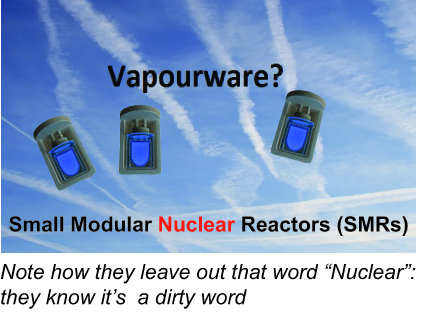
Bagging DOE Support, Westinghouse Eyes Demonstration for Nuclear Micro-reactor by 2022, Power, 03/28/2019 | Sonal Patel The Department of Energy (DOE) is funding a project that would prepare Westinghouse’s 25-MWe eVinci micro-reactor for nuclear demonstration readiness by 2022.
The agency on March 27 said it will provide $12.9 million of the estimated $28.6 million Westinghouse needs for a project to prepare the micro-reactor for a demonstration, including for design, analysis, licensing to manufacture, siting, and testing.
eVinci is one of three small modular reactors (SMRs) and the first micro-reactor whose first-of-a-kind development the DOE is subsidizing under a December 2017–issued “
U.S. Industry Opportunities for Advanced Nuclear Technology Development” funding opportunity announcement (FOA). (Details of other projects that have won funding awards under previous rounds of the FOA are at the end of this article.)
The funding announcements are part of a recent ramp up in attention and efforts by the U.S. government to boost development of advanced nuclear technologies. Also on March 27, a bipartisan group of senators introduced legislation to bolster innovation for advanced reactors. Lawmakers said the U.S., which once led efforts to invent and commercialize key nuclear technologies, has “slipped” in leadership, and it risks losing out to Russia and China.
…… According to Westinghouse, the eVinci reactor is an innovative combination of nuclear fission and space reactor technologies ……
However, Westinghouse admits that it is fielding a number of challenges related to the deployment of the micro-reactor. While the eVinci will use fuel enriched to 19.75 weight %, the industrial scale amount of uranium enriched to more than 5% is limited. …….
Westinghouse also notes that while eVinci reactors will be manufactured and assembled in a factory, first reactor startup should also happen at that site, which means the factory will need to be equipped with radio protection equipment, safety and security systems, and have a license from the Nuclear Regulatory Commission (NRC). Transportation must also take into account safety and security. And because the reactor will be operated autonomously, Westinghouse will need to field first-of-their-kind challenges in licensing, instrumentation, remote reactor monitoring, and logistics…..https://www.powermag.com/bagging-doe-support-westinghouse-eyes-demonstration-for-nuclear-micro-reactor-by-2022/
March 30, 2019
Posted by Christina Macpherson |
business and costs, politics, USA |
Leave a comment
Department of Energy Further Advances Nuclear Energy Technology through Industry Awards of $19 Million,, Office of Nuclear Energy, MARCH 27, 2019 WASHINGTON, D.C. – The U.S. Department of Energy (DOE) today announced funding selectees for multiple domestic advanced nuclear technology projects. Four projects in two states will receive varying amounts for a total of approximately $19 million in funding. The projects are cost-shared and will allow industry-led teams, including participants from federal agencies, public and private laboratories, institutions of higher education, and other domestic entities, to advance the state of U.S. commercial nuclear capability.
The awards are through the Office of Nuclear Energy’s (NE) funding opportunity announcement (FOA) U.S. Industry Opportunities for Advanced Nuclear Technology Development. This is the fourth round of funding through this FOA. The first group was announced on April 27, the second group was announced on July 10, and the third group was announced on November 13, 2018. The total of the four rounds of awards is approximately $117 million. Subsequent quarterly application review and selection processes will be conducted over the next four years.
March 30, 2019
Posted by Christina Macpherson |
politics, USA |
Leave a comment
https://www.cagw.org/thewastewatcher/nuclear-bailouts-radioactive-cost-taxpayers March 29, 2019 – 10:11 — Allen  Johnson
On March 22, 2019, the Trump Administration took another step to act on the president’s campaign promise to financially support coal and nuclear power.
The Department of Energy announced that it would be providing a $3.7 billion loan guarantee to the Vogtle Electric Generation Plant located in near Waynesboro Georgia. That brings the total government financing on this project to $12 billion.
President Obama allocated an $8.3 billion loan to complete the Vogtle facility back in 2010 with the goal of constructing of the first new nuclear plant in the U.S. in 30 years. However, since President Obama’s initial loan, cost increases and delays (in part due to a contractor’s bankruptcy) have left the plant unfinished. Yet, taxpayers will now be forced to throw further good taxpayer money after bad.
Our March 22, 2019, blog highlighted how state-level bailout plans for failing nuclear power generation plants are gaining steam in several states, with the administration’s encouragement. The saga at Vogtle Electric underscores the hefty risk taxpayers would incur as bailouts continue across the country. For an administration keen on cutting wasteful government spending, an additional $3.9 billion loan undercuts that commitment and could be the first step toward a larger grid-intervention policy that will cost taxpayers dearly.
A July 19, 2018, report by the Brattle Group estimated it will cost taxpayers $34 billion over two years if every coal and nuclear plant in the country were bailed out as the administration originally proposed. That is a steep price to pay when those funds could be used for more practical measures like strengthening the nation’s energy grid, investing in cyber-protection technologies, or upgrading general infrastructure to bolster the nation’s natural gas supply.
To bailout a power plant that a private corporation has failed to keep within budget and on schedule brings this flawed policy to a new level. The latest announcement from Secretary Perry signals unnecessary political interference in energy markets. A corporation that cannot manage its projects properly doesn’t deserve a federal bailout by taxpayers. Taxpayer dollars are intended to serve the public, not support corporate irresponsibility.
March 30, 2019
Posted by Christina Macpherson |
business and costs, politics, USA |
Leave a comment
 Illinois lawmakers move ahead with bill to benefit nuclear power plants, The Neighbour, By Cole Lauterbach | Watchdog.org, 29Mar19,
 Illinois lawmakers have set the wheels in motion to allow for power provider Exelon’s nuclear fleet, as well as wind and solar power providers, to sell energy to a state authority that opponents say will give it preferential pricing over coal and natural gas sources.
March 30, 2019
Posted by Christina Macpherson |
politics, USA |
Leave a comment
Nuclear Energy Policy after the Fukushima Nuclear Accident: An Analysis of “Polarized Debate” in Japan, Intechopen, By Tatsujiro Suzuki February 6th 2019
DOI: 10.5772/intechopen.83435
Abstract
The Tokyo Electric Power’s Fukushima Daiichi nuclear accident in 2011 was a turning point for Japan’s nuclear energy and overall energy policy. In reality, Japan has reduced its dependence on nuclear energy drastically despite the government’s policy to maintain nuclear energy as a major power source. Even with sharp drop in production from nuclear energy, Japan could achieve carbon reduction of around 60–70% by 2050 even without nuclear power. But the biggest impact of the Fukushima accident is the loss of public trust. The policy debate on nuclear energy is now divided between “pro” and “anti” of nuclear power. The aim of this study is to analyze why such “polarized debate” has not been resolved and find a way to restore public trust. This study analyzes three important nuclear energy policy issues, i.e., decommissioning of Fukushima Daiichi nuclear plant, spent nuclear fuel and waste management, and plutonium stockpile management. The analysis of these three cases suggest that lack of independent oversight organizations is a common cause of impasse of nuclear energy policy debate. The author argues that Japan needs to establish independent oversight organizations in order to gain public trust and solve important policy issues regardless of the future of nuclear energy………. https://www.intechopen.com/online-first/nuclear-energy-policy-after-the-fukushima-nuclear-accident-an-analysis-of-polarized-debate-in-japan?fbclid=IwAR1UJO5oepfNQeoUK82tXQzZUDRwvP9GQclVPkI2ONiq3dQ56w4LBRhbQIY
March 27, 2019
Posted by Christina Macpherson |
Japan, politics |
Leave a comment
 WASHINGTON — Energy Secretary Rick Perry acknowledged Tuesday that the Nevada National Security Site — where weapons-grade plutonium is being stored — and the proposed Yucca Mountain nuclear waste repository are located in an area considered a seismic hazard.