nuclear-news

The News That Matters about the Nuclear Industry Fukushima Chernobyl Mayak Three Mile Island Atomic Testing Radiation Isotope

With tax-payer funding, and weakened safety regulation, Bill Gates’ nuclear project could be a goer in USA

TRUMP ADMINISTRATION WANTS BILL GATES TO DITCH CHINA AND BUILD HIS NUCLEAR PROJECT IN THE US, Daily Caller, Jason Hopkins | Energy Investigator 01/08/2019 |  Members of the Trump administration are actively working to convince Bill Gates to relocate his now-scrapped nuclear reactor project in China over to the U.S.

“We hope we can work with them and bring them back,” said Deputy Energy Secretary Dan Brouillette in an exchange with reporters Monday. Brouillette revealed the Energy Department has held “several conversations” with Gates, adding that he was optimistic the U.S. government could streamline the permitting process and entice the billionaire to bring his project stateside…….

“Unfortunately, America is no longer the global leader on nuclear energy that it was 50 years ago. To regain this position, it will need to commit new funding, update regulations, and show investors that it’s serious,” Gates wrote in a year-end blog post, first revealing his botched nuclear plans. ……

In the waning days of December, Congress passed the The Nuclear Energy Innovation and Modernization Act by wide margins in both chambers. The legislation aims to streamline the regulatory process for commercial nuclear plants, with an end game of making the development and commercialization of nuclear technology more affordable.

If signed by President Donald Trump, the bill could make nuclear projects, like the one Gates is spearheading, easier to accomplish. https://dailycaller.com/2019/01/08/bill-gates-nuclear-project/

January 10, 2019 Posted by | politics, USA | 1 Comment

State of Oregon not happy with federal govt plan to declassify some high level nuclear wastes

Feds say some Hanford radioactive waste is not so dangerous. Oregon disagrees, Tri City Herald, BY ANNETTE CARY, JANUARY 07, 2019 RICHLAND, WA 

January 10, 2019 Posted by | politics, USA, wastes | Leave a comment

EDF’s plans for construction of the Sizewell C twin-reactor will cause widespread disruption

East Anglian Daily Times 7th Jan 2019 ,Campaigners have been left furious over the latest plans for a new nuclear power plant on the Suffolk coast – and say EDF Energy is still not
listening to residents’ concerns. The construction of the Sizewell C
twin-reactor is expected to cause widespread disruption with concern over
hundreds of trucks using unsuitable roads, the impact on the local economy
and worries over the effect on RSPB Minsmere. A main concern is the use of
land near Eastbridge for a campus for 2,400 workers which campaigners say
are “substantially unchanged” from early designs. Alison Downes,
co-chairman of Theberton and Eastbridge Action Group on Sizewell (TEAGS),
was furious at the lack of consideration being taken of the villages as EDF
clamours to start construction.
https://www.eadt.co.uk/news/edf-energy-sizewell-plan-slated-by-theberton-middleton-eastbridge-activists-1-5840910

January 10, 2019 Posted by | politics, UK | Leave a comment

Misgivings in UK about China’s involvement in Bradwell nuclear project, as enthusiasm for ‘new nuclear’ wanes

FT 7th Jan 2019 The Huawei affair has revived the unresolved question of whether the non-Chinese world can trust Chinese companies as the country becomes an industrial superpower. The US has cited Huawei’s alleged breaches of Iranian sanctions to request the extradition of Meng Wanzhou, the company’s chief financial officer, from Canada, but it is clear that the real concern is about the ability of Huawei’s advanced technology to gather information.
The US, Australia and New Zealand have already banned Huawei from future G5mobile projects. The UK will soon have to face up to an additional aspect of the issue as a key decision approaches on Chinese plans to build a series of civil nuclear reactors in Britain, starting with Bradwell B on the site of a former air base in Essex.
But what happens next is not simply a matter for the US and the UK. China itself must decide what place in the world it wants. For the UK, the test of whether to follow the American line
will focus not just on Huawei but also on the proposed development of Bradwell B. The plant is intended to be a joint project between the Chinese nuclear company CGN and France’s EDF, with CGN set to own 66.5 per cent of the venture and use its HPR 1000 nuclear reactor. CGN is, on its own estimation, the world’s third largest nuclear power company but its operations have so far been concentrated in China and Bradwell would be a flagship project for its international ambitions.
The HPR Hualong design is going through the assessment process required by the UK nuclear regulator,but there is no reason to suppose it will fail on technical grounds. For the moment, CGN’s plans to build Bradwell B are going ahead but warning signs are appearing. The company was not encouraged to take up the option of developing the planned nuclear project at Moorside in Cumbria that was abandoned by Toshiba in November.
The UK’s National Infrastructure Commission has said the need for new nuclear is much less clear than envisaged in 2013 when the current plans were drawn up.
https://www.ft.com/content/8a1d7432-0e8b-11e9-a3aa-118c761d2745

January 8, 2019 Posted by | politics, UK | Leave a comment

UK govt now prevents any one local council from pulling out of plans for a vast underground nuclear waste dump in Cumbria

Times 5th Jan 2019 A million tonnes of nuclear waste could be buried under the Lake District after the government removed the right of county councils to veto plans for a vast underground dump.

The £19 billion “geological disposal facility” will have an underground area of up to 20 square kilometres, with radioactive waste stored in vaults at depths of between 200m and 1km.

Copeland borough council in Cumbria — the home of Sellafield, where most of Britain’s nuclear waste is stored — had wanted to be considered for the dump because it would create thousands of highly paid jobs and require local investment. But in 2013 Cumbria county council vetoed the idea.

Now the Department for Business, Energy and Industrial Strategy has published a plan for “the long-term management of higher activity radioactive waste” that prevents any one council in areas with two tiers of local government from pulling out of discussions on hosting the dump. Both councils can choose to withdraw but “no single principal local authority
will be able to unilaterally invoke the right”.
https://www.thetimes.co.uk/article/radioactive-waste-could-be-buried-under-lake-district-rqxpm9pjw

January 7, 2019 Posted by | politics, UK, wastes | Leave a comment

Putin puts shipping safety regulation in the Arctic into the hands of the nuclear industry!

It’s a law – Russian Arctic shipping to be regulated by Rosatom https://thebarentsobserver.com/en/arctic/2019/01/its-law-russian-arctic-shipping-be-regulated-rosatom

President Putin signs the bill that makes the country’s state nuclear power company top regulator of the Northern Sea Route.By Atle Staalesen, January 02, 2019

Rosatom has officially been granted the leading role in the development of the vast Russian Arctic. The company that employs more than 250,000 people and engages in a multitude of activities related to nuclear power development and production is now formally Russia’s management authority for the Northern Sea Route.

The law was adopted by the State Duma on the 11th December and on the 28th signed by Vladimir Putin.

The new legislation comes as Russian Arctic shipping is on rapid increase. In 2018, about 18 million tons of goods was transported on the sea route, an increase of almost 70 percent from 2017. And more is to come. According to Vladimir Putin so-called May Decrees, the top national priorities, shipping on the Northern Sea Route is to reach 80 million tons already by year 2024.

Rosatom’s new powers in the Arctic include development and operational responsibilities for shipping, as well as infrastructure and sea ports along the northern Russian coast.

The responsibilities of the Northern Sea Route Administration, that until now has operated under the Ministry of Transport, will now be transferred to Rosatom.

It was Putin himself who in early 2017 made clear that a coordinating government agency for the Northern Sea Route was needed. A battle between Rosatom and the Ministry of Transport followed. In December 2017, it became clear that the nuclear power company had won that fight.

A central person in the new structure will be Vyacheslav Ruksha, the former leader of nuclear icebreaker base Atomflot.

The nuclear power company has since 2008 operated the fleet of nuclear-power icebreakers. Currently, five icebreakers are based in Atomflot, Murmansk, and several more ships are under construction, including four powerful LK-60 vessels.

Rosatom is also in the planning process of the «Lider», the 120 MW capacity super-powerful ship that can break through two meter thick ice at an unprecedented 10-12 knot speed.

January 5, 2019 Posted by | politics, Russia, safety, secrets,lies and civil liberties | 10 Comments

USA’s new Speaker in Congress, Nancy Pelosi states climate change as ‘The existential threat of our time’

‘The existential threat of our time’: Pelosi elevates climate change on Day One, Politico, By ANTHONY ADRAGNA and ZACK COLMAN , 01/03/2019 
Democrats put climate change back on the forefront of their governing agenda Thursday, portraying the issue as an “existential threat” even as the caucus remains split over how forcefully to respond.
Speaker Nancy Pelosi brought up the issue in her opening address while touting a new select panel to come up with ideas on how to solve it, and the Energy and Commerce Committee announced that climate change would be the subject of its very first hearing this year……..

Progressives, led in part by Rep. Alexandria Ocasio-Cortez (D-N.Y.), are tugging the caucus into a more urgent posture that they say best reflects what scientists have called for to avert climate change. The Intergovernmental Panel on Climate Change warned last year that the world has 12 years to put policies in place to avoid irreversible, catastrophic effects of climate change. ……..https://www.politico.com/story/2019/01/03/nancy-pelosi-climate-change-congress-1059148

January 5, 2019 Posted by | climate change, politics, USA | Leave a comment

Trump’s done one good thing – stopped the Bill Gates- China “new nuclear power” push

Bill Gates shelves nuclear reactor in China, citing U.S. policy, Axios, Dec 30

TerraPower, a nuclear-energy company founded by Bill Gates, is unlikely to follow through on building a demonstration reactor in China, due largely to the Trump administration’s crackdown on the country.

Why it matters: This is a blow to America’s attempts to commercialize advanced, smaller scale nuclear technology and, separately, further evidence of soured relations between the U.S. and China under President Trump.

Driving the news: In a year-end blog post covering various topics published Saturday night, Gates said of TerraPower: “We had hoped to build a pilot project in China, but recent policy changes here in the U.S. have made that unlikely.”

Details: The Trump administration, led by the Energy Department, announced in October that it was implementing measures to “prevent China’s illegal diversion of U.S. civil nuclear technology for military or other unauthorized purposes.”

  • Those measures have made it nearly impossible for TerraPower’s project to go forward, according to multiple people familiar with the development.
  • TerraPower had pursued plans to build a pilot reactor in China because that country has two things America doesn’t — growing electricity demand and a long-term strategic energy plan — a top TerraPower executive told me last year.
  • Morning Consult and, separately, an analyst for the think tank International Institute for Strategic Studies, covered the impacts of the October policy change shortly after it occurred, with brief mentions of the likely negative impact on TerraPower………

What’s next: “We may be able to build it [the reactor] in the United States if the funding and regulatory changes that I mentioned earlier happen,” Gates said in his post, although he didn’t specify which funding or regulations.

Meanwhile, the Energy Department just announced it plans to buy some of the power from new advanced reactors being pursued by NuScale, another advanced nuclear company, for here in the United States. https://www.axios.com/bill-gates-nuclear-reactor-china-terrapower-be4c792c-6f76-4723-bf63-d8f9fb527dc1.html


January 1, 2019 Posted by | business and costs, China, politics, USA | 2 Comments

Russian commentator Yakovenko says “Putinism is 21st century fascism with nuclear weapons”

Putinism is 21st century fascism with nuclear weapons, Yakovenko says https://www.stopfake.org/en/putinism-is-21st-century-fascism-with-nuclear-weapons-yakovenko-says/  This article represents personal opinions of the author. Stopfake editors may not share this opinion.  By Paul Goble, Window on Eurasia, 30 Dec 18

Putin’s Russia manifests in one way or another all of the 14 signs of “eternal fascism” Umberto Eco has outlined, “from the cult of tradition, the rejection of modernism, and reliance on historical traumas to the ideas of international and domestic conspiracy, and a cult of death,” according to Igor Yakovenko.

But it is distinctive from 20th century models of fascist regimes in “about 20 ways,” the Russian commentator said in a December 26 talk to the Parnas Political University in Moscow, of which seven are the most important (kasparov.ru/material.php?id=5C27592F3D167).  They include the following:

  1. The absence of ideology and as a result the absence of propaganda. “The Putin media are not only not journalism but also not propaganda … They are weapons of an information war. They do not disseminate information and ideas: their product is feelings and emotions, including hatred, anger, and aversion to the West, Ukraine and the opposition. And love for Putin.”
  1. It is parasitic on the West.  Putinism relies on economic and technological resources created by the West. That makes it very different from the USSR or Nazi Germany, “Parasitic fascism” does not have plans for “the seizure of the planet.” Were it to do so, Yakovenko argues, it would immediately “die” as a system.
  1. It uses ‘spider’ wars which seek to exhaust opponents by spider-like attacks on its neighbors and the destruction of its opponents from the inside. All of Putin’s wars “bear a ‘spider’ character.” That is, they seek to kill the organism they are attacking and then consume it once it is dead.
  1. Lies are the foundation of the regime and information forces are the most important weapons it has.  In the fascist regimes of the 20th centuries, military force was predominant and propaganda played a supportive role. In Putin’s regime, the reverse is true.
  1. Putin’s fascism bears “a fake character.” It professes to be anti-Western but its “children and money are in the West;” and it claims to be a democracy but in fact is the most brutal of dictatorships. The Stalinist and Hitlerite elites also lived “not in complete correspondence with their ideologies, but the Putin elite lives by rules which directly oppose those it declares as the norms for the population.” It is thus, to use Yekaterina Schulmann’s, term, “’a reverse cargo cult.’”
  1. Putinism in contrast to 20th century fascism seeks the unlimited enrichment of its elites, either via corruption or economic machinations.
  1. Putinism is fascism with nuclear weapons, which makes it more dangerous because it is in a position, however weak otherwise, to inflict unacceptable damage on its opponents.

According to Yakovenko, the Putin regime will inevitably lose because it is fascist “and fascism always loses.” Putin himself has accelerated this process by destroying the previous social contract with the population, by breaking the agreement with the elite for wealth in return for loyalty, and by destroying cooperation with the West via aggression.

Four categories of people oppose the Putin regime: the politically active emigres, the supporters of street protests, the supporters of elections, and those who cooperate up to a point with the regime but ultimately oppose it like Kudrin. Unfortunately, for success, they need to cooperate but each of them dislikes the others more than it dislikes the Putin regime.

That makes the direct cooperation of the four “impossible,” Yakovenko says. But success may come if they appreciate the need for all four, and each acts so as to not interfere with the others even if it can’t cooperate with them.  That is a real possibility if all understand what they are up against, the commentator concludes.


December 31, 2018 Posted by | politics, Russia | Leave a comment

Disputes between Democrats and Republicans over nuclear weapons policy and procurement –

Nuclear Winter Is Coming: Nuclear ‘War’ To Hit Washington In 2019, Investor’s Business Daily , GILLIAN RICH, 12/18/2018

Nuclear weapons are about to explode as an issue on Capitol Hill, because partisan warfare is threatening to consume debates over nuclear procurement and policy in 2019.
Two events are converging that will blow up an already tenuous give-and-take deal between Republicans and Democrats. The first is the Trump administration’s threat to leave the Intermediate-range Nuclear Forces Treaty early next year if Russia doesn’t come into compliance. The second is the Democratic takeover of the House of Representatives next month.
There has been a “fragile bipartisan consensus” on nuclear weapons, according to Frank Rose, a senior fellow for security and strategy at the Brookings Institution.

During the Obama administration, a deal was brokered under which Republicans supported the New START treaty to reduce nuclear weapons while Democrats backed the modernization of the U.S.’ nuclear arsenal, he said.

All-out partisan warfare on the issue would come at a bad time for the Pentagon. In 2017, the Congressional Budget Office put the price tag of sustaining and modernizing the full nuclear triad of land-, air- and sea-based weapons at $1.2 trillion in constant dollars through 2046.

But, like other things that happened under Obama, the Republican-Democratic deal on nuclear weapons is starting to unravel under Trump.

Nuclear Weapons Treaties

In early December, the Trump administration gave Russia 60 days to come into compliance with the INF treaty or the U.S. will leave.

Trump’s threat raises questions about whether he will renew the New START treaty, which expires in 2021. Without the arms-control treaties, Democrats could block the funding of nuclear weapons in the 2020 budget with their new majority in the House.

“They can’t build a consensus to do something new or different — the Senate or president might not go along — but they can stop things from happening,” Tom Collina, director of policy at the Ploughshares Fund, which is focused on reducing nuclear weapons. “The power of ‘no’ is a significant force.”……….

Nuclear Weapons That May Go Boom Or Bust

To modernize the air-based leg of the nuclear weapons triad, the Air Force awarded the B-21 contract to Northrop Grumman (NOC) in 2015 to replace Cold War-era Boeing (BA) B-52s. The eventual procurement price tag is estimated at $80 billion.

Cancian believes that this new stealth bomber will survive upcoming procurement battles because of its ability to deliver conventional munitions as well.

New Columbia-class ballistic missile submarines will modernize the sea-based leg of the nuclear triad and replace Ohio-class “boomers.” General Dynamics’ (GD) Electric Boat is building them with total acquisition costs expected to hit $128 billion.

Cancian also believes that the Columbia-class submarine program will continue, saying ballistic subs are most likely to survive a nuclear attack because they are hidden underwater.

Then there are two missile programs without contract awards yet that have been more controversial. Lockheed and Raytheon (RTN) are competing for the Long-Range Standoff weapon (LRSO), a nuclear cruise missile to be launched from strategic bombers.

Northrop and Boeing are competing to build the Ground-Based Strategic Deterrent (GBSD) program to replace Boeing’s aging land-based Minuteman III intercontinental ballistic missile system.

Former Defense Secretary William Perry and retired Gen. James Cartwright, former vice chair of the Joint Chiefs, argued last year that ICBMs and nuclear cruise missiles carry greater risks of accidentally setting off a nuclear war because they can’t be recalled once launched.

Canceling them would also save billions of dollars that could be used for other pressing national security needs, they said.  ………

High Anxiety Over Low-Yield Nuclear Weapons

The U.S. already has about 500 low-yield airdropped nuclear weapons in its arsenal. And Smith is extremely critical of the low-yield warheads for Lockheed’s Trident D5 submarine-launched ballistic missile.

“It makes no sense for us to build low-yield nuclear weapons,” Smith said at a Ploughshares conference in November. “It brings us no advantage and it is dangerously escalating. It just begins a new nuclear arms race with people just building nuclear weapons all across the board in a way that I think places us at greater danger.”……….

Pentagon Budget Uncertainty

Amid the policy and procurement debates, another source of uncertainty on defense spending is coming from Trump himself.

He blasted the current $716 billion Pentagon budget, tweeting earlier this month that it was “crazy.” But days later he reportedly said he wanted to give the Pentagon $750 billion, above the $733 billion the DOD requested…….https://www.investors.com/news/nuclear-weapons-upgrades-nuclear-treaties-inf-new-start/

December 29, 2018 Posted by | politics, USA, weapons and war | Leave a comment

Will Nuclear Advocates Undermine the Green New Deal?

The Green New Deal Promises Peace and Progress. Will Nuclear Advocates Undermine it? The environmental policy centerpiece of the incoming Democratic House of Representatives has ignited tremendous grassroots enthusiasm.by Harvey Wasserman, The Progressive  December 27, 2018
he environmental policy centerpiece of the incoming Democratic House of Representatives is what’s now known as “The Green New Deal.” But it’s already hit deeply polarizing pushback from the old-line Democratic leadership. And it faces divisive jockeying over the future of nuclear power.The Green New Deal’s most visible public advocate, newly elected twenty-nine-year-old U.S. Representative Alexandria Ocasio-Cortez, Democrat of New York, has laid out a preliminary blueprint advocating an energy economy meant to be based entirely on “renewable” and “clean” sources. According to a report in The Hill, fossil fuels and nuclear power are “completely out” of her plan.

The draft proposal has ignited tremendous grassroots enthusiasm, with massively favorable poll readings, even among some Republicans. Substantial grassroots pressure has grown on presumptive House Speaker Nancy Pelosi to form a Green New Deal Committee chaired by Ocasio-Cortez.

But on December 20, the Democratic leadership announced it will not support a separate House Committee on the deal. Instead, it will proceed with a panel on climate change, to be chaired by Florida Representative Kathy Castor, who has taken substantial funding from the fossil fuel industry. It remains unclear whether Ocasio-Cortez will even get a seat on the committee.

But the grassroots push for a Green New Deal is clearly not going to go away. The youthful Sunrise Movement has vowed to fight for it, along with a wide range of others, including Senator Bernie Sanders, Independent of Vermont, a likely 2020 presidential contender………..

nuclear reactors do emit trace quantities of radioactive Carbon-14. The fuel rods that power reactor are produced with significant carbon in mining, milling, and enrichment. They pump huge quantities of waste heatdirectly into the eco-sphere, operating far less efficiently even than coal burners. They yield large quantities of radioactive waste, directly related to nuke weapons production. And five of them (Chernobyl 4 and Fukushima 1-2-3-4) have blown up.

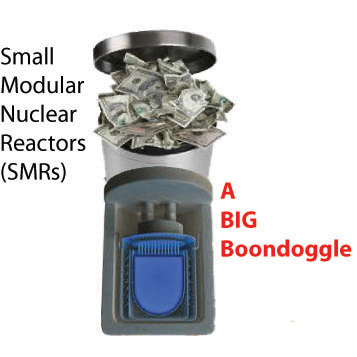
Reactor enthusiasts like Senator Barrasso invariably conjure visions of a “new generation” of small, modular nukes, and other techno-variants like molten salt and thorium, alleged to be safe, cleaner and cheaper that the current fleet. But there are few tangible indications such alternative reactors can come on line anytime soon, or beat the price of wind and solar, which continue to plummet. The criticism that renewables are intermittent is also losing its sting as large-scale battery arrays are also dropping in price while rising in efficiency and capacity………..

outspoken peace groups like Code Pink are eager to move the money out of the military and into the social/infrastructure programs that can rebuild the nation. High-profile campaigns led by activists Jodie Evans and Medea Benjamin were integral to the shocking defection of seven Republican Senators to deny the Trump Administration funding to support the Saudi war in Yemen.

Activists must now argue that the trillion-plus dollars we spend annually on arming the Empire should instead fund those wind turbines and solar panels at the heart of the Green New Deal.   https://progressive.org/dispatches/the-green-new-deal-promises-peace-and-progress-181227/

December 29, 2018 Posted by | politics, USA | 1 Comment

Australian Labor Party in a progressive move, plans to sign and ratify UN Nuclear Weapons Ban Treaty

Labor’s pledge to commit to nuclear disarmament puts the alternative party of government on the right side of history.

The gulf between the shenanigans of way too many politicians, and the growing urgency of grave and looming threats has rarely seemed wider. Action on crucial issues languishes while parliamentarians make naked grabs for power, acting in the interests only of themselves. Poor personal behaviour seems endemic. On the two unprecedented dangers looming over all humanity – nuclear war and climate disruption – Australia has been not just missing in action, but actively on the wrong side of history, part of the problem rather than the solution.

The government’s own figures demonstrate that our country, awash with renewable sun and wind, is way off track to meet even a third of its greenhouse gas emissions reduction target by 2030 – itself nowhere near enough.

Not only is nuclear disarmament stalled, but one by one, the agreements that reduced and constrained nuclear weapons, hard-won fruit of the end of the first cold war, are being trashed. All the nuclear-armed states are investing massively not simply in keeping their weapons indefinitely, but developing new ones that are more accurate, more deadly and more “usable”. The cold war is back, and irresponsible and explicit threats to use nuclear weapons have proliferated. Any positive effect that Australia might have on reducing nuclear weapons dangers from the supposed influence afforded us by our uncritical obsequiousness to the US is nowhere in sight. Our government has been incapable of asserting any independence even from the current most extreme, dysfunctional and unfit US administration. The US has recently renounced its previous commitments under the nuclear non-proliferation treaty (NPT); we have said nothing.

The one bright light in this gathering gloom is the 2017 UN treaty on the prohibition of nuclear weapons. For its role in helping to bring this historic treaty into being, the International Campaign to Abolish Nuclear Weapons (Ican) was awarded the Nobel peace prize for 2017 – the first to an entity born in Australia. This treaty provides the first comprehensive and categorical prohibition of nuclear weapons. It sets zero nuclear weapons as the clear and consistent standard for all countries and will help drive elimination of these worst weapons of mass destruction, just as the treaties banning biological and chemical weapons, landmines and cluster munitions have played a decisive role in progressing the elimination of those other indiscriminate and inhumane weapons. The treaty lays out a clear pathway for all states, with and without nuclear weapons, to fulfil their binding legal obligation to accomplish nuclear disarmament. It is currently the only such pathway.

Regrettably, the Australian government was the most active “weasel” in opposing the treaty’s development at every step and was one of the first to say it would not sign, even though we have signed every other treaty banning an unacceptable weapon.

Hence the Labor party’s commitment at its recent national conference in Adelaide that “Labor in government will sign and ratify the Ban Treaty” is an important and welcome step. It is a clear commitment, allowing no room for weaselling.

The considerations articulated alongside this commitment are fairly straightforward and consistent with the commitment. First, recognition of the need for “an effective verification and enforcement architecture” for nuclear disarmament. The treaty itself embodies this. Governments joining the treaty must designate a competent international authority “to negotiate and verify the irreversible elimination of nuclear weapons” and nuclear weapons programmes, “including the elimination or irreversible conversion of all nuclear-weapons-related facilities”. Australia should also push for the same standard for any nuclear disarmament that happens outside the treaty.

Second, the Labor resolution prioritises “the interaction of the Ban Treaty with the longstanding Nuclear Non-Proliferation Treaty”. The treaty has been carefully crafted to be entirely compatible with the NPT and explicitly reaffirms that the NPT “serves as a cornerstone of the nuclear disarmament and non-proliferation regime”, and that its full and effective implementation “has a vital role to play in promoting international peace and security”. All the governments supporting the treaty support the NPT, and the NPT itself enshrines a commitment for all its members to “pursue negotiations in good faith on effective measures relating to cessation of the nuclear arms race at an early date and to nuclear disarmament”. The UN secretary general, Antonio Guterres, and the International Committee of the Red Cross are among those who have affirmed that the treaty and the NPT are entirely consistent, complementary and mutually reinforcing. Even opponents of the treaty recognise that prohibition is an essential part of achieving and sustaining a world free of nuclear weapons.

Third, the Labor resolution refers to “Work to achieve universal support for the Ban Treaty.” This too is mirrored in one of the commitments governments take on in joining the treaty, to encourage other states to join, “with the goal of universal adherence of all States to the Treaty.”

An Australian government joining the treaty would enjoy wide popular support in doing so – an Ipsos poll last month found that 79% of Australians (and 83% of Labor voters) support, and less than 8% oppose, Australia joining the treaty.

Australia would also stop sticking out like a sore thumb among our southeast Asian and Pacific Island neighbours and be able to work more effectively with them. Brunei, Cook Islands, Fiji, Indonesia, Kiribati, Laos, New Zealand, Malaysia, Myanmar, Palau, Philippines, Samoa, Thailand, Timor-Leste, Tuvalu, Vanuatu and Vietnam have already signed the treaty.

Most importantly, joining the treaty and renouncing nuclear weapons would mean that Australia would become part of the solution rather than the problem of the acute existential peril that hangs over all of us while nuclear weapons exist, ready to be launched within minutes. Time is not on our side. Of course this crucial humanitarian issue should be above party politics. The commitment from the alternative party of government to join the treaty and get on the right side of history when Labor next forms government is to be warmly welcomed. It is to be hoped that the 78% of federal parliamentary Labor members who have put on record their support for Australia joining the treaty by signing Ican’s parliamentary pledge will help ensure Labor keeps this landmark promise.

 Dr Tilman Ruff is co-founder of the International Campaign to Abolish Nuclear Weapons (Ican) and Nobel peace prize winner (2017)

December 29, 2018 Posted by | AUSTRALIA, politics, politics international, weapons and war | Leave a comment

Inconvenient truths on nuclear waste ignored or buried by UK Government (again).

David Lowry’s Blog 27th Dec 2018 , Just before Christmas (19 December 2018) the Business Energy and
Industrial Strategy (BEIS) department published two important new documents dealing with the UK radioactive waste strategy.
They received no mainstream media print coverage.
One document was a new 68-page consultation policy paper on ‘Implementing geological disposal – working with communities: long term management of higher activity radioactive waste’ described as “An updated framework for the long term management of higher activity radioactive waste.”
The second was a 40-page ‘Summary of Responses to the Consultation ‘Working with Communities’: implementing GeologicalDisposal’.
http://drdavidlowry.blogspot.com/2018/12/inconvenient-truths-on-nuclear-waste.html

December 28, 2018 Posted by | politics, UK, wastes | Leave a comment

Enormous costs of shutting down Japan’s nuclear facilities

December 27, 2018 Posted by | decommission reactor, Japan, politics | Leave a comment

Donald Trump can launch nuclear weapons anytime: even Secretary of Defense Jim Mattis (now sacked) could not have stopped him.

December 24, 2018 Posted by | politics, USA, weapons and war | 2 Comments