Nearly 1000 climate protestors arrested in London – and Extinction Rebellion is changing tack
|
Extinction Rebellion: The People Risking Their Freedom For Climate Change | HuffPost Reports: UK Extinction Rebellion arrests close to 1,000 as protesters ‘pause rebellion’ ITV 21 Apr 19 Climate change protesters who have stopped traffic in a series of peaceful demonstrations across London will “pause” their rebellion in a bid to achieve their political aims, as the arrest total nears 1,000.Extinction Rebellion (XR) have announced they are switching disruptive tactics for political negotiations as they enter a second week of campaigning to have the Government declare a climate emergency. The number of people arrested in connection with the protests has hit 963 and 40 people have been charged. Continue reading |
Britain’s slow path to zero carbon emissions
Extinction Rebellion: what pushes people to drastic action on climate change?
Slow burn? The long road to a zero-emissions UK, Guardian, Robin McKie, Observer science editor, Sun 21 Apr 2019
Extinction Rebellion protesters want a carbon-free UK by 2025. But can the financial and political hurdles be overcome?
Many experts disagree, however. They argue that such an imminent target is completely impractical. “Yes, you could decarbonise Britain by 2025 but the cost of implementing such vast changes at that speed would be massive and hugely unpopular,” says Lord Turner, former chairman of the climate change committee.
Most expect the climate change committee will plump for 2050 as Britain’s ideal decarbonisation date. “2050 is do-able and desirable and would have an insignificant overall cost to the economy,” states Turner, who is now chairman of the Energy Transitions Commission. According to this scenario, developed nations, including Britain, would aim to achieve zero-emissions status by 2050 and then use the decarbonising technologies they have developed to achieve this goal – hydrogen plants, carbon dioxide storage vaults and advanced renewable generators – to help developing nations halt their greenhouse gas emissions by 2060.
Many experts disagree, however. They argue that such an imminent target is completely impractical. “Yes, you could decarbonise Britain by 2025 but the cost of implementing such vast changes at that speed would be massive and hugely unpopular,” says Lord Turner, former chairman of the climate change committee.
Most expect the climate change committee will plump for 2050 as Britain’s ideal decarbonisation date. “2050 is do-able and desirable and would have an insignificant overall cost to the economy,” states Turner, who is now chairman of the Energy Transitions Commission. According to this scenario, developed nations, including Britain, would aim to achieve zero-emissions status by 2050 and then use the decarbonising technologies they have developed to achieve this goal – hydrogen plants, carbon dioxide storage vaults and advanced renewable generators – to help developing nations halt their greenhouse gas emissions by 2060.
And the change has already been reflected in Britain’s power statistics. In 2013, 62.5% of UK electricity was generated by oil, coal and gas stations, while renewable provided only 14.5%. In 2018, the figure for oil, coal and gas had been reduced to 44% while renewables were generating 31.7%. It is a distinct improvement – though we have yet to be given a date when engineers expect the last UK fossil-fuelled power plant to produce its final watts of electricity and to emit its last puffs of carbon dioxide
“Decarbonising UK power production is going well,” says George Day, head of policy for the technology and innovation centre Energy Systems Catapult. “There is a clear path forward.” But as he points out, there are many other sources of carbon dioxide in the UK. “The next big challenge will be heating. Gas boilers are major carbon emitters and dealing with them is going to be very difficult.”
According to Day, about 90% of British people have gas boilers in their homes, most having been fitted relatively recently …
………In the end, it will simply not be possible to reduce Britain’s fossil-fuel emissions to zero, say scientists. To compensate, we will have to take carbon dioxide back out of the atmosphere. “That is the logical, inevitable consequence of trying to achieve zero net emissions in this country,” argues Corinne Le Quéré, of the University of East Anglia. “If you are looking for any net zero target then you have to remove carbon dioxide from the atmosphere.”
This can be done in three ways: naturally, by planting trees and shrubs that absorb carbon dioxide. Or artificially – on a larger scale – the gas can be removed as it is produced at a factory or power station that burns trees for energy.
Or it can be removed by huge numbers of man-made air filters, known as direct air capture. The carbon dioxide can be liquefied and stored underground in underground caverns, or old, depleted gas fields under the North Sea. This is known as carbon capture utilisation and underground storage (CCUS).
“In the end, your choice of replanting or of building underground storage facilities depends on how much carbon you will need to remove,” says Le Quéré. “Most calculations suggest Britain will need to take quite a lot of carbon dioxide out of the atmosphere to keep its net emissions at zero.”……….
UK carbon emissions have fallen for the sixth year running
This need for speed is shared by many other parts of the zero-emissions programme, as we have seen. It may seem odd given it is unlikely it will reach its conclusion for another three decades. Nevertheless, scientists are adamant that even if choose 2050 for our decarbonisation date, we need to act now.
This urgency of the task is emphasized by Joeri Rogelj at Imperial College London. “If the world limits emissions of carbon dioxide to no more than 420 billion tonnes this century, we will have a two in three chance of keeping global warming down to around 1.5C.
“However, if we go above to 580 billion tonnes then our chances will be reduced to 50-50. The problem is that in 2017 alone, a total of 42 billion tonnes of carbon dioxide was emitted in a single year. By that calculation, we clearly do not have a lot of time to waste.”https://www.theguardian.com/environment/2019/apr/21/long-road-to-zero-emissions-uk
A conservative backlash against Trump, as he appoints fossil fuel insiders to federal agencies?
|
Trump Appointed Fossil Fuel Insiders to Federal Agencies. It’s Backfiring. BY Mike Ludwig, Truthout, April 20, 2019 President Trump enjoys broad support from conservative Christians because of his promises to attack reproductive rights and stack the courts in their favor, but thousands of anti-choice “evangelical environmentalists” lashed out at his administration this week. Their gripe? An Environmental Protection Agency (EPA) proposal to gut the regulatory analysis behind pollution standards that have drastically reduced mercury and other toxic emissions from coal-burning power plants. Mercury, after all, can harm fetuses and developing brains.
In a letter published in The Hill this week, the Evangelical Environmental Network became the latest group to speak out against an EPA that would heavily revise the cost-benefit analysis behind its Mercury and Air Toxics Standards, or MATS, which have required coal plants to invest in pollution controls that reduced the amount of mercury they spew into the air by up to 90 percent over the past decade. Progressive environmental groups, lawmakers in both parties and even electric utilities also came out against the proposed rule-making during a public comment period that ended this week. The unusual dissent from conservative evangelicals was the latest evidence that Trump’s plan to unleash fossil fuels production by stacking federal agencies with industry insiders and slashing regulatory oversight is backfiring. The president’s first picks to run the EPA and the Interior Department resigned in scandal, and their replacements are already mired in investigations and ethical concerns. ……… https://truthout.org/articles/trump-appointed-fossil-fuel-insiders-to-federal-agencies-its-backfiring/ |
|
An emerging hopeful trend for US nuclear policy
A new, hopeful moment for US nuclear policy, Bulletin of the Atomic Scientists, By Joe Cirincione, April 17, 2019 Underneath the daily, depressing headlines, five converging trends offer hope, for the first time in more than a decade, for dramatic positive change in US nuclear policy.
The first trend is the growing recognition that current US nuclear security strategies have failed to make America safer. The policies pursued by President Donald Trump have made every nuclear danger he inherited worse, not better. Military budgets are spiraling out of control, new weapons and new doctrines are increasing the risk of nuclear use, effective treaties and agreements are frivolously discarded, and diligent diplomacy is replaced with narcissistic summitry. Our policies have alienated our allies and, most ominously, the instability of the president has exposed the underlying insanity of a system that gives one person the unchecked power to start a nuclear war that could end human civilization.
It is hard to find a bright spot in the Trump approach to nuclear affairs. The world is fully entrenched in a new arms race, with every nuclear-armed nation producing new weapons. Yet Trump is trying to destroy the accord that rolled back and contained Iran’s nuclear program, and he has seesawed his way to an incoherent North Korea policy. In fact, he and National Security Adviser John Bolton are methodically shredding the entire nuclear safety net of agreements, treaties, alliances, and security assurances constructed by their predecessors over decades.
This torrent of bad news has had one positive impact: It has made crystal clear that the United States needs a fundamentally new, saner nuclear strategy.
The second trend offers hope for developing such a strategy. The November elections brought fresh leadership and energy to the Congress. The House of Representatives can provide a check on a dangerous president and become a proving ground for new ideas and new policies. Leaders old and new are rising to the challenge.
Rep. Adam Smith, a 20-year veteran and now chair of the House Armed Services Committee, wants to “totally re-do the nuclear posture review.” Dozens of senators and members have introduced visionary legislation that could form the planks of a new strategic platform. There will be debates and votes on new weapons, a no first use policy, and efforts to prevent a nuclear arms race by preserving existing treaties.
The presidential campaigns, meanwhile, have started in earnest. Some candidates are already advancing dramatic, alternative security policies to end unjust wars and rethink our nuclear posture. Sen. Elizabeth Warren—who says, “our current nuclear strategy is not just outdated, it is dangerous”—mirrors Smith’s policy priorities with a three-part proposal: No new weapons, more arms control not less, and no first use. Sen. Bernie Sanders told a Fox News town hall April 15, “We have to bring the United States and the rest of the world together to do everything we can to rid this world of nuclear weapons.”
Meanwhile, six candidates have already said that one of their top priorities would be to re-commit the United States to the Iran anti-nuclear deal, including Warren, Sanders, Kamala Harris, Julian Castro, Amy Klobuchar, and Wayne Messam. Many also support negotiations with North Korea—but done with a competent team, a fully staffed State Department, and plans that rely less on summitry and more on diplomacy.
The most important trend, however, is the rise of vibrant mass movements that have translated angry street protests into sustained political action, powered 100 new members into Congress, and now are linking up with the “activist leadership” style of these members and some presidential candidates. Though primarily focused on domestic matters, these organizations are ready to embrace national security in their campaigns for a more just and equitable society. This is precisely the type of grassroots pressure needed to encourage political leaders to break with the nuclear-industrial complex and its outmoded programs and strategies—and then press for the implementation of new policies in Congress and in the White House.
Relatedly, the success of the Treaty on the Prohibition of Nuclear Weapons campaign indicates that the global appetite for the elimination of these weapons is growing. Allied governments—often in the grip of conservative defense officials who resist changes to nuclear doctrine—may be more receptive to discussion about disarmament, faced with this popular sentiment and the scares Trump’s personality and policies have given them.
Finally, trillion-dollar tax cuts and profligate military spending have brought budget realities home to America. ….. https://thebulletin.org/2019/04/a-new-hopeful-moment-for-us-nuclear-policy/
Dangerous electioneering: India’s Modi ramps up the nuclear weapons rhetoric

 Express Tribune 19th April 2019 During an election rally on April 14, Prime Minister Narendra Modi claimed
that he had called Pakistan’s nuclear “bluff” by carrying out air
strikes within Pakistan. In his exact words, Modi boasted, “Pakistan has
threatened us with nuclear, nuclear, nuclear” and then he asked
rhetorically, “Did we deflate their nuclear threat or not?”
Of course, Modi’s supporters raised chants in an expression of their approval.
Perhaps this was merely a case of aggressive electioneering in which Modi
has focused on national security as the main theme. But such claims have
also been made by several Indian policymakers and defence analysts after
the recent Pulwama crisis which demonstrates that there is a wider
acceptance for such views. In reality this is a dangerous delusion.
https://tribune.com.pk/story/1953964/6-indias-dangerous-delusions/
On climate change impacts, nuclear lobby has captured the regulators
 Watchdog Sounds Alarm Over Regulatory Capture as New Reporting Shows Nuclear Plants Unprepared for Climate Crisis https://www.commondreams.org/news/2019/04/19/watchdog-sounds-alarm-over-regulatory-capture-new-reporting-shows-nuclear-plants “We do not have an independent regulator that is heeding its mandate to protect public health and safety first.” Despite that threat, says a watchdog, the industry’s regulatory capture means its interests are set to continue to take precedence over public health and safety. As Bloomberg‘s Christopher Flavelle and Jeremy C.F. Lin laid out Thursday, in the wake of the 2011 Fukushima disaster the five-member Nuclear Regulatory Commission (NRC) tasked the roughly 60 operating plants in the U.S. with assessing what their flood risks were compared to what flood risks the plants were actually built to withstand. That was a logical step, given many of the American plants’ proximity to waterways, and the heightened risk of flooding in the face of the climate crisis. Shortfalls in the assessments were evident.
What’s more, those shortfalls may represent a better case scenario, as the NRC allowed the plant operators—not an outside authority—to perform the flood estimates and were not required to assess projected flood risks. “It’s difficult to come across as an independent regulator and rely on self-assessment” from plants, as Tony Vegel, a Texas-based reactor safety official for the NRC, said previously. The nuclear industry, as Bloomberg reported, wasn’t interested in facility redesigns to better withstand flood risks. Rather, it wanted
The three Trump-appointed commissioners did the industry’s bidding and said the existing regulations afforded enough protection. The NRC’s two Democratic commissioners disagreed. Bloomberg quoted Edwin Lyman, head of the Nuclear Safety Project at the Union of Concerned Scientists, as saying, “The NRC basically did everything the industry wanted.” Paul Gunter, director of the Reactor Oversight Project at Beyond Nuclear, concurred with that assessment. Another issue, he told Common Dreams, is that “the commission’s January 2019 voteappears to have violated the federal Administrative Procedures Act by erasing what had been established as mandatory requirements through the agency’s rulemaking process for post-Fukushima flooding preparations at U.S. reactors.” “The Commission vote,” he said, “inexplicably switched out ‘mandatory’ requirements with ‘voluntary’ initiatives after the public comment period on the final rule was closed. The NRC did not receive a single comment from either the public or the industry to make such a change.” Gunter also noted that the NRC’s failings didn’t just begin once Trump entered the White House. For example, he said, “following the Fukushima catastrophe, in 2012 the NRC technical staff unanimously agreed that the agency issue an order to 31 U.S. Fukushima-style GE Mark I and II boiling water reactors requiring operators to install severe accident-capable radiation filters on hardened containment vents.” These vents, he explained, “would allow operators to vent the containment of a severe accident’s extreme heat, pressure, and explosive gases to save the structure while filtering out the release of harmful radiation.” But in a June 2013 vote, “the commission voted to order the installation of hardened containment vents but without the engineered external radiation filters which industry opposed on cost.” While the NRC “suggested that the filters could be taken up later in a rulemaking process for public comment,” it “abandoned the measure,” said Gunter. In another sign of the NRC’s capture by the nuclear industry The Associated Pressreported last month:
The battle lines, said Gunter, are clear. “The essential step forward must address the regulatory agency’s deepening capture by an aging and financially failing nuclear industry,” he said. “We do not have an independent regulator that is heeding its mandate to protect public health and safety first.” |
|
State subsidies for nuclear power in USA are simply not necessary
 State Nuclear Subsidies Not Needed, Forbes, Adam Millsap-19 Apr 19
Natural gas has become the dominant source of electricity generation in the United States and this is creating some financial issues for the nuclear industry. Since 2010, several nuclear plants around the country have closed and economic conditions, particularly low natural gas prices, are often citedas a factor. Officials from companies that own and operate struggling plants are seeking government assistance to stay afloat, but state lawmakers should be skeptical.
The decline in the price of natural gas since 2008, shown in the figure below, [on original] has made it difficult for some nuclear plants to compete. Prior to 2008, some thought a nuclear renaissance was on the horizon. Now this seems unlikely.
Nuclear power is characterized by the initial high costs of plant construction followed by relatively low operating costs. When alternative energy sources—such as coal, oil, solar, etc.—are expensive, it can make economic sense to bear the high costs of nuclear plant construction. But when other prices are low, as with today’s abundant natural gas and increasingly competitive wind and solar power, it’s harder to justify new plant construction.
Not only are economic conditions working against new nuclear plants, but they are also unfavorable to many existing plants. Unsurprisingly, officials from the companies that own and operate the struggling plants want some government help. A recent report in Pennsylvania’s York Dispatch shows that Exelon Corp.—the owner of some of the struggling plants—significantly increased its lobbying spending in Pennsylvania in 2018 compared to the previous five election cycles. Spending increased from an average of just over $646,000 from 2008 to 2016 to nearly $1.8 million in 2018.
There is some evidence that the lobbying is working. …..
Subsidies work by taxing one group and giving the revenue to another. In the Pennsylvania and Ohio bills, the funding for the subsidy is raised via higher electricity rates on consumers.
Supporters of both bills argue that nuclear is a vital source of clean energy and that without legislation nuclear plants will continue to shut down. But despite competition from natural gas and renewables, it’s not clear that the nuclear industry as a whole is in deep financial trouble. According to a recent analysis, all but one of Pennsylvania’s five nuclear plants are covering their costs. Since there is no financial stress requirement in the Pennsylvania bill, profitable plants in the state will benefit just as much as the current unprofitable one—Three Mile Island Unit 1.
More broadly, a recent State of the Market Report for PJM, which is the regional transmission organization that coordinates the movement of wholesale electricity in Pennsylvania, Ohio, and other nearby states, also casts doubt on the general unprofitability of nuclear power. The report projects that only three of 18 nuclear plants in the region—Three Mile Island along with Davis-Besse and Perry in Ohio—won’t be able to cover their costs for at least one year between 2019 to 2021. ……
it’s not clear that subsidizing inefficient nuclear plants is the most economical way to address climate change , since subsides have problems of their own……
subsidies to nuclear plants are also likely to crowd out new, more efficient electricity plants. Total electricity generation in the United States has declined slightly since 2010 despite economic growth in the form of real GDP per capita, as shown below. [on original]
In a world of declining or even stable electricity use, the profit motive for investing in new capacity is weakened if new plants are not allowed to out-compete less efficient plants for market share. So as long as less efficient nuclear plants are meeting consumer demand, newer plants powered by natural gas, wind, solar, or some other source will have a difficult time finding a market.
Stu Bressler, senior vice president of operations and markets for PJM Interconnection, recently said essentially this when he told Ohio lawmakersthat subsidizing less competitive plants “…could prevent the building of more efficient and cost effective plants, including cleaner technologies like solar and wind.”
Finally, just because a subsidy has the potential to improve economic efficiency doesn’t mean it will. A subsidy that is too small will not generate enough of the good or service. A subsidy that is too large can generate too much, leading to more inefficiency than no subsidy at all. The bureaucratic costs of estimating the correct subsidy, implementing it, and administering it must also be considered. If these costs outweigh the potential gains in efficiency from the subsidy, then the economy would be better off without it.
It doesn’t appear that Ohio or Pennsylvania lawmakers have rigorously estimated the appropriate subsidy or accounted for the costs of implementing and administering one in their proposals. Without such analysis, it’s unlikely that the proposed nuclear subsidies will lead to an improvement in consumer welfare. Instead, these subsidies will likely do more harm than good, as they seem to be primarily designed to help a few unprofitable nuclear plants rather than carefully thought out pieces of a broader, market-based energy plan.
Adam A. Millsap is the Assistant Director of the L. Charles Hilton Jr. Center at Florida State University and an Affiliated Scholar at the Mercatus Center at George Mason University. https://www.forbes.com/sites/adammillsap/2019/04/19/state-nuclear-subsidies-not-needed/#e532f23111dc
Harvey Wasserman: America’s “Hole-in-the-Head” Nuke Suicide Pact Gets Court Approval
|
Every downwind American is now threatened with deadly radiation while state after state bankrupts itself with soaring electric bills and ecological disaster, crippling the Solartopian green energy revolution. It is, in short, the “hole in the head” wave of massive state-based nuke bailouts All across the US, brain-dead Trumpist legislatures are scamming public billions into dying nuke reactors that pose the #1 threat to human survival on this planet. All the world’s 440 reactors (98 in the US) are decrepit, crumbling, ready to blow. They’re uninspected, under-maintained, filthy, falling apart. They emit massive quantities of heat and radiation that cause climate chaos. Most are huge money-losers that can’t compete with green Solartopian technologies. They are epitomized by Ohio’s infamous “hole in the head” Davis-Besse nuke, currently crumbling outside Toledo. In keeping with the Luddite wave now sweeping Trumpnation, the Ohio legislature may soon fork over billions to keep it running toward the ultimate failure. The state-based nuke bailout craze actually started with New York governor Andrew Cuomo. In 2016-2017, he began gouging the Empire State for some $7.6 billion to underwrite four dying upstate nukes. All lose mega-cash while killing countless jobs by raising electric rates and blocking renewables. Wind, solar, batteries and LED/efficiency were set to make the Empire state both energy independent and fully employed. But Cuomo is blocking that by scamming ratepayers as far away as Long Island who get zero juice from the nukes they’re being forced to subsidize. Cuomo originally promised the payouts would soon decline. Instead, they rose $50 million this year, even beyond the original bailout scam. The Illinois legislature is doing the same for three downstate reactors. New Jersey and Pennsylvania are contemplating a similar suicide. But Ohio may top them all. Center stage is FirstEnergy’s infamous money-losing Davis-Besse “hole-in-the-head” nuke near Toledo. Its bankrupt owner’s precursor blacked out the entire Northeast in 2003. FE says without a gargantuan bailout, DB will shut by 2021. So the gerrymandered GOP legislature may soon gouge tax/ratepayers some $300 million/year to keep DB and the nearby Perry reactor open, dooming the state’s remnant rust belt economy. DB dumps its waste heat into Lake Erie, between Toledo and Cleveland. A 1977 accident portended what destroyed its clone, Three Mile Island Unit Two, on March 28, 1979. TMI2’s owners later sued because lessons learned at DB that might’ve helped them avoid their own disaster were not passed on. In 2002, news of a hole in DB’s head astonished the industry. Dripping boric acid had eaten nearly through the reactor vessel head. Cleveland and the Great Lakes were 3/5ths of an inch from permanent irradiation. Rather than shut permanently, FE spent millions on a “fix” that failed. Then they cut through the containment and glued on a badly-fitted head from an unfinished Michigan reactor canceled by citizen action. Shoddy construction and faulty maintenance have perforated the building meant to shield the public from DB’s radiation. Its operating/maintenance costs soar while it can’t compete with methane. But it’s wind that Ohio’s nuke-loving lawmakers most hate. “North coast” breezes blow steadily over flat agricultural land filled with transmission lines. Farmers are desperate for the steady income turbines can bring, especially when sited so close to urban consumers. More than $4 billion in private funding is pending for Ohio wind farms, guaranteeing billions in longterm revenue and thousands of secure jobs. But in 2015, FE’s bought lawmakers concocted a setback provision meant to kill those projects. Other midwestern/Great Plains states are now filling with cheap nature-based electricity. But anti-wind Ohio may now bury its fiscal future with unsustainable electric rates. All reactors spew carbon 14 along with huge quantities of hot water and steam that warm the planet and kill trillions of marine creatures. Their cooling towers kill countless birds. All American reactors (except Watts Bar) are more than twenty years old; some are more than forty. Now the Trump-run Nuclear Regulatory Commission says it may simply stop inspecting these older reactors just as they most need it. They want owners to stop informing the public of mishaps just as they become more frequent and dangerous. The terrifying escalation of reactor disasters has risen from the near-miss at Michigan’s Fermi One (1966) to the melt-down at TMI (1979) to the mega-explosion at Chernobyl (1986) to the three melt-downs/four explosions at Fukushima. After that 2011 disaster, NRC staff compiled upgrades to guard against another one. But the Trump Commission killed them all, leaving the fleet even more dangerous than before Fukushima. When the next big reactor blows, industry hacks like Ann Coulter will be all over Fox explaining that radiation is good and that plutonium is pixie dust that really won’t harm our kids. But the ghastly death tolls at TMI, Chernobyl, and Fukushima say otherwise. Based on the insane claim that nukes deserve “zero emission credits,” the Supreme Court has cleared the way for still more of these insane bailouts. Grassroots Solartopians are fighting back. Ohio’s bailout has been held off for years, and may yet fail. They’ve petitioned California Governor Gavin Newsom to independently inspect Diablo Canyon. They’ve also poured into the bankruptcy court, where FirstEnergy’s inabilities are on global display alongside those of California’s Pacific Gas & Electric, the money-losing behemoth that in 2010 killed eight people with badly maintained pipelines, then killed eighty more with badly maintained power lines that incinerated an entire ecosystem, including 12,000 structures. The uncaring incompetence of this dying industry and its technology of death guarantee that unless these bailouts stop, far worse is yet to come. Harvey Wasserman’s Green Power & Wellness Show is podcast at prn.fm; California Solartopia is broadcast at KPFK-Pacifica, 90.7 fm, Los Angeles. His Life & Death Spiral of US History: From Deganawidah to Solartopia will soon be at www.solartopia.org. |
|

 he Supreme Court has just now certified the deadliest and most economically
 Finland to start constructing nuclear plant with Russian reactor in 2021
|
New Europe By Kostis GeropoulosEnergy & Russian Affairs Editor,19 Apr 19 SOCHI, Russia – Fennovoima is proceeding with plans to build the Hanhikivi 1 nuclear power plant in the northern Finnish city of Pyhäjoki and expects to receive the construction license in 2021, Fennovoima CEO Toni Hemminki told New Europe in an interview on the sidelines of the 2019 Atomexpo XI in Sochi on 15 April. Fennovoima had originally expected to start construction of the plant in 2019.
“At the end of the year, the supplier, RAOS Project, communicated to us that, according to the estimation, we can start the construction in 2021 and then that means commercial operational date would be the 2028,” he said, referring to RAOS Project Oy, a subsidiary of Rosatom Energy International. “Those are the milestones that we are working on accordingly at the moment and we are also fine tuning the detailed schedule for it with the supplier,” he said, adding that the structure with the supplier is the same but there have been some organizational changes within Fennovoima. …… Hemminki argued that building the plant in Finland would be a showcase for the Rosatom State Atomiс Energy Corporation. “We might be the only customer of Rosatom that is commercial. ……
He noted that Russia would provide nuclear fuel to the Finnish plant for at least 10 years. Turning to sanctions against Russia, he said they did not affect the nuclear industry. “Globally, there are a few supplies going to different countries from Russia. I think this is functioning and for our project as well, we have not seen any direct effect at the moment,” Hemminki said……
He acknowledged that nuclear waste is a long-term fundamental issue, saying: “We are going to select the locations for final disposal in 2040 so that’s a very long-term project so it’s not acute at the moment.” https://www.neweurope.eu/article/finland-to-start-constructing-nuclear-plant-with-russian-reactor-in-2021/
|
|
|
UK’s EPA concerned over proposals for Sizewell new nuclear power station in Suffolk
ENDS 16th April 2019 The Environment Agency has flagged a series of concerns over proposals for a new nuclear power station in Suffolk, warning that a lack of detail means
that the impacts and proposed suitability of mitigations “cannot be
assessed at this time”. Energy firm EDF plans to build and operate the new
Sizewell C nuclear power station in Suffolk on land immediately to the
north of the Sizewell B power station. The application – which has yet to
be submitted – will be determined via the fast-track Planning Act 2008
regime for nationally significant infrastructure projects, with the
business secretary responsible for making a final decision.
https://www.endsreport.com/article/1582216/environment-agency-concerned-lack-detail-sizewell-c-plans
Nuclear plant operators must pay price for missing deadline
|
Asai Shimbun, April 20, 2019 Recent announcements by three electric utilities that they will miss the deadline for taking legally required anti-terrorism measures for their nuclear power plants raises serious questions about their commitment to nuclear safety.Kansai Electric Power Co., Kyushu Electric Power Co. and Shikoku Electric Power Co. said on April 17 that they will miss the deadline for completing the facilities to respond to emergencies triggered by terrorist attacks against their reactors. The reactors include ones that have been restarted after being shut down following the 2011 Fukushima nuclear disaster.
The companies have asked the Nuclear Regulation Authority to extend the deadline. The facilities in question are supposed to be at the forefront of efforts to prevent severe nuclear accidents in the event their reactors come under terrorist attacks using aircraft. The utilities should not be permitted to continue their operations until this crucial safety aspect is fixed. We call on the nuclear safety watchdog to take a firm stand toward their request. Nuclear plant operators are required to erect anti-terrorism facilities under new nuclear safety standards that took effect in 2013. The regulations are modeled on measures to deal with the risk of terror attacks against nuclear plants worked out by the U.S. Nuclear Regulatory Commission following the Sept. 11 attacks against the United States in 2001. The principal objective of the measures is to prevent the kind of nuclear meltdowns that occurred at the Fukushima No. 1 nuclear power plant in 2011 even if the control room is destroyed by an aerial terror attack…….. http://www.asahi.com/ajw/articles/AJ201904200025.html |
|
|
USA Congressmen concerned at slow clean-up of dangerous San Onofre nuclear site
 The Nuclear Cleanup At San Onofre Isn’t Moving Fast Enough, Congressmen Say, laist.com, APRIL 17, 2019 About 8 million people live within 50 miles of San Onofre, the now-defunct, beach-adjacent nuclear plant located between Oceanside and San Clemente. Inside the plant is 1,600 tons of radioactive waste. Much of the spent nuclear fuel is currently sitting in cooling pools waiting to be moved to a safer location — specifically, one that’s less vulnerable to earthquake faults and rising sea levels.On Tuesday, Rep. Mike Levin and Orange County Rep. Harley Rouda spoke to reporters at Southern California Edison’s decommissioned facility about a proposal to speed up the removal of that waste. The Nuclear Cleanup At San Onofre Isn’t Moving Fast Enough, Congressmen Say, laist.com, APRIL 17, 2019 About 8 million people live within 50 miles of San Onofre, the now-defunct, beach-adjacent nuclear plant located between Oceanside and San Clemente. Inside the plant is 1,600 tons of radioactive waste. Much of the spent nuclear fuel is currently sitting in cooling pools waiting to be moved to a safer location — specifically, one that’s less vulnerable to earthquake faults and rising sea levels.On Tuesday, Rep. Mike Levin and Orange County Rep. Harley Rouda spoke to reporters at Southern California Edison’s decommissioned facility about a proposal to speed up the removal of that waste.
There are two moves needed. One is to get it out of the cooling ponds at San Onofre and into the dry concrete bunkers. That will enable the defunct plant to be dismantled. But the members of Congress want to accelerate another move of the spent fuel out of state to “interim” storage and eventually to permanent storage Nuclear waste cleanup at the San Onofre nuclear power plant has been on hold since last summer after a mishap involving a 50-ton container of radioactive material. Rep. Mike Levin says Congress should set new priorities for which power plants get top priority to ship the fuel elsewhere. The oceanfront San Onofre plant within his Oceanside Congressional district would be right at the top of the list, according to his proposed new criteria. “We probably shouldn’t have had a nuclear power plant here in the first place,” Levin said. “But now that we do, and we’re stuck with 1,600 tons of spent radioactive nuclear fuel, we better do everything we can do to prioritize.” He wants plants that are closed, and located near near large population centers and at risk from earthquake faults and rising sea levels to get priority permits to transport the waste out of state. Levin said he would introduce a bill when he returns to Congress that would change the criteria. He said he disagreed with current policies that call for the oldest fuel to be shipped to remote storage first, citing the higher risk to dense nearby populations. Rouda and Levin were among 15 members who called on Congress earlier this month to spend $25 million hurrying the development of interim storage spots. Two locations, in West Texas and New Mexico, are in the process of getting permits to store nuclear waste on an interim basis while the federal government seeks a permanent home for it. WHAT WENT WRONG AT SAN ONOFRE LAST AUGUST? Spent nuclear fuel is being held in cooling ponds and being transferred in giant canisters to new concrete bunkers about 100 feet from the ocean. A 28-foot high seawall is meant to keep seawater out of the bunkers. Edison contractors had already transferred 29 of 73 containers of nuclear waste to the new location. But on August 3, a 20-foot tall canister containing more than 50 tons of radioactive waste was left suspended on a metal flange 18 feet above a storage bunker floor during its transfer. Safety slings to keep the canister from falling were disabled, so the danger was that the canister could have fallen and perhaps ruptured. SCE’s contractor doing the work did not properly disclose the incident that day. The Nuclear Regulatory Commission found that from Jan. 30 to Aug. 3, 2018, workers loading the canisters into the bunkers “frequently” knocked the canister against components of the vault, potentially gouging the steel container. Again, the contractors didn’t immediately tell Edison that was happening, depriving the company and other workers of a chance to correct the loading procedure. The NRC cited “apparent weaknesses in management oversight” of how the waste canisters were stored, and fined Edison $116,000 for the violation. The company did not sufficiently oversee its contractor doing the work of moving the canisters, the NRC said. The company is waiting for the green light from the Nuclear Regulatory Commission to resume the work of transferring the waste. Here is the NRC’s November 2018 report that criticized Edison’s handling of waste………https://laist.com/2019/04/17/the_nuclear_cleanup_at_san_onofre_isnt_moving_fast_enough_congressmen_say.php |
|
Trump’s administration speeds up the revolving door between Pentagon and nuclear weapons companies
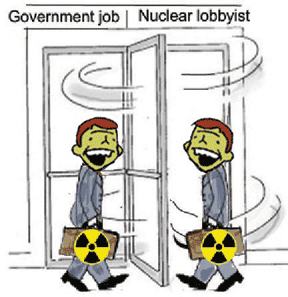 Tomgram: Smithberger and Hartung, The Pentagon’s Revolving Door Spins Faster Tomgram: Smithberger and Hartung, The Pentagon’s Revolving Door Spins Faster
|
|
Some consternation in France, as EDF plans to split off its nuclear section
Le Monde 15th April 2019 For several weeks, EDF’s management and the executive have been
preparing a plan to separate nuclear activities from the rest of the group.
A high-risk issue for the government.
Le Monde 15th April 2019 The CGT secretary of the EDF works council, François Dos Santos, protested against the government’s desire to divide the group into two separate
subsidiaries.
Electricite de France (EDF) €33 billion debt, and more problems – its nuclear section to be nationalised.

 Times 16th April 2019 A row erupted in France yesterday after it emerged that EDF’s board will discuss plans to renationalise the group’s nuclear activities and split them from the rest of its business. Unions reacted with anger to what they depicted as the first step towards the dismantling of the energy group that is building Britain’s new reactors at Hinkley Point in Somerset.
The board is due to review the restructuring plan next month before presenting it to senior managers and union representatives in June, according to a source. The scheme involves the creation of a parent company to run the group’s 58 reactors in France, as well as new ones that it may build.
This part of the group could be renationalised, rolling back the partial privatisation of EDF in 2004, which left the state with an 83.7 per cent stake. Most of the rest of the group’s activities then would be placed in a subsidiary that would continue to seek private investors under the plan, which has been codenamed Project Hercules, according to the newspaper Le Parisien.
People close to President Macron, who has the final say, claim that he broadly supports the idea, but may backtrack if the price of compensating shareholders proves to be beyond the means of France’s hard-pressed state budget. A fierce union reaction also could prompt him to retreat,
commentators said.
Although a source insisted that the restructuring would have no direct impact on Hinkley Point, it is likely to create short-term uncertainty for EDF Energy, the group’s British division.
EDF is struggling to meet the cost of renovating its ageing French nuclear fleet, which is estimated at between €55 billion and €75 billion. In addition, the group, which has a debt of €33 billion, is facing several other difficulties, not least that it is committed to funding two thirds of the estimated £22.3 billion cost of the new-generation European pressurised reactors being built at Hinkley Point.
A similar reactor at Flamanville in northern France was meant to cost €3 billion and come on stream in 2012. The reactor is still not operating and the budget has reached €10.9 billion. Last week, it emerged that experts had advised that EDF should repair faulty weldings at Flamanville, which would add hundreds of millions of euros to the bill and lead to a further delay.
1 This Month





PLEASE OPPOSE HR 8255 AND S.3639 – bills would accelerate satellite deployment, with no environmental review or safeguards – https://ncstd5li.quorum.us/campaign/169331/
To see nuclear-related stories in greater depth and intensity – go to https://nuclearinformation.wordpress.com
-
Archives
- October 2026 (81)
- September 2026 (339)
- August 2026 (330)
- July 2026 (355)
- June 2026 (287)
- May 2026 (306)
- April 2026 (356)
- March 2026 (251)
- February 2026 (267)
- January 2026 (308)
- December 2025 (358)
- November 2025 (359)
-
Categories
- 1
- 1 NUCLEAR ISSUES
- business and costs
- climate change
- culture and arts
- ENERGY
- environment
- health
- history
- indigenous issues
- Legal
- marketing of nuclear
- media
- opposition to nuclear
- PERSONAL STORIES
- politics
- politics international
- Religion and ethics
- safety
- secrets,lies and civil liberties
- spinbuster
- technology
- Uranium
- wastes
- weapons and war
- Women
- 2 WORLD
- ACTION
- AFRICA
- Atrocities
- AUSTRALIA
- Christina's notes
- Christina's themes
- culture and arts
- Events
- Fuk 2022
- Fuk 2023
- Fukushima 2017
- Fukushima 2018
- fukushima 2019
- Fukushima 2020
- Fukushima 2021
- general
- global warming
- Humour (God we need it)
- Nuclear
- RARE EARTHS
- Reference
- resources – print
- Resources -audiovicual
- Weekly Newsletter
- World
- World Nuclear
- YouTube
-
RSS
Entries RSS
Comments RSS

