Subsidies to nuclear industry – legislation “anti-competitive” and “anti-consumer.”
 Free-market advocate chastises nuclear energy subsidies in committee hearing, Ohio Watchdog, By Tyler Arnold | Watchdog.org, Apr 24, 2019,
No to nuclear power: Taiwan’s president reaffirms anti-nuclear stance
 Taiwan’s president reaffirms anti-nuclear stance at march https://mainichi.jp/english/articles/20190428/p2g/00m/0in/056000c, April 28, 2019 (Mainichi Japan) TAIPEI, Taiwan (AP) — Taiwanese President Tsai Ing-wen on Saturday reaffirmed her opposition to nuclear power before marching with anti-nuclear protesters, reviving an issue that has proven politically divisive in the past.
Tsai said at a news conference that her administration was taking efforts to promote renewable energy and reduce the need for nuclear power.
“In the past, people often said we won’t have electricity without nuclear power, or that Taiwan does not have the conditions to develop renewable energy, or even that renewable and green energy are too expensive,” Tsai said. “But after the efforts we have made since taking office, such talk has dissipated.”
She also vowed to reach her targets in reducing emissions from thermal power plants and to retire current nuclear power plants, though without giving any timeline.
“We will carry on with the targets to eliminate nuclear power and reduce carbon,” Tsai said. “We will reach the targets and Taiwan will not be short of electricity” for the island’s 23 million people.
She then joined hundreds of people who marched through the streets of Taipei, the capital, beginning at the Presidential Office Building in the city’s center, in a show of opposition to nuclear power.
Tsai’s Democratic Progressive Party has long opposed the nuclear industry, particularly construction of the high-tech island’s fourth nuclear plant on the tip of the island, north of Taipei. Nuclear power now accounts for about 15% of Taiwan’s electricity generation, according to the World Nuclear Association.
The main opposition Nationalist Party has promoted nuclear power as one of the best ways to provide reliable energy to the island. The issue has in the past sparked occasionally violent clashes between proponents and supporters.
“Climate Emergency Independents” emerge from Extinction Rebellion to stand for UK Parliament

 Guardian 26th April 2019, Activists who took part in the Extinction Rebellion protests have announcedthey will stand in the European elections on a “climate emergency” ticket.
Under the name Climate Emergency Independents the new group, which is
separate from Extinction Rebellion, nine candidates will stand in the 23
May polls – seven in London and two in south-west England region. The group
said it was inspired by the mass civil disobedience demonstrations on the
streets of London over the past two weeks as well by Greta Thunberg and the
global school strikes movement she inspired.
Opposition to nuclear subsidies in Pennsylvania
|
Nuclear subsidies an uphill battle in Pennsylvania WHYY, By Marie Cusick
|
|
British govt about to give nuclear power a massive state-funded financial boost
|
For instance the Financial Times describes the use of “RAB” (regulated asset base) financing as similar to the system used to build the Thames Tideway tunnel’ Under such schemes the developers are allowed to charge consumers in advance for the capital building projects. What Ministers are not emphasising of course, is that in industries such as water the Government does not lend lots of money to the privatised companies. They raise this on private markets. But in the case of nuclear power plants the bulk of the money needed to build them will be borrowed from the Government.
RAB has been used to try to finance nuclear power plants in the USA, in the states of Georgia and South Carolina recently. The result was disaster and the developing company, Westinghouse, went bust. But this was ‘normal’ RAB where the developer takes the risk of cost overruns. But in the proposed UK nuclear version it will be the electricity consumer who goes bust when the almost inevitable cost-overruns set in! The nuclear RAB is really a cover for a nuclear bailout. So let’s call it a ‘nuke bailout RAB’.
What makes this move even more infuriating for green energy supporters is that Hammond offered what amount to a few superficial titbits for green energy in his Spring statement. Meanwhile renewable energy projects will not be able to take part in RAB projects. Not only will nuclear power be funded under much more preferential terms compared to offshore or onshore renewable energy projects but they will be directly funded by government and large parts, if not all, of their liabilities guaranteed by the treasury – again something that does not apply to renewable energy. (1)
According to Harminder Singh, Power Analyst at GlobalData, the RAB model would shift the risk from the developers to consumers, thus raising the electricity bills of consumers. Consumers will be effectively paying for an asset that will come up some time in the future, with all the risks associated with it. Furthermore, with the cost escalations associated with nuclear power projects, there is an additional uncertainty regarding how much it will add to the consumer power bill. The model has so far not been used for projects as expensive as nuclear power plants, which is seen as a key cause for concern. On the other hand, the RAB is a useful tool to attract private investments in the sector, as investors are able to see a fixed rate of return as the project is being built. The key problem that RAB addresses is that of high cost of capital for nuclear power projects. It is revised at regular intervals to take into account increases in capex – subject to regulatory approval. The regulatory protection and government backing means that the RAB is treated as a strong, secure asset. (2) http://www.no2nuclearpower.org.uk/wp/wp-content/uploads/2019/04/NuClearNewsNo116.pdf |
|
|
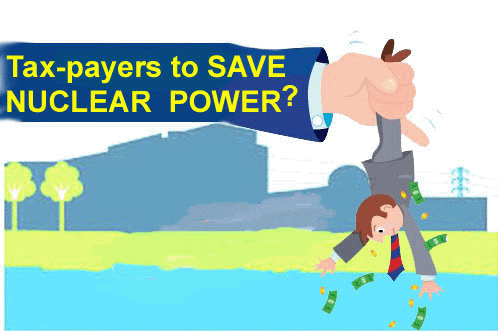
USA’s Dept of Energy fails to provide adequate funding for Hanford nuclear clean-up
“The HAB views the combined lack of compliant budget appropriations, the unanticipated problems at Hanford, and the extreme increase in estimated funding levels identified in the lifecycle cost report with great concern,” the board told DOE. Those factors will result in cleanup taking longer and costing more, putting workers, the environment, and the public at increased risk, the letter says.
“They will also result in additional discussion about reducing standards or potentially conducting a lesser quality cleanup,” according to the board.
Unanticipated problems in work at the former plutonium production complex have included the spread of radioactive contamination at the Plutonium Finishing Plant demolition in 2017 and the May 2017 collapse of the older of two PUREX Plant radioactive waste storage tunnels.
The Energy Department has addressed the issues, but the costs and schedule impacts from these and other unanticipated setbacks could compound the challenge of meeting milestones set under the legally binding Tri-Party Agreement on Hanford cleanup, the budget letter said.
The latest Hanford Lifecycle Scope, Schedule and Cost Report, released in January, “is particularly concerning,” the board said. It put the remaining cost of Hanford cleanup and the initiation of long-term stewardship at $323 billion to $677 billion, and said work could continue beyond this century. The amount of funding needed annually would increase to $4 billion starting in fiscal 2020 and later could peak as high as $16 billion in 2088 under the worst-case scenario.
“Receiving appropriation for even the low-range annual funding estimates will be extremely challenging, thereby putting the cleanup mission in further jeopardy,” the letter said.
For fiscal 2020, which begins Oct. 1, DOE is seeking $2.1 billion for the two offices at Hanford. That would be a $400 million reduction from current funding levels.
Lawmakers and media are being conned, as nuclear industry manipulates climate change rules
|
In state after state, operators have figured out how turn green-power incentives into sweetheart deals. https://www.politico.com/agenda/story/2019/04/23/nuclear-energy-climate-change-000893, By TRAVIS KAVULLA 04/23/2019 Yet these laws remain on the books, and recently some of the nation’s largest energy producers have started to turn them to their own benefit. For the past several years, I’ve been researching clean-energy regulations at the state level, and a troubling pattern has begun to emerge: In numerous states, companies with large investments in nuclear energy — including Exelon, First Energy, Dominion and PSEG — have lobbied states to reconfigure their clean-power incentives to subsidize existing nuclear plants, rather than the emergent technologies that the laws were intended for.
 The result is a contagion of subsidies to nuclear power plants that started in Democratic states like Illinois and New York in 2016, spread to Connecticut in 2017 and New Jersey in 2018. Bills to this effect are now being considered by Republican-led chambers in Ohio and Pennsylvania. If those measures pass, nuclear interests will have executed a clean sweep of the six northeastern states that have the largest quantities of nuclear generation.The state nuclear-handout schemes are all slightly different. But they all take advantage of green-sounding energy incentives, and they share a basic outline intended to avoid the appearance of being a naked subsidy. For example, Illinois’ program creates a commodity called a “zero emission credit,” or ZEC. A ZEC may only be created by a “zero emission facility” — which makes it sound like they are available to any form of zero-carbon energy. But the law defines “zero emission facility” as being a power plant “fueled by nuclear power.” The law then creates an artificial demand for ZECs, requiring utilities to buy a certain quantity. The law sets this number at a level tellingly similar to the total expected output of the state’s nuclear power fleet. All of this is topped off with a requirement that a government commission pass through the costs of these ZECs to customers through a mandatory rate they have no choice (other than cutting the cord entirely) but to pay. The result is a contagion of subsidies to nuclear power plants that started in Democratic states like Illinois and New York in 2016, spread to Connecticut in 2017 and New Jersey in 2018. Bills to this effect are now being considered by Republican-led chambers in Ohio and Pennsylvania. If those measures pass, nuclear interests will have executed a clean sweep of the six northeastern states that have the largest quantities of nuclear generation.The state nuclear-handout schemes are all slightly different. But they all take advantage of green-sounding energy incentives, and they share a basic outline intended to avoid the appearance of being a naked subsidy. For example, Illinois’ program creates a commodity called a “zero emission credit,” or ZEC. A ZEC may only be created by a “zero emission facility” — which makes it sound like they are available to any form of zero-carbon energy. But the law defines “zero emission facility” as being a power plant “fueled by nuclear power.” The law then creates an artificial demand for ZECs, requiring utilities to buy a certain quantity. The law sets this number at a level tellingly similar to the total expected output of the state’s nuclear power fleet. All of this is topped off with a requirement that a government commission pass through the costs of these ZECs to customers through a mandatory rate they have no choice (other than cutting the cord entirely) but to pay.In short, the law seems to be creating a program that promotes adoption of all kinds of clean energy, but in fact creates a direct subsidy for nuclear power plants and guarantees them customers for years to come. Instead of spurring competition between emissions-reducing power sources, it locks in one energy supplier for the foreseeable future. These state policies starkly differ from other carbon-reduction policies, such as a carbon tax or a cap-and-trade program. Those policies have the advantage of aiming directly at their target: carbon emissions. While potentially costly, either would circulate revenue back to consumers or taxpayers, or use that revenue on government spending intended to amplify the program’s core purpose. THAT’S NOT THE case here. The nuclear subsidy schemes are an elaborate greenwashing that neither returns money to the public nor further reduces carbon emissions.
It’s also important to keep sight of the big picture: Lower energy prices are a good thing for consumers, both private citizens and businesses. Lower prices are only a crisis for energy suppliers who can’t compete. In my conversations with state officials, some have struggled to understand how this has emerged as a political issue if the nuclear fleet is not, in fact, facing an existential crisis. This is naïve. Executives at corporations that own nuclear power plants, watching as neighboring states hand out subsidies, have a fiduciary duty to their shareholders to try to get it for themselves—whether or not their plants are already turning a profit. Debra Raggio, senior vice president for regulatory affairs for Talen Energy, admitted as much when she testified before a Pennsylvania legislative committee at an April 8 hearing, saying that if the state’s legislation featured a needs test to determine whether nuclear plants actually needed a subsidy to remain open, her company would oppose the bill. Bowring projects that the company’s only Pennsylvania nuclear plant, located along the Susquehanna River, will be profitable in each of the coming three years. In Ohio and Pennsylvania, the whole drama is unfolding on terms dictated by the nuclear plant owners, with utility corporations making threats to shut down certain facilities to force sweeping legislative action without the time for meaningful scrutiny. BY PROPPING UP older technologies, these state bailouts actually risk doing harm to innovative technologies looking to break into the market. Pennsylvania provides a useful example. In 2004, the state Legislature set aside a relatively modest amount of consumer demand to be served by renewable and other technologies in its Alternative Energy Portfolio Standard. That program constitutes 18 percent of consumer demand. Under the current proposal, a whopping 50 percent would be carved out for existing nuclear plants. In other words, 68 percent of customer demand would be met by power plants preordained by government officials for that purpose. That leaves energy producers who don’t benefit from subsidies left to fight for the scraps. One cannot encourage innovation when the innovators have only one-third of the market share to compete for. Sadly, these handouts are unraveling a successful state policy that has benefited customers and reduced carbon emissions in the process. Pennsylvania and the other nuclear battleground states adopted policies two decades ago to replace government planning and monopolies with competition between generators. The results have been significant. Customers in these so-called restructured states have seen their electricity costs drop an average of 8 percent between 2008 and 2016, according to a 2017 study by Phil O’Connor, the late chairman of the Illinois Commerce Commission. Customers in states where legislatures, government commissions, and monopolies together select the “right” resource mix have seen prices rise 15 percent. Meanwhile, these competitive markets ensured that when the Marcellus natural gas shale supply boomed, that uneconomic coal plants did not hang around. Carbon emissions from the U.S. power sector have declined 3,855 million metric tons between 2005 and 2017, according to the Energy Information Administration. The majority of those savings, 2,360 million metric tons, come from natural gas’ replacement of coal, and not zero-emission facilities. It’s deeply ironic that these competitive markets might become a victim of their own successes. The necessity of acting on climate change is palpable in our politics today. But the answer is a genuine competition between low-emission producers through a market for carbon, not handouts to the nuclear industry. The legislation proposed in the Pennsylvania House of Representatives plays footsie with this issue, suggesting that if a price of $15 per ton of carbon emissions were enacted, the nuclear handout would sunset. This is silly. After all, if you’ve got your subsidy, are you going to be willing to support a law that sets a more level playing field between clean-energy technologies—or where you might lose out to efficient gas generators? It would be next to impossible to obtain a comprehensive carbon policy if technology-specific handouts such as these continue to become law, because the political support that might have existed for a carbon policy would have been sapped. Whatever your view of nuclear energy, it should compete fairly against other electricity sources. In the run-up to this year’s legislative session in Harrisburg, Exelon tripled its lobbying expenditures in Pennsylvania, to $1.7 million, which is a lot of money in state politics. But the company stands to obtain a large portion of the annual $500 million dole of the Pennsylvania nuclear program. That’s a good return on investment—and easier to earn than having to compete for it. Travis Kavulla is director of energy and environment policy at the R Street Institute. |
|

Turkish nuclear power project looks like being shelved
|
Clouds gather over Turkey’s nuclear ambitions Pantelis Oikonomou is a former nuclear inspector at the International Atomic Energy Agency. The article is an excerpt from his upcoming book “Global Nuclear Threat” (published by Sideris). In early December 2018, five years after Turkey and Japan signed a bilateral agreement concerning the construction of four nuclear reactors in the city of Sinop on the Black Sea, the project looks like it might be shelved. According to foreign news agencies, the Japanese-French consortium is set to abandon the project.The consortium says that delays in launching construction have more than doubled the estimated costs. Tougher international safety measures that came into force following the Fukushima nuclear disaster in 2011 have reportedly inflated the bill from 20 billion to 44 billion dollars. Turkey’s economic problems and the significant plunge of the Turkish lira also played a role. It should be noted that the Turkey-Japan deal and the Turkey-Russia agreement for the construction of the Akkuyu power station in the southern province of Mersin both contain controversial clauses (articles 8 and 12 respectively) giving Ankara access to enriched uranium and plutonium. Both nuclear materials are, under certain conditions, required to build nuclear weapons. According to a senior official in the Japanese Foreign Ministry, Article 8 was included on Turkey’s persistent request. In early December 2018, five years after Turkey and Japan signed a bilateral agreement concerning the construction of four nuclear reactors in the city of Sinop on the Black Sea, the project looks like it might be shelved. According to foreign news agencies, the Japanese-French consortium is set to abandon the project. The consortium says that delays in launching construction have more than doubled the estimated costs. Tougher international safety measures that came into force following the Fukushima nuclear disaster in 2011 have reportedly inflated the bill from 20 billion to 44 billion dollars. Turkey’s economic problems and the significant plunge of the Turkish lira also played a role. It should be noted that the Turkey-Japan deal and the Turkey-Russia agreement for the construction of the Akkuyu power station in the southern province of Mersin both contain controversial clauses (articles 8 and 12 respectively) giving Ankara access to enriched uranium and plutonium. Both nuclear materials are, under certain conditions, required to build nuclear weapons. According to a senior official in the Japanese Foreign Ministry, Article 8 was included on Turkey’s persistent request. Pantelis Oikonomou is a former nuclear inspector at the International Atomic Energy Agency. The article is an excerpt from his upcoming book “Global Nuclear Threat” (published by Sideris). |
|
Narendra Modi using threat of nuclear bombing Pakistan, as an election campaign tactic
Dear Mr. Modi, A Nuclear Bomb Is Not A Campaign Prop, https://www.newsclick.in/narendra-modi-nuclear-bomb-diwali-pakistan In a campaign speech in Rajasthan on April 22, prime minister Narendra Modi casually threatened Pakistan with the use of nuclear bombs, saying India’s nuclear arsenal has not been saved for Diwali. Newsclick Team, 24 Apr 2019
How a nuclear apocalypse could be launched: how a president’s power to do this could be restrained
|
PRESSING THE BUTTON: HOW NUCLEAR-ARMED COUNTRIES PLAN TO LAUNCH ARMAGEDDON (AND WHAT TO DO ABOUT THE U.S.) War on the Rocks, By ANDY CHOW 24 Apr 19, “What would happen if the president of the U.S.A. went stark-raving mad?”That question appeared on the cover of Fletcher Knebel’s bestselling 1965 novel, Night of Camp David. Knebel, who also wrote Seven Days in May, described a president succumbing to paranoia as those around him struggled to keep him from starting a nuclear war. For obvious reasons, the book was re-released in 2018 in a new edition.
The presidency of Donald Trump has renewed a lingering debate about how much of the terrible responsibility to inflict large-scale nuclear destruction nuclear-armed countries should invest in a single person. The question is not only about Trump, of course. He is a member of a club that also includes Russia’s Vladimir Putin, China’s Xi Jinping and North Korea’s Kim Jong Un — “Rocketman” himself. It is a club that is far more exclusive than the Mar-a-Lago. The terms of this debate are well-known and relate to the specific requirements of nuclear deterrence. On the one hand, there is a broad desire to retain political control over the use of nuclear weapons and to ensure that nuclear weapons are never used by accident or by an unauthorized person. On the other hand, it is typically thought that the credibility of deterrence relies on the certainty of retaliation under all circumstances, even in difficult ones, such as in response to a surprise attack. These twin goals are in tension, a situation that Peter Feaver famously termed the “always/never” dilemma — the weapons should “always” launch when ordered by a legitimate authority, but “never” if no legal order has been given. Each nuclear-armed state has struck a slightly different balance at different points in time, with states shifting “back and forth between delegative and assertive postures” depending on the importance placed on the urgency of response and the general state of civil-military relations and domestic politics. A preference for “always” — certainty that any lawful launch order will be executed — may lead a state to accept a greater risk that nuclear weapons could be used without proper authorization. The preference for “always” could, in extreme cases, lead to so-called “dead hand” systems that would ensure the launch of nuclear-armed missiles even if political leaders were dead. A common procedure to manage the always/never dilemma is to require two or more persons at various links in the chain of command to agree on a step involving nuclear weapons (the so-called “two-man” rule.) The two-person rule may differ greatly in practice across states……. Neither of us is terribly convinced by recent proposals from Congress to insert itself into the process and usurp, in part, the president’s authority to order a nuclear strike. The president is the commander in chief. Once Congress appropriates the funds for military forces, it has little to say about how these forces might be used beyond the power to declare war. Congress has consistently avoided even this responsibility, as the failure to revise the 2001 Authorization for the Use of Military Force demonstrates. Nevertheless, Congress could attempt to compel the president, time and circumstances permitting, to confer with at least the vice president, secretary of defense, and the chairman of the Joint Chiefs of Staff regarding any decision to use nuclear weapons and especially a decision to initiate the use of nuclear weapons. These individuals need not be given a veto in the process, but each must be offered a chance to give advice. There would be little downside to such an approach. In our work, we find no evidence that states requiring a collective decision are seen by potential adversaries as less credible than single-person models that favor speed and legitimacy. In NATO, the collective use of nuclear weapons requires consensus of all members of the North Atlantic Council, although the United States, the United Kingdom, and France retain the ability to use nuclear weapons on their own. Whatever doubts we might have about the certainty of retaliation in the most extreme scenarios, those doubts pale in comparison to the ones we have about the wisdom of allowing a single individual unfettered authority to order the use of nuclear weapons. Jeffrey Lewis is a scholar at the Middlebury Institute of International Studies at Monterey. Bruno Tertrais is Deputy Director at the Fondation pour la recherche stratégique in Paris. https://warontherocks.com/2019/04/pressing-the-button-how-nuclear-armed-countries-plan-to-launch-armageddon-and-what-to-do-about-the-u-s/ |
In USA most men support nuclear power, but most women do not.
Americans love clean energy. Do they care if it includes nuclear?
A new poll gets deep into voter preferences on climate policy. VOX, By Nuclear power: The numbers on nuclear power are fascinatingly all over the place. More Republicans than Democrats support it, and more Democrats than Republicans oppose, but not by a ton in either case. The biggest split was not by party but by gender, with 62 percent of men somewhat or strongly supporting it and just 32 percent of women. ……. https://www.vox.com/energy-and-environment/2019/4/23/18507297/nuclear-energy-renewables-voters-poll
PM Narendra Mo di , at election rallies, repeatedly boasts of India’s nuclear weapons
|
At Indian General Election Rallies, Modi Beats the Nuclear Drums
The Indian prime minister touts New Delhi’s nuclear capabilities. The Diplomat |
|
Problems and many outages at India’s Kudankulam nuclear power plant
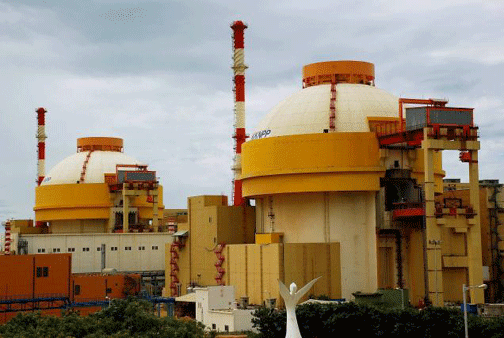
Frequent outages at Kudankulam plant unusual, trying to fix it: Dept of Atomic Energy
This is the first acknowledgement from a government authority and comes months after the issue of frequent power outages was flagged by Poovulagin Nanbargal. The NEWS Minute, TNM Staff
ANOTHER FEDERAL JUDGE RULES THE TRUMP ADMINISTRATION ILLEGALLY ROLLED BACK CRITICAL ENVIRONMENTAL PROTECTIONS
 ON EVE OF EARTH DAY, ANOTHER FEDERAL JUDGE RULES THE TRUMP ADMINISTRATION ILLEGALLY ROLLED BACK CRITICAL ENVIRONMENTAL PROTECTIONS https://www.atg.wa.gov/news/news-releases/eve-earth-day-another-federal-judge-rules-trump-administration-illegally-rolled Apr 21 2019
AG Ferguson’s 20th legal victory against Trump Administration
OLYMPIA — Attorney General Bob Ferguson released the following statement today after a federal judge in Montana ruled that the Trump Administration illegally revoked an Obama-era moratorium on new coal leases on federal lands, and must comply with a federal law requiring environmental analysis before leasing coal-mining rights on public lands:
“It’s fitting that on the eve of Earth Day, another federal judge slaps down the Trump Administration’s illegal effort to roll back basic environmental protections,” said Ferguson. “The Trump Administration illegally revoked the Obama-era moratorium on leasing public lands for coal-mining even though its Interior Department admitted it did not fully understand the societal and environmental impacts of extraction. This ruling sends a clear message that the federal government cannot take an action that impacts our environment without careful review and deliberation – which, to be polite, is not a strong suit of The Trump Administration.”
Case background
In May 2017, Ferguson filed a federal lawsuit against the U.S. Department of the Interior and the Bureau of Land Management over a program to lease coal mining rights on public land, which contributes to significant coal-train traffic through the state of Washington. The lawsuit challenged then-Secretary Ryan Zinke’s decision to restart the federal coal-leasing program without supplementing or replacing its nearly 40-year-old environmental study.
The lawsuit was jointly filed by California, New Mexico, New York and Washington in the U.S. District Court for the District of Montana, Great Falls Division.
Coal from federal leases following Zinke’s order would be transported by rail across Washington. In particular, coal from the Powder River Basin is shipped to or through the state. According to the Washington Department of Transportation, the baseline number of trains in 2015 numbered 70 per day on some track segments in the state, including multiple coal trains. Diesel exhaust and coal dust from uncovered coal train cars can negatively affect air quality.
Washington has a further interest in the effects of increased coal production and consumption on climate change. Washington experiences many negative effects of climate change, including rising ambient temperatures, a diminished and unpredictable snowpack necessary for water consumption and hydropower generation, and ocean warming and acidification, which is harmful to Washington’s shellfishery.
The AGO’s Counsel for Environmental Protection is handling the case for Washington.
Attorney General Ferguson created the Counsel for Environmental Protection in 2016 to protect our environment and the safety and health of all Washingtonians.
Ferguson has filed 35 lawsuits against the Trump Administration and has not lost a case. Ferguson now has 20 legal victories against the Trump Administration. Eleven of those cases are finished and cannot be appealed. The Trump Administration has or may appeal the other nine, which include lawsuits involving Dreamers and 3D-printed guns. After more than two years of litigation, no court to rule on the merits of the Attorney General’s arguments in a lawsuit against the Trump Administration has ruled against the office.
-30-
The Office of the Attorney General is the chief legal office for the state of Washington with attorneys and staff in 27 divisions across the state providing legal services to roughly 200 state agencies, boards and commissions. Visit www.atg.wa.gov to learn more.
Contacts:
Brionna Aho, Communications Director, (360) 753-2727; Brionna.aho@atg.wa.gov
Pennsylvania considers subsidising so-called “clean” nuclear energy
|
Pennsylvania decides whether to subsidize nuclear energy as “clean” https://thebulletin.org/2019/04/pennsylvania-decides-whether-to-subsidize-nuclear-energy-as-clean/
By Heather Wuest, April 22, 2019 To drive growth in its clean energy market and combat climate change, Pennsylvania adopted the Alternative Energy Portfolio Standards Act in 2004.This requires energy companies to buy specific percentages of their total electricity from clean energy sources. The requirements started small but are designed to increase over time. There are now 16 different clean energy choices for electric utilities to choose from in Pennsylvania. But new legislation would include a 17th clean generation option—nuclear power. Bills introduced in the state’s House and Senate are intended to prevent the retirement of the Three Mile Island nuclear plant outside Harrisburg and the Beaver Valley plant near Pittsburgh. Both plants are set for closure because they cannot compete on price with electricity from natural gas-fired power plants and renewable energy sources. Adding nuclear to the clean energy list would not be a simple or inexpensive process. Pennsylvania energy consumers would have to pay hundreds of millions in subsidies to make the nuclear plants economically viable. It’s a process that other energy generators and the manufacturing sector worry will distort Pennsylvania’s energy market. But the nuclear industry supports roughly 16,000 industry jobs and generates 93 percent of the electricity produced in the state by sources that don’t emit carbon dioxide in the process. Pennsylvania is hardly alone in its quest to buy clean energy; many other states are implementing plans that require energy companies to purchase set amounts so-called “carbon-free” electricity. In some states, nuclear is subsidized as a “green” energy source; in others, it is not. In Pennsylvania, it may be. The battle over that issue will play out in the state Legislature between now and early June, when the owner of the Three Mile Island plant is expected to decide whether to refuel or close it. |
|
|
1 This Month





PLEASE OPPOSE HR 8255 AND S.3639 – bills would accelerate satellite deployment, with no environmental review or safeguards – https://ncstd5li.quorum.us/campaign/169331/
To see nuclear-related stories in greater depth and intensity – go to https://nuclearinformation.wordpress.com
-
Archives
- October 2026 (81)
- September 2026 (339)
- August 2026 (330)
- July 2026 (355)
- June 2026 (287)
- May 2026 (306)
- April 2026 (356)
- March 2026 (251)
- February 2026 (267)
- January 2026 (308)
- December 2025 (358)
- November 2025 (359)
-
Categories
- 1
- 1 NUCLEAR ISSUES
- business and costs
- climate change
- culture and arts
- ENERGY
- environment
- health
- history
- indigenous issues
- Legal
- marketing of nuclear
- media
- opposition to nuclear
- PERSONAL STORIES
- politics
- politics international
- Religion and ethics
- safety
- secrets,lies and civil liberties
- spinbuster
- technology
- Uranium
- wastes
- weapons and war
- Women
- 2 WORLD
- ACTION
- AFRICA
- Atrocities
- AUSTRALIA
- Christina's notes
- Christina's themes
- culture and arts
- Events
- Fuk 2022
- Fuk 2023
- Fukushima 2017
- Fukushima 2018
- fukushima 2019
- Fukushima 2020
- Fukushima 2021
- general
- global warming
- Humour (God we need it)
- Nuclear
- RARE EARTHS
- Reference
- resources – print
- Resources -audiovicual
- Weekly Newsletter
- World
- World Nuclear
- YouTube
-
RSS
Entries RSS
Comments RSS

