Sceptisim over Boris Johnson’s promises environment and climate
 The Conversation 13th Dec 2019, Rebecca Willis: Climate change had a higher profile in the UK election campaign than ever before, with parties competing hard over their offer to concerned voters.
But this was a debate that the Conservatives – who won a landslide majority – largely stood back from. Their manifesto was light on detail compared to the other parties, and Boris Johnson chose not to take part in the first ever UK televised leaders’ debate on climate.
Conservative candidates were conspicuous by their absence in local climate
hustings, too. Neither was climate mentioned in their legislative plan for
the first hundred days. The Conservative government did legislate for a net
zero carbon emissions target back in June, following the advice of the
Committee on Climate Change. And there was an explicit manifesto pledge to
deliver on this target, with no signs of backtracking.
In his speech to the party faithful on the morning of his election, Johnson declared his ambition to “make this country the cleanest, greenest on Earth, with the most far-reaching environmental programme”, adding: And you the people of this country voted to be carbon-neutral in this election – you voted to be carbon-neutral by 2050. And we’ll do it.
But targets don’t reduce carbon. Policies do. And despite its much-admired Climate Change Act, the UK’s policy record lately has not been good. The Committee on Climate Change have repeatedly warned that the UK is off track to meet future commitments, a verdict shared by the independent Climate Action Tracker project, which assesses each country’s performance against the Paris Agreement. It rated the UK as “insufficient”, with policies compatible
with a 3°C world – not the 1.5°C level that we desperately need.
If the new government is serious about its commitment, it will have to signal this soon, and with confidence. Steps that it could and should take straight
away include: instigating a swift review of governance for net-zero, giving
responsibility and resources to other government departments, and,
crucially, to local areas, to deliver on carbon strategy; prioritising
climate and environmental protection in negotiations for a trading
relationship with the European Union; moving quickly to consult on a
phase-out date for petrol and diesel vehicles, as promised in its
manifesto; removing the de facto ban on onshore wind energy, which the
Committee on Climate Change advised needs to increase in capacity by 1GW a
year; confirming its opposition to fracking, and making its moratorium
permanent; pledging to formally consider the results of the national
citizens’ assembly on climate change, Climate Assembly UK, due to report
in 2020.
UK election. Green Party grew by 60%
 Business Green 13th Dec 2019, The Green Party saw its total number of votes grow by over 60 per cent in yesterday’s election, delivering the biggest percentage gains of any party following a campaign that saw environmental issues take centre stage.
Caroline Lucas retained her seat in Brighton Pavilion, increasing her share
of the vote by almost five per cent to 57 per cent.
https://www.businessgreen.com/bg/news/3084650/green-party-celebrates-60-per-cent-vote-surge
Nuclear power the worst, most unsuitable, most expensive power option for Ontario
 GIBBONS: Hydro power, not nuclear, is best for Ontario, BY JACK GIBBONS https://torontosun.com/opinion/columnists/gibbons-hydro-power-not-nuclear-is-best-for-ontario (Regarding Lorrie Goldstein’s column, “Nuclear power key to solving climate change,”Dec. 2.) 12 Dec 19, Using nuclear energy to address climate change is like offering every Toronto commuter a limo ride to work instead of building subways. GIBBONS: Hydro power, not nuclear, is best for Ontario, BY JACK GIBBONS https://torontosun.com/opinion/columnists/gibbons-hydro-power-not-nuclear-is-best-for-ontario (Regarding Lorrie Goldstein’s column, “Nuclear power key to solving climate change,”Dec. 2.) 12 Dec 19, Using nuclear energy to address climate change is like offering every Toronto commuter a limo ride to work instead of building subways.
It’s simply the most expensive way to reduce greenhouse gas pollution. Every nuclear project in Ontario’s history has run massively over budget. Remember the debt retirement charge on your hydro bill? You can thank bloated nuclear projects that left the old Ontario Hydro essentially bankrupt. Ontario is one of the few places left that still sees nuclear as a viable way to keep the lights on. And that’s going to hit you where it hurts – in the wallet. Ontario Power Generation has stated it needs to double the price it charges for nuclear energy to rebuild the Darlington nuclear station. Ontario has many better ways to simultaneously tackle climate change and lower electricity bills, something Premier Doug Ford has promised, but failed thus far to deliver. Quebec has the lowest electricity prices on the continent thanks to its cost-efficient, water-power system. It also has a large and growing power surplus and is keen to make export deals. Quebec has offered to sell Ontario power at half the cost of what we are paying for nuclear power today – one-third the cost of what we will be paying for nuclear power in five years. Both the Kathleen Wynne and Doug Ford governments have turned up their noses at this offer to protect our high-cost nuclear industry. Combine Quebec water power with energy efficiency programs in Ontario and you have the lowest-cost option for keeping the fridges humming. Ontario pays, on average, two cents per kilowatt hour for efficiency measures that reduce the need to generate electricity in the first place. You may have doubts about solar and wind energy, but one thing is certain — prices for these sources are plummeting as costs for nuclear rise. Quebec, by using its ability to store water, can act as a giant battery to smooth out the peaks and troughs of green energy in Ontario. It can supply Ontario with plenty of power virtually every hour of the year. And it has that power right now – it doesn’t need to build new dams. In the few hours a year when Quebec’s own demand maxes out, Ontario has plenty of gas-fired power plants that can fill the brief gap. For a fraction of the cost of rebuilding one nuclear reactor, we can upgrade our transmission links to get even more low-cost power from Quebec. Instead of banking on phantom solutions like non-existent “small modular reactors” that, if they are ever built, will have all the waste, cost and security problems of conventional nuclear plants, Ontario should make a money-saving deal with Quebec. As the people of Pickering are now discovering, Ontario has no long-term facility to store the huge pile of radioactive waste that has been built up over 50 years of nuclear operations. |
|
U.S. Democrats cave in to a weak compromise National Defense Authorization Act
 Democrats Retreat on Nuclear Policy Defense One, 13 Dec 19, The 2020 authorization bill fails to check Trump’s worst impulses. Democrats Retreat on Nuclear Policy Defense One, 13 Dec 19, The 2020 authorization bill fails to check Trump’s worst impulses.Question: How do you go from a National Defense Authorization Act that in July was opposed by every House Republican to one that was approved by more GOP votes than Democratic ones and that President Donald Trump called a huge win that he cannot wait to sign? Answer: Add Space Force and parental family leave and take out all of the progressive national security provisions. The House passed the compromise NDAA last night; President Trump has said he will sign it. This final bill is a world apart from the version passed by House Democrats in July. The House version, ably led by Rep. Adam Smith, D-Washington, chair of the House Armed Services Committee, prohibited deployment of Trump’s new “low-yield” nuclear weapon for Trident submarines, which defense experts called “a gateway to nuclear catastrophe.” It prohibited unauthorized U.S. military action against Iran, which Trump came within 10 minutes of ordering in June, and prohibited U.S. military support for the Saudi-led intervention in Yemen. And it supported extension of the New START treaty, which Trump seems to have every intention of sacking even though Russia supports keeping the crucial pact. The list goes on. In other words, the House bill would have constrained the most dangerous tendencies of an out-of-control White House. This is exactly what you would expect Democrats to do when faced with a President that they firmly believe is a danger to U.S. national security—and are now seeking to impeach on that basis. Not surprisingly, Republicans do not share this impression of the President, and they deeply opposed the nuclear policy provisions in the House NDAA……. The outcome was a disaster. The topline budget rose to $738 billion and the major constraints on Trump were ripped out. Others were watered down. The most we can say about the final NDAA is that it includes some useful language on arms control and missile defense, but nothing major. Such weak tea certainly does not justify supporting a bill that funds Trump’s excessive $2 trillion program to rebuild the nuclear arsenal, among other things. Rep. Ro Khanna, D-California, a member of the House Armed Services Committee and a vice-chair of the progressive caucus issued a joint statement with Sen. Bernie Sanders, D-Vermont, a presidential candidate, calling the final agreement “a bill of astonishing moral cowardice.” Over 30 progressive national security organizations (including Ploughshares Fund) sent a letter to Congress opposing the final bill as doing “almost nothing to constrain the Trump administration’s erratic and reckless foreign policy.” Senator and presidential candidate Elizabeth Warren said she would oppose the bill, calling it a “$738 billion Christmas present to giant defense contractors.” ….. Democrats cannot seek to impeach Trump and yet sometimes act as if he is a normal president. They cannot attempt to remove him from office as a danger to national security and yet hand him $738 billion in military spending with no limits on his nuclear weapons development, ability to attack Iran, freedom to abandon arms control treaties, and so much more. Trump is nothing if not a disrupter. The Democrats must give the president a taste of his own medicine. https://www.defenseone.com/ideas/2019/12/democrats-retreat-nuclear-policy/161855/ |
|
|
UK Conservatives get big donations from fossil fuel and weapons companiess
Unearthed 11th Dec 2019, The Conservative election campaign has received hundreds of thousands of pounds from wealthy investors in the global fossil fuels industry, according to a new analysis by Unearthed. Some of the companies and projects benefiting from donors’ investments are opening up new fossil fuel reserves – even as the world battles climate change and the UK
prepares to host a crunch summit next year.
One of the Tory’s major donors also runs a hedge fund that holds significant investments in a major weapons manufacturer and a mining giant. Meanwhile the Liberal Democrats have taken a significant donation from a subsidiary of a hedge fund that has a major stake in the energy firm being blamed for California’s deadly wildfires and another stake in a French oil services firm.
The analysis looked at donations to political parties over £50,000 during the first three weeks of the election campaign and the financial holdings of
investment companies, as collected and presented by Bloomberg.
https://unearthed.greenpeace.org/2019/12/11/donations-election-campaign-investments-fossil-fuels/
The status of Japan’s nuclear policy and future prospects
|
Tohoku reactor restart: What is the state of Japan’s nuclear policy? Japan Times, BY ERIC JOHNSTON 9 Dec 19, OSAKA – In late November, the Nuclear Regulation Authority (NRA) gave the green light for restarting the No. 2 reactor at Tohoku Electric Power Co.’s Onagawa plant in Miyagi Prefecture, which had been damaged in the March 11, 2011, earthquake and tsunami. The announcement once again put the spotlight on the country’s nuclear power policy, not only in Tohoku but nationwide.
Why did the Onagawa restart attract so much attention?
While the Onagawa plant is actually the second damaged on 3/11, after the Tokai No. 2 power station in Ibaraki Prefecture, to pass the NRA’s new safety regulations for nuclear power plants prepared after the disaster, it happens to be the nuclear plant closest to the epicenter of the magnitude 9 quake that struck off the Tohoku coast that day. The Onagawa facility is located near Ishinomaki, which received extensive damage and much domestic and international media attention after the tsunami claimed the lives of 74 Okawa Elementary School students. In addition, the Onagawa reactor, which was flooded on 3/11, is the first boiling water reactor to have its restart application approved by the NRA. There are three kinds of nuclear reactors in operation in Japan: 14 pressured water reactors (PWRs), four advanced boiling water reactors (ABWRs) and 13 boiling water reactors (BWRs), which are the same kind as those at the Fukushima No. 1 plant destroyed by the 3/11 quake and tsunami. The PWRs are considered more technologically stable than the other kinds, and have a better ability to contain radiation. Now that the NRA has greenlighted Onagawa’s restart, does that mean it will happen anytime soon? That depends on a number of factors. The Onagawa plant is not ready to be fired up tomorrow. It must first complete the installation of various anti-disaster measures, including a 29-meter-high, 800-meter-long seawall along the Pacific coast to guard against tsunami as high as 23.1 meters. That will not be completed until sometime in fiscal 2020, which begins April 1. Furthermore, various local governments, including Ishinomaki and Miyagi Prefecture, will have to give their consent to the restart. That could involve long, drawn out negotiations between the utility and local residents and politicians. It’s also probable that lawyers and local citizens opposed to a restart will seek a court injunction to halt the move based on safety concerns. If a court approves an injunction, that will create further delays. How many other nuclear power plants are there and what are their statuses? As of this month, there are nine reactors officially in operation. Four belong to Kansai Electric Power Co. (Kepco), which provides electricity mainly to Kyoto, Osaka, Nara, Hyogo, Shiga and Wakayama prefectures. Another four belong to Kyushu Electric Power Co. One of Shikoku Electric Power Co.’s reactors at its Ikata plant is also operating……. What about the future for nuclear power in Japan? The government’s long-term energy policy for 2030 calls for nuclear power to make up around 20 to 22 percent of the nation’s energy mix, and it is pushing hard for the restart of as many idled reactors as possible. By then, the plan calls for renewable energy to account for 22 to 24 percent of the mix, LNG to make up 27 percent, coal 26 percent and oil 3 percent. But the obstacles to restarting, or continuing to operate, nuclear plants in the coming years are vast. In addition to local opposition that could delay restarts for months or years, costing the utilities money, they include such issues as the economics of running reactors past 40 years, for which the utilities must first spend money to upgrade their facilities in order to meet new NRA standards regarding reactors older than four decades. While Kepco has secured permission to operate three reactors already over 40 years old for another two decades at the most, other utilities with reactors currently more than 30 years old — such as Tepco’s Kashiwazaki-Kariwa No. 1 reactor (34 years old) — will have to decide within a few years whether it’s worth the investment of money and time to apply for a two-decade extension or whether it’s cheaper to decommission. A second problem has to do with spent nuclear fuel generated by the restarted reactors. Tokyo is making efforts to find local governments able and willing to have a midterm spent fuel storage facility built in their backyard, and has agreed to offer financial incentives for anyone willing to accept a facility. No luck so far. Meanwhile, in Fukui Prefecture, which has the largest concentration of reactors (13 commercial reactors plus the Monju experimental fast-breeder reactor) in the nation, Gov. Tatsuji Sugimoto is insisting that such storage facilities be built outside the prefecture. His position could lead to other prefectures hosting nuclear power plants to take a firmer stance with utilities and the central government over what to do with spent nuclear fuel when they come seeking local consent for their own restart plans. https://www.japantimes.co.jp/news/2019/12/09/reference/japan-nuclear-power-onagawa-reactor-restart/#.Xe6m4egzbIU |
|
France’s nuclear industry in dire straits
 The French nuclear revolution is rusting away, December 6, 2019, THE AUSTRALIAN, Henry Ergas “……..France’s nuclear power industry faces a future that is more uncertain than ever. The problems gripping the industry were highlighted late last month in an official report prepared by the former president and chief executive of PSA Peugeot Citroen, Jean Martin Folz.
While the report’s focus is on the difficulties that have plagued the construction of a new reactor at Flamanville in northwestern France, its implications reach much further.
With nuclear power plants accounting for more than 70 per cent of its overall electricity generation, no country is as dependent on nuclear energy as is France.
The decision to rely so massively on nuclear energy was taken in 1974, after the oil shock of the previous year had underlined France’s vulnerability to Middle Eastern oil. Prime minister Pierre Messmer launched a crash program that led to the construction of 56 reactors in just 15 years.
…….. however, most of France’s generators are approaching the final decade of their useful life. Planning for their replacement has been a stop-start affair, with the Greens’ increasingly strident opposition to nuclear power deterring successive governments from taking action.
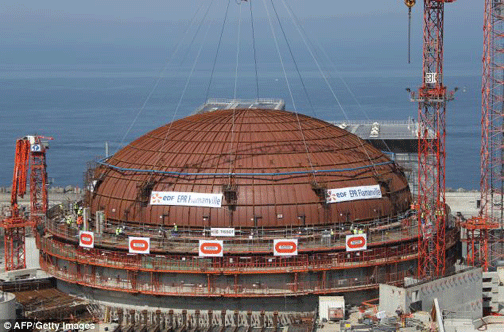 As a result, only the Flamanville plant received the go-ahead, with construction beginning in 2007 for an expected entry into service in 2012. Virtually from the outset, the project was beset by woes. At this stage, the total costs of construction are four times greater than initially estimated, while the plant will not enter service before the end of 2022.
The problems stem partly from the sheer complexity of the new reactor, which is the first of its kind to be built in France.
Additionally, the catastrophe at Fukushima in 2011 led to regulatory changes that necessitated costly redesigns. And the project has suffered more than its fair share of mismanagement, aggravated by a byzantine allocation of responsibilities between EDF, the main French electricity utility, which oversaw the project, and many layers of subcontractors.
However, as the Folz report shows, the primary cause of the difficulties lies in the erosion of the industry’s skill base during the long hiatus from the end of the crash program in 1990 to the initiation of Flamanville………
There is, at this point, no prospect of France scaling up its nuclear program  ………The cost blowout at Olkiluoto drove Areva, the “national champion” of France’s nuclear industry, into bankruptcy.
Even with an injection of $7.3bn in public funds EDF, which acquired Areva, lacks the balance sheet strength to underwrite new projects, while the French government’s borrowing ability is hampered by its already too high levels of debt.
To make matters worse, the regulated prices at which EDF has to sell the power it generates mean that it cannot charge its European clients the full value of the baseload it supplies.
 As for global investors, who might provide the debt financing EDF would require, they are wary of projects that are risky in themselves ….
Given those constraints, the government has announced a modest plan to eventually build six additional reactors. So far, however, there are no actionable decisions beyond the completion of Flamanville. And work on the next generation of reactors….. has been quietly downgraded, making it likely that there will no fourth generation reactor of French design.
The consequences for France itself are far-reaching. Beginning in the late 1950s, French firms succeeded in one high-technology market after the other by developing or acquiring a rather basic design (including the Westinghouse Pressurised Water Reactor, the Mirage jet fighter and the TGV high-speed train) that they upgraded while producing it on a large scale.
That era is over, and there is every sign France is struggling with almost all the major projects it has in train.
The Folz report should therefore come as an ominous warning for Australia’s submarine project, as it identifies French industry’s serious managerial and technological weaknesses in a range of areas, such as precision welding, that are crucial to that project’s success……. https://www.theaustralian.com.au/commentary/the-french-nuclear-revolution-is-rusting-away/news-story/afe4546ed799939cf117d71f05035c5e
Nuclear power headed to be excluded from EU green finance scheme
‘Do no harm’: Nuclear squeezed out of EU green finance scheme, 
 By Frédéric Simon | EURACTIV.com Dec 6, 2019 European Greens claimed victory on Thursday (5 December) after EU negotiators reached agreement on a green finance taxonomy aimed at channelling billions of private investor’s money into clean technologies. Coal, and – in principle – nuclear power, are out.
The deal, reached by national envoys and EU Parliament negotiators yesterday evening, marks a stunning defeat for France, which lobbied hard to win recognition for nuclear energy as a low-carbon source of energy…….
Do no harm” test
But the European Parliament “resisted attempts from national governments to politicise the environmental criteria” underpinning the EU’s new sustainable finance classification scheme, the Greens said in a statement.
A strengthened “do no harm” principle means nuclear power will – in all likelihood – be excluded from the EU’s green finance taxonomy when experts sit down to agree detailed implementing rules next year, they said.
The ‘no-harm’ test “will help avoid nuclear energy from being considered an environmentally sustainable investment,” the Greens said in a statement to the press.
The taxonomy will provide investors, pension funds and private equity firms with “a common definition of what is green and what is not” in order to channel more capital into sustainable businesses and prevent “green-washing,” the European Commission said last year when it tabled the proposed new regulation.
The deal creates three categories for sustainable investments: “green”, “enabling” and “transition”. It also obliges companies with more than 500 employees to disclose how much of their activities are compliant with the three new categories, the FT reported.
“Today’s compromise will shift financial flows away from dirty, carbon intensive investments and into sustainable economic activities,” said Bas Eickhout, a Dutch Green MEP who was the European Parliament’s lead negotiator on the draft EU regulation.
“Any investment in coal cannot be considered sustainable,” he said in a statement……..
EU experts will now have to sit down and lay out thresholds to determine which economic activities can qualify as green. These will include CO2 emission limits for power production, which EU experts have tentatively set at 100g of CO2 per KWh – a threshold that would, in principle, exclude natural gas.
Here again, the Greens claimed they won guarantees ensuring those implementing rules “will be prepared by a balanced platform of experts” – not national envoys.
During the negotiations, France pushed for technical thresholds to be decided by a group of experts appointed by EU national governments. But the Greens resisted those attempts, saying that would have exposed the group to political pressures.
“The key part of the agreement is the strong independent governance structure,” Jess said.
“The text establishes an independent Platform on Sustainable Finance who will be responsible for developing and maintaining the full taxonomy going forward,” he explained. The expert group will also be responsible for monitoring capital flows and advising governments in their economic transition.
NRC Approves Transfer of Nuclear Plant Operating Licenses From FirstEnergy Solutions to Energy Harbor,
On November 25, FES announced that it will change its corporate name to Energy Harbor when its restr
completed…..https://finance.yahoo.com/news/nrc-approves-transfer-nuclear-plant-140000164.html
U.S. election – views of Presidential candidates about nuclear weapons
 Nuclear weapons — they’re still out there. Presidential candidates have ideas on them, San Francisco Chronicle, Bob Egelko Dec. 1, 2019 , One topic that’s gotten little attention during the presidential campaign is the high-stakes issue of nuclear weapons. That’s partly because campaigns tend to focus on bread-and-butter issues, like health care and taxes. They largely steer clear of foreign policy, especially an aspect that’s downright terrifying.
One question that has surfaced is whether the United States, the only nation that has ever used atomic weapons, should reverse its policy and declare it would not strike the first nuclear blow in a future war.
Sen. Elizabeth Warren, D-Mass., has introduced legislation that would establish “no first use” of nuclear weapons as binding law. Sen. Bernie Sanders, independent-Vt., is a co-sponsor. Former Vice President Joe Biden told a public gathering in June that “I supported it 20 years before she introduced it.” Several other presidential hopefuls — Rep. Tulsi Gabbard, D-Hawaii; entrepreneur Andrew Yang; spirituality author Marianne Williamson; billionaire Tom Steyer — have endorsed the concept.
The only Democratic candidate with a contrary view is Montana Gov. Steve Bullock, who said in the second presidential debate in July that “I wouldn’t want to take that (first use) off the table.”
But others — Sens. Kamala Harris of California, Cory Booker of New Jersey and Amy Klobuchar of Minnesota, and former U.S. Housing Secretary Julián Castro — have told interviewers in recent months that they hadn’t reviewed Warren’s proposal and weren’t ready to take a position on it.
The interviewers were from the Union of Concerned Scientists, which favors nuclear de-escalation and sent young people to campaign events to question the candidates.
One prominent candidate, South Bend, Ind., Mayor Pete Buttigieg, appears to have come down on both sides…….
Besides no first use, The Chronicle asked candidates about the Nuclear Test Ban Treaty, signed by the United States in 1963 but never ratified by the Senate; the Treaty on the Prohibition of Nuclear Weapons, a disarmament pact endorsed by the U.N. General Assembly and ratified by 33 nations so far, but not by the United States or any other nuclear powers; and the Intermediate Range Nuclear Forces Treaty, a 1988 agreement between the Soviet Union and the United States under President Ronald Reagan that banned land-based ballistic missiles with a range of up to 3,400 miles. The Trump administration withdrew from that treaty in February.
Some candidates did not respond, including Warren, Harris and Booker. Among those who did, Sanders, Williamson and Steyer took the firmest positions in support of the weapons treaties……..
While Warren’s campaign did not reply to questions about the treaties, the senator has publicly opposed the nuclear buildup proposed by Obama and endorsed by Trump.
“No new nuclear weapons,” Warren said in a November 2018 speech on foreign policy. “We should not spend over a trillion dollars to modernize our nuclear arsenal, at a time when the president is doing everything he can to undermine generations of verified arms-control agreements.”
Perhaps some of those discussions will reach a public forum as the campaign continues. Bob Egelko is a San Francisco Chronicle staff writer. Email: begelko@sfchronicle.com Twitter:@BobEgelko https://www.sfchronicle.com/nation/article/Nuclear-weapons-they-re-still-out-there-14873992.php
UK election. Nuclear power is a hot topic in Wales
 General election 2019: Nuclear power in Wales – what will parties do? BBC News, 2 December 2019 Pick up any of the main parties’ election manifestos and it is hard to escape pledges on the environment and climate change.The Conservatives, Labour, Liberal Democrats and Plaid Cymru all make promises ranging from a “green industrial revolution” to “decarbonisation”. General election 2019: Nuclear power in Wales – what will parties do? BBC News, 2 December 2019 Pick up any of the main parties’ election manifestos and it is hard to escape pledges on the environment and climate change.The Conservatives, Labour, Liberal Democrats and Plaid Cymru all make promises ranging from a “green industrial revolution” to “decarbonisation”.
One question you have been asking is: What about nuclear power in Wales?….. Energy Island On Anglesey, nuclear has always been a hot potato of a topic – especially at election timeA lingering hope remains that a new plant will be built – and with it, more jobs – always a vote winner.
But there is also a vocal anti-nuclear lobby – they would rather see cash invested in wind, wave and solar technology, which is also a significant employer in a constituency that dubs itself ‘energy island‘…… The UK government’s research and innovation arm is pumping £18m into a consortium led by Rolls-Royce to develop low-cost, factory assembled small nuclear plants. Those involved hope they can use these sites to deliver “nuclear power at the price of wind”…… Where do the parties stand on nuclear? The Conservatives have been emphatically in favour of nuclear power – their manifesto states: “We will support gas for hydrogen production and nuclear energy, including fusion, as important parts of the energy system, alongside increasing our commitment to renewables.” Asked specifically about Wales – and Wylfa, the party said: “The Welsh Conservatives support Wyfla B and we believe that nuclear power will continue to play a vital role in meeting the energy needs of Wales and the UK in the coming decades. “We do not believe that Wales will need more nuclear power stations in addition to Wyfla.” Labour’s manifesto is equally clear in Wales – it is also backing nuclear power – insisting new nuclear is “needed for energy security”. On Wylfa Newydd – the party said: “The Tories have let down the people of Ynys Môn by failing to deliver the Wylfa project. Labour will work with people on the island to maximise its potential for new nuclear energy, alongside investment in renewables.” Plaid Cymru also addresses the issue – which is politically tricky for a party with an eye on recapturing Anglesey from Labour. Its manifesto states it will “oppose the development of new sites for nuclear power stations”. On Wylfa, the party said: “The question is hypothetical as the plans are currently suspended and no-one is proposing to underwrite the project. “Plaid Cymru opposes new nuclear projects and our priority is on the green jobs revolution – investing in renewables, creating tens of thousands of green collar jobs (including on Anglesey) and tackling the climate emergency.” The Liberal Democrats say they want to “decarbonise the power sector completely”. The party’s UK manifesto does not deal with the issue of nuclear energy directly – rather focusing on “supporting renewables”. But the Welsh party said there was currently “no economic or environmental case” to build any new nuclear plants in the UK. They went even further on Wylfa and new Welsh plants: “We therefore would not support a new nuclear site on Wylfa Newydd or new nuclear stations elsewhere in Wales.” However, because of the electoral pact with Plaid Cymru – the Welsh Liberal Democrats and the Green Party are not fielding candidates in Ynys Môn. The Green Party said nuclear energy was “a distraction from developing renewable energy”. It says it would “prohibit the construction of nuclear power stations” in its manifesto, ‘If Not Now, When’. UKIP’s manifesto states: “UK needs a mix of energy sources comprising nuclear, conventional and renewable”, while nuclear power does not feature in the Brexit Party’s election contract. https://www.bbc.com/news/election-2019-50559046 [ This site invites questions] |
|
Catastrophic weather in Australia does not influence its climate denialist government
 Time is running out for a climate adaptation plan, Independent Australia
THE POSSIBILITY that the effects of climate change could be more extreme and materialise much sooner than expected was never hypothetical. At the end of the last ice age, it is estimated that temperatures in some regions of the world spiked between five and 15 degrees celsius in just a few decades.
Catastrophic climate conditions have already arrived in Australia. With a growing sense that the events of the last few weeks could be the new normal, dealing with the immediate effects of climate change may take increasing priority over historically unsuccessful emissions reduction efforts.
It is striking that Australia has no unified climate adaptation plan.
Our bushfires are escalating in number and intensity. Given this reality, leaving individuals to enact their own bushfire survival plans again and again seems inadequate. In light of successive governments upholding policies designed to discourage asylum seekers from risking their lives at sea, where is the plan to permanently move residents out of areas surrounded by highly flammable material? …..
These are just a few matters of relevance, before we even get to responses to heat stress (cooler living spaces), or the erratic intensity of droughts (innovative measures to ensure food and water security), storms (systematic storm-proofing of property) and floods (moving communities to higher ground where necessary).
All of this will require a great deal of resources and coordination. While governments, both State and Federal, have been much too slow to act, politicians interested in keeping their jobs could conceivably be motivated to do so by increasingly engaged voters.
At the same time, the market has failed to respond anywhere near adequately and it is hard to see it doing so. The private sector-led installation of the flood-proofing infrastructure Brisbane needs is nowhere to be seen.
When warmer temperatures melt arctic ice, sun-reflecting white layers on that ice disappear, causing more heat to be absorbed by darker surfaces, a further rise in temperature and a further melting of ice. A number of chain reactions operate like this in the climate system. There could be many more that have not yet been discovered and that could behave in unanticipated ways.
Under some scenarios, changes could be so rapid that even attempts to adapt could become impractical. We haven’t a moment to lose. https://independentaustralia.net/politics/politics-display/time-is-running-out-for-a-climate-adaptation-plan,13365
Suffolk Coastal Labour opposes the development of new nuclear capacity at Sizewell
Suffolk Coastal Labour 27th Nov 2019, Suffolk Coastal Labour does not support the concept of ‘The Energy Coast’. The branding itself puts at risk the visitor and tourist economy of East Suffolk which depends on The Suffolk Coast and Heaths Area of Outstanding Natural Beauty.
It conflicts with established identities such as ‘The Sunshine Coast’ and ‘The Heritage Coast’. The huge industrial projects proposed threaten the local economy and environment without bringing any benefits. Traffic congestion on the A12 and ruralroads will discourage visitors and compromise the quality of life of localresidents.
In Suffolk Coastal, Labour opposes the development of new
nuclear capacity at Sizewell. The Sizewell C development cannot be
undertaken without unacceptable impacts on the Suffolk Coast and Heaths
Area of Outstanding Natural Beauty. It will compromise the future of RSPB
Minsmere, and, especially during the construction period, other Sites of
Special Scientific Interest and the highly sensitive local environment. It
will threaten jobs and prosperity in the visitor and tourist economy, the
agricultural sector and food and drink industries. It offers very few new
permanent jobs for local people. Current proposals to mitigate the worst
effects of the construction project are grossly underfunded and will not
relieve the impact of huge numbers of vehicle movements for goods and
people on the A12 and surrounding rural roads. There are no proposals to
invest adequately in rail alternatives.
UK’s Labour and Greens parties have highly prioritised climate change action
David Lowry’s Blog 29th Nov 2019, A letter writer in today’s Times newspaper complained that politicians have not prioritized climate change in their manifestos.Your correspondent Lesley Boase asks “why isn’t urgent action climate
change at the top of [political parties’] manifestos”? The day before
the letter appeared, the Labour Party launched its 48-page manifesto for
the environment ‘A Plan for the Environment. At its launch in
Southampton, Mr Corbyn stressed” The reality is this election is our last
chance to tackle the climate and environment emergency,” in setting out
“Labour’s plan for real change to protect our planet and restore our
natural world.” He added: “We have no time to waste…we have a choice.
We can shut our eyes, cross our fingers and entrust our fate to a system
that has already driven our planet to the brink of catastrophe. Or we can
do everything possible to tackle the biggest threat we face.
http://drdavidlowry.blogspot.com/2019/11/political-parties-prioritise-climate.html
Premiers of Ontario, Saskatchewan, New Brunswick to plan development of Small Modular Nuclear Reactors
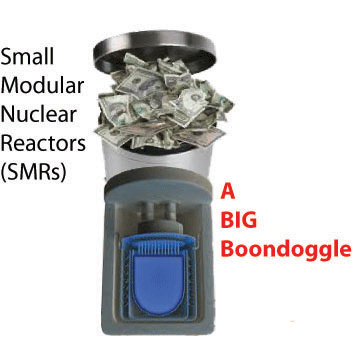 Ontario, Saskatchewan, N.B. premiers to announce nuclear reactor deal, Global News BY STAFF THE CANADIAN PRESS November 30, 2019 “….. The Ontario government said Premier Doug Ford will meet with Saskatchewan Premier Scott Moe and New Brunswick Premier Blaine Higgs for an announcement at a hotel near Pearson International Airport on Sunday afternoon.
A spokesman with Moe’s office confirmed the announcement is connected to an agreement on technology for small modular reactors, while a spokeswoman for Ford’s office said it’s an agreement to work together to determine the best technologies for the deployment of small modular reactors in Canada……
Moe has said that Saskatchewan will address climate change over the next decade by looking to carbon capture and storage technology and by increasing research efforts around small modular nuclear reactors.
However, the possibility of bringing nuclear power to Saskatchewan could still be years away https://globalnews.ca/news/6239231/premiers-nuclear-reactor-deal/
1 This Month





PLEASE OPPOSE HR 8255 AND S.3639 – bills would accelerate satellite deployment, with no environmental review or safeguards – https://ncstd5li.quorum.us/campaign/169331/
To see nuclear-related stories in greater depth and intensity – go to https://nuclearinformation.wordpress.com
-
Archives
- October 2026 (67)
- September 2026 (339)
- August 2026 (330)
- July 2026 (355)
- June 2026 (287)
- May 2026 (306)
- April 2026 (356)
- March 2026 (251)
- February 2026 (267)
- January 2026 (308)
- December 2025 (358)
- November 2025 (359)
-
Categories
- 1
- 1 NUCLEAR ISSUES
- business and costs
- climate change
- culture and arts
- ENERGY
- environment
- health
- history
- indigenous issues
- Legal
- marketing of nuclear
- media
- opposition to nuclear
- PERSONAL STORIES
- politics
- politics international
- Religion and ethics
- safety
- secrets,lies and civil liberties
- spinbuster
- technology
- Uranium
- wastes
- weapons and war
- Women
- 2 WORLD
- ACTION
- AFRICA
- Atrocities
- AUSTRALIA
- Christina's notes
- Christina's themes
- culture and arts
- Events
- Fuk 2022
- Fuk 2023
- Fukushima 2017
- Fukushima 2018
- fukushima 2019
- Fukushima 2020
- Fukushima 2021
- general
- global warming
- Humour (God we need it)
- Nuclear
- RARE EARTHS
- Reference
- resources – print
- Resources -audiovicual
- Weekly Newsletter
- World
- World Nuclear
- YouTube
-
RSS
Entries RSS
Comments RSS

