The European Pressurised Water Reactor (EPR) is dragging nuclear company EDF into $billions of debt

Climate News Network 31st Dec 2019, The edifice already heading for the status of the largest and most expensive construction project in the world, the Hinkley C nuclear power station (above) in the UK, is dragging its builder, the French giant EDF, into ever-deeper debt: the company’s flagship reactor is facing still more delay.
Although EDF is a vast company, owning 58 reactors in France alone,
and is 85% owned by the French state, it owes around €60 billion ($67bn),
a debt expected to increase by €3 billion ($3.35bn) a year.
This has led some city analysts, notably S&P Global, to downgrade the company’s prospects to “negative” − which is essentially a recommendation to
shareholders to sell.
Apart from the problem that EDF’s fleet of reactors in France is operating well beyond their original design life and are in constant need of safety and maintenance upgrades, the company’s main problem is its flagship, the European Pressurised Water Reactor (EPR), which is getting into ever-greater difficulties.

In Europe there are four EPRs under construction: the two barely begun at Hinkley Point in Somerset in the west of England; one in northern France at Flamanville (below) in Normandy; and the original prototype in Finland, known as Olkiluoto 3 (OL3) (above) . The extraordinary fact is that, although OL3 was due to start up in 2009, it is still incomplete, and its start date has just been put back again – until 2021.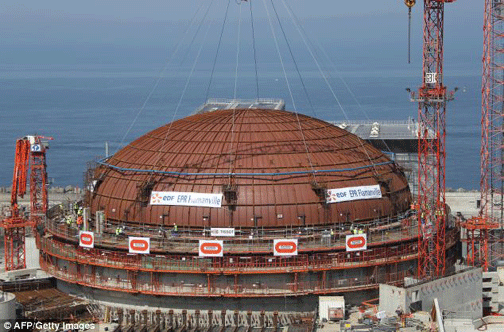
https://climatenewsnetwork.net/flagship-reactor-launch-postponed-again/
Dangerous climate is now upon Australia- Michael Mann
 Australia, your country is burning – dangerous climate change is here with you now , Guardian, Michael Mann 1 Jan 2020, I am a climate scientist on holiday in the Blue Mountains, watching climate change in action,
After years studying the climate, my work has brought me to Sydney where I’m studying the linkages between climate change and extreme weather events.
Prior to beginning my sabbatical stay in Sydney, I took the opportunity this holiday season to vacation in Australia with my family. We went to see the Great Barrier Reef – one of the great wonders of this planet – while we still can. Subject to the twin assaults of warming-caused bleaching and ocean acidification, it will be gone in a matter of decades in the absence of a dramatic reduction in global carbon emissions.
We also travelled to the Blue Mountains, another of Australia’s natural wonders, known for its lush temperate rainforests, majestic cliffs and rock formations and panoramic vistas that challenge any the world has to offer. It too is now threatened by climate change.
I witnessed this firsthand.
I did not see vast expanses of rainforest framed by distant blue-tinged mountain ranges. Instead I looked out into smoke-filled valleys, with only the faintest ghosts of distant ridges and peaks in the background. The iconic blue tint (which derives from a haze formed from “terpenes” emitted by the Eucalyptus trees that are so plentiful here) was replaced by a brown haze. The blue sky, too, had been replaced by that brown haze. ……
The brown skies I observed in the Blue Mountains this week are a product of human-caused climate change. Take record heat, combine it with unprecedented drought in already dry regions and you get unprecedented bushfires like the ones engulfing the Blue Mountains and spreading across the continent. It’s not complicated.
The warming of our planet – and the changes in climate associated with it – are due to the fossil fuels we’re burning: oil, whether at midnight or any other hour of the day, natural gas, and the biggest culprit of all, coal. That’s not complicated either.
When we mine for coal, like the controversial planned Adani coalmine, which would more than double Australia’s coal-based carbon emissions, we are literally mining away at our blue skies. The Adani coalmine could rightly be renamed the Blue Sky mine.
In Australia, beds are burning. So are entire towns, irreplaceable forests and endangered and precious animal species such as the koala (arguably the world’s only living plush toy) are perishing in massive numbers due to the unprecedented bushfires.
The continent of Australia is figuratively – and in some sense literally – on fire.
Yet the prime minister, Scott Morrison, appears remarkably indifferent to the climate emergency Australia is suffering through, having chosen to vacation in Hawaii as Australians are left to contend with unprecedented heat and bushfires.
Morrison has shown himself to be beholden to coal interests and his administration is considered to have conspired with a small number of petrostates to sabotage the recent UN climate conference in Madrid (“COP25”), seen as a last ditch effort to keep planetary warming below a level (1.5C) considered by many to constitute “dangerous” planetary warming.
But Australians need only wake up in the morning, turn on the television, read the newspaper or look out the window to see what is increasingly obvious to many – for Australia, dangerous climate change is already here. It’s simply a matter of how much worse we’re willing to allow it to get.
Australia is experiencing a climate emergency. It is literally burning. It needs leadership that is able to recognise that and act. And it needs voters to hold politicians accountable at the ballot box.
Australians must vote out fossil-fuelled politicians who have chosen to be part of the problem and vote in climate champions who are willing to solve it.
- Michael E Mann is distinguished professor of atmospheric science at Pennsylvania State University. His most recent book, with Tom Toles, is The Madhouse Effect: How Climate Change Denial Is Threatening Our Planet, Destroying Our Politics, and Driving Us Crazy (Columbia University Press, 2016).https://www.theguardian.com/commentisfree/2020/jan/02/australia-your-country-is-burning-dangerous-climate-change-is-here-with-you-now
Germany To Close All Nuclear Plants By 2022
In the wake of the Fukushima disaster in Japan in 2011, Germany ordered the immediate shutdown of eight of its 17 reactors, and plans to phase out nuclear power plants entirely by 2022.
The Philippsburg 2 reactor near the city of Karlsruhe in southwestern Germany has provided energy for 35 years. The Philippsburg 1 reactor—opened in 1979—was taken offline in 2011.
Over the past few years, nuclear power generation in Germany has been declining with the shutdown of its nuclear plants, while electricity production from renewable sources has been rising.
A government-appointed special commission at Europe’s largest economy announced the conclusions of its months-long review and proposed that Germany shut all its 84 coal-fired power plants by 2038.
Germany, where coal, hard coal, and lignite combined currently provide around 35 percent of power generation, has a longer timetable for phasing out coal than the UK and Italy, for example—who plan their coal exit by 2025—not only because of its vast coal industry, but also because Germany will shut down all its nuclear power plants within the next three years.
The closure of all nuclear reactors in Germany by 2022 means that Germany might need to retain half of its coal-fired power generation until 2030 to offset the nuclear phase-out, German Economy and Energy Minister Peter Altmaier said earlier this year.
Russia extends license for remote nuclear power plant
One of the reactors at Bilibino NPP has got permission for another five years despite the nearby new floating nuclear power plant now is in operation. By Thomas Nilsen– December 29, 2019
Just one week after “Akademik Lomonosov” started to produce electricity to the grid in Pevek, one of the three remaining reactors at Bilibino nuclear power plant (NPP) got a renewed five-years permission until December 31st, 2025.
Bilibino NPP is located in the far remote Bilibinsky District in the Chukotka Autonomous Okrug, Russia’s northeastern corner. The power plant provides electricity to the same Pevek-Chaun-Bilibino grid currently under construction as the new floating nuclear power plant.
One of the four reactors at Bilibino is already shut-down, while the other three were to follow as soon as the grid and the “Akademik Lomonosov” came in place. That would likely not happen before earliest by the end of 2021.
The license was issued by Rosteknadzor, Russia’s Federal Agency for Ecological, Technological and Nuclear Supervision and is valid for reactor No. 2.
It is operator of the plant, state nuclear corporation Rosatom, that informs about the renewed license.
Bilibino nuclear power plant started operation in 1974 with reactors supposed to run for a 30-years period. In 2004, the plant’s operational lifetime was prolonged with 15 years, and now, another five years is added to one of the reactors.
Bilibino NPP, which is located some 240 kilometers from Pevek, would need a prolonged license even if shut down by 2022, since the spent nuclear fuel most likely will stay in the reactors for a much longer period before decommissioning work can start.
Russian nuclear news-site Seogan reports that work is underway aimed at prolonging the lifetime of reactor No. 3 and No. 4 as well.
The reactors are of the EGP-6 type, a scaled down version of the Chernobyl-type RBMK light-water cooled graphite reactors. The plant is both the world’s smallest and most remote located onshore nuclear power plant.
In August this year, Rostechnadzor made a scheduled audit at the plant and discovered 19 violations of norms and rules for operating a nuclear power plant. 3 of the violations were fixed on spot, while the 16 others resulted in administrative protocols and sanctions, the agency reports on its own portal.
Germany’s nuclear phase-out enters final stretch
The 2011 Fukushima nuclear disaster in Japan led to widespread anti-atomic-power protests across Germany. Two months after the accident, Chancellor Angela Merkel announced that all plants would be closed over the next decade, making Germany the second country after Italy to shut down all of its atomic energy stations.
The German Federation for the Environment and Nature Conservation (BUND) welcomed the news. A BUND spokesman said the group hoped to see the end of nuclear power being “conjured up again and again as a supposed healing charm and climate savior.”
However, Wolfram König, who heads the German government’s office for the nuclear phase-out, warned that the country still faced the great “challenge” of trying to phase out both coal and atomic energy at the same time.https://www.dw.com/en/germany-shuts-down-atomic-plant-as-nuclear-phase-out-enters-final-stretch/a-51845616
The Green New Deal: Not Insanity, but an Investment.
businesses alike.
results of his number crunching and concluded that while the implementation
of a worldwide Green New Deal during a seven-year span would cost a
whopping $76 trillion dollars, the global economy would recoup that massive
sum relatively quickly by reaping annual savings of about $11 trillion –
not to mention the fact that citizens would benefit from reduced climate
action risks, cleaner air, fewer blackouts and more reliable sources of
energy and power.
https://www.triplepundit.com/story/2019/green-new-deal-not-insanity-investment/86036
Missouri lawmaker pushes for helping nuclear companies to charge customers in advance
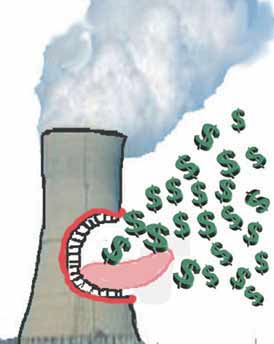 Local rep looks to boost nuclear by letting companies charge customers for plants up front, Austin Huguelet, Springfield News-Leader Dec. 29, 2019 Missouri hasn’t seen a new nuclear plant in more than 30 years.A local lawmaker and state air conservation officials say that needs to change to meet the demands of the future. Local rep looks to boost nuclear by letting companies charge customers for plants up front, Austin Huguelet, Springfield News-Leader Dec. 29, 2019 Missouri hasn’t seen a new nuclear plant in more than 30 years.A local lawmaker and state air conservation officials say that needs to change to meet the demands of the future.
Their first step: letting power companies bill customers up front for the cost. Rep. John Black, R-Marshfield, filed a bill earlier this month that would allow companies to add the cost of a new nuclear plant or renewable energy generator to customers’ rates while they’re under construction. Missouri voters banned the practice via initiative petition in 1976, shortly after St. Louis-based Ameren’s corporate predecessor won approval to collect costs while it built the state’s first nuclear power plant in Callaway County. Consumer advocates railed against the idea of paying for something not yet in service. Environmentalists raised the specter of potential disasters. At the ballot box, 63 percent of voters agreed, delivering a durable mandate that has withstood efforts to repeal the law. …….. John Coffman, who led the state’s utility watchdog from 2003-2005 and now does advocacy work around the country, said Black’s idea is simply about shifting risk from Wall Street to utility customers. “Sometimes Wall Street doesn’t want to invest in it unless they’re using the ratepayers’ money to do it,” Coffman said. “But then people should be asking, ‘Why is that?’” ……..Ed Smith, the policy director for the Missouri Coalition for the Environment he said the lack of easy taxpayer or ratepayer money for nuclear has led Ameren to make better decisions for the public. “Missouri was spared of having its customers spend billions of dollars on a nuclear plant,” he said. “And Ameren has acquired wind farms, built pipelines and done other things that are prudent for its customers rather than chasing this shiny nuclear idea that would generate a chunk of money for investors but was not in the best interest of their customers.”…….. John Coffman, who now represents the Consumers Council of Missouri, said all Black’s bill does is shift the risk taken on by investors and shareholders to customers. That may not be a problem if a project is completed on time and on budget, but Coffman said other recent projects suggest there’s no guarantee and plenty of downside. He represented AARP of South Carolina in the aftermath of that state passing a law allowing cost recovery during construction, which led to utility companies spending $9 billion on a reactor and then abandoning it amid cost overruns, delays, falling energy demand and the bankruptcy of its lead contractor. Ratepayers have already paid more than $2 billion for the project, according to the (Charleston) Post and Courier, and are on the hook to pay a new owner roughly the same amount over 20 years. “The public should not be their insurance,” Coffman said……… The legislation is House Bill 1784. https://www.news-leader.com/story/news/politics/2019/12/29/john-black-nuclear-power-charging-customers-up-front/2752198001/ |
|
Hawaii’s law-makers very worried about the nuclear coffin at the Marshall Islands
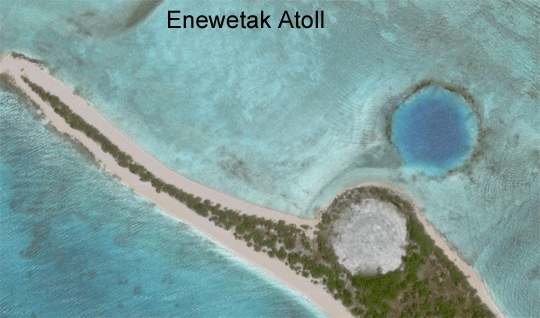 How A Nuclear Waste Site 2,800 Miles Away Became A Hawaii Priority https://www.civilbeat.org/2019/12/how-a-nuclear-waste-site-2800-miles-away-became-a-hawaii-priority/
The Runit Dome in the Marshall Islands is cracked and in danger of spilling its radioactive contents into the Pacific Ocean. By Nick Grube / December 26, 2019 WASHINGTON — A concrete dome built decades ago by the U.S. government on a Marshall Islands atoll 2,800 miles from Hawaii has the state’s federal lawmakers worried.
The Runit Dome is a relic of America’s atomic past. It’s home to 3 million cubic feet of radioactive waste that was buried there as part of the government’s effort to clean up the mess left from dozens of nuclear tests in the 1940s and ’50s that decimated the atoll.
A warming climate and rising sea levels now threaten the integrity of the saucer-shaped structure, which, if it fails, could spill its radioactive contents into the Pacific, a scenario that would threaten both people and the surrounding environment.
Members of Hawaii’s federal delegation, led by U.S. Rep. Tulsi Gabbard, recently secured a provision in the bipartisan National Defense Authorization Act to study what it would take to repair the dome.
It was among the top priorities for Hawaii, at least in the House. Hawaii Congressman Ed Case, who is a founder of the Pacific Islands Caucus, said the Runit Dome is of critical importance, not only for the islands but the U.S. as a whole.
“This is a concern on a number of levels,” Case said. “The basic one being: Is the Runit Dome capable, especially in a time of rising sea levels, of containing the very deadly radioactive waste that we deposited into that dome? The short answer is we’re not sure.”
Columbia University researchers published a study in July that found that the amount of radiation on Enewetak atoll, where the dome is located, and other parts of the Marshall Islands rival what’s been detected around Chernobyl and Fukushima, two locations synonymous with nuclear catastrophe.
The NDAA provision calls on the Secretary of Energy to submit a report to Congress within 180 days that includes a detailed plan to repair the Runit Dome and ensure that it “does not have any harmful effects to the local population, environment, or wildlife.”
The report should include an assessment of the current structure, cost analysis for the repair and a summary of discussions between the U.S. government and Marshall Islands regarding the dome.
In addition, the report will analyze how rising sea levels will affect the ability of the dome to contain the radioactive contents.
Case said the U.S. has an obligation to the Marshall Islands to at least analyze whether the Runit Dome is in danger of failure after it absolved itself of any responsibility through the execution of a Compact of Free Association, a treaty that effectively settled any claims related to past nuclear testing.
“The Marshall Islands obviously does not have the financial or human resources or expertise to effectively manage any issues that might be arising at the Runit Dome,” Case said.
“I think we owe it not only to the Marshalls but to the other islands of the Pacific to be sure we’re comfortable with what’s happening there, and, if we’re not comfortable with it, to determine what exactly we need to do to secure that waste.”
Case’s concerns about being a good ally come as the U.S. attempts to renegotiate its Compacts of Free Association with the Marshall Islands, Federated States of Micronesia and Palau.
The compacts give the U.S. military control over the countries’ land, airspace and surrounding waters, and are strategically important to American interests, especially as China tries to exert more influence in the region.
Gabbard did not respond to a Civil Beat request for an interview about the NDAA or the Runit Dome.
In June, Gabbard issued a press release stating that she was successful in including the provision for a public study in the House Armed Services Committee’s version of the NDAA.
She also noted that she was a co-sponsor of legislation named after former Hawaii Congressman Mark Takai that aimed to make it easier for veterans involved in the clean-up at Enewetak atoll to seek treatment through the Department of Veterans Affairs.
Takai died in 2016 of cancer.
“The Marshallese people are gravely concerned about environmental threats to the integrity of the storage site and the impact on their country,” Gabbard said in the statement. “The U.S. government is responsible for this storage site and must ensure the protection of the people and our environment from the toxic waste stored there.”
Germany’s next nuclear reactor closure on December 31st
|
German nuclear exit continues as planned with next reactor to close Dec 31, https://www.spglobal.com/platts/en/market-insights/podcasts/crude/122319-capitol-crude-oil-market-top-geopolitical-risks-2020. Andreas Franke Editor. Dan Lalor — Germany’s planned phasing out of nuclear power will continue with the closure next Tuesday of the 1.5 GW Philippsburg 2, leaving six reactors with a combined 8 GW online for the next 2-3 years. Federal environment minister, Svenja Schulze, said in a statement that the consensus in Germany behind the nuclear phase-out was “rock solid”. The last reactor will close by the end of 2022. “The nuclear exit makes our country safer [as it avoids radioactive waste]…It is important to emphasize in times when some propagate nuclear power as supposed climate savior that it solves no single problem, but creates new problems for a million years,” Schulze said. Germany decided in 2011 amid the aftermath of the Fukushima nuclear accident in Japan to immediately close reactors built before 1980 and reverse a planned run-time extension for modern nuclear plants by setting final closure dates. Nuclear operators still had to pay a combined Eur23 billion ($25.6 billion) into a state-run fund for the financing of mid- and long-term nuclear storage in Germany. So far, two modern reactors were shut in 2015 and 2017, with Philippsburg 2 the third reactor to close. The final shutdowns are more concentrated with three reactors set to close in December 2021 and the final three by the end of 2022. |
|
U.S. Congress votes $billions of tax-payers’ money for a new nuclear weapon for Trump
 Congress’s Christmas gift to Trump: A new nuclear weapon, The Hill Congress’s Christmas gift to Trump: A new nuclear weapon, The Hill
BY JOHN TIERNEY, OPINION CONTRIBUTOR — 12/24/19 In reaction to the Trump administration’s inept negotiating process on denuclearization, the North Koreans have threatened to send an ominous “Christmas gift.” Unfortunately, Americans are already certain to get a different nightmarish present, compliments of the U.S. Congress.
Absent convincing logic or reason, and against the House of Representative’s inclinations, legislators overwhelmingly decided to provide President Donald Trump with a new nuclear warhead — one that his administration thinks is “more usable.” Indeed, upon signing the Fiscal Year 2020 National Defense Authorization Act, this president — only the third in U.S. history to be impeached for high crimes and misdemeanors — will be in the position to gain control over the new nuclear weapon he first requested in 2018, a submarine-launched “low-yield” warhead. The United States has the most sophisticated conventional and nuclear arsenals in the world, with capabilities to respond to any limited use of nuclear weapons in multiple ways, including a thousand existing low-yield options that can be delivered by air. In fact, Congress and the last two administrations have already devoted billions of dollars to ensure these assets can effectively penetrate the most advanced air defenses. Based on existing bipartisan-supported plans, those investments are sure to continue. The Trump Administration has never given a convincing explanation why current bloated investments in upgrades to the U.S. nuclear deterrent are insufficient or why the deployment of the new warhead would make any real change in our current deterrent forces. Their half-hearted case for this new warhead is fragile, bordering on specious. It contends that Russia has a doctrine whereby it would employ nuclear weapons on a limited basis to end a conventional conflict with NATO. But there is scant evidence of this doctrine’s existence and the question remains: If the current and planned air-launched options cannot properly respond to any such Russian action, why are American taxpayers being asked to spend billions of dollars on those systems? Moreover, while the yield of this “low-yield” nuclear weapon is estimated to be roughly one-third to one-half of the yield of the bomb that destroyed Hiroshima and killed approximately 80,000 people, this is still a weapon that could kill tens of thousands of people in seconds. Launching even a “low-yield” nuclear weapon off a submarine greatly increases the chances of nuclear miscalculation. How would an adversary know the size of the weapon being launched at them? They would not, and would likely respond as if the worst-case scenario was occurring, exponentially increasing the risk of nuclear escalation. …….. https://thehill.com/opinion/national-security/475794-congresss-christmas-gift-to-trump-a-new-nuclear-weapon |
|
Philippines prone to natural disasters, but still contemplates nuclear power
Philippines seeks to relaunch nuclear power ambitions, Country prone to natural disasters eyes potential suppliers including Russia and US, Ft.com 27 Dec 19. The Philippines plans to revive its long-discontinued nuclear energy programme to combat the threat of a future power supply crunch — a prospect likely to raise safety concerns in a country prone to typhoons and earthquakes. The country is working with the International Atomic Energy Agency to meet the UN watchdog’s safety and other requirements, and investigating potential suppliers from Russia, South Korea, China and the US, said Alfonso Cusi, the energy secretary.
Kyrgyzstan bans uranium, thorium mining

Above – radioactive tailings mountain in Central Asia
|
Kyrgyzstan bans uranium, thorium mining http://www.xinhuanet.com/english/2019-12/16/c_138635832.htm 2019-12-16 BISHKEK, Dec. 16 (Xinhua) –– President of Kyrgyzstan Sooronbai Jeenbekov signed a decree banning the mining of uranium and thorium deposits in the Central Asian country, his press service reported on Monday.The law, aimed at ensuring radiation and environmental safety, prohibits geological exploration and development of uranium and thorium deposits in Kyrgyzstan, as well as dumping and transfer of the material, the report said.
Meanwhile, the import of raw materials and waste containing the two radioactive substances is not allowed by law, it said. Earlier this year, protests arose against the development of uranium deposits after reports that exploration work had begun in the Kyzyl-Ompol area in the Issyk-Kul region. |
|
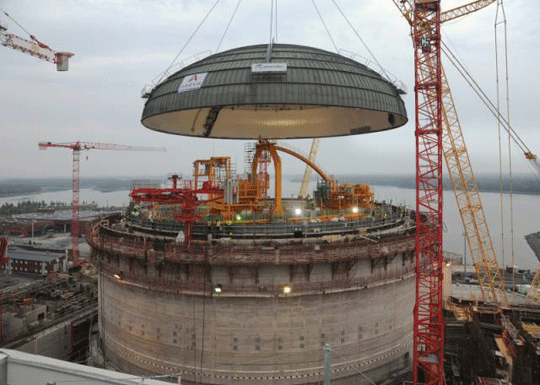
Yet more delay – Finland’s Olkiluoto 3 nuclear reactor already 12 years behind schedule
|
Olkiluoto 3 nuke delayed yet again, now 12 years behind schedule https://yle.fi/uutiset/osasto/news/olkiluoto_3_nuke_delayed_yet_again_now_12_years_behind_schedule/11128489
– 20 Dec 19, Finland’s fifth nuclear reactor will not begin regular operations before 2021, rather than 2009 as originally planned. The startup date for the Olkiluoto 3 (OL3) nuclear reactor on Finland’s southwest coast has been pushed back again. Plant owner Teollisuuden Voima (TVO) said on Thursday that it had been informed of the new schedule by the main supplier, the Areva-Siemens Consortium.The supplier now says that fuel will be loaded into the reactor next summer ahead of grid connection in November 2020. Regular electricity production would start in March 2021, instead of September 2020 as most recently announced. Faulty components foundTVO says the latest delays are due to slow progress in system testing and shortcomings in spare part deliveries. For instance auxiliary diesel generators were found to have faulty components. “Because of numerous delays we have to do maintenance to equipment and components already installed to ensure fluent start-up and continuous operation. The manufacturing and deliveries of the spare parts take time,” OL3 Project Director Jouni Silvennoinen said in a TVO statement. Construction work on OL3 started nearly 15 years ago. According to the original timetable, it was to have gone online in 2009. Since then there have been many delays, lawsuits and massive cost overruns. With a total cost estimate of at least 8.5 billion euros, it has been described as the second-most expensive building in human history, behind a hotel complex in Mecca. Construction of the original atomic power station began in 1973. The first unit began commercial operations six years later, becoming the country’s second reactor after one in Loviisa. The Fennovoima consortium hopes to build Finland’s first entirely new nuclear plant since the 1970s in Pyhäjoki, near Raahe. That project too has been beset by delays and is yet to receive a construction permit.
|
|

Boris Johnson’s overhaul of govt departments. Will it really be good for the environment?
Times 16th Dec 2019, Boris Johnson wants an overhaul of Whitehall that would merge departments and make it easier to fire civil servants and bring in experts from outside. Climate change would again become a separate department, allowing Mr Johnson to claim that he has a commitment to the environment.
https://www.thetimes.co.uk/article/prime-ministers-cummings-plan-for-civil-service-zv85vxd8z
Call to postpone a decision on Suffolk’s new nuclear power station bid

 East Anglian Daily Times 16th Dec 2019, An MP has called on the Secretary of State for Energy to postpone a decision on Suffolk’s new nuclear power station bid – accusing developers of failing to address community concerns.
Central Suffolk and North Ipswich MP Dan Poulter told Andrea Leadsom that EDF Energy’s latest consultation on Sizewell C still failed to provide enough information for consultees to make an informed response. EDF is expected to make its ‘Development Consent Order’ to the Planning Inspectorate early next year – after finishing its stage four consultation in September.
But Dr Poulter, said the company’s stage four consultation still left too many unanswered questions. EDF said its consultation had engaged with thousands of people across East Suffolk, providing updates on its plans as they evolved. It said it held regular meetings with parish councils and had provided funding to offer themindependent and free guidance during consultation.
But it faced regular criticism over the level of detail supplied in each stage of consultation. Dr Poulter said EDF’s lack of detail was a “common theme”. “There was some hope among interested parties in East Suffolk that EDF would use the stage four consultation to address the numerous calls for better information, but a review of the responses indicates EDF has missed this opportunity,” Dr Poulter wrote.
He said the collective response from the Suffolk Coast and Heaths AONB was “particularly damning”. The response said the consultation failed to pay proper regard to the purposes of the AONB – “despite comments made in previous consultations”. Dr Poulter said the information called for should be provided in EDF’s DCO but he had “serious reservations” of its ability to do so, given its failings so far.
Even if EDF was able to provide the information, Dr Poulter said the amount of data consultees would need to go through would be “substantial” – meaning their ability to make proper responses would be “severely limited”. Explaining his letter, Dr Poulter said: “EDF are behaving in a disdainful and unacceptable way towards many of the communities in East Suffolk. They should engage
properly and consult with local communities so the very real concerns of
residents about what the construction of Sizewell C means for them can be
properly considered and addressed.”
1 This Month





PLEASE OPPOSE HR 8255 AND S.3639 – bills would accelerate satellite deployment, with no environmental review or safeguards – https://ncstd5li.quorum.us/campaign/169331/
To see nuclear-related stories in greater depth and intensity – go to https://nuclearinformation.wordpress.com
-
Archives
- October 2026 (67)
- September 2026 (339)
- August 2026 (330)
- July 2026 (355)
- June 2026 (287)
- May 2026 (306)
- April 2026 (356)
- March 2026 (251)
- February 2026 (267)
- January 2026 (308)
- December 2025 (358)
- November 2025 (359)
-
Categories
- 1
- 1 NUCLEAR ISSUES
- business and costs
- climate change
- culture and arts
- ENERGY
- environment
- health
- history
- indigenous issues
- Legal
- marketing of nuclear
- media
- opposition to nuclear
- PERSONAL STORIES
- politics
- politics international
- Religion and ethics
- safety
- secrets,lies and civil liberties
- spinbuster
- technology
- Uranium
- wastes
- weapons and war
- Women
- 2 WORLD
- ACTION
- AFRICA
- Atrocities
- AUSTRALIA
- Christina's notes
- Christina's themes
- culture and arts
- Events
- Fuk 2022
- Fuk 2023
- Fukushima 2017
- Fukushima 2018
- fukushima 2019
- Fukushima 2020
- Fukushima 2021
- general
- global warming
- Humour (God we need it)
- Nuclear
- RARE EARTHS
- Reference
- resources – print
- Resources -audiovicual
- Weekly Newsletter
- World
- World Nuclear
- YouTube
-
RSS
Entries RSS
Comments RSS

