Nuclear waste Bill in U.S. House of Representatives – resistance in New Mexico to nuclear waste dump
 Nuclear waste bill advances to House, could push forward storage site in New Mexico Adrian Hedden, Carlsbad Current-Argus Nov. 27, 2019 A federal bill to alter policy for nuclear waste advanced to the full U.S. House of Representatives and could support the case for temporary storage of temporary storage of high-level waste at a facility like the one Holtec International proposed to build in southeast New Mexico.
The Nuclear Waste Policy Amendments Act was advanced by a unanimous voice vote to the House by the Energy and Commerce Committee on Nov. 20.
The bill, if passed, would move forward with safety licensing for a permanent nuclear waste repository at Yucca Mountain, Nevada, while providing the U.S. Department of Energy the authority to proceed with a program for consolidated interim storage (CIS) while the Yucca Mountain project progresses.
It also prioritized the transportation of spent nuclear fuel from generator sites in seismically active areas, and ensured the DOE has the funds to build and operate a repository
U.S. Rep. Ben Ray Lujan (D-NM), the only representative from New Mexico who sits on the committee, introduced an amendment that was approved to create a grant program to study the impacts radiation exposure including family members and non-workers resulting from uranium mining.
“Though we have a responsibility to address the waste issues that result from our country entering the atomic age, I am deeply concerned that this bill makes it more likely that a future interim storage site — potentially one in New Mexico — becomes a permanent home for nuclear waste,” he said.
One such interim facility, proposed by Holtec to be built in a remote, desert area near the Eddy-Lea county line, drew concerns from New Mexico environmentalist groups as it could put local communities at risk as well.
Don Hancock, nuclear waste program director at the Southwest Research and Information Center in Albuquerque cited a clause in the bill that required the governor of a state that would host a CIS facility to consent before moving forward.
New Mexico Gov. Michelle Lujan Grisham voiced her opposition to the Holtec project earlier this year, calling it “economic malpractice” as it could negatively impact two of the state’s biggest industries: oil and gas and agriculture.
“The bill says you must have approval from the state’s governor,” Hancock said. “New Mexico would be a non-starter. She (Lujan Grisham) has said she’s opposed to it.”
Hancock said he also opposed the project and the bill over the suggestion of transporting the waste hundreds or thousands of miles away from generator sites where it is currently stored.
Even if the waste approved to be shipped to a remote location like southeast New Mexico, Hancock argued it would take years for the infrastructure to be built and the waste to be moved.
“This approach doesn’t make any sense,” he said. “Why not do it in places that already have storage sites? It’s going to sit there for years. Let’s make that less dangerous. It can be done without massive transportation around the country.”…….. https://www.currentargus.com/story/news/local/2019/11/27/nuclear-waste-bill-advances-house-may-support-new-mexico-holtec-site/4297822002/
Onagawa nuclear plant to get approval for restart
 Nuclear watchdog approves restart of Onagawa reactor in Miyagi hit by 3/11 tsunami, Japan Times KYODO, STAFF REPORT. NOV 27, 2019
The No. 2 unit of Tohoku Electric Power Co.’s Onagawa plant in Miyagi Prefecture received the green light after the addition of disaster prevention measures, including a towering seawall that is nearing completion.
The approval, given in a unanimous vote, was the first to be secured by the operator under the revised standards. The reactor is only the second of those damaged in the March 2011 calamity to clear the Nuclear Regulation Authority’s new safety regulations, after the Tokai No. 2 power station in Ibaraki Prefecture.
Before the reactor can be restarted, the plant, which straddles the town of Onagawa and the city of Ishinomaki, still needs to finish installing anti-disaster measures, which are expected to be completed in fiscal 2020, and receive consent from the local governments.
Tohoku Electric expects to spend ¥340 billion ($3.1 billion) on the measures, the bulk of that being spent the seawall — which will run along 800 meters of Pacific coast and rise 29 meters above sea level to guard against tsunami as high as 23.1 meters. In the March 2011 disaster, parts of the basement floors of Onagawa’s No. 2 unit were flooded.
Costs for enhanced safety measures have ballooned and are expected to swell further with the construction of facilities to be used in the event of a terrorist attack, also required under the new safety standards.
The Onagawa plant is the closest nuclear plant to the epicenter of the magnitude 9.0 quake that struck northeastern Japan on March 11, 2011, and heavy shaking triggered an automatic shutdown of its three reactors……..
Onagawa’s approval will be formalized following a roughly one-month period where the NRA will accept comments from the public. During the meeting Wednesday, NRA Commissioner Shinsuke Yamanaka said the safety of the plant’s structural design had been reviewed carefully, in consideration that the Tohoku region has been hit by big earthquakes in the past. ……..
“I think there’s sufficient electricity without nuclear power,” said housewife Chisato Uno, 69. “Taking into account our children and grandchildren, no nuclear power is better.”….https://www.japantimes.co.jp/news/2019/11/27/national/nuclear-watchdog-restart-reactor-march-2011-tsunami/#.Xd7b2-gzbIU
Scotland’s Nicola Sturgeon’s outspoken opposition to use of nuclear weapons
 We don’t make the world safer by making it more dangerous first.
We [the UK] should lead the way by scrapping nuclear weapons and investing that money in our communities and our public services.
|
The consequences of this position should be made clear. The only time nuclear weapons have been used in war was the destruction of Hiroshima and Nagasaki by the US at the end of the second world war. The atomic bombs killed tens of thousands instantly. Radiation sickness killed many more. The first bomb destroyed five square miles of Hiroshima. No country has launched a nuclear attack since, but the world shortly afterwards entered a dangerous arms race. The nuclear weapons around today dwarf the bombs dropped in Japan. The death toll from a modern nuclear strike would not be counted in the tens of thousands, but in the millions. There is a theory – and it is one I fundamentally disagree with – that nuclear weapons make us safer, as no country would pick a fight with a nuclear power. But even those who buy into the idea of mutually assured destruction should balk at the casual way in which political discourse on this topic has developed. If a mainstream politician unblinkingly said that they would use chemical weapons against civilians there would be uproar. If a self-proclaimed candidate for prime minister boasted that they would commit war crimes, it would be a national scandal. Nuclear weapons should be seen no differently – but a dated cold war mentality is used to cloak these weapons of mass destruction in respectability. Their potential for death and destruction deserve better than trigger-happy bravado. It’s time that nuclear advocates spelt out the reality of what their position means. In 1961, despite public protests, the first US Polaris submarine sailed into Holy Loch in Argyll. By the end of that decade the UK had launched its own nuclear fleet, with four Polaris submarines based at Faslane. For 50 years nuclear submarines have been operational less than 30 miles from Glasgow, Scotland’s main population centre. Like many other Scots, I’ve always been appalled that Britain’s nuclear arsenal has been kept in my backyard. And I’ve always been astounded that UK government after UK government has paid the enormous cost of maintaining these dangerous weapons while children grow up in poverty in their shadow. I joined the Scottish Campaign for Nuclear Disarmament even before I joined the SNP. I don’t just want a Scotland free of nuclear weapons – I want a world free of nuclear weapons. But I have always felt that the only way to get nuclear weapons off the Clyde is for Scotland to become independent. This election campaign proves my point. Swinson is not alone in racing to embrace nuclear weapons to prove her leadership. Jeremy Corbyn, a long-time supporter of the CND, is now fully signed up to renewing Trident. While I have my differences with Corbyn, on this issue I believe that, in his heart of hearts, he still feels the same as I do. Yet, in attempting to become prime minister, the Labour leader feels the need to sell out his principled opposition to Trident and promise to keep it on the Clyde. The UK government has slashed conventional defence personnel and left Scotland without the defence capabilities that a maritime nation actually needs. We would be better protected, with more jobs, without Trident. Labour’s position is now that it supports a world free of nuclear weapons – but that the route there is to renew the missiles we already have. Like mutually assured destruction before it, this theory of multilateral disarmament relies on a massive leap of logic. We don’t make the world safer by making it more dangerous first. The cold war showed that developing nuclear weapons encourages an endless escalation, with status-obsessed powers demanding bigger and more destructive stockpiles. Even the progress made since the 1980s has proven to be built on unsteady ground. This year the US and Russia both withdrew from a key nuclear treaty, banning intermediate-range missiles. The last thing we need is a new arms race. The UK has an opportunity to show real, global leadership. It’s not enough to wait for other countries to see the error of their ways while spending tens of billions on new weapons for ourselves – with one estimate putting the lifetime cost of a new generation of Trident missiles at £200bn. We should lead the way by scrapping nuclear weapons and investing that money in our communities and our public services. The fact that the Westminster parties are united in their opposition to this approach will only confirm to many Scots that independence is the only way to scrap Trident once and for all. My message is simple – the overwhelming majority of countries the world over do not have nuclear weapons. We do not need nuclear weapons. And we should never, ever use nuclear weapons. |
|
Appeal from former political prisoner to Australia’s Prime Minister to help Julian Assange
“This is how diplomacy works,” “You can pick up the phone, Mr Morrison, and  speak with whoever the United Kingdom’s next prime minister is; requesting that Julian Assange not be extradited to the United States to face the very real possibility, if not the certainty, that he will die in prison.” at right, Prime Minister Morrison
 Former political prisoner pleads for Scott Morrison to not let Assange ‘die in jail’, The Age By Rob Harris, Filmmaker James Ricketson, who spent 15 months as a political prisoner in a Cambodian jail, has implored Prime Minister Scott Morrison to “pick up the phone” to his British counterpart to ensure Julian Assange does not die in prison.
There are growing fears for the psychical and mental health of the 48-year-old WikiLeaks founder, who is in a London prison fighting an extradition request to the United States, where he faces espionage charges relating to the release of classified files on the Iraq and Afghanistan wars.
In an open letter to Mr Morrison, Mr Ricketson has joined a “rising tide of voices” in support of Australian government intervention to bring Mr Assange back to Australia before full extradition proceedings in February.
“The evidence that Julian Assange is not being ‘treated fairly’ in accordance with UK law is now overwhelming, as is evidence of the psychological torture he is being subjected to in Belmarsh Prison,” Mr Ricketson writes.
“If Julian Assange does die in prison, will you, with a clear Christian conscience, be able to inform the Australian public, in all honesty, that you did all within your power (and more) to protect Assange’s legal and human rights.”
Mr Ricketson was arrested and charged with espionage in June 2017 for flying a drone over an anti-government rally in Phnom Penh. He was held in the notoriously overcrowded Prey Sar prison for 15 months until he was pardoned by Cambodian authorities.
The filmmaker said it was former prime minister Malcolm Turnbull who intervened to secure his release, despite the Department of Foreign Affairs and Trade’s insistence that it could not interfere with another country’s legal proceedings.
“This is how diplomacy works,” he writes. “You can pick up the phone, Mr Morrison, and speak with whoever the United Kingdom’s next prime minister is; requesting that Julian Assange not be extradited to the United States to face the very real possibility, if not the certainty, that he will die in prison.”
A newly formed federal cross-party parliamentary group, comprising 11 MPs dedicated to advocating for the return of Mr Assange, will meet formally for the first time on Monday in Canberra. ….
Mr Morrison and Foreign Minister Marise Payne have repeatedly ruled out any intervention in the case, with the PM saying last month he believed Mr Assange should “face the music” in court.
The former Australian high commissioner to Britain earlier this month mocked the idea of Mr Morrison acting on calls from Mr Assange’s supporters to do all he could to bring him home from Belmarsh Prison, where he has been held since his April 11 arrest at the Ecuadorian embassy, which gave him asylum for almost seven years. https://www.theage.com.au/politics/federal/former-political-prisoner-pleads-for-scott-morrison-to-not-let-assange-die-in-jail-20191124-p53dks.html
Scottish National Party will press Jeremy Corbyn to scrap UK’s nuclear deterrent
 Nicola Sturgeon to press Corbyn to scrap UK’s nuclear deterrent
Abandoning Trident would be key issue in SNP support for a minority Labour government, Guardian Severin Carrell Scotland editor
@severincarrell, Mon 25 Nov 2019
|
Nicola Sturgeon will press Jeremy Corbyn to scrap the UK’s nuclear deterrent in any talks on Scottish National party support for a minority Labour government. The SNP leader said abandoning Trident would a key issue in any post-election talks with Labour, alongside supporting a second independence referendum, abolishing the universal credit benefits system and devolving immigration policy to Holyrood. In an article for the Guardian Sturgeon attacked Corbyn for abandoning his longstanding opposition to nuclear weapons in favour of supporting Trident and its replacement by a new system, based at Faslane submarine base on the Clyde. “Like many other Scots, I’ve always been appalled that Britain’s nuclear arsenal has been kept in my back yard,” Sturgeon wrote. “Corbyn, a longtime supporter of the Campaign for Nuclear Disarmament, is now fully signed up to renewing Trident. While I have my differences with Jeremy, on this issue – in his heart of hearts – I believe he still feels the same as I do. Yet, in attempting to become prime minister, he feels the need to sell out his principled opposition to Trident and promise to keep them on the Clyde.”….. Corbyn and Jo Swinson, the Liberal Democrat leader, have both been asked during the election campaign whether they would use nuclear weapons. Corbyn refused to say; Swinson quickly said yes. Corbyn has also repeatedly insisted Labour will not negotiate with other parties to ensure it can govern. …… https://www.theguardian.com/politics/2019/nov/24/nicola-sturgeon-to-press-corbyn-to-scrap-uks-nuclear-deterrent |
|
USA’s “Senate Climate Caucus” full of climate deniers, funded by dirty industries
 New Senate Climate Caucus Is Filled With Climate Deniers and Climate “Delayers”, BY Sharon Zhang, Truthout, 14 Nov 19, What’s climate change to a senatorial non-believer? The new Senate Climate Solutions Caucus might soon answer that question.
Formed late last month, the caucus’s aim is to hold hearings with climate experts, educate fellow senators and introduce unanimously agreed-upon legislation. The caucus’s founders — Delaware Democrat Christopher Coons and Indiana Republican Mike Braun — boast of the mandated bipartisanship of the caucus. For every Democrat, there must be a Republican, and vice versa.
Floridian Sen. Marco Rubio, a former hardline climate denier, is the group’s latest addition. He joins fellow Republicans Lisa Murkowski, Mitt Romney (a former climate waffler) and Lindsey Graham, who once said that greenhouse gas emissions are bad but probably don’t warm the planet all that much.
“In its current state, our national conversation on this issue is too polarized, toxic, and unproductive,” Braun and Coons said in an op-ed about the caucus for The Hill. “Our caucus seeks to take the politics out of this important issue.”
Setting aside that the climate conversation isn’t as polarized among voters as Coons and Braun might think — in fact, an overwhelming majority of voters agree that global warming is happening — it’s strange that they think that bipartisanship on climate can be apolitical. For the last couple of decades, the Republican Party has been nearly united on the climate change denial front, and, in the name of compromise, Democrats have largely been hesitant to move to the left on climate — or make any moves at all.
RL Miller, political director of Climate Hawks Vote, a grassroots climate super PAC, calls bipartisanship in the caucus “a joke.”………
the biggest threat to any progress for the caucus isn’t necessarily the Republicans on it. The biggest threat may be the amount of fossil fuel money accepted by members on both sides of the aisle. Only one member so far has signed the No Fossil Fuel Money Pledge: Colorado’s Michael Bennet, a Democratic presidential candidate, non-supporter of the Green New Deal, and recipient of over $320,000 worth of oil and gas money in his time in Congress, according to the Center for Responsive Politics. The other three Democrats in the caucus – Jeanne Shaheen, Angus King and Coons — have received over $200,000 combined. Meanwhile, the Republican members of the caucus have received over $9.5 million combined, $7 million of which went to Romney alone.
the biggest threat to any progress for the caucus isn’t necessarily the Republicans on it. The biggest threat may be the amount of fossil fuel money accepted by members on both sides of the aisle. Only one member so far has signed the No Fossil Fuel Money Pledge: Colorado’s Michael Bennet, a Democratic presidential candidate, non-supporter of the Green New Deal, and recipient of over $320,000 worth of oil and gas money in his time in Congress, according to the Center for Responsive Politics. The other three Democrats in the caucus – Jeanne Shaheen, Angus King and Coons — have received over $200,000 combined. Meanwhile, the Republican members of the caucus have received over $9.5 million combined, $7 million of which went to Romney alone.
A starting point for bipartisan legislation would be some sort of carbon fee — an idea legislators on both sides of the aisle have been bouncing around for a while –which environmental experts consider to be a bare minimum requirement for the path to net-zero emissions. Considering all of the members of the caucus have to agree on any policy they write, however, even a carbon fee will likely be an uphill battle. Rubio derides the idea of a carbon tax and conflates it with the Green New Deal in a recent op-ed for USA Today; Murkowski has refused to endorse a carbon tax; and Graham has supported one in the past, but reneged on that view earlier this year. Even Braun says that he doesn’t want a carbon fee to be a focus of the caucus.
To say that the country needs to act on climate and then reject the most basic policy to address climate change appears to be a new form of climate denial among centrists and the right — they may not outright deny the existence of climate change, but refuse to acknowledge the all-encompassing scale of the problem. In March, when a video clip of Sen. Dianne Feinstein shows her dismissing Sunrise Movement activists circulated, Rep. Alexandria Ocasio-Cortez tweeted that Feinstein was a “climate delayer.”……..
Even if the caucus does produce legislation, “the very existence of something like this, with so many senators that have taken money from the fossil fuel industry — it risks locking us into inadequate policies,” Billings says. For instance, not only would a carbon tax alone be insufficient climate policy, but it may also contain covert fossil fuel riders. There’s a reason that ExxonMobil, BP and Shell have been pushing for the passage of a carbon tax; Exxon’s carbon tax proposal last year contained a liability waiver, granting the company immunity for any climate change lawsuits brought against it.
Most of the Republicans in the caucus and at least one of the Democrats have shown to be susceptible to fossil fuel industry messaging that’s disguised as “climate-friendly.” Climate plans with an emphasis on carbon capture are a dead giveaway on this. In the current political sphere, carbon capture primarily refers to a technology that, yes, captures carbon as it’s emitted, but also sequesters that carbon in depleted oil wells, helping the fossil fuel companies to extract more oil. Funding carbon capture research is bipartisan, too, but as its used currently, it’s as useful for the climate as using kerosene to put out a fire.
Some may hail the bipartisanship of this climate caucus as a step forward. But as long as the majority of the committee is taking fossil fuel money, any supposed progress is dubious at best, and stifling at worst. After all, there’s no way of telling what’s happening behind closed doors. https://truthout.org/articles/new-senate-climate-caucus-is-filled-with-climate-deniers-and-climate-delayers/?eType=EmailBlastContent&eId=5dfc1357-c5ab-4a92-a995-92190dbe348e
France’s Flamanville nuclear financial catastrophe gets worse
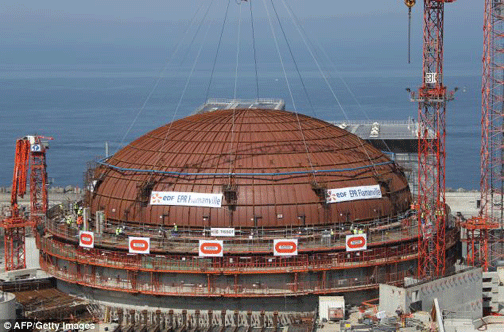 Le Monde 22nd Nov 2019, Jean-Martin Folz’s report on the construction of the Flamanville EPR, handed out on October 28 , is without appeal for the French nuclear power industry. The financial catastrophe continues to worsen. The project is currently 10 years late and 9 billion euros over budget. He helped engulf Areva, flagship of the French nuclear industry, declared bankrupt in 2016, which owed its salvation to a bailout on public funds of 4.5 billion euros.
It now weighs on the accounts of EDF, a new prime contractor since the
wreck of Areva, which no longer hopes to connect the reactor to the network
before 2022.
Ohio: the nuclear industry’s violent assault on democracy

Ohio’s GOP secretary of state has now asked the Ohio Supreme Court NOT to provide a federal judge with answers about key procedural questions surrounding the state’s referendum process.
The short-term issue is about a billion-dollar bailout for two nuke reactors and two coal burners.
Long-term it asks whether targeted violence perpetrated by paid thugs will now define our election process. And whether the public referendum will remain a workable part of our democracy.
The battle starts with House Bill 6, the now-infamous billion-dollar nuke bailout approved by the corrupt, gerrymandered Ohio legislature in late July.
HB6 forces all Ohio ratepayers to subsidize two crumbling nukes on Lake Erie, along with two decrepit coal burners, one of them in Indiana. It helps underwrite ten small solar farms, but undercuts much larger subsidies for other wind and solar facilities.
The Perry reactor east of Cleveland, and Davis-Besse near Toledo, are among the world’s most dangerous, decrepit reactors. Both were set to shut because they cannot compete with wind and solar, as well as fracked gas.
But Akron-based FirstEnergy spent millions to “persuade” the legislature to hand them a billion dollars to keep their uncompetitive, uninsured and essentially unregulated reactors on line.
When the bailout passed, a statewide group called Ohioans Against Corporate Bailouts turned in a petition for a repeal referendum on the 2020 ballot. The law allows 90 days for referendum sponsors to gather signatures to get on the ballot. In this case 265,711 would be required.
Ohio’s Attorney General David Yost sat on the request for 19 days, then rejected it. OACB filed a second application, which the AG sat on for another 19 days before approving it.
That left the petitioners just 52 days to gather signatures.
But signature gatherers were immediately attacked with violent threats and bribery offers. In the field, they (and potential signatories) were physically assaulted by “blockers” hired by the nuclear industry. Sworn testimony about these attacks was filmed at a public gathering in Columbus and can be seen here:
https://freepress.org/article/free-press-second-saturday-petition-blockers-threaten-our-democracy
Bailout opponents then went to federal court to ask that the 38 days consumed by the AG be restored to the petition campaign, which came up short at the 90-day deadline. A federal judge asked for guidance from the Ohio Supreme Court and submitted five questions for the Justices to answer.
And here things have leapt to another level. Frank LaRose, the Ohio Secretary of State, has now asked the Ohio Supreme Court NOT to respond to the federal judge’s queries.
In other words: the Republican attorney general killed nearly half the allotted signature gathering time for the repeal of this bailout. A federal judge has asked to hear from the state Supreme Court. And now Ohio’s Republican secretary of state has asked that Court NOT to comply, in a direct attempt to prevent Ohioans from voting on whether they’re to be forced to pay a billion dollar subsidy for two lethal, money losing atomic reactors.
This shocking combination of overt threats, bribery and outright physical violence, combined with judicial stall tactics by elected Ohio officials, breaks new ground in the assault on democracy itself in the American heartland.
The issue cuts to the core of the 2020 election. Donald Trump has met personally with at least one principal lobbyist for FirstEnergy, the prime beneficiary of the bailout. At least one of his associates lobbied at least five legislators in its behalf.
But a statewide referendum for repeal could be catastrophic for the GOP. Polls show more than 60% of Ohioans opposed. That includes much of the normally corporate statewide media. Many big industrial organizations have joined the fossil fuel industry here in fighting it.
If the referendum does get on the 2020 ballot, it will clearly energize a strong progressive voter turnout. Outraged ratepayers could very easily make the difference in a closely divided swing state. So for Trump and his minions, killing a vote on this billion-dollar rip-off is vital.
Their assault must be seen as part of a larger attack on democracy itself. The right to referendum has been established in numerous states for a century or more. That physical violence, choreographed bribery and official legal manipulation would now be used to kill it bodes badly for our future.
From the rise in violent white supremacist bigotry, to unaccountable police murders, to Charlottesville, to the recent attack on Code Pink’s Medea Benjamin to the concerted Republican assault on paper ballots and fair, inclusive voting practices, it’s clear the GOP intends to gut democracy in 2020 and beyond.
This all-out utility and official attack on the referendum process in Ohio has put a billion-dollar price tag on two nukes capable of doing trillions in damage to human health and the eco-systems of the Great Lakes region.
But it also signals a broader war against both democracy and truth, one we must all take very, very seriously.
—————-
Attorney Bob Fitrakis, Ph.D., is publisher of the Columbus Free Press. He’s co-author
France’s government is giving mixed messages on future of nuclear energy
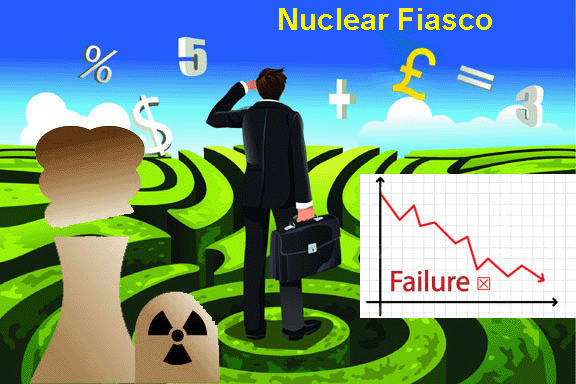 EDF gives Macron little reason to come clean on
  nuclear https://www.ft.com/content/adbe9da6-0ab8-11ea-bb52-34c8d9dc6d84 Problems at a flagship nuclear reactor means French government can take time over future of EDF, BEN HALL , Europe editor NOVEMBER 20 2019
The earthquake that shook the Rhone valley in south-east France last week could have been another financial disaster for energy giant EDF in what has been a bruising year. Its share price has taken a battering over concerns that it will struggle to pay for the upkeep of its ageing fleet of reactors, find money to build new ones and service its €37bn of net debt. The worries have been amplified by further delays and cost overruns at the mammoth nuclear plant it is building on the Normandy coast. The Rhone valley is home to four of the country’s 19 atomic power stations and a nuclear fuel processing facility, all operated by EDF. The tremor was the worst to hit France in 16 years. Three reactors at Cruas had to be shut down until mid-December for mandatory safety checks.
The French government, which owns 83.7 per cent of the company, is giving mixed messages about the way forward. It will not decide whether to build more EPRs until Flamanville is up and running — conveniently after the 2022 presidential election, allowing Emmanuel Macron to avoid the wrath of France’s increasingly powerful environmental movement. But according to Le Monde newspaper, the government has also secretly ordered EDF to draw up a feasibility study for six new EPRs built in pairs.
A Labour government in UK would revive Wylfa nuclear power project

|
|
 Labour commits to lagoon and nuclear plant in manifesto, BBC, 21 November 2019Major Welsh projects including a Swansea Bay tidal lagoon would be built if Labour wins the general election, the party’s manifesto says. Labour commits to lagoon and nuclear plant in manifesto, BBC, 21 November 2019Major Welsh projects including a Swansea Bay tidal lagoon would be built if Labour wins the general election, the party’s manifesto says.
Plans for a lagoon were dropped by UK ministers last year, but there have been efforts to revive such a scheme. Stalled plans for a new nuclear power station on Anglesey would also be revived under Labour, the party says……. Earlier this year, the Japanese firm Hitachi said it was suspending work on the £13bn Wylfa Newydd nuclear power project on Anglesey because of rising costs, after six months of talks with UK ministers about funding for the scheme. Labour’s manifesto states the party will “work with people on the island to maximise its potential for new nuclear energy, alongside investment in renewables”…….. What about Brexit? In his speech in Birmingham, Mr Corbyn said he would negotiate a “sensible” Brexit deal with the EU, that protects manufacturing and Northern Ireland’s Good Friday Agreement. Voters would be able to choose between that deal or staying in the EU in a referendum to be held within six months, he said. Mr Corbyn has refused to say which option he will back, although Welsh Labour leader Mark Drakeford says the party in Wales will campaign to keep the UK in the European Union. Recognising this difference between the two leaders on a key issue, the manifesto states “in Wales the Welsh Labour government will campaign to remain”. https://www.bbc.com/news/election-2019-50490159 |
|
Taiwan govt to give $2.55 billion to Orchid Island in nuclear waste compensation

 Orchid Island to get NT$2.55 billion in nuclear waste compensation, Focus Taiwan, (By Flor Wang, Elaine Hou, Lu Tai-cheng Taipei, Nov. 22 (CNA) The government will pay NT$2.55 billion (US$83.6 million) to Orchid Island residents to compensate them for infringing on their rights by maintaining a nuclear waste storage facility there over the past five decades, President Tsai Ing-wen (蔡英文) announced Friday.
Tsai announced the compensation at a news conference in Taitung and hailed the move as reflecting the goal of the current government to pursue transitional justice for indigenous tribes based on fact-finding efforts.
“Evidence we collected showed that the then-government decided to build a nuke waste storage in reserved lands for the Yami people on Orchid Island without their previous knowledge or agreement,” Tsai said.
She described the payment as a step toward compensating Orchid Island and its people, but said there was still a lot to do to “correct our past errors.”
The decision to position the facility to handle low- and medium-level nuclear waste from Taiwan’s nuclear power plants on Orchid Island was made in 1974 and it began receiving shipments in 1982.
The process has long been recognized as deceptive, with a report titled “Orchid Island: Taiwan’s Nuclear Dumpsite” in the newsletter Nuclear Monitor in 1993 detailing how residents were led to believe a cannery was being built.
The Executive Yuan brought up historical documents showing that former President Chiang Ching-kuo (蔣經國) and Premier Sun Yun-suan (孫運璿) went ahead with the decision to build the facility without informing the local Yami people in advance.
Since residents realized in the late 1980s what was actually on the site, they have feared it would contaminate the food chain and force them off the island and also led protests against nuclear power……http://m.focustaiwan.tw/news/aipl/201911220023.aspx
UK Labour touts ‘green industrial revolution’, BUT INCLUDES NUCLEAR POWER AS “GREEN”!
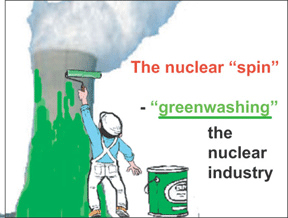
 Labour pledges ‘green industrial revolution’ with nuclear power and a digging over of allotment laws Labour pledges ‘green industrial revolution’ with nuclear power and a digging over of allotment lawsThe environment gets top billing in Labour’s manifesto. The first chapter of their 150 pages of policy pledges is devoted to what Labour are calling a “Green Industrial Revolution”. While they’ve conspicuously dropped a conference pledge of a net zero carbon target by 2030, which most serious analysts warned was impossible to achieve anyway, like the Liberal Democrats and Green Parties they’re planning to borrow big to invest in a low carbon economy. There’s a £250bn “Green Transformation Fund” to massively increase low carbon energy generation, warmer, lower carbon homes and promises to decarbonise heating in buildings — much needed if the UK is going to meet its existing climate change pledges. In a notable departure from Liberal Democrat and Green manifestos, they promise to support nuclear power as a way of ensuring stable electricity supply on a future national grid….. https://www.itv.com/news/2019-11-21/labour-pledges-green-industrial-revolution-with-nuclear-power-and-a-digging-over-of-allotment-laws/ |
|
|
For UK elections, top issue is climate change
Climate crisis topping UK election agenda is ‘unprecedented’ change Environmentalists say such political focus on green issues ‘unthinkable’ just five years ago, Guardian, Fiona Harvey Environment correspondent, Fri 22 Nov 2019 The climate emergency has risen to the top of the UK’s election agenda in a way that would have been “unthinkable” even five years ago, leading environmentalists have said, predicting that it augurs a permanent change in British politics.On Wednesday, Labour took the unprecedented move of putting green issues as the top section of its manifesto, the first time one of the UK’s two major parties has done so. Jeremy Corbyn led the appeal to voters with policies including an £11bn windfall tax on oil and gas companies, a million new jobs in a “green industrial revolution” and commitments on moving to a net-zero carbon economy.“Such focus on climate and the environment would have been almost unthinkable five years ago,” said Shaun Spiers, executive director of the Green Alliance. “Tackling climate change runs through this manifesto in a way that is unprecedented from either of the main parties ahead of a UK general election.”
“It would not have been possible five years ago,” said Tom Burke, chairman of environmental thinktank E3G and former adviser to several governments, who said the move marked a permanent change in British politics, as younger voters in particular were “energised” over the environment. Public anxiety had been fuelled by people seeing extreme weather around the world, and the rise of climate activism in movements such as Extinction Rebellion and the school climate strikes reflected that. “The politicians are following the public on this, not the other way round.”
…….. The Liberal Democrats, while focusing on Brexit, have also made the climate emergency a key priority, promising to generate 80% of the UK’s electricity from renewable sources by 2030, to bring forward to 2045 the deadline for net-zero carbon, and to expand electric vehicles and ban fracking. The Green party wants to spend £100bn a year for the next decade on the climate crisis, replacing high-carbon infrastructure and creating jobs…. https://www.theguardian.com/environment/2019/nov/21/climate-crisis-topping-uk-election-agenda-is-unprecedented-change
France’s nuclear company EDF – report – a litany of failures
EDF gives Macron little reason to come clean on nuclear, Problems at a flagship nuclear reactor means French government can take time over future of EDF. BEN HALL 20 Nov 19
The earthquake that shook the Rhone valley in south-east France last week could have been another financial disaster for energy giant EDF in what has been a bruising year. Its share price has taken a battering over concerns that it will struggle to pay for the upkeep of its ageing fleet of reactors, find money to build new ones and service its €37bn of net debt. The worries have been amplified by further delays and cost overruns at the mammoth nuclear plant it is building on the Normandy coast. The Rhone valley is home to four of the country’s 19 atomic power stations and a nuclear fuel processing facility, all operated by EDF. The tremor was the worst to hit France in 16 years. Three reactors at Cruas had to be shut down until mid-December for mandatory safety checks. ……..
…………The failures at Flamanville have given Paris reason to withhold the clarity EDF needs — even if Mr Macron’s regards the nuclear industry as a strategic asset for France and Europe. The risks of nuclear power to health and safety and the costs of decommissioning and waste storage may be overblown, as Jonathan Ford has argued in this column. But if the more basic challenge of building vaguely on time or on budget cannot be met, nuclear energy soon loses its appeal. ben.hall@ft.com https://www.ft.com/content/adbe9da6-0ab8-11ea-bb52-34c8d9dc6d84
UK’s Liberal Democrat leader criticised for her willingness to use nuclear weapons
Sickening’: Jo Swinson condemned for unhesitatingly saying she would use nuclear weapons, CND attacks ‘disgraceful response’, saying: ‘Not even a moment’s hesitation about the prospect of killing millions of people’ Independent, Rob MerrickDeputy Political Editor @Rob_Merrick, 20 Nov 19
Jo Swinson has been criticised for trying to pass a “virility test” after saying she would be willing to press the nuclear button if she becomes prime minister.
The Liberal Democrat leader was asked if she would “ever be prepared to use a nuclear weapon”, answering with a single word: “Yes.”
The Campaign for Nuclear Disarmament attacked the “disgraceful response”, saying: “Not even a moment’s hesitation about the prospect of killing millions of people. We need better than this.”
And Nicola Sturgeon, the Scottish National Party leader, said: “It’s sickening to hear this question asked and answered as if it’s some kind of virility test and without any context.
“Using nuclear weapons would mean killing millions of people. Those consequences should be made clear.”
But a Lib Dem spokesman defended Ms Swinson’s answer, saying: “We support multilateral disarmament, but if you have a nuclear deterrent and tell everyone you won’t use it, it ceases to be a deterrent.”
The controversy comes after Labour got into difficulty over its stance on the UK’s Trident nuclear submarines. It is party policy to retain them – but Jeremy Corbyn has previously said he would not use them.
Emily Thornberry, the shadow foreign secretary, said Labour would “work collectively” on how to respond to a nuclear threat.
The Lib Dem general election manifesto is expected to back maintaining “a minimum nuclear deterrent”, while pursuing international talks to achieve multilateral disarmament.
When in office, in the Cameron-Clegg coalition, the party pledged to put forward alternatives to scale down the Trident fleet, but the idea came to nothing.
Defence experts have suggested that the number of Vanguard submarines could be reduced, ending so-called ‘continuous at sea deterrence’, without putting the UK at risk.
However, little has been heard about the idea from the Lib Dems since Nick Harvey was sacked from his defence post in the coalition in 2012.
On the campaign trail, Mr Corbyn has also declined to rule out scrapping Trident as part of any post-election arrangement with the SNP.
The Labour leader said that, as prime minister, he would seek to revive non-proliferation talks with other nations, with the UK’s nuclear weapons on the table.
Asked whether he would agree to scrap Trident if the SNP insisted on that as the price of backing a Labour government in a hung parliament, Mr Corbyn said: “I think the SNP would actually agree with me, and indeed in the past they certainly have, that the priority has to be giving realism to the nuclear non-proliferation treaty.”
Ms Thornberry, asked if Mr Corbyn would press the button, replied: “I suspect that the way that Jeremy makes decisions is that he takes advice and that we work collectively.”
Social media is an increasingly important battle ground in elections – and home to many questionable claims pumped out by all sides. If social media sites won’t investigate the truth of divisive advertising, we will. Please send any political Facebook advertising you receive to digitaldemocracy@independent.co.uk, and we will catalogue and investigate it. Read more here.https://www.independent.co.uk/news/uk/politics/jo-swinson-nuclear-weapon-button-war-lib-dems-election-debate-a9210456.html

1 This Month





PLEASE OPPOSE HR 8255 AND S.3639 – bills would accelerate satellite deployment, with no environmental review or safeguards – https://ncstd5li.quorum.us/campaign/169331/
To see nuclear-related stories in greater depth and intensity – go to https://nuclearinformation.wordpress.com
-
Archives
- October 2026 (67)
- September 2026 (339)
- August 2026 (330)
- July 2026 (355)
- June 2026 (287)
- May 2026 (306)
- April 2026 (356)
- March 2026 (251)
- February 2026 (267)
- January 2026 (308)
- December 2025 (358)
- November 2025 (359)
-
Categories
- 1
- 1 NUCLEAR ISSUES
- business and costs
- climate change
- culture and arts
- ENERGY
- environment
- health
- history
- indigenous issues
- Legal
- marketing of nuclear
- media
- opposition to nuclear
- PERSONAL STORIES
- politics
- politics international
- Religion and ethics
- safety
- secrets,lies and civil liberties
- spinbuster
- technology
- Uranium
- wastes
- weapons and war
- Women
- 2 WORLD
- ACTION
- AFRICA
- Atrocities
- AUSTRALIA
- Christina's notes
- Christina's themes
- culture and arts
- Events
- Fuk 2022
- Fuk 2023
- Fukushima 2017
- Fukushima 2018
- fukushima 2019
- Fukushima 2020
- Fukushima 2021
- general
- global warming
- Humour (God we need it)
- Nuclear
- RARE EARTHS
- Reference
- resources – print
- Resources -audiovicual
- Weekly Newsletter
- World
- World Nuclear
- YouTube
-
RSS
Entries RSS
Comments RSS

