Nuclear Regulatory Commissions plans for lengthy lifetimes for U.S. nuclear power plants
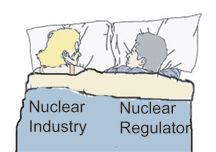 THE BIG PICTURE (Infographic): U.S. Nuclear Lifetimes, [ Excellent graph and table on original] https://www.powermag.com/the-big-picture-infographic-u-s-nuclear-lifetimes/ Mar 31, 2020. by Sonal Patel The U.S. has 96 licensed-to-operate nuclear power reactors and two reactors under construction. But the average age of the nation’s 96 licensed nuclear units is about 39 years old. That has been of some concern to the nuclear industry, which has provided roughly a fifth of the nation’s power since the 1990s. About 88 of the 96 reactors have already renewed their operating license once, extending their lifetimes from 40 to 60 years, but the majority of these will be “nearing the end of that 20-year extension by 2029 and will be seeking to renew their license a second time, for another 20-year period,” the Nuclear Energy Institute (NEI) has said.In December 2019, marking a major milestone, the Nuclear Regulatory Commission (NRC) granted the first-ever subsequent license renewal (SLR) applications to Turkey Point 3 and 4, and then to Peach Bottom 2 and 3 in March 2020, extending these reactors’ operating licenses from 60 to 80 years. THE BIG PICTURE (Infographic): U.S. Nuclear Lifetimes, [ Excellent graph and table on original] https://www.powermag.com/the-big-picture-infographic-u-s-nuclear-lifetimes/ Mar 31, 2020. by Sonal Patel The U.S. has 96 licensed-to-operate nuclear power reactors and two reactors under construction. But the average age of the nation’s 96 licensed nuclear units is about 39 years old. That has been of some concern to the nuclear industry, which has provided roughly a fifth of the nation’s power since the 1990s. About 88 of the 96 reactors have already renewed their operating license once, extending their lifetimes from 40 to 60 years, but the majority of these will be “nearing the end of that 20-year extension by 2029 and will be seeking to renew their license a second time, for another 20-year period,” the Nuclear Energy Institute (NEI) has said.In December 2019, marking a major milestone, the Nuclear Regulatory Commission (NRC) granted the first-ever subsequent license renewal (SLR) applications to Turkey Point 3 and 4, and then to Peach Bottom 2 and 3 in March 2020, extending these reactors’ operating licenses from 60 to 80 years.
More SLRs are expected this June for Surry 1 and 2. Meanwhile, owing to market conditions, technical issues, political pressure, and financial stresses, nine reactors have retired before their licenses expired since 2013, and an additional six units are slated to retire by 2026. The NEI suggests that half the nation’s nuclear fleet will need to obtain SLRs by 2040 to continue operating or be forced to retire. Sources: NRC, POWER |
|
Some politicians realising that climate change needs dramatic action, too
 FT 30th March 2020 As the coronavirus pandemic has sent governments scrambling to respond, many politicians have drawn a parallel with another global threat: climate change. “We have to act dramatically, boldly, if we’re going to save lives in this country and around the world,” Bernie Sanders, one of the Democratic presidential contenders, said recently. “I look at climate
change in the exact same way.”
Yet while the principles may be the same, the politics of the two pressing challenges are very different. The analogies between the coronavirus and climate change are easy to understand. The radical measures adopted to fight the pandemic look like precedents for addressing the potentially greater danger from climate change.
Fatih Birol, executive director of the International Energy Agency, has suggested that the need for widespread intervention by governments to
prevent economic collapse should be seen as a “historic opportunity” to
direct energy investment into technologies that reduce greenhouse gas
emissions. Large-scale investment to support solar and wind power,
batteries, hydrogen and carbon capture and storage would “bring the twin
benefits of stimulating economies and accelerating clean energy
transitions,” he wrote earlier this month.
https://www.ft.com/content/13ce469c-68fa-11ea-a6ac-9122541af204
USA nuclear industry uses coronavirus to gouge $billions of tax-payer money
|
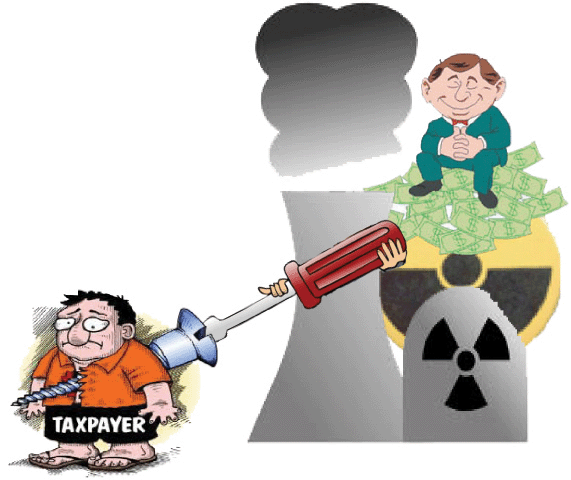
Out of control?, While industry looks for handouts, NRC gives nod to reduced safety oversight, https://wordpress.com/read/feeds/72759838/posts/2643325963By Linda Pentz Gunter 29 Mar 20, It was no surprise really, when the first to line up with outstretched palms as Congress debated and formulated its now passed $2 trillion coronavirus-prompted emergency relief bill, were nuclear corporations.The sinking nuclear power industry spotted an economic lifeline and couldn’t wait to make a grab for it. The Nuclear Energy Institute, the lobbying arm of the nuclear power industry, rushed off a letter to congressional leaders asking for a 30% tax credit and waivers for existing regulatory fees. One of NEI’s apparently needy recipients is the financial fiasco known as Vogtle 3 and 4, the new nuclear power plant construction project in Georgia, which is already more than five years behind schedule and is projected to cost $28 billion, double the original predicted price. The two new Georgia reactors aren’t needed, and their continued slow progress is by no means a matter of national security right now — or at all. But the NEI would like to see a nice fat grant go to Georgia Power to continue construction there, even though the company has already received two federal loan guarantees totaling $12 billion. In addition, the company is also gouging ratepayers in advance to cover the costs for the two reactors through the state’s Construction Work in Progress law, with no guarantee that they will ever reach completion. Before long, the nuclear weapons manufacturers got in on the act as well. Wrote the group, Code Pink: “Boeing has the audacity to demand a $60 billion taxpayer bailout for their shareholders and CEO.” Boeing is responsible for the Minuteman Intercontinental Ballistic Missiles, to be replaced this year with the misleadingly named Ground Based Strategic Deterrent. Boeing has also already received a $26.7 million contract from the U.S. Navy for Trident II D5 ballistic missile maintenance, rebuilding and technical services. Astonishingly, it was ultra conservative senator, Ted Cruz, who was one of those who pushed back against the corporate bailouts for the likes of Boeing and GE, manufacturer of the ill-fated Fukushima nuclear power plants and similar boiling water reactors in the US that are meltdowns waiting to happen. Cruz tweeted that “some are pushing for a special carve-out just for Boeing & GE. That would be WRONG. Millions are losing jobs; we don’t need bailouts or corporate welfare — those companies should participate in the same liquidity programs as everyone else.” But Boeing apparently got its wish. A $17 billion federal loan package contained in the stimulus bill passed by both the House and Senate and signed by President Trump on March 27, “was crafted largely for the company’s benefit,” according to reporting in the Washington Post. Boeing may also be able to dip its fingers into the “$58 billion the Senate package is providing in loans for cargo and passenger airlines, as well as the $425 billion in loans it is allocating to help firms, states and cities hurt by the current downturn,” wrote the Washington Post, even though, as Code Pink pointed out, alluding to the two 737 MAX disasters, Boeing is responsible for “defective civilian planes that plummet from the sky in mid-flight.” Boeing shares soared more than 24% on the day the Senate bill passed. The US is already spending $35.1 billion a year on its nuclear weapons arsenal. As the timely graph below [on original] from ICAN points out, this money could be redirected to a wealth of essential needs that would help quell the novel coronavirus in the US. … It’s not yet clear what portion of the stimulus money might go to the nuclear power industry, but the renewable energy sector took a hit. According to the San Diego Union Tribune, “the renewable energy industry had asked for — but did not get — extensions of deadlines related to construction or completion of solar and wind projects, without which they could lose access to time-sensitive tax credits. Industry associations were hopeful they’d be included in any later relief package.” There is also a $400 billion slush fund in the present legislation which can be used for loans and loan guarantees for large companies. Watch for the nuclear power industry to line up for a share of that in addition to its earlier pitch for a $23 billion bailout, which Lukas Ross, senior policy analyst with Friends of the Earth, called “a new low bar,,” and an attempt to use the coronavirus crisis “to try and brazenly grab more cash.” Meanwhile, the US Nuclear Regulatory Commission (NRC), in its usual fashion, has used the opportunity presented by the corona crisis to relax its already somnific safety oversight even more, and will allow nuclear power plant operators to defer safety maintenance, inspections and fitness for duty requirements during the outbreak. “Regulations to ensure safety should be strengthened at a time like this — not weakened,” Kevin Kamps, radioactive waste specialist at Beyond Nuclear, told Power Magazine. “It means operating nuclear plants without basic safety inspections.” One measure would be to allow workers to put in longer shifts than safety regulations allow, a measure that would place unnecessary additional “stress and strain on workers that need to be fully attentive and alert in sensitive jobs,” Kamps told the Carolina Public Press. He recommended powering down reactors instead, particularly given the current reduction in demand. But if the coronavirus pandemic causes higher than usual absenteeism among vital nuclear plant personnel, the NRC has a plan for that. Under normal circumstances, operating with too few control room staff is a safety violation. But under the coronavirus conditions, this would be exempted, or forgiven by the NRC, creating an added safety risk. During a recent NRC and industry telephone meeting on the topic, Beyond Nuclear’s director of reactor oversight, Paul Gunter, asked whether the NRC had supplied its reactor site personnel with sufficient protective equipment, masks, and respirators, as per the Centers for Disease Control guidelines. “They blew it off, Gunter said. “They claimed it was a matter for OSHA.” Industry representatives on the call remained silent on the matter. Gunter added that Kamps’s suggestion to power down reactors in regions where the demand was reduced and excess generating capacity was already high, could allow for resting the remaining workforce and keeping them healthy and ready to replace workers at still operating plants where personnel have been hit hardest by reactor operator shortages and extended security shifts. “We should be planning on how to keep stable and safety-compliant electricity going,” Gunter said. “One way would be to create a protected pool of sequestered nuclear utility workers. But that is not happening. The industry is dictating to the regulator what the agenda will be.” So, business as usual. |
|
2020 Olympics – Abe’s plan to help the nuclear industry has fallen through
 Abe’s decision to host the Olympics in the first place, and to plan to start the torch relay in Fukushima, as mere pretense that all is well in the prefecture, despite widespread contamination that continues since 2011.
The claim about the necessity of nuclear power makes little sense. Since 2011, the country has been generating only a fraction of the nuclear electricity it used to generate, and yet the lights have not gone off in Japan.
the Abe government seems to be involved in lowering incentives for the development of solar energy, and instead promoting nuclear power.
Efforts by Prime Minister Abe to support the failing and flailing nuclear sector in Japan are indicative of the significant political power wielded by the “nuclear village,” the network of power companies, regulators, bureaucrats and researchers that control nuclear and energy policy. The actions of the nuclear village is one of the factors responsible for the Fukushima accident.

Nuclear flame fizzles in Japan, But leaders still cling to failing nuclear power
Prime Minister Shinzo Abe and the “nuclear village” hoped the Olympics would normalize Japan’s radiological aftermath. But the Fukushima effect has meant zero nuclear exports, leading the government to shore up the nuclear industry at home at the expense of renewables. Beyond Nuclear, By Cassandra Jeffery and M.V. Ramana 29 Mar 20, Last week, International Olympic Committee President Thomas Bach and Japanese Prime Minister Shinzo Abe agreed to delay the 2020 Summer Olympic Games because of the COVID-19 pandemic. However, they will keep the Olympic flame burning in Fukushima Prefecture. The torch relay route was to have begun there, a poor decision, given the meltdown of multiple reactors in Fukushima nine years ago in March 2011. While radiation levels may have declined since 2011, there are still hotspots in the prefecture, including at the sports complex where the torch relay would have begun and along the relay route.
The persistence of this contamination, and the economic fallout of the reactor accidents, should remind us of the hazardous nature of nuclear power. Simultaneously, changes in the economics of alternative sources of energy in the last decade invite us to reconsider how countries, including Japan, should generate electricity in the future….
opposition is evident in Japan too, where opinion polls show overwhelming lack of support for the government’s plans to restart nuclear plants that have been shut down after the Fukushima accidents.
One poll from February 2019 found 56 percent of respondents were opposed to resuming nuclear operations; only 32 percent in favour of resumption. Other polls show significant local opposition, one example coming out of the Miyagi Prefecture, where some local residents have filed an injunction to ban the Miyagi governor from approving a utility plan to restart a nearby reactor.
Even the Japan Atomic Energy Relations Organization, which aims to promote nuclear power, finds that only 17.3 percent of survey respondents prefer nuclear energy, with much larger majorities preferring solar, wind, and hydro power.
The costs of dealing with such accidents are immense. Estimates for the Fukushima disaster range from nearly $200 billion to over $600 billion. Estimates for the costs imposed by the Chernobyl accident amount to nearly $700 billion. In 2013, France’s nuclear safety institute estimated that a similar accident in France could end up costing $580 billion. In Japan, just the cost of bringing old nuclear power plants into compliance with post-Fukushima safety regulations has been estimated at $44.2 billion.
Even in the absence of accidents and additional safety features, nuclear power is already very expensive. For the United States, the Wall Street firm Lazard estimates an average cost of $155 per megawatt hour of nuclear electricity, more than thrice the corresponding estimates of around $40 per megawatt hour each for wind and solar energy. The latter costs have declined by around 70 to 90 percent in the last 10 years.
In the face of the high costs of nuclear power—economic, environmental, and public health—and overwhelming public opposition, it is puzzling that the Japanese government would persist in trying to restart nuclear power plants.
To explain his support for the technology, Prime Minister Shinzo Abe claims that the country cannot do without nuclear power, especially in view of climate change concerns. The claim about the necessity of nuclear power makes little sense. Since 2011, the country has been generating only a fraction of the nuclear electricity it used to generate, and yet the lights have not gone off in Japan.
Further, starting in 2015, Japan’s total greenhouse gas emissions have fallen below the levels in 2011, because of “reduced energy consumption” and the increase in “low-carbon electricity.” The latter, in turn, is because of an increasing fraction of renewable energy in electricity generation, a factor that could play an important role in the future.
Some, including the Global Energy Network Institute and a group of analysts led by Stanford University’s Mark Jacobson, argue that Japan could be 100 percent powered by renewable energy. Regardless of whether Japan reaches that goal, there is little doubt that Japan could be expanding renewable energy, and that increased reliance on renewables makes economic and environmental sense.
Instead, the Abe government seems to be involved in lowering incentives for the development of solar energy, and instead promoting nuclear power. The government has also increased the financial assistance retainer for Tokyo Electric Power Company, the company that operated the Fukushima Daiichi plant from ¥9 trillion to ¥13.5 trillion. This amount is borrowed from banks and the interest costs on this retainer will be paid by Japanese taxpayers.
Efforts by Prime Minister Abe to support the failing and flailing nuclear sector in Japan are indicative of the significant political power wielded by the “nuclear village,” the network of power companies, regulators, bureaucrats and researchers that control nuclear and energy policy. The actions of the nuclear village is one of the factors responsible for the Fukushima accident.
Indeed, the Rebuild Japan Initiative Foundation’s Independent Investigation Commission, traced the accident to, among other things, the presence of “sweetheart relationships and revolving doors that connected the regulatory bodies and electric companies, academics, and other stakeholders in the nuclear community.” Such relationships also exist between institutions involved in energy planning and the nuclear community, which accounts for some of the reluctance on the part of Japan’s energy policy makers to let go of the nuclear dream.
Nuclear sweethearts aside, Prime Minister Abe has another problem; his economic agenda, dubbed “Abenomics” by many, involves exports “of nuclear components and technology, as well as conventional arms” as an important component. So far, despite many trips to various countries by Prime Minister Abe, Japan has yet to export any reactors in the last decade; a project with the most likely client, Turkey, collapsed because of high costs. Because Prime Minister Abe and the nuclear village sees the lack of sales as a problem, they seem to want to shore up the domestic nuclear industry and “prove” that Japan has fully recovered from the 2011 nuclear disaster. But, are the financial costs and the effort worth the risk?
It is not a stretch of the imagination to regard Abe’s decision to host the Olympics in the first place, and to plan to start the torch relay in Fukushima, as mere pretense that all is well in the prefecture, despite widespread contamination that continues since 2011. Restarting nuclear reactors or constructing new ones, should that ever happen, only increases the likelihood of more nuclear accidents in the future and raises the costs of electricity. This is especially irrational when alternative, less risky, sources of electricity have become far cheaper than nuclear energy……..https://wordpress.com/read/feeds/72759838/posts/2643325783
Vogtle nuclear power plant construction – “Essential workers”, as the company wants to build in a hurry
 Coronavirus could disrupt normal refueling practices for
  nuclear facilities as staffing concerns grow, Utility Dive, By Iulia Gheorghiu , March 26, 2020

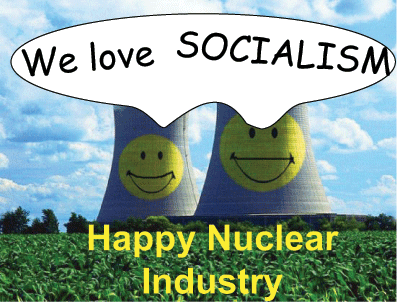
“………Nuclear construction
Various states have included construction work in the categories of essential work when issuing directives to keep people at home.
With pandemic plans in place, Southern Company construction is continuing on the Vogtle units in Georgia. Vogtle construction has not encountered major changes from the novel coronavirus, CEO Tom Fanning told Bloomberg.
Southern announced a non-manual worker for the construction of Vogtle units 3 and 4 was being tested for coronavirus two weeks ago.
“I completely understand that [Southern] wants to finish as soon as possible,” Buongiorno said, given the delays and cost overruns of the construction. (Professor Jacopo Buongiorno, director of the Massachusetts Institute of Technology’s Center for Advanced Nuclear Energy Systems.)…https://www.utilitydive.com/news/coronavirus-could-disrupt-normal-refueling-practices-for-nuclear-facilities/574920/
Government under pressure to suspend non-essential construction work (such as building nuclear plants)
“The judgment we have made is that in work, in many instances, the 2m rule can be applied,” he said.
However critics say public health should be prioritised over the economy during the coronavirus outbreak.
Former Tory cabinet minister Iain Duncan Smith joined those calling for a temporary suspension of work. He told the BBC: “I think the balance is where we should delete some of those construction workers from going to work and focus only on the emergency requirements.”
The confusion over who is able to work came after Prime Minister Boris Johnson’s announced a nationwide lockdown in a televised address on Monday night.
The PM said people should only leave their homes to shop for basic goods, fulfil medical needs, to exercise and to travel to work when “absolutely necessary”. However the types of work considered necessary has not yet been made clear….. https://www.cityam.com/government-under-pressure-to-suspend-non-essential-construction-work/
Olympic Torch Relay stopped – another blow to the nuclear propaganda about “Fukushima recovery”

Now Postponed, The Olympic Torch Relay Was To Bring Hope To Ravaged Fukushima, March 26, 2020, Heard on All Things Considered“………….This region was devastated nine years ago when the largest earthquake in Japan’s recorded history triggered a massive tsunami. The giant wave washed away nearly 20,000 people, including thousands in Fukushima. It also hit the Fukushima Daiichi Nuclear Power Station right down the coast, causing a partial meltdown that sent plumes of radioactive particles for miles. The area has been trying to rebuild ever since.
Ueno, a 46-year-old wheat farmer, was supposed to run the torch on Thursday through his hometown of Minamisoma. His current home, down the street from the empty field he’s standing in, is one of the only buildings around. His old houseused to be here too…..
This part of Fukushima, in the area around the Daiichi power plant, is still suffering from high levels of radiation. Only a tiny fraction of the population has returned, most over the age of 60, and many streets still sit empty and deserted, left exactly as they were nine years ago tumbled by the earthquake and rotting. It’s not the same Fukushima that it was before the disaster. … https://www.npr.org/2020/03/26/821402324/now-postponed-the-olympic-torch-relay-was-to-bring-hope-to-ravaged-fukushima
Coronavirus brings a big problem for nuclear reactors’ scheduled outages: the industry demands special exemptions
Covid 19 threatens outages scheduled at 97% of U.S. nuclear plants in 2020
by Sonal Patel, powermag.com, 27 Mar 20
Challenged by the COVID-19 pandemic, the U.S. nuclear industry has asked the Trump administration to ensure nuclear workers, suppliers, and vendors will have access to nuclear plants and personal protective equipment (PPE) during the 2020 spring and fall refueling outage seasons and beyond. All but two of the nation’s nuclear plants had scheduled planned outages this year, work that the generators consider crucial to keep the lights on.
In a March 20 letter to Energy Secretary Dan Brouillette, Nuclear Energy Institute (NEI) President and CEO Maria Korsnick noted nuclear reactors have a “unique requirement” to load a fresh batch of fuel once every 18 to 24 months. The event necessitates a shut down for two to four weeks during which intense work occurs, including critical maintenance.
Each plant typically brings in several hundred specialized workers for this work over a typical period of 30-60 days, which includes activities in advance of and following the outage. These workers typically stay in hotels or board with local families, and eat in restaurants,” Korsnick wrote. In the course of performing outages and in routine operations, nuclear plant workers also use PPE and supplies for radiological protection. As the COVID-19 pandemic intensifies, the industry will also require medical PPE and supplies to minimize its spread, she said. Continue reading
Trump missed his chance to lead the world on tackling coronavirus
The president and his far-right allies see the pandemic as one more chance to again rip apart the notion that countries do better by cooperating.
While we have to self-isolate from the virus, we don’t have to isolate ourselves from the world. Trump could be uniting our strengths. We all could.


Trump Could Have Led the World Against the Coronavirus We have to isolate ourselves from the virus. He doesn’t have to isolate us from the world. 25 Mar 20, https://www.defenseone.com/ideas/2020/03/trump-could-have-led-world-against-coronavirus/164086/?oref=d-topstory
Trump can’t help himself. He is missing his chance to live out “America First.”
In January or February, he could have convened world leaders, determined a plan to stop the coronavirus, and shown what American power can really do with all of the pomp and circumstance of summit stages and Fox News backdrops. He could have made the world grateful for his leadership.
Even now, as the world stays home FaceTiming with family, Trump could convene a video conference of world leaders, sitting in Washington’s big chair in the middle of the virtual table, directing help, aid, relief, supplies, NATO militaries and the narrative. He could have even liberals and TV pundits praising him as the global leader he believes himself to be.
The coronavirus pandemic is more than a 9/11 moment. It’s a Reagan-second-term-chance-to-beat-the-Soviets moment. It’s a political opening to soften up, wake up, and bring the world together. It’s an opportunity to diminish Beijing and Moscow and marginalize violent extremists.
The United States should be leading the world through this pandemic. Americans should be leading the world. Trump should be leading the world.
He could have thought big, but instead he plays small. On Tuesday night, the president of the United States was up late retweeting posts from the partisan and anti-Semitic information warfare site Breitbart, amplifying their praise and thumping liberal snowflakes and the corporate media.
Yesterday, the number of Americans who have died from the coronavirus rose by 160. The number of Americans who tested positive for the virus rose by 10,000. The number of infected reached 26,000 in New York state. The number worldwide is nearly 500,000. Continue reading
UK and Fench govts consider nuclear construction as “essential”, so can remain open
The Government has deemed the jobs at Hinkley Point C nuclear power station near Bridgwater to be essential and French energy giant EDF says that it is “a project of critical national importance”.
The number of construction workers will now be reduced by more than half to around 2,000 to mitigate the coronavirus risk and bosses have pledged to reduce staffing levels further as the project progresses.
But critics and opponents have rounded on the decision to carry on and have called on the Government to halt proceedings.
This is putting lives at risk right across Somerset and the whole of the country. Why hasn’t the Prime Minister ordered them to stay at home – is he just pandering to the nuclear lobby? While the rest of the country is in lockdown, EDF fails to acknowledge that if someone has developed a fever, they have been incubating and spreading the virus for days beforehand.
Workers have been photographed close to each other in the canteen and sitting shoulder to shoulder on the buses which transport them to and from the site.
This is at odds with Government advice to socially distance.
They need to put something else in place. They need to consider their workers. If there is an outbreak at Hinkley Point then it would be uncontrollable. Our NHS system here in the South West is quite small compared to big cities.
American expert Dr Fauci takes coronavirus seriously. Will Trump fire him?

|
Trump Will Feed You to COVID-19 to Keep the Money Happy, William Rivers Pitt, Truthout, March 24, 2020
I have developed a strange affinity for Dr. Anthony S. Fauci. Donald Trump made Fauci — the 36-year director of the National Institute of Allergy and Infectious Diseases who has advised every president over that span — the hood ornament on this administration’s careening coronavirus Cadillac. Fauci is the face of SCIENCE in this fight, and from the sound of things, SCIENCE is about to get fired. According to a number of sources, Trump has grown irritated at Fauci for the ever-increasing frequency of Fauci’s public corrections of Trump. Trump has been using the daily coronavirus briefings as a stand-in for his raucous, fiction-raddled rallies to spray dangerous, history-obscuring gibberish into the wind. He does not like it when Fauci, his own hand-picked face of SCIENCE, clowns him from the same podium. Because of this, Fauci may soon be gone.
The reasons for Fauci’s sudden cascade into disfavor are enough to stagger the imagination. I wrote on Monday about the capitalists jumping on television to demand the huddled masses get back to work. As it turns out, one of the larger cats in that particular tree — former Goldman Sachs CEO Lloyd Blankfein — started yelling about this very thing before I’d written a sentence. That’s not the worst part, however. This is the worst part, as reported by Gabriel Sherman of Vanity Fair:
|
|
Moscow preparing highway though nuclear waste site, despite protests
|
Moscow starts work on highway through nuclear waste site https://www.dw.com/en/moscow-starts-work-on-highway-through-nuclear-waste-site/a-52864335Preparation for the construction of a controversial road in the Russian capital has kicked off. Activists say it could send radioactive dust into the air and river. But the authorities are pushing on with the project. Residents film on their mobile phones as an excavator broke ground to prepare the construction site. They film through the shoulders of a row of police officers, pointing out that no one is wearing protective clothing for work on a nuclear waste site. “These comrades are protecting us from the radiation,” says one woman sarcastically about the officers. “Just wonderful.”
Behind the police line is a factory that produces military equipment. The onetime Polymetals factory used to extract thorium and uranium from ore and dump radioactive waste here in the 1950s and 1960s, before this spot became part of the territory of the capital. The site stretches along the sloping banks of the Moskva River, with the popular Kolomenskoe park on one side and residential apartment blocks on the other. Since January, Sergey Vlasov has been one of around 50 local activists standing guard at the site around the clock to prevent construction. “My family has lived here for decades,” he says. “It’s my home and I don’t want to have to move to avoid the threat of nuclear radiation. I don’t want to have to worry about them thoughtlessly digging this all up and radioactive dust being released into the air.” Vlasov is an elected deputy in the municipal council of the Pechatniki district across the river, and he also worries about representing his voters. There have been several protests against the highway, which demonstrators have call the “Road to Death.” Another local resident, Anna, whose windows look out on the nuclear waste dump, says the project is “scary” and complains that the police officers here are essentially “acting as security guards for the bridge building company.” Killing two birds with one stone
According to city authorities, the planned highway and flyover will help with Moscow’s chronic traffic problems by connecting districts and helping free up the city’s main ring road. In an official blog post Moscow’s mayor, Sergey Sobyanin, wrote in January that although the highway is no “panacea,” there are “no logical alternatives” to it. He did, however, admit for the first time that the area is contaminated. Sobyanin insists that construction of the highway will “solve two problems at once” by “radically improving the transportation situation and eliminating a radioactive dump.” On the other hand, the city authorities have repeatedly insisted that the actual highway will not cut through the nuclear waste itself. On its website the city planning department explains that the current work is merely preparation for construction, and that they will only begin work on the flyover after “positive results” confirm that the area is clean. Beneath the surface But the cleanup is difficult. The government agency in charge of it, Radon, has been removing contaminated soil from the site for years to prevent slippages. In an agency publication from 2006, Radon’s chief engineer for Moscow, Alexander Barionov, said that the hilly location of the site would make a full cleanup tough. “One incautious step, and radioactive soil gets into the river.” Rashid Alimov from the Russian branch of Greenpeace thinks authorities should not be digging in the area without having carried out a full ecological evaluation of the site. “We don’t really even know to what extent the company, Radon, understands where exactly the nuclear waste is and how deep it really is in the ground.”
The authorities did check the area ahead of the decision to build. But Greenpeace insists they were too superficial, and the group is taking the city to court to get that evaluation declared invalid. “Our position is that this place should have officially been declared a nuclear waste dump,” Alimov says. Greenpeace carried out its own tests with an external company in October and found that radiation in several samples from the area is “above the permissible norm” and that building work should not be carried out there. Alimov also points out that the government is contradicting itself. He cites a 2017 report from the official Russian consumer watchdog Rospodtrebnadzor on the “sanitary and epidemic” conditions in Moscow, which stated that there were 60,000 tons of nuclear waste by the former Polymetals factory. “That’s a very inconvenient number for Moscow authorities now,” he says. Keeping up the fight But many local residents seem to feel that the work being done ahead of building shows the authorities will most likely go ahead with their plans no matter what. Still, even after the excavators arrived, they were as determined as ever to stand their ground, despite the high police presence at the construction site. Authorities have opened a criminal case against several activists for apparently damaging a radiation monitor on the site. And there were several standoffs between protesters and police last week. On Thursday, over 60 activists were briefly detained. Vlasov says that since the arrests the residents have been regrouping. They may have to call off their shift duty at the construction site, he says. But just like Greenpeace, they are hoping to take authorities to court over the highway plans. “Of course we will keep fighting,” he says. “We plan to take this case to court — even though no one really believes we can win.”
|
|
USA nuclear industry exploits coronavirus, seeking tax-payer funds
 Nuclear Industry Effort to Exploit Coronavirus Crisis for Backdoor Bailout Decried as ‘Disaster Capitalism at its Worst’ https://www.commondreams.org/news/2020/03/23/nuclear-industry-effort-exploit-coronavirus-crisis-backdoor-bailout-decried-disaster Nuclear Industry Effort to Exploit Coronavirus Crisis for Backdoor Bailout Decried as ‘Disaster Capitalism at its Worst’ https://www.commondreams.org/news/2020/03/23/nuclear-industry-effort-exploit-coronavirus-crisis-backdoor-bailout-decried-disaster
“The nuclear industry begged for a bailout last fall and is now using coronavirus to try and brazenly grab more cash,” warned Friends of the Earth. by Andrea Germanos, staff writer, Jon Queally, staff writer According to E&E News, which focuses on the energy industry, the request came in a letter sent to congressional leaders and White House officials on Friday by Nuclear Energy Institute president and CEO Maria Korsnick. In addition to other forms of aid—including sick leave for employees and “prioritized access” to testing and masks—the letter requested taxpayer-funded grants in the form of broad tax credits and waivers for existing regulatory fees. “Our member companies are anticipating—or are already experiencing—severe financial strain as product orders are delayed or canceled, as industrial electricity demand falls, and as workforce availability becomes increasingly constrained,” Krosnick wrote to in a letter sent to lawmakers, Treasury Sectary Steven Mnuchin, and Larry Kudlow, director of the National Economic Council. In reaction, Friends of the Earth senior policy analyst Lukas Ross called the request a bald effort to exploit the current outbreak and economic downturn to obtain the same kind of financial bailout it has repeatedly sought from the U.S. government in recent years. “Demanding a $23 billion gift from taxpayers during an unprecedented public health crisis sets a new low bar,” said Lukas Ross, senior policy analyst with Friends of the Earth. “The nuclear industry begged for a bailout last fall and is now using coronavirus to try and brazenly grab more cash.” The industry proposal, added Ross, “would hurt ratepayers and the climate at a time when immediate need for people must be the first priority. The nuclear lobby should be ashamed. This is disaster capitalism at its worst.” |
|
“Balance” a dangerous practice – journalists presenting as equal -Trump’s and scientists’ opinion on coronavirus science
 Presenting Trump and Science as Equals Isn’t Balanced, It’s Dangerous, FAIR, NEIL DEMAUSE, 23 Mar 20, With more than 32,000 COVID-19 infections and 400 deaths in the US to date, and Surgeon General Jerome Adams predicting that “this week, it’s going to get bad,” as hospitals prepare for the eventuality of rationing treatment for patients least likely to survive, the president of the United States hit his caps lock key and typed out a tweet:
America’s economic plan for Covid19 directs money to big corporations
Democrats are balking at the Senate GOP’s version of the bill because it is far too top-heavy with financial assistance to corporations and lacks sufficient assistance for working families.

The Virus of Capitalism Has Infected the COVID-19 Fight, William Rivers Pitt, Truthout, 23 Mar 20, …….. Under vastly different circumstances, perhaps it would have been possible to argue for a different path of action than dramatic physical-distancing measures, following from the idea that to develop a herd immunity to COVID-19, a certain number of people have to contract it and recover (assuming we are even capable of developing an immunity, which is not yet confirmed). To even countenance this idea, however, we would need a robust and fully functional health care system to aid in the recovery process.
Why? Money.
And then there is the currently stalled $1.8 trillion COVID-19 relief bill, which hit the reef in Congress over the weekend. Democrats are balking at the Senate GOP’s version of the bill because it is far too top-heavy with financial assistance to corporations and lacks sufficient assistance for working families.
Natch. These fellows never, ever, ever miss an opportunity to loot the till.
And therein lies the rub. The priority of the people (for the most part) is to stay safe, to get well if they fall ill, and to do what must be done to eventually return to some semblance of a normal life. The priority of the capitalists is to get the money machine going again, to take full advantage of the crisis in the name of profit, and to defend their well-staked financial turf from any reforms that may be proposed in the aftermath.
U.S.-style capitalism is also a virus, and it has infected every aspect of this situation. Worker safety, insurance coverage and costs, medical preparedness, and vital supplies — even the bill intended to rescue the country from some final financial calamity: All have been perverted and disrupted by the profit motive that never, ever, ever sleeps. https://truthout.org/articles/the-virus-of-capitalism-has-infected-the-covid-19-fight/?eType=EmailBlastContent&eId=e1200502-b139-4a26-8fdd-b7207fc3df68
1 This Month





PLEASE OPPOSE HR 8255 AND S.3639 – bills would accelerate satellite deployment, with no environmental review or safeguards – https://ncstd5li.quorum.us/campaign/169331/
To see nuclear-related stories in greater depth and intensity – go to https://nuclearinformation.wordpress.com
-
Archives
- October 2026 (58)
- September 2026 (339)
- August 2026 (330)
- July 2026 (355)
- June 2026 (287)
- May 2026 (306)
- April 2026 (356)
- March 2026 (251)
- February 2026 (267)
- January 2026 (308)
- December 2025 (358)
- November 2025 (359)
-
Categories
- 1
- 1 NUCLEAR ISSUES
- business and costs
- climate change
- culture and arts
- ENERGY
- environment
- health
- history
- indigenous issues
- Legal
- marketing of nuclear
- media
- opposition to nuclear
- PERSONAL STORIES
- politics
- politics international
- Religion and ethics
- safety
- secrets,lies and civil liberties
- spinbuster
- technology
- Uranium
- wastes
- weapons and war
- Women
- 2 WORLD
- ACTION
- AFRICA
- Atrocities
- AUSTRALIA
- Christina's notes
- Christina's themes
- culture and arts
- Events
- Fuk 2022
- Fuk 2023
- Fukushima 2017
- Fukushima 2018
- fukushima 2019
- Fukushima 2020
- Fukushima 2021
- general
- global warming
- Humour (God we need it)
- Nuclear
- RARE EARTHS
- Reference
- resources – print
- Resources -audiovicual
- Weekly Newsletter
- World
- World Nuclear
- YouTube
-
RSS
Entries RSS
Comments RSS

