Bulgaria delays deadline for Belene nuclear project bids
French energy company EDF’s Framatome and U.S. group General Electric, which had both offered to provide equipment for the 2,000 megawatt project and arrange financing, will also be part of the process.
“At the moment we cannot provide access to the data room for the project. So we would have to extend the deadline for filing bids until we can grant such access,” Energy Minister Temenuzhka Petkova said. “It would mean a delay of a month, month and a half.”
She added that all shortlisted bidders remain interested.
Sofia has revived the Belene project to make use of two nuclear reactors it bought for more than 620 million euros from Rosatom in compensation for scrapping the original project in 2012. It plans to have the project operational in 10 years. ($1 = 0.9351 euros) (Reporting by Tsvetelia Tsolova Editing by David Goodman)
Coronavirus threatens nuclear power plants with staff shortages, possible shutdowns

 Covid-19 could cause staff shortages in the nuclear power industry https://bellona.org/news/nuclear-issues/2020-03-covid-19-could-cause-staff-shortages-in-the-nuclear-power-industry
As the Covid-19 virus grinds world economies to a halt, several national nuclear operators are weighing how to keep sensitive and vulnerable infrastructure chugging along in the face of staff shortages due to the illness. March 20, 2020 by Charles Digges
As the Covid-19 virus grinds world economies to a halt, several national nuclear operators are weighing how to keep sensitive and vulnerable infrastructure chugging along in the face of staff shortages due to the illness.
A number of national contingency plans, if enacted, could mark an unprecedented step by nuclear power providers to keep their highly-skilled workers healthy as governments scramble to minimize the impact of the global pandemic that has infected more than 240,000 people worldwide.
Officials in the United States, for instance, have suggested they might isolate critical technicians at the country’s nuclear power plants and ask them to live onsite to avoid exposure to the virus. Many operators say they have been stockpiling beds, blankets and food to support staff for that purpose.
Should that fail to stem the pandemic’s effect on the nuclear work force, the US Nuclear Regulatory Commission said it would shut down any of America’s 60 nuclear plants if they can’t be appropriately staffed.
Other operators, however, are already seeing the spread of the infection slow things down. In Great Britain, authorities announced they are shutting down a nuclear fuel reprocessing site at Sellafield after 8 percent of its 11,500-strong staff were forced to self-isolate to avoid infection. The move came after an employee tested positive for the coronavirus last week, and will lead to a gradual shutdown of the site’s Magnox facility, which is slated to close permanently later this year.
Sellafield told employees that it would work to “make best use of available people”.
France, the world’s most nuclear dependent nation, announced staff reductions at its Flameville plant in the country’s north. The EDF, France’s national nuclear operator, said that, due to high regional infection rates, it was reducing the staff at the plant from 800 to 100. As early as March 10, EDF reported that three workers at nuclear power plants had tested positive for the virus.
A spokesman for the Flameville plant told Reuters that “we have decided to only keep those in charge of safety and security” working while the coronavirus crisis runs its course.
French grid operator RTE expects nuclear availability to stay 3.6GW below the 2015 to 2019 average and likewise predicts a national drop in nuclear demand.
Taken together, the emergency responses of national nuclear operators are symptoms of a big problem that Covid-19 posed to the nuclear sector, Mycle Schneider and independent energy and nuclear policy analyst told Power Technology Magazine.
“Covid-19 constitutes an unprecedented threat on sensitive strategic infrastructure, above all the power sector,” he said.
“The French case sheds light on a fundamental societal safety and security issue that got little attention in the current Covid-19 crisis. Operation and maintenance of nuclear power plants draw on a small group of highly specialized technicians and engineers.”
Because of that very level of specialization, some in the US nuclear industry are considering simply isolating nuclear plant technicians onsite in a sort of preventative quarantine.
Maria Korsnick, head of the Washington-based Nuclear Energy Institute told the New York Times that plants are “considering measures to isolate a core group to run the plant, stockpiling ready-to-eat meals and disposable tableware, laundry supplies and personal care items.”
The US Department of Homeland Security is responsible for working with nuclear power plant operators to maintain their operations during a national emergency. On Thursday, the department issued guidelines that echoed the ones suggested by Korsnick.
When continuous remote work is not possible, businesses should enlist strategies to reduce the likelihood of spreading the disease,” the DHS said in a memo, according to Power Magazine. “This includes, but is not necessarily limited to, separating staff by off-setting shift hours or days and/or social distancing.”
Roy Palk, president and CEO of New Horizons Consulting, which advises energy companies in the US, told the magazine that, “There are a lot of unanswered questions because this is not a model everyone is used to working with.”
To keep the lights on, he said, utilities and power plant operators might have to consider keeping staff onsite for the long term.
“These operators have a license to operate, they’re highly skilled, highly trained. They have to be certified.” he told the magazine. “These individuals need to be on the job, they need to be healthy. They have a big obligation to the public.”
Reuters contacted a dozen other power providers, all of whom said they were implementing plans to moderate risks to their employees and to ensure continuity of service, but who declined to comment on whether sequestering staff was a possibility.
In New York, Consolidated Edison Inc, which provides power to around 3.3 million customers and gas to about 1.1 million customers in New York City and Westchester County – both of which are under virus lockdowns – said it was taking steps to keep critical employees healthy, including separating some control center personnel to other locations where they can perform their work.
Duke Energy Corp, which provides power to 7.7 million customers in six states and gas to 1.6 million customers in five states, said it instituted additional worker screening measures, such as temperature checks, at generating and other critical facilities.
Puget Sound Energy, which serves more than 1.5 million customers in the Seattle, Washington area – a region hard hit by coronavirus – said all non-essential workers are working remotely, and the utility has limited access to facilities that provide critical operations.
Japanese govt moving to transfer renewable energy funds to Fukushima nuclear clean-up.
 State funds to be juggled to cover cleanup costs from Fukushima http://www.asahi.com/ajw/articles/13225190, THE ASAHI SHIMBUN, March 18, 2020 The government has moved to revise a law to allow for the diversion of budgetary funds set aside for the promotion of renewable energy to help cover ballooning costs related to the storage of radioactive waste produced during cleanup work after the Fukushima nuclear disaster.
Tax revenues appropriated for renewable-related projects are not permitted to be used for nuclear power programs under the special account law, which governs budgets allocated for specific purposes.
Earlier this month, however, the government submitted a bill to the Diet to revise the law to make the diversion of funds legal. It plans to enact the legislation during the current Diet session and put the revised law into force in April 2021.
This would be the first time for a revenue source earmarked for a specific expenditure to be diverted to a different purpose.
But the revision bill is likely to draw criticism from the public as it concerns the divisive issue of nuclear power and raises further questions about the government’ longstanding insistence that nuclear power is an inexpensive energy source.
Energy-related expenditures are booked under the government’s special account, separately from the general account.
These expenditures are grouped into more categories, such as one for nuclear energy and another for renewable energy sources.
About 300 billion yen ($2.78 billion) a year is allocated for programs associated with nuclear energy, including grants to local governments hosting nuclear power plants, while 800 billion yen or so is set aside to promote renewable energy, energy saving efforts and ensuring a stable energy supply.
Revenues for nuclear energy-related programs are collected under the promotion of power resources development tax, which are levied on electricity rates. Those for renewables are collected from businesses importing petroleum and coal under the petroleum and coal tax.
They are project-specific tax revenues, meaning they cannot be used for other purposes. The amount of those budgets remains at similar levels each year.
The government’s move was prompted by runaway costs to process a vast volume of contaminated waste due to the 2011 disaster at the Fukushima No. 1 nuclear plant and maintain them in interim storage facilities in Fukushima Prefecture.
The government decided to shoulder some of the costs to help Tokyo Electric Power Co, operator of the stricken plant, and gained Cabinet approval to do so in December 2013.
Since fiscal 2014, it has set aside about 35 billion yen annually for the interim storage facilities. The funds come from revenues earmarked for nuclear energy-related projects in the special account.
But expenditures concerning the storage facilities are running a lot higher than initially envisaged.
An estimate released in late 2016 by the Ministry of Trade, Economy and Industry showed that the project will eventually cost 1.6 trillion yen, compared with an initial projection of 1.1 trillion yen.
The government has allocated an additional 12 billion yen annually for the storage facility project since fiscal 2017.
Government officials say the price tag could further increase in coming years, likely leaving the government with scant financial resources to cover the project.
The revision bill has a clause stipulating that funds diverted to nuclear energy-related programs must eventually be returned to renewable energy project-specific tax revenues.
But it remains unclear if the clause will ease objections from opponents of nuclear energy, even if the fund diversion is a temporary measure.
Yoshikazu Miki, former president of Aoyama Gakuin University and a specialist of the tax system in Japan, called on the government to justify its proposed fund diversion by providing a full explanation of the issue.
“A special account budget has rarely been scrutinized during Diet debate, unlike the general account,” Miki said. “The revision bill requires special attention as it is related to a nuclear power plant. Some members of the public may raise objections to the revision. The government needs to explain the matter to taxpayers to defend its need to act in this way.”
(This article was written by Tsuneo Sasaki and Hiroki Ito.)
The Blackwater Against New Nuclear Group (BANNG) protests the lack of full information on nuclear plans
BANNG 19th March 2020, In the wake of the coronavirus epidemic, Bradwell B has cancelled two-thirds of the exhibitions it had planned as part of its public
consultation on its proposals for a new nuclear power station. But, the
company is still calling for feedback on its plans to be given at any time
up to 27th May 2020.
The Blackwater Against New Nuclear Group (BANNG) has protested that the partial consultation will be only partially informed and
consequently feedback will be unrepresentative of the views of the whole of
the Blackwater communities. Prof. Andy Blowers, Chair of BANNG has written
to the Chinese company developing the proposals urging that the
consultation be terminated altogether. The exhibitions that did take place
were well attended, engaging in robust discussion where citizens were able
to question the plans and make clear in face-to-face exchanges with company
staff their concerns about the imposition of a massive nuclear complex on
the Dengie peninsula. The meetings at Maldon and Bradwell Village were well
attended, informative and occasionally emotional.
https://www.banng.info/news/banng-press-release-19th-march-2020/
EDF reassures UK that during coronavirus epidemic, nuclear operations will continue
|
EDF Energy says plans in place to maintain operations at UK nuclear plants https://uk.finance.yahoo.com/news/edf-energy-says-plans-place-144424093.html?guccounter=1&guce_referrer=aHR0cHM6Ly9uZXdzLmdvb2dsZS5jb20v&guce_referrer_sig=AQAAABq2naeyyQ9ohtcPQW2Ho9e2-qDfI6XSbDwfZUneTxi4VhdT3GWx-zWbqg0MCFS2ArOO-cBI7xrEXbGJxc_Z4MEQGCMb8xZYz9GdF6dLu3azUPUvN5EB4x2GgyUSjwZkX1E93xGECuqxS4HnxqOETaVwytGf9KBTZIzT3QuaBP-R Reuters18 March 2020 By Nina ChestneyLONDON (Reuters) – EDF Energy has plans in place to maintain operations at its nuclear power plants in Britain during the coronavirus outbreak, it told Reuters on Tuesday.
The company operates all 15 nuclear reactors in Britain. Currently eight of those, with a combined capacity of around 4.2 gigawatts – almost half of the country’s total nuclear power capacity – are offline for planned or unplanned outages. “We have comprehensive plans in place to maintain operations at all of our power stations and planned generation is not affected at any of our sites,” said a spokeswoman, declining to specify what the measures were. On Monday, EDF Energy’s parent company EDF <EDF.PA> said it would reduce staff at its Flamanville nuclear power plant in northern France due to coronavirus infections in the Cotentin region. The plant has been offline for maintenance. Britain’s Office for Nuclear Regulation (ONR) said all UK sites have minimum staffing levels, and contingency plans should they fall below these levels, to enable them to stay in control of activities that could affect nuclear safety under all foreseeable circumstances. The ONR, which is in charge of overseeing nuclear safety, said its staff have been directed to work at home. “A number of inspectors will continue to travel to sites where required, but we will endeavour to carry out as much of our business as possible via phone, email and Skype,” it said. “These measures will not have a severe impact on our regulation of the nuclear industry.” (Reporting by Nina Chestney; Editing by Pravin Char and Jan Harvey) |
|
Democrats may not support Trump’s new W93 nuclear weapons program
|
Political Battle Brewing Over New Nuclear Program, National Defense
3/17/2020, By Jon Harper The Trump administration’s proposal to begin work on a new nuclear warhead program to modernize the nation’s aging stockpile is expected to be hotly contested.For fiscal year 2021, President Donald Trump requested $28.9 billion for the Pentagon’s nuclear enterprise. He requested an additional $15.6 billion for efforts by the National Nuclear Security Administration, which manages the stockpile, including $53 million for NNSA work on a new warhead, dubbed the W93.
The Pentagon’s budget blueprint includes $480 million for work on the weapon system over the future years defense program, with $32 million slated for 2021. The W93 is intended for the Navy’s submarine-launched ballistic missiles, according to senior defense officials. There are currently two families of warheads for the sea-based leg of the triad: the W76 and the W88. “Both of these systems are growing old, and so now we must start thinking about a warhead that will replace one of those two when it’s time for those systems to retire,” a senior defense official told reporters during a background briefing. “These things take a long time. There’s a seven-stage process by which we start to develop a warhead.”…….. The Department of Energy has estimated that the program will cost about $10.9 billion in 2019 dollars. Hans Kristensen, director of the Nuclear Information Project at the Federation of American Scientists, said the $10.9 billion estimate is “low-balling it.” A new fuze is also needed, he noted in an email. “New fuzes are expensive.” Other components could increase the price tag. “The W88 uses the Mk5 [reentry body] but the W93 will likely use a new Mk7, which will add to the cost projection,” Kristensen said. “A W93 using Mk7 obviously will be more expensive than the standard life-extension programs.”….. Nuclear modernization programs, especially those related to warheads, have put Republicans and Democrats at loggerheads in the past. “This will be, I predict, the probably most contentious issue in this year’s defense authorization bill about modernizing the stockpile,” House Armed Services Committee Ranking Member Rep. Mac Thornberry, R-Texas, said during recent remarks at the Brookings Institution. “There is a temptation to say, ‘Oh, it’s worked pretty well so far. Why do we need to mess with it and spend all this money?’” Thornberry said the nuclear arsenal needs to be modernized. However, Democrats may not go along with the W93 plans. “Congressional leadership has yet to receive the military requirement or justification for another new nuclear warhead,” a spokesperson for HASC Democrats said in an email. “As recently as July 2019, the Department of Energy projected it would begin work on this warhead in 2023. Work on this new warhead will add billions of dollars to an already strained nuclear modernization plan.”…… https://www.nationaldefensemagazine.org/articles/2020/3/17/political-battle-brewing-over-new-nuclear-program |
|
Coronavirus cluster in the area – construction stalled at France’s Flamanville nuclear reactor
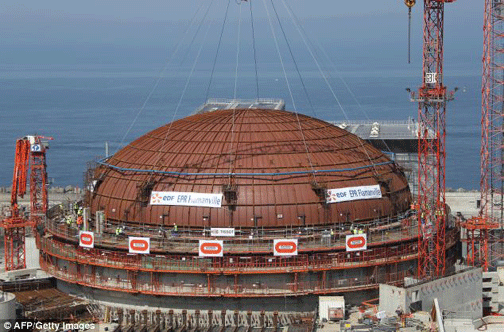
France’s EDF to reduce Flamanville nuclear plant staffing over virus, PARIS, March 16 (Reuters) – EDF will reduce staff to around 100 from 800 at its Flamanville nuclear power plant in northern France due to coronavirus infections in the Cotentin region, a spokesman for the French utility said on Monday.
Only people in charge of safety and security will remain on-site.
The decision was made because of a cluster of COVID-19 infections in region, the spokesman said adding that some staff displayed signs of the virus.
“But today, it is no longer possible to carry out tests. There are too many cases,” he said. “As a preventive measure and because it is no longer possible to carry out tests to confirm cases, we have decided to only keep those in charge of safety and security,” the spokesman said.
While the two reactors have been offline for maintenance since January and September, respectively, major maintenance work was under way.
EDF also said construction work on a long-delayed third reactor on the site would be reduced.
The French government is preparing an order that would put its inhabitants under partial lockdown to combat the coronavirus epidemic, sources aware of the planning said on Sunday, a move that would tighten further restrictions on public life. (Reporting by Bate Felix; writing by Geert De Clercq; editing by Jason Neely and Louise Heavens) AT TOP https://uk.reuters.com/article/health-coronavirus-france-nuclear/update-1-frances-edf-to-reduce-flamanville-nuclear-plant-staffing-over-virus-idUKL8N2B962I
Murky links between the nuclear and coal lobbies in South Africa
 Anatomy of a lobby: How, and why, coal and nuclear interests are converging https://www.news24.com/SouthAfrica/News/anatomy-of-a-lobby-how-and-why-coal-and-nuclear-interests-are-converging-20200315, Sarah Evans
While in South Africa, there is little proof of such an organised, funded campaign being conducted by the coal industry itself, a motley crew of intersecting interests has coalesced around common policy goals: Attempting to stop government’s policy of introducing renewable energy onto the national grid by purchasing power from Independent Power Producers (IPPs), and pushing a narrative that says that Eskom needs to keep buying coal, and that the life of its ageing power stations needs to be extended.
The narrative is also centred around the idea that government must once again pursue a large nuclear building programme, once favoured by former president Jacob Zuma, but since shelved by the Cyril Ramaphosa administration.
Many of the anti-IPP lobbyists are strongly sympathetic to the former president.
The is despite the release of the Integrated Resource Plan last year – the country’s energy roadmap – which seeks to phase out coal, gradually, over the coming decades, increase the use of renewable energy onto the grid, with a reduced role for nuclear energy.
Lobbying efforts by the industry itself have cropped up all over the world as governments are pressured to radically reduce their reliance on burning fossil fuels.
The Guardian reported last year that such a campaign had been launched on a global scale by mining giant Glencore.
But in South Africa, the campaign has taken on the face of a coalition of forces, more than an organised and well-funded propaganda effort, as far as we know.
To the one side of the anti-IPP coalition are some unions, some obscure pro-Zuma lobby groups, coal truckers and disgruntled individuals such as former acting Eskom CEO Matshela Koko.
This campaign has played out in the mainstream media, but seems to have the most traction on social media.
The campaign reached Eskom’s physical doors last week when the EFF entered the fray on the side of the lobbyists. The party took its message to the power utility in the form of a protest, flanked by nuclear energy industry lobbyists like Adil Nchabaleng of pro-Zuma lobby group Transform RSA.
On the other side of the campaign is the coal industry itself, which appears to be in the initial stages of an advocacy campaign.
Transform RSA teamed up with Numsa and the Coal Truckers Association in 2018 in a failed court bid to stop the signing of IPP agreements – a case that Nchabaleng tried to link to a break-in at his home where his housekeeper was tied up and held at gunpoint.
He is also a Member of Parliament, representing the African People’s Convention.
Transform RSA’s politics were made clear when, also in early 2018, it threatened to take legal action against the ANC’s leadership if they moved against former president Jacob Zuma by discussing his recall at a meeting.
On the social media front, the South African Energy Forum (SAEF_ZA) has been actively opposing IPPs, and has advocated for more nuclear energy in South Africa’s energy mix in a “People’s IRP” released on behalf of itself and sister organisations last year.
Another vocal advocate of nuclear energy, and of abandoning the IPP project, is Khandani Msibi, who heads up Numsa’s investment arm.
The SAEF’s members are all APC party members, with the exception of one Ronald Mumyai. His social media accounts show that he is a former EFF member, supporter of Zuma, and homophobe, although the homophobic tweet in question has since been deleted.
Another obscure entity that appears only to exist online is the Anti-Poverty Forum, which, when it is not laying complaints with the Public Protector over IPPs, spends its days campaigning against Zuma’s nemesis, Public Enterprises Minister Pravin Gordhan.
The forum is fronted by ANC Brian Bunting branch member Phapano Phasha, also formerly associated with the Gupta’s failed television station ANN7, who laid a complaint against Public Enterprises Minister Pravin Gordhan with the ANC’s integrity commission last year.
Coal industry advocacy
As for the industry itself, it seems clear that many players feel coal is unfairly under attack, in the face of overwhelming scientific evidence of its contribution to climate change.
At a gathering of coal industry leaders in Cape Town in February, Minerals Council South Africa (MCSA) senior economist Bongani Motsa said there was a need for a “strong coal advocacy group” to lobby for the industry, against what it views as an onslaught from the “renewables lobby”.
Motsa likened the Integrated Resource Plan (IRP) to an abusive spouse that was unkind to the industry, in spite of its willingness to invest in “clean coal” technologies.
Motsa did not provide any details as to what this would look like.
In February 2018, when heated talks over the IRP were ongoing behind closed doors at Nedlac, the MSCA released a document titled “Coal Strategy 2018” in which it outlined plans to counter the narrative around coal.
The plan’s executive summary states: “The Chamber of Mines Coal Leadership Forum, consisting of coal executives, commissioned a report to determine what needs to be done to increase the profile of the coal mining industry in the face of seemingly ineluctable negative public opinion around the use of coal in industrial processes. Negative views on coal and its impact on the environment have resulted in a precipitous decline in the use of coal by the major economies of the world…”
The plan decried the introduction of strict laws to protect the environment that would stifle the coal industry, and implied that the industry’s contribution to the economy and jobs needed to be punted in public.
For now, the links between the pro-coal, anti-IPP actors are murky. But what is clear is that their interests align around policy and political goals, and it remains to be seen whether they carry enough weight to have real impact on either front.
UK’s nuclear regulated asset base (RAB) financing passes all financial risks to electricity customers
 Times 15th March 2020 David Lowry: I read with incredulity the claims of Horizon nuclear chief Duncan Hawthorne that his company, which is really a Japanese shell company with no products, could build nuclear plants offering power at half the currently projected cost from the Hinkley Point C plant being built.
Fukushima Daiichi reactors in Japan on March 11, 2011 — costs $250bn
(£200bn) and rising — suggests Horizon has not learnt the full lessons
of that. The regulated asset base (RAB) financing mechanism Horizon
advocates transfers all financial investment risk to electricity customers
before a single unit is delivered to a home, allowing the foreign nuclear
company to build plants without having to pay attention to keeping costs
under control. This is an extraordinarily one-sided proposal. Surely even
this nuclear-friendly government cannot fall for it.
South Africa’s Eskom nuclear troubles – the outcome of years of corruption
 Eskom’s ailing Koeberg nuclear plant a result of years of corruption https://www.thesouthafrican.com/news/eskom-koeberg-nuclear-plant-corruption/ What Eskom continues to do to this country should be viewed as a human rights violation, says Safcei. by Andrea Chothia, 2020-03-12 Eskom’s ailing Koeberg nuclear plant a result of years of corruption https://www.thesouthafrican.com/news/eskom-koeberg-nuclear-plant-corruption/ What Eskom continues to do to this country should be viewed as a human rights violation, says Safcei. by Andrea Chothia, 2020-03-12
The Southern African Faith Communities’ Environment Institute (Safcei) said that Eskom needs to be more realistic about the country’s precarious energy situation and consider whether pushing the Koeberg Nuclear Power Station past its sell-by date is worth risking an energy catastrophe.
Koeberg’s electricity unit 1 has only been up and running for a matter of weeks after it was closed for essential repairs. But after coming back into service in January, it has only returned to cause more problems. About 930 MW of power has been taken off the national grid because of its breakdown.
|
|
Angst in Nevada over law designating Yucca Mt for a national repository.
 CORTEZ MASTO PRESSES DOE SECRETARY ON PLAN TO SEEK YUCCA ALTERNATIVES Lincoln County Central | Mar 13, 2020 By Humberto Sanchez, The Nevada Independent
Energy Secretary Dan Brouillette sought to reassure Sen. Catherine Cortez Masto on Tuesday that the Department of Energy plans to seek alternatives to storing nuclear waste at Yucca Mountain, but he stopped short of backing an effort to change the law designating the site for a national repository.
At a Senate Energy and Natural Resources Committee hearing Tuesday on the DOE budget, Cortez Masto, who opposes the project, asked Brouillette what DOE would do if Congress provided funds for the Yucca project in the current fiscal year.
‘We will follow the law, obviously, but it’s our intent to look for alternatives to Yucca Mountain,” Brouillette said. “It’s our intent to begin a process, and that’s why we’ve requested $27.5 million in the budget, to do a few things.” ……
Cortez Masto also pressed Brouillette about whether he would support a repeal of the 1987 law that designated the Yucca the spot for the nation to bury its nuclear waste. …..
At a House hearing last week, Brouillette said the administration currently has no plans to change the law even though it would be needed to implement storing waste at temporary sites, which is something DOE has said it could explore……
After seeking funds for the project in his first three budgets, President Donald Trump reversed course in the fiscal 2021 budget blueprint and in a tweet last month said he heard Nevadans on the issue of Yucca. Most Nevada lawmakers and business interest groups oppose the project’s proposed site, which is located about 90 miles from Las Vegas.
Following the release of the budget, Gov. Steve Sisolak, who was in Washington for the annual National Governors Association winter meeting, hand-delivered a letter to the White House calling on Trump to pledge to veto legislation that would advance the Yucca project and “undermine the State’s legal standing or consent requirements.”
The White House has not yet responded according to Sisolak’s office……..
Trump’s decision on Yucca also comes as he looks to win Nevada in his 2020 re-election bid. He lost the state to Hillary Clinton in 2016 by two points.
After the hearing, Murkowski said she welcomed the president’s budget request dropping funds for Yucca because it would allow Congress to focus on advancing legislation to authorize temporary nuclear waste storage rather than expending energy on the Gordian knot that is Yucca.
“We think we have an opportunity to move on our interim waste bill,” Murkowski said. “I always thought that was a path that we needed to pursue as well. And so I think this gives us an opportunity and an opening.”
The energy secretary also said that DOE remains on track for removing the half metric-ton of weapons-grade plutonium the agency secretly shipped to the Nevada National Security Site (NNSS) from the Savannah River site in South Carolina.
In April, Cortez Masto struck a deal with then-Energy Secretary Rick Perry to remove the plutonium beginning in 2021 and getting all of it out by 2026. The DOE disclosed in January 2019 as part of a lawsuit filed by the state to prevent any plutonium shipment—after talks with DOE yielded no resolution—that it had already shipped the plutonium. ……. https://lccentral.com/2020/03/13/cortez-masto-presses-doe-secretary-on-plan-to-seek-yucca-alternatives/
Pentagon’s latest scam for tax-payers’ money; dangerous, costly portable nuclear reactors

Pentagon hands out contracts for PORTABLE nuclear reactors… yet  another gold vein for cash-savvy military? https://www.rt.com/news/482942-us-military-nuclear-microreactor/ 13 Mar, 2020 There’s no shortage of hefty defense deals awarded by the US Department of Defense, but the $40 million contract for micro-reactors definitely stands out, as it hides safety risks and raises doubts over its economic efficiency.
The nuclear device that the DoD strategists want must have the capability to be safely and rapidly transported by road, rail, sea or air (sic!) as well as swiftly set up and shut down. The project split between three companies — BWX Technologies, Westinghouse Government Services and X-energy — calls for a “safe, mobile and advanced nuclear micro-reactor.”
The safety part sounds particularly soothing, but how would it look on the ground? What if those miniature reactors, when moved by land, become targets of high-profile terrorist attacks? And will it prove to be a real alternative (which means cheaper price, of course) to conventional energy sources?
‘The more reactors — the greater the danger’
“Any nuclear reactor attracts terrorists,” Andrey Ozharovsky, nuclear scientist, program expert at the Russian Social Ecological Union, told RT. “It doesn’t matter if it’s located at a nuclear power plant [or inside a portable device]… if you remember, the terrorists planned directing one of the planes at a nuclear plant during 9/11.”
The logic here is simple, he pointed out: “the more reactors are out there — the greater the danger.” If the US builds hundreds, or even dozens of such devices, it’ll be really hard for them to properly defend them all.
Another vital safety issue is the reliability of the nuclear micro-reactors. Interestingly enough, the US military had already experimented with them back in the 1950s and 1960s — and it ended in a tragedy.
Several portable reactors were built and setup in Greenland and Panama, but one of them blew up in 1961, killing three operators. The Army Nuclear Power Program was shut down shortly after that.
“There were eight US micro-reactors and one of them exploded. That’s how safe they are,” Ozharovsky said, adding that the Pentagon’s idea of bringing them back will “likely create more risks instead of solving any problems.”
‘Micro-reactors yet to prove their economic efficiency’
But even if the portable reactors will be shielded from the perils of the battlefield and operate without failure, what’s the Pentagon’s rationale behind bringing the radioactive fuel to their military bases? For decades, the army had been successfully running on gasoline, diesel and fuel oil; when going off-grid, it would switch to generators and high-power accumulators.
“The main problem has nothing related to safety,” Anton Khlopkov, director of Energy and Security Center and member of Russian Security Council’s Scientific Council argued.
Micro-reactors must prove their viability from the economic point of view, since such plants always have alternatives.
It is yet to be proven that micro-reactors won’t be “many times more” expensive than other conventional sources of energy. Electricity produced by such devices should be at least comparable in cost to the one produced by diesel generators, he said.
‘Some kind of a soap bubble’
If micro-reactors are such a questionable solution, why is the Pentagon pushing for their development? The answer isn’t lying on the surface, but it isn’t buried too deep.
“They work against the trends,” Ozharovsky suggested. And those trends are that the world is giving up on the use of civilian nuclear energy due to being too expensive.
Washington may be trying to “support the US the nuclear industry that’s dying out with the use of the military budget; sponsor their research and development — which is an expensive thing.”
Ozharovsky didn’t rule out the possibility that the whole thing “is some kind of a soap bubble.” The research will be made, some prototypes may even be put together, but no actual mini-reactors will be ordered by the Pentagon, he said.
The DoD’s was never shy to spend the US taxpayer dollars: its F-35 program was worth a whopping $1.4 trillion in procurement and operating costs over its lifetime, while Pentagon also acquired such items of prime necessity as… $640 toilet seats and $7,600 coffee makers. The micro-reactors may well become another entry in this wasteful list.
Bradwell BNuclear power plant consultations cancelled amid coronavirus fears
 Nuclear power plant consultations cancelled amid coronavirus fears, East Anglian Daily Times, 13 Mar 20, Public consultations for the proposed Bradwell B power plant in Essex have been cancelled amid growing coronavirus uncertainty.
Project partners EDF and China General Nuclear (CGN) took the decision to cancel the stage one events in the interest of public safety.
In total, 10 of the events will no longer take place, including exhibitions in Brightlingsea, Great Barrow and South Woodham Ferrers.
A spokesman for the project said: ‘The Bradwell B project has been closely monitoring the rapidly changing situation relating to Covid-19 and listening both to advice from Public Health England and to the concerns of the public, our staff and other stakeholders……
Those who wish to have their say on the plans can still do so until May 27, with consultation documents still available online and at various libraries and council offices in the county. ……
So far, 590 people have been diagnosed with the virus – including six in Essex.
Those who wish to obtain hard copies of the documents or have questions about the proposals can contact developers on 01621 451451 or by email here. https://www.eadt.co.uk/news/bradwell-b-events-cancelled-amid-coronavirus-fears-1-6559799
This week’s uranium report- prices fall again, Australia’s “nuclear future” going nowhere
 Uranium Week: The Nuclear Debate https://www.fnarena.com/index.php/2020/03/11/uranium-week-the-nuclear-debate-3/ Mar 11 2020
Moves are afoot once again in Australia to lift bans on both uranium mining and nuclear power. The uranium spot price has slipped once more.
-U3O8 spot prices fall again
-Nuclear debate reopens in Australia
-History suggests it will be no easy road
By Greg Peel This week’s uranium report could simply be left as “nothing happened”. At least nothing of major uranium industry implication. The same issues remain in place, so rather than rake over old ground yet again, as to why uranium prices are in the doldrums, this week we’ll zoom in Australia’s nuclear dilemma.
For the record, industry consultant TradeTech reported ten transactions completed in the uranium spot market last week totalling 1mlbs U3O8 equivalent. As buyers were again largely MIA, prices fell gradually during the week. TradeTech’s weekly spot price indicator has fallen -US50c to US$24.40/lb.
Term price indicators remain at US$28.25/lb (mid) and US$33.00 (long).
How to React?
The nuclear power debate has heated up in Australia once more. Driving fresh debate is the pending shutdown of ageing coal-fired power stations that provide Australia’s base load electricity. The federal government wants to build new coal-fired power stations. This policy already had its critics but as a result of this season’s bushfire disaster, an electoral groundswell is calling for the government to recognise climate change and act accordingly before it’s too late.
Australians are now generally opposed to both coal-fired power and new thermal coal mines. But not all Australians. The country is the world’s largest exporter of coal. The coal mining industry employs thousands, and thousands more are supported indirectly by that industry. The surprise victory for the coal-friendly Coalition at last year’s federal election was in part due to support from Queensland-based electorates, Queensland being Australia’s premier coal producing state.
Nuclear power has long been proposed as an alternative source to meet Australia’s electricity needs, if for no other reason Australia boasts the world’s largest known reserves of uranium. But from Three Mile Island to Chernobyl and Fukushima, successive governments have considered nuclear power to be electoral suicide. The debate is now back on again nevertheless, to lift bans on uranium mining and build nuclear reactors.
Australia is a federation of six sovereign states and two federal territories. Of those six states, four have bans on uranium mining. Tasmania has no known commercial uranium deposits, leaving South Australia as the only state with operating uranium mines. Of those four operating mines, two are currently under care & maintenance pending improved uranium prices, leaving only BHP Group’s ((BHP)) Olympic Dam and the foreign-owned Beverley in operation. A fifth mine – Ranger in the Northern Territory — is currently producing uranium but only from stockpiled ore.
Over a decade ago, the then Queensland premier decided to lift the state’s ban on uranium mining. So swift and brutal was the backlash from the coal lobby, the premier very quickly changed his mind. In the interim, one Western Australia state government lifted the ban on uranium mining, only to have the next government ban it again. Two mines under construction on the basis of the prior policy were exempted.
The Australian federal government previously limited the number of allowable uranium mines, but that policy has since been abandoned. The federal government is currently content to restrict the number of countries Australia can export uranium to.
Last week the New South Wales deputy premier supported a bill in state parliament to overturn a nuclear power ban, after a parliamentary inquiry recommended that the law prohibiting uranium mining and nuclear facilities should be repealed. The bill has the support of the Minerals Council of Australia, and the Australian Workers Union, which supports uranium mining and nuclear power for the jobs both will create. But the AWU’s stance puts it at odds with the Australian Council of Trade Unions, which has long been anti-uranium for what we might call Fukushima reasons.
And support for uranium mining and nuclear power is not split down party lines at either federal or state level. The debate is splitting parties.
A lifting of state uranium mining bans would likely not achieve much in the near term. The marginal cost of new production well exceeds current uranium trading prices. To not build nuclear reactors, on the other hand, when the issue of Australia’s future base load power and electricity prices is paramount, and Australia has abundant uranium resources, is seen by supporters as pure folly.
The debate will rage on, but in the short term at least, likely go nowhere.
They’ve licensed Exelon’s Peach Bottom Nuclear Plant for 80 Years – but it mightn’t last
Exelon’s Peach Bottom Nuclear Plant Licensed for 80 Years—Will It Make It? Power, Mar 12, 2020, by Aaron Larson The U.S. Nuclear Regulatory Commission (NRC) granted a 20-year license extension for Peach Bottom Atomic Power Station Units 2 and 3. The extension authorizes the two reactors—both of which began commercial operation in 1974—to continue operating through 2054…….
Exelon, which operates the largest fleet (21 reactors) of nuclear plants in the U.S., has lobbied strongly for years to obtain government support for nuclear power. The company was successful in getting legislation passed in Illinois and New York that provides financial incentives for some of its plants. Government investigations, however, have put Exelon under a microscope as a result of its lobbying activities.
Exelon received a grand jury subpoena in the second quarter of 2019 from the U.S. Attorney’s Office for the Northern District of Illinois, requiring production of information concerning the company’s lobbying activities in the state. On Oct. 4, 2019, Exelon received a second grand jury subpoena, requiring production of records of any communications with certain individuals and entities. On Oct. 22, 2019, the U.S. Securities and Exchange Commission (SEC) notified Exelon that it had also opened an investigation into the company’s lobbying activities. ……..
Other units have also been retired long before their licenses expired, including Kewaunee, Vermont Yankee, Fort Calhoun, and Pilgrim, so obtaining a license extension is no guarantee of long-term operation for the Peach Bottom facility. ………https://www.powermag.com/exelons-peach-bottom-nuclear-plant-licensed-for-80-years-will-it-make-it/
1 This Month





PLEASE OPPOSE HR 8255 AND S.3639 – bills would accelerate satellite deployment, with no environmental review or safeguards – https://ncstd5li.quorum.us/campaign/169331/
To see nuclear-related stories in greater depth and intensity – go to https://nuclearinformation.wordpress.com
-
Archives
- October 2026 (58)
- September 2026 (339)
- August 2026 (330)
- July 2026 (355)
- June 2026 (287)
- May 2026 (306)
- April 2026 (356)
- March 2026 (251)
- February 2026 (267)
- January 2026 (308)
- December 2025 (358)
- November 2025 (359)
-
Categories
- 1
- 1 NUCLEAR ISSUES
- business and costs
- climate change
- culture and arts
- ENERGY
- environment
- health
- history
- indigenous issues
- Legal
- marketing of nuclear
- media
- opposition to nuclear
- PERSONAL STORIES
- politics
- politics international
- Religion and ethics
- safety
- secrets,lies and civil liberties
- spinbuster
- technology
- Uranium
- wastes
- weapons and war
- Women
- 2 WORLD
- ACTION
- AFRICA
- Atrocities
- AUSTRALIA
- Christina's notes
- Christina's themes
- culture and arts
- Events
- Fuk 2022
- Fuk 2023
- Fukushima 2017
- Fukushima 2018
- fukushima 2019
- Fukushima 2020
- Fukushima 2021
- general
- global warming
- Humour (God we need it)
- Nuclear
- RARE EARTHS
- Reference
- resources – print
- Resources -audiovicual
- Weekly Newsletter
- World
- World Nuclear
- YouTube
-
RSS
Entries RSS
Comments RSS

