Purpose of US International Development Finance Corporation perverted in the interests of the nuclear industry
|
Trump’s new foreign investment agency: Itching to build on nuclear quicksand. Bulletin of the Atomic Scientists, By Victor Gilinsky, Henry Sokolski, July 17, 2020 In 2018 a Republican Congress, with strong Democratic support, created the US International Development Finance Corporation to “provide the developing world with financially sound alternatives to unsustainable and irresponsible state-directed initiatives.” That’s government-speak for competing with China’s Belt and Road initiative. It didn’t take very long, however, for the new agency to fall in line with an irresponsible state-directed initiative of its own—the Trump administration’s all-out effort to encourage nuclear exports.
In June, the agency, whose own rules prohibit financing nuclear exports, proposed to fling the doors open to such financing, without limiting its scope to the agency’s mission to help the economies of the lower income countries with modest, environmentally sensible projects. There is no hint on what sorts of conditions would apply on funding nuclear reactors. Would the country have to have a system of safety regulation? Would it have to meet security requirements? Would it have to allow international inspections? It isn’t even clear whether the agency’s support would be limited to US reactor exports, and therefore subject to the requirements of the Atomic Energy Act’s Section 123 or whether they could also cover equipment purchases from other suppliers. Such details determine whether a federal bureaucracy is constrained to act responsibly, or whether it is free to cater to the latest whims of the White House. To justify its proposed action, the agency relies on the administration’s ritual talking points—that nuclear exports will “offer an alternative to the financing of authoritarian regimes while advancing US nonproliferation safeguards and supporting US nuclear competitiveness.” These pearls are straight out of the administration’s April 2020 interagency report “Restoring America’s Competitive Nuclear Energy Advantage.” So are the agency’s assurances that advanced “small modular reactors” and “microreactors” will have significantly lower costs than existing nuclear power plants and “could help deliver a zero-emission, reliable, and secure power source to developing countries, promoting economic growth and affordable energy access in underserved communities.” This is all pie in the sky: None of these plants have been built, and their characteristics and economics are speculative. But if the proposed change is restricted to small reactors or microreactors, the nuclear industry’s influential registered lobby, the Nuclear Energy Institute, hasn’t heard about it. The Institute’s president crowed her unqualified approval: “The US International Development Finance Corporation’s proposed policy change to lift its legacy prohibition on nuclear energy projects supports the development of clean, reliable energy worldwide, helps countries reach their energy development goals, buttresses US national security, and can help level the playing field for US firms.” Nor does her response suggest any awareness that the agency’s financing of nuclear projects will be limited to countries in the lower portion of the economic scale……, This whole affair is the latest expression of the administration’s organizing principle for nuclear energy policy—finding ways to loosen rules and to create subsidies to propel nuclear exports. This is supposed to energize the much-diminished domestic nuclear manufacturing sector. Since the whole policy doesn’t make any economic sense, the ultimate argument is based on the dogma: Come what may, we have to head off sales by our adversaries China and Russia……. The agency does have on its books good environmental, social, and economic criteria for evaluating projects. But will they be applied as intended?,………..https://thebulletin.org/2020/07/trumps-new-foreign-investment-agency-itching-to-build-on-nuclear-quicksand/# |
|
Slow progress of Michigan bill opposing high-level nuclear waste dump
Michigan bill opposing high-level nuclear waste dump languishes in Senate committee Iosco County News Herald, By Jim Bloch For MediaNews Group,Jul 16, 2020
-
- The Michigan House of Representative passed a concurrent resolution on Feb. 5 opposing the proposed high-level nuclear waste dump near the shores of Lake Huron in the municipality of South Bruce, Ontario, Canada.
The resolution was sponsored by Gary Howell, the republican representative of the 82nd District, which comprises Lapeer County.
It urges “the United States Congress to take every legal action possible to prevent the construction of any underground high-level nuclear waste repository in the Great Lakes basin,” and urges “the Canadian government to prohibit a high-level nuclear waste repository anywhere in the Great Lakes basin.”
One of the cosponsors of the resolution was Gary Eisen, the St. Clair Township Republican who represents the 81st District, which swoops around the southern half of St. Clair County and includes Marysville, St. Clair, Marine City and Algonac, as well as surrounding townships.
“It’s sitting in the Senate now in Dan Lauwers’s committee,” Eisen said in June, noting that the onset of the COVID-19 pandemic put the brakes on a lot of the legislature’s work. “Everything’s ten times harder now.”
The resolution is in the Committee on Energy and Technology, which Lauwers chairs. His 25th Senate District includes St. Clair County………..
“Placing a deep geological repository near the Great Lakes is a high-risk venture with the potential of causing irreparable harm to millions of lives,” said the resolution. “Underground waste repositories have leaked in the past, costing billions of dollars to repair. Germany, for instance, is spending billions of dollars to dig up low- and intermediate-level radioactive waste that was stored in a salt mine due to leakage and other environmental concerns. In 2014, chemical reactions in a steel barrel full of radioactive waste caused an explosion and fire at a low- and intermediate-level underground waste site in Carlsbad, New Mexico causing a cloud of radioactivity to be released at the surface. Not only did this put the health and safety of the public at risk, it cost taxpayers $2 billion to clean up and repair. As demonstrated, low- and intermediate-level facilities have failed, and this high-level nuclear proposal provides no guarantee, whatsoever, to keep radioactive waste from our environment.”
If the Michigan Senate approves the resolution, it will be sent to Prime Minister of Canada, the Minister of Environment and Climate Change, the Minister of Foreign Affairs, the Premier of Ontario, the Canadian Nuclear Safety Commission, the Canadian Environmental Assessment Agency, the Speaker of the U.S. House, the President of the U.S. Senate, the members of the Michigan congressional delegation, and the U.S. Nuclear Regulatory Commission.
On Jan. 17, Michigan’s U.S. Sens. Debbie Stabenow and Gary Peters, along with Congressman Dan Kildee and Congressman John Moolenaar, introduced a bipartisan resolution opposing Canada’s placement of a permanent nuclear waste storage in South Bruce.
If the Michigan Senate approves the resolution, it will be sent to Prime Minister of Canada, the Minister of Environment and Climate Change, the Minister of Foreign Affairs, the Premier of Ontario, the Canadian Nuclear Safety Commission, the Canadian Environmental Assessment Agency, the Speaker of the U.S. House, the President of the U.S. Senate, the members of the Michigan congressional delegation, and the U.S. Nuclear Regulatory Commission.
On Jan. 17, Michigan’s U.S. Sens. Debbie Stabenow and Gary Peters, along with Congressman Dan Kildee and Congressman John Moolenaar, introduced a bipartisan resolution opposing Canada’s placement of a permanent nuclear waste storage in South Bruce. http://www.iosconews.com/news/state/article_c5a6ae58-996b-5665-b599-cfa8fde7c6ae.html
Electricite de France (EDF) ‘s new nuclear reactors not financially viable

French auditor calls for financing guarantee for future EPR projects, WNN, 15 July 2020, EDF must ensure the financing and profitability of its proposed EPR2 reactor before starting construction of any plants based on the design in France, the country’s state audit office has said. The EPR2 is a simplified version of the EPR design, construction of which has been hit by delays and cost increases in France and Finland……..
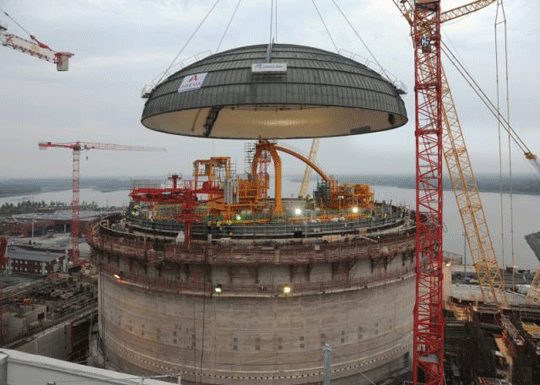 Construction of the Olkiluoto 3 EPR began in 2005, with completion of the reactor originally scheduled for 2009. However, with various delays and setbacks, fuel loading is now planned for later this year. The loading of fuel into the Flamanville EPR in France, construction of which began in December 2007, is now scheduled for the end of 2022. Two EPR units are also under construction at the Hinkley Point C project in Somerset, UK.
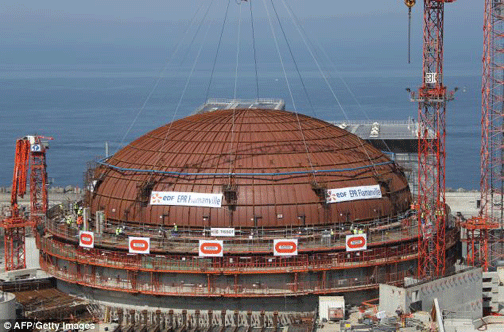 launch of the construction sites of the first two EPRs, in Finland and in Flamanville. This insufficient preparation led to underestimating the difficulties and the construction costs, and to overestimating the capacity of the French nuclear sector to face it, at the cost of financial risks for the companies of the sector.”
The audit office added, “The construction of new EPRs in France cannot in any event be envisaged without clear prior answers on the methods of financing and the role of nuclear power production in the electricity mix of tomorrow.”
The report says EDF is no longer in a position to finance the construction of new reactors on its own. The utility, it says, is studying means of financing that either makes the consumer – as in the case of the UK’s contract-for-difference for construction of Hinkley Point C – or the taxpayer bear the costs of construction.
“The financial challenges are major, with the cost of construction of three pairs of EPR2 reactors being estimated at EUR46 billion (2018 value),” the Cour des Comptes notes. “Taking into account their duration of construction, production and dismantling, the decision to build or not to build future EPRs will have consequences until the 22nd Century. …. https://world-nuclear-news.org/Articles/French-auditor-calls-for-financing-guarantee-for-f
Deeply flawed public consultation on Bradwell nuclear power plan: it should be suspended
 SPRU 9th July 2020, A public consultation on plans for the UK’s newest nuclear power station
is deeply flawed and should be suspended, according to two leading energy
policy experts. Professor Andrew Stirling and Dr Philip Johnstone say the
consultation into Bradwell B is invalid because the UK government has
repeatedly failed to make the case for nuclear in the face of its
ever-rising costs, slow lead times and poor value-for-money comparison to
renewables.
Unit (SPRU) at the University of Sussex Business School have criticised the
restrictive nature of the consultation’s scope which they argue excludes
crucial underlying questions over the rationale for building more nuclear
power stations in the UK. Prof Stirling and Dr Johnstone say the
consultation should resume only when the government publish a long-promised
rigorous justification for nuclear power compared to other low carbon
energy sources – something they argue it has failed to do for the past 17
years.
Maldon District Council Planning Committee does an about turn, now rejects Bradwell nuclear power project
BANNG 9th July 2020, Maldon District Council Planning Committee’s comprehensive rejection
today of the Chinese state-backed nuclear developer’s (CGN) application
for permission to undertake ground investigations came like a bolt from the
blue.
For so long a firm supporter of a new nuclear power station at
Bradwell, Maldon has done a complete volte-face.
Prof. Andy Blowers, Chair of the Blackwater Against New Nuclear Group (BANNG) commented: ‘From the
moment CGN revealed its plans just before lockdown it became clear the
Bradwell B project would be dead in the water. The massive scale of the
project which would totally overwhelm the Blackwater area and the Dengie
peninula has proved too much to stomach, even for those who were seduced by
the promise of thousands of jobs. The price, in terms of loss of
environment and wellbeing, was simply too high.’
But the project is also
being threatened by the political fallout in relations with China. Chinese
ambitions to build a new nuclear power station at Bradwell do not come
without serious risks to national security and the threat of Chinese
economic dominance over the UK’s sensitive infrastructure.
Democrats split on Trump plan to use development funds for nuclear projects
Democrats split on Trump plan to use development funds for nuclear projects, The Hill, BY REBECCA BEITSCH – 07/13/20 Democratic lawmakers are split over a Trump administration proposal that would allow international development funds to be used for overseas nuclear projects.
The U.S. International Development Finance Corp. (DFC), a fledgling government fund with an aim to alleviate poverty, has proposed lifting the longtime ban it inherited from its predecessor that bars funding for any nuclear projects.
Proponents say nixing the ban, originally conceived to limit the risks of nuclear proliferation, will allow the U.S. to help provide nuclear power to countries that will need more energy to grow their economies.
But opponents of removing the prohibition see a number of issues arising if the ban is lifted, including how to handle spent nuclear fuel, the potential for money to be funneled away from poorer nations and the challenge of dealing with risky and expensive projects.
“International nuclear power projects described by DFC are not a cost-competitive form of zero-carbon energy, remain unproven, will divert funds from higher-priority low-income countries, and are not supported by other development banks,” Sens. Ed Markey (D-Mass.) and Bernie Sanders (I-Vt.) wrote in a letter to the DFC on Friday.
“DFC financing of overseas nuclear reactors may offshore the physical risks associated [with] nuclear power, but they would keep U.S. taxpayers on the hook for the steep financial ones,” the senators added. ………
Sen. Sheldon Whitehouse (D-R.I.) and Rep. Conor Lamb (D-Pa.) along with seven other Democratic lawmakers, called the ban “outdated because of advances in nuclear technology.”…….
Lifting the DFC’s prohibition against financing nuclear power would likely direct more funding toward wealthier countries, instead of to the countries that the DFC was created to help,” Markey and Sanders wrote in their letter, pointing to Eastern Europe and the Middle East……… The DFC should not be dedicating its limited financing to unproven technologies that present both safety and security risks. Pushing experimental research and development is not part of the DFC’s mandate.”…… https://thehill.com/policy/energy-environment/507052-democrats-split-on-trump-plan-to-use-development-funds-for-nuclear
Senators urge US Development Finance Corp not to fund ‘risky’ overseas nuclear projects
US senators urge agency not to allow funding of ‘risky’ nuclear projects, S and P Global Platts, Author Joniel Cha , Editor Keiron Greenhalgh 12 July 20
HIGHLIGHTS
DFC proposes to reverse prior policy
Lawmakers say nuclear not cost competitive
- Washington — Senators Edward Markey, Democrat-Massachusetts, and Bernie Sanders, Independent-Vermont, in a July 10 letter jointly urged US Development Finance Corp., not to “waste American tax dollars on risky international nuclear projects.”
DFC proposed June 10 to revise its policy so that the federal agency could provide financing for nuclear power projects, beginning a 30-day public comment period ending July 10.
The agency was created in 2019 through the consolidation of Overseas Private Investment Corp. and the US Agency for International Development’s Development Credit Authority.
OPIC and USAID both had bans in place prohibiting them from supporting nuclear reactor projects.
The senators said international nuclear power projects “are not a cost-competitive form of zero-carbon energy, remain unproven, will divert funds from higher-priority low-income countries, and are not supported by other development banks.” ……..
- The senators said: “DFC should not be dedicating its limited financing to unproven technologies that present both safety and security risks. Pushing experimental research and development is not part of the DFC’s mandate.”
DFC has a total investment limit of $60 billion……..
The senators requested a response from DFC by July 31.
The American Nuclear Society and advocacy group Clear Path, along with 40 other organizations and individuals, submitted comment letters to DFC July 2 and 9, respectively, supporting the removal of the ban.
DFC did not respond to requests for comment July 9.https://www.spglobal.com/platts/en/market-insights/latest-news/electric-power/071020-us-senators-urge-agency-not-to-allow-funding-of-risky-nuclear-projects
Court reveals that EDF deceived UK about the true financial risks of Hinkley Point nuclear project
EDF boss suppressed report calling Hinkley Point ‘risky’Adam Sage, The Times, 10 July 20, thetimes.co.uk/article/edf-boss-suppressed-report-calling-hinkley-point-risky-gd5vcdhrx
The Times reports that the chief executive of the French company building the UK’s new nuclear reactors won boardroom approval for the project after suppressing an internal review labelling it as risk-laden. In a “highly critical report on the European Pressurised Reactors”, France’s Court of Audit said that the Hinkley Point project in Somerset, led by EDF, represented a “high financial risk” for the French state electricity group, the Times adds.
The court uncovered that the risks had been pointed out in a 2015 review that warned there “were not efficient enough to guarantee that risks would be controlled”. The Times continues: “The court said that Jean-Bernard Lévy, EDF’s executive chairman, had ‘refused to transmit the full report’ to directors or the government, even though the state has an 83.7% stake. They received only a synopsis.” The project received approval from the EDF board in 2016. The court also said that EDF must establish the financing and profitability of nuclear reactors before launching projects, reports Reuters, “dealing a blow to the state-owned utility’s ambitions to build new units”. And Reuters also reports that nuclear power generation at its reactors in France plunged 25.1% in June (compared to 2019) due to the effects of the coronavirus pandemic.
Meanwhile, writing in the Daily Telegraph, Sir Iain Duncan-Smith – MP and former leader of the Conservative Party – argues that the UK should “unwind its dependence on China” for “cheap goods and nuclear power”. He says: “The UK has enormous home grown tidal power potential, yet both tidal and hydrogen seem to have been brushed aside in favour of our growing dependence on large Chinese-run nuclear projects.” He concludes: “From Huawei to hydrogen and Hong Kong, we need to recognise the strategic threat China poses and, together with our allies, decide what we will do to reduce it, otherwise we risk repeating the failed lessons of the past.” And also in the Daily Telegraph, chief city commentator Ben Marlow says that the government should be stimulating manufacturing demand to contain the damage caused by Covid-19 to Rolls Royce – “Britain’s most illustrious engineering company”. He says: “It should start with nuclear where enlisting the expertise of Rolls-Royce in building so-called mini-nukes would help to solve its current geo-political nightmare with China. It would make it easier to ditch China General Nuclear Power Group from the plans to build giant new plants at Sizewell on the Suffolk coast and Bradwell in Essex, or scrap the proposals altogether.” These decisions would “also offer a greener and cheaper alternative to a technology that looks decidedly out of date already, and it would create jobs at a company in desperate need of a leg up – three birds with one stone”.
Britain’s nuclear future in trouble, aging reactors, and not enough money without China’s help
Britain’s Nuclear Future Uncertain as Relations With China Fray, https://business.financialpost.com/pmn/business-pmn/britains-nuclear-future-uncertain-as-relations-with-china-fray Rachel Morison and William Mathis, Bloomberg) 8 July 20, — Britain’s fraying relationship with China has the potential to undo a decade of mixed efforts to keep nuclear power flowing as an aging generation of plants drop out of service.
Once the heart of the U.K.’s energy plans, nuclear has been sidelined by spiraling costs and cheaper renewables. It also finds itself at the center of a diplomatic row spanning trade and human rights that threatens to undermine how the sector is financed.
Relations between China and the U.K. have been strained as the row over Huawei Technologies Co. intensified. When sweeping new national security laws were introduced in Hong Kong Prime Minister Boris Johnson offered its citizens the right to live and work in Britain.
China warned the U.K. Monday it’ll face “consequences” if it chooses to be a “hostile partner” after it emerged the government is planning to phase out the company’s equipment in the U.K.’s 5G telecommunications networks.
For nuclear, the sticking point has become the once-feted relationship with China General Nuclear Power Corp. that’s supposed to deliver the next generation of large nuclear plants. That link has come into sharp focus as the U.K. scrambles to find a funding model for projects that aren’t getting any cheaper.
Without CGN, its money and its technology, the U.K. will be left with a huge funding gap that other investors don’t seem willing to fill. It’ll also leave the country’s nuclear plans in disarray.
Equity funding for nuclear power stations is very difficult for private actors,” said Rob Gross, director of the U.K. Energy Research Centre. The risks are significant, timescales long and individual projects are very large. That’s why governments have always played a role in nuclear power, he said.
CGN’s involvement in Britain’s nuclear industry started in 2016 when a deal was signed with Electricite de France SA to cooperate on a trio of reactors totaling 8.7 gigawatts starting with Hinkley Point C in southwest England.
Nuclear remains important for the British government but it’s becoming increasingly pushed to the margins of energy policy as cheaper wind and solar have taken center stage.
Nuclear power has traditionally been seen as a low-carbon way of supplementing renewables — and as such a key part of the future energy mix envisioned in a net zero world.
Losing nuclear power probably wouldn’t pose a threat to the U.K.’s ability to generate enough power. The gap could be filled by gas, batteries or small modular reactors that can provide back-up to renewable energy and keep the lights on.
The sector is also important to the country as a way of building a large, skilled workforce and creating a supply chain using British companies.
False Starts
In 2017, ministers envisioned building 18 gigawatts of new projects but one by one each project folded, unable to negotiate the financing, leaving just EDF and CGN.
The government’s offer in 2018 to Hitachi to take a third of the equity at the Wylfa nuclear project wasn’t enough to keep the company interested.
How best to finance the technology, which costs billions, has become the latest hump in the road for policymakers. The Hinkley Point reactors – expected to start producing power by 2025 – have been hit by delays and cost overruns.
“The precise funding model for nuclear is up to the government to decide,” an EDF spokesman said.
That project will now cost as much as 22.5 billion pounds ($28.1 billion), taking into account inflation, and the guaranteed price of power is significantly higher than the latest round of offshore wind projects. Sizewell-C, still in the planning process, is slated to cost 20 billion pounds.
EDF is struggling and can’t afford to finance Sizewell on its own. The utility has cut costs and jobs, and pared investments setting out a plan to divest at least 10 billion euros of assets from 2015 to 2020 to help fund its share of Hinkley Point.
* CGN’s investment is in the planning and development stage only for Sizewell whereas it is involved in the construction of Hinkley.
The industry favors paying for the massive projects through a Regulated Asset Base model, a proven success on other infrastructure projects. The previous Conservative government was thought to back the financing option but the idea looks to be losing traction.
“If the Chinese pull out, then Sizewell will still go ahead but EDF will be unable to take on another major project,” Elchin Mammadov, a Bloomberg Intelligence analyst, said “So, Bradwell will be dead or put on hold for another decade.”
The debate has gone quiet following a consultation on the RAB model which closed in October.
RAB likely wouldn’t transfer enough risk from the project’s backers — EDF and CGN. The government would have to offer some kinds of guarantee on the project in order to get private investors to finance it.
One option would be for the government to take either a majority or minority stake in Sizewell C..
I wouldn’t be surprised if what is adopted is either a model with many of the characteristics of RAB, or potentially consideration of a more direct stake. This is about reducing the cost of capital.” said Tom Greatrex, chief executive officer of the Nuclear Industry Association.
But despite the long delays, there’s no indication that the government’s made up its mind how it will proceed.
“We are currently considering responses to inform the best approach to the financing of future nuclear projects,” a spokesperson for the Department for Business, Energy & Industrial Strategy said.
As much as 80% of electricity will be produced from low carbon sources by 2030, according to scenarios modeled by the U.K.’s Committee on Climate Change.
“With all but one of the nuclear fleet set to retire by 2030, and uncertainty over the scale of the new build program, it is likely that more electricity from renewable sources will be needed,” said Jonathan Marshall, head of analysis at the Energy and Climate Intelligence Unit.
U.S. Rep. Ben McAdams announces opposition to nuclear testing, hopes to extend compensation for downwinders
|
McAdams announces opposition to nuclear testing, hopes to extend compensation for downwinders https://www.stgeorgeutah.com/news/archive/2020/07/07/rmw-mcadams-announces-opposition-to-nuclear-testing-hopes-to-extend-compensation-for-downwinders/#.XwZb3CgzbIU
by Ryne Williams, July 7, 2020 ST. GEORGE —
U.S. Rep. Ben McAdams, D-Utah, announced Monday that he would be sponsoring an extension of the Radiation Exposure Control Act as well as opposing the possibility of more explosive nuclear weapons testing in the United States. McAdams said that next year’s House spending bill covering the Energy Department’s National Nuclear Security Administration would prohibit the use of money to prepare or conduct any nuclear testing. The RECA act was originally passed in 1990 and compensated people who are known as “downwinders,” those who worked on the sites of the nuclear testing and the Uranium Miners, Millers and Ore Transporters. The act covered nine counties in Utah as well as areas of Arizona and Nevada, where the nuclear testing took place. “In Utah, we’ve seen increases in certain types of cancers — myeloma, thyroid cancer, breast cancer — much of that is due to some of this nuclear weapons testing that happened in Nevada,” McAdams said in a Facebook live video. “RECA, the compensation act, is set to expire in 2022. The impacts are still here, so this would extend it through 2045, so those people who are impacted can receive compensation. Nothing is going to replace the loss of life or a cancer diagnosis, but at the very least, for the harm caused by our government, they should receive some compensation to help pay their medical bills, lost of income and other things.” A press release from McAdams mentioned the Trump Administration’s recent announcement of plans to resume nuclear testing. Dickson also spoke out about the issue with the congressman at Monday’s press conference. “People are still getting sick, their cancers are coming back,” Dickson said. “We are living with health consequences that haven’t gone away. The way I view it is we were all deemed expendable. They killed their own in the name of national security, and it’s so important for us to tell our stories and have these opportunities, or they die with us.” |
|
EU lawmakers ban nuclear from green transition fund, leave loophole for gas
EU lawmakers ban nuclear from green transition fund, leave loophole for gas https://www.reuters.com/article/us-climate-change-eu-transitionfund/eu-lawmakers-ban-nuclear-from-green-transition-fund-leave-loophole-for-gas-idUSKBN2472HN
By Kate Abnett and Marine Strauss, 8 July 20,
BRUSSELS (Reuters) – European Union leaders are split over which fuels deserve support from the bloc’s flagship green energy fund, after lawmakers on Monday called for rules that could allow the money to be spent on some fossil gas projects.
The European Commission wants to launch a 40 billion euro ($45 billion) Just Transition Fund using cash from the bloc’s coronavirus recovery fund and its budget for 2021-27, to help carbon-intensive regions launch green industries and retrain workers currently in polluting sectors.
All EU member states agreed last week that the new fund should exclude nuclear and fossil fuels projects, including natural gas projects – a position also shared by the EU Commission.
But on Monday a committee of lawmakers leading talks on the issue in the European Parliament broke ranks. They said that while nuclear energy projects should not be eligible, some fossil gas projects could get just transition funding.
The committee voted in favour of requiring green finance rules to be applied to funding of gas projects – which would effectively exclude such projects. But they also said the EU Commission could make exemptions to this rule and approve some gas projects that don’t meet the green criteria.
The full legislative assembly will vote in September on whether or not to approve the rules. Once the assembly has agreed its position, talks will start with the EU Commission and national governments in the EU Council on the final terms of the funding.
Gas emits roughly 50% less CO2 than coal when burned in power plants, but it is not a “zero-carbon” fuel and is associated with leaks of methane, a potent greenhouse gas.
Can Hunterston nuclear power station restart? Are UK tax-payers to pay billions for new nuclear?
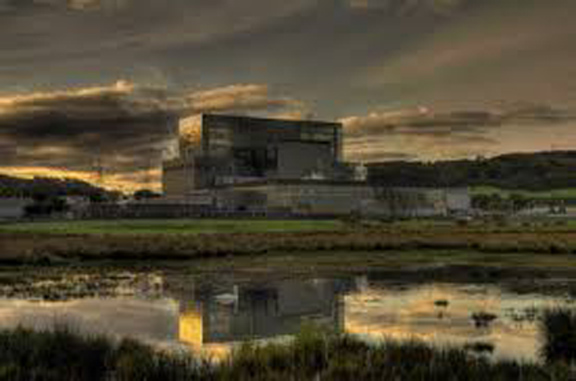
Times 5th July 2020, A high-stakes game of chance is being played at Hunterston B nuclear power
station on the west coast of Scotland. Engineers from the French giant EDF and safety experts from the Office for Nuclear Regulation are trying to work out if and when the plant’s two reactors can be restarted.
Forty-four years of hard use have not been kind to the plant’s graphite core — a vast chunk of carbon riddled with cracks that weighs the same as 110 double-decker buses. While the regulator and EDF insist that, with careful supervision, a cracked graphite core is nothing to worry about, it
is a symptom of its advancing years.
Hunterston, like the rest of EDF’s nuclear power stations around the UK, is on borrowed time. Seven nuclear stations capable of supplying about a sixth of the UK’s power needs will shut during the next decade. Unless ministers leap into action, the country that opened the first industrial-scale nuclear power station in 1956 at Calder Hall, Cumbria, will be left with just one replacement plant, Hinkley Point C on the Somerset coast, which is under construction.
The government faces difficult decisions: what next in its race to eliminate carbon emissions by 2050? A boom in renewable power has offered the beguiling prospect that wind and solar, combined with storage such as big batteries and hydrogen, could fill the void. A report from the National Infrastructure Commission has suggested that commercially unproven technologies, such as hydrogen generation, could negate the need for more nuclear power and be “substantially cheaper”.
With half an eye on this utopian future, successive governments have tried to persuade European
power giants such as Germany’s RWE and Eon, and Japan’s Toshiba and Hitachi, to pump cash into new reactors. However, one by one, those companies have dropped out, leaving just a handful of options remaining.
EDF and China General Nuclear (CGN) — both backed by their governments — are building the £22bn Hinkley plant. Without a state support package, EDF will struggle to build the planned Sizewell C in Suffolk. That would leave CGN as the only developer capable of going it alone without UK taxpayer support. ……
The prime minister’s adviser Dominic Cummings is thought to be a fan of small nuclear power stations, and Boris Johnson hinted about a role for nuclear last week………. Taxpayers are about
to find out whether billions of pounds will be pumped into nuclear power……
https://www.thetimes.co.uk/edition/business/atomic-quandary-for-ministers-after-years-of-dallying-over-nuclear-power-dzsc2s25l
European Commission demands that Romania adopt a nation radioactive waste management programme
 Radioactive waste: Commission calls on ROMANIA to enact correctly EU law in this field act, Media Romania News Agency , July 3, 2020
The Commission has decided to send reasoned opinions to Bulgaria, Denmark, Greece, Lithuania, Poland and Romania for failing to adopt a national programme for radioactive waste management compliant with the requirements of the Spent Fuel and Radioactive Waste Directive (Council Directive 2011/70/Euratom), and has also sent another reasoned opinion to Romania for failing to transpose correctly certain requirements of the same Directive. ….
The Directive establishes a Community framework for ensuring the responsible and safe management of spent fuel and radioactive waste to ensure a high level of safety and avoid imposing undue burdens on future generations. In particular, it requires Member States to draw up and implement national programmes for the management of all spent fuel and radioactive waste generated on their territory, from generation to disposal.
The aim is to protect workers and the general public from the dangers arising from ionising radiation. Member States were required to transpose the Directive by 23 August 2013 and to notify their national programmes for the first time to the Commission by 23 August 2015. The Member States concerned have three months to act. Otherwise, the Commission may decide to refer these cases to the Court of Justice of the EU. https://www.actmedia.eu/daily/radioactive-waste-commission-calls-on-romania-to-enact-correctly-eu-law-in-this-field/87391
Long process ahead, if Estonia to get nuclear power – at least 15 years
Environment ministry: If Estonia gets nuclear power plant, not before 2035, ERR News, 3 July 20, Estonia’s first nuclear power plant would not start operating before 2035, according to a memorandum from the Ministry of the Environment (Keskkonnaministeerium), which the government will discuss later this summer.
The memorandum “Possibilities for the Deployment of Nuclear Energy in Estonia” (“Tuumaenergia kasutuselevõtmise võimalused Eestis”) describes a process of at which would take at least 15 years which would follow the government agreeing to a nuclear power plant. Estonia is starting this process almost from scratch.
The first proposal of the memorandum signed by Minister of the Environment Rene Koka calls for the establishment of an inter-ministerial working group on nuclear energy in order to form publicly agreed positions on the possibility of introducing nuclear energy in Estonia.
…….. The memorandum states it is important to determine society’s support for nuclear energy as soon as possible and to avoid problems caused by poor communication. Holding a referendum on this issue should also be discussed….
The memorandum lists the main risks and describes possibilities to mitigate them. These include problems with the introduction of new technology, the possibility of an emergency, concerns about the production and supply of nuclear fuel, financial and nuclear liability, radioactive waste management, lack of know-how and specialists, public involvement and communication.
……Finally, there are political risks.
If a referendum is held on the construction of a nuclear power plant and if the public vote against it, the ability to initiative nuclear energy projects in Estonia will be ruled out for a very long time, and Estonia’s energy policy may change with the change of government,
But there is also a broader, international view that Estonia’s neighbors, such as Sweden and Lithuania, who have themselves decided to abandon nuclear energy, or Russia, who may not want a nuclear power plant built in Estonia for geopolitical reasons if US technology is introduced…….. https://news.err.ee/1109118/environment-ministry-if-estonia-gets-nuclear-power-plant-not-before-203
Boris Johnson pledges to get ‘big nuclear things’ done in message to Copeland mayor
|
Boris Johnson pledges to get ‘big nuclear things’ done in message to Copeland mayor
By Liam Waite @imliamwaiteSports reporter We’re going to get massive things done and we’re going to get big, big nuclear things done as well.”Mr Starkie said he was “delighted” to receive the welcome and felt the message on nuclear made the future seem “bright”….. https://www.newsandstar.co.uk/news/18557769.boris-johnson-pledges-get-big-nuclear-things-done-message-copeland-mayor/
|
|
|
1 This Month





PLEASE OPPOSE HR 8255 AND S.3639 – bills would accelerate satellite deployment, with no environmental review or safeguards – https://ncstd5li.quorum.us/campaign/169331/
To see nuclear-related stories in greater depth and intensity – go to https://nuclearinformation.wordpress.com
-
Archives
- October 2026 (58)
- September 2026 (339)
- August 2026 (330)
- July 2026 (355)
- June 2026 (287)
- May 2026 (306)
- April 2026 (356)
- March 2026 (251)
- February 2026 (267)
- January 2026 (308)
- December 2025 (358)
- November 2025 (359)
-
Categories
- 1
- 1 NUCLEAR ISSUES
- business and costs
- climate change
- culture and arts
- ENERGY
- environment
- health
- history
- indigenous issues
- Legal
- marketing of nuclear
- media
- opposition to nuclear
- PERSONAL STORIES
- politics
- politics international
- Religion and ethics
- safety
- secrets,lies and civil liberties
- spinbuster
- technology
- Uranium
- wastes
- weapons and war
- Women
- 2 WORLD
- ACTION
- AFRICA
- Atrocities
- AUSTRALIA
- Christina's notes
- Christina's themes
- culture and arts
- Events
- Fuk 2022
- Fuk 2023
- Fukushima 2017
- Fukushima 2018
- fukushima 2019
- Fukushima 2020
- Fukushima 2021
- general
- global warming
- Humour (God we need it)
- Nuclear
- RARE EARTHS
- Reference
- resources – print
- Resources -audiovicual
- Weekly Newsletter
- World
- World Nuclear
- YouTube
-
RSS
Entries RSS
Comments RSS

