It’s been a bit of a Watergate week for nuclear power, with individuals in two states arrested for criminally defrauding the public to keep nuclear power alive. In Ohio, it was public officials, backed by nuclear company money, who illegally orchestrated a massive subsidy. In South Carolina, it was the arrest of an energy company official who has pled guilty to a $9 billion nuclear fraud. This week, we feature the Ohio story. Next week, it will be South Carolina’s turn.
If you were going to pull someone out of central casting to play a thuggish villain, you would choose Larry Householder. But he wouldn’t need any acting skills.
On July 21, Householder, along with four others, was arrested for his alleged involvement in what amounts to the biggest criminal racketeering conspiracy in Ohio history. Somehow it’s not a surprise that it revolved around pots of money to keep two aging and unaffordable nuclear power plants open.
While Householder may physically embody everyone’s idea of a gangster, it’s not his official profession. He is — and presumably that will soon be a “was” — the Speaker of the Ohio House of Representatives.
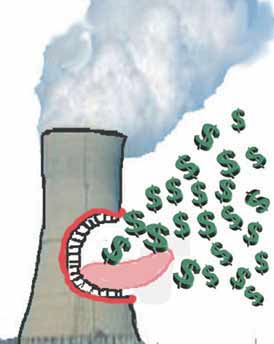
The scheme is laid bare in an 81-page criminal complaint. It was busted open by a year-long, detailed and covert investigation by the US Attorney’s office and the FBI, and involves the flow of $61 million of dark money directed toward activities that would ensure the passage of legislation in Ohio guaranteeing the bailout of the Davis-Besse and Perry nuclear reactors to the tune of $1.5 billion. The subsidy is being funded via a surcharge on electricity customers.
The bill, known as HB6, also slashed mandates for wind and solar energy and eliminated energy efficiency requirements. It was, as David Roberts described it on Vox just after the bill passed in July 2019, “the worst piece of legislation in the 21st century” and “the most counterproductive and corrupt piece of state energy legislation I can recall in all my time covering this stuff.”
FirstEnergy Solutions, the then owner of the plants, had threatened their closure if the subsidy was not forthcoming.
That ultimatum set in motion a breathtaking sequence of criminal activities beginning in 2018, with the $61 million slush fund first used to bankroll political elections, then to ensure sufficient votes for the July 2019 passage of HB 6, and finally the sometimes violent suppression of citizen efforts to overturn it.
Millions of dollars went into the campaign war chests of 21 political candidates, in order to stack the House with friendly votes for the subsequent nuclear bailout bill. (Only one ended up voting against it.) The money also shored up Householder’s successful bid to regain the House Speakership.
The money also went into the personal pockets of the co-conspirators, although the exact amounts and their purposes are still being investigated. As events unfold we may also learn whether votes in favor of HB6 were “bought” by Householder.
As the story is far from over, more arrests will almost certainly follow. And more news on this will continue to break. By necessity, this can only be a glimpse of the story so far.
The crimes with which Householder and four political advisors and lobbyists have been charged constitute “a shameful betrayal of public trust,” said FBI special agent, Chris Hoffman during a July 21 press conference announcing the arrests and indictment.
It was also, “likely the largest bribery money-laundering scheme ever perpetrated against the people of the state of Ohio,” said US Attorney for the Southern District of Ohio, David DeVillers at the same press conference, whose department led the investigation alongside the FBI.
But whose money was it?
The racketeering scheme that the justice department uncovered found a money trail of $61 million flowing from what they are required to call “Company A” in the indictment, into a 501(c)(4) fund named Generation Now. Generation Now has also been charged with racketeering conspiracy.
“Company A” is FirstEnergy, whose subsidiary, FirstEnergy Solutions (FES) was the then owner of the crumbling and uneconomical Davis-Besse and Perry reactors. (They are now owned by yet another spin-off, Energy Harbor).
Although FirstEnergy has been served with subpoenas, so far no one there has been named in the indictment. And while the company clearly handed out the $61 million, DeVillers said of the web of conspirators that “this enterprise went looking for someone to bribe them”.
Meanwhile, the money trail that led from FirstEnergy to Larry Householder’s pocket and others’ was deftly concealed. As DeVillers described it, the entire scheme was “created completely and utterly to hide where there donor came from and [who it] was.”
Generation Now, as a 501(c)(4), was not obliged to declare the source of its funding. If it had been, said DeVillers at the press conference, the criminal enterprise it operated could never have happened. Despite its name, DeVillers said, “make no mistake, this is Larry Householder’s 501(c)(4).”
And a Republican-led operation. Generation Now’s treasurer is D. Eric Lycan, a Lexington, KY attorney with ties to the Kentucky House Republican Leadership Caucus. In addition to the ad buys Generation Now made for FirstEnergy, it also made them for an entity called Strategic Media Placement, run by GOP operative, Rex Elass. As DeVillers told the media as he pointed to a rather simple flow chart displayed at the press conference, “the real one would have covered this whole wall.”
FBI special agent Hoffman lumped Householder and his cronies in with FBI usual suspects like “gangs, child sex trafficking and Chinese spies,” but said that “public corruption is actually the top criminal priority for the FBI.”
But it should not be the priority for the US Attorney’s office. DeVillers, a Republican and Trump appointee, could not suppress his anger as he told reporters that his district is already struggling with limited resources and “a massive overdose epidemic where you’ve got people dying of overdoses of fentanyl, people stacked up like cord wood at a coroner’s office, we’ve got violent crime sky-rocketing, we’ve got two Franklin County sheriff’s deputies shot this morning.”
And yet, he continued, “we have to take our resources away from those real victim cases and investigate and prosecute some politicians who just won’t do their damn job.”
Chinese spies were in fact part of the Generation Now misinformation campaign, a scare tactic used to derail efforts by a coalition called Ohioans Against Corporate Bailouts (OACB), which launched a petition drive to repeal HB6.
A FirstEnergy/Householder front group ran scaremongering “yellow peril” ads to deter people from signing a petition that would have reversed the nuclear bailout bill, HB6
As petitioners took to the streets, attempting to gather enough signatures to get a repeal of HB6 onto a November ballot, a smear campaign suggested that, among other things, the petition gatherers were in the payroll of Chinese government operatives who were “quietly invading our American electric grid” and that if you signed the HB6 repeal petition, the Chinese government would be capturing “your name, your address, your signature”. National security would be at risk.
Most ludicrously, the Chinese scare ad, put together by Ohioans for Energy Security (in reality a front group funded by Generation Now) suggested China, and by definition the ballot petitioners, were “taking Ohio money,” which is precisely what the Householder racket was doing.
It worked. OACB eventually ran out of time and petition gatherers, with some having been bought off with a portion of the $61 million. In October 2019, OACB withdrew the initiative, which is when HB6 effectively became law. And it still is.
That’s the worst part of the news. Householder and others may pay a fine, or even see jail time, but the people of Ohio remain in danger. Davis-Besse and Perry are two of the most seriously degraded reactors in the country and should have been shut down long ago.
If Davis-Besse suffered a serious meltdown, there could be “1,400 peak early fatalities, 73,000 peak early injuries, 10,000 peak cancer deaths, and $84 billion in property damage,” according to Beyond Nuclear’s Kevin Kamps, citing a 1982 study by the Nuclear Regulatory Commission. With populations having soared since then, today’s figures would be far higher, he pointed out.
Likewise, the Perry plant’s numbers would be well above the 5,500 acute radiation deaths, 180,000 radiation injuries, 14,000 latent cancer fatalities, and $102 billion in property damage, cited in the 1982 study, should that reactor suffer a major accident.
The $1.5 billion subsidy, says Toledo public interest attorney, Terry Lodge, “didn’t go to ensure safe nuclear plant operations for the next five years, but instead was paid to investors as dividends once the FirstEnergy bailout was over.”
However, it looks unlikely that HB6 will be undone, despite the criminal machinations behind its passage. While Howard Learner, executive director of the Chicago-based Environmental Law & Policy Center, told the Toledo Blade that the Ohio bailout “should not remain in effect if obtained through bribery or other means”, it would have to be nullified by the legislature itself, an action for which there seems little political inclination.
One reason for that reluctance could be yet one more sinister discovery. Prior to the vote on HB6, a Trump operative, Bob Paduchik had pressured “at least five members of the Ohio House of Representatives,” to vote ‘yes’ on HR6, according to Politico. “The message is that if we have these plants shut down we can’t get Trump reelected,” one senior legislative source told Politico.
As DeVillers said: “We’re not done with this case.”
How bankrupt US nuclear financing schemes are going to be used to fund nuclear power in the UK to fund nuclear power. https://100percentrenewableuk.org/blogby David Toke 24 July, 20 As different types of corrupt pro-nuclear handouts in the USA unravel the British Government is expected to support bringing in a legalised version of bankrupt US nuclear financing practices to fund Sizewell C nuclear power plant.
The US nuclear power industry is in danger of implosion as corrupt practices used to maintain its old power plant and pay for new plant are the subject of prosecutions. In Ohio the Speaker of the House of Representatives has been arrested on account of charges that he was bribed to ensure that nuclear power and coal plant in Ohio were given bailouts whilst policies supporting renewable energy and energy efficiency were cut back.
Meanwhile in South Carolina the Securities and Exchange Committee has charged executives of the State’s monopoly utility with fraud after the abandonment of two of the only four nuclear reactors whose construction has been started in the USA this century. According to the Wall Street Journal: ‘The defendants claimed the project was on track even though they knew it was significantly delayed and wouldn’t be completed on time by Jan. 1, 2021, to qualify for $1.4 billion of federal tax credits, the securities regulator alleged’. In the process the electricity consumers were charges billions of dollars for the power plant which were not built through a similar cost recovery process that is proposed for the UK.
Over to Florida, and while nobody has been charged with any offences there is great controversy over the way the dominant state utility has charged the electricity consumer for a nuclear power plant that was never built. In this case they never even got as far as breaking ground, but the consumers had to pay out $871 million as well as lots more money for other bungled projects relating to nuclear energy. Florida, like other US states has simultaneously erected huge barriers stopping homeowners (in the so-called ‘Sunshine State’) from putting solar panels on their roofs.
According to the New York Times: ‘Florida is one of eight states that prohibit the sale of solar electricity directly to consumers unless the provider is a utility. There is also a state rule, enforced by the utilities, requiring expensive insurance policies for big solar arrays on houses’.
Meanwhile in Georgia, the third state to use the cost recovery method for financing nuclear plant, the only two nuclear power plant being built in the USA (Vogtle III and IV) are hopelessly delayed with massive cost overruns, again, yes you’ve guessed it, with costs paid by electricity consumers.
Of course all of these real or abandoned nuclear plant were financed under the so-called Regulated Asset Base (RAB) model that is being slated to pay for Sizewell C in the UK. This is hailed as a much cheaper way to pay for nuclear power compared with the way that Hinkley C is financed. Cheaper, for the developer (in this case EDF), certainly, but for the electricity consumer it’s a disaster! The consumer, as the US experience clearly illustrates, starts paying and continues paying for a nuclear power plant long before it is generating any energy, and there is no guarantee even that it will ever generate anything! But the consumer still pays, no matter what the constructions cost overruns turn out to be! And invariably, with nuclear power plant, there are very large cost overruns.
Added to this of course the bias in favour of new nuclear as opposed to new renewable energy schemes is also assured. The contracts nuclear power are being given assure them that they will get paid the premium price for energy generated even if wholesale electricity prices are negative whereas windfarms and solar farms will get nothing in such circumstances. See our report on this. Of course there’s nothing illegal in this because mountains of impenetrable contractual and accountancy paperwork make it so. It is just written by the the people who have the energy establishment’s interests at heart.
Ohio House Republicans introduce legislation to repeal controversial bailout of nuclear power plants, Cleveland 19 News, Jim Nelson | July 23, 2020 COLUMBUS, Ohio (WOIO) – A pair of republican members of the Ohio House of Representatives are introducing a bill to repeal House Bill 6, the controversial bailout of the state’s nuclear power plants now at the center of a bombshell corruption scandal.
“Not only because it was bad policy from the start, but because we need to reassure Ohioans that their representatives, be they democrat or republican, are truly working in their interest,” said Rep. Laura Lanese (R-Grove City).
She, along with Rep. Mark Romanchuk (R-Ontario), will co-sponsor the bill.
Federal investigators say the passage of the controversial legislation was helped by a phony social welfare organization, orchestrated by House Speaker Larry Householder.
They say $61 million was funneled through the organization to Householder and his associates, who in turn helped elect 21 members of the Ohio House of Representatives.
Nearly all of them voted in favor of the bailout.
“House Bill 6 was bad policy from the start,” Lanese said. “From the beginning to the middle through the end, this legislation has been tainted.”
Neither Lanese nor Romanchuk supported the bill.
Romanchuk was not at the Thursday news conference held in Columbus, where Lanese stressed the importance of coming up with a new energy solution.
“Many of my house colleagues are not against nuclear energy. We are part of the ‘all of the above’ policy. This is not about kicking out nuclear energy or destroying jobs,” she said. “I would like to see [that] we include a lot of the clean energy portfolio pieces that were part of the last general assembly’s legislation. Those were taken out in this piece.”
“We did have a lot of support for energy efficiency and renewable energy,” she pointed out……..
While Householder is the only elected official implicated in the criminal complaint, released on Tuesday by the U.S. Attorneys Office, there is speculation that others could be more deeply involved. …….
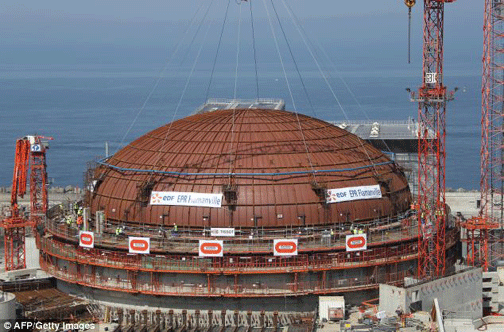
Montel News 23rd July 2020, The new generation EPR reactor EDF is building at Flamanville in France
“is a mess,” France’s new energy minister Barbara Pompili said on Thursday. “I think it’s clear. The Flamanville EPR is a mess. This has been said in a number of reports which cannot be suspected of being anti-nuclear, notably the Court of Auditors report,” she told France Inter radio. “The initial costs (of the EPR) have multiplied by four,” she said, pointing to “problems of competence” that “had to be resolved.”
Former and current Utah Congressmen: Say no to nuclear testing, KSL News Radio, BY CURT GRESSETH JULY 23, 2020 SALT LAKE CITY — The US Senate is ready to restart nuclear weapons testing, but both a current and a former Utah congressman say the testing is still not safe.
The House recently passed the National Defense Authorization Act along with an amendment by Utah Democratic Rep. Ben McAdams that would block funding to restart nuclear weapons testing in the United States.
McAdams’ amendment was adopted along a mostly party-line vote of 227-179.
The Senate version of the NDAA includes $10 million to resume nuclear testing for the first time since 1992.
Nuclear testing
“Explosive nuclear testing causes irreparable harm to human health and to our environment, and jeopardizes the U.S. leadership role on nuclear nonproliferation,” McAdams said Monday in the House.
McAdams joined Lee Lonsberry on Live Mic to discuss his amendment on blocking funding for nuclear testing.
“Utah has been devastated from nuclear weapons testing for decades. The federal government lied to us. They told us it was safe, that there would be no harm that would come from this testing. Then so many people across our state developed cancer and other issues related to that testing, so we were lied to for years by our federal government,” McAdams said. ……..
Former Utah Rep. Jim Matheson
Former Utah Rep. Jim Matheson, also a Democrat, lost his father, former Utah Gov. Scott Matheson, to cancer blamed on living downwind from the Nevada Test Site where atomic tests were conducted in the 1950 and 1960s.
“This is an issue that obviously affected my family in a significant way — my extended family, let alone my own father, who was a Downwinder,” Matheson said.
While serving in Congress, Matheson said his efforts on nuclear weapons testing were focused on whether it was safe to conduct weapons tests. He said he introduced legislation that said the testing couldn’t move forward without the equivalent of an environmental impact statement to assess all the risks and prove that it’s safe to test.
“The folks who were trying to move ahead with testing didn’t like that idea at all,” Matheson said. “It wasn’t safe when it was above ground and it wasn’t safe when it was below ground. It’s still not safe today.”
Cause for alarm
“Technology has not advanced to the point where you can be satisfied with the assertions of these testers, essentially that tests of this nature are safe,” Lee said.
“Absolutely not,” Matheson replied. “They have no justification for even saying that.”
If proponents wish to proceed, the former congressman called for a transparent, public process to assess all the risks of nuclear weapons testing.
“The facts will speak for themselves,” he said.
He said the $10 million appropriation in the Senate NDAA bill to start preparing sites for testing “should be a cause for alarm for all of us.”
“My gosh, we had the government lie to us here in Utah way back when. They told us it was safe. They knew it wasn’t,” he said.
Matheson said the government only did the testing when the wind blew the fallout in the least populated direction, which was southern Utah. He added that declassified documents referred to people living in southern Utah as a low-use segment of the nation’s population.
“Let’s not tuck $10 million into a defense bill in the Senate and say let’s get the site ready without any process to determine if it’s safe or not, without any public effort to reevaluate the risk associated with this. This doesn’t sound right to me. This doesn’t pass the smell test,” Matheson said.
Mersea Island Environmental Alliance 22nd July 2020, Mersea Island Environmental Alliance have been investigating discrepancies between the National Policy Statement for Bradwell in Essex and what is ‘proposed’ by CGN/EDF in their Consultation document. CGN/EDF Consultation
proposal is for two reactors and in that document, they state that:
“Parts of the Project which are not likely to be influenced by the
consultation include:
“The principle of building a new nuclear power
station on land adjacent to the existing Bradwell power station (as a
matter of Government policy)…and…Technical details including the
proposed deployment of two reactors”.
The National Policy Statement for Bradwell however is for just one reactor. Mersea Island Environmental
Alliance working with The Environmental Law Foundation sought legal
opinion. This is the Barrister’s opinion having reviewed the Consultation
document: “Arguably this is highly misleading as the National Policy
Statement does not set out government policy support for a two-reactor
station, which was not assessed as part of the NPS. Consultees (the public
included) may not be aware that they are entitled to make representations
on this.
This is potentially unlawful since a single reactor station is an
alternative option, and consultees should be made aware that they are
entitled to comment on this: see R. (Moseley) v LB Haringey [2014] UKSC 56.
Section 104(3) of the Planning Act 2008 states: “The Secretary of State
must decide the application in accordance with any relevant national policy
statement, except to the extent that one or more of subsections (4) to (8)
applies.”
The relevant NPS is EN-6 (although the Government is in the
process of preparing a new NPS for nuclear power). This states at paragraph
4.1.1 that Bradwell is a site “that the Government has determined are
potentially suitable for the deployment of new nuclear power stations in
England and Wales before the end of 2025”
The public have been forced to
engage in a mockery of a consultation held at the peak of the Pandemic. To
make matters worse Government are clearly aware of the CGN/EDF remit. The
public have been deliberately mislead! The site selection process for one
reactor and the NPS are being ignored both by the developer and Government.
The public are illegally excluded from comment on the two-reactor proposal.
The latter exclusion courtesy of CGN/EDF who are just the contractor! The
intriguing side to this is how despite the initial enthusiasm from my media
contacts over the developing story it hits the buffers of the editorial
desks and goes no further.
By Hugh Jackson, July 23, 2020 Nuclear waste is probably the last thing on the minds of Nevadans these days, what with … everything.
But Nevada politicians, industries, and people have expended untold jillions of FTE hours fighting Yucca Mountain over more than three decades.
So Nevadans may be interested to know that the industry trying to ram that waste down our throats is at the heart of this week’s FBI arrest of the Speaker of the Ohio House of Representatives on a racketeering charge.
Recap (cribbed from the Current’s sibling, the Ohio Capital Journal): A now-bankrupt utility called FirstEnergy Solutions paid $61 million into a “dark money” PAC controlled by Ohio state Rep. Larry Householder, who then showered the money on fellow Republican legislators, who then selected Householder as House Speaker, and next thing you know Ohio lawmakers passed (and Ohio’s governor signed) a $1.2 billion bailout for FirstEnergy’s economically failing nuclear power plants.
Nevadans may like to take a perverse pride in their state as a very interesting, anything-goes sort of place where a uniquely craven politics is unusually rife with shady shenans and sweetheart deals.
To which Ohio is entitled to say, hold my beer.
I mean, sure, Ohio’s population is about four times bigger than Nevada’s. But $61 million? That’s pretty impressive.
The $1.2 billion public subsidy for a private company, on the other hand, is not particularly outlandish by Nevada standards. Nevada shelled out as much in “incentives” for Tesla, and ladled $750 million to the Raiders.
At least when Nevada elected officials recklessly steered public resources away from public services and to the private sector, it got a battery factory and Mid-Air Engine Failure Field. All Ohio got was a pair of old nuclear power plants that Ohio already had.
Leaving aside for the moment Ohio’s policy decision, ludicrous in design and corrupt in execution, to force electricity customers to rescue a power company, you may be wondering, Why would an electric utility need $1.2 billion to keep some old reactors reacting in the first place?
Glad you asked!
When nuclear power was new on the scene, which is to say about the same time charming mid-mod houses were being built east of the Strip & south of Desert Inn, it came with the promise nuclear energy would be “too cheap to meter.”
A half-dozen decades and countless cost overruns, skyrocketing maintenance expenses and public bailouts later, the financial sector won’t touch nuclear power with a 13-foot spent fuel rod assembly.
The Bush-Cheney administration was hot for nuclear power. Early in Bush’s first term, Cheney stacked a panel with nuclear industry representatives to prepare a plan to build more plants, part of of what people sometimes back then called “a nuclear renaissance.” At the time I was working for Public Citizen, writing about nuclear power (we were against it) and I will never forget one surprisingly candid phrase from the report: “economic viability for a nuclear power plant is difficult to demonstrate.”
Even then, the price per kilowatt was more expensive than coal, let alone gas. It still is, of course. And nearly 20 years later, nuclear can be almost three times as expensive as solar or wind.
Finance is only one industry that wants nothing to do with nuclear power. There’s another: Insurance.
That’s why there is U.S. law called the Price-Anderson Act. If/when a nuclear power plant has, you know, an “incident” that causes economic as well as ecological devastation, taxpayers will foot the bill, even in cases of private sector negligence or misconduct.
As businesses today clamor for protection against covid-related liability, perhaps they’ll point to the no-fault insurance model Congress pioneered in the Price-Anderson Act. If protection from liability is a good idea for nuclear power plants, why wouldn’t it be a good idea for casinos and retailers who put their employees in impossible and risky situations by failing to protect them from the rona?
About the same time Bush and Cheney were firing up their nuclear revival scheme, Nevada Gov. Kenny Guinn was disapproving the Bush administration’s official designation of Yucca Mountain as a nuclear waste dump.
“Nevada is not anti-nuclear and does not oppose nuclear power,” Guinn wrote.
To which you might ask, Why not?
The answer I always got had nothing to do with the desirability, expense or calamitous risk of nuclear power, but the politics of nuclear waste: If Nevada, including and especially its congressional delegation, were against nuclear power, it would make it all the more difficult to win support of congressional colleagues in other states in the effort to keep waste out of Nevada.
It’s a legitimate concern, one on display as recently as last year, when Trump’s plan to fund the dump were supported not only by all the Republicans in the U.S. House (except Mark Amodei), but a whole lot of Democrats, too. But in the end Nancy Pelosi backed Nevada, and Trump’s Yucca wishes fizzled.
Gregory Jazcko was a nuclear policy staffer for Harry Reid, a position where he probably had to draw distinctions between opposing Yucca Mountain, but not nuclear power, on an almost daily basis. In fact, Jazcko would later become chairman of the Nuclear Regulatory Commission, which has never been a habitat for people who oppose nuclear power.
But after leaving that job, Jazcko wrote a book describing nuclear power as “a failed technology” that “is more hazardous than it’s worth,” and “will lead to catastrophe.”
Thankfully earlier this year, Trump proclaimed to Nevada via twitter that the tiny Trump palm had gone to the orange Trump forehead so he no longer wanted to dump nuke waste in Nevada. And if he wins a second term, well, everyone knows how trustworthy and consistent the president is.
In other words, during a second term, maybe Trump will put a revived Yucca project under the direction of former Ohio House Speaker Larry Householder.
Many people in this county who are joining community choice energy options in order to use and support advancing clean energy sources will be very upset when they learn our Assembly member, Jordan Cunningham, has introduced AB 2898 to amend California’s Renewables Portfolio Standard Program allowing nuclear power to be named as a carbon free and renewable resource.
However, nuclear is neither carbon free nor renewable. There is a finite supply of uranium 235, which nuclear plants use to power their reactors. The ore is mined, processed, and enriched. The resulting material is manufactured into pellets and rods to contain them. All this industry and transport causes a lot of greenhouse gas emissions. Additionally, during the operation of nuclear plants, CO2 is emitted with water vapor, steam, and heat.
Another “renewable standard” states there is to be no waste. We certainly will have waste—thousands of tons of highly radioactive waste with nowhere to store it. The Central Coast deserves representatives who will be looking out for our health and dollars. One who will look beyond the dinosaur of nuclear power with its dangers, waste, and cost to embrace a future of truly clean sustainable power.
Environmental groups want controversial Ohio nuclear bailout bill reexamined; HB6 now at the center of FBI investigation, Cleveland.com, By Emily Bamforth, cleveland.com 22 Jul 20, CLEVELAND, Ohio — Ohio House Bill 6 bailed out two FirstEnergy power plants and gave subsidies to coal plants, while dismantling mandates designed to move Ohio’s clean energy landscape forward.
The corruption scandal is now prompting groups that already opposed HB6 because of its implications for the economy or environment to call for a re-examination of the bill, or its total repeal. Both the Sierra Club and American Wind Energy Association issued statements on the case Tuesday evening.
“The legislative push to bail out legacy generation and roll back Ohio’s renewable energy commitments was always against the will of Ohioans, who overwhelmingly support renewable energy,” American Wind Energy Association Eastern State Affairs Director Andrew Gohn said in a statement. “It now appears that the passage of this bill was not just against the will of the people, but also may have involved serious and possibly criminal impropriety.”
Supporters of the bill claimed the bailout would save jobs in nuclear energy and reconfigure surcharges to Ohio customers to save money. But those fighting against it, including environmental groups, balked at the changes which effectively “gutted” energy-efficiency and renewable-energy mandates for utilities.
The bill changed Ohio’s renewable-energy goal from a maximum of 12.5 percent by 2027 to 8.5 percent by 2026. Under Ohio requirements introduced in 2008, utilities must reduce customers’ power usage by 22 percent by 2027.
Under House Bill 6, these standards would end after utilities companies reached a 17.5 percent drop in customer power use.
The bill also included subsidies for coal power plants.
Neil Waggoner, the Sierra Club Ohio’s Beyond Coal Campaign representative, said this year the group has seen utilities companies petitioning the state’s public utilities commission to end energy efficiency programs, because companies are already hitting the lowered standard.
Ohio House Speaker Arrested In Case Related To Nuclear Power Plant Bailout Law, Statehouse News Bureau, ByKAREN KASLER•JUL 21, 2020 House Speaker Larry Householder (R-Glenford) has been arrested in connection to a $60 million public corruption racketeering conspiracy case. Federal agents were at his farm in Perry County Tuesday morning.
Sources have confirmed that former Ohio GOP Chairman Matt Borges was also arrested, along with Householder’s adviser Jeff Longstreth. Veteran lobbyist Neil Clark was also arrested, according to sources.
The law sends $150 million a year to the Davis-Besse and Perry power plants, which were owned by FirstEnergy Solutions. That company, which had been a subsidiary of FirstEnergy Corporation when it was first created but was no longer related to FirstEnergy Corporation, emerged from bankruptcy protection earlier this year and is now known as Energy Harbor.
FirstEnergy Solutions had said it would decommission its power plants starting this year if it didn’t get some financial relief from the state…… The law took effect in October after a group that opposed it missed the deadline to collect signatures. In January, that group dropped their courtroom battle to stop the law from taking effect. There was dark money on both sides, and donors were never revealed.
The law sends $150 million a year to the Davis-Besse and Perry power plants, which were owned by FirstEnergy Solutions. That company, which had been a subsidiary of FirstEnergy Corporation when it was first created but was no longer related to FirstEnergy Corporation, emerged from bankruptcy protection earlier this year and is now known as Energy Harbor
House Democrats vote to block funding for nuclear weapons tests, Defense News, by: Joe Gould 21 July 20, WASHINGTON ― No funding would be available for live nuclear weapons testing under an amendment the House adopted to its version of the annual defense policy bill.
The amendment from Rep. Ben McAdams, D-Utah, was adopted, 227-179, in a mostly party-line vote. The House is expected Tuesday to vote to pass the 2021 National Defense Authorization Act.
The amendment’s adoption will likely make it harder for House Republicans to vote for the House’s FY21 NDAA, and it likely sets up a fight with the Republican-controlled SASC when leaders of both panels reconcile their versions of the bill.
The FY21NDAA was voted out of the House Armed Services Committee on a bipartisan 56-0 vote earlier this month.
“Explosive nuclear testing is not necessary to ensure our stockpile remains safe and nothing in this amendment would change that,” McAdams said in a floor speech ahead of the vote. “Explosive nuclear testing causes irreparable harm to human health and to our environment. and jeopardizes the U.S. leadership role on nuclear nonproliferation.” ………
The House, separately, adopted an amendment that would give the energy secretary a stronger hand in setting nuclear policy by making him co-chair, alongside the defense secretary, of the Nuclear Weapons Council. The council is charged with the coordinating policy to manage the existing nuclear weapons stockpile and plan future nuclear deterrents.
The amendment, from House Energy and Commerce Committee ranking member Greg Walden, R-Ore., is to “to provide Cabinet-level visibility and accountability of our nuclear deterrent and the NWC budget process,” according to an amendment summary. Under current law, DoD’s undersecretary of defense for acquisition and sustainment chairs the council.
It was adopted in larger package of amendments, approved by a bipartisan 336-71.
– uranium to stay a “matter of national environmental significance”
– federal government should maintain powers to intervene in uranium mining
Mineral Policy Institute and Friends of the Earth Australia, 20 July 2020 National and state environment groups have given a cautious welcome to the continuation of long-standing protections against nuclear risks in the current statutory review of the Environmental Protection Biodiversity Conservation Act – Australia’s federal environmental laws. The interim report released today has stated that the Commonwealth should maintain the capacity to intervene in uranium mining and made no recommendation to change existing prohibitions on nuclear activities, including domestic nuclear power.
Civil society groups made a joint submission to the EPBC review calling for the retention of the long standing ban on nuclear power and continuing federal oversight of uranium mining. The EPBC review committee’s interim report has flagged an intention to continue both protections despite lobbying from the Mineral Council of Australia to weaken these.
However, environment groups are concerned about a possible weakening of uranium mining regulations flagged in the interim report. Associate Professor Gavin Mudd, Chair of the Mineral Policy Institute, said: “The interim report proposes the further devolution of uranium mining regulation to states and territories, coupled to the establishment of ‘National Environmental Standards’. An obvious risk is that the standards will be weak, enforcement will be deficient as is already the case, and devolution will weaken the already inadequate oversight of uranium mining.”
“Uranium mining is different to other types of mining. Australia’s uranium mining sector has been dominated by license breaches, accidents, spills and a persistent failure to rehabilitate as promised. The last thing we need is a weakening of regulations and oversight. Apart from SA and NT every state and territory have a ban or prohibition on uranium mining. It is unsafe and unpopular and needs greater scrutiny, not less,” Assoc. Prof. Mudd said.
The Review’s interim report makes no recommendation to repeal the long-standing prohibition on domestic nuclear power. “Nuclear power is expensive, dangerous and unpopular,” said Dr Jim Green, national nuclear campaigner with Friends of the Earth Australia. “The prohibition in the EPBC Act reflects this. Nuclear is thirsty, produces high level nuclear waste for which there are no safe storage options and produces materials that can be diverted into nuclear weapons. It is a profound security and safety risk. And nuclear power is absurdly expensive.”
“Recent comments from the current Environment Minister and Opposition Leader show a clear bipartisan rejection of nuclear power. There is broad opposition among civil society as shown through a joint statement by over 60 organisations representing millions of Australians. Given the lack of social license for nuclear power in Australia we welcome the continuation of this prudent prohibition,” Dr Green said.
Following the Australian uranium-fuelled Fukushima nuclear disaster the UN Secretary General called for all uranium producing countries to conduct a cost-benefit analysis of the industry. Groups have called on the Morrison government to now hold an independent review of the uranium sector.
A nuclear accord, 15 years ago: Has the agreement, and US-India partnership, lived up to the 2005 hype? The answer is mixed. Times of India, July 18, 2020, Donald Camp i The visit of Indian Prime Minister Manmohan Singh to Washington between July 17 and July 19, 2005, was heralded as a new beginning in the US-India partnership by both the countries. The highlight of the summit – an agreement to cooperate in civil nuclear power – was indeed path breaking as it upended the US (and international) focus on rolling back India’s nuclear weapons capabilities, and implicitly acknowledged India’s status as a nuclear weapons power.
Fifteen years later, has the agreement – and the partnership – lived up to the hype? The answer is mixed. ……..
The US-India relationship has continued to grow since 2005 but not in the way the agreement had intended. There has been no great cooperation in civilian nuclear energy; in fact, no contract has been signed with a US company towards that end till today. Of the two American nuclear engineering giants, General Electric (builder of India’s Tarapur reactor in the 1960s) had left the business and Westinghouse was sold to Toshiba in 2006.
India itself has not committed to the great transition to nuclear power it once envisioned. Russia and France are the major nuclear suppliers to India, though Westinghouse was promised a contract for six reactors in 2016, before its bankruptcy in 2017. Today solar and other renewable energy sources are attracting more attention and investment. …………
Over fifteen years, China’s increasing global power as well as its territorial ambitions in both the Himalayas and the South China Sea have significantly worsened China’s relations with both India and the US. After border clashes in recent years in Doklam and now Aksai Chin, India seems less hesitant about a partnership explicitly aimed at containing China. In addition to new arms sales, there is a renewed commitment to the “Quad”, the informal mechanism for security discussions and more between Japan, the US, India and Australia. The current US administration would be delighted to have India buy in more completely to its Indo-Pacific strategy………. https://timesofindia.indiatimes.com/blogs/toi-edit-page/a-nuclear-accord-15-years-ago-has-the-agreement-and-us-india-partnership-lived-up-to-the-2005-hype-the-answer-is-mixed/
Harwich and North Essex MP Sir Bernard Jenkin is calling on ministers to introduce provisions to grant the UK Government a golden share in critical infrastructure projects such as the proposed Bradwell B power plant.
Under his proposal, the share would grant the Government powers to prevent takeovers and appoint board members.
It will also place obligations on directors to inform the Government if activities, such as the theft of nuclear secrets, were taking place against the national interest.
Sir Bernard, who is chairman of the Liaison Committee, said the safeguards in place for nuclear power stations were “wholly inadequate”.
In an article on the ConservativeHome website he wrote: “The only safeguards proposed for Bradwell B are the same as for any nuclear power station. They are wholly inadequate.
“At present, China will finance, build, own and operate Bradwell B. The Government has agreed that the Chinese government should build a key part of our own critical national infrastructure.
If this is to go ahead, the very least we should insist upon is a set of safeguards to protect our national security and critical national infrastructure from malign foreign influence from a hostile government.
“Chinese companies are not the same as private companies based in Europe or the United States, or even state owned ones like the French EDF, which is building Hinkley Point.
“If we don’t want the UK taxpayer to contribute to the strength of the Chinese military, or UK-based technology to mysteriously end up in Beijing, we need to act swiftly and decisively, whilst also recognising that, at least for now, we still need Chinese financing and technical expertise in order to expand the UK’s civil nuclear infrastructure.”
Gov. Gavin Newsom and leaders from the Legislature must demand action on nuclear waste and fill gaps in oversight. By Bart Ziegler, CalMatters, 17 Jul 20,
From San Onofre to Humboldt Bay, nuclear waste is piling up in California.
This most-toxic waste – tons and tons of it – is deadly for 200,000 years. Stranded next to a rising ocean at aging and decommissioned plants, the waste has no permanent home.
California is overdue in showing leadership.
Just as California has broken ranks with the federal government on regulating greenhouse gas emissions, Gov. Gavin Newsom and leaders from the Legislature must demand action on nuclear waste and fill gaps in oversight.
With federal regulators all but cornering nuclear policy, the industry all too often is left to regulate itself. Meanwhile, private contractors slop at ratepayer-funded decommissioning troughs while running loose with safety.
Enough is enough, California!
In north San Diego County, conditions at the shuttered San Onofre Nuclear Generating Station scream for state intervention, as Rep. Mike Levin, a Democrat from San Juan Capistrano, concluded in a task force report issued recently.
First, some background.
Decommissioning started this year at the San Onofre plant, which quit making electricity in 2012. The plant’s majority owner, Southern California Edison, has opened its $4 billion decommissioning purse to Holtec International as lead contractor in charge of transferring 3.6 million pounds of spent nuclear fuel from cooling pools to a storage system of Holtec’s design.
That’s where things get dicey.
Edison’s contractors are cramming the spent fuel assemblies into thin-walled, steel canisters. Workers hoist the canisters from wet storage with a behemoth, track-driven gantry crane and crawl them to a concrete, dry-storage vault. That’s where the 73 canisters will stay. Indefinitely.
Public hand-wringing intensified after a near-accident in 2018 involving a fully-loaded canister and the release of reports showing the canisters are prone to gouging during transfer. That can lead to corrosion and failure, especially in a marine environment. To make matters worse, the canisters cannot be repaired, monitored, inspected or transported once entombed in the vault.
What can California do? For starters, leaders can immediately improve oversight of nuclear waste storage.
Nuclear plant owners admit to not having developed procedures to replace fully-loaded canisters. That’s why, as part of decommissioning California’s coastal nuclear plants at San Onofre, Diablo Canyon and Humboldt Bay, the state Coastal Commission must demand the construction of handling facilities – known as “hot cells” – where canisters can be repaired or replaced.
State lawmakers should order construction of a hot cell at the decommissioned Rancho Seco Nuclear Generating Station, just 40 miles south of their offices in Sacramento.
In San Diego County, near the border with Orange County, 8.2 million people live within 50 miles of the old San Onofre plant. On July 16, the California Coastal Commission is set to act on a staff recommendation to approve Edison’s application to dismantle the plant’s cooling pools. That approval would be disastrous. For now at least, the spent fuel cooling pools provide our last option for dealing with a damaged canister.
Coastal Commissioners are appointed by the same Legislature that should prepare for a crisis instead of responding to one. You don’t wait for a fire to create a fire department. Preparation is cheaper and faster than responding to a crisis. Tragically, the COVID-19 pandemic has shown that preparation is not always our strongest suit.
As recommended in the Report of the San Onofre Nuclear Generating Station Task Force, a state model would improve agency coordination on waste storage permit applications and increase engagement with federal agencies to advance solutions for containing and handling deadly nuclear waste. The solutions should be tied to strict, economic enforcement.
Coastal commissioners, lawmakers, regulators and anyone else with a stake in California – that’s nearly 40 million of us – should read the report and demand action on nuclear waste.