UK Labour says state-owned Chinese firm CGN should be excluded from Hinkley nuclear project
Labour Questions ‘Aggressive’ China’s Involvement In UK 5G And Nuclear Energy Deals
Shadow foreign secretary signals tougher stance on Huawei and Hinckley Point amid Hong Kong crisis. Huffington Post, By Rachel Wearmouth, 2 July 20 China’s involvement in the UK’s 5G network and nuclear energy programme should be questioned after “aggressive” actions towards the UK, Labour has said.
Nandy said the UK should dump the 5G deal and said state-owned Chinese firm CGN should also be excluded from plans to finance nuclear energy plant Hinckley Point, in Somerset.
Speaking to Times Radio presenter John Pienaar, Nandy said: “We need far greater strategic independence from China, which means that we need to have home-grown alternatives for our 5G network and our nuclear power.”
She went on to say: “I don’t think we should be handing over large chunks of our energy infrastructure, especially our nuclear energy infrastructure, to a country that’s behaved in such an aggressive way towards the UK and the people of Hong Kong in recent weeks.” …………. https://www.huffingtonpost.co.uk/entry/bar-aggressive-china-from-5g-and-nuclear-energy-deals-in-uk-says-labour_uk_5efcb53bc5b612083c55d19e?guccounter=1&guce_referrer=aHR0cHM6Ly9uZXdzLmdvb2dsZS5jb20v&guce_referrer_sig=AQAAAATQSZ7H9fv_HgI3hWPha0plWMLUzrUnPUbrBmIuuNrwU_Rjr1Nt
France’s EDF in a financial pickle over huge costs of UK’s Hinkley C nuclear project
Dave Toke’s Blog 27th June 2020, The chickens are coming home to roost for EDF for their 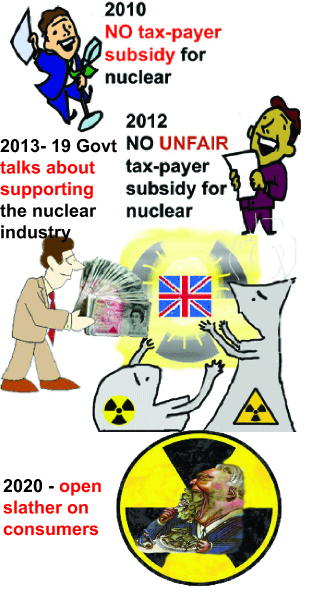 questionable decision to go ahead with building Hinkley C -a decision they took despite the lack of certainty over whether they would get enough backing from the British Government.
Originally EDF was publicised as being offered UK Treasury loan guarantees that had been widely touted as a vital basis for building Hinkley C. But now the French Financial Markets Regulator has
sanctioned EDF for not flagging up how conditional such loan guarantees were. These loan guarantees have never materialised.
Essentially, EDF is now continuing to build Hinkley C using money borrowed on its own balance
sheets – borrowings which are much more costly than UK Government backed guarantees and which reduce its own (EDF) profitability.
The Finance Officer of EDF actually resigned at the time EDF decided to go ahead with building Hinkley C. Of course all this is happening at the same time when we are being asked to believe that the next EPR (at Sizewell C) is going to be delivered at low cost to the consumer if the risk of building the plant is transferred from EDF to the British taxpayer and consumer!
This is the so-called RAB mechanism, something that could well just turn out to be an
almost unlimited cash facility for EDF to park their financial black hole in the centre of British finances (as well as those of the French).
https://realfeed-intariffs.blogspot.com/2020/06/edf-sanctioned-by-french-regulators-for.html
Donald Trump intervenes in Wylfa nuclear project discussions
North Wales Live 28th June 2020, Donald Trump is understood to have intervened in discussions about the next generation of nuclear power on Anglesey. According to reports, the US
president’s administration has warned Hitachi, the company behind the site,
not to sell it on to the Chinese government. The intervention is a sign of
escalating tensions between the Americans and the Chinese, according to the
Times. It reports today that the White House is heaping pressure on Hitachi
– which is a Japanese-owned company – not to sell on its interest into the
site to Beijing.
https://www.dailypost.co.uk/news/north-wales-news/donald-trump-intervenes-anglesey-nuclear-18502362
Hungary to apply for nuclear plant expansion licence
Hungary to apply for nuclear plant expansion licence on Tuesday, BUDAPEST, June 29 (Reuters) – Hungary will on Tuesday submit licensing paperwork to the state atomic agency to expand its sole nuclear power plant and fast-track the first phase of its construction, the earth works at the reactor site, the government said on Monday.
Hungary is planning to double the capacity of its 2-gigawatt Paks nuclear power plant with two Russian-made VVER reactors.
The project, awarded in 2014 without a tender to Russian state nuclear giant Rosatom, is often cited as a sign of the exceptionally warm ties between Hungarian premier Viktor Orban and Russian President Vladimir Putin, a connection that has unnerved Western allies.
Budapest has requested and received European Union approval for the fast-track process which will allow it to start construction at the site in January 2021, Minister Janos Suli, who is in charge of the expansion, told parliament.
In response to a question from an opposition lawmaker, he denied sweetening the process for Russia. ……..
Experts have warned that approval for the reactor hole, a massive project to remove 8 million cubic metres of earth and build a 2,500 metre (8,200 ft) concrete wall more than a metre thick, could make the project much more difficult to abandon……https://af.reuters.com/article/commoditiesNews/idAFL8N2E62VR
Sizewell nuclear plant – untried, costly, environmentally damaging, and no electricity for 10 years or more!

the government is exploring novel ways in which to lay the burden for financing a dangerous and costly nuclear venture on you, the consumer.
‘The Sizewell C plans are an insult to the people of Suffolk’ https://www.eadt.co.uk/news/pete-wilkinson-together-against-sizewell-c-campaign-1-6718925 27 June 2020, Pete Wilkinson, Together Against Sizewell C
Chairman of Together Against Sizewell C, Pete Wilkinson, has described it is a “battle for the soul and integrity of East Suffolk”. Here he explains why he is opposing the nuclear project.
Anyone new to Suffolk, ignorant of EDF’s nuclear plans, would be forgiven for laughing out loud.
An untried reactor, labelled ‘technically complicated to construct’ by its own designers, a cost of £20billion-plus, taking at least 10 years to build, producing waste which is not only lethal to living tissue but which remains so for thousands of years and for which there is no agreed or proven disposal or management route, to be built in the middle of a community of 5,000, which will not produce electricity for at least 10 years by which time its output will be redundant to needs, built on an eroding coast? Yeah, sure: pull the other one.
You really couldn’t make it up.
Yet this is what residents up and down the East Suffolk are facing. They have been led to believe that the destruction of their environment on a massive scale, the compulsory purchases, the roads, the workers’ campuses, the borrow pits, the huge water demand in the driest county is inevitable – and to make the best of it.
When did anyone ask YOU, resident of East Suffolk, if you wanted your tranquil, culturally rich and peaceful rural environment urbanised and anonymised, requiring six new roundabouts on the A12 and up to 1,000 vehicle movements a day along our country roads to ferry the material required for our own white elephantine carbuncle on our heritage coast, light, noise and dust pollution 24 hours a day, seven days a week or a decade of accommodating 4,000 workers? Of course you were not asked. They knew the answer. The new nuclear policy has not been subjected to anything like forensic public or Parliamentary scrutiny.
Democratic deficit runs through all aspects of this programme like the letters in a stick of rock and is presented by its advocates as ‘inevitable’. The National Policy Statement process renders what government calls ‘national infrastructure projects of over-riding importance’ inviolate, untouchable and – yes – inevitable unless the planning authorities have the courage or unless the Secretary of State has the guts to do what they should – throw the EDF plans out as an insult to the people of Suffolk. Sizewell C is important to no-one other than EDF.
But just how ‘over-riding’ is the need for Sizewell C? The French-made film, ‘The Nuclear Trap’ makes it clear that Hinkley C in Somerset and Sizewell C are more critical to the survival of the French nuclear industry than they are to providing electricity to UK consumers.
There has been a huge reduction in electricity demand since 2013 – over 16% – making earlier predictions of an increase of 15% by 2020 an overestimation of more than 30%.
Renewables out-compete nuclear on every front – cost, waste, jobs, CO2 and time for deployment. If ever Sizewell was built, it would be at least a decade, probably more like 15 years given the history of cost and time over-runs of its flagship plant at Flamanville, before it turned one kilowatt hour of electricity.
In 15 years, we will – one can only hope – have grown out of our obsession with nuclear and invested at suitably high levels in realising the huge job potential in micro-technology, decentralisation, efficiency and conservation of energy, and look back on our nuclear infatuation with a shake of the head.
The current National Policy Statement which covers the nuclear component of the energy policy, EN6, is entirely unfit for purpose as it gives policy authority only to those nuclear plants which can be deployed before 2025 – i.e. not, Hinkley, not Sizewell and not Bradwell, none of which will be generating electricity by that date.
Therefore the EN6 policy document is null and void. Its replacement is still undergoing review and will depend heavily on the financing arrangements the government can agree to in order to remove the need for EDF to fork out for it.
Instead, the government is exploring novel ways in which to lay the burden for financing a dangerous and costly nuclear venture on you, the consumer.
So much for ‘no subsidy’ nuclear, but in policy terms, it is legally questionable for Hinkley C to continue to be built, for Sizewell C’s planning application to be submitted or for CGN/EDF to consult on plans to build Bradwell B when there is no policy architecture to justify and legitimise any of this work or progress.
EN6 has fallen as a legitimate policy statement for new nuclear build but that does not seem to have any effect on the way the French and Chinese backers of new nuclear in the UK are required to act nor the complacency and indifference with which the government seems to take these gaping legal inconsistencies.
The waste problem that nuclear generates is probably the most intractable. In the 15 years of the existence of the Nuclear Decommissioning Authority, it has failed to secure a site, a volunteer community or to satisfactorily solve many of the dozens of technical and engineering problems associated with burying 500,000 cubic metres of legacy waste while ensuring that the estimated 78,000,000 units of radioactivity remain underground.
While new build waste such as that from Sizewell C is likely to be less bulky, its high burn up in the reactor means that it will be far hotter than even Sizewell B’s waste and will generate much more radioactivity – up to five times that contained in the legacy waste. How can any government or industry knowingly embark on a development programme which will create such a mountain of waste when a repository for its safe disposal is still more a matter of hope over expectation?
The only legacy Sizewell C will leave for Suffolk is a degraded environment and a radioactive waste mountain which future generations will have to deal with. Please tell your councillor to vote to remove the support for Sizewell C at the full council meeting on July 7, please write to the planning inspector to voice your concerns and please urge your MP to tell the Secretary of State to put EDF’s planning application where it belongs – in the bin.
Ukraine declassifies Chernobyl nuclear disaster documents
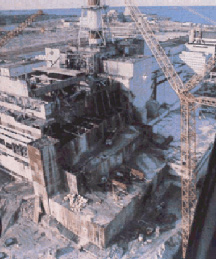 Ukraine declassifies Chernobyl nuclear disaster documents https://www.brusselstimes.com/all-news/119019/ukraine-declassifies-chernobyl-documents/
The archives, published in a book edited by the Ukrainian secret service, SBU, give an overview of the various construction errors, accidents and emergency interruptions at the plant between 1971 and the day of the disaster.
After Reactor 4 of the Soviet nuclear plant at Chernobyl exploded, a no-go zone was set up around the area due to the risk of radiation.
The biggest nuclear disaster in History caused the deaths of thousands of people, while tens of thousands had to be displaced.
On Sunday, a new fire occurred in the red zone around the plant, which is about three hectares in area. The Ukrainian authorities said on Monday that the fire had, for the most part, been put out.
In early April, a forest fire fed by gusty winds and unusually dry weather had broken out around the abandoned nuclear plant.
By the time it was brought under control in mid-May, about 11,500 hectares had been destroyed.
France’s old Fessenheim nuclear reactor to finally shut down- the first of many
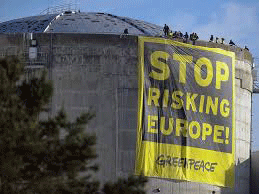 France’s oldest nuclear reactor to finally shut down,Guardian,
Environmentalists have welcomed news that the 43-year-old Fessenheim reactor will close, nine years after it was first planned, Agence France-Presse, 28 June 20,
France’s oldest nuclear power plant will shut down on Tuesday after four decades in operation, to the delight of environmental activists who have long warned of contamination risks, but stoking worry for the local economy.
The Fessenheim plant, opened in 1977 and already three years over its projected 40-year life span, became a target for anti-nuclear campaigners after the catastrophic meltdown at Fukushima in Japan in 2011.
Despite a pledge by then-president Francois Hollande just months after the Fukushima disaster to close Fessenheim – on the Rhine river near France’s eastern border with Germany and Switzerland – it was not until 2018 that his successor Emmanuel Macron gave the final green light.
Run by state-owned energy company EDF, one of Fessenheim’s two reactors was disconnected in February.
The second is to be taken off line early on Tuesday, but it will be several months before the reactors have cooled enough for the used fuel to be removed.
That process should be completed by 2023, and the plant is not expected to be fully dismantled before 2040 at the earliest. …..
More will follow, with only 294 people needed on site for the fuel removal process until 2023, and about 60 after that for the final disassembly. ……
There is no legal limit on the life span of French nuclear power stations, but the EDF had envisaged a 40-year ceiling for all second-generation reactors, which use pressurised water technology.
France’s ASN nuclear safety authority has said reactors can be operated beyond 40 years only if ambitious safety improvements are undertaken.
In the 1990s and 2000s, several safety failures were reported at Fessenheim, including an electrical fault, cracks in a reactor cover, a chemistry error, water pollution, a fuel leak, and non-lethal radioactive contamination of workers.
In 2007, the same year a Swiss study found that seismic risks in the Alsace region had been underestimated during construction, the ASN denounced a “lack of rigour” in EDF’s operation of the plant.
Without Fessenheim, France will still have 56 pressurised water reactors at 18 nuclear plants generating some 70% of its electricity. Only the US, with 98, has more reactors, but France is by far the world’s biggest consumer of nuclear energy.
In January, the French government said it would shut 12 more reactors nearing or exceeding the 40-year limit by 2035, when nuclear power should represent just 50% of the country’s energy mix in favour of renewable sources.
At the same time, the EDF is racing to get its first next-generation reactor running by 2022 – 10 years behind schedule – and more may be in the pipeline…….https://www.theguardian.com/environment/2020/jun/28/frances-oldest-nuclear-reactor-to-finally-shut-down
New Zealand stood up to the nuclear bullies- the Rainbow Warrior story

NZ gained ‘international creds’ as nuclear-free nation with Rainbow Warrior bombing, says author, Asia Pacific Report
New Zealand established its credentials as an independent small nation after the fatal bombing of the Greenpeace flagship Rainbow Warrior in 1985, says an author and academic who spent weeks on the vessel shortly before it was attacked.
On 10 July 1985, the Rainbow Warrior was sunk at an Auckland wharf by two bombs planted on the hull of the ship by French secret agents.
The event is often referred to as the first act of terrorism in New Zealand.
LISTEN: The Afternoons with Jesse Mulligan Crime NZ interview with David Robie
WATCH: Eyes of Fire archival videos
READ: The Eyes of Fire book
Two French agents planted two explosives on the ship while it was berthed at Marsden wharf, the second explosion killing Greenpeace photographer Fernando Pereira.
Dr David Robie, who is an AUT professor of journalism and communication studies, as well as the director of the university’s Pacific Media Centre, had spent more than 10 weeks on the ship as a journalist covering its nuclear rescue mission in the Pacific.
He wrote about his experience in Eyes of Fire, a book about the last voyage of the first Rainbow Warrior – two other Rainbow Warrior ships have followed.
In 1985, Rongelap atoll villagers in the Marshall Islands asked Greenpeace to help them relocate to a new home at Mejato atoll. Their island had been contaminated by radioactive fallout from US atmospheric nuclear weapons testing in the Pacific.
Environmental journalism
“At the time I was very involved in environmental issues around the Pacific and in those days Greenpeace was very small, a fledgling organisation,” he tells Jesse Mulligan.
“They had a little office in downtown Auckland and Elaine Shaw was the coordinator and she was quite worried that this was going to be a threshold voyage.
“It was probably the first campaign by Greenpeace that was humanitarian, it wasn’t just environmental – to rescue basically the people who had been suffering from nuclear radiation.” ……….
Moruroa protest planned
The US had carried out 67 nuclear tests at the Marshall Islands. France was also carrying out 193 tests in the Pacific and Greenpeace had planned on confronting that situation at Moruroa Atoll after its Marshall Islands rescue effort.
New Zealand had already voiced disapproval of the testing in the region, with then Prime Minister David Lange in 1984 rebuking the French for “arrogantly” continuing the programme in the country’s backyard.
Dr Robie left the ship when it docked in Auckland after the Marshall Islands stage of the mission. Three days after the ship had docked, a birthday celebration was held for Greenpeace campaign organiser Steve Sawyer onboard. The attack happened after the party.
Just before midnight on the evening of 10 July 1985, two explosions ripped through the hull as the ship.
Portuguese crew member Fernando Pereira was killed after returning on board after the first explosion……..
Thirteen foreign agents were involved, operating in three teams. The first team brought in the explosives, the second team would plant these and the third was on stand-by in case anything went wrong with the first two teams.
“A commanding officer kept an overview of the whole operation. I think there was an element of arrogance, the same arrogance as with the testing itself. There was a huge amount of arrogance about taking on an operation like this in a peaceful country – we were allies of France at the time – and it is extraordinary that they assumed they could get away with this outrageous act.”
Two of the spies were caught. Two General Directorate for External Security (DGSE) officers, Dominique Prieur and Alain Mafart, were arrested on July 24. Both were charged with murder, pleaded guilty to manslaughter and were sentenced to 10 years’ imprisonment.
Repression of independence movements
“You have to see it within the context of the period of the time,” Dr Robie says.
He says that the French policy of repression against independence movements in New Caledonia and Tahiti, with assassinations of Kanak leaders like Eloi Machoro, needed to be understood to put the Rainbow Warrior attack in perspective. France was bitterly defending its nuclear force de frappe.
“New Zealand was unpopular with the major nuclear powers and there was certainly no sympathy for New Zealand’s position about nuclear testing. So, there wasn’t really any co-operation, even from our closest neighbour, Australia……..
The case was a source of considerable embarrassment to the French government.
“They did pay compensation after arbitration that went on with the New Zealand government and Greenpeace. But justice was never really served… the 10 years were never served, both Prieur and Mafart were part of the negotiations with French government.
NZ was held ‘over a barrel’
“Basically, France had New Zealand over a barrel over trade and the European Union, so compromises were reached and Prieur and Mafart were handed over to France for three years. Essentially house arrest at Hao atoll, the rear base of the French nuclear operations in Polynesia.”
Dr Robie said the rear base was widely regarded as a military “Club Med”.
He says they didn’t even spend three years there, but left for France within the time period.
While the attack was on an international organisation rather than New Zealand itself, most New Zealanders saw it as an attack on the sovereignty of the nation
Dr Robie says it left a long-lasting impression on New Zealanders.
“It was a baptism of fire. It was a loss of innocence when that happened. And in that context, we had stood up as a small nation on being nuclear-free. Something we should have been absolutely proud of, which we were, with all those who campaigned for that at the time. I think that really established our independence, if you like, as a small nation.
“I think we have a lot to contribute to the world in terms of peace-making and we shouldn’t lose track of that. The courage that was shown by this country, standing up to a major nuclear power. We should follow through on that kind of independence of thought.” https://asiapacificreport.nz/2020/06/29/nz-gained-international-creds-as-nuclear-free-nation-with-rainbow-warrior-bombing-says-author/
Wylfa nuclear project: Donald Trump plea over site sale dismissed
Work on the £13bn project was put on hold last year because of rising costs after Hitachi failed to reach a funding agreement with the UK government.
A Horizon Energy spokesman said: “We don’t comment on speculation.
“Our focus remains on securing the conditions necessary to restart this crucial project, which would bring transformative economic benefits to the region and play a huge role in helping deliver the UK’s climate change commitments.”
Horizon is owned by Hitachi and was set to lead the project to build the site……. https://www.bbc.com/news/uk-wales-politics-53212790
Sizewell planning documents reveal higher-than-expected £20bn price tag
  Cost of new Sizewell C nuclear plant put at £20bn https://www.ft.com/content/77c209f7-6d18-4609-ac3c-77d1b5b82b34 26 June 20, Higher-than-expected price tag revealed for first time in planning documents. Nathalie Thomas in Edinburgh and Donato Paolo Mancini in London Cost of new Sizewell C nuclear plant put at £20bn https://www.ft.com/content/77c209f7-6d18-4609-ac3c-77d1b5b82b34 26 June 20, Higher-than-expected price tag revealed for first time in planning documents. Nathalie Thomas in Edinburgh and Donato Paolo Mancini in London
A new nuclear plant proposed on England’s east coast will cost £20bn, according to planning documents that reveal the higher-than-expected price of the project for the first time. The developers of the proposed plant at Sizewell in Suffolk — France’s EDF and Chinese state-owned CGN — had previously indicated the power station could be built for 20 per cent less than Hinkley Point C. Britain’s first new nuclear plant in a generation is under construction in Somerset.
This implied a cost of about £18bn for the Suffolk plant, called Sizewell C, after EDF last year said the price tag for Hinkley Point had risen to as much as £22.5bn. The first new-build project has suffered a string of cost overruns.
The revelation of Sizewell’s cost in extensive planning documents published on Thursday will reignite the ferocious debate around whether the UK should build large new nuclear plants.
Some backbench Conservative MPs, opposed to Chinese state involvement in critical national infrastructure, have concerns about the project because of the presence of CGN. The Chinese state-owned company is a junior financing partner on the Sizewell C project but hopes to install its own reactor technology in another proposed nuclear station at Bradwell-on-Sea, Essex.
The Financial Times reported on Wednesday that CGN, or China General Nuclear Power Corporation, was on a US list of 20 companies with links to the Chinese military compiled by the Pentagon. The list is part of an attempt by the White House and Congress to prevent Beijing from obtaining sensitive technologies as well as US funding.
EDF said in the planning documents that the cost estimate for Sizewell C includes design, construction and land costs associated with the proposed site, which is situated next to one of the UK’s operational nuclear plants, known as Sizewell B. It also takes into account “expected inflation and contingencies”, according to the document.
The company had previously claimed the cost savings on Sizewell could be delivered because it would be a “near identical copy” of Hinkley Point C.
EDF said the budget detailed in the planning application includes inflation over the estimated 10 years of construction, whereas the latest estimate for Hinkley Point C — estimated to be in a range of £21.5bn to £22.5bn — was based on 2015 prices.
The 20 per cent cost saving still stood if you subtracted a fifth from the Hinkley budget and then adjusted that sum for inflation, the company added.
EDF and CGN are yet to clarify how the new plant would be funded. The UK government last year launched a consultation on a so-called regulated asset base model (RAB) — used for other forms of infrastructure such as energy networks. This would lower the cost of capital of the scheme because consumers would have a surcharge added to their energy bills before the plant was completed.
Stop Sizewell C, a local campaigning group, said the funding statement was “a work of fiction” and described the £20bn pricetag as “totally eye-watering”.
Greenpeace UK’s chief scientist Doug Parr said the nuclear industry’s claim that it can always make the next power plant cheaper was “just never true.” He pointed out that the costs of renewable power had dropped below half those of nuclear “and just keep dropping”.
The government is yet to report back on the consultation. Privately, some nuclear industry leaders have been making an argument for the taxpayer to take a stake in any new project.
|
|
UK planning inspectorate accepts Sizewell C nuclear plans for examination
|
Sizewell C: Nuclear power station plans accepted for scrutiny, https://www.bbc.com/news/uk-england-suffolk-53176514, 25 June 2020
An application to build a new nuclear power station has been accepted for examination by the planning inspectorate. Plans for the Sizewell C plant on the Suffolk coast were put forward by EDF Energy after being mooted 10 years ago. The acceptance means an examining authority will now be appointed to scrutinise the application, with the government having final decision. Stop Sizewell C (SSC) group said it will continue to fight the application. EDF Energy said in a statement: “The decision means the Inspectorate is satisfied that the eight years of public consultation by the project was conducted properly and that full examination of the proposals can now take place.” But Alison Downes from SSC said the “quality of EDF’s consultations failed to provide required information”. She added EDF “had not been transparent in its disclosures of environmental assessment or transport strategy” nor the plant’s impact on the local area. Concerns about effective scrutiny of pre-application proposals during the lockdown restrictions was supported in letters from local MP Dr Dan Poulter and Suffolk County Council. In a joint statement on Wednesday Suffolk County Council and East Suffolk Council said: “The lack of a comprehensive set of documents up to this point has compromised the engagement that has taken place, and the Councils do not feel they have been able to complete their pre-application work with the Applicant (EDF Energy) to the extent set out by the Planning Act 2008,” EDF Energy said a copy of the full planning application and supporting documents would become available on the Planning Inspectorate website. |
|
Nuclear developers push UK government for prompt decision on government finance for new construction
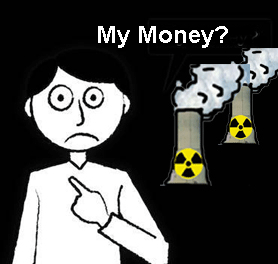 Nuclear developers press for ‘prompt’ decision on new UK plants , Ft.com, Nathalie Thomas in Edinburgh, JUNE 24 2020
Britain’s nuclear energy industry has said it could cut the price of power from new large power stations by more than half as it presses ministers for a “prompt” decision on government financing to support construction. …….
The NIA argues that supply chain costs would fall further if it can build further scale and experience. But it warns that new projects rely on “prompt decisions” by ministers on an alternative financing mechanism to support nuclear plant construction. Executives at EDF have made clear they will not replicate the model used for Hinkley, which has been beset by cost overruns. A government consultation on alternative funding models, launched last year, is yet to report back.
Under a RAB model, households would pay for a plant’s construction through their energy bills long before any electricity is generated, allowing developers to attract cheaper finance from investors such as pension funds. But it also leaves consumers on the hook for cost overruns.
UK’s expensive problem of nuclear power’s inflexibility
Because of the inflexibility of the AGRs, RE suppliers are shut off first. This is explained in a recent report by the newly-formed pressure group, 100 percentrenewable uk, which explains that the inflexible nature of nuclear power is instrumental in forcing the National Grid to turn off large amounts of wind power (ie in the jargon to be ‘constrained’) in Scotland when there is too much electricity on the network.
This appears nonsensical as the Grid is turning off cheap renewables to preserve expensive nuclear, and then paying large compensation payments to them to do so.
UK Electricity: Renewables and the problem with inflexible nuclear, Ian Fairlea, June 21, 2020
In recent years, the share of the UK’s electricity supplied by renewable energy (RE) sources has increased substantially to the point that RE is now the second largest source after gas: It now supplies 20% to 25% of our electrical needs. This is greater than the amount supplied by nuclear – about 15% to 18%. Coal, hydroelectric, and mainly gas (~40%) constitute the other sources. See chart [on original] for Britain’s electrical power supplies in 2019.
Why are AGR reactors inflexible? Continue reading
Trump administration says it won’t carry out a nuclear weapons test ‘at this time’
 Trump administration says it won’t carry out a nuclear weapons test ‘at this time’, By Kylie Atwood, CNN, June 24, 2020 Washington , The US told Russia that that there is no reason for the Trump administration to carry out a nuclear weapons test “at this time,” during nuclear negotiations in Vienna this week, but reserved the right to conduct one if they see a need to do so.
Coalition for Responsible Energy Development wants a stop to nuclear expansion in Canada
The Coalition for Responsible Energy Development in New Brunswick includes public interest organizations and individuals and is intended to advocate for responsible energy development.
David Thompson is a project coordinator for CRED-NB.
“I guess a number of people in the province were looking at organizations also, were looking at the way energy was proposed to be developed and the kind of energy we had here and we felt that something a lot better could happen,” he said.
Thompson said there is a need to reduce the demand for energy in the province by eliminating energy waste and maximizing energy efficiency.
“We respond to climate change and to promote emission-free and waste-free energy, that sort of thing and to get on the bandwagon of the new renewable energies,” he said.
CRED-NB wants the provincial and federal government to invest in sources of renewable energy such as wind, solar, geo-thermal, tidal, certain types of bio-energy and water-driven power.
“I think everyone wants more cost-effective energy and energy that’s not going to leave behind waste or pollute our environment and we have to get energy in place rather quickly now to deal with climate change.”
The coalition is calling upon governments to invest in less costly and safer renewable energy, coupled with energy efficiency and conservation programs. CRED-NB says this will create more jobs and economic activity in New Brunswick.
1 This Month





PLEASE OPPOSE HR 8255 AND S.3639 – bills would accelerate satellite deployment, with no environmental review or safeguards – https://ncstd5li.quorum.us/campaign/169331/
To see nuclear-related stories in greater depth and intensity – go to https://nuclearinformation.wordpress.com
-
Archives
- October 2026 (58)
- September 2026 (339)
- August 2026 (330)
- July 2026 (355)
- June 2026 (287)
- May 2026 (306)
- April 2026 (356)
- March 2026 (251)
- February 2026 (267)
- January 2026 (308)
- December 2025 (358)
- November 2025 (359)
-
Categories
- 1
- 1 NUCLEAR ISSUES
- business and costs
- climate change
- culture and arts
- ENERGY
- environment
- health
- history
- indigenous issues
- Legal
- marketing of nuclear
- media
- opposition to nuclear
- PERSONAL STORIES
- politics
- politics international
- Religion and ethics
- safety
- secrets,lies and civil liberties
- spinbuster
- technology
- Uranium
- wastes
- weapons and war
- Women
- 2 WORLD
- ACTION
- AFRICA
- Atrocities
- AUSTRALIA
- Christina's notes
- Christina's themes
- culture and arts
- Events
- Fuk 2022
- Fuk 2023
- Fukushima 2017
- Fukushima 2018
- fukushima 2019
- Fukushima 2020
- Fukushima 2021
- general
- global warming
- Humour (God we need it)
- Nuclear
- RARE EARTHS
- Reference
- resources – print
- Resources -audiovicual
- Weekly Newsletter
- World
- World Nuclear
- YouTube
-
RSS
Entries RSS
Comments RSS

