UK’s Regulated Asset Base (RAB) “a very bad deal for consumers” – like the USA’s disastrous system in South Carolina
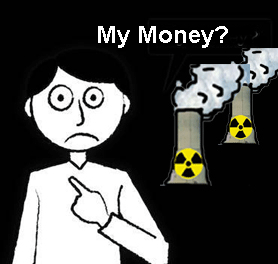
Reaction to the Bill from stakeholders has been mixed. Some environmental bodies have questioned whether the RAB model set out in the Bill offers value for money for consumers and whether it transfers the risk of cost overruns to consumers. Tom Burke, the co-founder of E3G, a climate think-tank, told the Financial Times that the model risked being “a very bad deal for consumers” on the grounds that electricity generated from nuclear power would be more expensive than that from ‘homegrown’ renewables and would simultaneously “inhibit the market in wind, [an] area where we have the opportunity to create a global competitive industry in the UK”.145 The same article included comment from Steve Thomas, Professor of Energy Policy at the University of Greenwich, who questioned whether people would want their pension funds exposed to construction risk cost and whether that meant the consumer would take on all the risk. In an article in the i on the day the legislation was published, Doug Parr, Chief Scientist at Greenpeace, noted that the RAB model had already been used to finance nuclear power in the United States, adding that the “results were disastrous”: “It transfers huge financial risk from the builders to bill payers. In South Carolina, 18 per cent of residents’ energy bills went to pay for a half-built reactor which has been abandoned and will never produce electricity.” House of Commons Library 1st Nov 2021 https://researchbriefings.files.parliament.uk/documents/CBP-9356/CBP-9356.pdf |
Opposition Leader Keresztes accuses Hungarian government of secrecy and errors in approval of Paks Nuclear Power Plant Upgrade

LMP Accuses Govt of Secrecy on Paks Nuclear Power Plant Upgrade https://hungarytoday.hu/lmp-accuses-govt-of-secrecy-on-paks-nuclear-power-plant-upgrade/MTI-Hungary Today 2021.11.13. Publicity, professionalism, and security are the most important principles in the use of nuclear energy, yet the government has chosen secrecy, outsourcing, and political control, the leader of the opposition LMP party’s parliamentary group said on Saturday.
Speaking at an online press conference, László Lóránt Keresztes said the government is unwilling to admit that it has made seriously wrong decisions and it is ready to take further ones.
In addition, “substantive information (.) has been classified in connection with the failure to secure permission for the Paks II [upgrade] project,” he said.
They make wrong decisions such as licensing excavation work in the absence of key permissions, Keresztes said.
The government has reached a dead-end over the final disposal of spent nuclear fuel rods. The decisions made in the recent period are especially detrimental to the city of Pécs and Baranya County, he said.
If the government keeps hiding information, LMP will resort to legal means to finally inform the Hungarian public about the state of the Paks nuclear power plant expansion. The opposition party is convinced that the project should not be negotiated in Moscow, behind closed doors, he added.
LMP is of the view that the deeply flawed project should be stopped, Keresztes said.
József Kóbor, LMP’s municipal councilor of Pécs, said the disposal of radioactive waste is a huge problem throughout Europe.
Referendum on safety issues concerning Taiwan’s long-mothballed Fourth Nuclear Power Plant
REFERENDUMS 2021/Nuclear advocate, opponent argue over safety issues in televised forum
Focus Taiwan, (By Lee Hsin-Yin)
Enditem/HY–Taipei, Nov. 13 (CNA) A deputy minister defending the government’s anti-nuclear position and a nuclear advocate argued over safety issues concerning Taiwan’s long-mothballed Fourth Nuclear Power Plant Saturday in a televised forum ahead of an upcoming referendum that will determine its fate.
Nuclear advocate Huang Shih-hsiu (黃士修), who initiated the campaign for a public vote to unseal the power plant and start commercial operations, said a majority of the plant’s safety checks were passed by the Ministry of Economic Affairs (MOEA) before it was mothballed by then-President Ma Ying-jeou (馬英九) in 2014 due to public concerns.
The referendum question on the nuclear plant, which Huang wrote, asks: “Do you agree that the Fourth Nuclear Power Plant should be unsealed and operated commercially to generate electricity?”
The refusal of the Atomic Energy Council (AEC) to conduct a safety inspection of the power plant made it look like a safety failure, Huang said during the first of five televised forums on four referendums scheduled for Dec. 18.
In response, Deputy Economic Affairs Minister Tseng Wen-sheng (曾文生) said “the completion of safety tests is a lie,” as an MOEA inspection, instead of one conducted by the AEC, was like a “mock test,” which was not credible.
Even if the safety checks were completed for the plant’s test run, it did not mean there were no safety concerns, Tseng stressed, as such a check was only one of the 75 tests required for formal operation.
There were 40 tests that the power plant failed to pass, he said, arguing that it was an “unrealistic” expectation to think it was possible to reactivate the power plant.
Tseng also pointed out that counting on the Fourth Nuclear Power Plant to tackle Taiwan’s energy shortage was exactly why the country has been struggling with the problem, accusing the Kuomintang’s Ma of failing to invest in energy development other than nuclear power during his tenure………..
The next four forums – on issues including nuclear power, pork imports, conservation of algal reefs, and whether future referendums should be held on the same day as major elections – will take place on Nov. 18, Nov. 24, Dec. 2, and Dec. 11, the Central Election Commission (CEC) said. https://focustaiwan.tw/politics/202111130012
President Biden is marginalised by the Pentagon
The nuclear bureaucracy is adamant about not upsetting the programs and
polices forged during the Cold War. “There’s no points of debate” in
the internal discussions, a former Pentagon official said recently. Rather
than working to implement President Joe Biden’s long-held views on
restraining the massive destructive power of the nuclear arsenal, the
Pentagon has rigged the system to marginalize the president.
Responsible Statecraft 9th Nov 2021
Speaker of UK Parliament refuses debate on motions against Nuclear Energy (Financing) Bill.

Of course, consumers who have signed up to buy 100% renewable electricity could quite rightly feel aggrieved at having to pay the “nuclear tax” as well.
nuClear News, November. 21. Nuclear Energy Finance Bill On Wednesday 3rd November, MPs debated the second reading of the Nuclear Energy (Financing) Bill. The Liberal Democrats and the SNP, bot put forward an amendment, but neither was accepted for debate by the Speaker.
LibDem Motion: That this House declines to give a Second Reading to the Nuclear Energy (Financing) Bill because there is no economic or environmental case for the construction of any further nuclear stations in the UK; because the Bill does nothing to address concerns about costs around nuclear waste disposal and decommissioning; because the Bill fails to bring forward meaningful reforms to accelerate the deployment of renewable power or the removal of restrictions on solar, wind and the building of more interconnectors to guarantee security of supply; and because it fails to remove barriers to investment in renewables or to support investment and innovation in cutting-edge energy technologies, including tidal and wave power, energy storage, demand response, smart grids and hydrogen.
SNP Motion: This House declines to give a Second Reading to the Nuclear Energy (Financing) Bill because it believes there is no longer a justification for a large nuclear power station to provide base load energy, because large scale nuclear is not compatible as a counter to the intermittency of renewable wind as nuclear stations are too inflexible, because pumped storage hydro should be utilised to provide renewable energy that can be dispatched when required and pumped storage hydro should be supported with a minimum electricity price providing better value to bill payers than funding new nuclear, because wave and tidal technologies should be utilised to provide stable and predictable electricity generation and these technologies should be supported to scale up via the provision of a ring fenced pot of funding within the forthcoming contracts for difference auction, because the net zero pathway will be better advanced by supporting the Scottish Cluster as a fast track Carbon Capture, Utilisation and Storage project given that it includes hydrogen production, direct air capture and carbon storage facilities that will serve the wider UK, and because greater support and investment should be directed towards green hydrogen production and emerging storage technologies; and, as the cost of energy increases, this House calls on the Government to spend more money on energy efficiency measures and targeted support for those who suffer from or are at risk of fuel povertyac1
Continue readingPresident Macron does not have the legal power to decide on new nuclear reactors – requires Parliamentary agreement
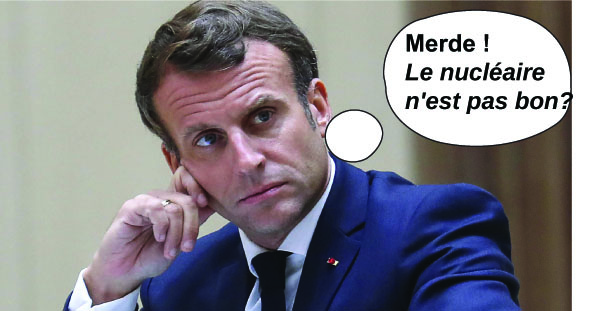
Emmanuel Macron does not have the legal power to decide on his own the order for new nuclear reactors, as he announced he wanted to do, Tuesday, November 9, denounces the former Minister of the Environment, former MEP and famous lawyer specializing in the ecology, Corinne Lepage.
The President of the Republic must first seize the Parliament in order to comply with the multiannual energy programming.
Ouest France 10th Nov 2021
The consortium wanting to develop UK’s min-nuclear plants will have to rely on tax-payer funding.

State support a fallback option for UK’s mini-nuclear plants rollout.
The head of the consortium, which is developing a £ 30 billion fleet of mini-nuclear power stations, has indicated that it will have to rely on UK taxpayers to help fund the construction of the first of the new designs if there is not enough investor interest. Kwasi Kwarteng, business secretary, confirmed on Tuesday that the government is committed to £ 210 million in state funding to a Rolls-Royce-led consortium developing a new generation of small modular reactors (SMRs) as part of a new push into nuclear power
to help achieve the UK’s net zero target.
The government has previously seen that it was prepared to approve up to £ 2 billion in state funding to help start the program, which envisages the construction of at least 16 SMR power stations. Consortium chief executive Tom Samson told the Financial
Times that he had held talks with the government on the possibility of “putting in part of the cost for the first three or four units and then using it as a way to exploit private capital”.
Samson declined to comment on the potential scope of any further government investment and stressed that while it is an option, the aim was to “move forward in line with the
technology that requires the least government funding”. He added: “It is our duty to bring this story to the [capital] markets.”. The first five SMR power stations would cost £ 2.2bn each, with the price of subsequent units dropping to £ 1.8bn, according to Rolls-Royce. The consortium is looking to build the plants at operational and mothballs nuclear power plants in Britain.
FT 10th Nov 2021
https://www.ft.com/content/869279aa-f771-4025-8719-c3b8bdf1f375
The consortium wanting to develop UK’s min-nuclear plants will have to rely on tax-payer funding.
President Macron boosts nuclear industry, but in reality, France’s prospects for new reactors are grim

“too expensive, too slow and too dangerous”.
“Announcing a nuclear revival and the construction of new reactors is totally disconnected from reality”
Macron boosts nuclear power plans to meet France’s net-zero ambitions, The Age, By Bevan Shields, November 10
”…………………in a shift, the French President on Tuesday night, Paris time (Wednesday morning AEDT) said the country would rededicate itself to atomic power.
“…………….we will for the first time in decades revive the construction of nuclear reactors in our country………….” Macron said.
He did not give details but the comments were seen as a reference to the expected green-lighting of as many as 14 next-generation nuclear plants proposed by grid operator RTE.
Macron made the announcement against the background of the COP26 climate summit in Glasgow, where new forms of electricity generation have been identified as a key issue in the fight against climate change, and an energy crisis in Europe triggered by falling gas supplies and an unusually calm summer and autumn which has affected the output of wind turbines.
While confidence in nuclear took a hit in France following the 2011 Fukushima disaster in Japan, it is still a relatively uncontroversial technology compared to other countries such as Australia, where some Coalition MPs are pushing Prime Minister Scott Morrison to explore its feasibility.
Macron sought to tie the new nuclear push to French innovation and national pride – key themes for the President as he enters a tough presidential election campaign in 2022.
His position is in stark contrast to Germany, where nuclear power is on course to be phased out by next year.
The vast majority of France’s nuclear facilities were built in the 1970s and 1980s. A third reactor is being added to a plant in Flamanville, in the Normandy region, but the project which started in 2007 has been plagued by cost overruns and huge delays.
Greenpeace France energy transition campaigner Nicolas Nace condemned Macron’s latest announcement and pointed to the Flamanville project to claim nuclear power was “too expensive, too slow and too dangerous”.
“Announcing a nuclear revival and the construction of new reactors as the nuclear industry is totally disconnected from reality,” Nace said.
A new nuclear facility being constructed in Somerset, England, has also been hit by delays and cost blowouts.
An International Energy Agency analysis released earlier this month found global nuclear capacity would reach 582 gigawatts by 2040 – well below the 730 gigawatts needed to achieve net zero emissions.
“This gap widens even further after 2040, so long-term operation of the existing nuclear fleet and a near-doubling of the annual rate of capacity additions are required,” the report said.
“While some of this additional nuclear capacity will not come online until the late 2030s, policy decisions are required now to put nuclear back on track.”
About 20 gigawatts of new nuclear capacity need to be added each year between now and 2050 to achieve carbon neutrality – a rate of construction is comparable with the pre-Fukushima period. https://www.smh.com.au/world/europe/macron-backs-nuclear-power-to-meet-france-s-net-zero-ambitions-20211110-p597kk.html
Finland’s Greens remain anti-nuclear, despite antics of a breakaway group


‘Which greens, there’s two? One carrying the original Green message, of the 1970s, egalitarian, social democracy, adopted by all other European countries.Green League – The Greens” Known throughout Europe, as the European Greens• Finnish: Vihreä liitto• Swedish: Gröna förbundet
— Paul RichardsNuclear Fuel Cycle Watch Australia, 11 Nov 21, Finland greens are reported to have switched to pro-nuclear power
The other, pro-nuclear group, broke away, branding itself green. Much like the Liberal Party, in Australia, who are hard-right, neocon and neoliberal.Liberal by brand, conservative by demonstrated values. A long con, that thoroughly confuses the Republican idiocracy in the US. A group, who think liberals are, communists. https://www.facebook.com/groups/1021186047913052
Biden and Congress agree: Build Back Bombs Better

Biden and Congress agree: Build Back Bombs Better, $1.75 trillion for the social welfare/climate bill; $1.75 trillion for ‘modernizing’ nukes. Asia Times, By JOHN WALSH, NOVEMBER 8, 2021 Last Friday, the US Congress passed the “Infrastructure” Bill, which will be signed into law post haste, says the White House. The bill, designed to upgrade roads, bridges, transport and broadband, is a bricks-and-mortar affair and will benefit industry and commerce. It is the first of two bills that have been the center of attention in the US for months now
The second bill is the Build Back Better bill. This bill has provisions for childcare and preschool, elder care, health care, prescription-drug pricing, immigration and curbing greenhouse-gas emissions. This might be described as a bill for people, not for bricks and mortar. It has been the darling of progressives in Congress. The White House has now promised it will come up for a vote by November 15.
Whatever one may think of the Build Back Better bill, there is no doubt it is a shadow of its original self. The total for the Build Back Better plan was to be in the neighborhood of $6 trillion, as originally envisaged by congressional progressives, and then it slipped to about $3 trillion, and now it has shrunk again to $1.75 trillion – the incredible shrinking Build Back Better bill.
It is woefully inadequate. On health care, greenhouse gases, family leave, education and other matters, it is little more than a stingy beginning.
Now look at the cost of “upgrading” and “modernizing” the US nuclear arsenal, a program that was originated by Barack Obama, after he got his Nobel Peace Prize, and has now ballooned beyond its original $1 trillion price tag to a stunning $1.75 trillion. No shrinkage there. For both main US political parties, no cost is too high to keep us Americans poised every instant on the razor edge of Accidental Armageddon.
Nuclear weapon “modernization,” however, is only one small corner of the total picture. Let’s look at the entire military budget. ………..
The situation is even more barbaric when we look at the entire “national security” budget, which includes the yearly budget of the 17 “intel” agencies and comes to $1.3 trillion. No expenditure is too great, it seems, to ensure that the feds track all our phone conversations and e-mails and harass every unsuspecting Chinese student and academic they can get their mitts on. It would take only 13% of that $1.3 trillion to fund Build Back Better. …………
From all of the above, a compelling proposal emerges. A 23% cut in the military budget (or if you wish to cast your net wider, a 13% cut in the “national security” budget) would fund the entire Build Back Better Bill – with no more cuts.
With a 23% cut for fiscal 2022, the military budget drops from $750 billion to $580 billion. That is still well in excess of the combined military expenditures of $314 billion for China ($252 billion) and Russia ($62 billion). In fact a cut of 50% in the military outlay would still leave it at $375 billion, still higher than the combined expenditure of Russia and China.
If an elected official cannot agree to that, he or she is either paranoid or a hegemonist up to no good. In either event. they should be barred from public office………..
Bomb Back Better,” if we might call it that, will sail through Congress and the White House as effortlessly as a vulture on the wing.
Common sense suggests we Americans transfer our hard-earned dollars from guns to butter, but no such prospect is in sight. Only one act is required to get to that promised land. We must not vote for anyone who cannot see his or her way to an ironclad commitment to a 50% cut in the National “Security” Budget – for starters. It’s as easy as that. https://asiatimes.com/2021/11/biden-and-congress-agree-build-back-bombs-better/
Taiwan’s referendum about unsealing nuclear power plant: but safety risks persist
Yes’ vote will unseal nuclear plant: premier, Taipei Times, 10 Nov 21, By Chien Hui-ju and Kayleigh Madjar / Staff reporter, with staff writer and CNA
- The Fourth Nuclear Power Plant would be unsealed if people vote in favor of its activation in a referendum next month, Premier Su Tseng-chang (蘇貞昌) said yesterday, although one of his ministers earlier said that nuclear power is not an answer to Taiwan’s energy challenges.
- Provisions of the Referendum Act (公民投票法) stipulate that the plant in New Taipei City’s Gongliao District (貢寮) — which has lain dormant since 2015, when it was mothballed by then-president Ma Ying-jeou (馬英九) — must be unsealed if enough people vote that way on Dec. 18.Launched by nuclear power advocate Huang Shih-hsiu (黃士修), referendum No. 17 — one of four referendums to be voted on — asks: “Do you agree that the Fourth Nuclear Power Plant should be unsealed and operated commercially to generate electricity?”
A possible start of the plant has worried people in the area, Su said at the legislature in Taipei, citing feedback from Yilan County.
The plant was sealed by Ma after public opposition rose due to perceived safety risks at the nearly completed facility.
However, Minister of Economic Affairs Wang Mei-hua (王美花) told reporters before the legislative session that anyone who understands the safety concerns and related problems at the plant would know that activation “is not an option.”
Responding to a comment by Huang that Japan’s Kyushu Electric Power restarted a reactor late last year, despite earthquake and volcano concerns, Wang said that every plant is different.
- Taiwan has its own set of circumstances that it must consider, for instance a geological survey after it was built found that the Fourth Nuclear Power Plant is in a fault zone, she said, adding that it has operational problems with its No. 1 generator, which has not passed inspections.
- Activation of the plant would take more than 10 years, she said, citing evaluations from the Atomic Energy Council.All professional decisions on the matter are in the hands of the council, she said.There would be many issues to work through before the facility could generate power were the vote to succeed, including new construction contracts, as well as fixing outdated equipment and interface integration issues, she said.The Democratic Progressive Party is intent on phasing out nuclear power by 2025, and Taiwan’s dependence on such energy has fallen significantly from more than 50 percent in 1985 to only 12.7 percent last year, Taiwan Power Co data showed……… https://www.taipeitimes.com/News/taiwan/archives/2021/11/10/2003767647
Much pressure on President Biden to drop plans to limit nuclear weapons

Pentagon bearing down on Biden to shelve nuclear reforms
The president has pledged to narrow the role of atomic weapons. But others cite China to argue for the status quo. Politico, By BRYAN BENDER, ALEXANDER WARD and PAUL MCLEARY 11/05/2021,
President Joe Biden’s pledge to limit the role of nuclear weapons is facing growing resistance from Pentagon officials and their hawkish allies, who are arguing to keep the status quo in the face of Chinese and Russian arms buildups.
Biden’s top national security advisers will soon review the conditions under which the United States might resort to using nuclear weapons. Among the options are adopting a “no first use” policy, or declaring that the “sole purpose” of the arsenal is to deter a nuclear conflict and not use them in response to a conventional war or other strategic assault like a cyber attack.
Both would mark major departures from the current posture, which has been purposely ambiguous throughout the nuclear age about whether the United States might strike first, and holds that atomic weapons are for “deterrence of nuclear and non-nuclear attack.”
Biden’s National Security Council plans to convene a high-level meeting on nuclear declaratory policy this month, according to a White House official who spoke to POLITICO on the condition of anonymity because of the issue’s sensitivity.
But China’s surprising nuclear expansion in recent months alongside Russia’s modernization of its arsenal has strengthened the hand of military leaders who oppose any policy changes or significant cuts to a new generation of missiles, bombers and other atomic weapons, according to a half a dozen current and former government officials privy to the discussions.
Lack of answers’
Biden’s allies in Congress are also beginning to complain about the lack of details from the administration on the nuclear review process, who is advising it, and what it might mean for the president’s goals.
“The Nuclear Posture Review must reflect the President’s guidance to ‘reduce the role of nuclear weapons in our national strategy,’” Sen. Ed Markey (D-Mass.), a member of the Foreign Relations Committee and co-chair of the Nuclear Weapons Working Group, told POLITICO.
Markey penned a letter to Biden in September seeking further explanation on why the Pentagon removed Leonor Tomero from her position running the nuclear review. Tomero, a longtime nuclear policy official, previously worked for Rep. Adam Smith (D-Wash.), chair of the House Armed Services Committee, who has promised legislation to adopt a no first use policy………………..
The “Pentagon’s lack of answers to date about the Nuclear Posture Review leave me concerned the policy review will prioritize the old assumptions of the military industrial complex at the expense of diverse voices seeking to reduce nuclear risks,” Markey told POLITICO in a statement.
………………….. leading arms control advocates don’t sound hopeful that Biden will get the full menu to choose from. “We want to make sure that the president is presented with a full range of options even those that particular agencies — NSC, the Pentagon — may not prefer or recommend,” said Daryl Kimball, executive director of the Arms Control Association. “And it would be a disservice to the president’s Nuclear Posture Review if the nuclear weapons blob at the Pentagon were to give him a limited range of options.” https://www.politico.com/news/2021/11/05/pentagon-biden-nuclear-weapons-519738
Former UK environment minister Tim Yeo an unreliable ”expert” on nuclear energy .
Is Tim Yeo really a reliable expert of nuclear energy? https://electricalreview.co.uk/2021/11/05/is-tim-yeo-really-a-reliable-expert-of-nuclear-energy/
As part of a lengthy feature querying the need for new nuclear power stations, how magnanimous it is of The Sunday Times to quote Tim Yeo, the former Tory environment minister.
He said, “We need a significant nuclear element in the energy mix if we’re going to get to net zero in the timeframe that is necessary — and that means having these new plants built.” He was cited as the current chairman of an entity called New Nuclear Watch Institute, which is funded by the nuclear industry.
But how reliable is Tim Yeo? Back in 2015, Yeo was described by a judge when he lost a libel case as “unreliable,” “dishonest,” “untruthful,” “untrue,” and “unworthy of belief.”
He has also recently been found guilty of deliberately misusing his “fiduciary powers” as Chair of TMO Renewables, and repeatedly offering misleading evidence in court. He was accused of a “dishonest strategy for maintaining control of the board,” a strategy that included “misleading existing shareholders” into thinking the company had just received a substantial cash investment, when in reality the ‘new friendly shareholders’ he had cited had not invested a penny. Amongst the latest judge’s conclusions were that Yeo was motivated by an “improper purpose,” and that his tendency to “speechify” gave his evidence a “contrived, evasive and rather self-serving quality.”
I am sure it is a coincidence that the libel case he lost back in 2015 was against The Sunday Times.
UK govt calls for submissions on Nuclear Energy Financing Bill
Do you have relevant expertise and experience or a special interest in the
Nuclear Energy (Financing) Bill 2021-22, which is currently passing through
Parliament? If so, you can submit your views in writing to the House of
Commons Public Bill Committee which is going to consider this Bill. The
first sitting of the Public Bill Committee is expected to be on Tuesday 16
November. Written evidence can now be sent in to the Public Bill Committee.
The Committee is scheduled to report by Tuesday 30 November. However,
please note that when the Committee concludes its consideration of the Bill
it is no longer able to receive written evidence and it can conclude
earlier than the expected deadline of 5.00pm on Tuesday 30 November. You
are strongly advised to submit your written evidence as soon as possible.
The sooner you send in your submission, the more time the Committee will
have to take it into consideration.
House of Commons 4th Nov 2021
UK govt would do better to spend consumers’ money on making homes sustainable, and supporting smart grids, rather than on a nuclear tax
NFLA comments on Plans to Impose a Nuclear Tax on Consumers’ Bills. The
Minister justifies this on the basis that consumers will save more than
£30 billion compared with the system used to pay for Hinkley Point C.
NFLA UK & Ireland Steering Committee Chair Councillor David Blackburn said:
“The Minister is comparing one expensive environmentally unsustainable
project with another expensive environmentally unsustainable project.
If he really wanted to save consumers’ money he would introduce a National
Homes Retrofit Scheme as quickly as possible having learned the lessons
from its failed Green Homes Scheme, and introduce a scheme to support
flexibility, demand management and smart grids so that we can use more of
our cheap, sustainable renewable electricity.”
The Minister went on to argue that despite the fact that the Scottish Government has a different
position with regard to new nuclear projects, Scottish Consumers should
also pay his “nuclear tax” because they “will benefit from a cheaper,
more resilient and lower-carbon electricity system.”
Scottish NFLA Chair, Cllr. Feargal Dalton said: “Renewables met 97% of Scotland’s
electricity demand in 2020. The Scottish electorate has consistently voted
for Governments opposed to building new nuclear power stations. With wind
and solar now the cheapest forms of electricity Scottish consumers
shouldn’t have to pay for the Tories’ failed energy policies.”
NFLA 4th Nov 2021
1 This Month
23-25 October – on Zoom – World BEYOND War’s annual global conferenc


Shut down the radiation-damaged Heysham nuclear reactors now
To see nuclear-related stories in greater depth and intensity – go to https://nuclearinformation.wordpress.com

Say No to NASA’s Reckless Nuclear Reactor on the Moon
Say No to NASA’s Reckless Nuclear Reactor on the Moon

-
Archives
- October 2026 (209)
- September 2026 (339)
- August 2026 (330)
- July 2026 (355)
- June 2026 (287)
- May 2026 (306)
- April 2026 (356)
- March 2026 (251)
- February 2026 (267)
- January 2026 (308)
- December 2025 (358)
- November 2025 (359)
-
Categories
- 1
- 1 NUCLEAR ISSUES
- business and costs
- climate change
- culture and arts
- ENERGY
- environment
- health
- history
- indigenous issues
- Legal
- marketing of nuclear
- media
- opposition to nuclear
- PERSONAL STORIES
- politics
- politics international
- Religion and ethics
- safety
- secrets,lies and civil liberties
- spinbuster
- technology
- Uranium
- wastes
- weapons and war
- Women
- 2 WORLD
- ACTION
- AFRICA
- Atrocities
- AUSTRALIA
- Christina's notes
- Christina's themes
- culture and arts
- Events
- Fuk 2022
- Fuk 2023
- Fukushima 2017
- Fukushima 2018
- fukushima 2019
- Fukushima 2020
- Fukushima 2021
- general
- global warming
- Humour (God we need it)
- Nuclear
- RARE EARTHS
- Reference
- resources – print
- Resources -audiovicual
- Weekly Newsletter
- World
- World Nuclear
- YouTube
-
RSS
Entries RSS
Comments RSS

